The Constellation  Our starting point   Ownership  +  strengths  =  local response
Let’s ask ourselves a question….. … can communities progress in terms of  HIV ?
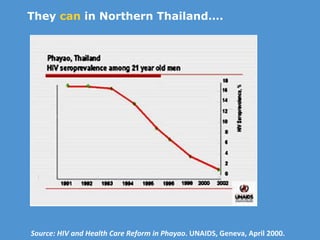
Source:  HIV and Health Care Reform in Phayao .  UNAIDS, Geneva, April 2000. They  can  in Northern Thailand….
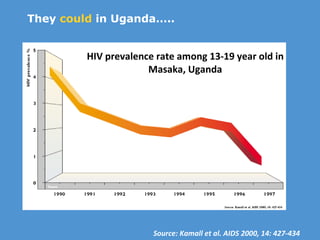
Source: Kamall et al. AIDS 2000, 14: 427-434 HIV prevalence rate among 13-19 year old in Masaka, Uganda They  could  in Uganda…..
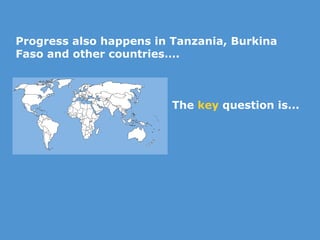
Progress also happens in Tanzania, Burkina Faso and other countries…. The  key  question is...
What  distinguishes  these countries from others?
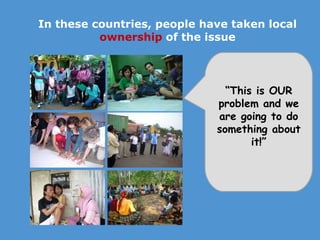
In these countries, people have taken local  ownership   of the issue “ This is OUR problem and we are going to do something about it!”
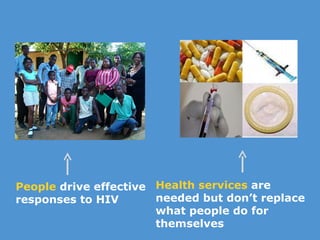
People  drive effective  responses to HIV Health services  are needed but don’t replace what people do for themselves
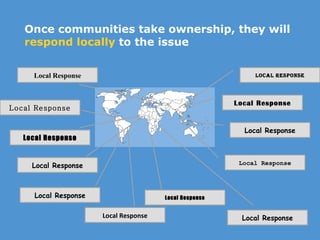
Once communities take ownership, they will  respond locally  to the issue Local Response Local Response Local Response Local Response Local Response Local Response Local Response Local Response Local Response Local Response Local Response Local Response
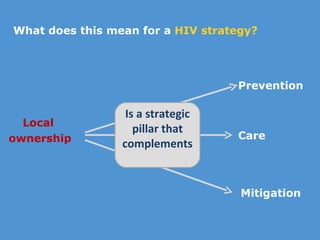
What does this mean for a  HIV strategy? Local  ownership Prevention  Care Mitigation Is a strategic pillar that complements
But, is  local ownership  enough to drive local responses? …..
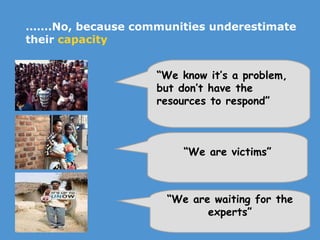
…… .No, because communities underestimate their  capacity “ We know it’s a problem, but don’t have the resources to respond” “ We are waiting for the experts” “ We are victims”
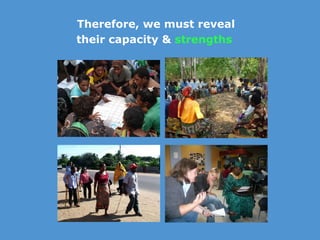
Therefore, we must reveal  their capacity &  strengths
Once  communities  know their  strengths , their self-confidence grows..…..
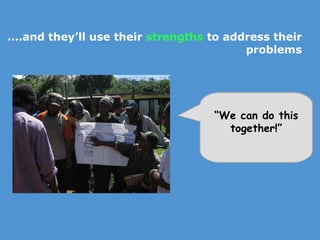
… .and they’ll use their  strengths  to address their problems “ We can do this together!”
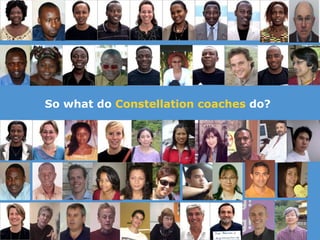
s So what do  Constellation coaches  do?
Our coaches:   Foster  reveal   to stimulate Ownership  +  strengths  =  local response
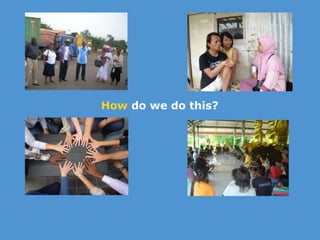
How  do we do this?
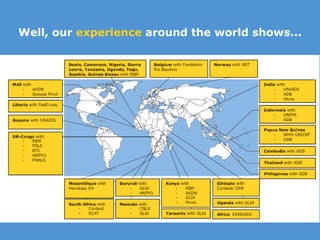
Well, our  experience  around the world shows...
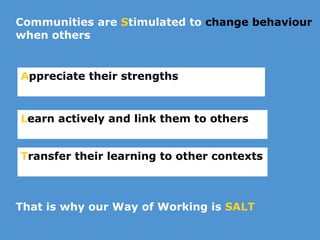
Communities are  S timulated to  change behaviour  when others That is why our Way of Working is  SALT  A ppreciate their strengths T ransfer their learning to other contexts L earn actively and link them to others
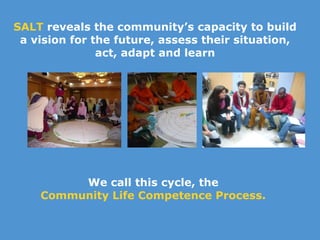
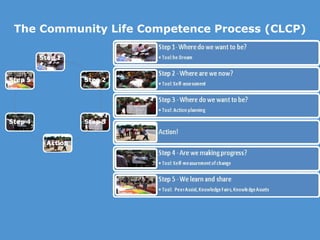
SALT  reveals the community’s capacity to build a vision for the future, assess their situation, act, adapt and learn We call this cycle, the  Community Life Competence Process.
The Community Life Competence Process (CLCP)
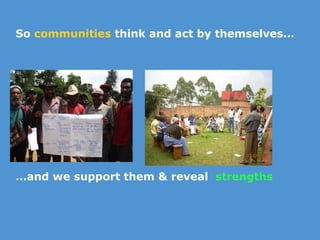
So  communities  think and act by themselves… … and we support them & reveal  strengths
You might think: Does this really  work ?
UNAIDS Evaluation (2005)  "between 83% and 87% [of AIDS Competence Process users] are satisfied and confident that the program achieves impact within communities.  WHO-UNICEF Evaluation Papua New Guinea (2009)  “ The AIDS Competence Process is an effective approach in combating HIV/AIDS through local empowerment. For its low-cost but often labor intensive input of resources, the output has been substantial.” Roll Back Malaria / MACEPA  Evaluation (2008) “ The Malaria Competence process is very likely to foster a strong sense of community ownership and led to a surge in community-led initiatives”
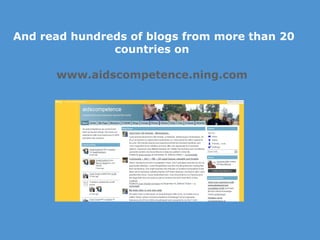
And read hundreds of blogs from more than 20 countries on  www.aidscompetence.ning.com
Or you can subscribe to our  online course
You might think: How much does it  cost ?
The process is cost-effective “ T he AIDS Competence Programme was found to be highly cost-effective when compared to other programmes (0.10 to US$ 2.00 per person reached )” –  UNAIDS (2005) The Constellation is cost-effective   “ The administrative overhead costs of the Constellation  in 2008 amounted to 5,8% “ -  Belgian Ministry of Finance (2009) Tools and online course can be accessed for free
Interested?
1. Visit our  website :  www.communitylifecompetence.org 2. Join our  online community : www.aidscompetence.ning.com   3. Apply  SALT  today. Learn more on www.communitylifecompetence.org/whatyoucando 4. Contact  Gaston  to see how we can support [email_address]
And don’t forget….
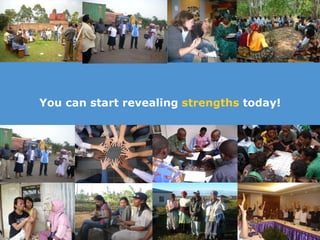
You can start revealing  strengths  today!

Community Life Competence - EN

  • 1.
    The Constellation Our starting point   Ownership + strengths = local response
  • 2.
    Let’s ask ourselvesa question….. … can communities progress in terms of HIV ?
  • 3.
    Source: HIVand Health Care Reform in Phayao . UNAIDS, Geneva, April 2000. They can in Northern Thailand….
  • 4.
    Source: Kamall etal. AIDS 2000, 14: 427-434 HIV prevalence rate among 13-19 year old in Masaka, Uganda They could in Uganda…..
  • 5.
    Progress also happensin Tanzania, Burkina Faso and other countries…. The key question is...
  • 6.
    What distinguishes these countries from others?
  • 7.
    In these countries,people have taken local ownership of the issue “ This is OUR problem and we are going to do something about it!”
  • 8.
    People driveeffective responses to HIV Health services are needed but don’t replace what people do for themselves
  • 9.
    Once communities takeownership, they will respond locally to the issue Local Response Local Response Local Response Local Response Local Response Local Response Local Response Local Response Local Response Local Response Local Response Local Response
  • 10.
    What does thismean for a HIV strategy? Local ownership Prevention Care Mitigation Is a strategic pillar that complements
  • 11.
    But, is local ownership enough to drive local responses? …..
  • 12.
    …… .No, becausecommunities underestimate their capacity “ We know it’s a problem, but don’t have the resources to respond” “ We are waiting for the experts” “ We are victims”
  • 13.
    Therefore, we mustreveal their capacity & strengths
  • 14.
    Once communities know their strengths , their self-confidence grows..…..
  • 15.
    … .and they’lluse their strengths to address their problems “ We can do this together!”
  • 16.
    s So whatdo Constellation coaches do?
  • 17.
    Our coaches:  Foster reveal to stimulate Ownership + strengths = local response
  • 18.
    How dowe do this?
  • 19.
    Well, our experience around the world shows...
  • 20.
    Communities are S timulated to change behaviour when others That is why our Way of Working is SALT A ppreciate their strengths T ransfer their learning to other contexts L earn actively and link them to others
  • 21.
    SALT revealsthe community’s capacity to build a vision for the future, assess their situation, act, adapt and learn We call this cycle, the Community Life Competence Process.
  • 22.
    The Community LifeCompetence Process (CLCP)
  • 23.
    So communities think and act by themselves… … and we support them & reveal strengths
  • 24.
    You might think:Does this really work ?
  • 25.
    UNAIDS Evaluation (2005) "between 83% and 87% [of AIDS Competence Process users] are satisfied and confident that the program achieves impact within communities. WHO-UNICEF Evaluation Papua New Guinea (2009) “ The AIDS Competence Process is an effective approach in combating HIV/AIDS through local empowerment. For its low-cost but often labor intensive input of resources, the output has been substantial.” Roll Back Malaria / MACEPA Evaluation (2008) “ The Malaria Competence process is very likely to foster a strong sense of community ownership and led to a surge in community-led initiatives”
  • 26.
    And read hundredsof blogs from more than 20 countries on www.aidscompetence.ning.com
  • 27.
    Or you cansubscribe to our online course
  • 28.
    You might think:How much does it cost ?
  • 29.
    The process iscost-effective “ T he AIDS Competence Programme was found to be highly cost-effective when compared to other programmes (0.10 to US$ 2.00 per person reached )” – UNAIDS (2005) The Constellation is cost-effective “ The administrative overhead costs of the Constellation in 2008 amounted to 5,8% “ - Belgian Ministry of Finance (2009) Tools and online course can be accessed for free
  • 30.
  • 31.
    1. Visit our website : www.communitylifecompetence.org 2. Join our online community : www.aidscompetence.ning.com 3. Apply SALT today. Learn more on www.communitylifecompetence.org/whatyoucando 4. Contact Gaston to see how we can support [email_address]
  • 32.
  • 33.
    You can startrevealing strengths today!

Editor's Notes

  • #4 This is point-prevalence, so shows the trend really well. It’s not a small sample. All conscripts of 21 year old have to go for (anonymous) HIV testing. At the moment, prevalence is 0,9% among the same demographic group. Key factor contributing to this progress after a 10-year research: LOCAL RESPONSES through ownership.
  • #5 Progress in other countries as well, for example in Uganda.