New ways of working…

 Mapping local action:
supporting sustainable
consumption initiatives

          Chris Church
        ANPED Trustee
  Director, Mapping for change
SCP - What is civil society doing?

Activities around the SCP agenda:
  Consumer focussed campaigning & lobbying
  Work in multi-stakeholder processes & alliances
  Engaging with communities
Issues emerging from the ‘Action Town’ programme

A range of problems to tackle
Consumer campaigns

Plenty of activity – needs to be more effective. We need:
  Better dissemination of examples of good practice
  To show what is effective and ‘mainstream’ this work
  To go beyond preaching to the converted
  To link to social and winder media
  To inform and impact on political campaigns.
But ‘just what is SCP’?

  It is the nature of ‘SCP’ that it is difficult to define
   what ‘it’ is.
  We lack common principles which could be used
   as a basis for joint working.
  Those who see this as their ‘single issue’ are a
   very small group.
  The linking of consumption and production makes
   it more complex.
Too big an issue?

  Most NGOs only approach this through
   projects.
  Little focus on policy and global issues.
  There is a lack of capacity and of the skills
   needed to address, engage with and influence
   work on these issues.
  Many other priorities for NGO activity
A lack of leadership and support
  Any NGO looking to work on biodiversity or
   waste will find networks to provide information
   and support.
  This is not the case with SCP.
  ANPED has focused on this issue but is small.
   EEB may promote these ideas, but mostly to
   larger organisations
  So much of what smaller civil society groups
   want to know about is being done by…
  …Smaller civil society groups
So…
If this work is to develop we need to:
 Make it easy to find what is happening
 Avoid duplication but replicate where
   appropriate
 Share information
 Provide advice and support


We need innovation in our information systems
Lessons from on-line mapping:
     Keeping it all together
  It’s almost impossible to know what’s going
   on in any large city (or diffuse rural area)
  Traditional networks work for those already
   engaged
  Many new ideas emerging
Mapping for Change
  A social enterprise set up as a partnership between
   the London 21 sustainability network and University
   College London
  Provide participatory mapping services to
   communities, voluntary sector organisations, local
   authorities and developers using a suite of innovative
   tools for communication.
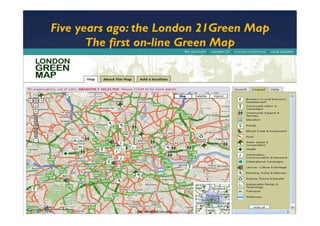
Five years ago: the London 21Green Map
       The first on-line Green Map
The value of mapping
  Any thing that is ‘based in a place’ can be placed
   on a map
  This can turn a ‘directory’ into a living resource
  Organisations can design their own maps to
   record the information that they want to use and
   that they want others to see
  Maps can be local, wider-ranging and / or
   thematic
Local Mapping
We can map
  Quantitative data - measurements of the local
   environment or the economy.
  Qualitative data - surveys of people’s perceptions,
   the things people like, dislike or want to change.
  Ideas - or at least the places where ideas can turn into
   reality: possible sites for growing food or creating new
   play spaces, or sites that need to change.
  Stories and histories - records of what has happened
   in an area can be linked to specific places
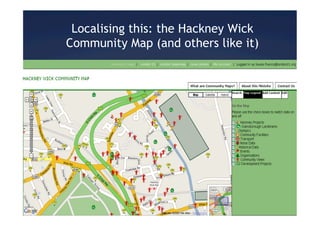
Localising this: the Hackney Wick
Community Map (and others like it)
So what could we map for SCP?
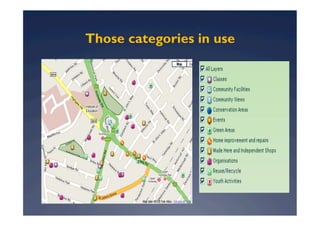
One part of London has mapped:
  Community Views and Facilities
  Made Here and Independent Shops
  Home improvement and repairs
  Organisations
  Reuse/Recycle facilities
  Conservation Areas
   Events
   Green Areas
   Youth Activities
Those categories in use
Mapping for SCP: one approach
A London-wide map of resources for climate and consumption
1. Climate-focused bodies (including campaign groups, transition
    towns, etc.)
2. Community / resource centres
3. Renewable energy projects and energy advice centres
4. City Farms and larger community gardens / food-growing / green
    spaces
5. Community health / well-being projects
6. Key ethnic minority / faith / cultural / refugee / organisations and
    networks
7. Time Banks and other local economic development projects
8. Community media organisations
9.  Upcoming relevant events
Mapping good practice across Europe

   Some issues:
     Easy as local at one level
     Who chooses?
     Who maintains?
How does this impact on policy?
  Any interested agency can find out more
   about what is really happening
  Any individual can get active more easily –
   this may lead to their greater engagement in
   lobbying etc.
  Policy needs infrastructure for
   implementation – maps can show existing
   work and also the gaps
Maps tells us where we should be
              going…
 “It is not down in any map; true places
   never are”. - Herman Melville (Moby Dick)

 Or maybe we don’t have the right kind of
  maps… Yet…
Mapping for change.org.uk

Thankyou!
Chris Church chrischurch@phonecoop.coop

Mapping for sustainable consumption initiatives

  • 1.
    New ways ofworking… Mapping local action: supporting sustainable consumption initiatives Chris Church ANPED Trustee Director, Mapping for change
  • 2.
    SCP - Whatis civil society doing? Activities around the SCP agenda:   Consumer focussed campaigning & lobbying   Work in multi-stakeholder processes & alliances   Engaging with communities Issues emerging from the ‘Action Town’ programme A range of problems to tackle
  • 3.
    Consumer campaigns Plenty ofactivity – needs to be more effective. We need:   Better dissemination of examples of good practice   To show what is effective and ‘mainstream’ this work   To go beyond preaching to the converted   To link to social and winder media   To inform and impact on political campaigns.
  • 4.
    But ‘just whatis SCP’?   It is the nature of ‘SCP’ that it is difficult to define what ‘it’ is.   We lack common principles which could be used as a basis for joint working.   Those who see this as their ‘single issue’ are a very small group.   The linking of consumption and production makes it more complex.
  • 5.
    Too big anissue?   Most NGOs only approach this through projects.   Little focus on policy and global issues.   There is a lack of capacity and of the skills needed to address, engage with and influence work on these issues.   Many other priorities for NGO activity
  • 6.
    A lack ofleadership and support   Any NGO looking to work on biodiversity or waste will find networks to provide information and support.   This is not the case with SCP.   ANPED has focused on this issue but is small. EEB may promote these ideas, but mostly to larger organisations   So much of what smaller civil society groups want to know about is being done by…   …Smaller civil society groups
  • 7.
    So… If this workis to develop we need to:  Make it easy to find what is happening  Avoid duplication but replicate where appropriate  Share information  Provide advice and support We need innovation in our information systems
  • 8.
    Lessons from on-linemapping: Keeping it all together   It’s almost impossible to know what’s going on in any large city (or diffuse rural area)   Traditional networks work for those already engaged   Many new ideas emerging
  • 9.
    Mapping for Change  A social enterprise set up as a partnership between the London 21 sustainability network and University College London   Provide participatory mapping services to communities, voluntary sector organisations, local authorities and developers using a suite of innovative tools for communication.
  • 10.
    Five years ago:the London 21Green Map The first on-line Green Map
  • 11.
    The value ofmapping   Any thing that is ‘based in a place’ can be placed on a map   This can turn a ‘directory’ into a living resource   Organisations can design their own maps to record the information that they want to use and that they want others to see   Maps can be local, wider-ranging and / or thematic
  • 12.
    Local Mapping We canmap   Quantitative data - measurements of the local environment or the economy.   Qualitative data - surveys of people’s perceptions, the things people like, dislike or want to change.   Ideas - or at least the places where ideas can turn into reality: possible sites for growing food or creating new play spaces, or sites that need to change.   Stories and histories - records of what has happened in an area can be linked to specific places
  • 13.
    Localising this: theHackney Wick Community Map (and others like it)
  • 14.
    So what couldwe map for SCP? One part of London has mapped:   Community Views and Facilities   Made Here and Independent Shops   Home improvement and repairs   Organisations   Reuse/Recycle facilities   Conservation Areas    Events    Green Areas    Youth Activities
  • 15.
  • 16.
    Mapping for SCP:one approach A London-wide map of resources for climate and consumption 1. Climate-focused bodies (including campaign groups, transition towns, etc.) 2. Community / resource centres 3. Renewable energy projects and energy advice centres 4. City Farms and larger community gardens / food-growing / green spaces 5. Community health / well-being projects 6. Key ethnic minority / faith / cultural / refugee / organisations and networks 7. Time Banks and other local economic development projects 8. Community media organisations 9.  Upcoming relevant events
  • 17.
    Mapping good practiceacross Europe Some issues:   Easy as local at one level   Who chooses?   Who maintains?
  • 18.
    How does thisimpact on policy?   Any interested agency can find out more about what is really happening   Any individual can get active more easily – this may lead to their greater engagement in lobbying etc.   Policy needs infrastructure for implementation – maps can show existing work and also the gaps
  • 19.
    Maps tells uswhere we should be going… “It is not down in any map; true places never are”. - Herman Melville (Moby Dick) Or maybe we don’t have the right kind of maps… Yet…
  • 20.
    Mapping for change.org.uk Thankyou! ChrisChurch chrischurch@phonecoop.coop