National Association of Student
                 Financial Aid Administrators


                    What You
                  Need to Know
                about Financial Aid

© NASFAA 2011
Topics We Will Discuss Tonight

   • What is financial aid
   • Cost of attendance (COA)
   • Expected Family Contribution (EFC)
   • What is financial need
   • Categories, types, and sources of financial aid
   • Free Application for Federal Student Aid
     (FAFSA)
   • Special circumstances
© NASFAA 2011                                      Slide 2
What is Financial Aid?

   Financial aid consists of funds provided to
   students and families to help pay for
   postsecondary educational expenses


© NASFAA 2011                                    Slide 3
What is Cost of Attendance (COA)

   • Direct costs

   • Indirect costs

   • Direct and indirect costs combined into
     cost of attendance

   • Varies widely from college to college

© NASFAA 2011                                  Slide 4
What is the Expected Family
   Contribution (EFC)
   • Amount family can reasonably be expected
     to contribute
   • Stays the same regardless of college
   • Two components
        – Parent contribution
        – Student contribution
   • Calculated using data from a federal
     application form and a federal formula
© NASFAA 2011                                 Slide 5
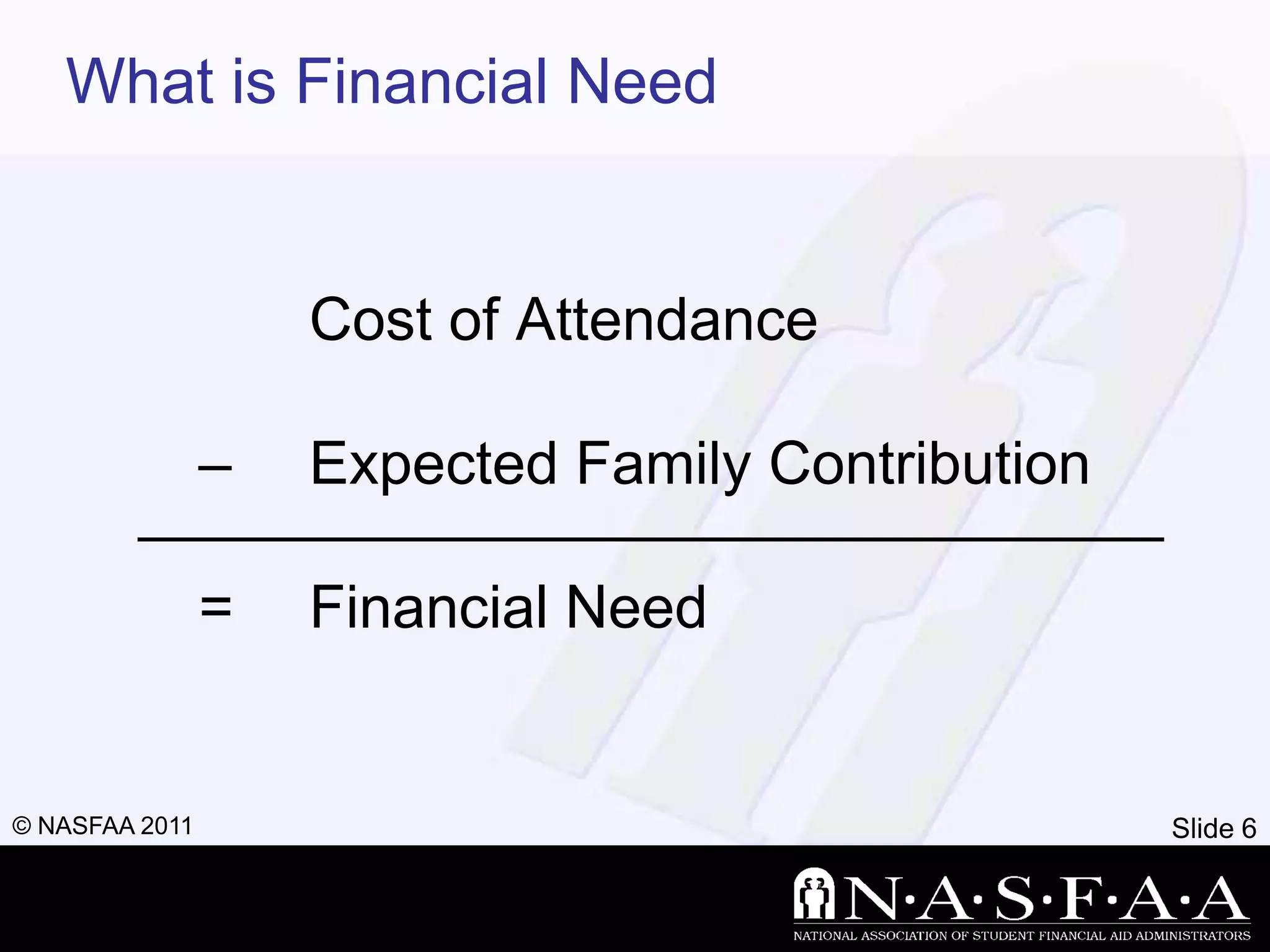
What is Financial Need


                    Cost of Attendance

                –   Expected Family Contribution

                =   Financial Need


© NASFAA 2011                                      Slide 6
Categories of Financial Aid

   • Need-based


   • Non-need-based


© NASFAA 2011                    Slide 7
Types of Financial Aid

   • Scholarships

   • Grants

   • Loans

   • Employment

© NASFAA 2011               Slide 8
Scholarships

   • Money that does not have to be paid
     back

   • Awarded on the basis of merit, skill,
     or unique characteristic


© NASFAA 2011                                Slide 9
Grants

   • Money that does not have to be paid
     back

   • Usually awarded on the basis of
     financial need


© NASFAA 2011                              Slide 10
Loans

   • Money students and parents borrow to help
     pay college expenses
   • Repayment usually begins after education
     is finished
   • Only borrow what is really needed
   • Look at loans as an investment in the future

© NASFAA 2011                                  Slide 11
Employment

   Allows student to earn money to help pay
   educational costs

   • A paycheck; or

   • Non-monetary compensation, such as room
     and board


© NASFAA 2011                                 Slide 12
Sources of Financial Aid

   • Federal government

   • States

   • Private sources

   • Civic organizations and churches

   • Employers
© NASFAA 2011                           Slide 13
Federal Government

   • Largest source of financial aid

   • Aid awarded primarily on the basis of
     financial need

   • Must apply every year using the Free
     Application for Federal Student Aid
     (FAFSA)
© NASFAA 2011                                Slide 14
Common Federal Aid Programs

   • Federal Pell Grant        • Federal Perkins Loan

   • Teacher Education         • Federal Work-Study
     Assistance for College
     and Higher Education      • Subsidized and
     Grant                       Unsubsidized Loans

   • Federal Supplemental      • PLUS Loans
     Educational Opportunity
     Grant

© NASFAA 2011                                      Slide 15
States

   • Residency requirements
   • Award aid on the basis of both merit and
     need
   • Use information from the FAFSA
   • Deadlines vary by state; check paper
     FAFSA or FAFSA on the Web site
© NASFAA 2011                                   Slide 16
Private Sources

   • Foundations, businesses, charitable
     organizations
   • Deadlines and application procedures
     vary widely
   • Begin researching private aid sources
     early

© NASFAA 2011                                Slide 17
Civic Organizations and Churches

   • Research what is available in community

   • To what organizations and churches do
     student and family belong?

   • Application process usually spring of senior
     year

   • Small scholarships add up!
© NASFAA 2011                                  Slide 18
Employers

   • Companies may have scholarships
     available to the children of employees

   • Companies may have educational
     benefits for their employees


© NASFAA 2011                                 Slide 19
Free Application for Federal Student Aid
   (FAFSA)
   • A standard form that collects demographic
     and financial information about the student
     and family

   • May be filed electronically or using paper
     form
       – Available in English and Spanish

© NASFAA 2011                                     Slide 20
FAFSA

   • Information used to calculate the Expected
     Family Contribution or EFC
       – The amount of money a student and his or her
         family may reasonably be expected to
         contribute towards the cost of the student’s
         education for an academic year

   • Colleges use EFC to award financial aid

© NASFAA 2011                                       Slide 21
FAFSA

   • May be filed at any time during an academic
     year, but no earlier than the January 1st prior
     to the academic year for which the student
     requests aid
   • For the 2012–13 academic year, the FAFSA
     may be filed beginning January 1, 2012
   • Colleges may set FAFSA filing deadlines
© NASFAA 2011                                    Slide 22
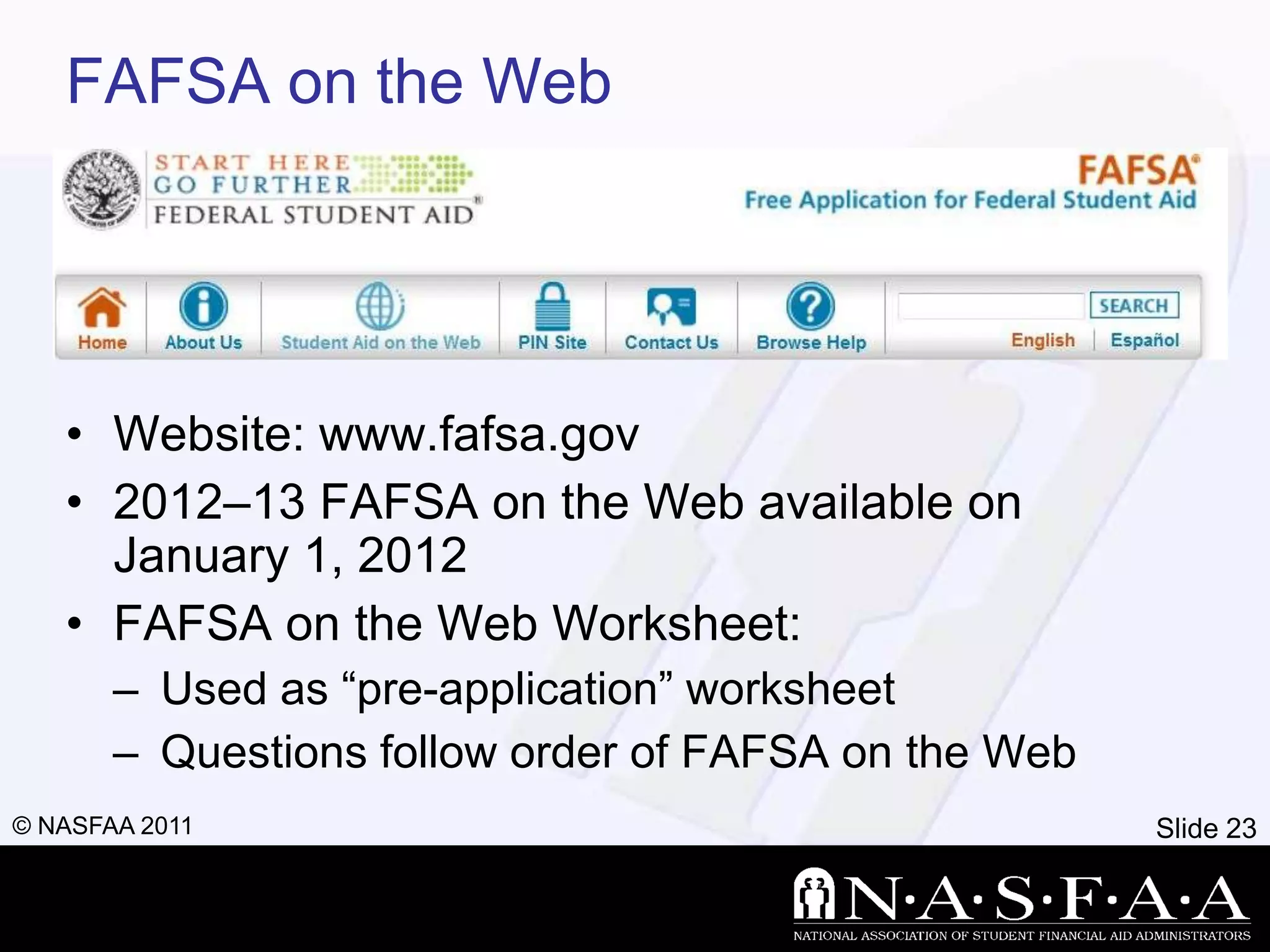
FAFSA on the Web


   • Website: www.fafsa.gov
   • 2012–13 FAFSA on the Web available on
     January 1, 2012
   • FAFSA on the Web Worksheet:
       – Used as ―pre-application‖ worksheet
       – Questions follow order of FAFSA on the Web
© NASFAA 2011                                         Slide 23
FAFSA on the Web

   Good reasons to file electronically:
   • Built-in edits to prevent costly errors
   • Skip logic allows student and/or parent to
     skip unnecessary questions
   • Option to use Internal Revenue Service
     (IRS) data retrieval

© NASFAA 2011                                     Slide 24
FAFSA on the Web

   Good reasons to file electronically:
   • More timely submission of original
     application and any necessary corrections
   • More detailed instructions and ―help‖ for
     common questions
   • Ability to check application status on-line
   • Simplified application process in the future
© NASFAA 2011                                      Slide 25
IRS Data Retrieval

   • While completing FOTW, applicant may
     submit real-time request to IRS for tax data
   • IRS will authenticate taxpayer’s identity
   • If match found, IRS sends real-time results
     to applicant in new window
   • Applicant chooses whether or not to
     transfer data to FOTW
© NASFAA 2011                                    Slide 26
IRS Data Retrieval

   • Available early February 2012 for 2012–13
     processing cycle

   • Participation is voluntary

   • Reduces documents requested by financial
     aid office


© NASFAA 2011                                Slide 27
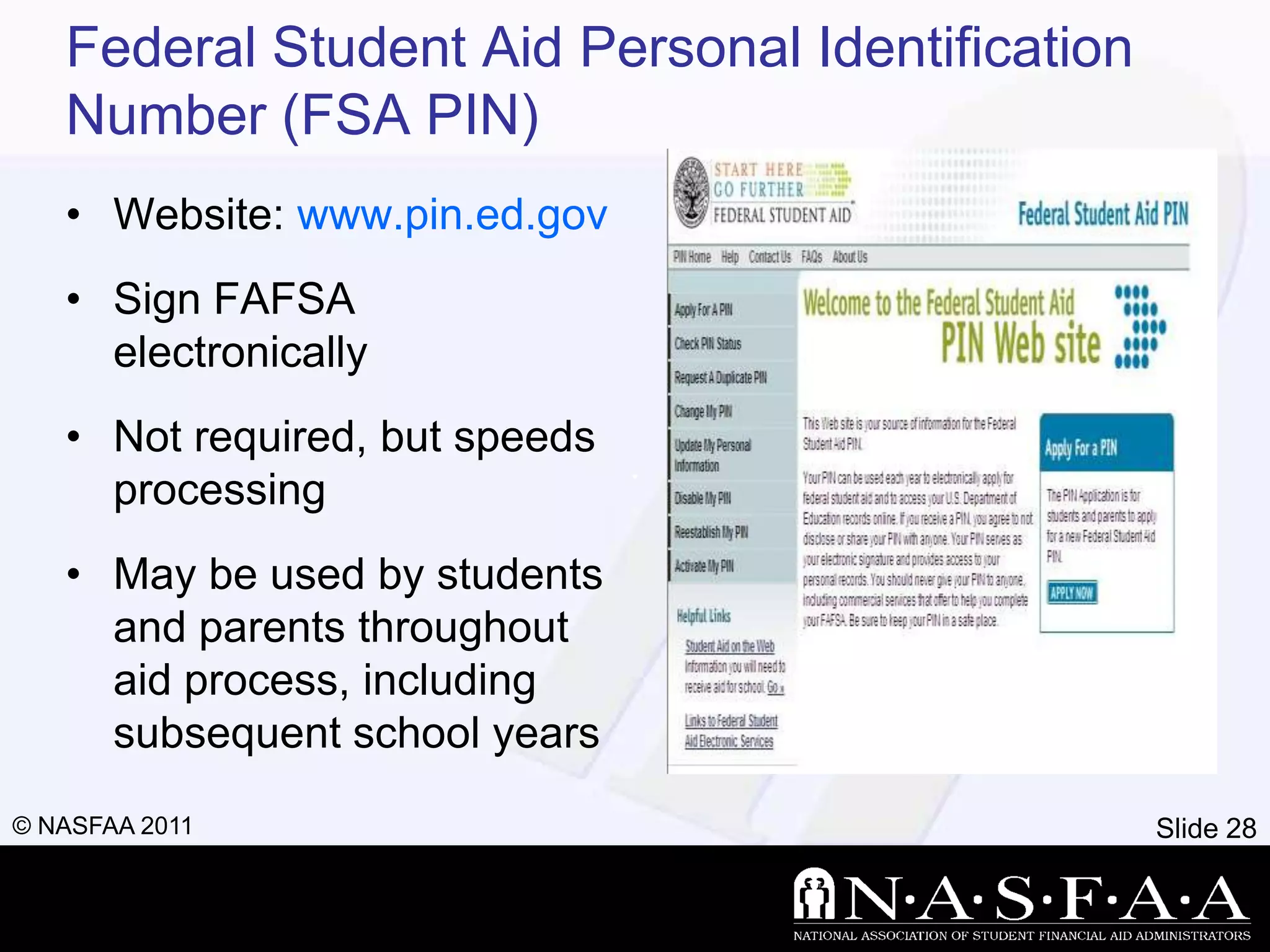
Federal Student Aid Personal Identification
   Number (FSA PIN)
   • Website: www.pin.ed.gov
   • Sign FAFSA
     electronically
   • Not required, but speeds
     processing
   • May be used by students
     and parents throughout
     aid process, including
     subsequent school years
© NASFAA 2011                                    Slide 28
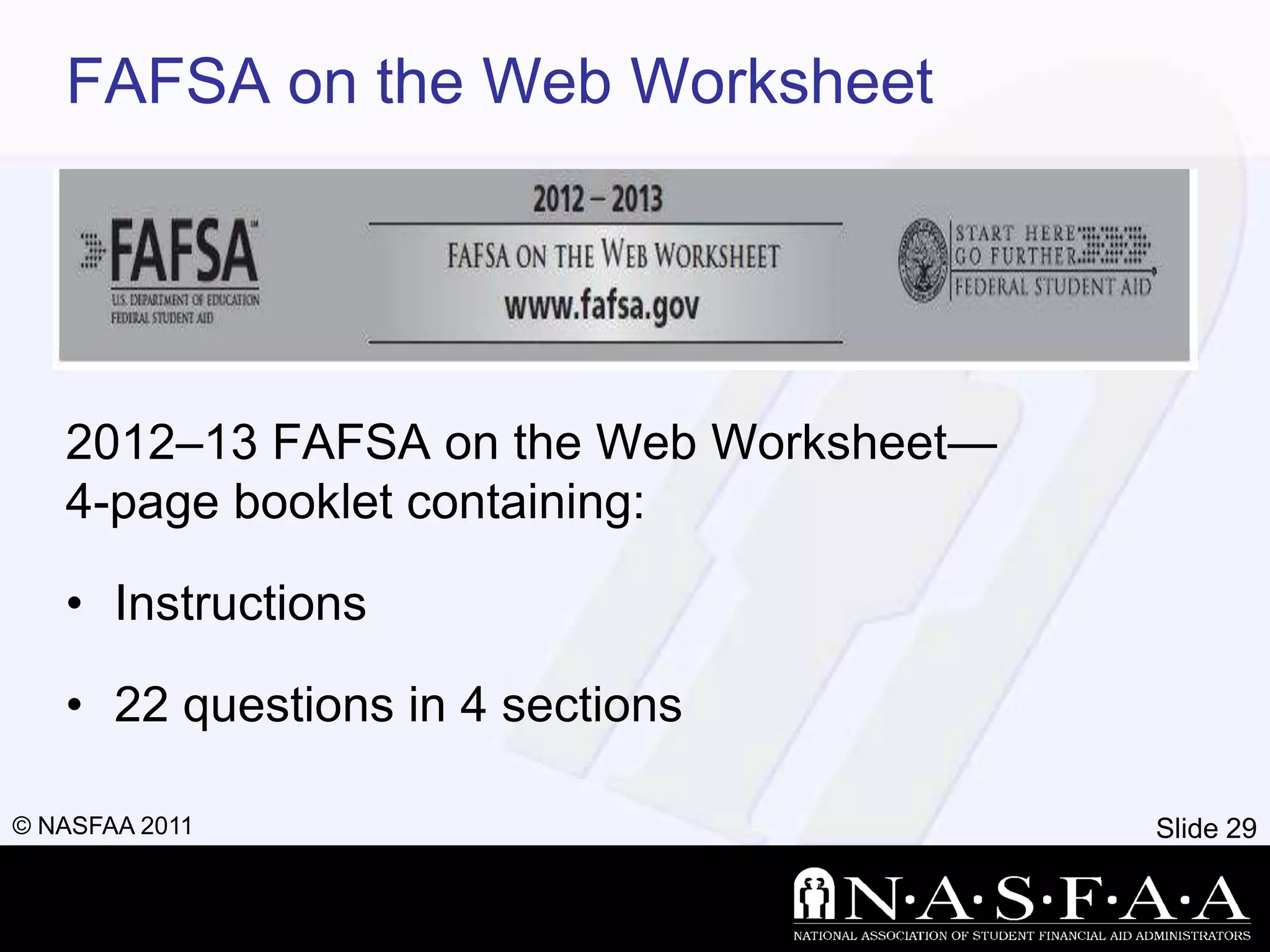
FAFSA on the Web Worksheet


   2012–13 FAFSA on the Web Worksheet—
   4-page booklet containing:

   • Instructions

   • 22 questions in 4 sections

© NASFAA 2011                            Slide 29
FOTW Worksheet: Section 1

   General student information:

   • Social Security Number

   • Citizenship status

   • Drug convictions

   • Selective Service registration
© NASFAA 2011                         Slide 30
FOTW Worksheet: Section 2

   Student’s dependency status:

   • If all ―No‖ responses, student is dependent

   • If ―Yes‖ to any question, student is
     independent


© NASFAA 2011                                  Slide 31
FOTW Worksheet: Section 3

   Information about the parents of dependent
   students:

   • Tax, income, and other financial information

   • Dislocated worker status

   • Assets

© NASFAA 2011                                   Slide 32
FOTW Worksheet: Section 4

   Information about the student (and spouse):

   • Tax, income, and other financial information

   • Dislocated worker status

   • Assets


© NASFAA 2011                                 Slide 33
Additional Information

   • College and housing information


© NASFAA 2011                          Slide 34
Signatures

   • Required
       – Student
       – One parent (dependent students)
   • Format
       – Electronic using PIN
       – Signature page
       – Paper FAFSA
© NASFAA 2011                              Slide 35
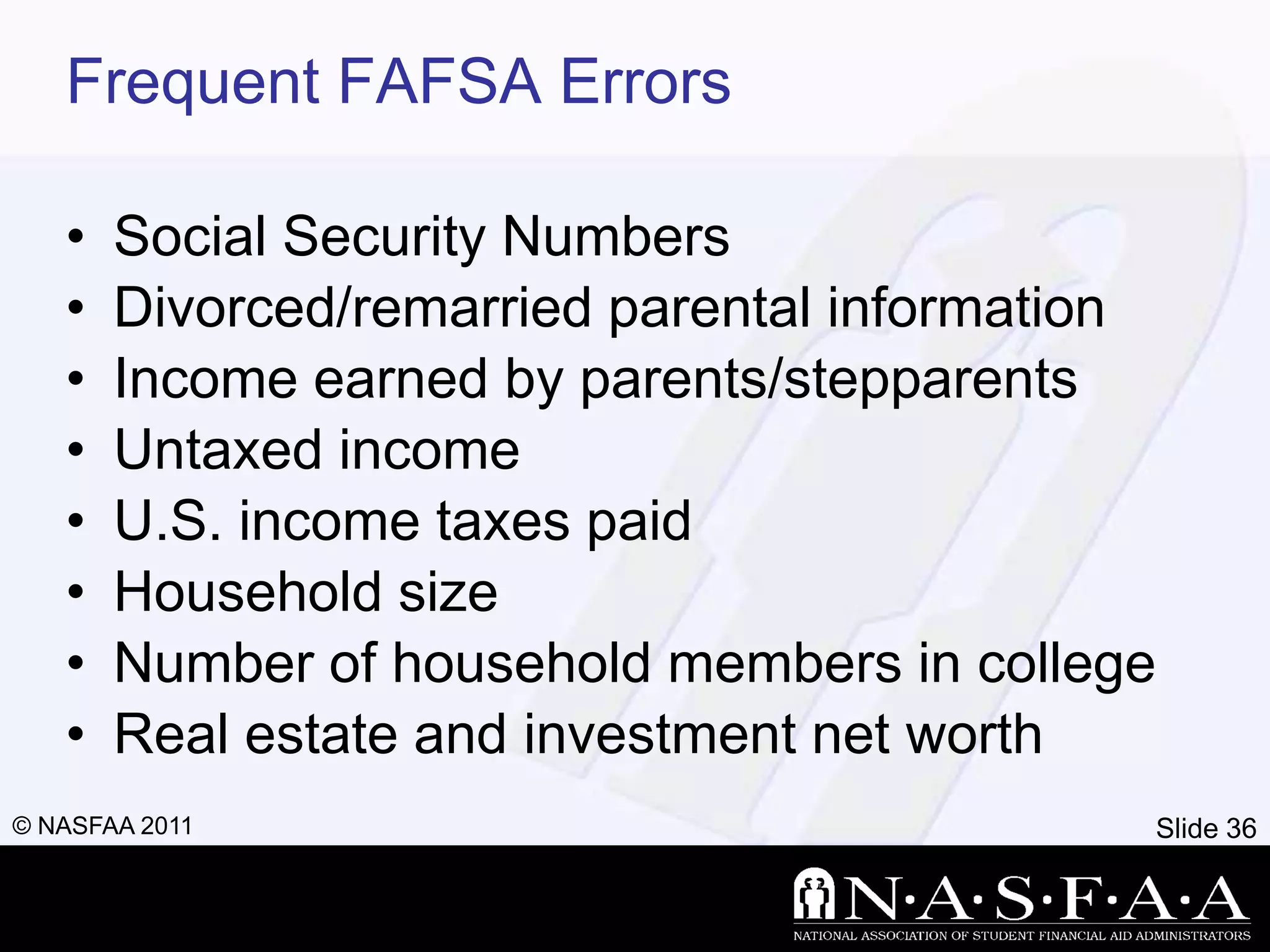
Frequent FAFSA Errors

   •   Social Security Numbers
   •   Divorced/remarried parental information
   •   Income earned by parents/stepparents
   •   Untaxed income
   •   U.S. income taxes paid
   •   Household size
   •   Number of household members in college
   •   Real estate and investment net worth
© NASFAA 2011                                Slide 36
FAFSA Processing Results

   Central Processing System (CPS) notifies
   student of FAFSA processing results by:
   • Paper Student Aid Report (SAR) if paper FAFSA
     was filed and student’s e-mail address was not
     provided
   • SAR Acknowledgement if filed FAFSA on the
     Web and student’s e-mail address was not
     provided
© NASFAA 2011                                     Slide 37
FAFSA Processing Results

   • CPS notifies student of FAFSA processing
     results by:
       – E-mail notification containing a direct link to
         student’s on-line SAR if student’s e-mail was
         provided on paper or electronic FAFSA

   • Student with PIN may view SAR on-line at
     www.fafsa.gov
© NASFAA 2011                                              Slide 38
FAFSA Processing Results

   • Institutional Student Information Record
     (ISIR) sent to colleges listed on FAFSA
     approximately 10 to 14 days after FAFSA
     submitted

   • College reviews ISIR
       – May request additional documentation, such
         as proof that a sibling is enrolled in college

© NASFAA 2011                                             Slide 39
Student Aid Report

   • Review data for accuracy

   • Update estimated information when
     actual figures are available


© NASFAA 2011                            Slide 40
Making Corrections

   If necessary, corrections to FAFSA data may
   be made by:
   • Using FAFSA on the Web (www.fafsa.gov) if
       student has a PIN;
   • Updating paper SAR (SAR Information
     Acknowledgement cannot be used to make
     corrections); or
   • Submitting documentation to college’s
     financial aid office
© NASFAA 2011                                 Slide 41
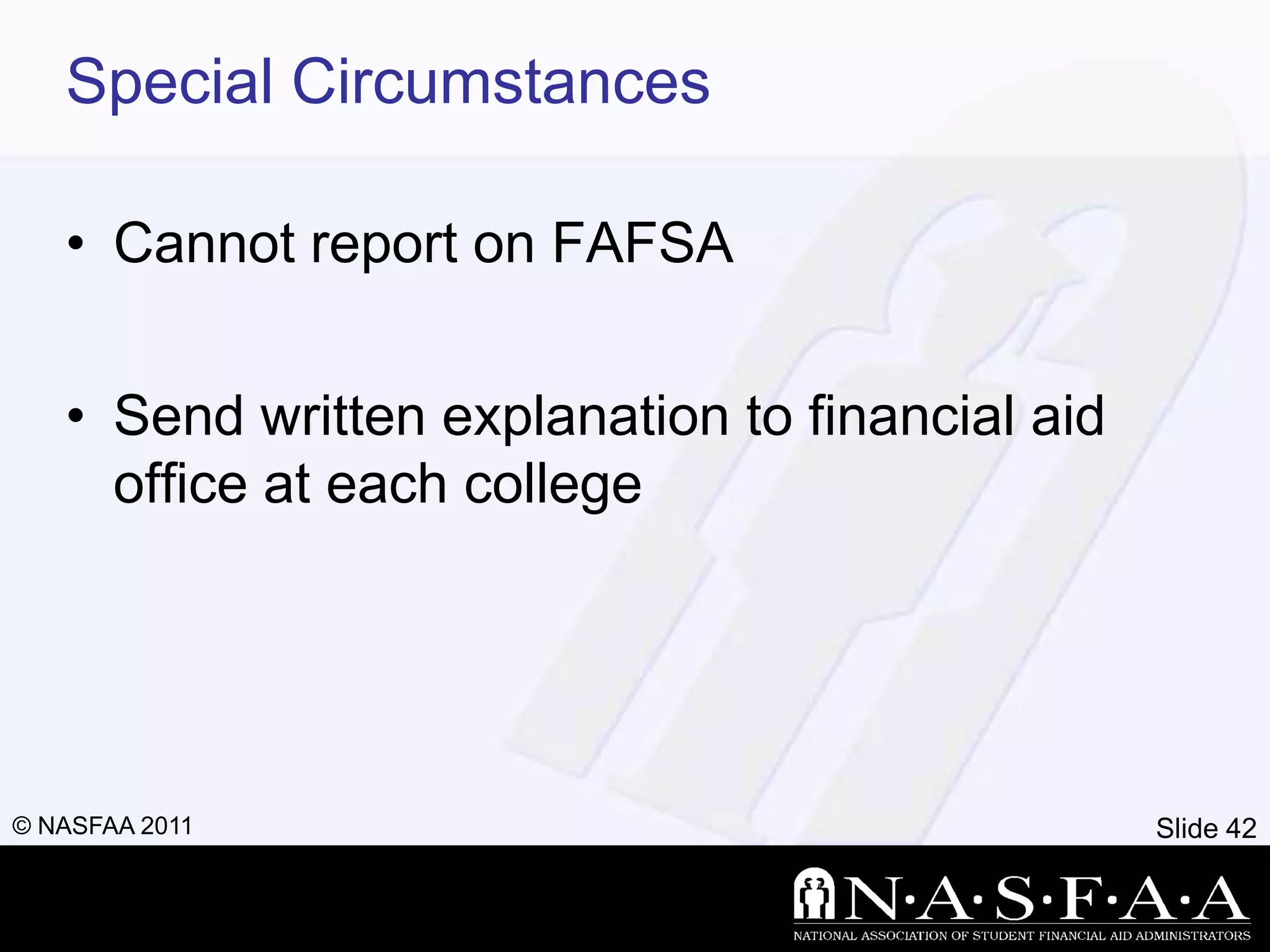
Special Circumstances

   • Cannot report on FAFSA


   • Send written explanation to financial aid
     office at each college


© NASFAA 2011                                    Slide 42
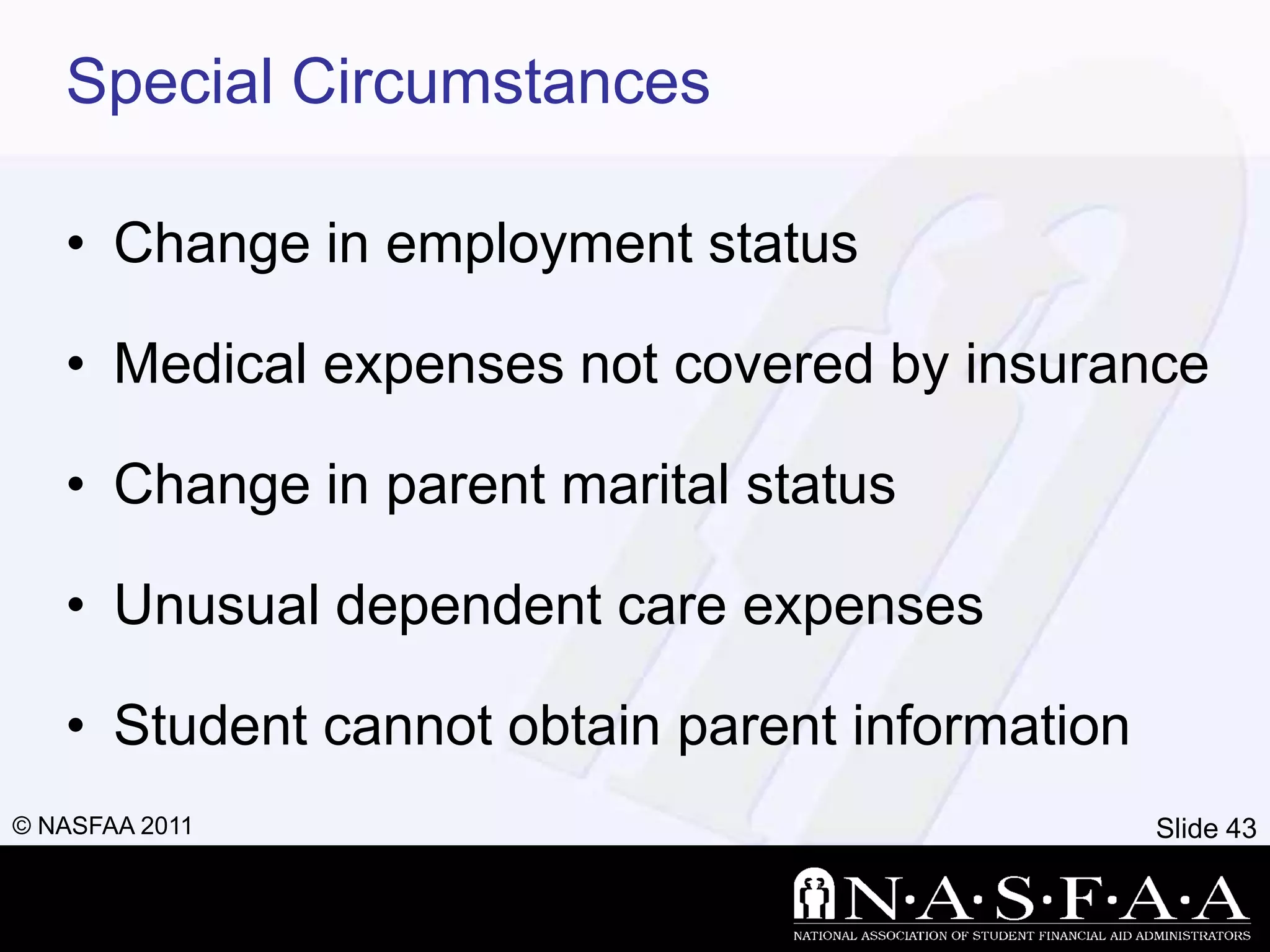
Special Circumstances

   • Change in employment status

   • Medical expenses not covered by insurance

   • Change in parent marital status

   • Unusual dependent care expenses

   • Student cannot obtain parent information
© NASFAA 2011                                   Slide 43
© NASFAA 2011   Slide 44

Slideshow fa night

  • 1.
    National Association ofStudent Financial Aid Administrators What You Need to Know about Financial Aid © NASFAA 2011
  • 2.
    Topics We WillDiscuss Tonight • What is financial aid • Cost of attendance (COA) • Expected Family Contribution (EFC) • What is financial need • Categories, types, and sources of financial aid • Free Application for Federal Student Aid (FAFSA) • Special circumstances © NASFAA 2011 Slide 2
  • 3.
    What is FinancialAid? Financial aid consists of funds provided to students and families to help pay for postsecondary educational expenses © NASFAA 2011 Slide 3
  • 4.
    What is Costof Attendance (COA) • Direct costs • Indirect costs • Direct and indirect costs combined into cost of attendance • Varies widely from college to college © NASFAA 2011 Slide 4
  • 5.
    What is theExpected Family Contribution (EFC) • Amount family can reasonably be expected to contribute • Stays the same regardless of college • Two components – Parent contribution – Student contribution • Calculated using data from a federal application form and a federal formula © NASFAA 2011 Slide 5
  • 6.
    What is FinancialNeed Cost of Attendance – Expected Family Contribution = Financial Need © NASFAA 2011 Slide 6
  • 7.
    Categories of FinancialAid • Need-based • Non-need-based © NASFAA 2011 Slide 7
  • 8.
    Types of FinancialAid • Scholarships • Grants • Loans • Employment © NASFAA 2011 Slide 8
  • 9.
    Scholarships • Money that does not have to be paid back • Awarded on the basis of merit, skill, or unique characteristic © NASFAA 2011 Slide 9
  • 10.
    Grants • Money that does not have to be paid back • Usually awarded on the basis of financial need © NASFAA 2011 Slide 10
  • 11.
    Loans • Money students and parents borrow to help pay college expenses • Repayment usually begins after education is finished • Only borrow what is really needed • Look at loans as an investment in the future © NASFAA 2011 Slide 11
  • 12.
    Employment Allows student to earn money to help pay educational costs • A paycheck; or • Non-monetary compensation, such as room and board © NASFAA 2011 Slide 12
  • 13.
    Sources of FinancialAid • Federal government • States • Private sources • Civic organizations and churches • Employers © NASFAA 2011 Slide 13
  • 14.
    Federal Government • Largest source of financial aid • Aid awarded primarily on the basis of financial need • Must apply every year using the Free Application for Federal Student Aid (FAFSA) © NASFAA 2011 Slide 14
  • 15.
    Common Federal AidPrograms • Federal Pell Grant • Federal Perkins Loan • Teacher Education • Federal Work-Study Assistance for College and Higher Education • Subsidized and Grant Unsubsidized Loans • Federal Supplemental • PLUS Loans Educational Opportunity Grant © NASFAA 2011 Slide 15
  • 16.
    States • Residency requirements • Award aid on the basis of both merit and need • Use information from the FAFSA • Deadlines vary by state; check paper FAFSA or FAFSA on the Web site © NASFAA 2011 Slide 16
  • 17.
    Private Sources • Foundations, businesses, charitable organizations • Deadlines and application procedures vary widely • Begin researching private aid sources early © NASFAA 2011 Slide 17
  • 18.
    Civic Organizations andChurches • Research what is available in community • To what organizations and churches do student and family belong? • Application process usually spring of senior year • Small scholarships add up! © NASFAA 2011 Slide 18
  • 19.
    Employers • Companies may have scholarships available to the children of employees • Companies may have educational benefits for their employees © NASFAA 2011 Slide 19
  • 20.
    Free Application forFederal Student Aid (FAFSA) • A standard form that collects demographic and financial information about the student and family • May be filed electronically or using paper form – Available in English and Spanish © NASFAA 2011 Slide 20
  • 21.
    FAFSA • Information used to calculate the Expected Family Contribution or EFC – The amount of money a student and his or her family may reasonably be expected to contribute towards the cost of the student’s education for an academic year • Colleges use EFC to award financial aid © NASFAA 2011 Slide 21
  • 22.
    FAFSA • May be filed at any time during an academic year, but no earlier than the January 1st prior to the academic year for which the student requests aid • For the 2012–13 academic year, the FAFSA may be filed beginning January 1, 2012 • Colleges may set FAFSA filing deadlines © NASFAA 2011 Slide 22
  • 23.
    FAFSA on theWeb • Website: www.fafsa.gov • 2012–13 FAFSA on the Web available on January 1, 2012 • FAFSA on the Web Worksheet: – Used as ―pre-application‖ worksheet – Questions follow order of FAFSA on the Web © NASFAA 2011 Slide 23
  • 24.
    FAFSA on theWeb Good reasons to file electronically: • Built-in edits to prevent costly errors • Skip logic allows student and/or parent to skip unnecessary questions • Option to use Internal Revenue Service (IRS) data retrieval © NASFAA 2011 Slide 24
  • 25.
    FAFSA on theWeb Good reasons to file electronically: • More timely submission of original application and any necessary corrections • More detailed instructions and ―help‖ for common questions • Ability to check application status on-line • Simplified application process in the future © NASFAA 2011 Slide 25
  • 26.
    IRS Data Retrieval • While completing FOTW, applicant may submit real-time request to IRS for tax data • IRS will authenticate taxpayer’s identity • If match found, IRS sends real-time results to applicant in new window • Applicant chooses whether or not to transfer data to FOTW © NASFAA 2011 Slide 26
  • 27.
    IRS Data Retrieval • Available early February 2012 for 2012–13 processing cycle • Participation is voluntary • Reduces documents requested by financial aid office © NASFAA 2011 Slide 27
  • 28.
    Federal Student AidPersonal Identification Number (FSA PIN) • Website: www.pin.ed.gov • Sign FAFSA electronically • Not required, but speeds processing • May be used by students and parents throughout aid process, including subsequent school years © NASFAA 2011 Slide 28
  • 29.
    FAFSA on theWeb Worksheet 2012–13 FAFSA on the Web Worksheet— 4-page booklet containing: • Instructions • 22 questions in 4 sections © NASFAA 2011 Slide 29
  • 30.
    FOTW Worksheet: Section1 General student information: • Social Security Number • Citizenship status • Drug convictions • Selective Service registration © NASFAA 2011 Slide 30
  • 31.
    FOTW Worksheet: Section2 Student’s dependency status: • If all ―No‖ responses, student is dependent • If ―Yes‖ to any question, student is independent © NASFAA 2011 Slide 31
  • 32.
    FOTW Worksheet: Section3 Information about the parents of dependent students: • Tax, income, and other financial information • Dislocated worker status • Assets © NASFAA 2011 Slide 32
  • 33.
    FOTW Worksheet: Section4 Information about the student (and spouse): • Tax, income, and other financial information • Dislocated worker status • Assets © NASFAA 2011 Slide 33
  • 34.
    Additional Information • College and housing information © NASFAA 2011 Slide 34
  • 35.
    Signatures • Required – Student – One parent (dependent students) • Format – Electronic using PIN – Signature page – Paper FAFSA © NASFAA 2011 Slide 35
  • 36.
    Frequent FAFSA Errors • Social Security Numbers • Divorced/remarried parental information • Income earned by parents/stepparents • Untaxed income • U.S. income taxes paid • Household size • Number of household members in college • Real estate and investment net worth © NASFAA 2011 Slide 36
  • 37.
    FAFSA Processing Results Central Processing System (CPS) notifies student of FAFSA processing results by: • Paper Student Aid Report (SAR) if paper FAFSA was filed and student’s e-mail address was not provided • SAR Acknowledgement if filed FAFSA on the Web and student’s e-mail address was not provided © NASFAA 2011 Slide 37
  • 38.
    FAFSA Processing Results • CPS notifies student of FAFSA processing results by: – E-mail notification containing a direct link to student’s on-line SAR if student’s e-mail was provided on paper or electronic FAFSA • Student with PIN may view SAR on-line at www.fafsa.gov © NASFAA 2011 Slide 38
  • 39.
    FAFSA Processing Results • Institutional Student Information Record (ISIR) sent to colleges listed on FAFSA approximately 10 to 14 days after FAFSA submitted • College reviews ISIR – May request additional documentation, such as proof that a sibling is enrolled in college © NASFAA 2011 Slide 39
  • 40.
    Student Aid Report • Review data for accuracy • Update estimated information when actual figures are available © NASFAA 2011 Slide 40
  • 41.
    Making Corrections If necessary, corrections to FAFSA data may be made by: • Using FAFSA on the Web (www.fafsa.gov) if student has a PIN; • Updating paper SAR (SAR Information Acknowledgement cannot be used to make corrections); or • Submitting documentation to college’s financial aid office © NASFAA 2011 Slide 41
  • 42.
    Special Circumstances • Cannot report on FAFSA • Send written explanation to financial aid office at each college © NASFAA 2011 Slide 42
  • 43.
    Special Circumstances • Change in employment status • Medical expenses not covered by insurance • Change in parent marital status • Unusual dependent care expenses • Student cannot obtain parent information © NASFAA 2011 Slide 43
  • 44.
    © NASFAA 2011 Slide 44