Self-Directed Support
international best practice
Dr Simon Duffy
Centre for Welfare Reform
on behalf of Inclusion Ireland &
Down Syndrome Association Ireland
• The growth in the economic cost
of health and social services is
an international problem.
• More expensive, more
centralised and more institutional
services grow in cost, but do not
become more efficient.
• Greater value lies in supporting
citizenship, families and local
communities, but investment in
this is reducing.
• How can we move resources
upstream to solve problems
earlier and more efficiently?
The socio-economic challenge
€
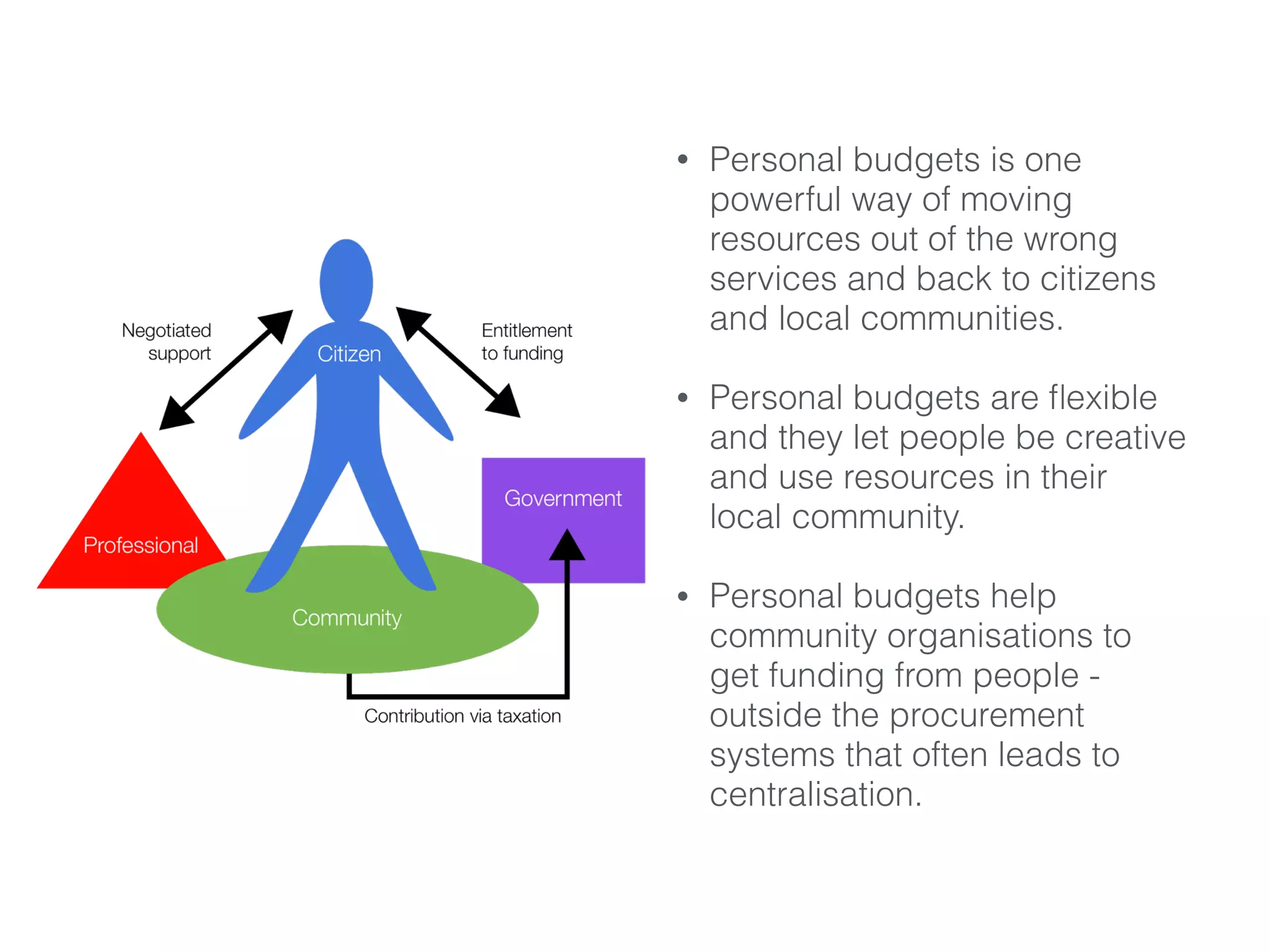
• Personal budgets is one
powerful way of moving
resources out of the wrong
services and back to citizens
and local communities.
• Personal budgets are flexible
and they let people be creative
and use resources in their
local community.
• Personal budgets help
community organisations to
get funding from people -
outside the procurement
systems that often leads to
centralisation.
Self-directed support has been growing for 50 years
People take control and so can become full
citizens playing and active part in community life
• Personal budgets are
different to vouchers,
benefits or other systems of
‘customer choice’ or
‘money follows the patient’.
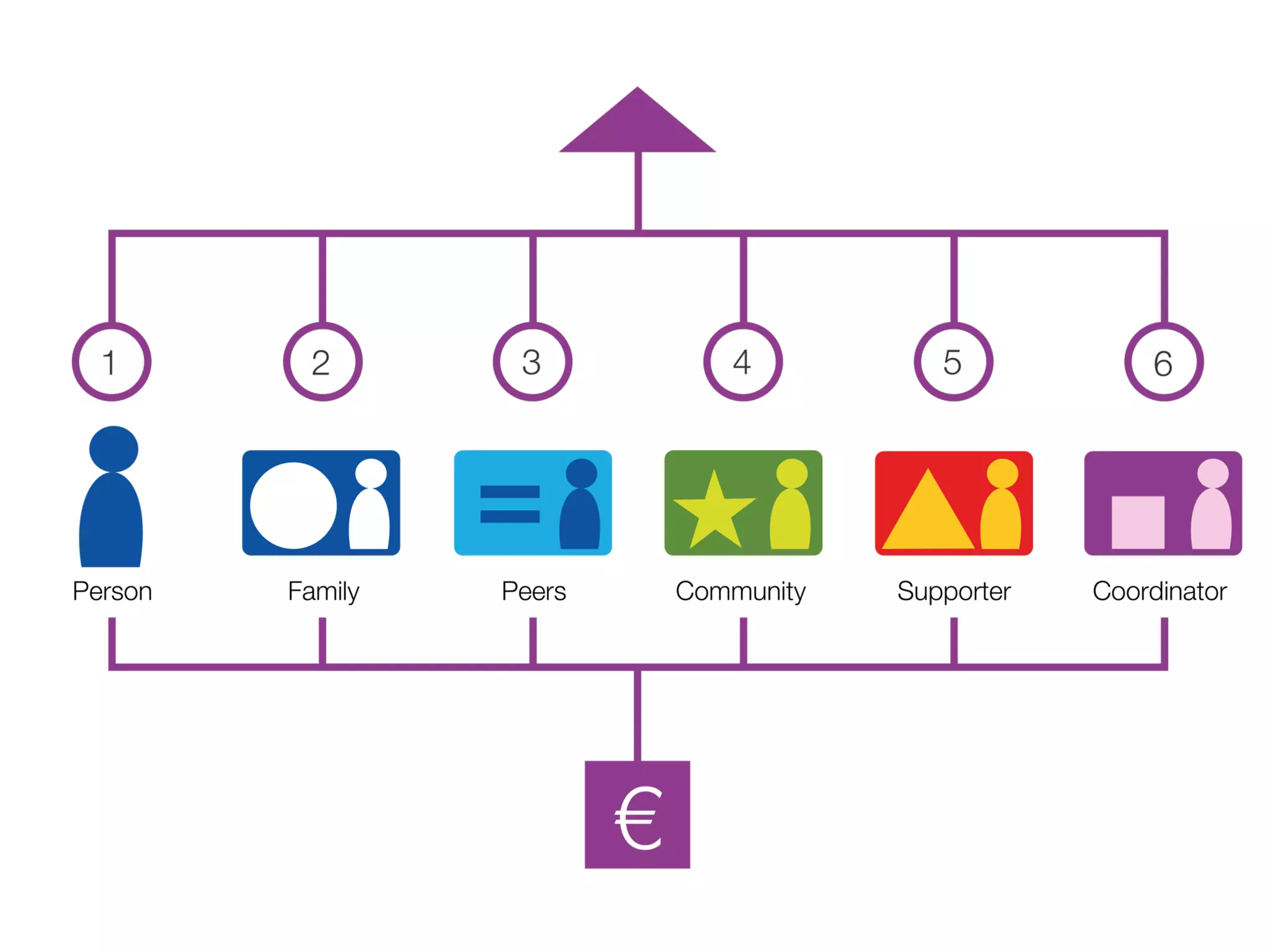
• They can be controlled by
the person, family,
community organisations or
government professionals.
• They have led to significant
improvements in life,
satisfaction and efficiency.
Control & creativity, not just choice
If budgets can be used flexibly then people use money differently and
connect to community
Location N Change
England - 6 Sites Phase I Report 60 -18.0%
England - 17 Sites Phase II Report 128 -9.0%
England - 13 Sites IBSEN Report 203 -6.0%
England - Northamptonshire 17 -18.7%
England - City of London 10 -30.0%
England - Worcestershire 73 -17.0%
England - Southwark 85 -29.8%
Scotland - Glasgow 12 -44.0%
USA - Denver - Disabled Children - -34.0%
USA - Florida - Disabled Children - -30.0%
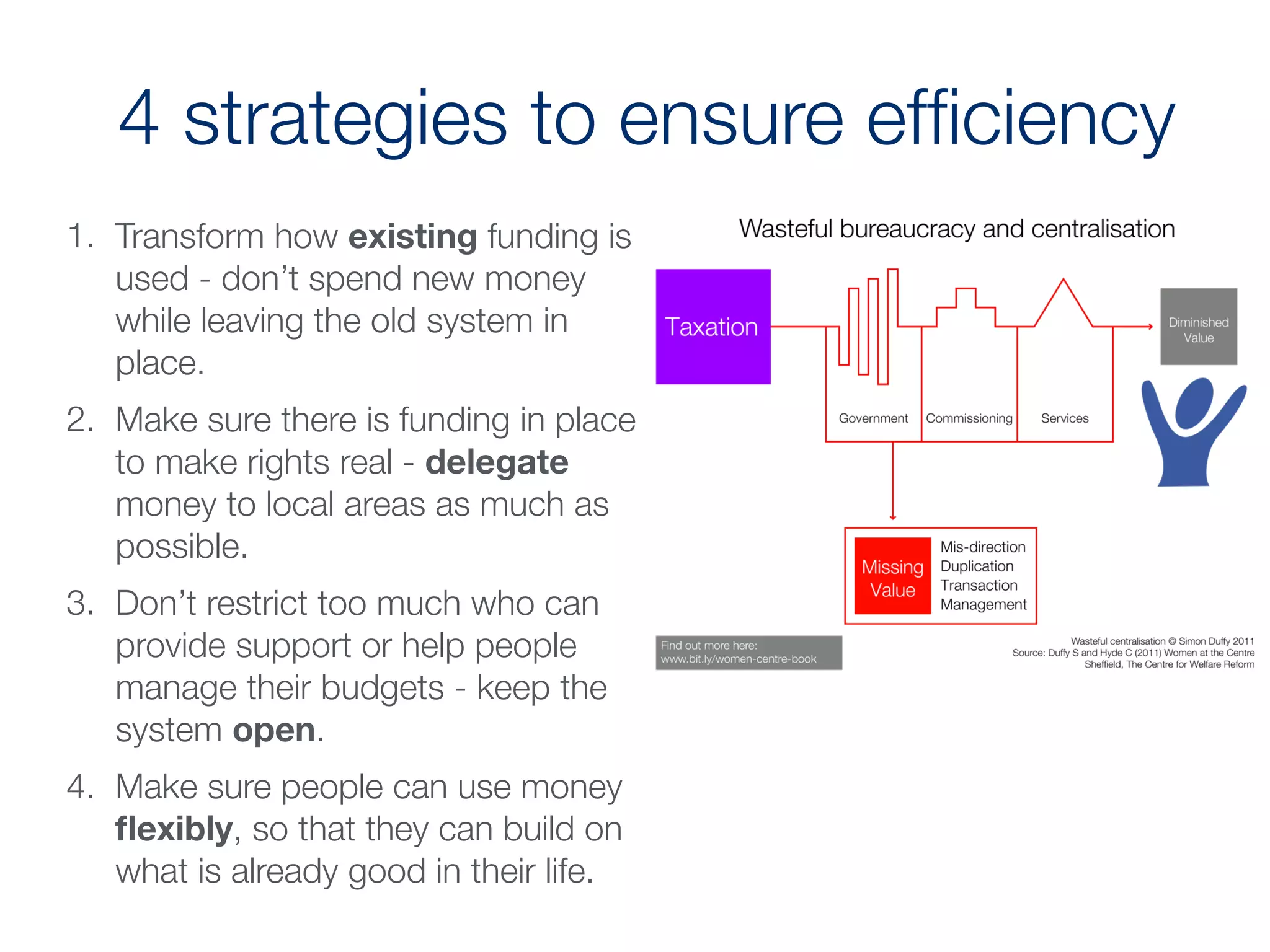
4 strategies to ensure efficiency
1. Transform how existing funding is
used - don’t spend new money
while leaving the old system in
place.
2. Make sure there is funding in place
to make rights real - delegate
money to local areas as much as
possible.
3. Don’t restrict too much who can
provide support or help people
manage their budgets - keep the
system open.
4. Make sure people can use money
flexibly, so that they can build on
what is already good in their life.
4 implementation challenges
1. Systems tend to try and take
back control via regulation and
bureaucracy.
2. Systems should become easier
to navigate and control should
be made easier over time.
3. Rights need to be underpinned
by legal and advocacy
measures.
4. Policy-makers need to focus on
the legal and policy barriers.
5. Implementation should be lean
and focus on improving value.

Self-Directed Support - international best practice

  • 1.
    Self-Directed Support international bestpractice Dr Simon Duffy Centre for Welfare Reform on behalf of Inclusion Ireland & Down Syndrome Association Ireland
  • 2.
    • The growthin the economic cost of health and social services is an international problem. • More expensive, more centralised and more institutional services grow in cost, but do not become more efficient. • Greater value lies in supporting citizenship, families and local communities, but investment in this is reducing. • How can we move resources upstream to solve problems earlier and more efficiently? The socio-economic challenge €
  • 5.
    • Personal budgetsis one powerful way of moving resources out of the wrong services and back to citizens and local communities. • Personal budgets are flexible and they let people be creative and use resources in their local community. • Personal budgets help community organisations to get funding from people - outside the procurement systems that often leads to centralisation.
  • 6.
    Self-directed support hasbeen growing for 50 years
  • 7.
    People take controland so can become full citizens playing and active part in community life
  • 8.
    • Personal budgetsare different to vouchers, benefits or other systems of ‘customer choice’ or ‘money follows the patient’. • They can be controlled by the person, family, community organisations or government professionals. • They have led to significant improvements in life, satisfaction and efficiency. Control & creativity, not just choice
  • 13.
    If budgets canbe used flexibly then people use money differently and connect to community
  • 14.
    Location N Change England- 6 Sites Phase I Report 60 -18.0% England - 17 Sites Phase II Report 128 -9.0% England - 13 Sites IBSEN Report 203 -6.0% England - Northamptonshire 17 -18.7% England - City of London 10 -30.0% England - Worcestershire 73 -17.0% England - Southwark 85 -29.8% Scotland - Glasgow 12 -44.0% USA - Denver - Disabled Children - -34.0% USA - Florida - Disabled Children - -30.0%
  • 15.
    4 strategies toensure efficiency 1. Transform how existing funding is used - don’t spend new money while leaving the old system in place. 2. Make sure there is funding in place to make rights real - delegate money to local areas as much as possible. 3. Don’t restrict too much who can provide support or help people manage their budgets - keep the system open. 4. Make sure people can use money flexibly, so that they can build on what is already good in their life.
  • 16.
    4 implementation challenges 1.Systems tend to try and take back control via regulation and bureaucracy. 2. Systems should become easier to navigate and control should be made easier over time. 3. Rights need to be underpinned by legal and advocacy measures. 4. Policy-makers need to focus on the legal and policy barriers. 5. Implementation should be lean and focus on improving value.