Presentation Prepared by:
Dr. Omosa Elijah
Kisii University
Chapter 2
Com
m
unication Processes
The Communication Process
2-4
COMMUNICATION
Emotional Intelligence (EI)
•Daniel Goleman states that leaders must build consensus, see
things from the perspectives of others, and promote cooperation,
while avoiding conflicts (Odell, 2003).
•EI is a combination of intrapersonal communication (personal
competence) and interpersonal communication (social
competence).
2-5
COMMUNICATION
• Communication Defined
• O’Hair, Friedrich, and Shaver (1998) identify six key components of
effective communication skills:
1. Creative insight
2. Sensitivity
3. Vision
4. Versatility
5. Focus
6. Patience
2-6
COMMUNICATION
• Intentional-Unintentional Communication
– Intentional messages have a purpose
• to get our point across;
• to persuade another;
• to prompt action;
• or simply to have fun
– Unintentional messages are not purposeful, but may be transmitted
by action as well as by words.
– Like the intended message, feedback also has content and
relationship levels.
2-7
COMMUNICATION
• Intentional-Unintentional Communication
• The arc of distortion is the gap between what we intend to communicate and
what is actually received
• Effective feedback should (1) be clear and understandable, (2) come from a
trusted person, and (3) be as immediate as possible.
2-8
COMMUNICATION
Verbal-Nonverbal Communication
–Visual cues
•Facial expression
•Eye contact
•Body positioning
•Hand gestures
•Style of dress
•Physical appearance
•Body movements
2-9
COMMUNICATION
• Verbal-Nonverbal Communication
– Vocal Cues
• Vocal cues include regional dialects, methods of pronunciation,
and the five major factors:
–Volume
–Rate and fluency
–Pitch
–Quality
–Inflection
Purpose of Communication
• Sharing our ideas, thoughts
• Making ourselves understood
• Reaching decisions
• Engaging in discussions
The Elements of Communication Process
• Sender
• Encode
• Channel
• Decode
• Receiver
• Feedback
Changing ideas into symbols + organizing into a message
Encoding
• An effective communicator ensures that his target
recipient understands what is being communicated.
• Words, tone and actions that you choose to encode
your idea represent specific content meaning …
therefore, choose them wisely.
• Keep the target recipient in mind.
Does the recipient understand the words used?
Does the recipient have the maturity and enough
experience to understand what is being
communicated?
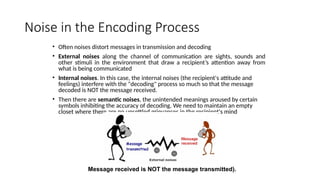
Noise in the Encoding Process
• Often noises distort messages in transmission and decoding
• External noises along the channel of communication are sights, sounds and
other stimuli in the environment that draw a recipient’s attention away from
what is being communicated
• Internal noises. In this case, the internal noises (the recipient's attitude and
feelings) interfere with the "decoding" process so much so that the message
decoded is NOT the message received.
• Then there are semantic noises, the unintended meanings aroused by certain
symbols inhibiting the accuracy of decoding. We need to maintain an empty
closet where there are no unsettled grievances in the recipient's mind
Message received is NOT the message transmitted).
Decoding
• Decoding is the reverse of encoding, which is the process of
transforming information from one format into another. Information
about decoding can be found in the following:
Successful Communication
Discussion
• Draw the communication process diagram and explain the process
• Explain with examples, the elements in the communication
process.
2-18
COMMUNICATION PROCESSES
• Communication
• Language Behavior
• Self-Disclosure
• Interaction Roles
• Review of the Systems Approach
2-19
COMMUNICATION
• Defensive-Supportive Communication
• Supportive Climates Defensive Climates
• Description Evaluation
• Problem orientation Control
• Spontaneity Strategy
• Empathy Neutrality
• Equality Superiority
• Provisionalism Certainty
2-20
COMMUNICATION
• Content and Process of Communication
• One rather difficult distinction to make about group discussion is the
difference between the content of the discussion and the process.
2-21
COMMUNICATION
• Listening
• When we can make the other person feel really
understood, we are often seen as effective
communicators.
2-22
COMMUNICATION
Listening
–Improving listening skills:
1. Pay attention to differences in thinking styles.
2. Listen for the subtext
3. Suspend judgment when hearing something new.
4. Explain things in the other person’s thinking pattern, not always your
own.
5. Remember that ‘truth’ is relative to the individual brain-mind system in
which it arises, and to the language system used to construct it.
6. To change the way you’re feeling, change what you’re doing.
2-23
LANGUAGE BEHAVIOR
•General semantics is the study of the interaction between verbal
symbols and the thought patterns associated with them.
2-24
LANGUAGE BARRIERS
Bypassing
– In group discussions, the entire focus of the discussion may be diverted by a
difference in interpretation of a given word.
2-25
LANGUAGE BEHAVIOR
• Inference Making
• Inferences involve going beyond the facts.
• It is wise to recognize that analyses often involve inferences that go beyond
what we have observed and involve some probability for error.
2-26
LANGUAGE BEHAVIOR
• Polarizing
· Polarizing is defined as “the process that causes people who had been staying
neutral to take sides in a conflict” (The University of Colorado Conflict
Research Consortium).
· When people polarize, they perceive things to be at the ends of the
continuum, such as terrible-fantastic, huge-miniscule, and so on.

communication presentation for year two students

  • 1.
    Presentation Prepared by: Dr.Omosa Elijah Kisii University
  • 2.
  • 3.
  • 4.
    2-4 COMMUNICATION Emotional Intelligence (EI) •DanielGoleman states that leaders must build consensus, see things from the perspectives of others, and promote cooperation, while avoiding conflicts (Odell, 2003). •EI is a combination of intrapersonal communication (personal competence) and interpersonal communication (social competence).
  • 5.
    2-5 COMMUNICATION • Communication Defined •O’Hair, Friedrich, and Shaver (1998) identify six key components of effective communication skills: 1. Creative insight 2. Sensitivity 3. Vision 4. Versatility 5. Focus 6. Patience
  • 6.
    2-6 COMMUNICATION • Intentional-Unintentional Communication –Intentional messages have a purpose • to get our point across; • to persuade another; • to prompt action; • or simply to have fun – Unintentional messages are not purposeful, but may be transmitted by action as well as by words. – Like the intended message, feedback also has content and relationship levels.
  • 7.
    2-7 COMMUNICATION • Intentional-Unintentional Communication •The arc of distortion is the gap between what we intend to communicate and what is actually received • Effective feedback should (1) be clear and understandable, (2) come from a trusted person, and (3) be as immediate as possible.
  • 8.
    2-8 COMMUNICATION Verbal-Nonverbal Communication –Visual cues •Facialexpression •Eye contact •Body positioning •Hand gestures •Style of dress •Physical appearance •Body movements
  • 9.
    2-9 COMMUNICATION • Verbal-Nonverbal Communication –Vocal Cues • Vocal cues include regional dialects, methods of pronunciation, and the five major factors: –Volume –Rate and fluency –Pitch –Quality –Inflection
  • 10.
    Purpose of Communication •Sharing our ideas, thoughts • Making ourselves understood • Reaching decisions • Engaging in discussions
  • 11.
    The Elements ofCommunication Process • Sender • Encode • Channel • Decode • Receiver • Feedback
  • 12.
    Changing ideas intosymbols + organizing into a message Encoding • An effective communicator ensures that his target recipient understands what is being communicated. • Words, tone and actions that you choose to encode your idea represent specific content meaning … therefore, choose them wisely. • Keep the target recipient in mind. Does the recipient understand the words used? Does the recipient have the maturity and enough experience to understand what is being communicated?
  • 13.
    Noise in theEncoding Process • Often noises distort messages in transmission and decoding • External noises along the channel of communication are sights, sounds and other stimuli in the environment that draw a recipient’s attention away from what is being communicated • Internal noises. In this case, the internal noises (the recipient's attitude and feelings) interfere with the "decoding" process so much so that the message decoded is NOT the message received. • Then there are semantic noises, the unintended meanings aroused by certain symbols inhibiting the accuracy of decoding. We need to maintain an empty closet where there are no unsettled grievances in the recipient's mind Message received is NOT the message transmitted).
  • 14.
    Decoding • Decoding isthe reverse of encoding, which is the process of transforming information from one format into another. Information about decoding can be found in the following:
  • 16.
  • 17.
    Discussion • Draw thecommunication process diagram and explain the process • Explain with examples, the elements in the communication process.
  • 18.
    2-18 COMMUNICATION PROCESSES • Communication •Language Behavior • Self-Disclosure • Interaction Roles • Review of the Systems Approach
  • 19.
    2-19 COMMUNICATION • Defensive-Supportive Communication •Supportive Climates Defensive Climates • Description Evaluation • Problem orientation Control • Spontaneity Strategy • Empathy Neutrality • Equality Superiority • Provisionalism Certainty
  • 20.
    2-20 COMMUNICATION • Content andProcess of Communication • One rather difficult distinction to make about group discussion is the difference between the content of the discussion and the process.
  • 21.
    2-21 COMMUNICATION • Listening • Whenwe can make the other person feel really understood, we are often seen as effective communicators.
  • 22.
    2-22 COMMUNICATION Listening –Improving listening skills: 1.Pay attention to differences in thinking styles. 2. Listen for the subtext 3. Suspend judgment when hearing something new. 4. Explain things in the other person’s thinking pattern, not always your own. 5. Remember that ‘truth’ is relative to the individual brain-mind system in which it arises, and to the language system used to construct it. 6. To change the way you’re feeling, change what you’re doing.
  • 23.
    2-23 LANGUAGE BEHAVIOR •General semanticsis the study of the interaction between verbal symbols and the thought patterns associated with them.
  • 24.
    2-24 LANGUAGE BARRIERS Bypassing – Ingroup discussions, the entire focus of the discussion may be diverted by a difference in interpretation of a given word.
  • 25.
    2-25 LANGUAGE BEHAVIOR • InferenceMaking • Inferences involve going beyond the facts. • It is wise to recognize that analyses often involve inferences that go beyond what we have observed and involve some probability for error.
  • 26.
    2-26 LANGUAGE BEHAVIOR • Polarizing ·Polarizing is defined as “the process that causes people who had been staying neutral to take sides in a conflict” (The University of Colorado Conflict Research Consortium). · When people polarize, they perceive things to be at the ends of the continuum, such as terrible-fantastic, huge-miniscule, and so on.

Editor's Notes