COURSE INTRODUCTON
ON
COMMUNICATION ELECTRONICS
Presented by
L.Sarala
UNITS:
1.Electronic communication & Analog
Modulation
2.Analog Pulse Modulation
3.Digital Pulse Modulation
4.Mobile Telephony System
5.Antennas & Wireless Communication
Introduction to Communication Systems
1. Communication is the process of exchanging information.
2. Most human communication is oral, but a great deal of it is also in written
or printed form.
3. The two main barriers to communication are language and distance.
4. Major electrical discoveries in the mid- and late nineteenth century made
possible the development of electronic communications over long
distances.
5. The telegraph (1844) and telephone (1876) were the first two long-
distance communications systems.
6. Electronic communications plays a vital role in all our lives and is
essential to the success of our information society.
7.The major elements of a communications system are a transmitter to
send a message, a communications medium, a receiver to pick up the
message, and noise.
8. Radio was discovered in 1887, and wireless telegraphy was
demonstrated in 1895.
9.The three primary communications media are wires, free space, and
fiber-optic cable.
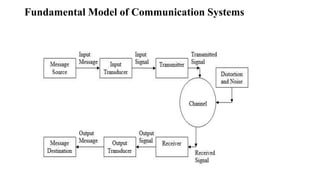
Fundamental Model of Communication Systems
• Message Source: The originator of the message
• Input Message: The message/data/info that is to be communicated
• Input Transducer: Converts the input message into electrical form
• Input Signal: The data in electrical form (this is a baseband signal)
• Transmitter: Modifies the signal for transmission
• Channel: The medium over which the transmitted signal is sent (e.g.,
wire, air, optical fiber, free space)
• Distortion/Noise: External signals/features that affect the signal
• Receiver: Modifies the received signal, undoing the modifications
done by the transmitter
• Output Transducer: Converts message from electrical signal back
into its original form
• Output Message: The message/data/info that has been communicated
• Message Destination: Who/what the message/data/info was intended
for
[adrotate banner=”3″]
Example System
• 1: FM Radio
• 2: Sending a Text Message

Communication electronics ppt

  • 1.
  • 2.
    UNITS: 1.Electronic communication &Analog Modulation 2.Analog Pulse Modulation 3.Digital Pulse Modulation 4.Mobile Telephony System 5.Antennas & Wireless Communication
  • 3.
    Introduction to CommunicationSystems 1. Communication is the process of exchanging information. 2. Most human communication is oral, but a great deal of it is also in written or printed form. 3. The two main barriers to communication are language and distance. 4. Major electrical discoveries in the mid- and late nineteenth century made possible the development of electronic communications over long distances. 5. The telegraph (1844) and telephone (1876) were the first two long- distance communications systems.
  • 4.
    6. Electronic communicationsplays a vital role in all our lives and is essential to the success of our information society. 7.The major elements of a communications system are a transmitter to send a message, a communications medium, a receiver to pick up the message, and noise. 8. Radio was discovered in 1887, and wireless telegraphy was demonstrated in 1895. 9.The three primary communications media are wires, free space, and fiber-optic cable.
  • 5.
    Fundamental Model ofCommunication Systems
  • 6.
    • Message Source:The originator of the message • Input Message: The message/data/info that is to be communicated • Input Transducer: Converts the input message into electrical form • Input Signal: The data in electrical form (this is a baseband signal) • Transmitter: Modifies the signal for transmission • Channel: The medium over which the transmitted signal is sent (e.g., wire, air, optical fiber, free space)
  • 7.
    • Distortion/Noise: Externalsignals/features that affect the signal • Receiver: Modifies the received signal, undoing the modifications done by the transmitter • Output Transducer: Converts message from electrical signal back into its original form • Output Message: The message/data/info that has been communicated • Message Destination: Who/what the message/data/info was intended for [adrotate banner=”3″]
  • 8.
    Example System • 1:FM Radio • 2: Sending a Text Message