Signal and
Communication
Telecommunication
Telecommunications aka communications
What is it?
• Process by which information is exchanged
• The word Telecommunication is merger of two words Tele + communications,
which means communication at distance!
What are the forms of communication?
• Audio, visual, audio/visual, radio, electrical signal over copper etc.
Basic Elements of a Communication
System
Every communication system consists of
A transmitter
A receiver
A medium over which transmission occurs
Practical communication systems are more complex.
Basic Elements of a Communication System
 Transmitter
“transmit” = send information to the receiver
Uses the most suitable method to convey information
• Method depends upon the communication medium
• Audio
• Visual/Video
• Hand gestures, smoke signals…
 Communication medium
Literally, medium of communication
• Wired and wireless
 Receiver
“receiver” = receive/recover information from the transmitter
Receiver designed according to the transmitter
Classification of Communication systems
 There are many ways to differentiate one communication
system from other! (Classification). For example
Wired and Wireless
Electrical and optical
 Narrowband and wideband
Based on modes: Simplex, Half duplex and Full duplex
How do we communicate these days…
 Landline telephones
 Wireless broadband
 DSL
 LAN
 Cable TV
 AM/ FM radio
 GSM/GPRS/EDGE
 WLAN
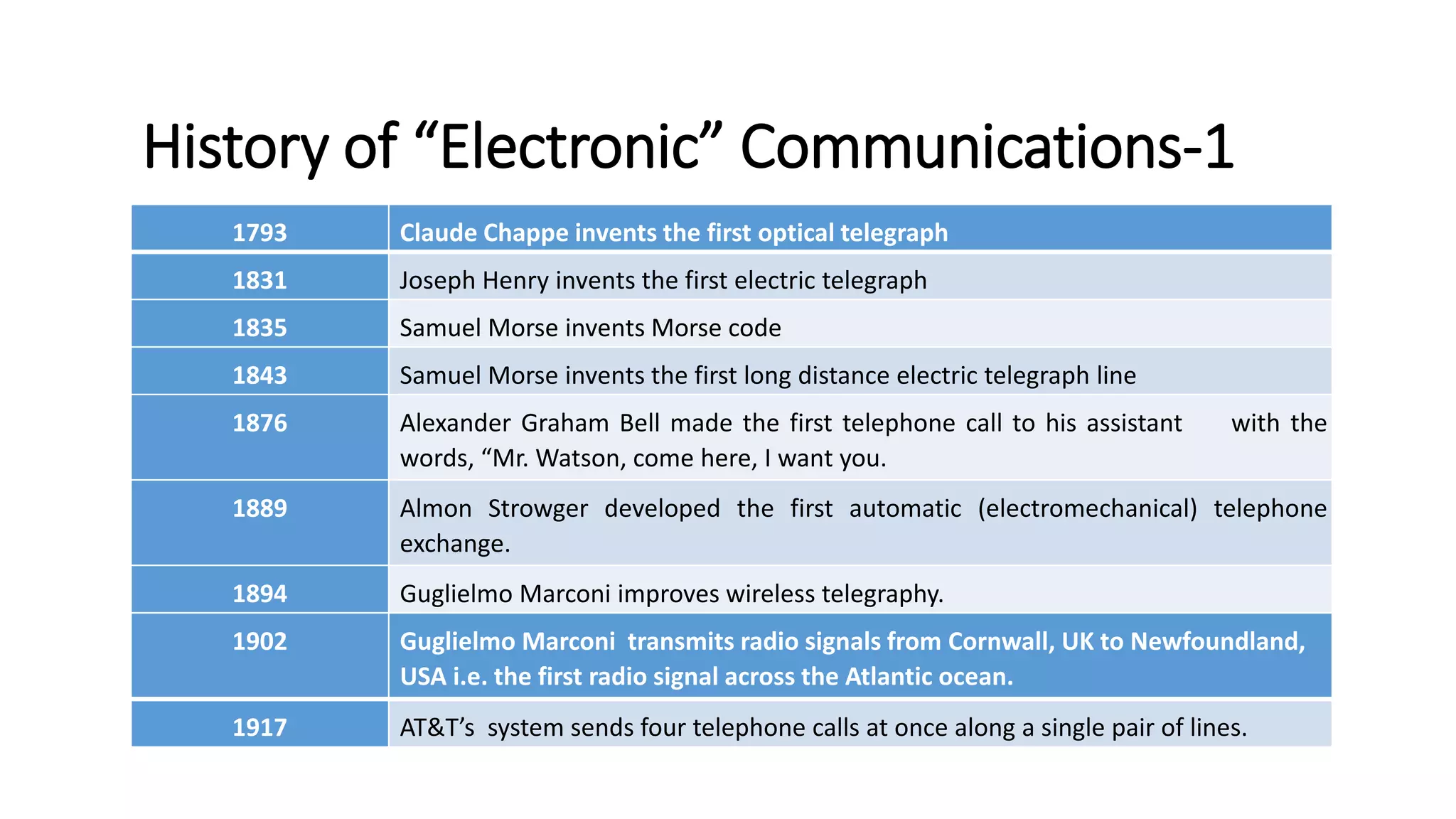
History of “Electronic” Communications-1
1793 Claude Chappe invents the first optical telegraph
1831 Joseph Henry invents the first electric telegraph
1835 Samuel Morse invents Morse code
1843 Samuel Morse invents the first long distance electric telegraph line
1876 Alexander Graham Bell made the first telephone call to his assistant with the
words, “Mr. Watson, come here, I want you.
1889 Almon Strowger developed the first automatic (electromechanical) telephone
exchange.
1894 Guglielmo Marconi improves wireless telegraphy.
1902 Guglielmo Marconi transmits radio signals from Cornwall, UK to Newfoundland,
USA i.e. the first radio signal across the Atlantic ocean.
1917 AT&T’s system sends four telephone calls at once along a single pair of lines.
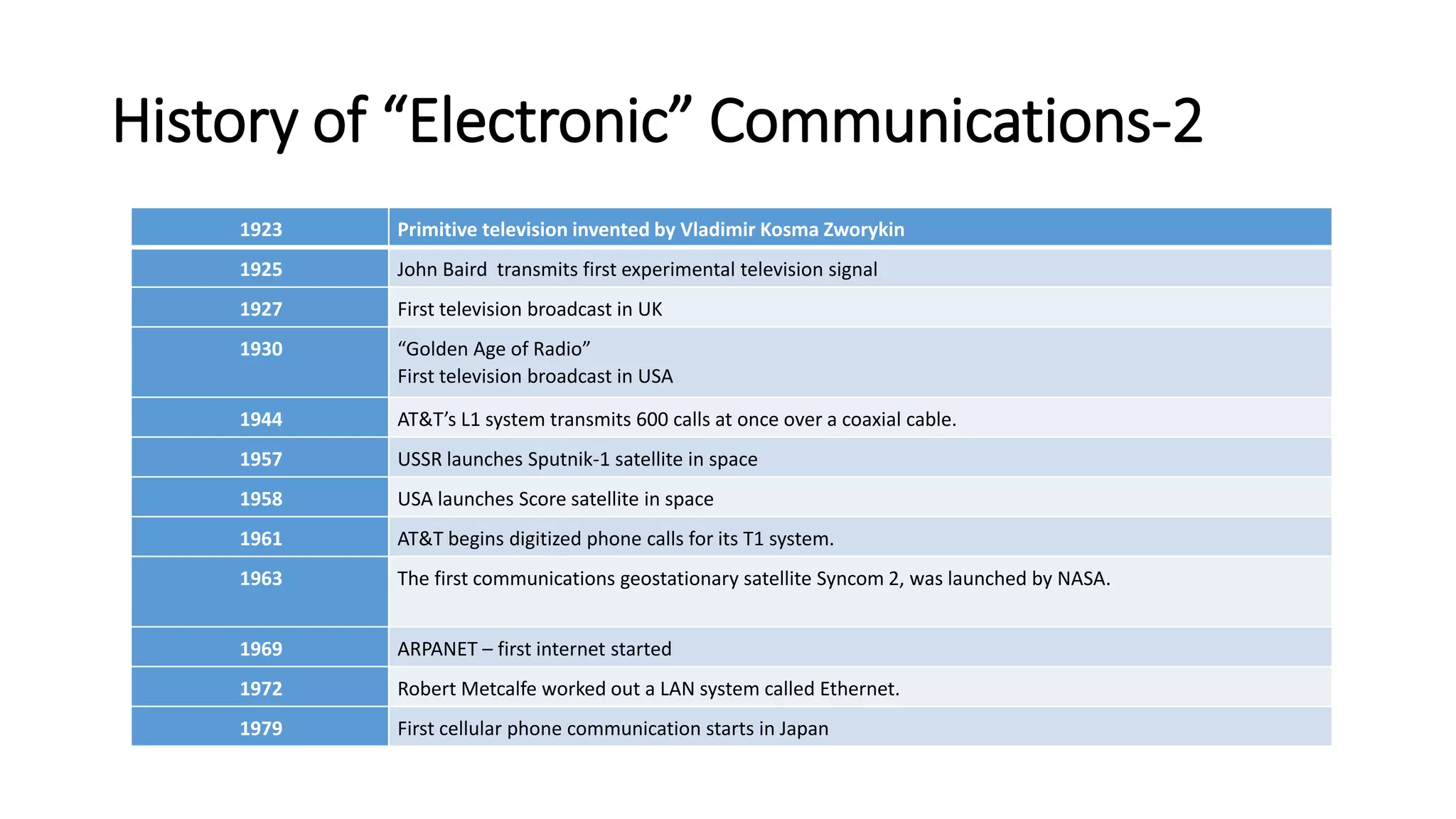
History of “Electronic” Communications-2
1923 Primitive television invented by Vladimir Kosma Zworykin
1925 John Baird transmits first experimental television signal
1927 First television broadcast in UK
1930 “Golden Age of Radio”
First television broadcast in USA
1944 AT&T’s L1 system transmits 600 calls at once over a coaxial cable.
1957 USSR launches Sputnik-1 satellite in space
1958 USA launches Score satellite in space
1961 AT&T begins digitized phone calls for its T1 system.
1963 The first communications geostationary satellite Syncom 2, was launched by NASA.
1969 ARPANET – first internet started
1972 Robert Metcalfe worked out a LAN system called Ethernet.
1979 First cellular phone communication starts in Japan
History of “Electronic” Communications-3
1983 Cellular phone communication starts in USA
1989 PTAT-1 the first private trans-Atlantic fiber optic cable carries two third of all trans-
Atlantic data traffic.
1991 First GSM call made in Finland
1992 First SMS made
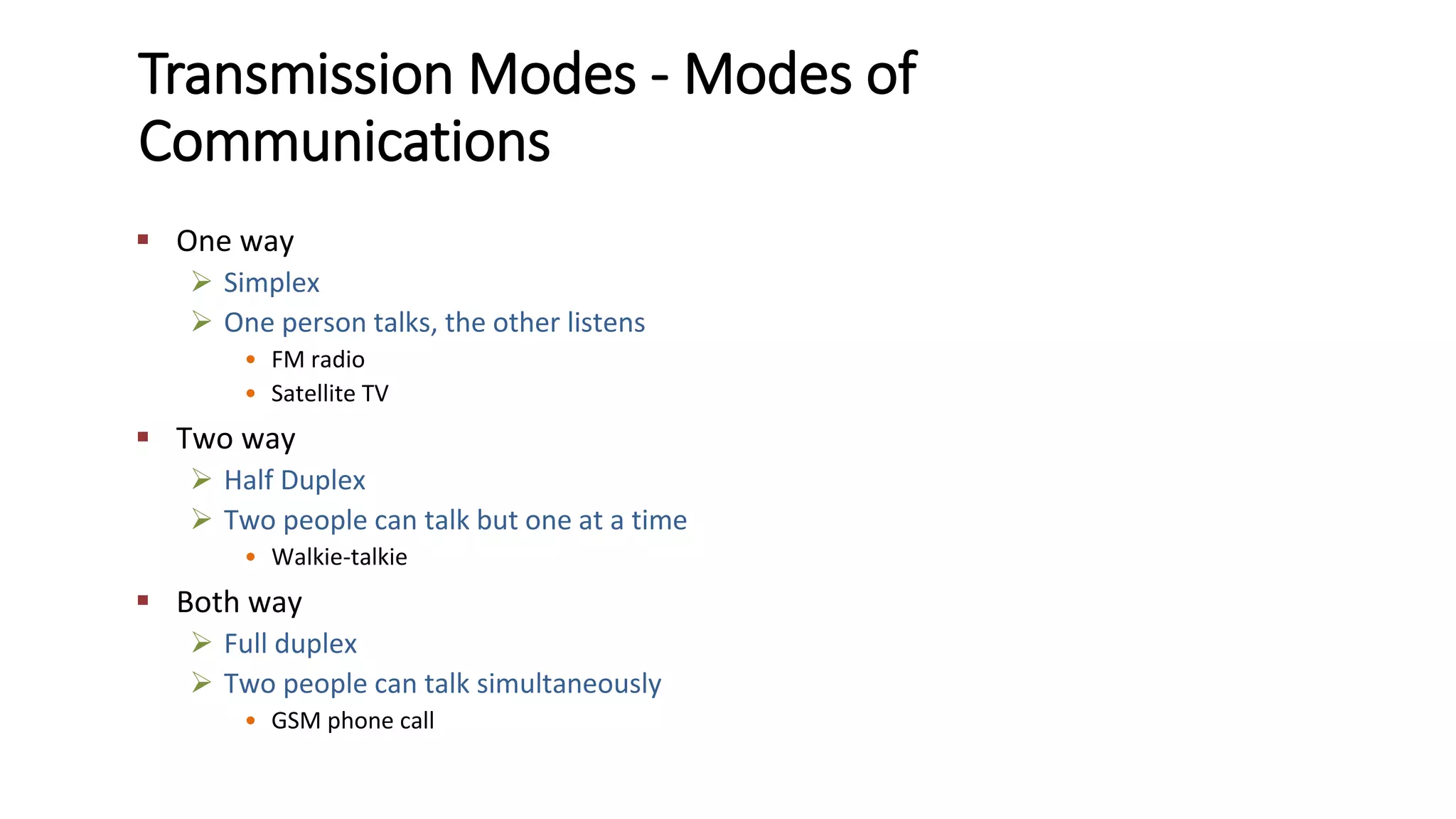
Transmission Modes - Modes of
Communications
 One way
 Simplex
 One person talks, the other listens
• FM radio
• Satellite TV
 Two way
 Half Duplex
 Two people can talk but one at a time
• Walkie-talkie
 Both way
 Full duplex
 Two people can talk simultaneously
• GSM phone call
 In 1948, Claude Shannon proposed a comm. model
Source
Receiver
Sender/ Transmitter
Destination
Channel
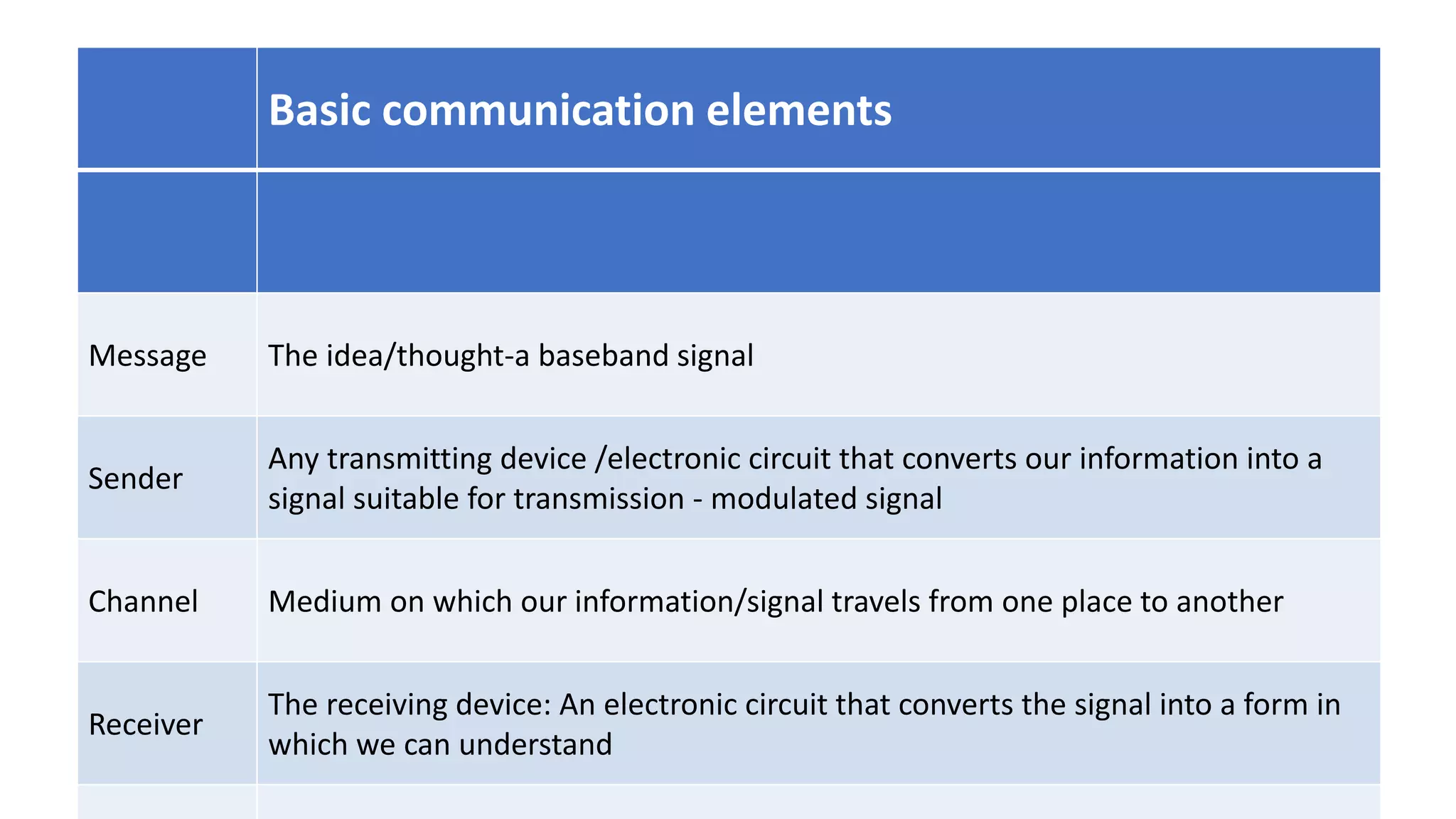
Basic communication elements
Message The idea/thought-a baseband signal
Sender
Any transmitting device /electronic circuit that converts our information into a
signal suitable for transmission - modulated signal
Channel Medium on which our information/signal travels from one place to another
Receiver
The receiving device: An electronic circuit that converts the signal into a form in
which we can understand
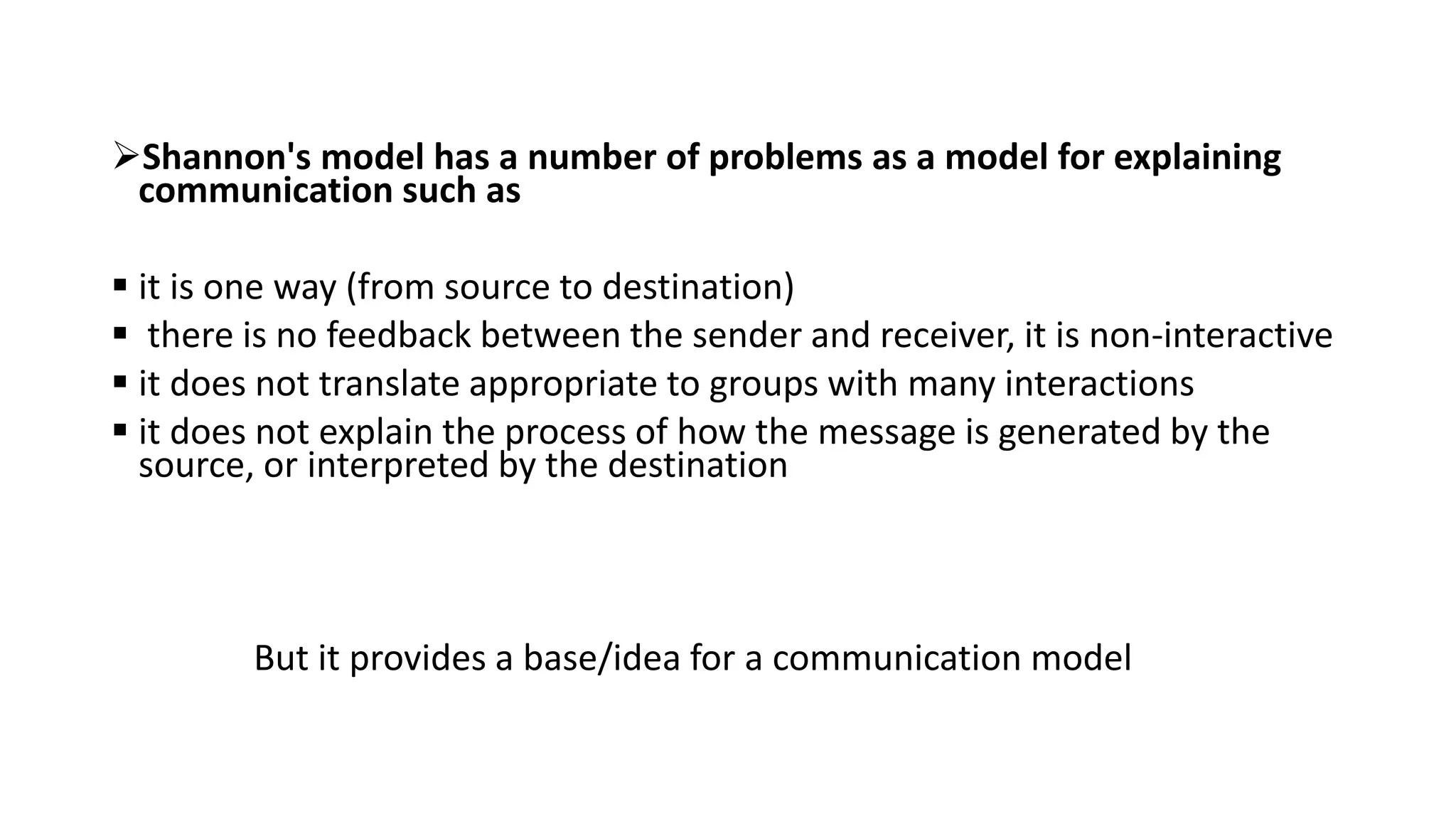
Shannon's model has a number of problems as a model for explaining
communication such as
 it is one way (from source to destination)
 there is no feedback between the sender and receiver, it is non-interactive
 it does not translate appropriate to groups with many interactions
 it does not explain the process of how the message is generated by the
source, or interpreted by the destination
But it provides a base/idea for a communication model
Simplex Duplex
Cable Tv LAN
Telemetry Sonar
Facsimile Radar
Music Service Telephones
Surveillance Mobile telephony
Radio astronomy Two-way radio
Teletext and view data Data communication
Wireless remote control
AM, FM, and Tv broadcast

Signal and Communication.pptx

  • 1.
  • 2.
    Telecommunication Telecommunications aka communications Whatis it? • Process by which information is exchanged • The word Telecommunication is merger of two words Tele + communications, which means communication at distance! What are the forms of communication? • Audio, visual, audio/visual, radio, electrical signal over copper etc.
  • 3.
    Basic Elements ofa Communication System Every communication system consists of A transmitter A receiver A medium over which transmission occurs Practical communication systems are more complex.
  • 4.
    Basic Elements ofa Communication System  Transmitter “transmit” = send information to the receiver Uses the most suitable method to convey information • Method depends upon the communication medium • Audio • Visual/Video • Hand gestures, smoke signals…  Communication medium Literally, medium of communication • Wired and wireless  Receiver “receiver” = receive/recover information from the transmitter Receiver designed according to the transmitter
  • 5.
    Classification of Communicationsystems  There are many ways to differentiate one communication system from other! (Classification). For example Wired and Wireless Electrical and optical  Narrowband and wideband Based on modes: Simplex, Half duplex and Full duplex
  • 6.
    How do wecommunicate these days…  Landline telephones  Wireless broadband  DSL  LAN  Cable TV  AM/ FM radio  GSM/GPRS/EDGE  WLAN
  • 7.
    History of “Electronic”Communications-1 1793 Claude Chappe invents the first optical telegraph 1831 Joseph Henry invents the first electric telegraph 1835 Samuel Morse invents Morse code 1843 Samuel Morse invents the first long distance electric telegraph line 1876 Alexander Graham Bell made the first telephone call to his assistant with the words, “Mr. Watson, come here, I want you. 1889 Almon Strowger developed the first automatic (electromechanical) telephone exchange. 1894 Guglielmo Marconi improves wireless telegraphy. 1902 Guglielmo Marconi transmits radio signals from Cornwall, UK to Newfoundland, USA i.e. the first radio signal across the Atlantic ocean. 1917 AT&T’s system sends four telephone calls at once along a single pair of lines.
  • 8.
    History of “Electronic”Communications-2 1923 Primitive television invented by Vladimir Kosma Zworykin 1925 John Baird transmits first experimental television signal 1927 First television broadcast in UK 1930 “Golden Age of Radio” First television broadcast in USA 1944 AT&T’s L1 system transmits 600 calls at once over a coaxial cable. 1957 USSR launches Sputnik-1 satellite in space 1958 USA launches Score satellite in space 1961 AT&T begins digitized phone calls for its T1 system. 1963 The first communications geostationary satellite Syncom 2, was launched by NASA. 1969 ARPANET – first internet started 1972 Robert Metcalfe worked out a LAN system called Ethernet. 1979 First cellular phone communication starts in Japan
  • 9.
    History of “Electronic”Communications-3 1983 Cellular phone communication starts in USA 1989 PTAT-1 the first private trans-Atlantic fiber optic cable carries two third of all trans- Atlantic data traffic. 1991 First GSM call made in Finland 1992 First SMS made
  • 10.
    Transmission Modes -Modes of Communications  One way  Simplex  One person talks, the other listens • FM radio • Satellite TV  Two way  Half Duplex  Two people can talk but one at a time • Walkie-talkie  Both way  Full duplex  Two people can talk simultaneously • GSM phone call
  • 11.
     In 1948,Claude Shannon proposed a comm. model Source Receiver Sender/ Transmitter Destination Channel
  • 12.
    Basic communication elements MessageThe idea/thought-a baseband signal Sender Any transmitting device /electronic circuit that converts our information into a signal suitable for transmission - modulated signal Channel Medium on which our information/signal travels from one place to another Receiver The receiving device: An electronic circuit that converts the signal into a form in which we can understand
  • 13.
    Shannon's model hasa number of problems as a model for explaining communication such as  it is one way (from source to destination)  there is no feedback between the sender and receiver, it is non-interactive  it does not translate appropriate to groups with many interactions  it does not explain the process of how the message is generated by the source, or interpreted by the destination But it provides a base/idea for a communication model
  • 14.
    Simplex Duplex Cable TvLAN Telemetry Sonar Facsimile Radar Music Service Telephones Surveillance Mobile telephony Radio astronomy Two-way radio Teletext and view data Data communication Wireless remote control AM, FM, and Tv broadcast