Communication is the transfer of information from one place to
another.
This should be done
- as efficiently as possible
- with as much fidelity/reliability as possible
- as securely as possible
Communication System: Components/subsystems act together to
accomplish information transfer/exchange.
Overview
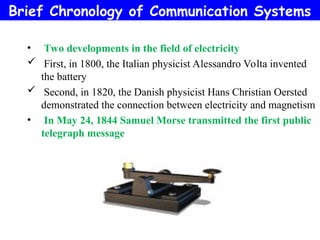
• Two developments in the field of electricity
 First, in 1800, the Italian physicist Alessandro Volta invented
the battery
 Second, in 1820, the Danish physicist Hans Christian Oersted
demonstrated the connection between electricity and magnetism
• In May 24, 1844 Samuel Morse transmitted the first public
telegraph message
Brief Chronology of Communication Systems
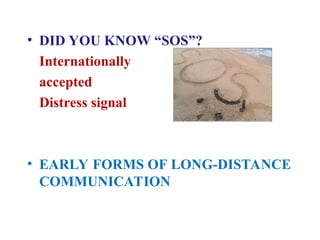
• DID YOU KNOW “SOS”?
Internationally
accepted
Distress signal
• EARLY FORMS OF LONG-DISTANCE
COMMUNICATION
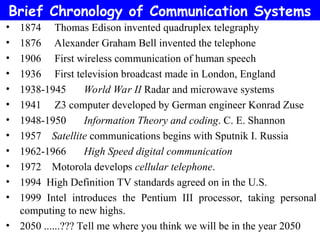
• 1874 Thomas Edison invented quadruplex telegraphy
• 1876 Alexander Graham Bell invented the telephone
• 1906 First wireless communication of human speech
• 1936 First television broadcast made in London, England
• 1938-1945 World War II Radar and microwave systems
• 1941 Z3 computer developed by German engineer Konrad Zuse
• 1948-1950 Information Theory and coding. C. E. Shannon
• 1957 Satellite communications begins with Sputnik I. Russia
• 1962-1966 High Speed digital communication
• 1972 Motorola develops cellular telephone.
• 1994 High Definition TV standards agreed on in the U.S.
• 1999 Intel introduces the Pentium III processor, taking personal
computing to new highs.
• 2050 ......??? Tell me where you think we will be in the year 2050
Brief Chronology of Communication Systems
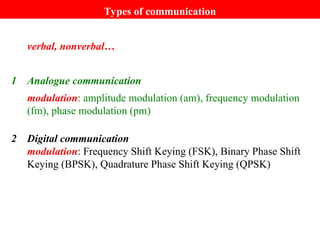
verbal, nonverbal…
1 Analogue communication
modulation: amplitude modulation (am), frequency modulation
(fm), phase modulation (pm)
2 Digital communication
modulation: Frequency Shift Keying (FSK), Binary Phase Shift
Keying (BPSK), Quadrature Phase Shift Keying (QPSK)
Types of communication
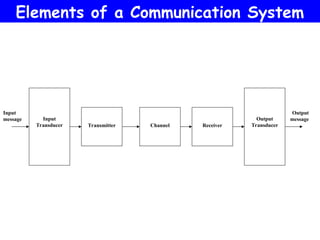
Output
message
Input
message Input
Transducer Transmitter Channel Receiver
Output
Transducer
Elements of a Communication System
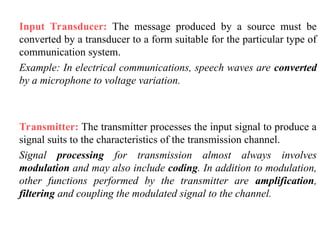
Input Transducer: The message produced by a source must be
converted by a transducer to a form suitable for the particular type of
communication system.
Example: In electrical communications, speech waves are converted
by a microphone to voltage variation.
Transmitter: The transmitter processes the input signal to produce a
signal suits to the characteristics of the transmission channel.
Signal processing for transmission almost always involves
modulation and may also include coding. In addition to modulation,
other functions performed by the transmitter are amplification,
filtering and coupling the modulated signal to the channel.
Channel: The channel can have different forms: The atmosphere (or free space),
coaxial cable, fiber optic, waveguide, etc.
The signal undergoes some amount of degradation from noise, interference and
distortion
Receiver: The receiver’s function is to extract the desired signal from the received
signal at the channel output and to convert it to a form suitable for the output
transducer.
Other functions performed by the receiver: amplification (the received signal may
be extremely weak), demodulation and filtering.
Output Transducer: Converts the electric signal at its input into the form desired
by the system user.
Example: Loudspeaker, personal computer (PC), tape recorders.
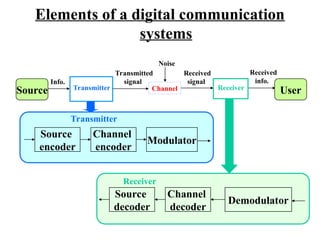
Elements of a digital communication
systems
Source
encoder
Channel
encoder
Modulator
Source
decoder
Channel
decoder
Demodulator
Transmitter
Receiver
SOURCE
Info.
Transmitter
Transmitted
signal
Received
signal
Receiver
Received
info.
Noise
Channel
Source User

Communication electronics basics ppt 1.ppt

  • 1.
    Communication is thetransfer of information from one place to another. This should be done - as efficiently as possible - with as much fidelity/reliability as possible - as securely as possible Communication System: Components/subsystems act together to accomplish information transfer/exchange. Overview
  • 2.
    • Two developmentsin the field of electricity  First, in 1800, the Italian physicist Alessandro Volta invented the battery  Second, in 1820, the Danish physicist Hans Christian Oersted demonstrated the connection between electricity and magnetism • In May 24, 1844 Samuel Morse transmitted the first public telegraph message Brief Chronology of Communication Systems
  • 3.
    • DID YOUKNOW “SOS”? Internationally accepted Distress signal • EARLY FORMS OF LONG-DISTANCE COMMUNICATION
  • 4.
    • 1874 ThomasEdison invented quadruplex telegraphy • 1876 Alexander Graham Bell invented the telephone • 1906 First wireless communication of human speech • 1936 First television broadcast made in London, England • 1938-1945 World War II Radar and microwave systems • 1941 Z3 computer developed by German engineer Konrad Zuse • 1948-1950 Information Theory and coding. C. E. Shannon • 1957 Satellite communications begins with Sputnik I. Russia • 1962-1966 High Speed digital communication • 1972 Motorola develops cellular telephone. • 1994 High Definition TV standards agreed on in the U.S. • 1999 Intel introduces the Pentium III processor, taking personal computing to new highs. • 2050 ......??? Tell me where you think we will be in the year 2050 Brief Chronology of Communication Systems
  • 6.
    verbal, nonverbal… 1 Analoguecommunication modulation: amplitude modulation (am), frequency modulation (fm), phase modulation (pm) 2 Digital communication modulation: Frequency Shift Keying (FSK), Binary Phase Shift Keying (BPSK), Quadrature Phase Shift Keying (QPSK) Types of communication
  • 7.
    Output message Input message Input Transducer TransmitterChannel Receiver Output Transducer Elements of a Communication System
  • 8.
    Input Transducer: Themessage produced by a source must be converted by a transducer to a form suitable for the particular type of communication system. Example: In electrical communications, speech waves are converted by a microphone to voltage variation. Transmitter: The transmitter processes the input signal to produce a signal suits to the characteristics of the transmission channel. Signal processing for transmission almost always involves modulation and may also include coding. In addition to modulation, other functions performed by the transmitter are amplification, filtering and coupling the modulated signal to the channel.
  • 9.
    Channel: The channelcan have different forms: The atmosphere (or free space), coaxial cable, fiber optic, waveguide, etc. The signal undergoes some amount of degradation from noise, interference and distortion Receiver: The receiver’s function is to extract the desired signal from the received signal at the channel output and to convert it to a form suitable for the output transducer. Other functions performed by the receiver: amplification (the received signal may be extremely weak), demodulation and filtering. Output Transducer: Converts the electric signal at its input into the form desired by the system user. Example: Loudspeaker, personal computer (PC), tape recorders.
  • 10.
    Elements of adigital communication systems Source encoder Channel encoder Modulator Source decoder Channel decoder Demodulator Transmitter Receiver SOURCE Info. Transmitter Transmitted signal Received signal Receiver Received info. Noise Channel Source User