Communication
Design
By W.Beji
Communication
Design
Knowledge day 6/1 2013
What is
Communication
Design?
Design
Information-development
Communicate to people via Media
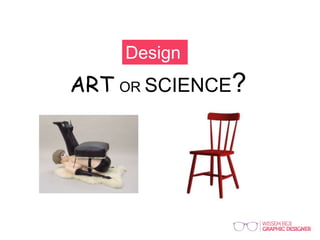
Design
ART OR SCIENCE?
This is Graphic Design
The term graphic design can refer to a number of artistic and
professional disciplines which focus on visual communication and
presentation.
Various methods are used to create and combine symbols, images
and/or words to create a visual representation of ideas and messages
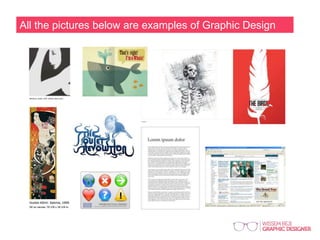
All the pictures below are examples of Graphic Design
What does a Graphic Designer do?
Start with asking yourself the following fundamental questions:
• What is the objective of the communication
• What needs to be said first and then next and then after that? (levels
of hierarchy)
• How do you want the eye to flow through the page?
• What is the tone of voice?
• Who are you speaking to?
Objectives of the communication
What is the information that needs to be passed on?
When the audience reads your book/webpage/ad what’s he supposed to get out of
it?
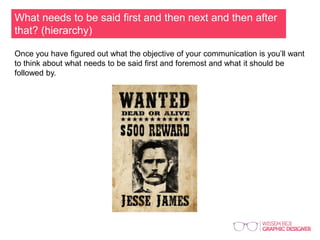
What needs to be said first and then next and then after
that? (hierarchy)
Once you have figured out what the objective of your communication is you’ll want
to think about what needs to be said first and foremost and what it should be
followed by.
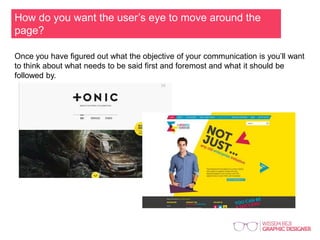
How do you want the user’s eye to move around the
page?
Once you have figured out what the objective of your communication is you’ll want
to think about what needs to be said first and foremost and what it should be
followed by.
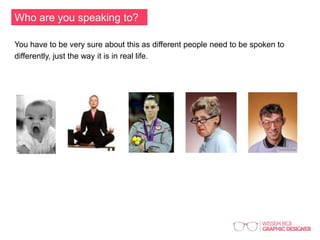
Who are you speaking to?
You have to be very sure about this as different people need to be spoken to
differently, just the way it is in real life.
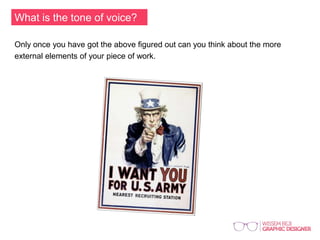
What is the tone of voice?
Only once you have got the above figured out can you think about the more
external elements of your piece of work.
The solutions to these
questions are tackled
using the graphic
designer’s tool kit.
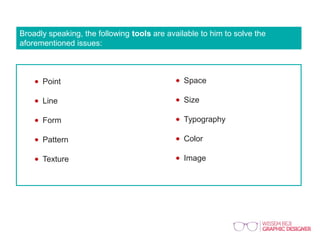
Broadly speaking, the following tools are available to him to solve the
aforementioned issues:
Point
Line
Form
Pattern
Texture
Space
Size
Typography
Color
Image
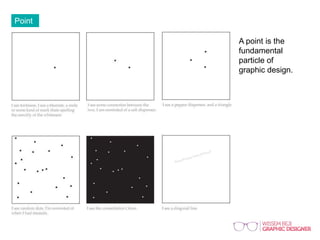
Point
A point is the
fundamental
particle of
graphic design.
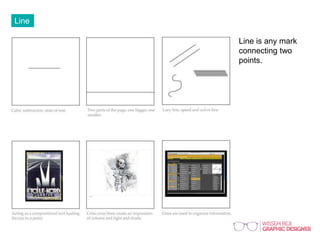
Line
Line is any mark
connecting two
points.
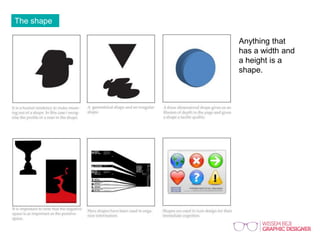
The shape
Anything that
has a width and
a height is a
shape.
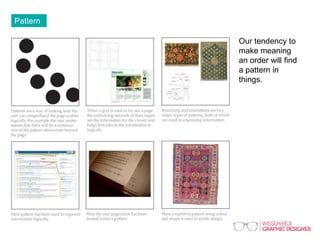
Pattern
Our tendency to
make meaning
an order will find
a pattern in
things.
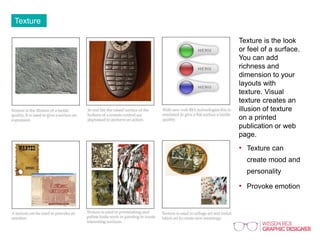
Texture
Texture is the look
or feel of a surface.
You can add
richness and
dimension to your
layouts with
texture. Visual
texture creates an
illusion of texture
on a printed
publication or web
page.
• Texture can
create mood and
personality
• Provoke emotion
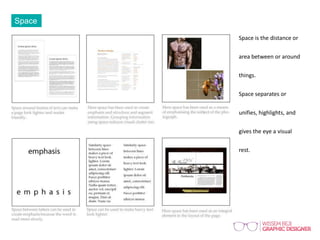
Space
Space is the distance or
area between or around
things.
Space separates or
unifies, highlights, and
gives the eye a visual
rest.
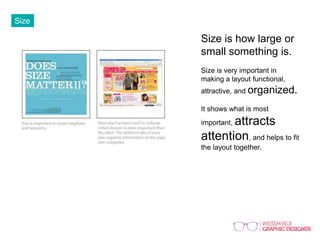
Size
Size is how large or
small something is.
Size is very important in
making a layout functional,
attractive, and organized.
It shows what is most
important, attracts
attention, and helps to fit
the layout together.
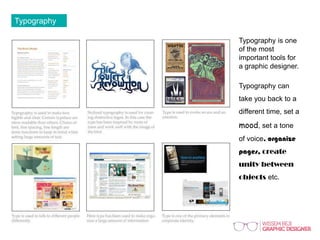
Typography
Typography is one
of the most
important tools for
a graphic designer.
Typography can
take you back to a
different time, set a
mood, set a tone
of voice, organize
pages, create
unity between
objects etc.
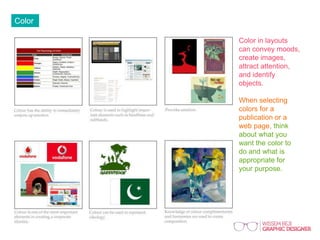
Color
Color in layouts
can convey moods,
create images,
attract attention,
and identify
objects.
When selecting
colors for a
publication or a
web page, think
about what you
want the color to
do and what is
appropriate for
your purpose.
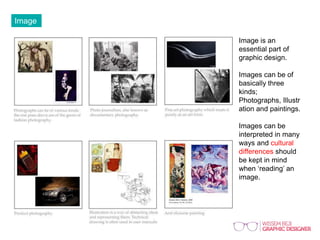
Image
Image is an
essential part of
graphic design.
Images can be of
basically three
kinds;
Photographs,
Illustration and
paintings.
Images can be
interpreted in many
ways and cultural
differences should
be kept in mind
when ‘reading’ an
image.
The techniques:
How to use these tools to
transmit messages?
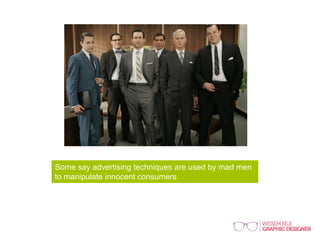
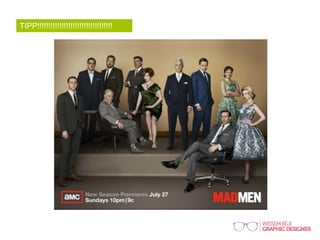
Some say advertising techniques are used by mad men
to manipulate innocent consumers
TIPP!!!!!!!!!!!!!!!!!!!!!!!!!!!!!!!!!!
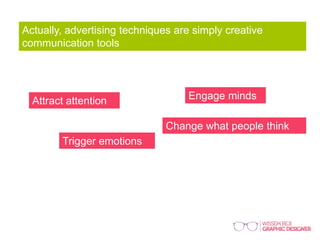
Actually, advertising techniques are simply creative
communication tools
Attract attention Engage minds
Trigger emotions
Change what people think
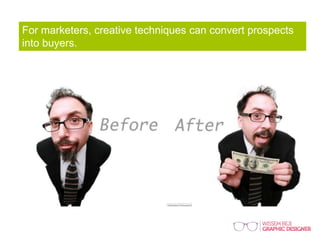
For marketers, creative techniques can convert prospects
into buyers.
Ok we get it, show us
these techniques
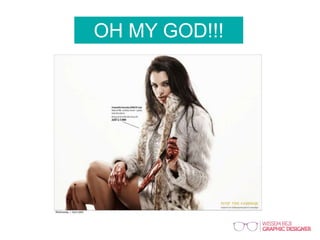
OH MY GOD!!!
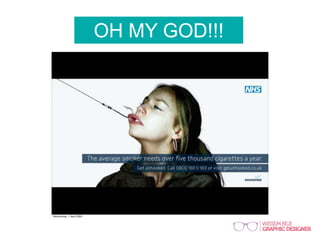
OH MY GOD!!!
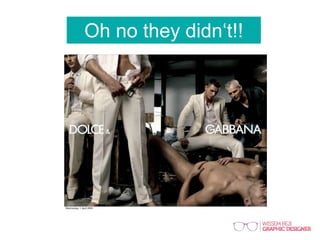
Oh no they didn‘t!!
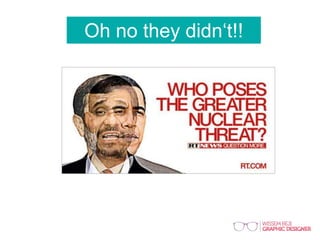
Oh no they didn‘t!!
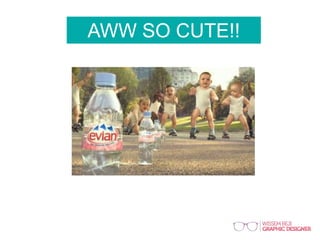
AWW SO CUTE!!
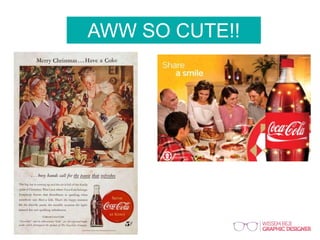
AWW SO CUTE!!
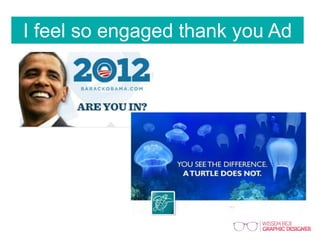
I feel so engaged thank you Ad
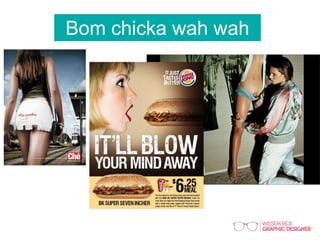
Bom chicka wah wah
Do you feel smarter now?
You are welcome!
Questions?

Communication design

  • 1.
  • 2.
  • 3.
  • 4.
  • 5.
    This is GraphicDesign The term graphic design can refer to a number of artistic and professional disciplines which focus on visual communication and presentation. Various methods are used to create and combine symbols, images and/or words to create a visual representation of ideas and messages
  • 6.
    All the picturesbelow are examples of Graphic Design
  • 7.
    What does aGraphic Designer do? Start with asking yourself the following fundamental questions: • What is the objective of the communication • What needs to be said first and then next and then after that? (levels of hierarchy) • How do you want the eye to flow through the page? • What is the tone of voice? • Who are you speaking to?
  • 8.
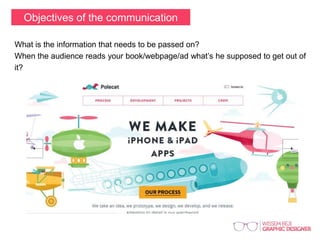
    Objectives of thecommunication What is the information that needs to be passed on? When the audience reads your book/webpage/ad what’s he supposed to get out of it?
  • 9.
    What needs tobe said first and then next and then after that? (hierarchy) Once you have figured out what the objective of your communication is you’ll want to think about what needs to be said first and foremost and what it should be followed by.
  • 10.
    How do youwant the user’s eye to move around the page? Once you have figured out what the objective of your communication is you’ll want to think about what needs to be said first and foremost and what it should be followed by.
  • 11.
    Who are youspeaking to? You have to be very sure about this as different people need to be spoken to differently, just the way it is in real life.
  • 12.
    What is thetone of voice? Only once you have got the above figured out can you think about the more external elements of your piece of work.
  • 13.
    The solutions tothese questions are tackled using the graphic designer’s tool kit.
  • 14.
    Broadly speaking, thefollowing tools are available to him to solve the aforementioned issues: Point Line Form Pattern Texture Space Size Typography Color Image
  • 15.
    Point A point isthe fundamental particle of graphic design.
  • 16.
    Line Line is anymark connecting two points.
  • 17.
    The shape Anything that hasa width and a height is a shape.
  • 18.
    Pattern Our tendency to makemeaning an order will find a pattern in things.
  • 19.
    Texture Texture is thelook or feel of a surface. You can add richness and dimension to your layouts with texture. Visual texture creates an illusion of texture on a printed publication or web page. • Texture can create mood and personality • Provoke emotion
  • 20.
    Space Space is thedistance or area between or around things. Space separates or unifies, highlights, and gives the eye a visual rest.
  • 21.
    Size Size is howlarge or small something is. Size is very important in making a layout functional, attractive, and organized. It shows what is most important, attracts attention, and helps to fit the layout together.
  • 22.
    Typography Typography is one ofthe most important tools for a graphic designer. Typography can take you back to a different time, set a mood, set a tone of voice, organize pages, create unity between objects etc.
  • 23.
    Color Color in layouts canconvey moods, create images, attract attention, and identify objects. When selecting colors for a publication or a web page, think about what you want the color to do and what is appropriate for your purpose.
  • 24.
    Image Image is an essentialpart of graphic design. Images can be of basically three kinds; Photographs, Illustration and paintings. Images can be interpreted in many ways and cultural differences should be kept in mind when ‘reading’ an image.
  • 25.
    The techniques: How touse these tools to transmit messages?
  • 26.
    Some say advertisingtechniques are used by mad men to manipulate innocent consumers
  • 27.
  • 28.
    Actually, advertising techniquesare simply creative communication tools Attract attention Engage minds Trigger emotions Change what people think
  • 29.
    For marketers, creativetechniques can convert prospects into buyers.
  • 30.
    Ok we getit, show us these techniques
  • 31.
  • 32.
  • 33.
    Oh no theydidn‘t!!
  • 34.
    Oh no theydidn‘t!!
  • 35.
  • 36.
  • 37.
    I feel soengaged thank you Ad
  • 38.
  • 39.
    Do you feelsmarter now? You are welcome!
  • 40.