Role of Communication in Conflict Management
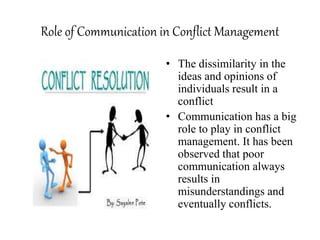
• The dissimilarity in the
ideas and opinions of
individuals result in a
conflict
• Communication has a big
role to play in conflict
management. It has been
observed that poor
communication always
results in
misunderstandings and
eventually conflicts.
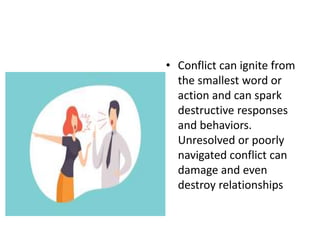
• Conflict can ignite from
the smallest word or
action and can spark
destructive responses
and behaviors.
Unresolved or poorly
navigated conflict can
damage and even
destroy relationships
Navigating an Argument
• One of the primary
communication skills for resolving
conflict successfully is learning
how to navigate an argument
effectively. This includes keeping
the focus on a single issue and
avoiding personal attacks.
• Active listening skills, such as
talking less and asking questions
for clarity, also play a role in
effectively resolving conflict.
Practicing strong verbal and
nonverbal communication further
contributes toward the successful
resolution of conflict, whether
between individuals or within a
group.
Challenges
• Conflict escalation can
result in broken
communication, false
assumptions and negative
commitments, all of
which can further
complicate the initial
conflict. It needed to help
those involved “move
back to positions of
normalcy and objectivity.”
Be clear and concise in your
message
• Beating around the
bush or talking about
unrelated issues will
sometimes escalate a
conflict or not result in
a resolution. Be direct
and to the point while
resolving conflicts.
Articulate your message
clearly so that there is
no scope for
miscommunication.
Communicating courteously is
imperative during conflict resolution
• Conflicts may escalate if others perceive your
communication as being rude or discourteous.
Using words and phrases like “please”, “thank you”
and “I apologize” can go a long way in ensuring a
courteous conflict resolution. We realize that many
times conflicts may arise due to discourteous
communication to begin with.
Back your stance with solid logic and
concrete data.
• If your point of view is based on logical
argument, it will be easy for the other
person to come around to your idea.
Be empathetic.
• Conflicts can be resolved if you are empathetic to the
other person and understand their point of view.
Remember that conflict resolution is not about
getting your opinion heard, it is about giving way to
the best idea. Using phrases like “I understand” show
that you are empathetic to the other person.
Use positive body language
• Maintain eye contact, maintain a friendly and non-
threatening posture and voice. Your body
language and verbal communication both should
emanate positivity and convey the same message.

Communication conflict resolution.pptx

  • 1.
    Role of Communicationin Conflict Management • The dissimilarity in the ideas and opinions of individuals result in a conflict • Communication has a big role to play in conflict management. It has been observed that poor communication always results in misunderstandings and eventually conflicts.
  • 2.
    • Conflict canignite from the smallest word or action and can spark destructive responses and behaviors. Unresolved or poorly navigated conflict can damage and even destroy relationships
  • 3.
    Navigating an Argument •One of the primary communication skills for resolving conflict successfully is learning how to navigate an argument effectively. This includes keeping the focus on a single issue and avoiding personal attacks. • Active listening skills, such as talking less and asking questions for clarity, also play a role in effectively resolving conflict. Practicing strong verbal and nonverbal communication further contributes toward the successful resolution of conflict, whether between individuals or within a group.
  • 4.
    Challenges • Conflict escalationcan result in broken communication, false assumptions and negative commitments, all of which can further complicate the initial conflict. It needed to help those involved “move back to positions of normalcy and objectivity.”
  • 5.
    Be clear andconcise in your message • Beating around the bush or talking about unrelated issues will sometimes escalate a conflict or not result in a resolution. Be direct and to the point while resolving conflicts. Articulate your message clearly so that there is no scope for miscommunication.
  • 6.
    Communicating courteously is imperativeduring conflict resolution • Conflicts may escalate if others perceive your communication as being rude or discourteous. Using words and phrases like “please”, “thank you” and “I apologize” can go a long way in ensuring a courteous conflict resolution. We realize that many times conflicts may arise due to discourteous communication to begin with.
  • 7.
    Back your stancewith solid logic and concrete data. • If your point of view is based on logical argument, it will be easy for the other person to come around to your idea.
  • 8.
    Be empathetic. • Conflictscan be resolved if you are empathetic to the other person and understand their point of view. Remember that conflict resolution is not about getting your opinion heard, it is about giving way to the best idea. Using phrases like “I understand” show that you are empathetic to the other person.
  • 9.
    Use positive bodylanguage • Maintain eye contact, maintain a friendly and non- threatening posture and voice. Your body language and verbal communication both should emanate positivity and convey the same message.