Contents
• What is Communication
• Process of Communication
• Types of Communication
• Levels of Communication
• Communication Barriers
• Tools of Effective Communication
10/3/2013 1:41:04AM 2
is what ??
It is aprocess of exchanging–
Information
Ideas
Thoughts
Feelings
Emotions
Through –
Speech
Signals
Writing
Behavior
10/3/2013 1:41:04AM 3
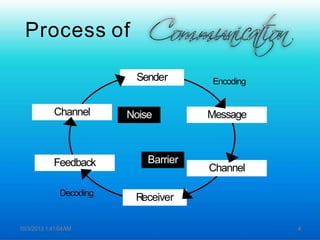
Sender
Channel
Receiver
Feedback
Channel
Encoding
Decoding
MessageNoise
Barrier
Process of
10/3/2013 1:41:04AM 4
Types of
People communicate with each other in a number of ways
that depend upon the message and its context in which it
is being sent.
Typesof communication based on the communication
channels used are –
 Verbal Communication
 Nonverbal Communication
10/3/2013 1:41:04AM 5
Verbal
 It refers to the form of communication in which message
is transmitted verbally.
 Communication is done by word of mouth and apiece of
writing.
 In verbal communication remember the acronym “KISS”
(keep it short andsimple).
VerbalCommunicationis divided into:
 Oral Communication
 Written Communication
10/3/2013 1:41:04AM 6
Oral
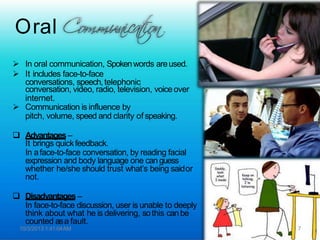
 In oral communication, Spokenwords areused.
 It includes face-to-face
conversations, speech,telephonic
conversation, video, radio, television, voiceover
internet.
 Communication is influence by
pitch, volume, speed and clarity of speaking.
 Advantages –
It brings quickfeedback.
In aface-to-face conversation, by reading facial
expression and body language one can guess
whether he/she should trust what’s being saidor
not.
 Disadvantages –
In face-to-face discussion, user is unable to deeply
think about what he is delivering, sothis canbe
counted asa fault.
10/3/2013 1:41:04AM 7
Written
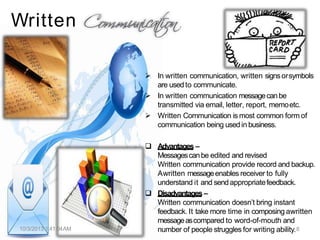
 In written communication, written signsorsymbols
are usedto communicate.
 In written communication messagecanbe
transmitted via email, letter, report, memoetc.
 Written Communication is most common form of
communication being usedin business.
10/3/2013 1:41:04AM
 Advantages –
Messagescanbe edited and revised
Written communication provide record and backup.
Awritten messageenables receiver to fully
understand it and sendappropriatefeedback.
 Disadvantages –
Written communication doesn’t bring instant
feedback. It take more time in composing awritten
messageascompared to word-of-mouth and
number of people struggles for writing ability.8
Nonverbal
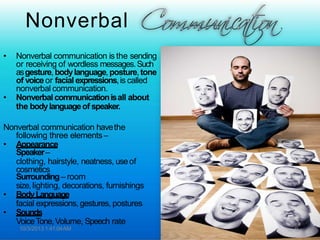
• Nonverbal communication is the sending
or receiving of wordless messages.Such
asgesture,bodylanguage,posture,tone
of voice or facial expressions,is called
nonverbal communication.
• Nonverbal communicationisall about
the bodylanguageof speaker.
Nonverbal communication havethe
following three elements–
• Appearance
Speaker–
clothing, hairstyle, neatness, useof
cosmetics
Surrounding– room
size,lighting, decorations, furnishings
• BodyLanguage
facial expressions, gestures, postures
• Sounds
VoiceTone,Volume, Speech rate
10/3/2013 1:41:04AM 9
Levels of
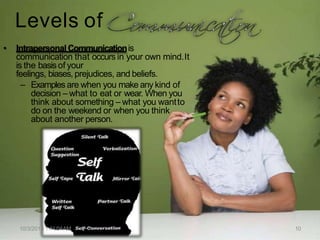
• IntrapersonalCommunicationis
communication that occurs in your own mind.It
is the basisof your
feelings, biases, prejudices, and beliefs.
– Examples are when you make any kind of
decision – what to eat or wear. When you
think about something – what you wantto
do on the weekend or when you think
about another person.
10/3/2013 1:41:04AM 10
• Interpersonalcommunication is the
communication between two people butcan
involve more in informal conversations.
– Examples are when you are talking to your
friends. Ateacher and student discussingan
assignment.Apatient and adoctor
discussing atreatment. Amanager and a
potential employee during aninterview.
10/3/2013 1:41:04AM 11
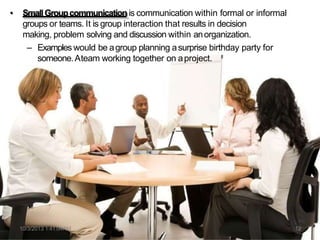
• SmallGroupcommunication is communication within formal or informal
groups or teams. It is group interaction that results in decision
making, problem solving and discussion within anorganization.
– Examples would be agroup planning asurprise birthday party for
someone.Ateam working together on aproject.
10/3/2013 1:41:04AM 12
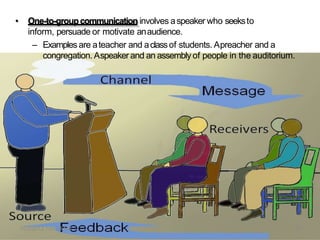
• One-to-groupcommunication involves aspeaker who seeksto
inform, persuade or motivate anaudience.
– Examples are ateacher and aclassof students. Apreacher and a
congregation. Aspeaker and an assembly of people in the auditorium.
10/3/2013 1:41:04AM 13
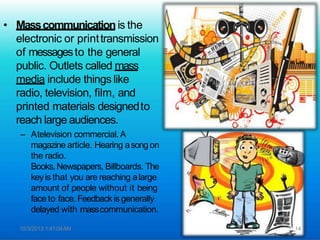
• Masscommunication is the
electronic or printtransmission
of messagesto the general
public. Outlets called mass
media include things like
radio, television, film, and
printed materials designedto
reach large audiences.
– Atelevision commercial. A
magazine article. Hearing asongon
the radio.
Books,Newspapers, Billboards. The
keyis that you are reaching alarge
amount of people without it being
face to face. Feedbackis generally
delayed with masscommunication.
10/3/2013 1:41:04AM 14
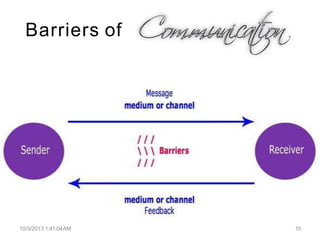
Barriers of
10/3/2013 1:41:04AM 15
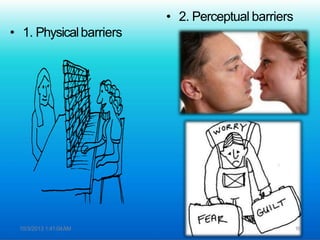
• 2. Perceptual barriers
• 1. Physicalbarriers
10/3/2013 1:41:04AM 16
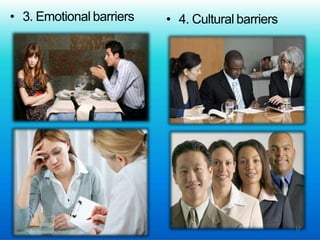
• 3. Emotional barriers • 4. Cultural barriers
10/3/2013 1:41:04AM 17
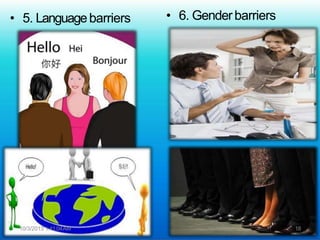
• 5. Languagebarriers • 6. Genderbarriers
10/3/2013 1:41:04AM 18
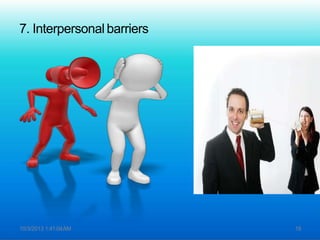
7. Interpersonal barriers
10/3/2013 1:41:04AM 19
How to Overcome Barriers of
• Takingthe receiver moreseriously
• Crystal clear message
• Delivering messagesskilfully
• Focusingon the receiver
• Using multiple channels to communicate insteadof
relying on onechannel
• Ensuring appropriate feedback
• Beaware of your own state ofmind/emotions/attitude
10/3/2013 1:41:04AM 20
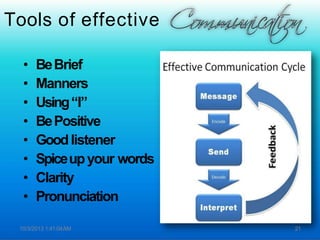
Tools of effective
• BeBrief
• Manners
• Using“I”
• BePositive
• Goodlistener
• Spiceupyour words
• Clarity
• Pronunciation
10/3/2013 1:41:04AM 21
MBA, 1st Semester
2013-2015 Batch
iLEAD,Kolkata
West Bengal University ofTechnology10/3/2013 1:41:04AM 22

Communication

  • 2.
    Contents • What isCommunication • Process of Communication • Types of Communication • Levels of Communication • Communication Barriers • Tools of Effective Communication 10/3/2013 1:41:04AM 2
  • 3.
    is what ?? Itis aprocess of exchanging– Information Ideas Thoughts Feelings Emotions Through – Speech Signals Writing Behavior 10/3/2013 1:41:04AM 3
  • 4.
  • 5.
    Types of People communicatewith each other in a number of ways that depend upon the message and its context in which it is being sent. Typesof communication based on the communication channels used are –  Verbal Communication  Nonverbal Communication 10/3/2013 1:41:04AM 5
  • 6.
    Verbal  It refersto the form of communication in which message is transmitted verbally.  Communication is done by word of mouth and apiece of writing.  In verbal communication remember the acronym “KISS” (keep it short andsimple). VerbalCommunicationis divided into:  Oral Communication  Written Communication 10/3/2013 1:41:04AM 6
  • 7.
    Oral  In oralcommunication, Spokenwords areused.  It includes face-to-face conversations, speech,telephonic conversation, video, radio, television, voiceover internet.  Communication is influence by pitch, volume, speed and clarity of speaking.  Advantages – It brings quickfeedback. In aface-to-face conversation, by reading facial expression and body language one can guess whether he/she should trust what’s being saidor not.  Disadvantages – In face-to-face discussion, user is unable to deeply think about what he is delivering, sothis canbe counted asa fault. 10/3/2013 1:41:04AM 7
  • 8.
    Written  In writtencommunication, written signsorsymbols are usedto communicate.  In written communication messagecanbe transmitted via email, letter, report, memoetc.  Written Communication is most common form of communication being usedin business. 10/3/2013 1:41:04AM  Advantages – Messagescanbe edited and revised Written communication provide record and backup. Awritten messageenables receiver to fully understand it and sendappropriatefeedback.  Disadvantages – Written communication doesn’t bring instant feedback. It take more time in composing awritten messageascompared to word-of-mouth and number of people struggles for writing ability.8
  • 9.
    Nonverbal • Nonverbal communicationis the sending or receiving of wordless messages.Such asgesture,bodylanguage,posture,tone of voice or facial expressions,is called nonverbal communication. • Nonverbal communicationisall about the bodylanguageof speaker. Nonverbal communication havethe following three elements– • Appearance Speaker– clothing, hairstyle, neatness, useof cosmetics Surrounding– room size,lighting, decorations, furnishings • BodyLanguage facial expressions, gestures, postures • Sounds VoiceTone,Volume, Speech rate 10/3/2013 1:41:04AM 9
  • 10.
    Levels of • IntrapersonalCommunicationis communicationthat occurs in your own mind.It is the basisof your feelings, biases, prejudices, and beliefs. – Examples are when you make any kind of decision – what to eat or wear. When you think about something – what you wantto do on the weekend or when you think about another person. 10/3/2013 1:41:04AM 10
  • 11.
    • Interpersonalcommunication isthe communication between two people butcan involve more in informal conversations. – Examples are when you are talking to your friends. Ateacher and student discussingan assignment.Apatient and adoctor discussing atreatment. Amanager and a potential employee during aninterview. 10/3/2013 1:41:04AM 11
  • 12.
    • SmallGroupcommunication iscommunication within formal or informal groups or teams. It is group interaction that results in decision making, problem solving and discussion within anorganization. – Examples would be agroup planning asurprise birthday party for someone.Ateam working together on aproject. 10/3/2013 1:41:04AM 12
  • 13.
    • One-to-groupcommunication involvesaspeaker who seeksto inform, persuade or motivate anaudience. – Examples are ateacher and aclassof students. Apreacher and a congregation. Aspeaker and an assembly of people in the auditorium. 10/3/2013 1:41:04AM 13
  • 14.
    • Masscommunication isthe electronic or printtransmission of messagesto the general public. Outlets called mass media include things like radio, television, film, and printed materials designedto reach large audiences. – Atelevision commercial. A magazine article. Hearing asongon the radio. Books,Newspapers, Billboards. The keyis that you are reaching alarge amount of people without it being face to face. Feedbackis generally delayed with masscommunication. 10/3/2013 1:41:04AM 14
  • 15.
  • 16.
    • 2. Perceptualbarriers • 1. Physicalbarriers 10/3/2013 1:41:04AM 16
  • 17.
    • 3. Emotionalbarriers • 4. Cultural barriers 10/3/2013 1:41:04AM 17
  • 18.
    • 5. Languagebarriers• 6. Genderbarriers 10/3/2013 1:41:04AM 18
  • 19.
  • 20.
    How to OvercomeBarriers of • Takingthe receiver moreseriously • Crystal clear message • Delivering messagesskilfully • Focusingon the receiver • Using multiple channels to communicate insteadof relying on onechannel • Ensuring appropriate feedback • Beaware of your own state ofmind/emotions/attitude 10/3/2013 1:41:04AM 20
  • 21.
    Tools of effective •BeBrief • Manners • Using“I” • BePositive • Goodlistener • Spiceupyour words • Clarity • Pronunciation 10/3/2013 1:41:04AM 21
  • 22.
    MBA, 1st Semester 2013-2015Batch iLEAD,Kolkata West Bengal University ofTechnology10/3/2013 1:41:04AM 22