WHAT EVERY PHYSICIAN
NEEDS TO KNOW:
COMMUNICATING WITH PATIENTS
IN THE DIGITAL AGE
WHAT’S CHANGED?
•	 Digital and social media such as
websites, social networks, blogs,
and online communities are
universal in our lives.
1
INTERNET AND
SOCIAL MEDIA USE
According to the Pew Research Center:
•	84% of U.S. adults use the Internet*
•	71% of online adults use social media sites*
2
* http://www.pewinternet.org/2015/06/26/americans-internet-access-2000-2015
http://www.pewinternet.org/2015/01/09/social-media-update-2014/
INTERNET AND
SOCIAL MEDIA USE
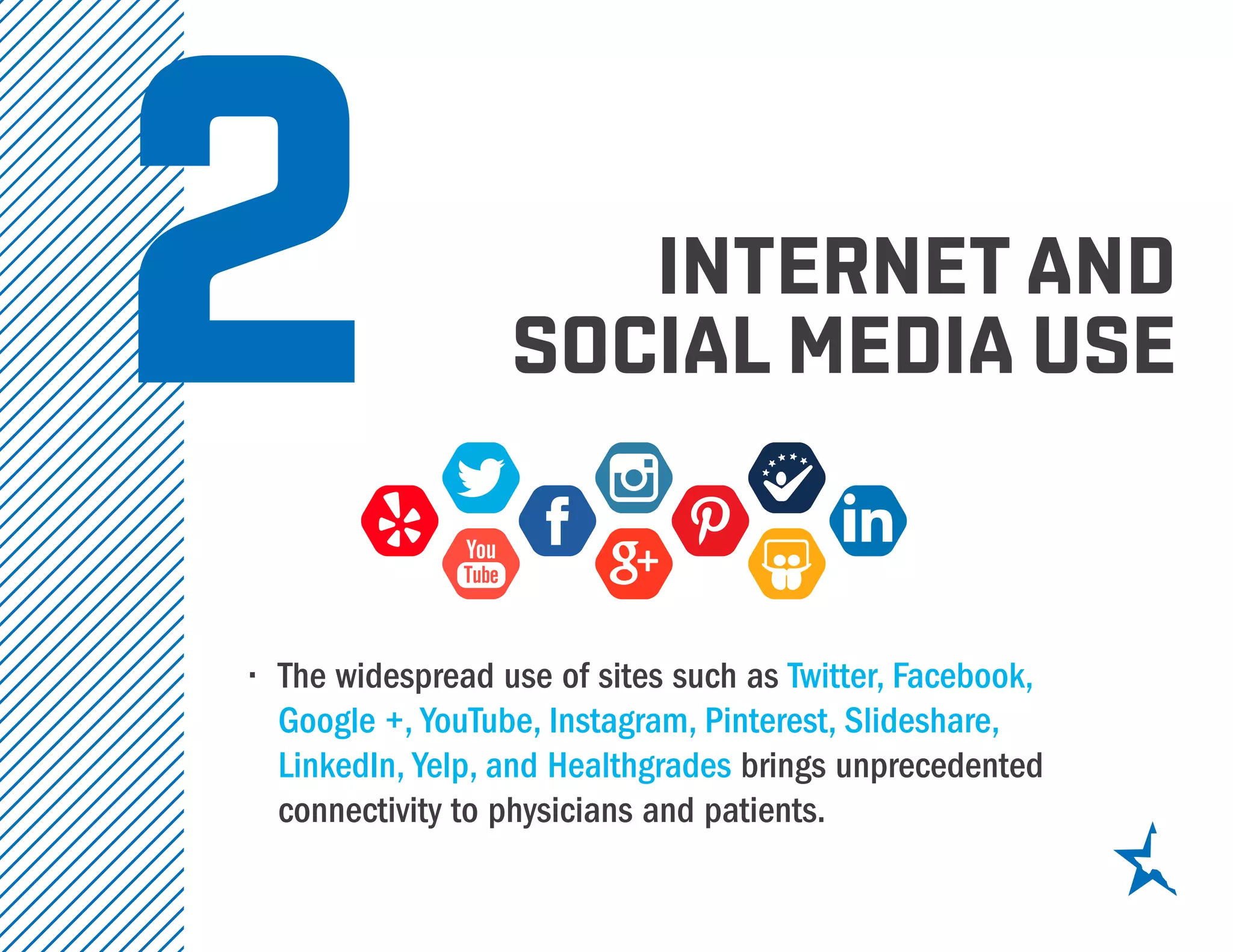
•	 The widespread use of sites such as Twitter, Facebook,
Google +, YouTube, Instagram, Pinterest, Slideshare,
LinkedIn, Yelp, and Healthgrades brings unprecedented
connectivity to physicians and patients.
2
PHYSICIAN SOCIAL
MEDIA USE3According to the Journal of Medical Internet
Research*
:
•	61% of physicians use social media once a
week or more to look for information.
•	46% say they contribute new information on
social media once per week or more.
* http://health.usnews.com/health-news/news/articles/2013/01/01/docs-often-use-social-media-on-the-job-survey
SMARTPHONES
Smartphones are further fueling the rise in connectivity.
•	2/3 of Americans now own smartphones*
and
they use them to watch videos, listen to music or
podcasts, and for social networking.
•	 Smartphones are also fueling the rise of video.
Because smartphones make it easy to watch and
share videos, people are reading less and
watching more.
4
* http://www.pewinternet.org/files/2015/03/PI_Smartphones_0401151.pdf
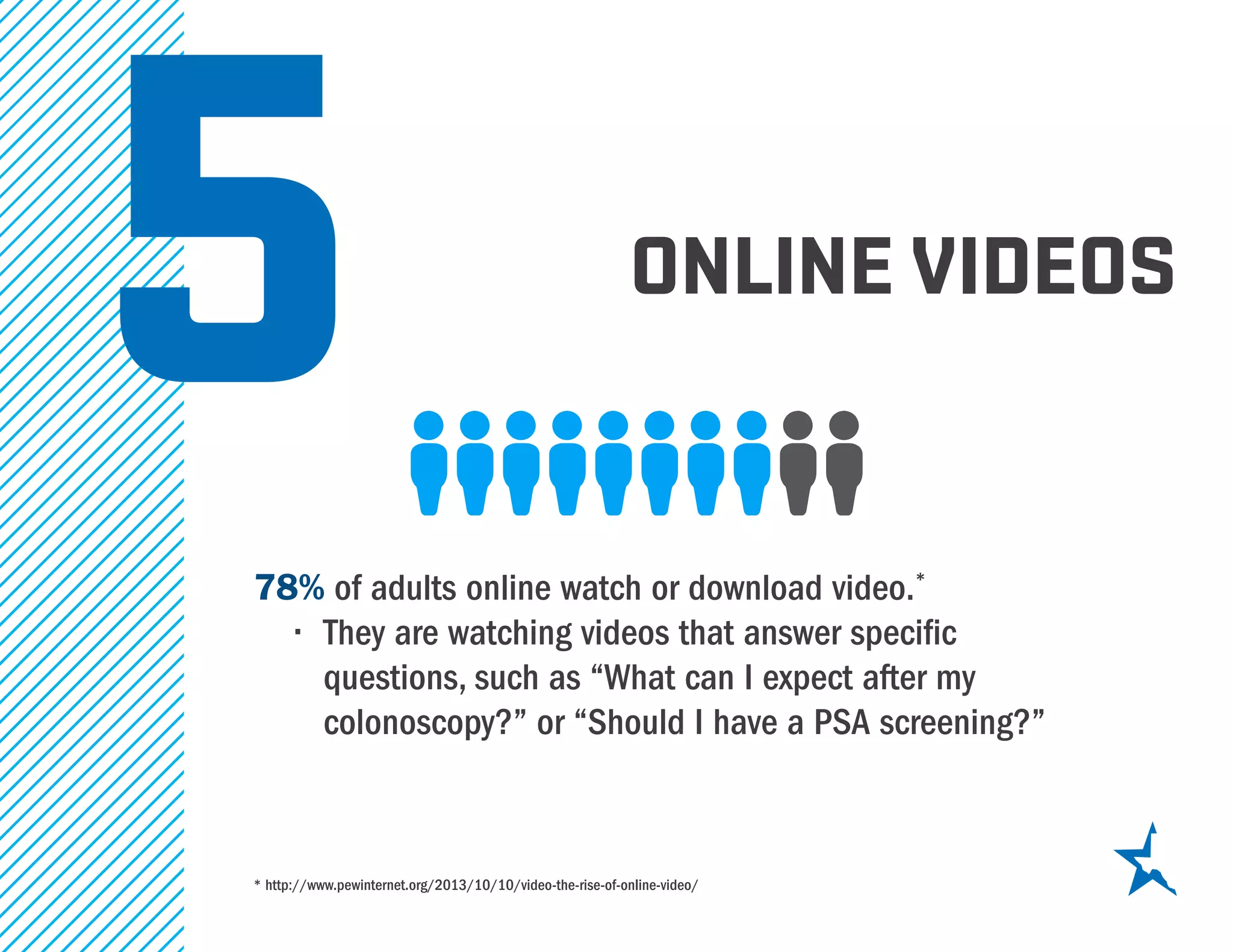
ONLINE VIDEOS
578% of adults online watch or download video.*
•	 They are watching videos that answer specific
questions, such as “What can I expect after my
colonoscopy?” or “Should I have a PSA screening?”
* http://www.pewinternet.org/2013/10/10/video-the-rise-of-online-video/
YOUTUBE
6•	 YouTube is now the number two search engine after
Google.
•	 More people search on YouTube than Yahoo or Bing
combined.
•	 Hospital systems and physicians have been using
YouTube — in addition to their websites and blogs — to
educate their audiences.
•	 The Mayo Clinic YouTube channel currently has more
than 3,600 videos with than 20 million views.
TWITTER AS A
NEWS SOURCE7
•	 Twitter now has more than 200 million active users
who post more than 400 million tweets a day.
•	 Twitter has become the “new” newswire and
millions of people now rely on it as a news source.
•	 It has supplanted the Associated Press, Dow Jones,
and Bloomberg for breaking news.
CHANGING
EXPECTATIONS8More and more, patients want to interact with
physicians online.
•	 Online information should be up-to-date,
reliable, and easily accessible.
•	 Physicians must constantly adapt their
online presence to meet these needs.
CHANGING
EXPECTATIONS
•	 A website with outdated content can
make your health care organization look
unprofessional and irrelevant.
•	 Credibility can be lost by simply not
keeping a website up-to-date.
8
CHANGING
EXPECTATIONS
In addition to keeping your website updated, consider
the following to help connect with patients online.
•	 Create and manage a LinkedIn profile.
•	 Update your profile information on physician
review sites.
•	 Create your own blog or contribute to your
hospital or specialty society blog.
8
PROTECTION FOR
A NEW ERA OF
MEDICINE
ABOUT TMLT:
With more than 17,500 physicians in its care, Texas Medical Liability Trust (TMLT)
provides malpractice insurance and related products to physicians. Our purpose is to
make a positive impact on the quality of health care for patients by educating, protecting,
and defending physicians. www.tmlt.org
Find us on:
9

Communicating With Patients in the Digital Age

  • 1.
    WHAT EVERY PHYSICIAN NEEDSTO KNOW: COMMUNICATING WITH PATIENTS IN THE DIGITAL AGE
  • 2.
    WHAT’S CHANGED? • Digitaland social media such as websites, social networks, blogs, and online communities are universal in our lives. 1
  • 3.
    INTERNET AND SOCIAL MEDIAUSE According to the Pew Research Center: • 84% of U.S. adults use the Internet* • 71% of online adults use social media sites* 2 * http://www.pewinternet.org/2015/06/26/americans-internet-access-2000-2015 http://www.pewinternet.org/2015/01/09/social-media-update-2014/
  • 4.
    INTERNET AND SOCIAL MEDIAUSE • The widespread use of sites such as Twitter, Facebook, Google +, YouTube, Instagram, Pinterest, Slideshare, LinkedIn, Yelp, and Healthgrades brings unprecedented connectivity to physicians and patients. 2
  • 5.
    PHYSICIAN SOCIAL MEDIA USE3Accordingto the Journal of Medical Internet Research* : • 61% of physicians use social media once a week or more to look for information. • 46% say they contribute new information on social media once per week or more. * http://health.usnews.com/health-news/news/articles/2013/01/01/docs-often-use-social-media-on-the-job-survey
  • 6.
    SMARTPHONES Smartphones are furtherfueling the rise in connectivity. • 2/3 of Americans now own smartphones* and they use them to watch videos, listen to music or podcasts, and for social networking. • Smartphones are also fueling the rise of video. Because smartphones make it easy to watch and share videos, people are reading less and watching more. 4 * http://www.pewinternet.org/files/2015/03/PI_Smartphones_0401151.pdf
  • 7.
    ONLINE VIDEOS 578% ofadults online watch or download video.* • They are watching videos that answer specific questions, such as “What can I expect after my colonoscopy?” or “Should I have a PSA screening?” * http://www.pewinternet.org/2013/10/10/video-the-rise-of-online-video/
  • 8.
    YOUTUBE 6• YouTube isnow the number two search engine after Google. • More people search on YouTube than Yahoo or Bing combined. • Hospital systems and physicians have been using YouTube — in addition to their websites and blogs — to educate their audiences. • The Mayo Clinic YouTube channel currently has more than 3,600 videos with than 20 million views.
  • 9.
    TWITTER AS A NEWSSOURCE7 • Twitter now has more than 200 million active users who post more than 400 million tweets a day. • Twitter has become the “new” newswire and millions of people now rely on it as a news source. • It has supplanted the Associated Press, Dow Jones, and Bloomberg for breaking news.
  • 10.
    CHANGING EXPECTATIONS8More and more,patients want to interact with physicians online. • Online information should be up-to-date, reliable, and easily accessible. • Physicians must constantly adapt their online presence to meet these needs.
  • 11.
    CHANGING EXPECTATIONS • A websitewith outdated content can make your health care organization look unprofessional and irrelevant. • Credibility can be lost by simply not keeping a website up-to-date. 8
  • 12.
    CHANGING EXPECTATIONS In addition tokeeping your website updated, consider the following to help connect with patients online. • Create and manage a LinkedIn profile. • Update your profile information on physician review sites. • Create your own blog or contribute to your hospital or specialty society blog. 8
  • 13.
    PROTECTION FOR A NEWERA OF MEDICINE ABOUT TMLT: With more than 17,500 physicians in its care, Texas Medical Liability Trust (TMLT) provides malpractice insurance and related products to physicians. Our purpose is to make a positive impact on the quality of health care for patients by educating, protecting, and defending physicians. www.tmlt.org Find us on: 9