I. Learning Objectives
Content
Standard
The Learner demonstrates understanding of the concepts of bar
graphs and simple experiments.
Performance
Standard
The Learner is able to create and interpret simple representations of
data (tables and bar graphs) and describe outcomes in simple
experiments.
Learning
Competency
M4SP-IVg-2.4- organizes data in tabular form and presents them
in a single/double horizontal or vertical bar graph.
Lesson
Objectives
at the end of a 70-minute discussion, the grade 6 pupils can do
the following with at least 85% level of accuracy:
A. identify the data and frequencies needed in a tabular format;
B. organizes data in tabular form; and
C. appreciate the lesson’s importance through reflection.
II. Subject Matter
Topic Collecting and Organizing Data using Tables
Reference ADM – Regional Module
Approach Explicit
Strategy/ies Brainstorming, 1-minute paper, APK, Collaborative Discussion, PTC
Integration Subject Integration, Cultural/Indigenous Integration
III. Materials Markers, board, chalks, laptop, Led TV
IV. Learning Process
A. Preparation – 10 minutes
1. Greetings (2
mins.)
A pleasant afternoon PG-4? A pleasant afternoon sir!
Today is another day and another lesson to be learned. Are you ready for
today’s discussion? Yes!
Subject Integration – Science, Health
Cultural Integration
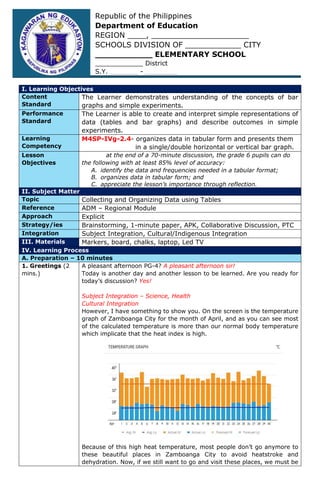
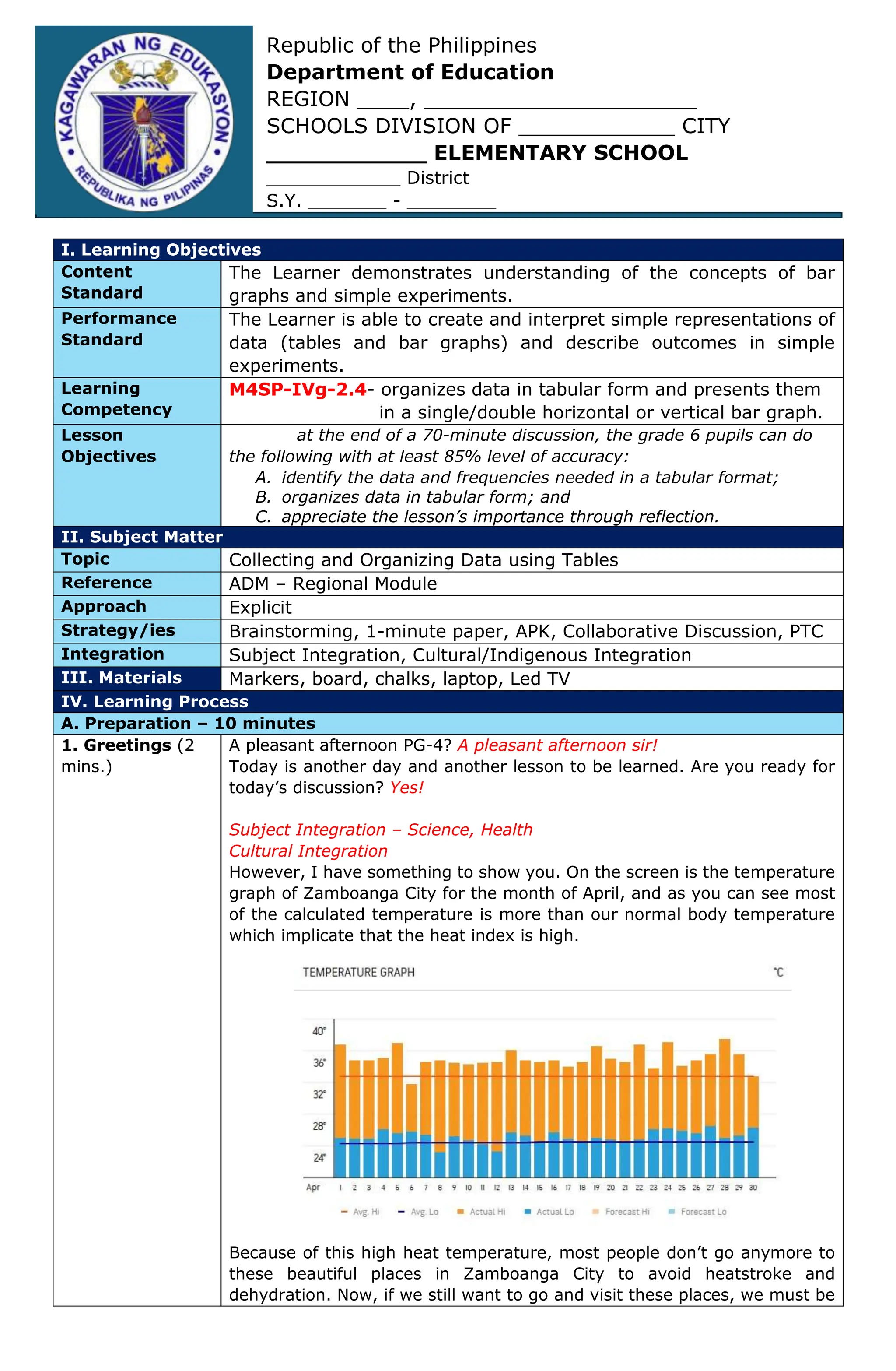
However, I have something to show you. On the screen is the temperature
graph of Zamboanga City for the month of April, and as you can see most
of the calculated temperature is more than our normal body temperature
which implicate that the heat index is high.
Because of this high heat temperature, most people don’t go anymore to
these beautiful places in Zamboanga City to avoid heatstroke and
dehydration. Now, if we still want to go and visit these places, we must be
Republic of the Philippines
Department of Education
REGION ____, _____________________
SCHOOLS DIVISION OF ____________ CITY
___________ ELEMENTARY SCHOOL
____________ District
S.Y. _______ - ________
reminded on what to prepare and bring to avoid complications. You will be
divided into three (3) groups and each group will represent a color. Now,
to get all the stuff needed to prepare when going out, what must you do?
(listen, participate, behave)
2. Drill (2 mins.) Cultural Integration
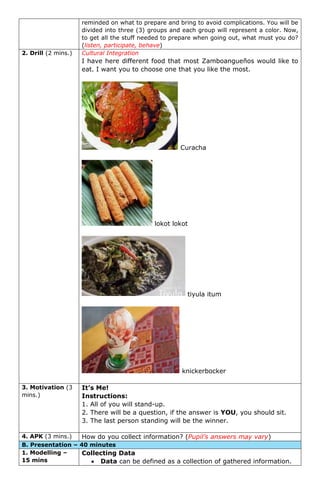
I have here different food that most ZamboangueĂąos would like to
eat. I want you to choose one that you like the most.
Curacha
lokot lokot
tiyula itum
knickerbocker
3. Motivation (3
mins.)
It’s Me!
Instructions:
1. All of you will stand-up.
2. There will be a question, if the answer is YOU, you should sit.
3. The last person standing will be the winner.
4. APK (3 mins.) How do you collect information? (Pupil’s answers may vary)
B. Presentation – 40 minutes
1. Modelling –
15 mins
Collecting Data
 Data can be defined as a collection of gathered information.
 They include characteristics that can be observed or measured.
We call these characteristics or quantities variables or data
items.
 A survey is a way of collecting data by asking people questions
either through questionnaires or interviews.
 An interview is a conversation between individuals to collect
relevant information.
 We use tally marks and frequency chart to record the results
of a survey.
 The total number of tally marks in each category represents
the frequency. A frequency is how often a particular response
occurred.
Example:
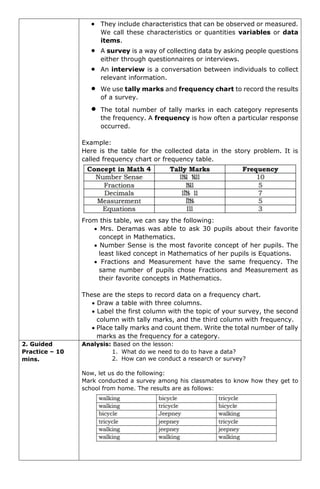
Here is the table for the collected data in the story problem. It is
called frequency chart or frequency table.
From this table, we can say the following:
 Mrs. Deramas was able to ask 30 pupils about their favorite
concept in Mathematics.
 Number Sense is the most favorite concept of her pupils. The
least liked concept in Mathematics of her pupils is Equations.
 Fractions and Measurement have the same frequency. The
same number of pupils chose Fractions and Measurement as
their favorite concepts in Mathematics.
These are the steps to record data on a frequency chart.
 Draw a table with three columns.
 Label the first column with the topic of your survey, the second
column with tally marks, and the third column with frequency.
 Place tally marks and count them. Write the total number of tally
marks as the frequency for a category.
2. Guided
Practice – 10
mins.
Analysis: Based on the lesson:
1. What do we need to do to have a data?
2. How can we conduct a research or survey?
Now, let us do the following:
Mark conducted a survey among his classmates to know how they get to
school from home. The results are as follows:
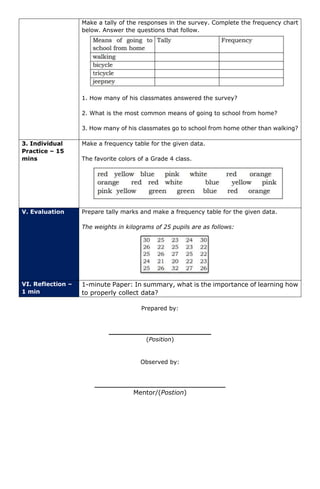
Make a tally of the responses in the survey. Complete the frequency chart
below. Answer the questions that follow.
1. How many of his classmates answered the survey?
2. What is the most common means of going to school from home?
3. How many of his classmates go to school from home other than walking?
3. Individual
Practice – 15
mins
Make a frequency table for the given data.
The favorite colors of a Grade 4 class.
V. Evaluation Prepare tally marks and make a frequency table for the given data.
The weights in kilograms of 25 pupils are as follows:
VI. Reflection –
1 min
1-minute Paper: In summary, what is the importance of learning how
to properly collect data?
Prepared by:
_________________________
(Position)
Observed by:
________________________________
Mentor/(Postion)

COT 4 Learning Plan: Collecting and Organizing Data using Tables-Grade 4 Mathematics

  • 1.
    I. Learning Objectives Content Standard TheLearner demonstrates understanding of the concepts of bar graphs and simple experiments. Performance Standard The Learner is able to create and interpret simple representations of data (tables and bar graphs) and describe outcomes in simple experiments. Learning Competency M4SP-IVg-2.4- organizes data in tabular form and presents them in a single/double horizontal or vertical bar graph. Lesson Objectives at the end of a 70-minute discussion, the grade 6 pupils can do the following with at least 85% level of accuracy: A. identify the data and frequencies needed in a tabular format; B. organizes data in tabular form; and C. appreciate the lesson’s importance through reflection. II. Subject Matter Topic Collecting and Organizing Data using Tables Reference ADM – Regional Module Approach Explicit Strategy/ies Brainstorming, 1-minute paper, APK, Collaborative Discussion, PTC Integration Subject Integration, Cultural/Indigenous Integration III. Materials Markers, board, chalks, laptop, Led TV IV. Learning Process A. Preparation – 10 minutes 1. Greetings (2 mins.) A pleasant afternoon PG-4? A pleasant afternoon sir! Today is another day and another lesson to be learned. Are you ready for today’s discussion? Yes! Subject Integration – Science, Health Cultural Integration However, I have something to show you. On the screen is the temperature graph of Zamboanga City for the month of April, and as you can see most of the calculated temperature is more than our normal body temperature which implicate that the heat index is high. Because of this high heat temperature, most people don’t go anymore to these beautiful places in Zamboanga City to avoid heatstroke and dehydration. Now, if we still want to go and visit these places, we must be Republic of the Philippines Department of Education REGION ____, _____________________ SCHOOLS DIVISION OF ____________ CITY ___________ ELEMENTARY SCHOOL ____________ District S.Y. _______ - ________
  • 2.
    reminded on whatto prepare and bring to avoid complications. You will be divided into three (3) groups and each group will represent a color. Now, to get all the stuff needed to prepare when going out, what must you do? (listen, participate, behave) 2. Drill (2 mins.) Cultural Integration I have here different food that most Zamboangueños would like to eat. I want you to choose one that you like the most. Curacha lokot lokot tiyula itum knickerbocker 3. Motivation (3 mins.) It’s Me! Instructions: 1. All of you will stand-up. 2. There will be a question, if the answer is YOU, you should sit. 3. The last person standing will be the winner. 4. APK (3 mins.) How do you collect information? (Pupil’s answers may vary) B. Presentation – 40 minutes 1. Modelling – 15 mins Collecting Data  Data can be defined as a collection of gathered information.
  • 3.
     They includecharacteristics that can be observed or measured. We call these characteristics or quantities variables or data items.  A survey is a way of collecting data by asking people questions either through questionnaires or interviews.  An interview is a conversation between individuals to collect relevant information.  We use tally marks and frequency chart to record the results of a survey.  The total number of tally marks in each category represents the frequency. A frequency is how often a particular response occurred. Example: Here is the table for the collected data in the story problem. It is called frequency chart or frequency table. From this table, we can say the following:  Mrs. Deramas was able to ask 30 pupils about their favorite concept in Mathematics.  Number Sense is the most favorite concept of her pupils. The least liked concept in Mathematics of her pupils is Equations.  Fractions and Measurement have the same frequency. The same number of pupils chose Fractions and Measurement as their favorite concepts in Mathematics. These are the steps to record data on a frequency chart.  Draw a table with three columns.  Label the first column with the topic of your survey, the second column with tally marks, and the third column with frequency.  Place tally marks and count them. Write the total number of tally marks as the frequency for a category. 2. Guided Practice – 10 mins. Analysis: Based on the lesson: 1. What do we need to do to have a data? 2. How can we conduct a research or survey? Now, let us do the following: Mark conducted a survey among his classmates to know how they get to school from home. The results are as follows:
  • 4.
    Make a tallyof the responses in the survey. Complete the frequency chart below. Answer the questions that follow. 1. How many of his classmates answered the survey? 2. What is the most common means of going to school from home? 3. How many of his classmates go to school from home other than walking? 3. Individual Practice – 15 mins Make a frequency table for the given data. The favorite colors of a Grade 4 class. V. Evaluation Prepare tally marks and make a frequency table for the given data. The weights in kilograms of 25 pupils are as follows: VI. Reflection – 1 min 1-minute Paper: In summary, what is the importance of learning how to properly collect data? Prepared by: _________________________ (Position) Observed by: ________________________________ Mentor/(Postion)