CTD Dossier Implementation by
DRAP
PresentedBy:
Dr. JibranKhan
ManagerRegulatoryAffairs BoschGroup
DRUG REGULATORY AUTHORITY OF PAKISTAN
► SRO. 932(I)/2017
► SRO. 713(I)/2018
► Enforcement of CTD (Common
Technical Document) as Standard
Dossier Document for Applying Drug
product Registration in DRAP
► Implementation Date: 01-01-2019
What is CTD
► CTD stand of Common Technical Document
► A CTD is a set of Technical Document required by International Regulatory
Agencies /HA’s for the purpose of Granting Marketing Authorization of a
Pharmaceutical Product in their respective countries.
► In Now days these CTD based Technical documents are included in the
Application Dossier for Registration/Renewal of Pharmaceutical Products
Human use.
for
History of CTD
► Before CTD Regulators from Different countries HA receives
application and spends about 2 to 3 Years in its review before
decision for its approval of Marketing Authorization for use in Human
a Dossier
giving any
Beings.
► Reason for such delay was more on ambiguity based on different types of
technical documents in which a Application Dossier were submitted by different
Pharmaceutical Companies.
► To harmonize these ambiguity Industries came up with CTD-Documents in
order to speed up Regulatory Approvals.
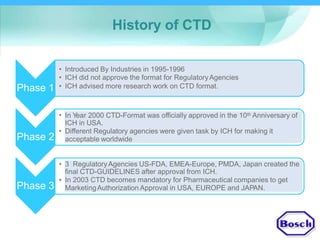
History of CTD
•
•
•
Introduced By Industries in 1995-1996
ICH did not approve the format for RegulatoryAgencies
ICH advised more research work on CTD format.Phase 1
In Year 2000 CTD-Format was officially approved in the 10th Anniversary of
ICH in USA.
Different Regulatory agencies were given task by ICH for making it
acceptable worldwide
•
•
Phase 2
• 3 RegulatoryAgencies US-FDA, EMEA-Europe, PMDA, Japan created the
final CTD-GUIDELINES after approval from ICH.
In 2003 CTD becomes mandatory for Pharmaceutical companies to get
MarketingAuthorization Approval in USA, EUROPE and JAPAN.
•
Phase 3
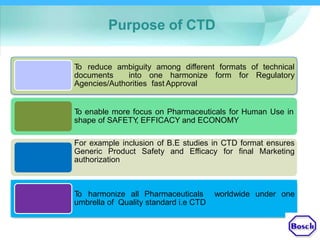
Purpose of CTD
To reduce ambiguity among different formats of technical
documents into one harmonize form for Regulatory
Agencies/Authorities fast Approval
To enable more focus on Pharmaceuticals for Human Use in
shape of SAFETY, EFFICACY and ECONOMY
For example inclusion of B.E studies in CTD format ensures
Generic Product Safety and Efficacy for final Marketing
authorization
To harmonize all Pharmaceuticals worldwide under one
umbrella of Quality standard i.e CTD
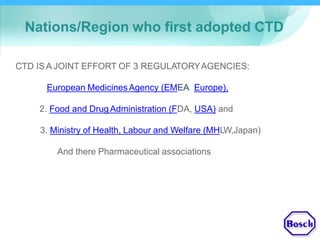
Nations/Region who first adopted CTD
CTD IS A JOINT EFFORT OF 3 REGULATORYAGENCIES:
1.European MedicinesAgency (EMEA, Europe),
2. Food and DrugAdministration (FDA, USA) and
3. Ministry of Health, Labour and Welfare (MHLW,Japan)
And there Pharmaceutical associations
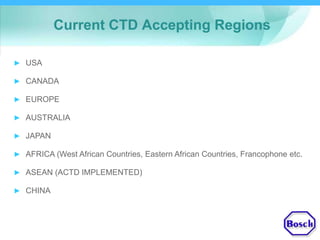
Current CTD Accepting Regions
► USA
► CANADA
► EUROPE
► AUSTRALIA
► JAPAN
► AFRICA (West African Countries, Eastern African Countries, Francophone etc.
► ASEAN (ACTD IMPLEMENTED)
► CHINA
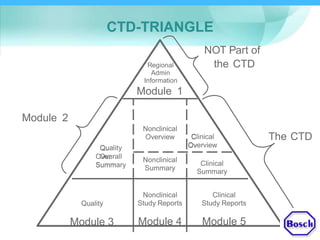
CTD-TRIANGLE
NOT Part of
the CTDRegional
Admin
Information
Module 1
Module 2
The CTDClinical
OverviewQuality
Overall
Summary
Module 3
Qu
Over
Summ
Nonclinical
Overview C
Ov
Nonclinical
Summary
Clinical
Summary
Quality
Nonclinical
Study Reports
Module 4
Clinical
Study Reports
Module 5
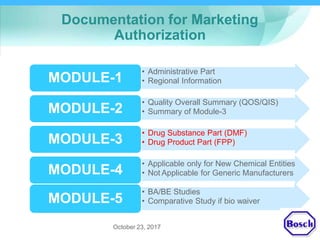
Documentation for Marketing
Authorization
•
•
Administrative Part
Regional InformationMODULE-1
•
•
Quality Overall Summary
Summary of Module-3
(QOS/QIS)
MODULE-2
•
•
Drug Substance Part (DMF)
Drug Product Part (FPP)MODULE-3
•
•
Applicable only for New Chemical Entities
Not Applicable for Generic ManufacturersMODULE-4
•
•
BA/BE Studies
Comparative Study if bio waiverMODULE-5
October 23, 2017 10
MODULE 1-Administrative Part
Regional Requirements of DRAP
Marketing Authorization
for
"FORM 5-F"
[See rule 26 (l)]
Common Technical Document (CTD) for Registration of Human Drugs
contents o fM0dule 1 :Admtntstrattve part
HeadingSection Sub-
Section
1.1
1.2
1.3
1.3.1
Covering Letter and Fee Deposit Slip
Table of Contents (From Module 1 to Module 5)
Applicant Information
Name, address and contact details of Applicant I Marketing Authorization
Holder:
Name, address and contact details of Manufacturing site. Specify
whether the Applicant is:
1.3.2
1.3.3
a.
b.
c.
Valid
D Manufacturer
D Importer
Dls involved in none ofthe above (contract giver)
Drug Manufacturing License (DML) of manufacturer I Applicant or1.3.4
Drug Sale License, whichever is aoolicable.
Evidence of approval of manufacturing facility I Approved Section from
Licensing Authority
List of already approved registered drugs in this section
1.3.5
1.3.6
1.3.7 Identification of Signature(s) of authorized persons, Incharge
Quality Control and Incharge Quality Assurance
Manufacturer's Site Master File and Credential (for importer)
Type ofAoolication
Application is for the registration of:
D New Drug Product (NDP)
D Generic Drug Product (GDP) Pharmaceutical
product is intended for: D Domestic sale
D Export sale
D Domestic and Export sales
For imported products, please specify one of following: D
Finished Pharmaceutical Product Import
D Bulk Import and local repacking (specify status of bulk)
D Bulk Import Local Repacking for Export purpose only
Production,
1.3.8
1.4
1.4.1
1.4.1
1.4.2
MODULE 1-Administrative Part
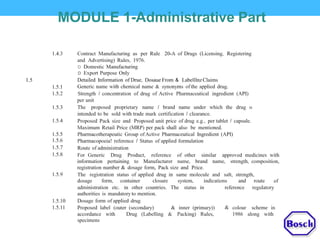
1.4.3 Contract Manufacturing as per Rule 20-A of Drugs (Licensing, Registering
and Advertising) Rules, 1976.
D Domestic Manufacturing
D Export Purpose Only
Detailed Information of Drue, Dosaue From & LabelllnzClaims
Generic name with chemical name & synonyms of the applied drug.
Strength I concentration of drug of Active Pharmaceutical ingredient (API)
per unit
The proposed proprietary name I brand name under which the drug lS
intended to be sold with trade mark certification I clearance.
Proposed Pack size and Proposed unit price of drug e.g., per tablet I capsule.
Maximum Retail Price (MRP) per pack shall also be mentioned.
Pharmacotherapeutic Group of Active Pharmaceutical Ingredient (API)
Pharmacopoeia! reference I Status of applied formulation
Route of administration
For Generic Drug Product, reference of other similar approved medicines with
information pertaining to Manufacturer name, brand name, strength, composition,
registration number & dosage form, Pack size and Price.
The registration status of applied drug in same molecule and salt, strength,
1.5
1.5.1
1.5.2
1.5.3
1.5.4
1.5.5
1.5.6
1.5.7
1.5.8
1.5.9
dosage form, container closure system, indications and route of
administration etc. in other countries. The status in
authorities is mandatory to mention.
Dosage form of applied drug
reference regulatory
1.5.10
1.5.11 Proposed label (outer (secondary) & inner (primary)) colour scheme in&
accordance with
specimens
Drug (Labelling & Packing) Rules, 1986 along with
MODULE 1-Administrative Part
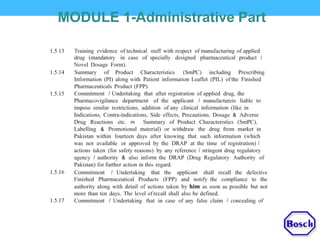
1.5.13 Training evidence of technical staff with respect of manufacturing of applied
drug (mandatory in case of specially designed pharmaceutical product I
Novel Dosage Form).
1.5.14 Summary of Product Characteristics (SmPC) including Prescribing
Information (PI) along with Patient information Leaflet (PIL) of the Finished
Pharmaceuticals Product (FPP).
Commitment I Undertaking that after registration of applied drug, the
Pharmacovigilance department of the applicant I manufactureis liable to
impose similar restrictions, addition of any clinical information (like in
Indications, Contra-indications, Side effects, Precautions, Dosage & Adverse
Drug Reactions etc. m Summary of Product Characteristics (SmPC),
Labelling & Promotional material) or withdraw the drug from market in
Pakistan within fourteen days after knowing that such information (which
was not available or approved by the DRAP at the time of registration) I
actions taken (for safety reasons) by any reference I stringent drug regulatory
agency I authority & also inform the DRAP (Drug Regulatory Authority of
Pakistan) for further action in this regard.
Commitment I Undertaking that the applicant shall recall the defective
Finished Pharmaceutical Products (FPP) and notify the compliance to the
authority along with detail of actions taken by him as soon as possible but not
more than ten days. The level of recall shall also be defined.
Commitment I Undertaking that in case of any false claim I concealing of
1.5.15
1.5.16
1.5.17
MODULE 1-Administrative Part
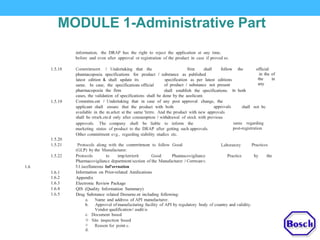
information, the DRAP has the right to reject the application at any time,
before and even after approval or registration of the product in case if proved so.
1.5.18 Cornrrritrnerrt I Undertaking that the firm shall follow the official
in the of
the in
any
phannacopoeia specifications for product I substance as published
latest edition & shall update its
same. In case, the specifications official
pharmacopoeia the firm
specification as per latest editions
of product I substance not present
shall establish the specifications. In both
cases, the validation of specifications shall be done by the aoolicant.
Commitm.ent I Undertaking that in case of any post approval change, the1.5.19
approvalsapplicant shall ensure that the product with both shall not be
available in the m.arket at the sarne 'tirrre. And the product with new approvals
shall be rrrark.eted only after consumption I withdrawal of stock with previous
approvals. The company shall be liable to inform the
marketing status of product to the DRAP after getting such approvals.
Other committnent evg., regarding stability studies etc.
sanie regarding
post-registration
1.5.20
1.5.21 Protocols along with the comrrritrnent to follow Good
(GLP) by the Manufacturer.
PracticesLaboratory
1.5.22 Protocols to irnplerrierit Good Phannacovigilance Practice by the
Pharmacovigilance department/section of the Manufacturer I Corrrcanv.
l1.iscellaneous Inf'orrnation
Information on Prior-related Annlications
Appendix
Electronic Review Package
QIS (Quality Information Summary)
Drug Substance related Doourne.nt including following:
1.6
1.6.1
1.6.2
1.6.3
1.6.4
1.6.5
a.
b.
Name and address of API manufacturer.
Approval of manufacturing facility of API by regulatory body of country and validity.
Vendor qualificationI audit is
Document based
Site inspection based
Reason for point c.
c.
o
0
d.
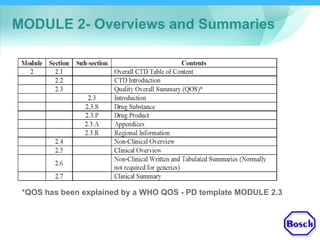
MODULE 2- Overviews and Summaries
*QOS has been explained by a WHO QOS - PD template MODULE 2.3
17
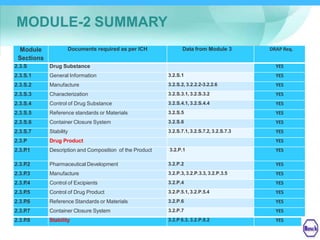
MODULE-2 SUMMARY
Module
Sections
Documents required as per ICH Data from Module 3 DRAP Req.
2.3.S Drug Substance YES
2.3.S.1 General Information 3.2.S.1 YES
2.3.S.2 Manufacture 3.2.S.2, 3.2.2.2-3.2.2.6 YES
2.3.S.3 Characterization 3.2.S.3.1, 3.2.S.3.2 YES
2.3.S.4 Control of Drug Substance 3.2.S.4.1, 3.2.S.4.4 YES
2.3.S.5 Reference standards or Materials 3.2.S.5 YES
2.3.S.6 Container Closure System 3.2.S.6 YES
2.3.S.7 Stability 3.2.S.7.1, 3.2.S.7.2, 3.2.S.7.3 YES
2.3.P Drug Product YES
2.3.P.1 Description and Composition of the Product 3.2.P.1 YES
2.3.P.2 Pharmaceutical Development 3.2.P.2 YES
2.3.P.3 Manufacture 3.2.P.3, 3.2.P.3.3, 3.2.P.3.5 YES
2.3.P.4 Control of Excipients 3.2.P.4 YES
2.3.P.5 Control of Drug Product 3.2.P.5.1, 3.2.P.5.4 YES
2.3.P.6 Reference Standards or Materials 3.2.P.6 YES
2.3.P.7 Container Closure System 3.2.P.7 YES
2.3.P.8 Stability 3.2.P 8.3, 3.2.P.8.2 YES
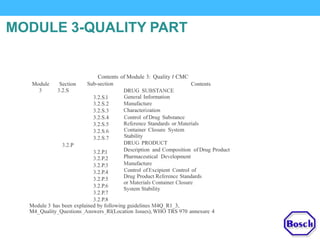
MODULE 3-QUALITY PART
Contents of Module 3: Quality I CMC
Sub-sectionModule
3
Section
3.2.S
Contents
DRUG SUBSTANCE
General Information
Manufacture
Characterization
Control of Drug Substance
Reference Standards or Materials
Container Closure System
Stability
DRUG PRODUCT
Description and Composition of Drug Product
Pharmaceutical Development
Manufacture
Control of Excipient Control of
Drug Product Reference Standards
or Materials Container Closure
System Stability
3.2.S.l
3.2.S.2
3.2.S.3
3.2.S.4
3.2.S.5
3.2.S.6
3.2.S.7
3.2.P
3.2.P.l
3.2.P.2
3.2.P.3
3.2.P.4
3.2.P.5
3.2.P.6
3.2.P.7
3.2.P.8
Module 3 has been explained by following guidelines M4Q_R1_3,
M4_Quality_Questions_Answers_Rl(Location Issues), WHO TRS 970 annexure 4
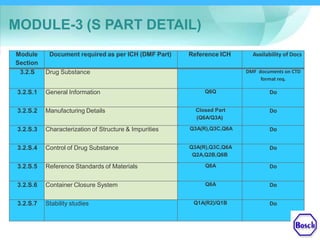
MODULE-3 (S PART DETAIL)
Module
Section
Document required as per ICH (DMF Part) Reference ICH Availability of Docs
3.2.S Drug Substance DMF documents on CTD
format req.
3.2.S.1 General Information Q6Q Do
3.2.S.2 Manufacturing Details Closed Part
(Q6A/Q3A)
Do
3.2.S.3 Characterization of Structure & Impurities Q3A(R),Q3C,Q6A Do
3.2.S.4 Control of Drug Substance Q3A(R),Q3C,Q6A
Q2A,Q2B,Q6B
Do
3.2.S.5 Reference Standards of Materials Q6A Do
3.2.S.6 Container Closure System Q6A Do
3.2.S.7 Stability studies Q1A(R2)/Q1B Do
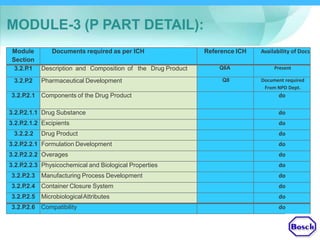
MODULE-3 (P PART DETAIL):
Module
Section
Documents required as per ICH Reference ICH Availability of Docs
3.2.P.1 Description and Composition of the Drug Product Q6A Present
3.2.P.2 Pharmaceutical Development Q8 Document required
From NPD Dept.
3.2.P.2.1 Components of the Drug Product do
3.2.P.2.1.1 Drug Substance do
3.2.P.2.1.2 Excipients do
3.2.2.2 Drug Product do
3.2.P.2.2.1 Formulation Development do
3.2.P.2.2.2 Overages do
3.2.P.2.2.3 Physicochemical and Biological Properties do
3.2.P.2.3 Manufacturing Process Development do
3.2.P.2.4 Container Closure System do
3.2.P.2.5 MicrobiologicalAttributes do
3.2.P.2.6 Compatibility do
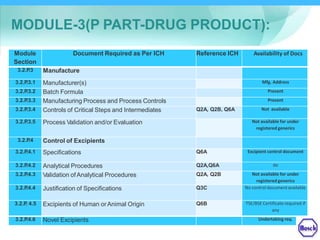
MODULE-3(P PART-DRUG PRODUCT):
Module
Section
Document Required as Per ICH Reference ICH Availability of Docs
3.2.P.3 Manufacture
3.2.P.3.1 Manufacturer(s) Mfg. Address
3.2.P.3.2 Batch Formula Present
3.2.P.3.3 Manufacturing Process and Process Controls Present
3.2.P.3.4 Controls of Critical Steps and Intermediates Q2A, Q2B, Q6A Not available
3.2.P.3.5 Process Validation and/or Evaluation Not available for under
registered generics
3.2.P.4 Control of Excipients
3.2.P.4.1 Specifications Q6A Excipient control document
3.2.P.4.2 Analytical Procedures Q2A,Q6A do
3.2.P.4.3 Validation ofAnalytical Procedures Q2A, Q2B Not available for under
registered generics
3.2.P.4.4 Justification of Specifications Q3C No control documentavailable
3.2.P. 4.5 Excipients of Human orAnimal Origin Q6B TSE/BSE Certificate required if
any
3.2.P.4.6 Novel Excipients Undertaking req.
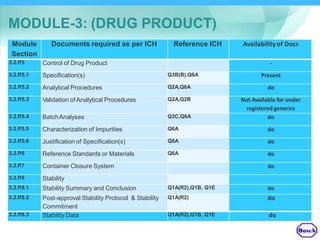
MODULE-3: (DRUG PRODUCT)
Module
Section
Documents required as per ICH Reference ICH Availability of Docs
3.2.P.5 Control of Drug Product -
3.2.P.5.1 Specification(s) Q3B(B),Q6A Present
3.2.P.5.2 Analytical Procedures Q2A,Q6A do
3.2.P.5.3 Validation ofAnalytical Procedures Q2A,Q2B Not Available for under
registered generics
3.2.P.5.4 BatchAnalyses Q3C,Q6A do
3.2.P.5.5 Characterization of Impurities Q6A do
3.2.P.5.6 Justification of Specification(s) Q6A do
3.2.P.6 Reference Standards or Materials Q6A do
3.2.P.7 Container Closure System do
3.2.P.8 Stability
3.2.P.8.1 Stability Summary and Conclusion Q1A(R2),Q1B, Q1E do
3.2.P.8.2 Post-approval Stability Protocol & Stability
Commitment
Q1A(R2) do
3.2.P.8.3 Stability Data Q1A(R2),Q1B, Q1E do
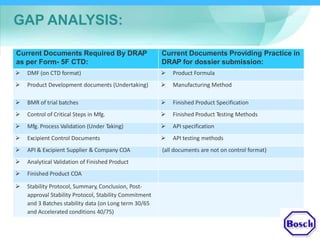
GAP ANALYSIS:
Current Documents Required By DRAP
as per Form- 5F CTD:
Current Documents Providing Practice in
DRAP for dossier submission:
 DMF (on CTD format)  Product Formula
 Product Development documents (Undertaking)  Manufacturing Method
 BMR of trial batches  Finished Product Specification
 Control of Critical Steps in Mfg.  Finished Product Testing Methods
 Mfg. Process Validation (Under Taking)  API specification
 Excipient Control Documents  API testing methods
 API & Excipient Supplier & Company COA (all documents are not on control format)
 Analytical Validation of Finished Product
 Finished Product COA
 Stability Protocol, Summary, Conclusion, Post-
approval Stability Protocol, Stability Commitment
and 3 Batches stability data (on Long term 30/65
and Accelerated conditions 40/75)
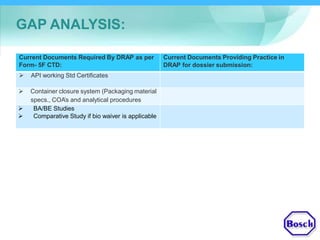
GAP ANALYSIS:
Current Documents Required By DRAP as per
Form- 5F CTD:
Current Documents Providing Practice in
DRAP for dossier submission:
 API working Std Certificates
 Container closure system (Packaging material
specs., COA’s and analytical procedures
 BA/BE Studies
 Comparative Study if bio waiver is applicable
Common Tecnical Dossier (CTD) implementtion in Pakistan

Common Tecnical Dossier (CTD) implementtion in Pakistan

  • 1.
    CTD Dossier Implementationby DRAP PresentedBy: Dr. JibranKhan ManagerRegulatoryAffairs BoschGroup
  • 2.
    DRUG REGULATORY AUTHORITYOF PAKISTAN ► SRO. 932(I)/2017 ► SRO. 713(I)/2018 ► Enforcement of CTD (Common Technical Document) as Standard Dossier Document for Applying Drug product Registration in DRAP ► Implementation Date: 01-01-2019
  • 3.
    What is CTD ►CTD stand of Common Technical Document ► A CTD is a set of Technical Document required by International Regulatory Agencies /HA’s for the purpose of Granting Marketing Authorization of a Pharmaceutical Product in their respective countries. ► In Now days these CTD based Technical documents are included in the Application Dossier for Registration/Renewal of Pharmaceutical Products Human use. for
  • 4.
    History of CTD ►Before CTD Regulators from Different countries HA receives application and spends about 2 to 3 Years in its review before decision for its approval of Marketing Authorization for use in Human a Dossier giving any Beings. ► Reason for such delay was more on ambiguity based on different types of technical documents in which a Application Dossier were submitted by different Pharmaceutical Companies. ► To harmonize these ambiguity Industries came up with CTD-Documents in order to speed up Regulatory Approvals.
  • 5.
    History of CTD • • • IntroducedBy Industries in 1995-1996 ICH did not approve the format for RegulatoryAgencies ICH advised more research work on CTD format.Phase 1 In Year 2000 CTD-Format was officially approved in the 10th Anniversary of ICH in USA. Different Regulatory agencies were given task by ICH for making it acceptable worldwide • • Phase 2 • 3 RegulatoryAgencies US-FDA, EMEA-Europe, PMDA, Japan created the final CTD-GUIDELINES after approval from ICH. In 2003 CTD becomes mandatory for Pharmaceutical companies to get MarketingAuthorization Approval in USA, EUROPE and JAPAN. • Phase 3
  • 6.
    Purpose of CTD Toreduce ambiguity among different formats of technical documents into one harmonize form for Regulatory Agencies/Authorities fast Approval To enable more focus on Pharmaceuticals for Human Use in shape of SAFETY, EFFICACY and ECONOMY For example inclusion of B.E studies in CTD format ensures Generic Product Safety and Efficacy for final Marketing authorization To harmonize all Pharmaceuticals worldwide under one umbrella of Quality standard i.e CTD
  • 7.
    Nations/Region who firstadopted CTD CTD IS A JOINT EFFORT OF 3 REGULATORYAGENCIES: 1.European MedicinesAgency (EMEA, Europe), 2. Food and DrugAdministration (FDA, USA) and 3. Ministry of Health, Labour and Welfare (MHLW,Japan) And there Pharmaceutical associations
  • 8.
    Current CTD AcceptingRegions ► USA ► CANADA ► EUROPE ► AUSTRALIA ► JAPAN ► AFRICA (West African Countries, Eastern African Countries, Francophone etc. ► ASEAN (ACTD IMPLEMENTED) ► CHINA
  • 9.
    CTD-TRIANGLE NOT Part of theCTDRegional Admin Information Module 1 Module 2 The CTDClinical OverviewQuality Overall Summary Module 3 Qu Over Summ Nonclinical Overview C Ov Nonclinical Summary Clinical Summary Quality Nonclinical Study Reports Module 4 Clinical Study Reports Module 5
  • 10.
    Documentation for Marketing Authorization • • AdministrativePart Regional InformationMODULE-1 • • Quality Overall Summary Summary of Module-3 (QOS/QIS) MODULE-2 • • Drug Substance Part (DMF) Drug Product Part (FPP)MODULE-3 • • Applicable only for New Chemical Entities Not Applicable for Generic ManufacturersMODULE-4 • • BA/BE Studies Comparative Study if bio waiverMODULE-5 October 23, 2017 10
  • 11.
    MODULE 1-Administrative Part RegionalRequirements of DRAP Marketing Authorization for
  • 12.
    "FORM 5-F" [See rule26 (l)] Common Technical Document (CTD) for Registration of Human Drugs contents o fM0dule 1 :Admtntstrattve part HeadingSection Sub- Section 1.1 1.2 1.3 1.3.1 Covering Letter and Fee Deposit Slip Table of Contents (From Module 1 to Module 5) Applicant Information Name, address and contact details of Applicant I Marketing Authorization Holder: Name, address and contact details of Manufacturing site. Specify whether the Applicant is: 1.3.2 1.3.3 a. b. c. Valid D Manufacturer D Importer Dls involved in none ofthe above (contract giver) Drug Manufacturing License (DML) of manufacturer I Applicant or1.3.4 Drug Sale License, whichever is aoolicable. Evidence of approval of manufacturing facility I Approved Section from Licensing Authority List of already approved registered drugs in this section 1.3.5 1.3.6 1.3.7 Identification of Signature(s) of authorized persons, Incharge Quality Control and Incharge Quality Assurance Manufacturer's Site Master File and Credential (for importer) Type ofAoolication Application is for the registration of: D New Drug Product (NDP) D Generic Drug Product (GDP) Pharmaceutical product is intended for: D Domestic sale D Export sale D Domestic and Export sales For imported products, please specify one of following: D Finished Pharmaceutical Product Import D Bulk Import and local repacking (specify status of bulk) D Bulk Import Local Repacking for Export purpose only Production, 1.3.8 1.4 1.4.1 1.4.1 1.4.2
  • 13.
    MODULE 1-Administrative Part 1.4.3Contract Manufacturing as per Rule 20-A of Drugs (Licensing, Registering and Advertising) Rules, 1976. D Domestic Manufacturing D Export Purpose Only Detailed Information of Drue, Dosaue From & LabelllnzClaims Generic name with chemical name & synonyms of the applied drug. Strength I concentration of drug of Active Pharmaceutical ingredient (API) per unit The proposed proprietary name I brand name under which the drug lS intended to be sold with trade mark certification I clearance. Proposed Pack size and Proposed unit price of drug e.g., per tablet I capsule. Maximum Retail Price (MRP) per pack shall also be mentioned. Pharmacotherapeutic Group of Active Pharmaceutical Ingredient (API) Pharmacopoeia! reference I Status of applied formulation Route of administration For Generic Drug Product, reference of other similar approved medicines with information pertaining to Manufacturer name, brand name, strength, composition, registration number & dosage form, Pack size and Price. The registration status of applied drug in same molecule and salt, strength, 1.5 1.5.1 1.5.2 1.5.3 1.5.4 1.5.5 1.5.6 1.5.7 1.5.8 1.5.9 dosage form, container closure system, indications and route of administration etc. in other countries. The status in authorities is mandatory to mention. Dosage form of applied drug reference regulatory 1.5.10 1.5.11 Proposed label (outer (secondary) & inner (primary)) colour scheme in& accordance with specimens Drug (Labelling & Packing) Rules, 1986 along with
  • 14.
    MODULE 1-Administrative Part 1.5.13Training evidence of technical staff with respect of manufacturing of applied drug (mandatory in case of specially designed pharmaceutical product I Novel Dosage Form). 1.5.14 Summary of Product Characteristics (SmPC) including Prescribing Information (PI) along with Patient information Leaflet (PIL) of the Finished Pharmaceuticals Product (FPP). Commitment I Undertaking that after registration of applied drug, the Pharmacovigilance department of the applicant I manufactureis liable to impose similar restrictions, addition of any clinical information (like in Indications, Contra-indications, Side effects, Precautions, Dosage & Adverse Drug Reactions etc. m Summary of Product Characteristics (SmPC), Labelling & Promotional material) or withdraw the drug from market in Pakistan within fourteen days after knowing that such information (which was not available or approved by the DRAP at the time of registration) I actions taken (for safety reasons) by any reference I stringent drug regulatory agency I authority & also inform the DRAP (Drug Regulatory Authority of Pakistan) for further action in this regard. Commitment I Undertaking that the applicant shall recall the defective Finished Pharmaceutical Products (FPP) and notify the compliance to the authority along with detail of actions taken by him as soon as possible but not more than ten days. The level of recall shall also be defined. Commitment I Undertaking that in case of any false claim I concealing of 1.5.15 1.5.16 1.5.17
  • 15.
    MODULE 1-Administrative Part information,the DRAP has the right to reject the application at any time, before and even after approval or registration of the product in case if proved so. 1.5.18 Cornrrritrnerrt I Undertaking that the firm shall follow the official in the of the in any phannacopoeia specifications for product I substance as published latest edition & shall update its same. In case, the specifications official pharmacopoeia the firm specification as per latest editions of product I substance not present shall establish the specifications. In both cases, the validation of specifications shall be done by the aoolicant. Commitm.ent I Undertaking that in case of any post approval change, the1.5.19 approvalsapplicant shall ensure that the product with both shall not be available in the m.arket at the sarne 'tirrre. And the product with new approvals shall be rrrark.eted only after consumption I withdrawal of stock with previous approvals. The company shall be liable to inform the marketing status of product to the DRAP after getting such approvals. Other committnent evg., regarding stability studies etc. sanie regarding post-registration 1.5.20 1.5.21 Protocols along with the comrrritrnent to follow Good (GLP) by the Manufacturer. PracticesLaboratory 1.5.22 Protocols to irnplerrierit Good Phannacovigilance Practice by the Pharmacovigilance department/section of the Manufacturer I Corrrcanv. l1.iscellaneous Inf'orrnation Information on Prior-related Annlications Appendix Electronic Review Package QIS (Quality Information Summary) Drug Substance related Doourne.nt including following: 1.6 1.6.1 1.6.2 1.6.3 1.6.4 1.6.5 a. b. Name and address of API manufacturer. Approval of manufacturing facility of API by regulatory body of country and validity. Vendor qualificationI audit is Document based Site inspection based Reason for point c. c. o 0 d.
  • 16.
    MODULE 2- Overviewsand Summaries *QOS has been explained by a WHO QOS - PD template MODULE 2.3
  • 17.
    17 MODULE-2 SUMMARY Module Sections Documents requiredas per ICH Data from Module 3 DRAP Req. 2.3.S Drug Substance YES 2.3.S.1 General Information 3.2.S.1 YES 2.3.S.2 Manufacture 3.2.S.2, 3.2.2.2-3.2.2.6 YES 2.3.S.3 Characterization 3.2.S.3.1, 3.2.S.3.2 YES 2.3.S.4 Control of Drug Substance 3.2.S.4.1, 3.2.S.4.4 YES 2.3.S.5 Reference standards or Materials 3.2.S.5 YES 2.3.S.6 Container Closure System 3.2.S.6 YES 2.3.S.7 Stability 3.2.S.7.1, 3.2.S.7.2, 3.2.S.7.3 YES 2.3.P Drug Product YES 2.3.P.1 Description and Composition of the Product 3.2.P.1 YES 2.3.P.2 Pharmaceutical Development 3.2.P.2 YES 2.3.P.3 Manufacture 3.2.P.3, 3.2.P.3.3, 3.2.P.3.5 YES 2.3.P.4 Control of Excipients 3.2.P.4 YES 2.3.P.5 Control of Drug Product 3.2.P.5.1, 3.2.P.5.4 YES 2.3.P.6 Reference Standards or Materials 3.2.P.6 YES 2.3.P.7 Container Closure System 3.2.P.7 YES 2.3.P.8 Stability 3.2.P 8.3, 3.2.P.8.2 YES
  • 18.
    MODULE 3-QUALITY PART Contentsof Module 3: Quality I CMC Sub-sectionModule 3 Section 3.2.S Contents DRUG SUBSTANCE General Information Manufacture Characterization Control of Drug Substance Reference Standards or Materials Container Closure System Stability DRUG PRODUCT Description and Composition of Drug Product Pharmaceutical Development Manufacture Control of Excipient Control of Drug Product Reference Standards or Materials Container Closure System Stability 3.2.S.l 3.2.S.2 3.2.S.3 3.2.S.4 3.2.S.5 3.2.S.6 3.2.S.7 3.2.P 3.2.P.l 3.2.P.2 3.2.P.3 3.2.P.4 3.2.P.5 3.2.P.6 3.2.P.7 3.2.P.8 Module 3 has been explained by following guidelines M4Q_R1_3, M4_Quality_Questions_Answers_Rl(Location Issues), WHO TRS 970 annexure 4
  • 19.
    MODULE-3 (S PARTDETAIL) Module Section Document required as per ICH (DMF Part) Reference ICH Availability of Docs 3.2.S Drug Substance DMF documents on CTD format req. 3.2.S.1 General Information Q6Q Do 3.2.S.2 Manufacturing Details Closed Part (Q6A/Q3A) Do 3.2.S.3 Characterization of Structure & Impurities Q3A(R),Q3C,Q6A Do 3.2.S.4 Control of Drug Substance Q3A(R),Q3C,Q6A Q2A,Q2B,Q6B Do 3.2.S.5 Reference Standards of Materials Q6A Do 3.2.S.6 Container Closure System Q6A Do 3.2.S.7 Stability studies Q1A(R2)/Q1B Do
  • 20.
    MODULE-3 (P PARTDETAIL): Module Section Documents required as per ICH Reference ICH Availability of Docs 3.2.P.1 Description and Composition of the Drug Product Q6A Present 3.2.P.2 Pharmaceutical Development Q8 Document required From NPD Dept. 3.2.P.2.1 Components of the Drug Product do 3.2.P.2.1.1 Drug Substance do 3.2.P.2.1.2 Excipients do 3.2.2.2 Drug Product do 3.2.P.2.2.1 Formulation Development do 3.2.P.2.2.2 Overages do 3.2.P.2.2.3 Physicochemical and Biological Properties do 3.2.P.2.3 Manufacturing Process Development do 3.2.P.2.4 Container Closure System do 3.2.P.2.5 MicrobiologicalAttributes do 3.2.P.2.6 Compatibility do
  • 21.
    MODULE-3(P PART-DRUG PRODUCT): Module Section DocumentRequired as Per ICH Reference ICH Availability of Docs 3.2.P.3 Manufacture 3.2.P.3.1 Manufacturer(s) Mfg. Address 3.2.P.3.2 Batch Formula Present 3.2.P.3.3 Manufacturing Process and Process Controls Present 3.2.P.3.4 Controls of Critical Steps and Intermediates Q2A, Q2B, Q6A Not available 3.2.P.3.5 Process Validation and/or Evaluation Not available for under registered generics 3.2.P.4 Control of Excipients 3.2.P.4.1 Specifications Q6A Excipient control document 3.2.P.4.2 Analytical Procedures Q2A,Q6A do 3.2.P.4.3 Validation ofAnalytical Procedures Q2A, Q2B Not available for under registered generics 3.2.P.4.4 Justification of Specifications Q3C No control documentavailable 3.2.P. 4.5 Excipients of Human orAnimal Origin Q6B TSE/BSE Certificate required if any 3.2.P.4.6 Novel Excipients Undertaking req.
  • 22.
    MODULE-3: (DRUG PRODUCT) Module Section Documentsrequired as per ICH Reference ICH Availability of Docs 3.2.P.5 Control of Drug Product - 3.2.P.5.1 Specification(s) Q3B(B),Q6A Present 3.2.P.5.2 Analytical Procedures Q2A,Q6A do 3.2.P.5.3 Validation ofAnalytical Procedures Q2A,Q2B Not Available for under registered generics 3.2.P.5.4 BatchAnalyses Q3C,Q6A do 3.2.P.5.5 Characterization of Impurities Q6A do 3.2.P.5.6 Justification of Specification(s) Q6A do 3.2.P.6 Reference Standards or Materials Q6A do 3.2.P.7 Container Closure System do 3.2.P.8 Stability 3.2.P.8.1 Stability Summary and Conclusion Q1A(R2),Q1B, Q1E do 3.2.P.8.2 Post-approval Stability Protocol & Stability Commitment Q1A(R2) do 3.2.P.8.3 Stability Data Q1A(R2),Q1B, Q1E do
  • 23.
    GAP ANALYSIS: Current DocumentsRequired By DRAP as per Form- 5F CTD: Current Documents Providing Practice in DRAP for dossier submission:  DMF (on CTD format)  Product Formula  Product Development documents (Undertaking)  Manufacturing Method  BMR of trial batches  Finished Product Specification  Control of Critical Steps in Mfg.  Finished Product Testing Methods  Mfg. Process Validation (Under Taking)  API specification  Excipient Control Documents  API testing methods  API & Excipient Supplier & Company COA (all documents are not on control format)  Analytical Validation of Finished Product  Finished Product COA  Stability Protocol, Summary, Conclusion, Post- approval Stability Protocol, Stability Commitment and 3 Batches stability data (on Long term 30/65 and Accelerated conditions 40/75)
  • 24.
    GAP ANALYSIS: Current DocumentsRequired By DRAP as per Form- 5F CTD: Current Documents Providing Practice in DRAP for dossier submission:  API working Std Certificates  Container closure system (Packaging material specs., COA’s and analytical procedures  BA/BE Studies  Comparative Study if bio waiver is applicable