COMMON ORTHOPAEDIC DISORDERS
PREVENTION VS TREATMENT
Ahmed Suparno Bahar Moni
MS (Ortho)
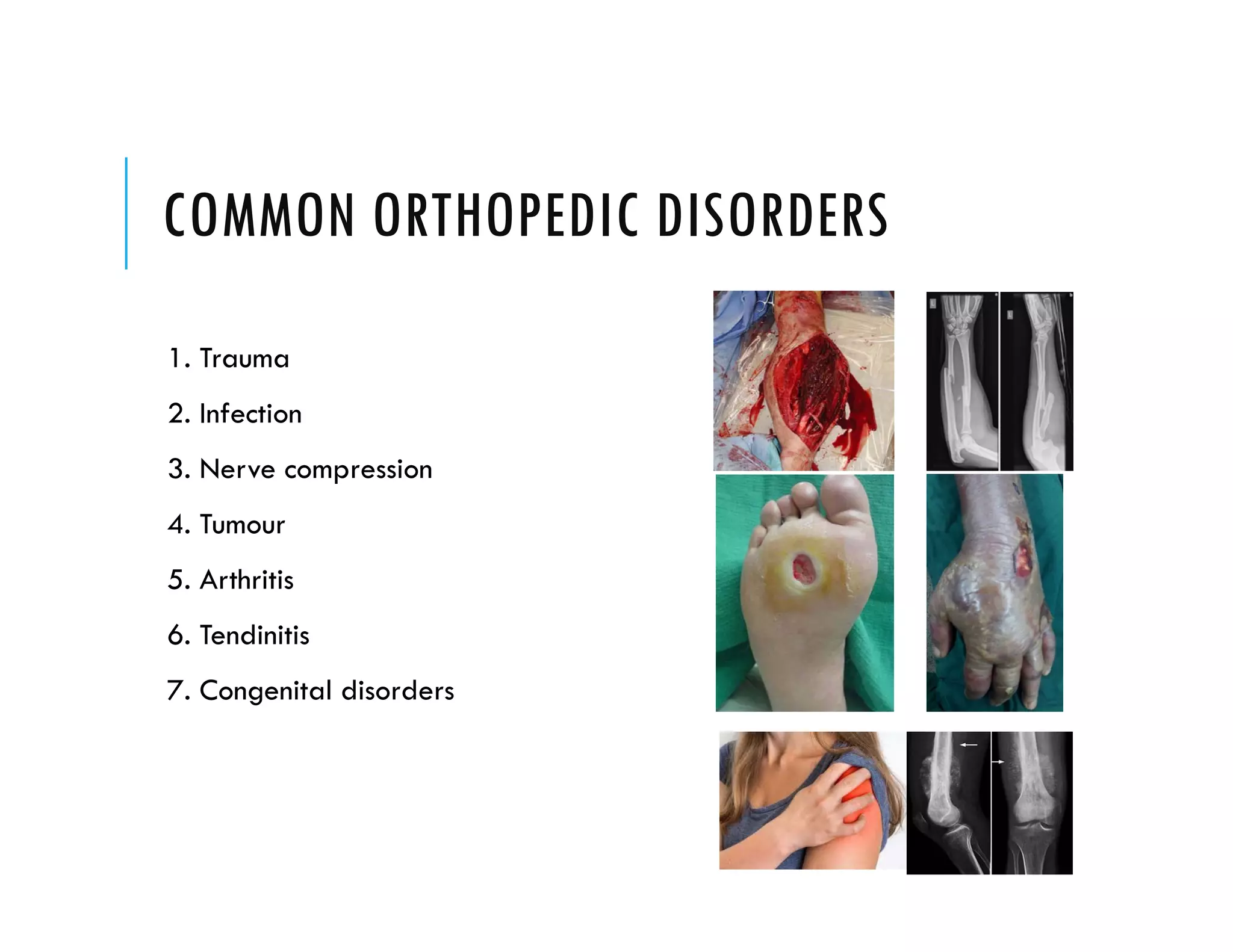
COMMON ORTHOPEDIC DISORDERS
1. Trauma
2. Infection
3. Nerve compression
4. Tumour
5. Arthritis
6. Tendinitis
7. Congenital disorders
TRAUMATIC INJURY
Soft tissue injury –
 Muscle injury
 Tendon injury – partial,
complete
 Ligament injury – sprain, strain,
rupture.
 Nerve injury
 Vessel injury
 Skin injury
ANKLE SPRAIN
Lig inj. – Talo-fibular or
calcaneo-fibular lig
C/F –
 Pain, specially when bear
weight
 Tenderness
 Swelling
 Bruising
 Restricted range of motion
 Instability in the ankle
CAUSES:
• Ankle twist.
• Landing awkwardly on foot
after jumping or pivoting.
• Walking or exercising on uneven
surface.
• Another person stepping or
landing on your foot during
sports.
TREATMENT
Self-care - R.I.C.E.
Rest - Avoid activities
Ice pack - immediately for 15 to
20 min, repeat every 2/3 hours.
Compression - With elastic
bandage
Don't wrap too tightly.
Elevation.
Drugs - Ibuprofen (Advil) or naproxen or acetaminophen (Panadol).
Devices - elastic bandage, sports tape or an ankle support brace.
In severe sprain, a cast or walking boot.
Crutch walking.
Therapy.
Rarely surgery to repair or reconstruct the ligament.
PREVENTION
• Wear proper, well fitted shoes.
• Minimize wearing high-heeled
shoes.
• Warm up before exercise or
sports
• Be careful when walking, running
or working on uneven surface.
• Don't participate sports or
activities you are not conditioned.
• Know and respect your
limitations.
• Maintain good muscle strength
and flexibility.
• Practice stability training,
including balance exercises.
• Use ankle support brace or tape
on previously injured ankle.
Bone and joint injury –
 Dislocation/ subluxation –
hip, shoulder, elbow
 Fracture – any bone
WRIST FRACTURE
Distal radius fracture
Fall on outstretched hand
C/F:
 Severe pain - might worsen
when squeezing or moving
 Swelling
 Tenderness
 Bruising
 Obvious deformity
RISK FACTORS
Age – elderly after 60
Sex – female
Osteoporosis
Common in sports like in-line skating
TREATMENT
Conservative:
 For un-displaced or displaced stable fracture –
Immobilization (if needed reduction) by plaster cast
Surgery:
 Unstable fracture - fracture in which bone pieces move before
healing
 Open fracture – associated soft tissue injury
 Intra articular fracture - fracture extend into joint
 Loose bone fragments that could enter a joint
 Damage to the surrounding ligaments, nerves or blood vessels
PLATTING
EX FIX
PREVENTION
Build bone strength -
 Nutritious diet - adequate calcium, vit. D
 Plenty of weight-bearing exercise -walking
 Quit smoking
Use protective gear for athletic activities - wrist guards
for high-risk activities.
Prevent fall onto outstretched hand -
 Wear sensible shoes
 Light up the living space
 Have vision checked
 Install grab bars in bathroom
 Install handrails on stairways
 Avoid slippery surfaces
INFECTION
 OM –
 Acute
 Chronic
 Septic arthritis
 DFU
 Hand infection
DFU
Very common in long standing
uncontrolled DM patients.
Sequel of diabetic neuropathy.
PREVENTION
Proper diabetes management: 3 D
• Healthy diet.
• Discipline - regular exercise
• Blood sugar monitoring and adherence to prescribed drugs.
Proper foot care:
• Inspect feet daily - for blisters, cuts, cracks, sores, redness,
tenderness or swelling.
If trouble reaching feet, use mirror to see the bottoms of the feet.
Place the mirror on the floor if it's too difficult to hold, or ask
someone to help.
• Wash feet daily - in lukewarm (not hot) water. Dry them gently,
especially between the toes.
Sprinkle talcum powder or cornstarch between toes to keep the skin
dry.
Use a moisturizing cream or lotion on the tops and bottoms of feet to
keep the skin soft.
• Don't remove calluses or other foot lesions - Don't use a nail file,
nail clipper or scissors on calluses, corns, bunions or warts. Don't use
chemical wart removers.
• Trim toenails carefully - Trim your nails straight across. Carefully file
sharp ends with an emery board.
• Don't go barefoot - even around the house.
• Wear clean, dry socks - Wear socks made of fibers that pull sweat
away from skin, such as cotton and special acrylic fibers.
• Buy shoes that fit properly - Avoid tightfitting shoes and high heels
or narrow shoes that crowd your toes.
May need specially designed shoes (orthopedic shoes).
• Don't smoke - Smoking impairs circulation and reduces the amount of
oxygen in your blood.
• Schedule regular foot checkups - Schedule foot exams at least once
a year or more often if recommended by your doctor.
TREATMENT
Vary depending on the severity.
In general, treatment includes
 Removal of dead tissue or debris.
 Keep the wound clean and promote healing.
Wounds need to be monitored frequently.
When the condition results in a severe loss of tissue or a
life-threatening infection, an amputation may be the only
option.
If ulcer is healthy, need to reconstruct the wound by
grafting or flap.
Hand Infection
TREATMENT
Antibiotic
Analgesic
Hand bath – with lukewarm saline
If needed surgery
CHRONIC PAIN
Neck and Back –
• Cervical Spondylosis
• Lumbar spondylosis
Shoulder –
• Frozen shoulder
• Rotator cuff tear
• OA
Elbow –
• Tennis elbow
• Golfer’s elbow
Wrist –
• De quervain’s disease
• Ulnar sided wrist pain – TFCC inj
Finger –
• Trigger finger
Knee –
• OA knee
• Gout
FROZEN SHOULDER
C/F:
Develops slowly, in 3 stages.
1. Freezing stage - movement of shoulder causes pain, and shoulder’s
ROM starts to become limited.
2. Frozen stage - Pain begin to diminish but shoulder becomes stiffer
3. Thawing stage - The ROM of shoulder begins to improve.
For some people, pain worsens at night.
RISK FACTORS
Age and sex - 40 and older, particularly women
Immobility or reduced mobility - may be the result of
 Rotator cuff injury
 Broken arm
 Stroke
 Recovery from surgery
Systemic diseases – DM, hyperthyroidism,
hypothyroidism, Cardiovascular disease, Tuberculosis,
Parkinson's disease
PREVENTION
One of the most common causes of frozen shoulder is
immobility during recovery from a shoulder injury, broken
arm or a stroke.
In case of injury that makes shoulder difficult to move,
have to take doctor’s advice about exercises to maintain
ROM of shoulder.
Pendulum exercise Towel stretch
Finger walk
TREATMENT
• Medications – NSAIDs, paracetamol
• Physical therapy - ROM exercises
• Steroid injections.
If not improved by 1 year:
• Joint distension by injecting sterile water into the joint
capsule to stretch the tissue.
• Shoulder manipulation - Under general anesthetic
• Surgery – arthroscopic debridement.
NERVE PROBLEMS
Compression neuropathies:
Tingling, numbness, pain, weakness
Common Sites:
• Common peroneal nerve – at fibular neck
• Tibial nerve – TTS
• Median nerve: CTS, Pronator syndrome
• Ulnar nerve: CuTS, Guyon Canal Syndrome
• Radial nerve: Wartenberg syndrome
CTS
Compression neuropathy of
Median nerve at carpal
tunnel.
Tingling, numbness, pain
and weakness of radial 3
and half fingers
RISK FACTORS
Anatomic factors - wrist fracture or dislocation or arthritis.
Sex - more common in women as carpal tunnel area is relatively
smaller.
Nerve-damaging conditions - chronic illnesses, such as DM
Inflammatory conditions - RA
Obesity.
Alterations in body fluids balance - Fluid retention - during
pregnancy, menopause.
Other medical conditions. thyroid disorders and kidney failure
Workplace factors - working with vibrating tools or work requires
prolonged or repetitive flexing of the wrist
PREVENTION
No proven strategy
Reduce the force and relax the grip - If work involves a keyboard, hit
the keys softly. For prolonged handwriting, use a big pen with an
oversized, soft grip adapter.
Take frequent breaks - Periodic gentle stretch and bend of hands and
wrists. Alternate tasks if possible.
Watch the form - Avoid bending wrist all the way up or down. A
relaxed middle position is best.
Improve posture - Incorrect posture rolls shoulders forward, shortening
the neck & shoulder muscles and compressing nerves at neck.
Change computer mouse – to a comfortable one
Keep hands warm.
TREATMENT
Conservative
 Wrist splinting - Night time splinting at neutral wrist
 NSAIDs - ibuprofen (Advil)
 Physio
 Corticosteroids inj.
 PRP
Surgery
 Open surgery
 Endoscopic surgery –
 Chow 2 portal
 Agee 1 portal
Open release of Median nerve
Under LA + tourniquet
Under WALANT
Endo release
Agee single portal
Under GA
ARTHRITIS
• OA
• RA
• Gout
OA
Develops slowly, worsen over time
C/F:
 Pain - during or after movement.
 Stiffness - most noticeable upon awakening or after being inactive.
 Tenderness - when apply light pressure
 Grating sensation - might feel grating sensation when use the joint
and might hear popping or crackling.
 Bone spurs - extra bits of bone, which feel like hard lumps, can form
around the affected joint.
 Swelling.
RISK FACTORS
Older age - risk increases with age.
Sex - Women are more likely to develop
Obesity -. Increased weight adds stress to weight-bearing joints, hips
and knees. Fat tissue produces proteins that can cause harmful
inflammation around the joints.
Joint injuries - those that occur when playing sports or from an
accident, can increase the risk of OA.
Repeated stress on the joint – repetitive stress on a joint due to job
or sports might eventually develop OA.
Genetics - Some people inherit a tendency to develop OA.
Bone deformities - Some people born with malformed joints or
defective cartilage.
Certain metabolic diseases – DM, condition in which body has too
much iron (hemochromatosis) contributes OA.
PREVENTION
No proven measures
Exercise - Low-impact exercise (walking, bicycling or water aerobics)
can increase endurance and strengthen the muscles around your joint,
making joint more stable.
Lose weight - even10% weight loss can relieve pain.
Movement therapies - Tai chi and yoga
TREATMENT
Drugs:
 Paracetamol
 NSAIDs – Ibuprofen, Naproxen
 Duloxetine
Physio and Occu therapy
Steroid injection
Hyaluronic acid injection
Other OTC drugs:
 Glucosamine, chondroitin
 Omega 3 fatty acid
Heat and cold.
Brace, shoe, assisted devices.
Transcutaneous electrical nerve
stimulation (TENS).
Surgery:
 Bone realignment surgery –
osteotomy
 Arthrodesis
 Arthroplasty -
CONGENITAL PROBLEMS
Club foot
DDH
Hand deformity -
 Polydactyly
 Syndactyly
POLYDACTYLY
Excision - Preschool
Syndactyly surgery
At 18 months
TUMOUR
Soft tissue tumor –
 Benign
 Malignant
Bony tumor-
 Benign – Osteochondroma, GCT
 Malignant – Secondaries, OS, ES, CS
C/F:
 Bone pain
 Swelling and tenderness near the affected area
 Weakened bone, leading to fracture
 Fatigue
 Unintended weight loss
RISK FACTORS
Inherited genetic syndromes - Li-Fraumeni syndrome, hereditary
retinoblastoma.
Paget's disease of bone - common in older adults. Increases the risk
of bone cancer developing later.
Radiation therapy for cancer.
Surgery-
 Limb salvage
 Amputation
Chemotherapy - not very
effective for chondrosarcoma,
but it's an important part of
treatment for osteosarcoma and
Ewing sarcoma.
Radiation therapy.
TENDON DISORDERS
Pain, weakness
• Trigger finger
• de Quervain Disease
• Intersection syndrome
• Tennis elbow
• Golfer’s elbow
TRIGGER FINGER
Tenosynovitis of A1 pulley
DE QUERVAIN DISEASE
Tenosynovitis of extensor1
compartment
TENNIS ELBOW
Lateral epicondylitis
GOLFER’S ELBOW
Medial epicondylitis
Common orthopedic disorders prevention vs cure

Common orthopedic disorders prevention vs cure

  • 1.
    COMMON ORTHOPAEDIC DISORDERS PREVENTIONVS TREATMENT Ahmed Suparno Bahar Moni MS (Ortho)
  • 2.
    COMMON ORTHOPEDIC DISORDERS 1.Trauma 2. Infection 3. Nerve compression 4. Tumour 5. Arthritis 6. Tendinitis 7. Congenital disorders
  • 3.
    TRAUMATIC INJURY Soft tissueinjury –  Muscle injury  Tendon injury – partial, complete  Ligament injury – sprain, strain, rupture.  Nerve injury  Vessel injury  Skin injury
  • 4.
    ANKLE SPRAIN Lig inj.– Talo-fibular or calcaneo-fibular lig C/F –  Pain, specially when bear weight  Tenderness  Swelling  Bruising  Restricted range of motion  Instability in the ankle
  • 5.
    CAUSES: • Ankle twist. •Landing awkwardly on foot after jumping or pivoting. • Walking or exercising on uneven surface. • Another person stepping or landing on your foot during sports.
  • 6.
    TREATMENT Self-care - R.I.C.E. Rest- Avoid activities Ice pack - immediately for 15 to 20 min, repeat every 2/3 hours. Compression - With elastic bandage Don't wrap too tightly. Elevation.
  • 7.
    Drugs - Ibuprofen(Advil) or naproxen or acetaminophen (Panadol). Devices - elastic bandage, sports tape or an ankle support brace. In severe sprain, a cast or walking boot. Crutch walking. Therapy. Rarely surgery to repair or reconstruct the ligament.
  • 8.
    PREVENTION • Wear proper,well fitted shoes. • Minimize wearing high-heeled shoes. • Warm up before exercise or sports • Be careful when walking, running or working on uneven surface. • Don't participate sports or activities you are not conditioned. • Know and respect your limitations.
  • 9.
    • Maintain goodmuscle strength and flexibility. • Practice stability training, including balance exercises. • Use ankle support brace or tape on previously injured ankle.
  • 10.
    Bone and jointinjury –  Dislocation/ subluxation – hip, shoulder, elbow  Fracture – any bone
  • 11.
    WRIST FRACTURE Distal radiusfracture Fall on outstretched hand C/F:  Severe pain - might worsen when squeezing or moving  Swelling  Tenderness  Bruising  Obvious deformity
  • 12.
    RISK FACTORS Age –elderly after 60 Sex – female Osteoporosis Common in sports like in-line skating
  • 13.
    TREATMENT Conservative:  For un-displacedor displaced stable fracture – Immobilization (if needed reduction) by plaster cast
  • 14.
    Surgery:  Unstable fracture- fracture in which bone pieces move before healing  Open fracture – associated soft tissue injury  Intra articular fracture - fracture extend into joint  Loose bone fragments that could enter a joint  Damage to the surrounding ligaments, nerves or blood vessels
  • 15.
  • 16.
  • 17.
    PREVENTION Build bone strength-  Nutritious diet - adequate calcium, vit. D  Plenty of weight-bearing exercise -walking  Quit smoking Use protective gear for athletic activities - wrist guards for high-risk activities.
  • 18.
    Prevent fall ontooutstretched hand -  Wear sensible shoes  Light up the living space  Have vision checked  Install grab bars in bathroom  Install handrails on stairways  Avoid slippery surfaces
  • 19.
    INFECTION  OM – Acute  Chronic  Septic arthritis  DFU  Hand infection
  • 20.
    DFU Very common inlong standing uncontrolled DM patients. Sequel of diabetic neuropathy.
  • 21.
    PREVENTION Proper diabetes management:3 D • Healthy diet. • Discipline - regular exercise • Blood sugar monitoring and adherence to prescribed drugs. Proper foot care: • Inspect feet daily - for blisters, cuts, cracks, sores, redness, tenderness or swelling. If trouble reaching feet, use mirror to see the bottoms of the feet. Place the mirror on the floor if it's too difficult to hold, or ask someone to help.
  • 22.
    • Wash feetdaily - in lukewarm (not hot) water. Dry them gently, especially between the toes. Sprinkle talcum powder or cornstarch between toes to keep the skin dry. Use a moisturizing cream or lotion on the tops and bottoms of feet to keep the skin soft. • Don't remove calluses or other foot lesions - Don't use a nail file, nail clipper or scissors on calluses, corns, bunions or warts. Don't use chemical wart removers. • Trim toenails carefully - Trim your nails straight across. Carefully file sharp ends with an emery board. • Don't go barefoot - even around the house.
  • 23.
    • Wear clean,dry socks - Wear socks made of fibers that pull sweat away from skin, such as cotton and special acrylic fibers. • Buy shoes that fit properly - Avoid tightfitting shoes and high heels or narrow shoes that crowd your toes. May need specially designed shoes (orthopedic shoes). • Don't smoke - Smoking impairs circulation and reduces the amount of oxygen in your blood. • Schedule regular foot checkups - Schedule foot exams at least once a year or more often if recommended by your doctor.
  • 25.
    TREATMENT Vary depending onthe severity. In general, treatment includes  Removal of dead tissue or debris.  Keep the wound clean and promote healing. Wounds need to be monitored frequently. When the condition results in a severe loss of tissue or a life-threatening infection, an amputation may be the only option. If ulcer is healthy, need to reconstruct the wound by grafting or flap.
  • 26.
  • 27.
    TREATMENT Antibiotic Analgesic Hand bath –with lukewarm saline If needed surgery
  • 28.
    CHRONIC PAIN Neck andBack – • Cervical Spondylosis • Lumbar spondylosis Shoulder – • Frozen shoulder • Rotator cuff tear • OA Elbow – • Tennis elbow • Golfer’s elbow
  • 29.
    Wrist – • Dequervain’s disease • Ulnar sided wrist pain – TFCC inj Finger – • Trigger finger Knee – • OA knee • Gout
  • 30.
    FROZEN SHOULDER C/F: Develops slowly,in 3 stages. 1. Freezing stage - movement of shoulder causes pain, and shoulder’s ROM starts to become limited. 2. Frozen stage - Pain begin to diminish but shoulder becomes stiffer 3. Thawing stage - The ROM of shoulder begins to improve. For some people, pain worsens at night.
  • 31.
    RISK FACTORS Age andsex - 40 and older, particularly women Immobility or reduced mobility - may be the result of  Rotator cuff injury  Broken arm  Stroke  Recovery from surgery Systemic diseases – DM, hyperthyroidism, hypothyroidism, Cardiovascular disease, Tuberculosis, Parkinson's disease
  • 32.
    PREVENTION One of themost common causes of frozen shoulder is immobility during recovery from a shoulder injury, broken arm or a stroke. In case of injury that makes shoulder difficult to move, have to take doctor’s advice about exercises to maintain ROM of shoulder.
  • 33.
  • 34.
  • 35.
    TREATMENT • Medications –NSAIDs, paracetamol • Physical therapy - ROM exercises • Steroid injections. If not improved by 1 year: • Joint distension by injecting sterile water into the joint capsule to stretch the tissue. • Shoulder manipulation - Under general anesthetic • Surgery – arthroscopic debridement.
  • 36.
    NERVE PROBLEMS Compression neuropathies: Tingling,numbness, pain, weakness Common Sites: • Common peroneal nerve – at fibular neck • Tibial nerve – TTS • Median nerve: CTS, Pronator syndrome • Ulnar nerve: CuTS, Guyon Canal Syndrome • Radial nerve: Wartenberg syndrome
  • 37.
    CTS Compression neuropathy of Mediannerve at carpal tunnel. Tingling, numbness, pain and weakness of radial 3 and half fingers
  • 38.
    RISK FACTORS Anatomic factors- wrist fracture or dislocation or arthritis. Sex - more common in women as carpal tunnel area is relatively smaller. Nerve-damaging conditions - chronic illnesses, such as DM Inflammatory conditions - RA Obesity. Alterations in body fluids balance - Fluid retention - during pregnancy, menopause. Other medical conditions. thyroid disorders and kidney failure Workplace factors - working with vibrating tools or work requires prolonged or repetitive flexing of the wrist
  • 39.
    PREVENTION No proven strategy Reducethe force and relax the grip - If work involves a keyboard, hit the keys softly. For prolonged handwriting, use a big pen with an oversized, soft grip adapter. Take frequent breaks - Periodic gentle stretch and bend of hands and wrists. Alternate tasks if possible. Watch the form - Avoid bending wrist all the way up or down. A relaxed middle position is best. Improve posture - Incorrect posture rolls shoulders forward, shortening the neck & shoulder muscles and compressing nerves at neck. Change computer mouse – to a comfortable one Keep hands warm.
  • 40.
    TREATMENT Conservative  Wrist splinting- Night time splinting at neutral wrist  NSAIDs - ibuprofen (Advil)  Physio  Corticosteroids inj.  PRP Surgery  Open surgery  Endoscopic surgery –  Chow 2 portal  Agee 1 portal
  • 41.
    Open release ofMedian nerve Under LA + tourniquet Under WALANT
  • 42.
    Endo release Agee singleportal Under GA
  • 43.
  • 44.
    OA Develops slowly, worsenover time C/F:  Pain - during or after movement.  Stiffness - most noticeable upon awakening or after being inactive.  Tenderness - when apply light pressure  Grating sensation - might feel grating sensation when use the joint and might hear popping or crackling.  Bone spurs - extra bits of bone, which feel like hard lumps, can form around the affected joint.  Swelling.
  • 45.
    RISK FACTORS Older age- risk increases with age. Sex - Women are more likely to develop Obesity -. Increased weight adds stress to weight-bearing joints, hips and knees. Fat tissue produces proteins that can cause harmful inflammation around the joints. Joint injuries - those that occur when playing sports or from an accident, can increase the risk of OA. Repeated stress on the joint – repetitive stress on a joint due to job or sports might eventually develop OA. Genetics - Some people inherit a tendency to develop OA.
  • 46.
    Bone deformities -Some people born with malformed joints or defective cartilage. Certain metabolic diseases – DM, condition in which body has too much iron (hemochromatosis) contributes OA.
  • 47.
    PREVENTION No proven measures Exercise- Low-impact exercise (walking, bicycling or water aerobics) can increase endurance and strengthen the muscles around your joint, making joint more stable. Lose weight - even10% weight loss can relieve pain. Movement therapies - Tai chi and yoga
  • 48.
    TREATMENT Drugs:  Paracetamol  NSAIDs– Ibuprofen, Naproxen  Duloxetine Physio and Occu therapy Steroid injection Hyaluronic acid injection Other OTC drugs:  Glucosamine, chondroitin  Omega 3 fatty acid
  • 49.
    Heat and cold. Brace,shoe, assisted devices. Transcutaneous electrical nerve stimulation (TENS).
  • 50.
    Surgery:  Bone realignmentsurgery – osteotomy  Arthrodesis  Arthroplasty -
  • 51.
    CONGENITAL PROBLEMS Club foot DDH Handdeformity -  Polydactyly  Syndactyly
  • 52.
  • 53.
  • 54.
    TUMOUR Soft tissue tumor–  Benign  Malignant Bony tumor-  Benign – Osteochondroma, GCT  Malignant – Secondaries, OS, ES, CS
  • 55.
    C/F:  Bone pain Swelling and tenderness near the affected area  Weakened bone, leading to fracture  Fatigue  Unintended weight loss
  • 56.
    RISK FACTORS Inherited geneticsyndromes - Li-Fraumeni syndrome, hereditary retinoblastoma. Paget's disease of bone - common in older adults. Increases the risk of bone cancer developing later. Radiation therapy for cancer.
  • 57.
    Surgery-  Limb salvage Amputation Chemotherapy - not very effective for chondrosarcoma, but it's an important part of treatment for osteosarcoma and Ewing sarcoma. Radiation therapy.
  • 58.
    TENDON DISORDERS Pain, weakness •Trigger finger • de Quervain Disease • Intersection syndrome • Tennis elbow • Golfer’s elbow
  • 59.
  • 60.
    DE QUERVAIN DISEASE Tenosynovitisof extensor1 compartment
  • 61.
  • 62.