


COMMON ERORRS
WITH
nagaRAJU
VERBS
nagaRAJU
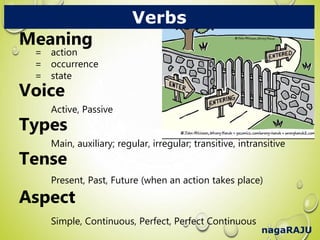
Verbs
Meaning
= action
= occurrence
= state
Voice
Active, Passive
Types
Main, auxiliary; regular, irregular; transitive, intransitive
Tense
Present, Past, Future (when an action takes place)
Aspect
Simple, Continuous, Perfect, Perfect Continuous
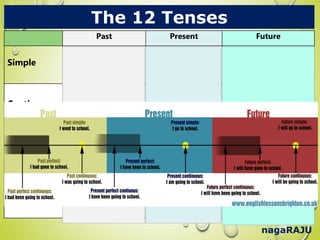
Past Present Future
Simple
I used English yesterday.
(past habit, completed action,
adverb of time)
I use English.
(habits, general truth,
future plan, with mental
action verbs)
I will use English tomorrow.
(future action or occurrence)
Continuous
I was using English when
you entered.
(uncompleted action of the
past, persistent past habits)
I am using English now.
(action going on now,
temporary action, stubborn
habit)
I will be using English when I
travel.
(what will be going on at
sometime in future, planned
future action)
Perfect
I had used English much
before you taught me.
(completed action before
another past event)
I have used English.
(action started in past and
has continued till now)
I will have used English by the
time you leave the class.
(action will be completed before
another future action)
Perfect
Continuous
I had been using English for
five years before you
arrived.
(action began before another
action and continued till then)
I have been using English
for five years.
(action started at a point in
the past and may not be
complete)
I will have been using English for
a few years when I return to India.
(action will have happened for
some time and will not be
complete yet)
nagaRAJU
The 12 Tenses
nagaRAJU
1. Incorrect Tense
 Stars are twinkling every night.
 The workshop has begun yesterday.
 Not even half of the participants are
asking any questions since yesterday.
 Stars are twinkling every night.
 The workshop has begun yesterday.
 Not even half of the participants are
asking any questions since yesterday.
nagaRAJU
Incorrect Tense
1. We not work in government.
2. All of us in this hall works for the Society.
3. One plus one make two.
4. I would want to buy a car.
5. Some students are hating the rigor.
6. I am coming from India.
7. Our college is offering BA & B Com.
1. We not work in government.
2. All of us in this hall works for the Society.
3. One plus one make two.
4. I would want to buy a car.
5. Some students are hating the rigor.
6. I am coming from India.
7. Our college is offering BA & B Com.
nagaRAJU
Incorrect Tense
1. She doesn’t coming to class regularly.
2. She is having two daughters.
3. We are believing you.
4. I am teaching in a Society college.
5. Enjoyed singing whenever you are alone.
6. Plants are needing water and sunlight.
7. The calendar is hanged.
1. She doesn’t coming to class regularly.
2. She is having two daughters.
3. We are believing you.
4. I am teaching in a Society college.
5. Enjoyed singing whenever you are alone.
6. Plants are needing water and sunlight.
7. The calendar is hanged.
nagaRAJU
Incorrect Tense
1. They have playing in the garden.
2. They reading the text very loud.
3. Our secretary gives a good message now.
4. They are showing interest?
5. We are knowing each other for a year.
6. “What are you doing now?” “I work as a
contract lecturer.”
7. I am going to teaching you grammar.
1. They have playing in the garden.
2. They reading the text very loud.
3. Our secretary gives a good message now.
4. They are showing interest?
5. We are knowing each other for a year.
6. “What are you doing now?” “I work as a
contract lecturer.”
7. I am going to teaching you grammar.
nagaRAJU
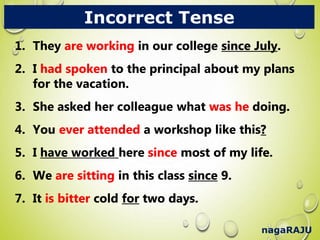
Incorrect Tense
1. They are working in our college since July.
2. I had spoken to the principal about my plans
for the vacation.
3. She asked her colleague what was he doing.
4. You ever attended a workshop like this?
5. I have worked here since most of my life.
6. We are sitting in this class since 9.
7. It is bitter cold for two days.
1. They are working in our college since July.
2. I had spoken to the principal about my plans
for the vacation.
3. She asked her colleague what was he doing.
4. You ever attended a workshop like this?
5. I have worked here since most of my life.
6. We are sitting in this class since 9.
7. It is bitter cold for two days.
nagaRAJU
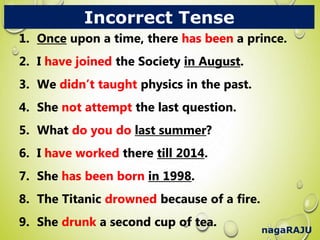
Incorrect Tense
1. Once upon a time, there has been a prince.
2. I have joined the Society in August.
3. We didn’t taught physics in the past.
4. She not attempt the last question.
5. What do you do last summer?
6. I have worked there till 2014.
7. She has been born in 1998.
8. The Titanic drowned because of a fire.
9. She drunk a second cup of tea.
1. Once upon a time, there has been a prince.
2. I have joined the Society in August.
3. We didn’t taught physics in the past.
4. She not attempt the last question.
5. What do you do last summer?
6. I have worked there till 2014.
7. She has been born in 1998.
8. The Titanic drowned because of a fire.
9. She drunk a second cup of tea.
nagaRAJU
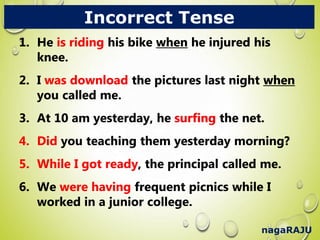
Incorrect Tense
1. He is riding his bike when he injured his
knee.
2. I was download the pictures last night when
you called me.
3. At 10 am yesterday, he surfing the net.
4. Did you teaching them yesterday morning?
5. While I got ready, the principal called me.
6. We were having frequent picnics while I
worked in a junior college.
1. He is riding his bike when he injured his
knee.
2. I was download the pictures last night when
you called me.
3. At 10 am yesterday, he surfing the net.
4. Did you teaching them yesterday morning?
5. While I got ready, the principal called me.
6. We were having frequent picnics while I
worked in a junior college.
nagaRAJU
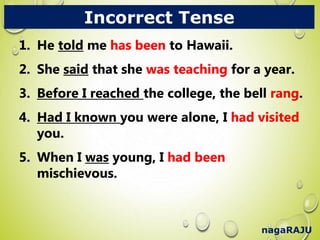
Incorrect Tense
1. He told me has been to Hawaii.
2. She said that she was teaching for a year.
3. Before I reached the college, the bell rang.
4. Had I known you were alone, I had visited
you.
5. When I was young, I had been
mischievous.
1. He told me has been to Hawaii.
2. She said that she was teaching for a year.
3. Before I reached the college, the bell rang.
4. Had I known you were alone, I had visited
you.
5. When I was young, I had been
mischievous.
nagaRAJU
Incorrect Tense
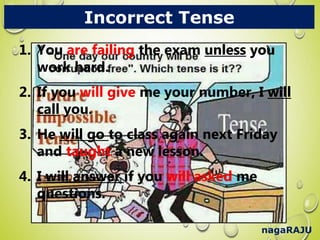
1. You are failing the exam unless you
work hard.
2. If you will give me your number, I will
call you.
3. He will go to class again next Friday
and taught a new lesson.
4. I will answer if you will asked me
questions.
1. You are failing the exam unless you
work hard.
2. If you will give me your number, I will
call you.
3. He will go to class again next Friday
and taught a new lesson.
4. I will answer if you will asked me
questions.
nagaRAJU
Incorrect Tense
1. I was suppose to finish the project last
Monday.
2. I use to work for a software company.
3. I ask you why you don’t listen to me.
4. I can able to do this.
5. Did she came to class yesterday?
6. She had gone yesterday.
7. Shall I help to you with the luggage?
nagaRAJU
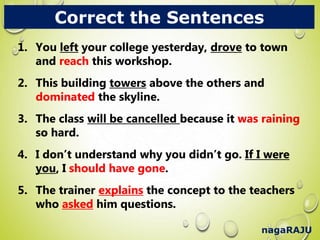
Correct the Sentences
1. Tomorrow, I submit the project report.
2. I am working on this project for two
weeks.
3. I have finished the project yesterday.
4. See that you will not delay the project
any longer.
5. I never ate broccoli.
6. We had finished the project last week.
1. Tomorrow, I submit the project report.
2. I am working on this project for two
weeks.
3. I have finished the project yesterday.
4. See that you will not delay the project
any longer.
5. I never ate broccoli.
6. We had finished the project last week.
nagaRAJU
2. Consistency
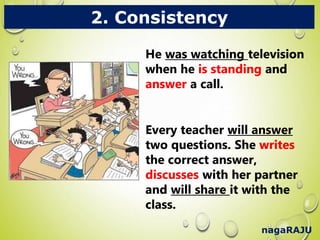
He was watching television
when he is standing and
answer a call.
Every teacher will answer
two questions. She writes
the correct answer,
discusses with her partner
and will share it with the
class.
He was watching television
when he is standing and
answer a call.
Every teacher will answer
two questions. She writes
the correct answer,
discusses with her partner
and will share it with the
class.
nagaRAJU
Correct the Sentences
1. You left your college yesterday, drove to town
and reach this workshop.
2. This building towers above the others and
dominated the skyline.
3. The class will be cancelled because it was raining
so hard.
4. I don’t understand why you didn’t go. If I were
you, I should have gone.
5. The trainer explains the concept to the teachers
who asked him questions.
1. You left your college yesterday, drove to town
and reach this workshop.
2. This building towers above the others and
dominated the skyline.
3. The class will be cancelled because it was raining
so hard.
4. I don’t understand why you didn’t go. If I were
you, I should have gone.
5. The trainer explains the concept to the teachers
who asked him questions.
nagaRAJU
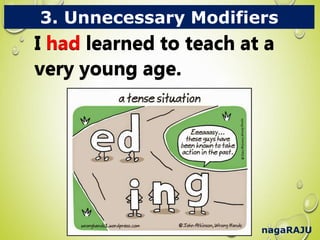
3. Unnecessary Modifiers
I had learned to teach at a
very young age.
I had learned to teach at a
very young age.
nagaRAJU
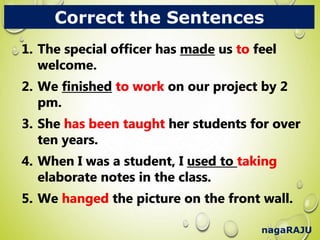
Correct the Sentences
1. The special officer has made us to feel
welcome.
2. We finished to work on our project by 2
pm.
3. She has been taught her students for over
ten years.
4. When I was a student, I used to taking
elaborate notes in the class.
5. We hanged the picture on the front wall.
1. The special officer has made us to feel
welcome.
2. We finished to work on our project by 2
pm.
3. She has been taught her students for over
ten years.
4. When I was a student, I used to taking
elaborate notes in the class.
5. We hanged the picture on the front wall.
nagaRAJU
4. Incorrect Conjugation
We have discuss language errors for an hour
already.
The young teacher drunk two glasses of water
immediately after the class.
We have discuss language errors for an hour
already.
The young teacher drunk two glasses of water
immediately after the class.
nagaRAJU
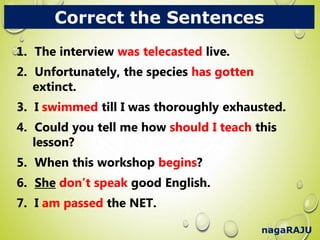
Correct the Sentences
1. The interview was telecasted live.
2. Unfortunately, the species has gotten
extinct.
3. I swimmed till I was thoroughly exhausted.
4. Could you tell me how should I teach this
lesson?
5. When this workshop begins?
6. She don’t speak good English.
7. I am passed the NET.
1. The interview was telecasted live.
2. Unfortunately, the species has gotten
extinct.
3. I swimmed till I was thoroughly exhausted.
4. Could you tell me how should I teach this
lesson?
5. When this workshop begins?
6. She don’t speak good English.
7. I am passed the NET.
nagaRAJU
5. Multiple Tense Markers
Did the principal returned
home immediately after
receiving a call from her
husband?
If the weather will improve
tomorrow, we will have a
picnic tomorrow.
Did the principal returned
home immediately after
receiving a call from her
husband?
If the weather will improve
tomorrow, we will have a
picnic tomorrow.
nagaRAJU
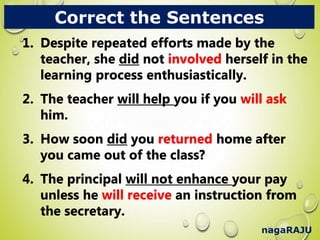
Correct the Sentences
1. Despite repeated efforts made by the
teacher, she did not involved herself in the
learning process enthusiastically.
2. The teacher will help you if you will ask
him.
3. How soon did you returned home after
you came out of the class?
4. The principal will not enhance your pay
unless he will receive an instruction from
the secretary.
1. Despite repeated efforts made by the
teacher, she did not involved herself in the
learning process enthusiastically.
2. The teacher will help you if you will ask
him.
3. How soon did you returned home after
you came out of the class?
4. The principal will not enhance your pay
unless he will receive an instruction from
the secretary.
nagaRAJU
6. Coordinating Multiple Actions
After reaching the
workshop, the teachers
realized that they came
unprepared.
I taught when the
Secretary suddenly
entered the hall to
make an
announcement.
After reaching the
workshop, the teachers
realized that they came
unprepared.
I taught when the
Secretary suddenly
entered the hall to
make an
announcement.
nagaRAJU
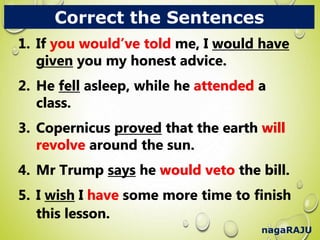
Correct the Sentences
1. If you would’ve told me, I would have
given you my honest advice.
2. He fell asleep, while he attended a
class.
3. Copernicus proved that the earth will
revolve around the sun.
4. Mr Trump says he would veto the bill.
5. I wish I have some more time to finish
this lesson.
1. If you would’ve told me, I would have
given you my honest advice.
2. He fell asleep, while he attended a
class.
3. Copernicus proved that the earth will
revolve around the sun.
4. Mr Trump says he would veto the bill.
5. I wish I have some more time to finish
this lesson.
nagaRAJU
7. Subject Verb Agreement
The novel, including the last ten chapters in the
last two sections, are terribly boring.
The novel, including the last ten chapters in the
last two sections, are terribly boring.
nagaRAJU
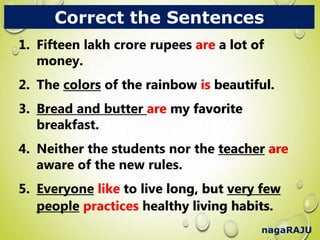
Correct the Sentences
1. Fifteen lakh crore rupees are a lot of
money.
2. The colors of the rainbow is beautiful.
3. Bread and butter are my favorite
breakfast.
4. Neither the students nor the teacher are
aware of the new rules.
5. Everyone like to live long, but very few
people practices healthy living habits.
1. Fifteen lakh crore rupees are a lot of
money.
2. The colors of the rainbow is beautiful.
3. Bread and butter are my favorite
breakfast.
4. Neither the students nor the teacher are
aware of the new rules.
5. Everyone like to live long, but very few
people practices healthy living habits.
nagaRAJU
Send your comments to
lionnagaraju@gmail.com
This slideshow is available at
www.authorstream.com/tag/lionnagaraju
www.slideshare.net/lionnagaraju
Thank you

Common Errors with Verbs

  • 1.
  • 2.
    nagaRAJU Verbs Meaning = action = occurrence =state Voice Active, Passive Types Main, auxiliary; regular, irregular; transitive, intransitive Tense Present, Past, Future (when an action takes place) Aspect Simple, Continuous, Perfect, Perfect Continuous
  • 3.
    Past Present Future Simple Iused English yesterday. (past habit, completed action, adverb of time) I use English. (habits, general truth, future plan, with mental action verbs) I will use English tomorrow. (future action or occurrence) Continuous I was using English when you entered. (uncompleted action of the past, persistent past habits) I am using English now. (action going on now, temporary action, stubborn habit) I will be using English when I travel. (what will be going on at sometime in future, planned future action) Perfect I had used English much before you taught me. (completed action before another past event) I have used English. (action started in past and has continued till now) I will have used English by the time you leave the class. (action will be completed before another future action) Perfect Continuous I had been using English for five years before you arrived. (action began before another action and continued till then) I have been using English for five years. (action started at a point in the past and may not be complete) I will have been using English for a few years when I return to India. (action will have happened for some time and will not be complete yet) nagaRAJU The 12 Tenses
  • 4.
    nagaRAJU 1. Incorrect Tense Stars are twinkling every night.  The workshop has begun yesterday.  Not even half of the participants are asking any questions since yesterday.  Stars are twinkling every night.  The workshop has begun yesterday.  Not even half of the participants are asking any questions since yesterday.
  • 5.
    nagaRAJU Incorrect Tense 1. Wenot work in government. 2. All of us in this hall works for the Society. 3. One plus one make two. 4. I would want to buy a car. 5. Some students are hating the rigor. 6. I am coming from India. 7. Our college is offering BA & B Com. 1. We not work in government. 2. All of us in this hall works for the Society. 3. One plus one make two. 4. I would want to buy a car. 5. Some students are hating the rigor. 6. I am coming from India. 7. Our college is offering BA & B Com.
  • 6.
    nagaRAJU Incorrect Tense 1. Shedoesn’t coming to class regularly. 2. She is having two daughters. 3. We are believing you. 4. I am teaching in a Society college. 5. Enjoyed singing whenever you are alone. 6. Plants are needing water and sunlight. 7. The calendar is hanged. 1. She doesn’t coming to class regularly. 2. She is having two daughters. 3. We are believing you. 4. I am teaching in a Society college. 5. Enjoyed singing whenever you are alone. 6. Plants are needing water and sunlight. 7. The calendar is hanged.
  • 7.
    nagaRAJU Incorrect Tense 1. Theyhave playing in the garden. 2. They reading the text very loud. 3. Our secretary gives a good message now. 4. They are showing interest? 5. We are knowing each other for a year. 6. “What are you doing now?” “I work as a contract lecturer.” 7. I am going to teaching you grammar. 1. They have playing in the garden. 2. They reading the text very loud. 3. Our secretary gives a good message now. 4. They are showing interest? 5. We are knowing each other for a year. 6. “What are you doing now?” “I work as a contract lecturer.” 7. I am going to teaching you grammar.
  • 8.
    nagaRAJU Incorrect Tense 1. Theyare working in our college since July. 2. I had spoken to the principal about my plans for the vacation. 3. She asked her colleague what was he doing. 4. You ever attended a workshop like this? 5. I have worked here since most of my life. 6. We are sitting in this class since 9. 7. It is bitter cold for two days. 1. They are working in our college since July. 2. I had spoken to the principal about my plans for the vacation. 3. She asked her colleague what was he doing. 4. You ever attended a workshop like this? 5. I have worked here since most of my life. 6. We are sitting in this class since 9. 7. It is bitter cold for two days.
  • 9.
    nagaRAJU Incorrect Tense 1. Onceupon a time, there has been a prince. 2. I have joined the Society in August. 3. We didn’t taught physics in the past. 4. She not attempt the last question. 5. What do you do last summer? 6. I have worked there till 2014. 7. She has been born in 1998. 8. The Titanic drowned because of a fire. 9. She drunk a second cup of tea. 1. Once upon a time, there has been a prince. 2. I have joined the Society in August. 3. We didn’t taught physics in the past. 4. She not attempt the last question. 5. What do you do last summer? 6. I have worked there till 2014. 7. She has been born in 1998. 8. The Titanic drowned because of a fire. 9. She drunk a second cup of tea.
  • 10.
    nagaRAJU Incorrect Tense 1. Heis riding his bike when he injured his knee. 2. I was download the pictures last night when you called me. 3. At 10 am yesterday, he surfing the net. 4. Did you teaching them yesterday morning? 5. While I got ready, the principal called me. 6. We were having frequent picnics while I worked in a junior college. 1. He is riding his bike when he injured his knee. 2. I was download the pictures last night when you called me. 3. At 10 am yesterday, he surfing the net. 4. Did you teaching them yesterday morning? 5. While I got ready, the principal called me. 6. We were having frequent picnics while I worked in a junior college.
  • 11.
    nagaRAJU Incorrect Tense 1. Hetold me has been to Hawaii. 2. She said that she was teaching for a year. 3. Before I reached the college, the bell rang. 4. Had I known you were alone, I had visited you. 5. When I was young, I had been mischievous. 1. He told me has been to Hawaii. 2. She said that she was teaching for a year. 3. Before I reached the college, the bell rang. 4. Had I known you were alone, I had visited you. 5. When I was young, I had been mischievous.
  • 12.
    nagaRAJU Incorrect Tense 1. Youare failing the exam unless you work hard. 2. If you will give me your number, I will call you. 3. He will go to class again next Friday and taught a new lesson. 4. I will answer if you will asked me questions. 1. You are failing the exam unless you work hard. 2. If you will give me your number, I will call you. 3. He will go to class again next Friday and taught a new lesson. 4. I will answer if you will asked me questions.
  • 13.
    nagaRAJU Incorrect Tense 1. Iwas suppose to finish the project last Monday. 2. I use to work for a software company. 3. I ask you why you don’t listen to me. 4. I can able to do this. 5. Did she came to class yesterday? 6. She had gone yesterday. 7. Shall I help to you with the luggage?
  • 14.
    nagaRAJU Correct the Sentences 1.Tomorrow, I submit the project report. 2. I am working on this project for two weeks. 3. I have finished the project yesterday. 4. See that you will not delay the project any longer. 5. I never ate broccoli. 6. We had finished the project last week. 1. Tomorrow, I submit the project report. 2. I am working on this project for two weeks. 3. I have finished the project yesterday. 4. See that you will not delay the project any longer. 5. I never ate broccoli. 6. We had finished the project last week.
  • 15.
    nagaRAJU 2. Consistency He waswatching television when he is standing and answer a call. Every teacher will answer two questions. She writes the correct answer, discusses with her partner and will share it with the class. He was watching television when he is standing and answer a call. Every teacher will answer two questions. She writes the correct answer, discusses with her partner and will share it with the class.
  • 16.
    nagaRAJU Correct the Sentences 1.You left your college yesterday, drove to town and reach this workshop. 2. This building towers above the others and dominated the skyline. 3. The class will be cancelled because it was raining so hard. 4. I don’t understand why you didn’t go. If I were you, I should have gone. 5. The trainer explains the concept to the teachers who asked him questions. 1. You left your college yesterday, drove to town and reach this workshop. 2. This building towers above the others and dominated the skyline. 3. The class will be cancelled because it was raining so hard. 4. I don’t understand why you didn’t go. If I were you, I should have gone. 5. The trainer explains the concept to the teachers who asked him questions.
  • 17.
    nagaRAJU 3. Unnecessary Modifiers Ihad learned to teach at a very young age. I had learned to teach at a very young age.
  • 18.
    nagaRAJU Correct the Sentences 1.The special officer has made us to feel welcome. 2. We finished to work on our project by 2 pm. 3. She has been taught her students for over ten years. 4. When I was a student, I used to taking elaborate notes in the class. 5. We hanged the picture on the front wall. 1. The special officer has made us to feel welcome. 2. We finished to work on our project by 2 pm. 3. She has been taught her students for over ten years. 4. When I was a student, I used to taking elaborate notes in the class. 5. We hanged the picture on the front wall.
  • 19.
    nagaRAJU 4. Incorrect Conjugation Wehave discuss language errors for an hour already. The young teacher drunk two glasses of water immediately after the class. We have discuss language errors for an hour already. The young teacher drunk two glasses of water immediately after the class.
  • 20.
    nagaRAJU Correct the Sentences 1.The interview was telecasted live. 2. Unfortunately, the species has gotten extinct. 3. I swimmed till I was thoroughly exhausted. 4. Could you tell me how should I teach this lesson? 5. When this workshop begins? 6. She don’t speak good English. 7. I am passed the NET. 1. The interview was telecasted live. 2. Unfortunately, the species has gotten extinct. 3. I swimmed till I was thoroughly exhausted. 4. Could you tell me how should I teach this lesson? 5. When this workshop begins? 6. She don’t speak good English. 7. I am passed the NET.
  • 21.
    nagaRAJU 5. Multiple TenseMarkers Did the principal returned home immediately after receiving a call from her husband? If the weather will improve tomorrow, we will have a picnic tomorrow. Did the principal returned home immediately after receiving a call from her husband? If the weather will improve tomorrow, we will have a picnic tomorrow.
  • 22.
    nagaRAJU Correct the Sentences 1.Despite repeated efforts made by the teacher, she did not involved herself in the learning process enthusiastically. 2. The teacher will help you if you will ask him. 3. How soon did you returned home after you came out of the class? 4. The principal will not enhance your pay unless he will receive an instruction from the secretary. 1. Despite repeated efforts made by the teacher, she did not involved herself in the learning process enthusiastically. 2. The teacher will help you if you will ask him. 3. How soon did you returned home after you came out of the class? 4. The principal will not enhance your pay unless he will receive an instruction from the secretary.
  • 23.
    nagaRAJU 6. Coordinating MultipleActions After reaching the workshop, the teachers realized that they came unprepared. I taught when the Secretary suddenly entered the hall to make an announcement. After reaching the workshop, the teachers realized that they came unprepared. I taught when the Secretary suddenly entered the hall to make an announcement.
  • 24.
    nagaRAJU Correct the Sentences 1.If you would’ve told me, I would have given you my honest advice. 2. He fell asleep, while he attended a class. 3. Copernicus proved that the earth will revolve around the sun. 4. Mr Trump says he would veto the bill. 5. I wish I have some more time to finish this lesson. 1. If you would’ve told me, I would have given you my honest advice. 2. He fell asleep, while he attended a class. 3. Copernicus proved that the earth will revolve around the sun. 4. Mr Trump says he would veto the bill. 5. I wish I have some more time to finish this lesson.
  • 25.
    nagaRAJU 7. Subject VerbAgreement The novel, including the last ten chapters in the last two sections, are terribly boring. The novel, including the last ten chapters in the last two sections, are terribly boring.
  • 26.
    nagaRAJU Correct the Sentences 1.Fifteen lakh crore rupees are a lot of money. 2. The colors of the rainbow is beautiful. 3. Bread and butter are my favorite breakfast. 4. Neither the students nor the teacher are aware of the new rules. 5. Everyone like to live long, but very few people practices healthy living habits. 1. Fifteen lakh crore rupees are a lot of money. 2. The colors of the rainbow is beautiful. 3. Bread and butter are my favorite breakfast. 4. Neither the students nor the teacher are aware of the new rules. 5. Everyone like to live long, but very few people practices healthy living habits.
  • 27.
    nagaRAJU Send your commentsto lionnagaraju@gmail.com This slideshow is available at www.authorstream.com/tag/lionnagaraju www.slideshare.net/lionnagaraju Thank you

Editor's Notes

  • #7 Sense verbs such as hear, smell, taste etc and feelings such as wish, hate, love, like, dislike, doubt, imagine, believe, know, prefer, realize, remember, understand, suppose, regret are not used in the present continuous. Possession verbs such as have and belong are not used in the present continuous. Stative verbs such as wish, hate, love, like, dislike, doubt, imagine, believe, know, prefer, realize, remember, understand, suppose, regret are not used in the present continuous. Communication verbs such as agree, disagree, deny, promise, mean, surprise, satisfy, impress are also not used in the present continuous.
  • #9 I have spoken, he has broken They have taken, he has shaken You have lost, it has cost Wind has blown, they have known Ram has been, Sam has seen We have given, the Sun has risen
  • #10 I have spoken, he has broken They have taken, he has shaken You have lost, it has cost Wind has blown, they have known Ram has been, Sam has seen We have given, the Sun has risen The first error using the wrong preposition. When using the present perfect to state where you have visited before using the verb ‘to be,’ many students use the preposition ‘in’ instead of ‘to.’ Where have you been? Another common error is using the present simple instead of the present perfect when talking about actions that started in the past and continue in the present. Time expressions are important with the present perfect as mistakes are made when the wrong time expressions are used. Note that specific time expressions in the past can’t be used with the present perfect.
  • #11 I have spoken, he has broken They have taken, he has shaken You have lost, it has cost Wind has blown, they have known Ram has been, Sam has seen We have given, the Sun has risen The first error using the wrong preposition. When using the present perfect to state where you have visited before using the verb ‘to be,’ many students use the preposition ‘in’ instead of ‘to.’ Where have you been? Another common error is using the present simple instead of the present perfect when talking about actions that started in the past and continue in the present. Time expressions are important with the present perfect as mistakes are made when the wrong time expressions are used. Note that specific time expressions in the past can’t be used with the present perfect.
  • #12 The past perfect is not used simply to say that something happened sometime ago. This meaning is conveyed by using the simple past. Sometimes, the error lies in using the simple past instead of the past perfect or the past continuous instead of the past perfect continuous. The past perfect denotes an action completed at some point in the past before some other past action commenced. When two actions in the past have to be referred to, the past perfect should be used for the earlier action, and the simple past for the later one.
  • #15 Incorrect: See that you will not do any damage. Correct: See that you do not do any damage. It is wrong to use the future tense in the subordinate clause when the verb in the main clause is in the imperative mood. If we’re talking about not having experienced something that we might experience in the future, we normally use the present perfect. I’ve never seen a movie in Spanish. I’ve never eaten broccoli. The present perfect is a present tense. It can’t be used with adverbs of past time. The present perfect tense cannot be used with adverbs that refer to a definite point of time in the past. If you want to say when something happened in the past, you have to use the simple past tense. The past perfect tense is not used to say that something happened some time ago. That idea is expressed using the simple past tense. The past perfect tense is only used to suggest that an action had completed before another action commenced.
  • #17 d
  • #19 I really enjoyed to be being there yesterday. After certain verbs, we use the gerund instead of the infinitive. Enjoy is one of these verbs. Some other verbs that are followed by the gerund are consider, delay, dislike, finish, imagine, mind, miss, practice, risk, and tolerate. Waking up early was hard at first, but now I’m used to do doing it. We use to be + used to + gerund to talk about something we are accustomed to doing.
  • #21 After expressions like Do you know…, Could you tell me,.. and I was wondering if… we do not invert the subject and the verb. These are called indirect questions.
  • #22 In English, when a sentence discusses a past event, the sentence only needs one word to show that the event is in the past. The sentence “I went home,” for example, only includes one past-tense verb: “went” is the past tense of the verb “go.” But if you ask the speaker, “Did you go home?” the past tense leaps from the verb “go” to the auxiliary verb “do.” Using two past-tense markers instead of one is a common mistake in tense formation, as in the question, “Did you went home?” Here, both “go” and “do” are in past tense, but only “do” should be.
  • #23 Incorrect: He will help if you will ask him. Correct: He will help if you ask him. When the verb in the main clause is in the future tense, the verb in the subordinate clause should be in the present and not in the future.
  • #24 To talk about a hypothetical past, we can use would/might/could + have + participle. We do not use should to talk about a hypothetical past. We use should to criticize past actions or express regret.