“CAP on a Map”
Dissemination Workshop
Nuwan Waidyanatha
nuwan {at} sahanafoundation {dot} org
Kunming, China
Philippines Warning and
Situational-Awareness: Lesson Learned
www.sahanafoundation.org
What is Sahana?
2
● Sahana EDEN is open source.
● No licensing fees or restrictions.
● You have “ the rights to study,
change, and distribute the
software to anyone and for any
purpose.”
● Sahana adopts MIT license
Sahana is an Open Source Community with a
mission to save lives by providing free and open
source information management systems that
improves the effectiveness of organizations and
communities throughout the disaster cycle.
Driving adoption to over 25 countries with
20 different disaster management modules
www.sahanafoundation.org
Sahana Alerting and Messaging Broker
3
function
scope
architecture keep it Simple
Alerting /
Warning
(EDXL-CAP)
SAMBRO
● Functions within the
Preparedness and Response
disaster management phases
● Messaging Broker allowing to
interconnect with other
brokers to integrate
Response Organizations
● Alerting / Warning
dissemination is the key
function
● Map-based visualization and
interaction for improved
situational-awareness
www.sahanafoundation.org
SAMBRO Interconnection Capabilities
4
BROWSER APP
Google Public Alerts Red Cross Hazard APP
MOBILE APP
Federation of Internet Alerts
SAMBRO Server (Browser
App) and Mobile APP talk to
each other
SAMBRO Server can talk
with Google, IFRC, FIA, and
any other CAP Alert Hubs
www.sahanafoundation.org
What is Situational-Awareness?
“Cross-Agency Situational Awareness System
is an information aggregation system that
facilitates sharing situational awareness within
the public safety community. Information shared
relates to incidents and planned events. It
includes public alerts, risks to responders, and
community profiles.” - Canada’s Multi-Agency Situational-Awareness
5
www.sahanafoundation.org
Why do we need Situational-Awareness
6
Perception Comprehension Projection
What is
happening?
Why do I care? What do I do
about it?
www.sahanafoundation.org
Effects of Situational-Awareness
7
1. Improves information sharing among
first-responders (e.g. Common Alerting Picture)
2. Immediate collaboration in response and
mitigation
3. Creates connected agencies for public safety
4. Manages resource more efficiently and cost
effectively
5. Saving lives and Livelihoods
Situational-Awareness
Decision
Perform
ActionsPerception Comprehension Projection
Philippines Warning and Situational Awareness System
www.sahanafoundation.org
CAP on a Map Project
8
Improving Institutional Responsiveness to Coastal Hazards
through Multi- Agency Situational Awareness
www.sahanafoundation.org
Report and Blog:
https://sahanafoundation.org/philippines-kickoff-workshop/
Awareness and Requirements
9
Discussed the “CAP on a Map”
project objectives and agreed on
a plan
Understood the current warning
and response practices in the
Philippines
Gathered preliminary
requirements to begin the
SAMBRO customization
Explored opportunities for
Formulate a CAP Working Group
(NDRRMC)
www.sahanafoundation.org
Current Warning Practices in the Philippines
10
NDRRMC
OP Center
Reg- 1
Reg -2
Reg- 3
Reg 4A
Reg 4B
ARMM
CAR
NCR
provinces
FAX
cities/
municipalities
cities/
municipalities
cities/
municipalities
cities/
municipalities
cities/
municipalities
cities/
municipalities
cities/
municipalities
cities/
municipalities
Barangays
(communities)
Barangays
(communities)
Barangays
(communities)
Barangays
(communities)
Barangays
(communities)
Barangays
(communities)
Barangays
(communities)
Barangays
(communities)
Barangays
(communities)
provinces
provinces
provinces
17 RDRRMO
provinces
provinces
81 PDRRMO
1490 C/MDRRMO
42,028 BDRRMO
provinces
F
A
X
FAX FAX SMS
Warning
www.sahanafoundation.org
SAMBRO Simplifying Warnings
11
● Publisher and a Subscriber messaging
broker
● CAP 1.2 compliant system.
● Efficiency gains through reduced traversal
times
● increased cost-effectiveness by
complementing current practices
● low-cost technology always on and ready to
use (integrated into the daily lives)
EOC - Emergency Operation Center RC - Red Cross (Society) Community - community of practice
Authority - Alerting Authority Hub - other relay and rendering agents Media - TV, Radio, SocMed
line Agencies emergency services - police/fire/SAR/health…
www.sahanafoundation.org
SAMBRO ALERT HUB
Proposed CAP-PH / SAMBRO Workflow
Complementing the existing warning procedures
12
PAGASA
PUBLISHER
PHIVOLCS
PUBLISHER
BULLETIN
Email
SMS
WEB
MOBILE APP
OTHER
OTHER
Free Mobile
Alert Act
www.sahanafoundation.org
Two PAGASA and One
PHIVOLCS Staff Members were
trained on as CAP/SAMBRO
Stewards on
● GIS techniques,
● Sahana software,
● CAP standard, policies,
procedures
● SAMBRO warning and
situational-awareness
workflows
Training of Trainers
Report and Blog: https://sahanafoundation.org/tot-final-day/
13
www.sahanafoundation.org
Training of National Trainers
14
PAGASA CAP/SAMBRO
Stewards trained National
Stakeholders to
1. Introduce CAP standard,
policies, and procedures to
their departments
2. Train a set of users for using
SAMBRO
3. Assist NDRRMC Members
with the implementation
4. Carry out Silent-Tests to
ready the system
www.sahanafoundation.org
Report and Blog:
https://sahanafoundation.org/philippines-simux/
Controlled-Exercises
15
A series of controlled-exercises were
carried out with:
● PAGASA & PHIVOLCS staff to test
the system and user readiness to
operationalize SAMBRO
● other Stakeholders at the OCD to
understand their perception of
SAMBRO
● First-Responders in Manila Bay
and Subic Bay (Olangapo)
Barangay (Councils)
www.sahanafoundation.org
Evaluation Methodology
16
1. No Surprises, prior the the exercises
a. Implementation should be complete (terminology, classifications, templates)
b. Users should have been trained for for originating / relaying messages
c. Siltet-test should have been carried out
2. During the exercises
a. Users defined a scenario, KPI, goals, intent, and actions
b. Discuss the steps for issuing with SAMBRO
c. Issue the alert/warning with SAMBRO
3. Evaluation
a. Observers record the user's’ behaviour applying a complexity index
b. Record the behaviour with screen capture software (CamStudio)
c. Users indicate the gulf of execution; i.e. “achieved level of the goal, intent, and actions”)
d. Users indicate their perception on the technology acceptance (usefulness, ease-of-use,
On the day of the exercise did the technology and the people work?
Carried out with both Publishers and Subscribers
www.sahanafoundation.org
Dept Irrig & Dam
Safety “relays” the
message to their
First-Responders
Exercise Workflows
17
Heavy Rain
Threatening
floods and
landslides
Dept Meteo & Hydro
“originates” (issues)
a “heavy rain”
warning
Dept Irrig & Dam
Safety Township focal
person relays the
message to other
First-Responders
Detect
Hazard
Event
Alerting
Authority
Issue Alert
Response
Organization
Relay Alert
First-
Responders
Receive Alerts
www.sahanafoundation.org
1. Technical issues delayed the alert
during the exercise
2. Most users were trained and competent
but few were not
3. Users need to make an effort to
understand the CAP standard
4. Compared to Myanmar similar pattern
but PAGASA more seasoned on
Cyclone work
Time To Completion
18
www.sahanafoundation.org
Observed Complexities
19
Workflow attempts show
Flood and Heavy Rains
showing complexities
Issues vary across Alert, Info,
and Area segments
mostly in Area because of
complexities in geocodes
lookup
No predefined area based on
risk / hazard maps
Average = 1.29 Standard Deviation = 0.83
www.sahanafoundation.org
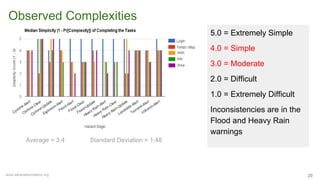
Observed Complexities
20
5.0 = Extremely Simple
4.0 = Simple
3.0 = Moderate
2.0 = Difficult
1.0 = Extremely Difficult
Inconsistencies are in the
Flood and Heavy Rain
warnings
Average = 3.4 Standard Deviation = 1.48
www.sahanafoundation.org
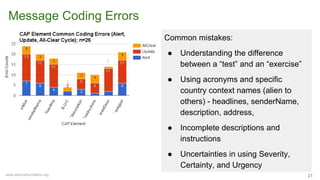
Message Coding Errors
21
Common mistakes:
● Understanding the difference
between a “test” and an “exercise”
● Using acronyms and specific
country context names (alien to
others) - headlines, senderName,
description, address,
● Incomplete descriptions and
instructions
● Uncertainties in using Severity,
Certainty, and Urgency
www.sahanafoundation.org
Technology Acceptance Model Evaluation
● Publishers :
○ 09 PAGASA
○ 10 PHIVOLCS
● Subscribers:
○ 10 Manila Bay (Metro Manila)
○ 11 Subic Bay (Olangapo)
● All users are inclined towards:
○ AGREEING that SAMBRO is
easy to use and useful
○ QUITE a POSITIVE attitude
towards using SAMBRO
SAMBRO Acceptance
22
Philippines
www.sahanafoundation.org
Project Outcomes
23
1) PAGASA CAP “public alerting system” and SAMBRO
interoperability was tested and proven to work well
2) Uptake or further use of SAMBRO by other Stakeholder:
a) PHIVOLCS implementing their own instance of SAMBRO
b) OCD EOC has realized value and discussing an implementation strategy
c) First-Responders were not trained but quick to adopted SAMBRO
www.sahanafoundation.org
Recommendations
1. Expanding CAP and SAMBRO in Philippines
2. Formulating a Philippines CAP Working Group
3. Training and Certification of National Trainers
24
www.sahanafoundation.org
Real Need:
Realize the potential
of CAP and adopt
CAP as the
all-hazard all-media
National warning
information
exchange standard
Action plan:
t = T Conduct a Stakeholder meeting, including members from
NDRRMC, to:
● realize the potential of SAMBRO
● share the knowledge from the “CAP on a Map”
project
t = T + 1 Develop a plan, in consultation with the relevant
NDRRMC members to:
● build CAP and SAMBRO capacity within those
Organizations
● extend SAMBRO to PHIVOLCS, OCD, and any
other Stakeholder for early warning dissemination
1. Expanding CAP and SAMBRO in Philippines
25
www.sahanafoundation.org
Action plan:
t = T + 3 Collaborate with the Stakeholder Organizations, to:
● Train the users in the respective organizations
● gather Stakeholders’ information needs
● iteratively, design, implement, and test (silent-tests)
t = T + 6 Conduct a set of controlled-exercises, with the
Stakeholder Organizations, to evaluate their readiness to
integrate SAMBRO into their warning practices
t = T + 12 Use the evidence gathered from the implementation,
testing, and controlled-exercises to support the policy
advocacy and policy development
1. Expanding CAP and SAMBRO in Philippines
26
Real Need:
Set a policy for
Philippines to adopt
CAP as the
all-hazard all-media
National warning
information
exchange standard
www.sahanafoundation.org
2. NDRRMC CAP-PH Working Group
Areas for Collaboration:
1. Common terminology
a. Event Types, Incident Types, Codes, Parameters
2. Warning Classifications
a. PAGASA already has for Tropical Cyclone but needs develop for flood
b. PHIVOLCS already has for Tsunami and Volcanic Eruption
c. Other Organizations may need to develop classifications
3. Description and Instructions
a. Different stages of an event required different description and
instructions NDRRMC should harmonize across all agencies
b. Relaying organizations (e.g. OCD) needs to augment the description
and instructions
4. Alert Area Polygons
a. Predefined alert area polygons for flood, volcanic eruption, tsunami 27
Real Need:
Establishing
common policies
and procedures
towards a
CAP-PH-enabled
interoperable and
coherent warning
practices in the
Philippines for
originating and
relaying messages
www.sahanafoundation.org
2. CAP-PH Working Group
How might NDRRMC CAP-PH Working Group involve
other Stakeholders?
● Rappler project AGOS
● GSM I’m Ready
● Batingaw Mobile APP
● eBanyanihan
● DREAM project
● SMART National Text Blast
● e-Health & Public Health Alerting
28
Real Need:
Establishing common
policies and
procedures towards a
CAP-PH-enabled
interoperable and
coherent warning
practices in the
Philippines for
originating and
relaying messages
www.sahanafoundation.org
Real Need:
Build capacity in Philippines to
enhance interoperability and the
exchange of disaster information
through CAP-enabled all-hazard
all-media and cross-agency
situational-awareness approach
3. Training and Certification
Syllabus:
1. CAP warning standard,
implementation, and operating
procedures
2. Operationalizing and maintaining a
SAMBRO Situational-awareness
platform
29
www.sahanafoundation.org
Discussion Points
1. How do the NDRRMC members envision expanding CAP in the
Philippines?
● Are their plans to make CAP “the” warning standard in the Philippines?
● Are their plans to develop a CAP-PH policy, procedure, and implementation plans?
2. Should the other Stakeholders be using SAMBRO:
● to “relay” (or re-originate) issued warnings to disseminate to their members? If yes,
what are the next steps?
● to serve as the Philippines Alert Hub at the OCD EOC for the media to subscribe to
alerts?
3. Any other issues?
30
www.sahanafoundation.org
Dissemination Workshop
Report and Blog:
31
Have we met the objectives?
● Make the Stakeholders, especially the decision makers, aware of the project
achievements to date.
● Create an opportunity for the Stakeholders to discuss the uptake and
integration of CAP and/or SAMBRO in Philippines
www.sahanafoundation.org
Thank You
32
www.sahanafoundation.org
Messaging Stages (or cap:status)
33
Originate
Alert
Event
Originate
Update
Originate
Update
Originate
All-Clear
PAG
ASA
Irrigation
&Dam
Safety
SAMBRO
SAMBRO
Relay
Alert
Relay
Update
Relay
Update
Relay
All-Clear
Originate
Update
Originate
Update
Originate
Update
www.sahanafoundation.org
PAGASA CAP/SAMBRO
Stewards trained National
Stakeholders to
1. Introduce CAP standard,
policies, and procedures to
their departments
2. Train a set of users for using
SAMBRO
3. Assist NDRRMC Members
with the implementation
4. Carry out Silent-Tests to
ready the system
Training of National Trainers
Report and Blog:
https://sahanafoundation.org/ph-sambro-national-training/
34

Philippines evaluation results

  • 1.
    “CAP on aMap” Dissemination Workshop Nuwan Waidyanatha nuwan {at} sahanafoundation {dot} org Kunming, China Philippines Warning and Situational-Awareness: Lesson Learned
  • 2.
    www.sahanafoundation.org What is Sahana? 2 ●Sahana EDEN is open source. ● No licensing fees or restrictions. ● You have “ the rights to study, change, and distribute the software to anyone and for any purpose.” ● Sahana adopts MIT license Sahana is an Open Source Community with a mission to save lives by providing free and open source information management systems that improves the effectiveness of organizations and communities throughout the disaster cycle. Driving adoption to over 25 countries with 20 different disaster management modules
  • 3.
    www.sahanafoundation.org Sahana Alerting andMessaging Broker 3 function scope architecture keep it Simple Alerting / Warning (EDXL-CAP) SAMBRO ● Functions within the Preparedness and Response disaster management phases ● Messaging Broker allowing to interconnect with other brokers to integrate Response Organizations ● Alerting / Warning dissemination is the key function ● Map-based visualization and interaction for improved situational-awareness
  • 4.
    www.sahanafoundation.org SAMBRO Interconnection Capabilities 4 BROWSERAPP Google Public Alerts Red Cross Hazard APP MOBILE APP Federation of Internet Alerts SAMBRO Server (Browser App) and Mobile APP talk to each other SAMBRO Server can talk with Google, IFRC, FIA, and any other CAP Alert Hubs
  • 5.
    www.sahanafoundation.org What is Situational-Awareness? “Cross-AgencySituational Awareness System is an information aggregation system that facilitates sharing situational awareness within the public safety community. Information shared relates to incidents and planned events. It includes public alerts, risks to responders, and community profiles.” - Canada’s Multi-Agency Situational-Awareness 5
  • 6.
    www.sahanafoundation.org Why do weneed Situational-Awareness 6 Perception Comprehension Projection What is happening? Why do I care? What do I do about it?
  • 7.
    www.sahanafoundation.org Effects of Situational-Awareness 7 1.Improves information sharing among first-responders (e.g. Common Alerting Picture) 2. Immediate collaboration in response and mitigation 3. Creates connected agencies for public safety 4. Manages resource more efficiently and cost effectively 5. Saving lives and Livelihoods Situational-Awareness Decision Perform ActionsPerception Comprehension Projection Philippines Warning and Situational Awareness System
  • 8.
    www.sahanafoundation.org CAP on aMap Project 8 Improving Institutional Responsiveness to Coastal Hazards through Multi- Agency Situational Awareness
  • 9.
    www.sahanafoundation.org Report and Blog: https://sahanafoundation.org/philippines-kickoff-workshop/ Awarenessand Requirements 9 Discussed the “CAP on a Map” project objectives and agreed on a plan Understood the current warning and response practices in the Philippines Gathered preliminary requirements to begin the SAMBRO customization Explored opportunities for Formulate a CAP Working Group (NDRRMC)
  • 10.
    www.sahanafoundation.org Current Warning Practicesin the Philippines 10 NDRRMC OP Center Reg- 1 Reg -2 Reg- 3 Reg 4A Reg 4B ARMM CAR NCR provinces FAX cities/ municipalities cities/ municipalities cities/ municipalities cities/ municipalities cities/ municipalities cities/ municipalities cities/ municipalities cities/ municipalities Barangays (communities) Barangays (communities) Barangays (communities) Barangays (communities) Barangays (communities) Barangays (communities) Barangays (communities) Barangays (communities) Barangays (communities) provinces provinces provinces 17 RDRRMO provinces provinces 81 PDRRMO 1490 C/MDRRMO 42,028 BDRRMO provinces F A X FAX FAX SMS Warning
  • 11.
    www.sahanafoundation.org SAMBRO Simplifying Warnings 11 ●Publisher and a Subscriber messaging broker ● CAP 1.2 compliant system. ● Efficiency gains through reduced traversal times ● increased cost-effectiveness by complementing current practices ● low-cost technology always on and ready to use (integrated into the daily lives) EOC - Emergency Operation Center RC - Red Cross (Society) Community - community of practice Authority - Alerting Authority Hub - other relay and rendering agents Media - TV, Radio, SocMed line Agencies emergency services - police/fire/SAR/health…
  • 12.
    www.sahanafoundation.org SAMBRO ALERT HUB ProposedCAP-PH / SAMBRO Workflow Complementing the existing warning procedures 12 PAGASA PUBLISHER PHIVOLCS PUBLISHER BULLETIN Email SMS WEB MOBILE APP OTHER OTHER Free Mobile Alert Act
  • 13.
    www.sahanafoundation.org Two PAGASA andOne PHIVOLCS Staff Members were trained on as CAP/SAMBRO Stewards on ● GIS techniques, ● Sahana software, ● CAP standard, policies, procedures ● SAMBRO warning and situational-awareness workflows Training of Trainers Report and Blog: https://sahanafoundation.org/tot-final-day/ 13
  • 14.
    www.sahanafoundation.org Training of NationalTrainers 14 PAGASA CAP/SAMBRO Stewards trained National Stakeholders to 1. Introduce CAP standard, policies, and procedures to their departments 2. Train a set of users for using SAMBRO 3. Assist NDRRMC Members with the implementation 4. Carry out Silent-Tests to ready the system
  • 15.
    www.sahanafoundation.org Report and Blog: https://sahanafoundation.org/philippines-simux/ Controlled-Exercises 15 Aseries of controlled-exercises were carried out with: ● PAGASA & PHIVOLCS staff to test the system and user readiness to operationalize SAMBRO ● other Stakeholders at the OCD to understand their perception of SAMBRO ● First-Responders in Manila Bay and Subic Bay (Olangapo) Barangay (Councils)
  • 16.
    www.sahanafoundation.org Evaluation Methodology 16 1. NoSurprises, prior the the exercises a. Implementation should be complete (terminology, classifications, templates) b. Users should have been trained for for originating / relaying messages c. Siltet-test should have been carried out 2. During the exercises a. Users defined a scenario, KPI, goals, intent, and actions b. Discuss the steps for issuing with SAMBRO c. Issue the alert/warning with SAMBRO 3. Evaluation a. Observers record the user's’ behaviour applying a complexity index b. Record the behaviour with screen capture software (CamStudio) c. Users indicate the gulf of execution; i.e. “achieved level of the goal, intent, and actions”) d. Users indicate their perception on the technology acceptance (usefulness, ease-of-use, On the day of the exercise did the technology and the people work? Carried out with both Publishers and Subscribers
  • 17.
    www.sahanafoundation.org Dept Irrig &Dam Safety “relays” the message to their First-Responders Exercise Workflows 17 Heavy Rain Threatening floods and landslides Dept Meteo & Hydro “originates” (issues) a “heavy rain” warning Dept Irrig & Dam Safety Township focal person relays the message to other First-Responders Detect Hazard Event Alerting Authority Issue Alert Response Organization Relay Alert First- Responders Receive Alerts
  • 18.
    www.sahanafoundation.org 1. Technical issuesdelayed the alert during the exercise 2. Most users were trained and competent but few were not 3. Users need to make an effort to understand the CAP standard 4. Compared to Myanmar similar pattern but PAGASA more seasoned on Cyclone work Time To Completion 18
  • 19.
    www.sahanafoundation.org Observed Complexities 19 Workflow attemptsshow Flood and Heavy Rains showing complexities Issues vary across Alert, Info, and Area segments mostly in Area because of complexities in geocodes lookup No predefined area based on risk / hazard maps Average = 1.29 Standard Deviation = 0.83
  • 20.
    www.sahanafoundation.org Observed Complexities 20 5.0 =Extremely Simple 4.0 = Simple 3.0 = Moderate 2.0 = Difficult 1.0 = Extremely Difficult Inconsistencies are in the Flood and Heavy Rain warnings Average = 3.4 Standard Deviation = 1.48
  • 21.
    www.sahanafoundation.org Message Coding Errors 21 Commonmistakes: ● Understanding the difference between a “test” and an “exercise” ● Using acronyms and specific country context names (alien to others) - headlines, senderName, description, address, ● Incomplete descriptions and instructions ● Uncertainties in using Severity, Certainty, and Urgency
  • 22.
    www.sahanafoundation.org Technology Acceptance ModelEvaluation ● Publishers : ○ 09 PAGASA ○ 10 PHIVOLCS ● Subscribers: ○ 10 Manila Bay (Metro Manila) ○ 11 Subic Bay (Olangapo) ● All users are inclined towards: ○ AGREEING that SAMBRO is easy to use and useful ○ QUITE a POSITIVE attitude towards using SAMBRO SAMBRO Acceptance 22 Philippines
  • 23.
    www.sahanafoundation.org Project Outcomes 23 1) PAGASACAP “public alerting system” and SAMBRO interoperability was tested and proven to work well 2) Uptake or further use of SAMBRO by other Stakeholder: a) PHIVOLCS implementing their own instance of SAMBRO b) OCD EOC has realized value and discussing an implementation strategy c) First-Responders were not trained but quick to adopted SAMBRO
  • 24.
    www.sahanafoundation.org Recommendations 1. Expanding CAPand SAMBRO in Philippines 2. Formulating a Philippines CAP Working Group 3. Training and Certification of National Trainers 24
  • 25.
    www.sahanafoundation.org Real Need: Realize thepotential of CAP and adopt CAP as the all-hazard all-media National warning information exchange standard Action plan: t = T Conduct a Stakeholder meeting, including members from NDRRMC, to: ● realize the potential of SAMBRO ● share the knowledge from the “CAP on a Map” project t = T + 1 Develop a plan, in consultation with the relevant NDRRMC members to: ● build CAP and SAMBRO capacity within those Organizations ● extend SAMBRO to PHIVOLCS, OCD, and any other Stakeholder for early warning dissemination 1. Expanding CAP and SAMBRO in Philippines 25
  • 26.
    www.sahanafoundation.org Action plan: t =T + 3 Collaborate with the Stakeholder Organizations, to: ● Train the users in the respective organizations ● gather Stakeholders’ information needs ● iteratively, design, implement, and test (silent-tests) t = T + 6 Conduct a set of controlled-exercises, with the Stakeholder Organizations, to evaluate their readiness to integrate SAMBRO into their warning practices t = T + 12 Use the evidence gathered from the implementation, testing, and controlled-exercises to support the policy advocacy and policy development 1. Expanding CAP and SAMBRO in Philippines 26 Real Need: Set a policy for Philippines to adopt CAP as the all-hazard all-media National warning information exchange standard
  • 27.
    www.sahanafoundation.org 2. NDRRMC CAP-PHWorking Group Areas for Collaboration: 1. Common terminology a. Event Types, Incident Types, Codes, Parameters 2. Warning Classifications a. PAGASA already has for Tropical Cyclone but needs develop for flood b. PHIVOLCS already has for Tsunami and Volcanic Eruption c. Other Organizations may need to develop classifications 3. Description and Instructions a. Different stages of an event required different description and instructions NDRRMC should harmonize across all agencies b. Relaying organizations (e.g. OCD) needs to augment the description and instructions 4. Alert Area Polygons a. Predefined alert area polygons for flood, volcanic eruption, tsunami 27 Real Need: Establishing common policies and procedures towards a CAP-PH-enabled interoperable and coherent warning practices in the Philippines for originating and relaying messages
  • 28.
    www.sahanafoundation.org 2. CAP-PH WorkingGroup How might NDRRMC CAP-PH Working Group involve other Stakeholders? ● Rappler project AGOS ● GSM I’m Ready ● Batingaw Mobile APP ● eBanyanihan ● DREAM project ● SMART National Text Blast ● e-Health & Public Health Alerting 28 Real Need: Establishing common policies and procedures towards a CAP-PH-enabled interoperable and coherent warning practices in the Philippines for originating and relaying messages
  • 29.
    www.sahanafoundation.org Real Need: Build capacityin Philippines to enhance interoperability and the exchange of disaster information through CAP-enabled all-hazard all-media and cross-agency situational-awareness approach 3. Training and Certification Syllabus: 1. CAP warning standard, implementation, and operating procedures 2. Operationalizing and maintaining a SAMBRO Situational-awareness platform 29
  • 30.
    www.sahanafoundation.org Discussion Points 1. Howdo the NDRRMC members envision expanding CAP in the Philippines? ● Are their plans to make CAP “the” warning standard in the Philippines? ● Are their plans to develop a CAP-PH policy, procedure, and implementation plans? 2. Should the other Stakeholders be using SAMBRO: ● to “relay” (or re-originate) issued warnings to disseminate to their members? If yes, what are the next steps? ● to serve as the Philippines Alert Hub at the OCD EOC for the media to subscribe to alerts? 3. Any other issues? 30
  • 31.
    www.sahanafoundation.org Dissemination Workshop Report andBlog: 31 Have we met the objectives? ● Make the Stakeholders, especially the decision makers, aware of the project achievements to date. ● Create an opportunity for the Stakeholders to discuss the uptake and integration of CAP and/or SAMBRO in Philippines
  • 32.
  • 33.
    www.sahanafoundation.org Messaging Stages (orcap:status) 33 Originate Alert Event Originate Update Originate Update Originate All-Clear PAG ASA Irrigation &Dam Safety SAMBRO SAMBRO Relay Alert Relay Update Relay Update Relay All-Clear Originate Update Originate Update Originate Update
  • 34.
    www.sahanafoundation.org PAGASA CAP/SAMBRO Stewards trainedNational Stakeholders to 1. Introduce CAP standard, policies, and procedures to their departments 2. Train a set of users for using SAMBRO 3. Assist NDRRMC Members with the implementation 4. Carry out Silent-Tests to ready the system Training of National Trainers Report and Blog: https://sahanafoundation.org/ph-sambro-national-training/ 34