COMMON ALERTING
PROTOCOL
FOR EARLY WARNING SYSTEMS
OUTLINE :
• Common Alerting Protocol (CAP)
• Adoption by the World Meteorological Organization
(WMO)
• CAP Implementation
• CAP for the Philippine Early Warning System
WHAT IS CAP?
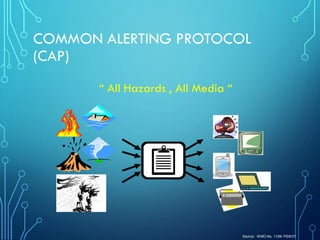
The Common Alerting Protocol (CAP) is a standard
message format designed for All-Media, All-Hazard,
communications:
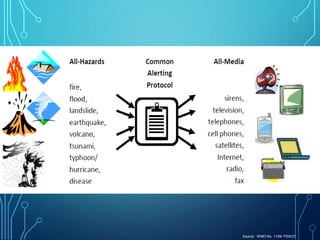
• over any and all media (television, radio, telephone,
fax, highway signs, e-mail, Web sites, RSS "Blogs", ...)
• about any and all kinds of hazard
(Weather, Fires, Earthquakes, Volcanoes, Landslides,
Child Abductions, Disease Outbreaks, Air Quality Warnings,
Transportation Problems, Power Outages ...)
• to anyone: the public at large; designated groups
(civic authority, responders, etc.); specific people
COMMON ALERTING PROTOCOL
(CAP)
“ All Hazards , All Media “
Source: WMO No. 1109/ PSW27
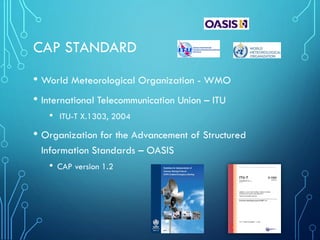
CAP STANDARD
• World Meteorological Organization - WMO
• International Telecommunication Union – ITU
• ITU-T X.1303, 2004
• Organization for the Advancement of Structured
Information Standards – OASIS
• CAP version 1.2
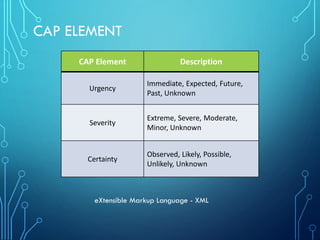
CAP ELEMENT
CAP Element Description
Urgency
Immediate, Expected, Future,
Past, Unknown
Severity
Extreme, Severe, Moderate,
Minor, Unknown
Certainty
Observed, Likely, Possible,
Unlikely, Unknown
eXtensible Markup Language - XML
OUTLINE :
• Common Alerting Protocol (CAP)
• Adoption by the World Meteorological Organization
(WMO)
• CAP Implementation
• CAP for the Philippine Early Warning System
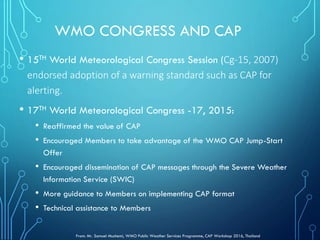
WMO CONGRESS AND CAP
• 15TH World Meteorological Congress Session (Cg-15, 2007)
endorsed adoption of a warning standard such as CAP for
alerting.
• 17TH World Meteorological Congress -17, 2015:
• Reaffirmed the value of CAP
• Encouraged Members to take advantage of the WMO CAP Jump-Start
Offer
• Encouraged dissemination of CAP messages through the Severe Weather
Information Service (SWIC)
• More guidance to Members on implementing CAP format
• Technical assistance to Members
From: Mr. Samuel Muchemi, WMO Public Weather Services Programme, CAP Workshop 2016, Thailand
OUTLINE :
• Common Alerting Protocol (CAP)
• Adoption by the World Meteorological Organization
(WMO)
• CAP Implementation
• CAP for the Philippine Early Warning System
11
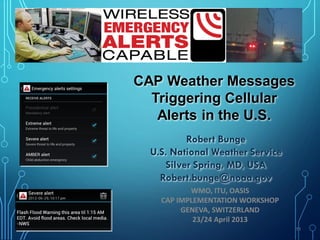
CAP Weather Messages
Triggering Cellular
Alerts in the U.S.
Robert Bunge
U.S. National Weather Service
Silver Spring, MD, USA
Robert.bunge@noaa.gov
WMO, ITU, OASIS
CAP IMPLEMENTATION WORKSHOP
GENEVA, SWITZERLAND
23/24 April 2013
12
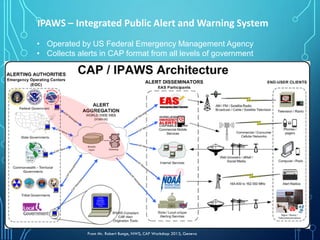
IPAWS – Integrated Public Alert and Warning System
• Operated by US Federal Emergency Management Agency
• Collects alerts in CAP format from all levels of government
From Mr. Robert Bunge, NWS, CAP Workshop 2013, Geneva
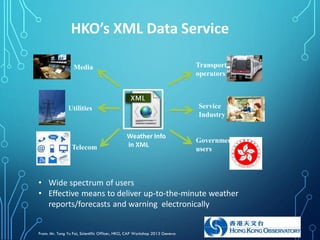
• Wide spectrum of users
• Effective means to deliver up-to-the-minute weather
reports/forecasts and warning electronically
Weather Info
in XML
Media Transport
operators
Utilities
Telecom
Service
Industry
Government
users
HKO’s XML Data Service
From: Mr. Tong Yu Fai, Scientific Officer, HKO, CAP Workshop 2013 Geneva
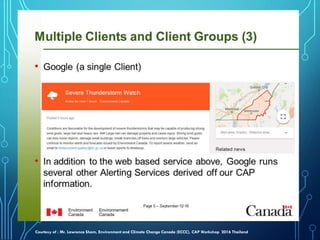
Courtesy of : Mr. Lawrence Sham, Environment and Climate Change Canada (ECCC), CAP Workshop 2016 Thailand
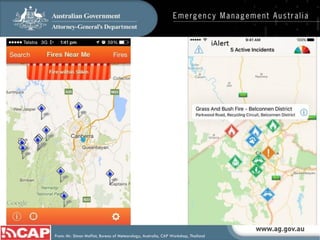
From: Mr. Simon Moffat, Bureau of Meteorology, Australia, CAP Workshop, Thailand
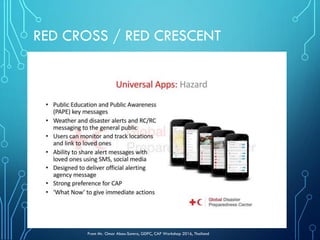
RED CROSS / RED CRESCENT
From Mr. Omar Abou-Samra, GDPC, CAP Workshop 2016, Thailand
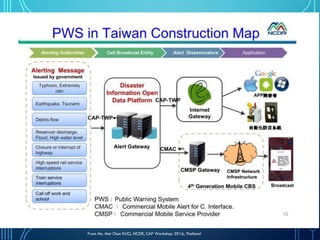
From Ms. Mei Chun KUO, NCDR, CAP Workshop 2016, Thailand
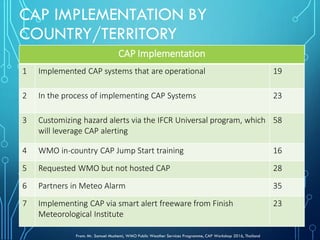
CAP IMPLEMENTATION BY
COUNTRY/TERRITORY
CAP Implementation
1 Implemented CAP systems that are operational 19
2 In the process of implementing CAP Systems 23
3 Customizing hazard alerts via the IFCR Universal program, which
will leverage CAP alerting
58
4 WMO in-country CAP Jump Start training 16
5 Requested WMO but not hosted CAP 28
6 Partners in Meteo Alarm 35
7 Implementing CAP via smart alert freeware from Finish
Meteorological Institute
23
From: Mr. Samuel Muchemi, WMO Public Weather Services Programme, CAP Workshop 2016, Thailand
OUTLINE :
• Common Alerting Protocol (CAP)
• Adoption by the World Meteorological Organization
(WMO)
• CAP Implementation
• CAP for the Philippine Early Warning System
CAP IMPLEMENTATION IN THE
PHILIPPINES
• Leverage Internet for mass dissemination of early warnings through
the world wide web
• Capitalize on Filipinos hooked up to their Smart Phones as well as on
social media
• Introduce CAP interface for AM / FM radio and TV broadcast
• Establish an integrated Early Warning System that will utilize CAP as
the alerting protocol
• Establish multi-agency multi-situational awareness application -
SAMBRO
THANK YOU FOR YOUR KIND
ATTENTION !
Philippine Atmospheric, Geophysical & Astronomical
Services Administration - Department of Science & Technology
Agham Road, Diliman, Quezon City 1103
http://www.pagasa.dost.gov.ph
Postal Address: P.O. Box 3278 Manila Tel No. 929-4865 (w/Fax) & 434-9040
24-Hour Weather News : 433 – ULAN (8526)
Arnel R. Manoos
WFSIII, METTSS/ETSD
5th Floor, PAGASA Central Office
Tel : (02)433-0744
arnel_manoos@yahoo.com
arnel.manoos@meteopilipinas.gov.ph

Common alerting protocol overview for pagasa 2016 [autosaved] [autosaved]

  • 1.
  • 2.
    OUTLINE : • CommonAlerting Protocol (CAP) • Adoption by the World Meteorological Organization (WMO) • CAP Implementation • CAP for the Philippine Early Warning System
  • 3.
    WHAT IS CAP? TheCommon Alerting Protocol (CAP) is a standard message format designed for All-Media, All-Hazard, communications: • over any and all media (television, radio, telephone, fax, highway signs, e-mail, Web sites, RSS "Blogs", ...) • about any and all kinds of hazard (Weather, Fires, Earthquakes, Volcanoes, Landslides, Child Abductions, Disease Outbreaks, Air Quality Warnings, Transportation Problems, Power Outages ...) • to anyone: the public at large; designated groups (civic authority, responders, etc.); specific people
  • 4.
    COMMON ALERTING PROTOCOL (CAP) “All Hazards , All Media “ Source: WMO No. 1109/ PSW27
  • 5.
    Source: WMO No.1109/ PSW27
  • 6.
    CAP STANDARD • WorldMeteorological Organization - WMO • International Telecommunication Union – ITU • ITU-T X.1303, 2004 • Organization for the Advancement of Structured Information Standards – OASIS • CAP version 1.2
  • 7.
    CAP ELEMENT CAP ElementDescription Urgency Immediate, Expected, Future, Past, Unknown Severity Extreme, Severe, Moderate, Minor, Unknown Certainty Observed, Likely, Possible, Unlikely, Unknown eXtensible Markup Language - XML
  • 8.
    OUTLINE : • CommonAlerting Protocol (CAP) • Adoption by the World Meteorological Organization (WMO) • CAP Implementation • CAP for the Philippine Early Warning System
  • 9.
    WMO CONGRESS ANDCAP • 15TH World Meteorological Congress Session (Cg-15, 2007) endorsed adoption of a warning standard such as CAP for alerting. • 17TH World Meteorological Congress -17, 2015: • Reaffirmed the value of CAP • Encouraged Members to take advantage of the WMO CAP Jump-Start Offer • Encouraged dissemination of CAP messages through the Severe Weather Information Service (SWIC) • More guidance to Members on implementing CAP format • Technical assistance to Members From: Mr. Samuel Muchemi, WMO Public Weather Services Programme, CAP Workshop 2016, Thailand
  • 10.
    OUTLINE : • CommonAlerting Protocol (CAP) • Adoption by the World Meteorological Organization (WMO) • CAP Implementation • CAP for the Philippine Early Warning System
  • 11.
    11 CAP Weather Messages TriggeringCellular Alerts in the U.S. Robert Bunge U.S. National Weather Service Silver Spring, MD, USA Robert.bunge@noaa.gov WMO, ITU, OASIS CAP IMPLEMENTATION WORKSHOP GENEVA, SWITZERLAND 23/24 April 2013
  • 12.
    12 IPAWS – IntegratedPublic Alert and Warning System • Operated by US Federal Emergency Management Agency • Collects alerts in CAP format from all levels of government From Mr. Robert Bunge, NWS, CAP Workshop 2013, Geneva
  • 13.
    • Wide spectrumof users • Effective means to deliver up-to-the-minute weather reports/forecasts and warning electronically Weather Info in XML Media Transport operators Utilities Telecom Service Industry Government users HKO’s XML Data Service From: Mr. Tong Yu Fai, Scientific Officer, HKO, CAP Workshop 2013 Geneva
  • 14.
    Courtesy of :Mr. Lawrence Sham, Environment and Climate Change Canada (ECCC), CAP Workshop 2016 Thailand
  • 15.
    From: Mr. SimonMoffat, Bureau of Meteorology, Australia, CAP Workshop, Thailand
  • 16.
    RED CROSS /RED CRESCENT From Mr. Omar Abou-Samra, GDPC, CAP Workshop 2016, Thailand
  • 17.
    From Ms. MeiChun KUO, NCDR, CAP Workshop 2016, Thailand
  • 19.
    CAP IMPLEMENTATION BY COUNTRY/TERRITORY CAPImplementation 1 Implemented CAP systems that are operational 19 2 In the process of implementing CAP Systems 23 3 Customizing hazard alerts via the IFCR Universal program, which will leverage CAP alerting 58 4 WMO in-country CAP Jump Start training 16 5 Requested WMO but not hosted CAP 28 6 Partners in Meteo Alarm 35 7 Implementing CAP via smart alert freeware from Finish Meteorological Institute 23 From: Mr. Samuel Muchemi, WMO Public Weather Services Programme, CAP Workshop 2016, Thailand
  • 20.
    OUTLINE : • CommonAlerting Protocol (CAP) • Adoption by the World Meteorological Organization (WMO) • CAP Implementation • CAP for the Philippine Early Warning System
  • 21.
    CAP IMPLEMENTATION INTHE PHILIPPINES • Leverage Internet for mass dissemination of early warnings through the world wide web • Capitalize on Filipinos hooked up to their Smart Phones as well as on social media • Introduce CAP interface for AM / FM radio and TV broadcast • Establish an integrated Early Warning System that will utilize CAP as the alerting protocol • Establish multi-agency multi-situational awareness application - SAMBRO
  • 22.
    THANK YOU FORYOUR KIND ATTENTION !
  • 23.
    Philippine Atmospheric, Geophysical& Astronomical Services Administration - Department of Science & Technology Agham Road, Diliman, Quezon City 1103 http://www.pagasa.dost.gov.ph Postal Address: P.O. Box 3278 Manila Tel No. 929-4865 (w/Fax) & 434-9040 24-Hour Weather News : 433 – ULAN (8526) Arnel R. Manoos WFSIII, METTSS/ETSD 5th Floor, PAGASA Central Office Tel : (02)433-0744 arnel_manoos@yahoo.com arnel.manoos@meteopilipinas.gov.ph