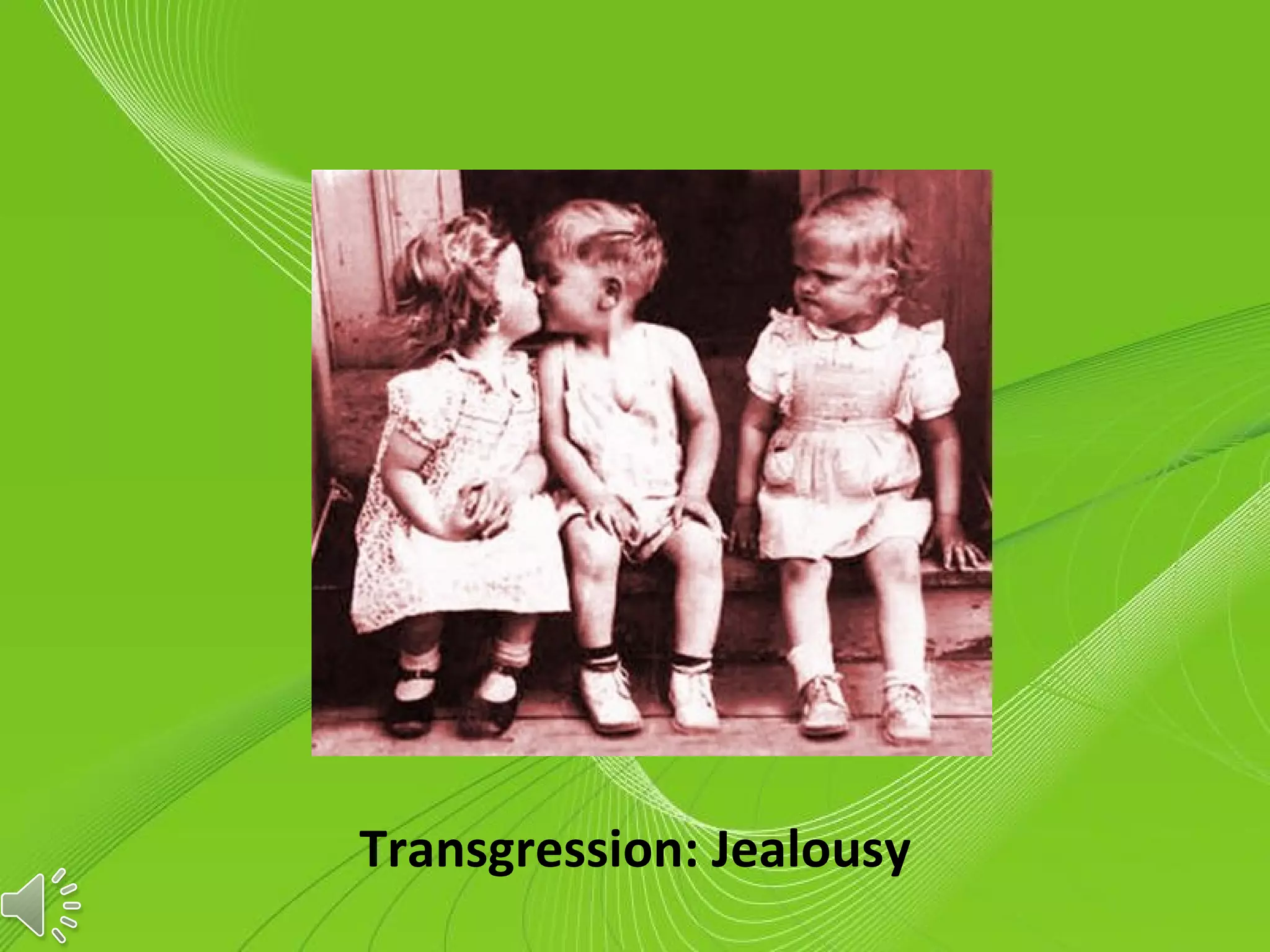
Transgression: Jealousy
    Powerpoint Templates
                           Page 1
JEALOUSY CONCEPTUALIZATION:

 Jealousy is the negative emotional reaction to the
  fear of losing a valued relationship to a real or
  imagined rival (Salovey, 1991)
 Jealousy is a complex of feelings, cognitions, and
  behaviors, but often includes: Hurt, anger, and fear
  (Guerrero & Andersen, 1998)


                     Powerpoint Templates
                                                  Page 2
JEALOUSY CONCEPTUALIZATION :

Jealousy is often confused with envy & rivalry:
    Envy occurs when people want something valuable that
     someone else has
    Rivalry occurs when two people are competing for
     something that neither one of them has
Jealousy occurs when people worry they might lose
    something they value (e.g., a good relationship or
    a high-status position) to someone else


                      Powerpoint Templates
                                                     Page 3
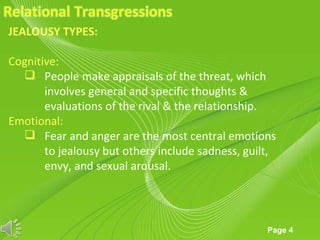
JEALOUSY TYPES:

Cognitive:
   People make appraisals of the threat, which
       involves general and specific thoughts &
       evaluations of the rival & the relationship.
Emotional:
   Fear and anger are the most central emotions
       to jealousy but others include sadness, guilt,
       envy, and sexual arousal.


                      Powerpoint Templates
                                                   Page 4
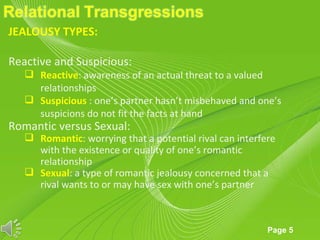
JEALOUSY TYPES:

Reactive and Suspicious:
    Reactive: awareness of an actual threat to a valued
     relationships
    Suspicious : one’s partner hasn’t misbehaved and one’s
     suspicions do not fit the facts at hand
Romantic versus Sexual:
    Romantic: worrying that a potential rival can interfere
     with the existence or quality of one’s romantic
     relationship
    Sexual: a type of romantic jealousy concerned that a
     rival wants to or may have sex with one’s partner


                        Powerpoint Templates
                                                          Page 5
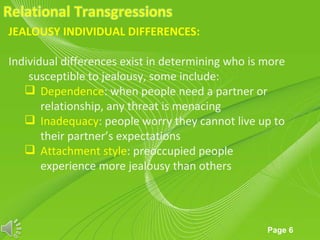
JEALOUSY INDIVIDUAL DIFFERENCES:

Individual differences exist in determining who is more
    susceptible to jealousy, some include:
    Dependence: when people need a partner or
       relationship, any threat is menacing
    Inadequacy: people worry they cannot live up to
       their partner’s expectations
    Attachment style: preoccupied people
       experience more jealousy than others


                      Powerpoint Templates
                                                   Page 6
"Mean Girls Theorize About Jealousy"


           Powerpoint Templates
                                       Page 7
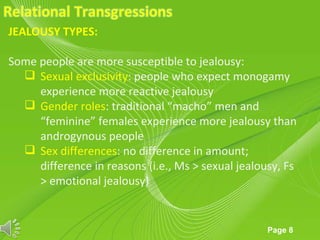
JEALOUSY TYPES:

Some people are more susceptible to jealousy:
   Sexual exclusivity: people who expect monogamy
     experience more reactive jealousy
   Gender roles: traditional “macho” men and
     “feminine” females experience more jealousy than
     androgynous people
   Sex differences: no difference in amount;
     difference in reasons (i.e., Ms > sexual jealousy, Fs
     > emotional jealousy)


                      Powerpoint Templates
                                                    Page 8
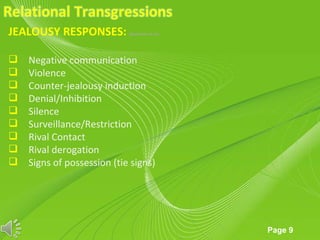
JEALOUSY RESPONSES:         (Guerrero et al.)


   Negative communication
   Violence
   Counter-jealousy induction
   Denial/Inhibition
   Silence
   Surveillance/Restriction
   Rival Contact
   Rival derogation
   Signs of possession (tie signs)


                          Powerpoint Templates
                                                 Page 9
Powerpoint Templates
                       Page 10

COMM332j

  • 1.
    Transgression: Jealousy Powerpoint Templates Page 1
  • 2.
    JEALOUSY CONCEPTUALIZATION:  Jealousyis the negative emotional reaction to the fear of losing a valued relationship to a real or imagined rival (Salovey, 1991)  Jealousy is a complex of feelings, cognitions, and behaviors, but often includes: Hurt, anger, and fear (Guerrero & Andersen, 1998) Powerpoint Templates Page 2
  • 3.
    JEALOUSY CONCEPTUALIZATION : Jealousyis often confused with envy & rivalry:  Envy occurs when people want something valuable that someone else has  Rivalry occurs when two people are competing for something that neither one of them has Jealousy occurs when people worry they might lose something they value (e.g., a good relationship or a high-status position) to someone else Powerpoint Templates Page 3
  • 4.
    JEALOUSY TYPES: Cognitive:  People make appraisals of the threat, which involves general and specific thoughts & evaluations of the rival & the relationship. Emotional:  Fear and anger are the most central emotions to jealousy but others include sadness, guilt, envy, and sexual arousal. Powerpoint Templates Page 4
  • 5.
    JEALOUSY TYPES: Reactive andSuspicious:  Reactive: awareness of an actual threat to a valued relationships  Suspicious : one’s partner hasn’t misbehaved and one’s suspicions do not fit the facts at hand Romantic versus Sexual:  Romantic: worrying that a potential rival can interfere with the existence or quality of one’s romantic relationship  Sexual: a type of romantic jealousy concerned that a rival wants to or may have sex with one’s partner Powerpoint Templates Page 5
  • 6.
    JEALOUSY INDIVIDUAL DIFFERENCES: Individualdifferences exist in determining who is more susceptible to jealousy, some include:  Dependence: when people need a partner or relationship, any threat is menacing  Inadequacy: people worry they cannot live up to their partner’s expectations  Attachment style: preoccupied people experience more jealousy than others Powerpoint Templates Page 6
  • 7.
    "Mean Girls TheorizeAbout Jealousy" Powerpoint Templates Page 7
  • 8.
    JEALOUSY TYPES: Some peopleare more susceptible to jealousy:  Sexual exclusivity: people who expect monogamy experience more reactive jealousy  Gender roles: traditional “macho” men and “feminine” females experience more jealousy than androgynous people  Sex differences: no difference in amount; difference in reasons (i.e., Ms > sexual jealousy, Fs > emotional jealousy) Powerpoint Templates Page 8
  • 9.
    JEALOUSY RESPONSES: (Guerrero et al.)  Negative communication  Violence  Counter-jealousy induction  Denial/Inhibition  Silence  Surveillance/Restriction  Rival Contact  Rival derogation  Signs of possession (tie signs) Powerpoint Templates Page 9
  • 10.