YBA & Sam Taylor - Wood Hyangbo Cho, Bona Kim
YBA  (Young British Artists) Charles   Saatchi Damien   Hirst Tracey   Emin   Chris   Ofili   Rachel  Whiteread
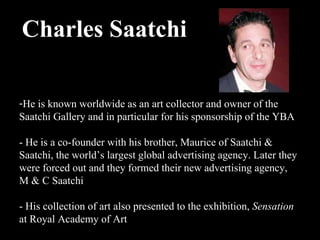
Charles Saatchi    He is known worldwide as an art collector and owner of the Saatchi Gallery and in particular for his sponsorship of the YBA - He is a co-founder with his brother, Maurice of Saatchi & Saatchi, the world’s largest global advertising agency. Later they were forced out and they formed their new advertising agency, M & C Saatchi  - His collection of art also presented to the exhibition,  Sensation  at Royal Academy of Art
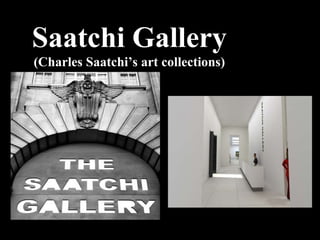
Saatchi Gallery (Charles Saatchi’s art collections)
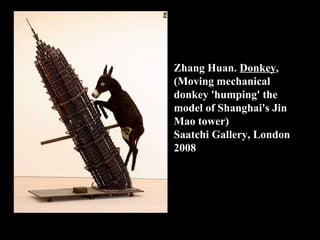
Zhang Huan.  Donkey ,  (Moving mechanical donkey 'humping' the model of Shanghai's Jin Mao tower) Saatchi Gallery, London 2008
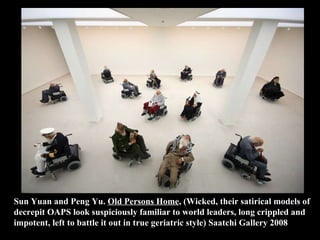
Sun Yuan and Peng Yu.  Old Persons Home , (Wicked, their satirical models of decrepit OAPS look suspiciously familiar to world leaders, long crippled and impotent, left to battle it out in true geriatric style) Saatchi Gallery 2008
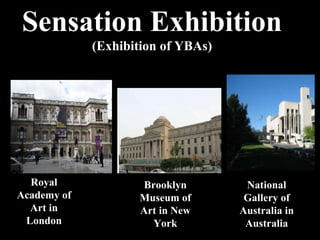
Sensation Exhibition (Exhibition of YBAs) Royal Academy of Art in London Brooklyn Museum of Art in New York National Gallery of Australia in Australia
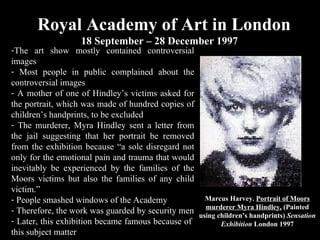
Royal Academy of Art in London 18 September – 28 December 1997  Marcus Harvey.  Portrait of Moors murderer Myra Hindley,  (Painted using children’s handprints)  Sensation Exhibition  London 1997 The art show mostly contained controversial images Most people in public complained about the controversial images A mother of one of Hindley’s victims asked for the portrait, which was made of hundred copies of children’s handprints, to be excluded  The murderer, Myra Hindley sent a letter from the jail suggesting that her portrait be removed from the exhibition because  “a sole disregard not only for the emotional pain and trauma that would inevitably be experienced by the families of the Moors victims but also the families of any child victim.” People smashed windows of the Academy Therefore, the work was guarded by security men Later, this exhibition became famous because of  this subject matter
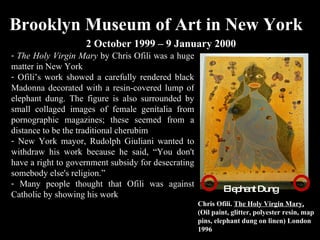
Brooklyn Museum of Art in New York 2 October 1999 – 9 January 2000 Chris Ofili.  The Holy Virgin Mary,  (Oil paint, glitter, polyester resin, map pins, elephant dung on linen) London 1996 Elephant Dung The Holy Virgin Mary  by Chris Ofili was a huge matter in New York  Ofili’s work showed a carefully rendered black Madonna decorated with a resin-covered lump of elephant dung. The figure is also surrounded by small collaged images of female genitalia from pornographic magazines; these seemed from a distance to be the traditional cherubim New York mayor, Rudolph Giuliani wanted to withdraw his work because he said, “You don't have a right to government subsidy for desecrating somebody else's religion.” Many people thought that Ofili was against Catholic by showing his work
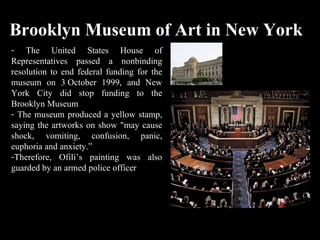
Brooklyn Museum of Art in New York The United States House of Representatives passed a nonbinding resolution to end federal funding for the museum on 3 October 1999, and New York City did stop funding to the Brooklyn Museum The museum produced a yellow stamp, saying the artworks on show "may cause shock, vomiting, confusion, panic, euphoria and anxiety.” Therefore, Ofili’s painting was also guarded by an armed police officer
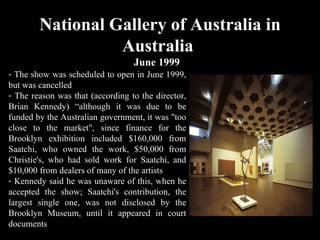
National Gallery of Australia in Australia  June 1999 The show was scheduled to open in June 1999, but was cancelled The reason was that (according to the director, Brian Kennedy) “although it was due to be funded by the Australian government, it was "too close to the market", since finance for the Brooklyn exhibition included $160,000 from Saatchi, who owned the work, $50,000 from Christie's, who had sold work for Saatchi, and $10,000 from dealers of many of the artists Kennedy said he was unaware of this, when he accepted the show; Saatchi's contribution, the largest single one, was not disclosed by the Brooklyn Museum, until it appeared in court documents
Renee Cox.  Yo Mama’s Last Supper,  (Montage of five photographs of 12 men and a naked black woman[Cox’s self portrait] posing Jesus)  Sensation Exhibition , New York 1996
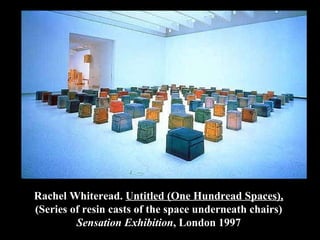
Rachel Whiteread.  Untitled (One Hundread Spaces),  (Series of resin casts of the space underneath chairs)  Sensation Exhibition , London 1997
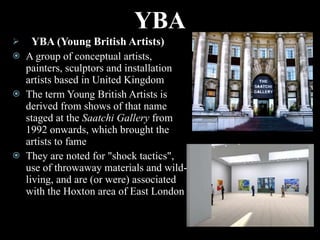
YBA YBA (Young British Artists) A group of conceptual artists, painters, sculptors and installation artists based in United Kingdom The term Young British Artists is derived from shows of that name staged at the  Saatchi Gallery  from 1992 onwards, which brought the artists to fame They are noted for "shock tactics", use of throwaway materials and wild-living, and are (or were) associated with the Hoxton area of East London
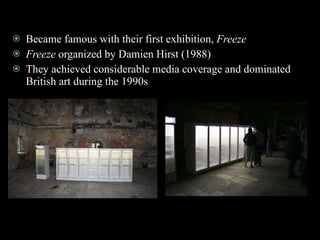
Became famous with their first exhibition,  Freeze   Freeze  organized by Damien Hirst (1988)  They achieved considerable media coverage and dominated British art during the 1990s
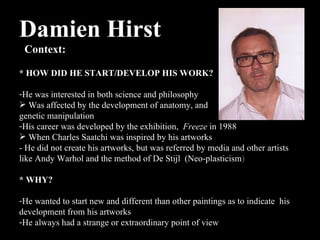
Damien Hirst  Context:  * HOW DID HE START/DEVELOP HIS WORK? He was interested in both science and philosophy  Was affected by the development of anatomy, and  genetic manipulation His career was developed by the exhibition,  Freeze  in 1988 When Charles Saatchi was inspired by his artworks  - He did not create his artworks, but was referred by media and other artists like Andy Warhol and the method of  De Stijl  (Neo-plasticism ) * WHY? He wanted to start new and different than other paintings as to indicate  his development from his artworks  He always had a strange or extraordinary point of view
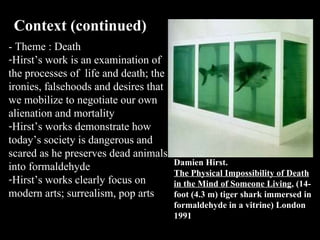
- Theme : Death  Hirst’s work is an examination of the processes of  life and death;  the  ironies, falsehoods and desires that we mobilize to negotiate our own alienation and  mortality Hirst’s works demonstrate how today’s society is dangerous and scared as he preserves dead animals into formaldehyde  Hirst’s works clearly focus on modern arts; surrealism, pop arts Context (continued)  Damien Hirst. The Physical Impossibility of Death in the Mind of Someone Living , (14-foot (4.3 m) tiger shark immersed in formaldehyde in a vitrine) London 1991
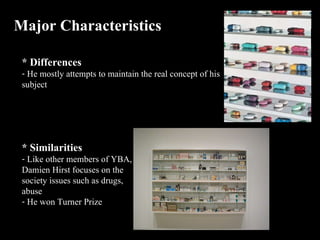
Major Characteristics  * Differences He mostly attempts to maintain the real concept of his subject * Similarities  Like other members of YBA, Damien Hirst focuses on the society issues such as drugs, abuse He won Turner Prize
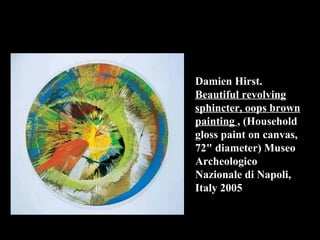
Damien Hirst. Beautiful revolving sphincter, oops brown painting  , (Household gloss paint on canvas, 72" diameter)  Museo Archeologico Nazionale di Napoli , Italy 2005
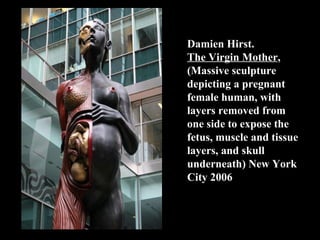
Damien Hirst. The Virgin Mother , (Massive sculpture depicting a pregnant female human, with layers removed from one side to expose the fetus, muscle and tissue layers, and skull underneath) New York City 2006
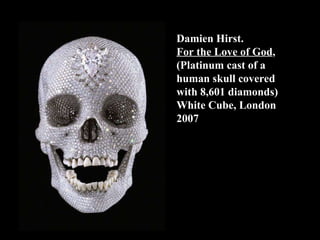
Damien Hirst. For the Love of God , (Platinum cast of a human skull covered with 8,601 diamonds) White Cube, London 2007
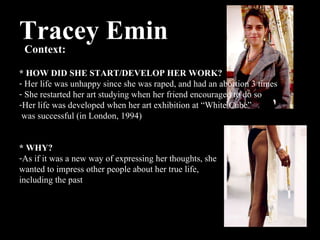
Tracey Emin Context:  * HOW DID SHE START/DEVELOP HER WORK? Her life was unhappy since she was raped, and had an abortion 3 times She restarted her art studying when her friend encouraged to do so Her life was developed when her art exhibition at “White Cube” was successful (in London, 1994) * WHY? As if it was a new way of expressing her thoughts, she  wanted to impress other people about her true life,  including the past
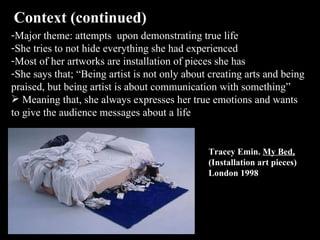
Context (continued)  Major theme: attempts  upon demonstrating true life  She tries to not hide everything she had experienced Most of her artworks are installation of pieces she has She says that; “Being artist is not only about creating arts and being praised, but being artist is about communication with something” Meaning that, she always expresses her true emotions and wants to give the audience messages about a life  Tracey Emin.  My Bed,  (Installation art pieces) London 1998
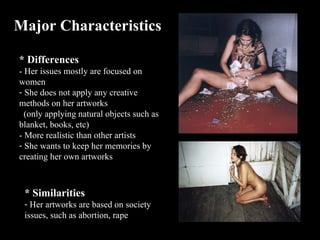
Major Characteristics * Differences - Her issues mostly are focused on women She does not apply any creative methods on her artworks (only applying natural objects such as blanket, books, etc) - More realistic than other artists She wants to keep her memories by creating her own artworks  * Similarities  Her artworks are based on society issues, such as abortion, rape
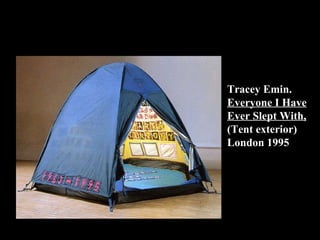
Tracey Emin.  Everyone I Have Ever Slept With,  (Tent exterior) London 1995
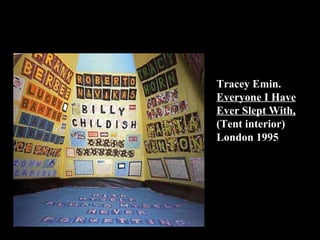
Tracey Emin.  Everyone I Have Ever Slept With,  (Tent interior) London 1995
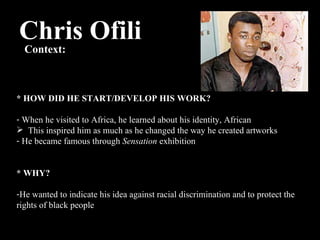
Chris Ofili Context:  * HOW DID HE START/DEVELOP HIS WORK? When he visited to Africa, he learned about his identity, African This inspired him as much as he changed the way he created artworks He became famous through  Sensation  exhibition * WHY? He wanted to indicate his idea against racial discrimination and to protect the rights of black people
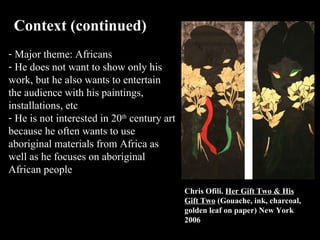
Context (continued)  Major theme: Africans He does not want to show only his work, but he also wants to entertain the audience with his paintings, installations, etc He is not interested in 20 th  century art because he often wants to use aboriginal materials from Africa as well as he focuses on aboriginal African people  Chris Ofili.  Her Gift Two & His Gift Two  (Gouache, ink, charcoal, golden leaf on paper) New York 2006
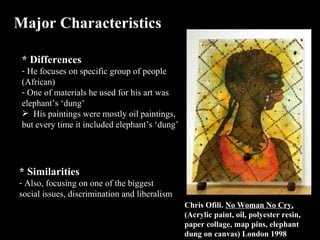
Major Characteristics * Differences He focuses on specific group of people (African) One of materials he used for his art was elephant’s ‘dung’  His paintings were mostly oil paintings, but every time it included elephant’s ‘dung’ * Similarities  Also, focusing on one of the biggest social issues, discrimination and liberalism Chris Ofili.  No Woman No Cry,  (Acrylic paint, oil, polyester resin, paper collage, map pins, elephant dung on canvas) London 1998
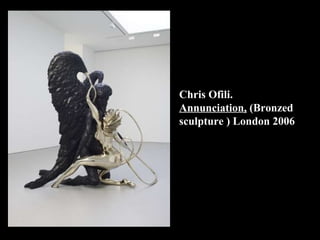
Chris Ofili.   Annunciation,  (Bronzed sculpture ) London 2006
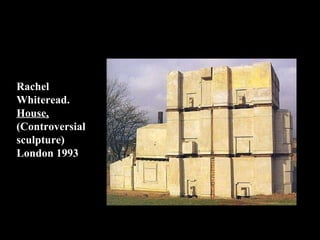
Rachel Whiteread Context:  HOW DID SHE START/ DEVELOP HER WORK? Major Theme: H uman traces left on ordinary objects In 1993, she was commissioned to make  House ,  the cast of the inside of a Victorian house in East  London, which provoked considerable media and public attention She was also influenced by Minimalism * WHY? She wants to illustrate that: “[Casts carry] the residue of years and years of use”
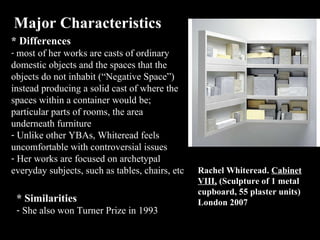
Major Characteristics * Differences most of her works are casts of ordinary domestic objects and the spaces that the objects do not inhabit (“Negative Space”) instead producing a solid cast of where the spaces within a container would be; particular parts of rooms, the area underneath furniture  Unlike other YBAs, Whiteread feels uncomfortable with controversial issues Her works are focused on  archetypal  everyday subjects, such as tables, chairs, etc * Similarities  She also won Turner Prize in 1993 Rachel Whiteread .  Cabinet VIII,  ( Sculpture of 1 metal cupboard, 55 plaster units ) London 2007
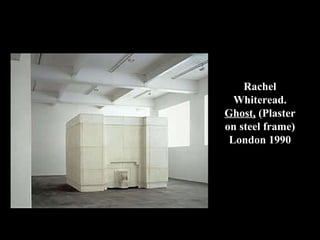
Rachel Whiteread .  Ghost,  ( Plaster on steel frame ) London 1990
Rachel Whiteread .  House,  ( Controversial sculpture ) London 1993
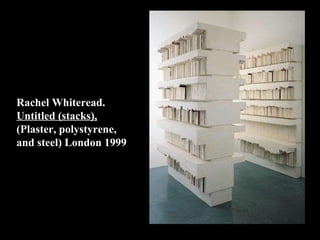
Rachel Whiteread .  Untitled (stacks),  ( Plaster, polystyrene,  and steel) London 1999
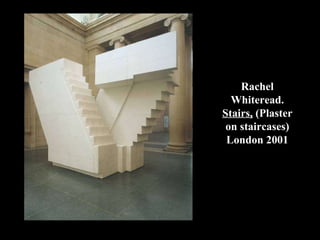
Rachel Whiteread .  Stairs,  ( Plaster on staircases ) London 2001
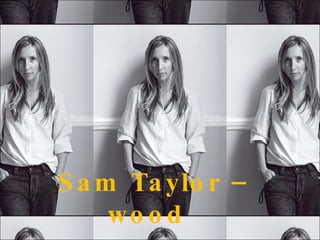
Sam Taylor – wood
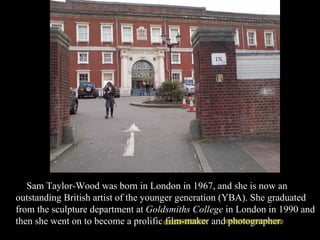
Sam Taylor-Wood was born in London in 1967, and she is now an outstanding British artist of the younger generation (YBA). She graduated from the sculpture department at  Goldsmiths College  in London in 1990 and then she went on to become a prolific film-maker and photographer.
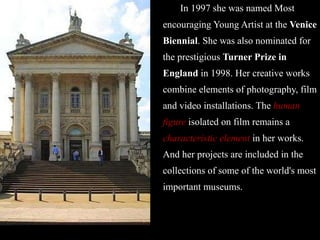
In 1997 she was named Most encouraging Young Artist at the  Venice Biennial . She was also nominated for the prestigious  Turner Prize in England  in 1998. Her creative works combine elements of photography, film and video installations. The  human figure  isolated on film remains a  characteristic element  in her works. And her projects are included in the collections of some of the world's most important museums.
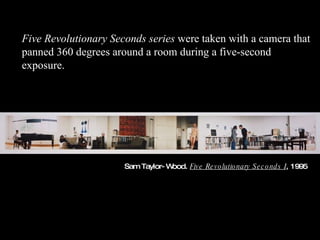
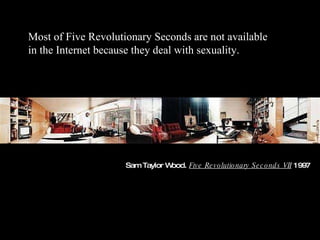
Sam Taylor-Wood.  Five Revolutionary Seconds I , 1995 Five Revolutionary Seconds series  were taken with a camera that panned 360 degrees around a room during a five-second exposure.
Sam Taylor Wood.  Five Revolutionary Seconds VII   1997 Most of Five Revolutionary Seconds are not available in the Internet because they deal with sexuality.
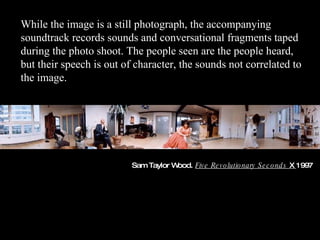
Sam Taylor Wood.  Five Revolutionary Seconds  X  1997 While the image is a still photograph, the accompanying soundtrack records sounds and conversational fragments taped during the photo shoot. The people seen are the people heard, but their speech is out of character, the sounds not correlated to the image.
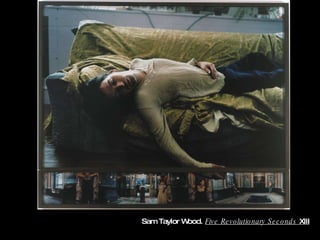
Sam Taylor Wood.   Five Revolutionary Seconds  XIII
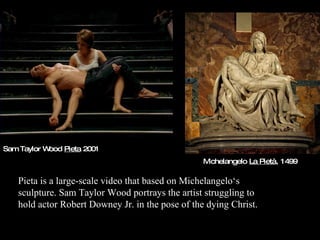
Sam Taylor Wood  Pieta   2001 Pieta is a large-scale video that based on Michelangelo‘s sculpture. Sam Taylor Wood portrays the artist struggling to hold actor Robert Downey Jr. in the pose of the dying Christ. Michelangelo  La Pietà , 1499
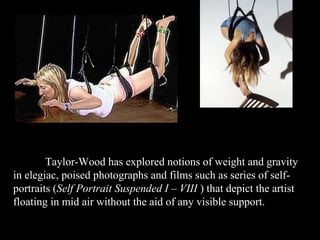
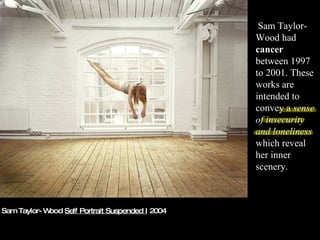
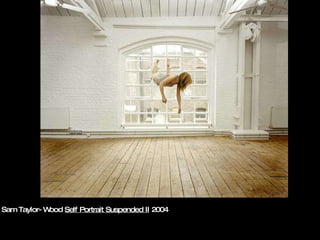
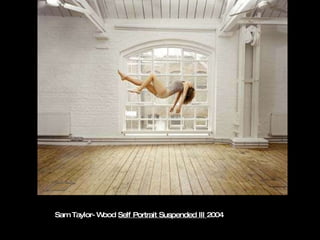
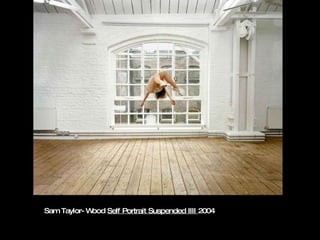
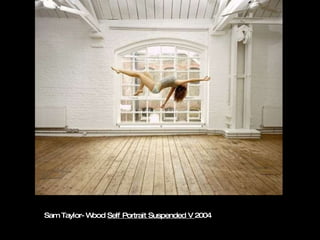
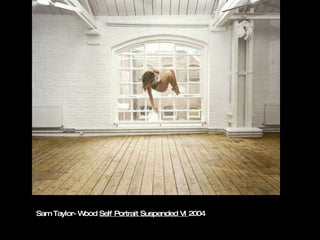
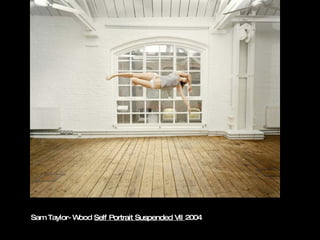
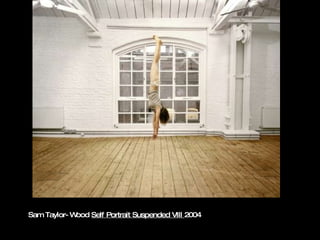
Taylor-Wood has explored notions of weight and gravity in elegiac, poised photographs and films such as series of self-portraits ( Self Portrait Suspended I – VIII  ) that depict the artist floating in mid air without the aid of any visible support.
Sam Taylor-Wood  Self Portrait Suspended I  2004 Sam Taylor-Wood had  cancer  between 1997 to 2001. These works are intended to convey a  sense of insecurity and loneliness  which reveal her inner scenery.
Sam Taylor-Wood  Self Portrait Suspended II  2004
Sam Taylor-Wood  Self Portrait Suspended III  2004
Sam Taylor-Wood  Self Portrait Suspended IIII  2004
Sam Taylor-Wood  Self Portrait Suspended V  2004
Sam Taylor-Wood  Self Portrait Suspended VI  2004
Sam Taylor-Wood  Self Portrait Suspended VII  2004
Sam Taylor-Wood  Self Portrait Suspended VIII  2004
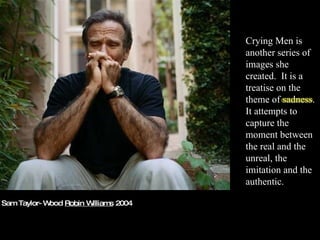
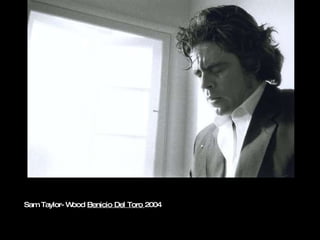
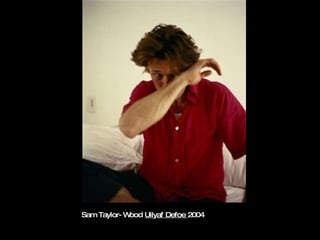
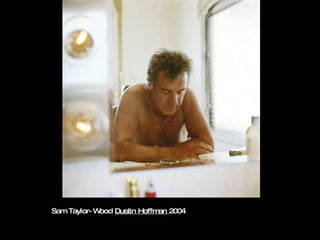
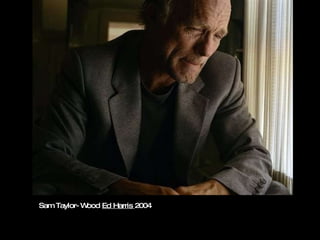
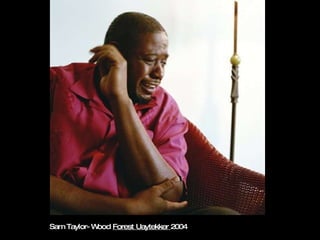
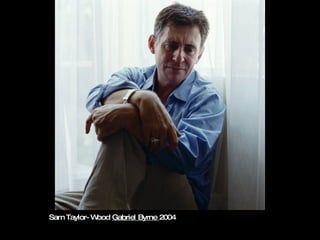
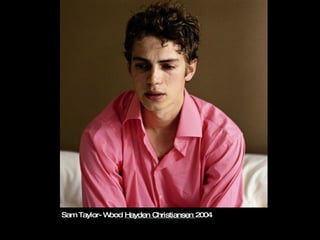
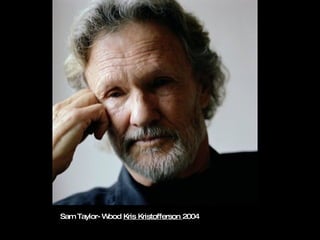
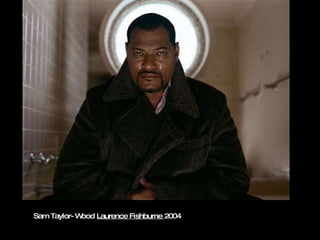
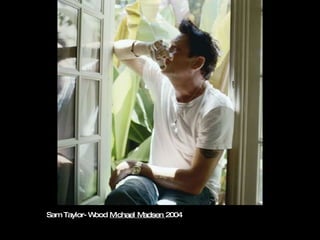
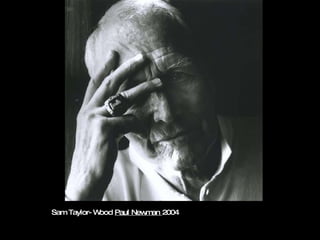
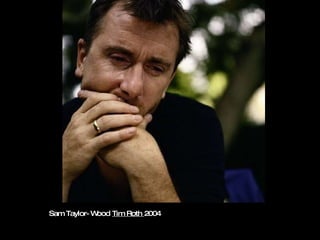
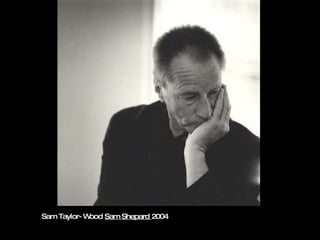
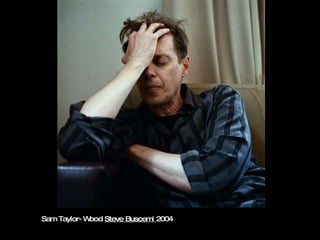
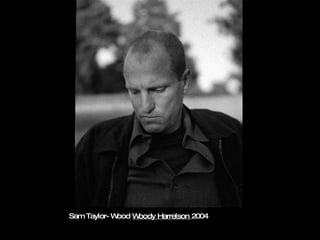
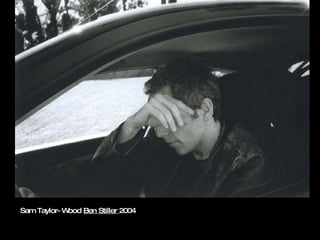
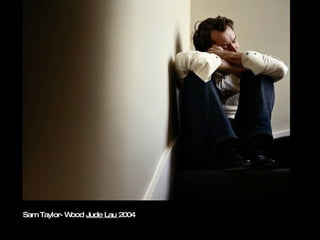
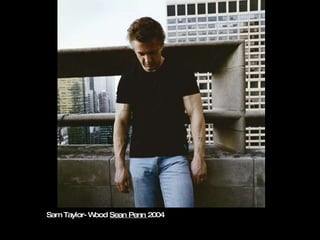
Sam Taylor-Wood  Robin Williams  2004 Crying Men is another series of images she created.  It is a treatise on the theme of sadness. It attempts to capture the moment between the real and the unreal, the imitation and the authentic.
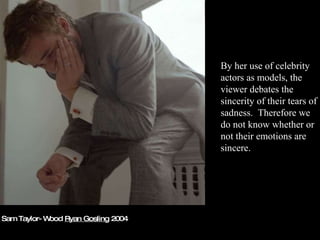
Sam Taylor-Wood  Ryan Gosling  2004 By her use of celebrity actors as models, the viewer debates the sincerity of their tears of sadness.  Therefore we do not know whether or not their emotions are sincere.
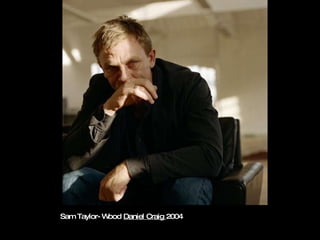
Sam Taylor-Wood  Daniel Craig  2004
Sam Taylor-Wood  Benicio Del Toro  2004
Sam Taylor-Wood  Uilyaf Defoe  2004
Sam Taylor-Wood  Dustin Hoffman  2004
Sam Taylor-Wood  Ed Harris  2004
Sam Taylor-Wood  Forest Uaytekker  2004
Sam Taylor-Wood  Gabriel Byrne  2004
Sam Taylor-Wood  Hayden Christiansen  2004
Sam Taylor-Wood  Kris Kristofferson  2004
Sam Taylor-Wood  Laurence Fishburne  2004
Sam Taylor-Wood  Michael Madsen  2004
Sam Taylor-Wood  Paul Newman  2004
Sam Taylor-Wood  Tim Roth  2004
Sam Taylor-Wood  Sam Shepard  2004
Sam Taylor-Wood  Sean Penn  2004
Sam Taylor-Wood  Steve Buscemi  2004
Sam Taylor-Wood  Woody Harrelson  2004
Sam Taylor-Wood  Ben Stiller  2004
Sam Taylor-Wood  Jude Lau  2004
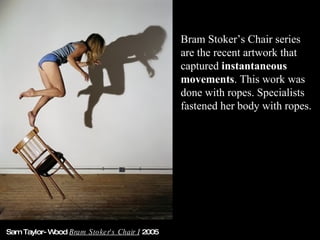
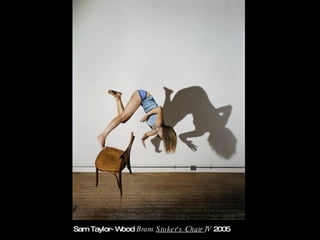
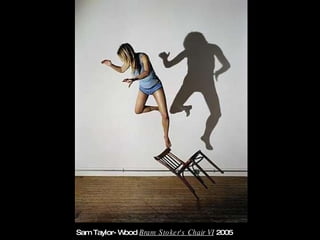
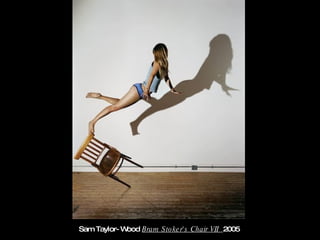
Bram Stoker’s Chair series are the recent artwork that captured  instantaneous movements . This work was done with ropes. Specialists fastened her body with ropes. Sam Taylor-Wood  Bram Stoker's Chair I  2005
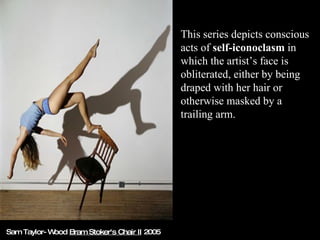
This series depicts conscious acts of  self-iconoclasm  in which the artist’s face is obliterated, either by being draped with her hair or otherwise masked by a trailing arm.  Sam Taylor-Wood  Bram Stoker's Chair II  2005
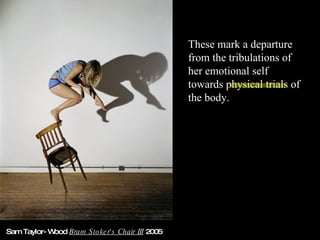
Sam Taylor-Wood  Bram Stoker's Chair III  2005 These mark a departure from the tribulations of her emotional self towards physical trials of the body.
Sam Taylor-Wood  Bram  Stoker's Chair  IV  2005
Sam Taylor-Wood  Bram Stoker's Chair VI  2005
Sam Taylor-Wood  Bram Stoker's Chair VII  2005

YBA & Sam Taylor-Wood

  • 1.
    YBA & SamTaylor - Wood Hyangbo Cho, Bona Kim
  • 2.
    YBA (YoungBritish Artists) Charles Saatchi Damien Hirst Tracey Emin Chris Ofili Rachel Whiteread
  • 3.
    Charles Saatchi   He is known worldwide as an art collector and owner of the Saatchi Gallery and in particular for his sponsorship of the YBA - He is a co-founder with his brother, Maurice of Saatchi & Saatchi, the world’s largest global advertising agency. Later they were forced out and they formed their new advertising agency, M & C Saatchi - His collection of art also presented to the exhibition, Sensation at Royal Academy of Art
  • 4.
    Saatchi Gallery (CharlesSaatchi’s art collections)
  • 5.
    Zhang Huan. Donkey , (Moving mechanical donkey 'humping' the model of Shanghai's Jin Mao tower) Saatchi Gallery, London 2008
  • 6.
    Sun Yuan andPeng Yu. Old Persons Home , (Wicked, their satirical models of decrepit OAPS look suspiciously familiar to world leaders, long crippled and impotent, left to battle it out in true geriatric style) Saatchi Gallery 2008
  • 7.
    Sensation Exhibition (Exhibitionof YBAs) Royal Academy of Art in London Brooklyn Museum of Art in New York National Gallery of Australia in Australia
  • 8.
    Royal Academy ofArt in London 18 September – 28 December 1997 Marcus Harvey. Portrait of Moors murderer Myra Hindley, (Painted using children’s handprints) Sensation Exhibition London 1997 The art show mostly contained controversial images Most people in public complained about the controversial images A mother of one of Hindley’s victims asked for the portrait, which was made of hundred copies of children’s handprints, to be excluded The murderer, Myra Hindley sent a letter from the jail suggesting that her portrait be removed from the exhibition because “a sole disregard not only for the emotional pain and trauma that would inevitably be experienced by the families of the Moors victims but also the families of any child victim.” People smashed windows of the Academy Therefore, the work was guarded by security men Later, this exhibition became famous because of this subject matter
  • 9.
    Brooklyn Museum ofArt in New York 2 October 1999 – 9 January 2000 Chris Ofili. The Holy Virgin Mary, (Oil paint, glitter, polyester resin, map pins, elephant dung on linen) London 1996 Elephant Dung The Holy Virgin Mary by Chris Ofili was a huge matter in New York Ofili’s work showed a carefully rendered black Madonna decorated with a resin-covered lump of elephant dung. The figure is also surrounded by small collaged images of female genitalia from pornographic magazines; these seemed from a distance to be the traditional cherubim New York mayor, Rudolph Giuliani wanted to withdraw his work because he said, “You don't have a right to government subsidy for desecrating somebody else's religion.” Many people thought that Ofili was against Catholic by showing his work
  • 10.
    Brooklyn Museum ofArt in New York The United States House of Representatives passed a nonbinding resolution to end federal funding for the museum on 3 October 1999, and New York City did stop funding to the Brooklyn Museum The museum produced a yellow stamp, saying the artworks on show "may cause shock, vomiting, confusion, panic, euphoria and anxiety.” Therefore, Ofili’s painting was also guarded by an armed police officer
  • 11.
    National Gallery ofAustralia in Australia June 1999 The show was scheduled to open in June 1999, but was cancelled The reason was that (according to the director, Brian Kennedy) “although it was due to be funded by the Australian government, it was "too close to the market", since finance for the Brooklyn exhibition included $160,000 from Saatchi, who owned the work, $50,000 from Christie's, who had sold work for Saatchi, and $10,000 from dealers of many of the artists Kennedy said he was unaware of this, when he accepted the show; Saatchi's contribution, the largest single one, was not disclosed by the Brooklyn Museum, until it appeared in court documents
  • 12.
    Renee Cox. Yo Mama’s Last Supper, (Montage of five photographs of 12 men and a naked black woman[Cox’s self portrait] posing Jesus) Sensation Exhibition , New York 1996
  • 13.
    Rachel Whiteread. Untitled (One Hundread Spaces), (Series of resin casts of the space underneath chairs) Sensation Exhibition , London 1997
  • 14.
    YBA YBA (YoungBritish Artists) A group of conceptual artists, painters, sculptors and installation artists based in United Kingdom The term Young British Artists is derived from shows of that name staged at the Saatchi Gallery from 1992 onwards, which brought the artists to fame They are noted for "shock tactics", use of throwaway materials and wild-living, and are (or were) associated with the Hoxton area of East London
  • 15.
    Became famous withtheir first exhibition, Freeze Freeze organized by Damien Hirst (1988) They achieved considerable media coverage and dominated British art during the 1990s
  • 16.
    Damien Hirst Context: * HOW DID HE START/DEVELOP HIS WORK? He was interested in both science and philosophy Was affected by the development of anatomy, and genetic manipulation His career was developed by the exhibition, Freeze in 1988 When Charles Saatchi was inspired by his artworks - He did not create his artworks, but was referred by media and other artists like Andy Warhol and the method of De Stijl (Neo-plasticism ) * WHY? He wanted to start new and different than other paintings as to indicate his development from his artworks He always had a strange or extraordinary point of view
  • 17.
    - Theme :Death Hirst’s work is an examination of the processes of life and death; the ironies, falsehoods and desires that we mobilize to negotiate our own alienation and mortality Hirst’s works demonstrate how today’s society is dangerous and scared as he preserves dead animals into formaldehyde Hirst’s works clearly focus on modern arts; surrealism, pop arts Context (continued) Damien Hirst. The Physical Impossibility of Death in the Mind of Someone Living , (14-foot (4.3 m) tiger shark immersed in formaldehyde in a vitrine) London 1991
  • 18.
    Major Characteristics * Differences He mostly attempts to maintain the real concept of his subject * Similarities Like other members of YBA, Damien Hirst focuses on the society issues such as drugs, abuse He won Turner Prize
  • 19.
    Damien Hirst. Beautifulrevolving sphincter, oops brown painting , (Household gloss paint on canvas, 72" diameter) Museo Archeologico Nazionale di Napoli , Italy 2005
  • 20.
    Damien Hirst. TheVirgin Mother , (Massive sculpture depicting a pregnant female human, with layers removed from one side to expose the fetus, muscle and tissue layers, and skull underneath) New York City 2006
  • 21.
    Damien Hirst. Forthe Love of God , (Platinum cast of a human skull covered with 8,601 diamonds) White Cube, London 2007
  • 22.
    Tracey Emin Context: * HOW DID SHE START/DEVELOP HER WORK? Her life was unhappy since she was raped, and had an abortion 3 times She restarted her art studying when her friend encouraged to do so Her life was developed when her art exhibition at “White Cube” was successful (in London, 1994) * WHY? As if it was a new way of expressing her thoughts, she wanted to impress other people about her true life, including the past
  • 23.
    Context (continued) Major theme: attempts upon demonstrating true life She tries to not hide everything she had experienced Most of her artworks are installation of pieces she has She says that; “Being artist is not only about creating arts and being praised, but being artist is about communication with something” Meaning that, she always expresses her true emotions and wants to give the audience messages about a life Tracey Emin. My Bed, (Installation art pieces) London 1998
  • 24.
    Major Characteristics *Differences - Her issues mostly are focused on women She does not apply any creative methods on her artworks (only applying natural objects such as blanket, books, etc) - More realistic than other artists She wants to keep her memories by creating her own artworks * Similarities Her artworks are based on society issues, such as abortion, rape
  • 25.
    Tracey Emin. Everyone I Have Ever Slept With, (Tent exterior) London 1995
  • 26.
    Tracey Emin. Everyone I Have Ever Slept With, (Tent interior) London 1995
  • 27.
    Chris Ofili Context: * HOW DID HE START/DEVELOP HIS WORK? When he visited to Africa, he learned about his identity, African This inspired him as much as he changed the way he created artworks He became famous through Sensation exhibition * WHY? He wanted to indicate his idea against racial discrimination and to protect the rights of black people
  • 28.
    Context (continued) Major theme: Africans He does not want to show only his work, but he also wants to entertain the audience with his paintings, installations, etc He is not interested in 20 th century art because he often wants to use aboriginal materials from Africa as well as he focuses on aboriginal African people Chris Ofili. Her Gift Two & His Gift Two (Gouache, ink, charcoal, golden leaf on paper) New York 2006
  • 29.
    Major Characteristics *Differences He focuses on specific group of people (African) One of materials he used for his art was elephant’s ‘dung’ His paintings were mostly oil paintings, but every time it included elephant’s ‘dung’ * Similarities Also, focusing on one of the biggest social issues, discrimination and liberalism Chris Ofili. No Woman No Cry, (Acrylic paint, oil, polyester resin, paper collage, map pins, elephant dung on canvas) London 1998
  • 30.
    Chris Ofili. Annunciation, (Bronzed sculpture ) London 2006
  • 31.
    Rachel Whiteread Context: HOW DID SHE START/ DEVELOP HER WORK? Major Theme: H uman traces left on ordinary objects In 1993, she was commissioned to make House , the cast of the inside of a Victorian house in East London, which provoked considerable media and public attention She was also influenced by Minimalism * WHY? She wants to illustrate that: “[Casts carry] the residue of years and years of use”
  • 32.
    Major Characteristics *Differences most of her works are casts of ordinary domestic objects and the spaces that the objects do not inhabit (“Negative Space”) instead producing a solid cast of where the spaces within a container would be; particular parts of rooms, the area underneath furniture Unlike other YBAs, Whiteread feels uncomfortable with controversial issues Her works are focused on archetypal everyday subjects, such as tables, chairs, etc * Similarities She also won Turner Prize in 1993 Rachel Whiteread . Cabinet VIII, ( Sculpture of 1 metal cupboard, 55 plaster units ) London 2007
  • 33.
    Rachel Whiteread . Ghost, ( Plaster on steel frame ) London 1990
  • 34.
    Rachel Whiteread . House, ( Controversial sculpture ) London 1993
  • 35.
    Rachel Whiteread . Untitled (stacks), ( Plaster, polystyrene, and steel) London 1999
  • 36.
    Rachel Whiteread . Stairs, ( Plaster on staircases ) London 2001
  • 37.
  • 38.
    Sam Taylor-Wood wasborn in London in 1967, and she is now an outstanding British artist of the younger generation (YBA). She graduated from the sculpture department at Goldsmiths College in London in 1990 and then she went on to become a prolific film-maker and photographer.
  • 39.
    In 1997 shewas named Most encouraging Young Artist at the Venice Biennial . She was also nominated for the prestigious Turner Prize in England in 1998. Her creative works combine elements of photography, film and video installations. The human figure isolated on film remains a characteristic element in her works. And her projects are included in the collections of some of the world's most important museums.
  • 40.
    Sam Taylor-Wood. Five Revolutionary Seconds I , 1995 Five Revolutionary Seconds series were taken with a camera that panned 360 degrees around a room during a five-second exposure.
  • 41.
    Sam Taylor Wood. Five Revolutionary Seconds VII 1997 Most of Five Revolutionary Seconds are not available in the Internet because they deal with sexuality.
  • 42.
    Sam Taylor Wood. Five Revolutionary Seconds X 1997 While the image is a still photograph, the accompanying soundtrack records sounds and conversational fragments taped during the photo shoot. The people seen are the people heard, but their speech is out of character, the sounds not correlated to the image.
  • 43.
    Sam Taylor Wood. Five Revolutionary Seconds XIII
  • 44.
    Sam Taylor Wood Pieta 2001 Pieta is a large-scale video that based on Michelangelo‘s sculpture. Sam Taylor Wood portrays the artist struggling to hold actor Robert Downey Jr. in the pose of the dying Christ. Michelangelo La Pietà , 1499
  • 45.
    Taylor-Wood has explorednotions of weight and gravity in elegiac, poised photographs and films such as series of self-portraits ( Self Portrait Suspended I – VIII ) that depict the artist floating in mid air without the aid of any visible support.
  • 46.
    Sam Taylor-Wood Self Portrait Suspended I 2004 Sam Taylor-Wood had cancer between 1997 to 2001. These works are intended to convey a sense of insecurity and loneliness which reveal her inner scenery.
  • 47.
    Sam Taylor-Wood Self Portrait Suspended II 2004
  • 48.
    Sam Taylor-Wood Self Portrait Suspended III 2004
  • 49.
    Sam Taylor-Wood Self Portrait Suspended IIII 2004
  • 50.
    Sam Taylor-Wood Self Portrait Suspended V 2004
  • 51.
    Sam Taylor-Wood Self Portrait Suspended VI 2004
  • 52.
    Sam Taylor-Wood Self Portrait Suspended VII 2004
  • 53.
    Sam Taylor-Wood Self Portrait Suspended VIII 2004
  • 54.
    Sam Taylor-Wood Robin Williams 2004 Crying Men is another series of images she created. It is a treatise on the theme of sadness. It attempts to capture the moment between the real and the unreal, the imitation and the authentic.
  • 55.
    Sam Taylor-Wood Ryan Gosling 2004 By her use of celebrity actors as models, the viewer debates the sincerity of their tears of sadness. Therefore we do not know whether or not their emotions are sincere.
  • 56.
    Sam Taylor-Wood Daniel Craig 2004
  • 57.
    Sam Taylor-Wood Benicio Del Toro 2004
  • 58.
    Sam Taylor-Wood Uilyaf Defoe 2004
  • 59.
    Sam Taylor-Wood Dustin Hoffman 2004
  • 60.
    Sam Taylor-Wood Ed Harris 2004
  • 61.
    Sam Taylor-Wood Forest Uaytekker 2004
  • 62.
    Sam Taylor-Wood Gabriel Byrne 2004
  • 63.
    Sam Taylor-Wood Hayden Christiansen 2004
  • 64.
    Sam Taylor-Wood Kris Kristofferson 2004
  • 65.
    Sam Taylor-Wood Laurence Fishburne 2004
  • 66.
    Sam Taylor-Wood Michael Madsen 2004
  • 67.
    Sam Taylor-Wood Paul Newman 2004
  • 68.
    Sam Taylor-Wood Tim Roth 2004
  • 69.
    Sam Taylor-Wood Sam Shepard 2004
  • 70.
    Sam Taylor-Wood Sean Penn 2004
  • 71.
    Sam Taylor-Wood Steve Buscemi 2004
  • 72.
    Sam Taylor-Wood Woody Harrelson 2004
  • 73.
    Sam Taylor-Wood Ben Stiller 2004
  • 74.
    Sam Taylor-Wood Jude Lau 2004
  • 75.
    Bram Stoker’s Chairseries are the recent artwork that captured instantaneous movements . This work was done with ropes. Specialists fastened her body with ropes. Sam Taylor-Wood Bram Stoker's Chair I 2005
  • 76.
    This series depictsconscious acts of self-iconoclasm in which the artist’s face is obliterated, either by being draped with her hair or otherwise masked by a trailing arm. Sam Taylor-Wood Bram Stoker's Chair II 2005
  • 77.
    Sam Taylor-Wood Bram Stoker's Chair III 2005 These mark a departure from the tribulations of her emotional self towards physical trials of the body.
  • 78.
    Sam Taylor-Wood Bram Stoker's Chair IV 2005
  • 79.
    Sam Taylor-Wood Bram Stoker's Chair VI 2005
  • 80.
    Sam Taylor-Wood Bram Stoker's Chair VII 2005