JRN 362/SPS 362 Story of Football
Rich Hanley, Professor Emeritus
Lecture Twenty-Two
JRN 362/SPS 362 Story of Football
Review
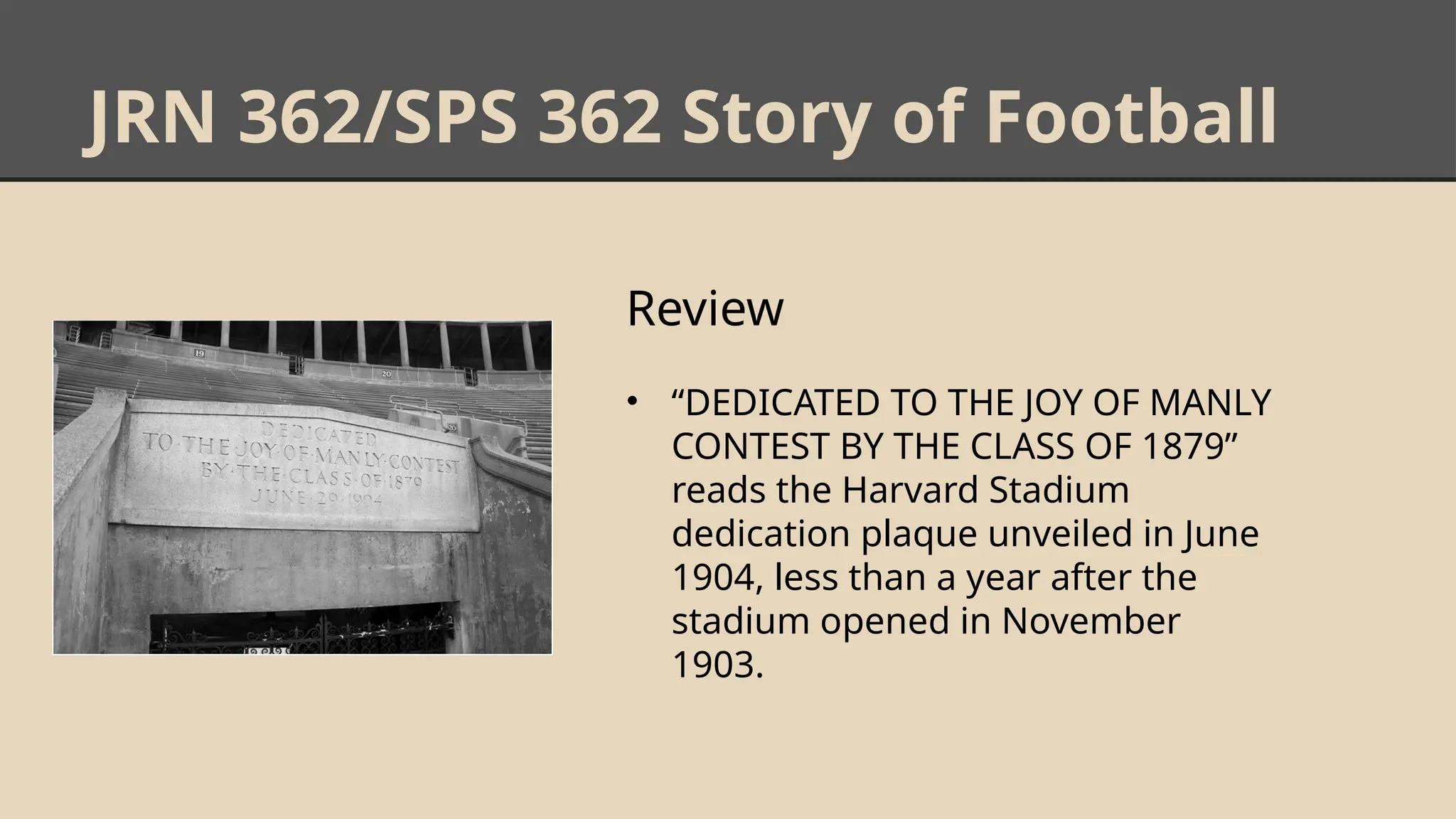
• “DEDICATED TO THE JOY OF MANLY
CONTEST BY THE CLASS OF 1879”
reads the Harvard Stadium
dedication plaque unveiled in June
1904, less than a year after the
stadium opened in November
1903.
JRN 362/SPS 362 Story of Football
Review
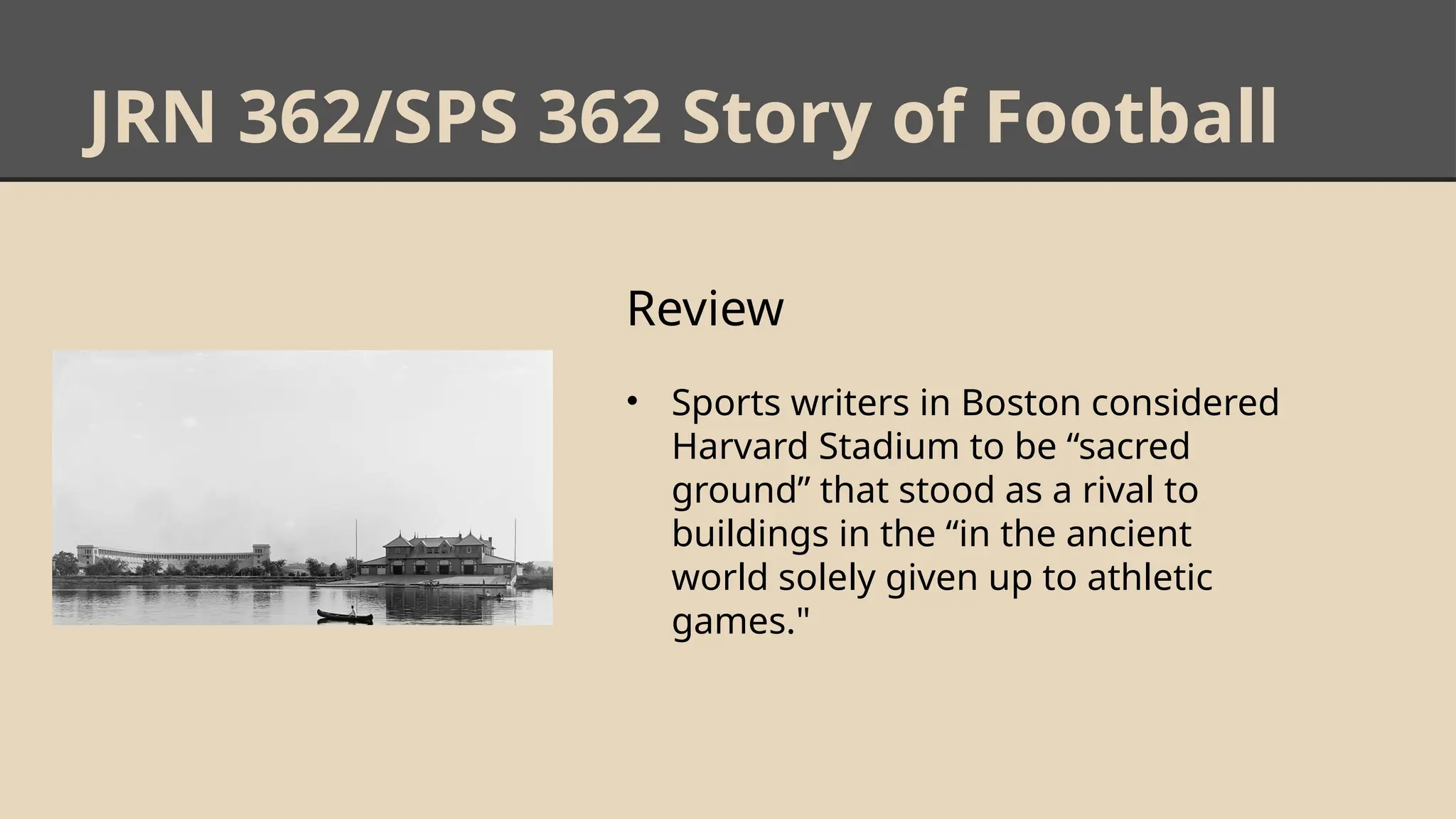
• Sports writers in Boston considered
Harvard Stadium to be “sacred
ground” that stood as a rival to
buildings in the “in the ancient
world solely given up to athletic
games."
JRN 362/SPS 362 Story of Football
Review
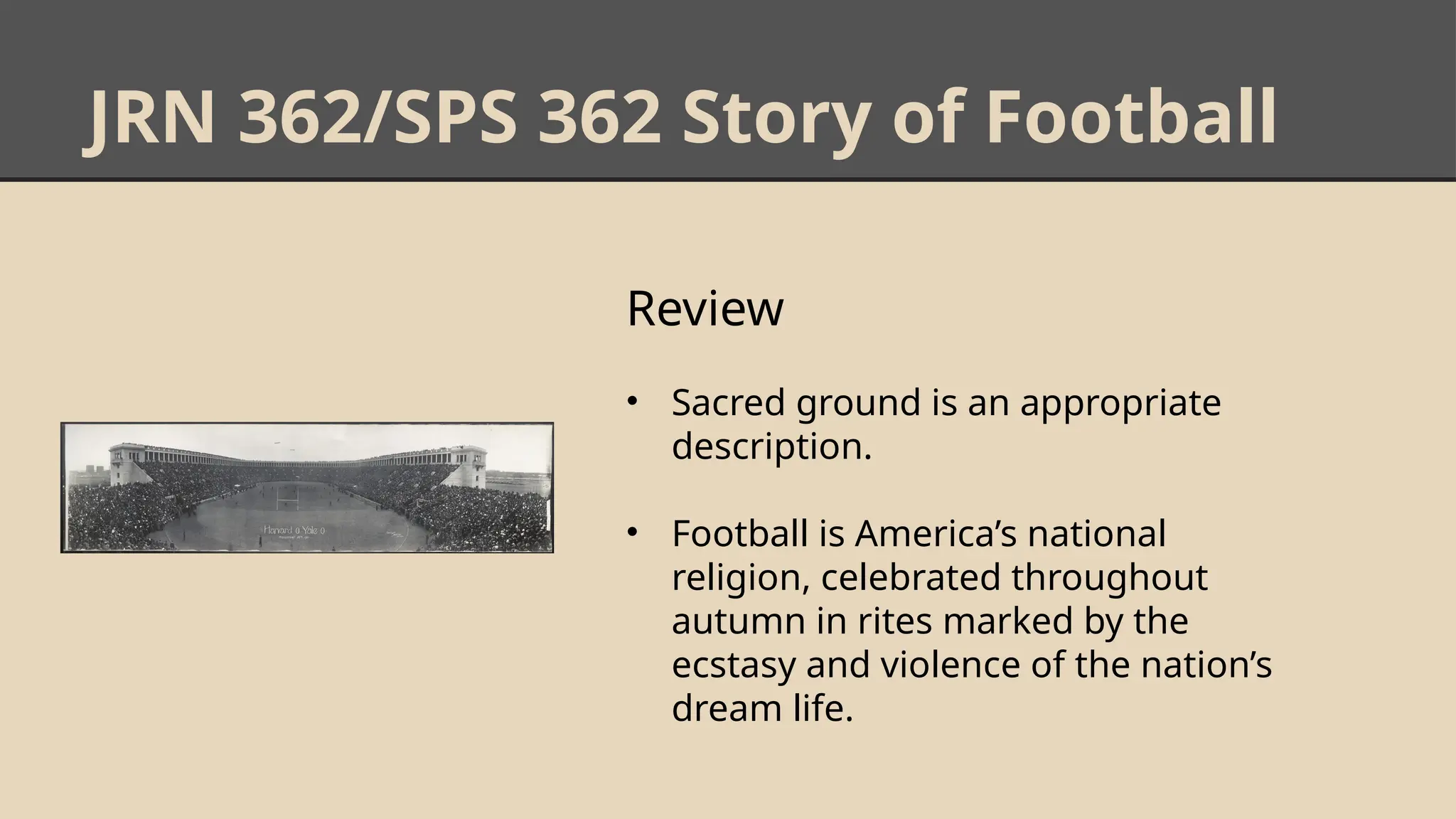
• Sacred ground is an appropriate
description.
• Football is America’s national
religion, celebrated throughout
autumn in rites marked by the
ecstasy and violence of the nation’s
dream life.
JRN 362/SPS 362 Story of Football
Review
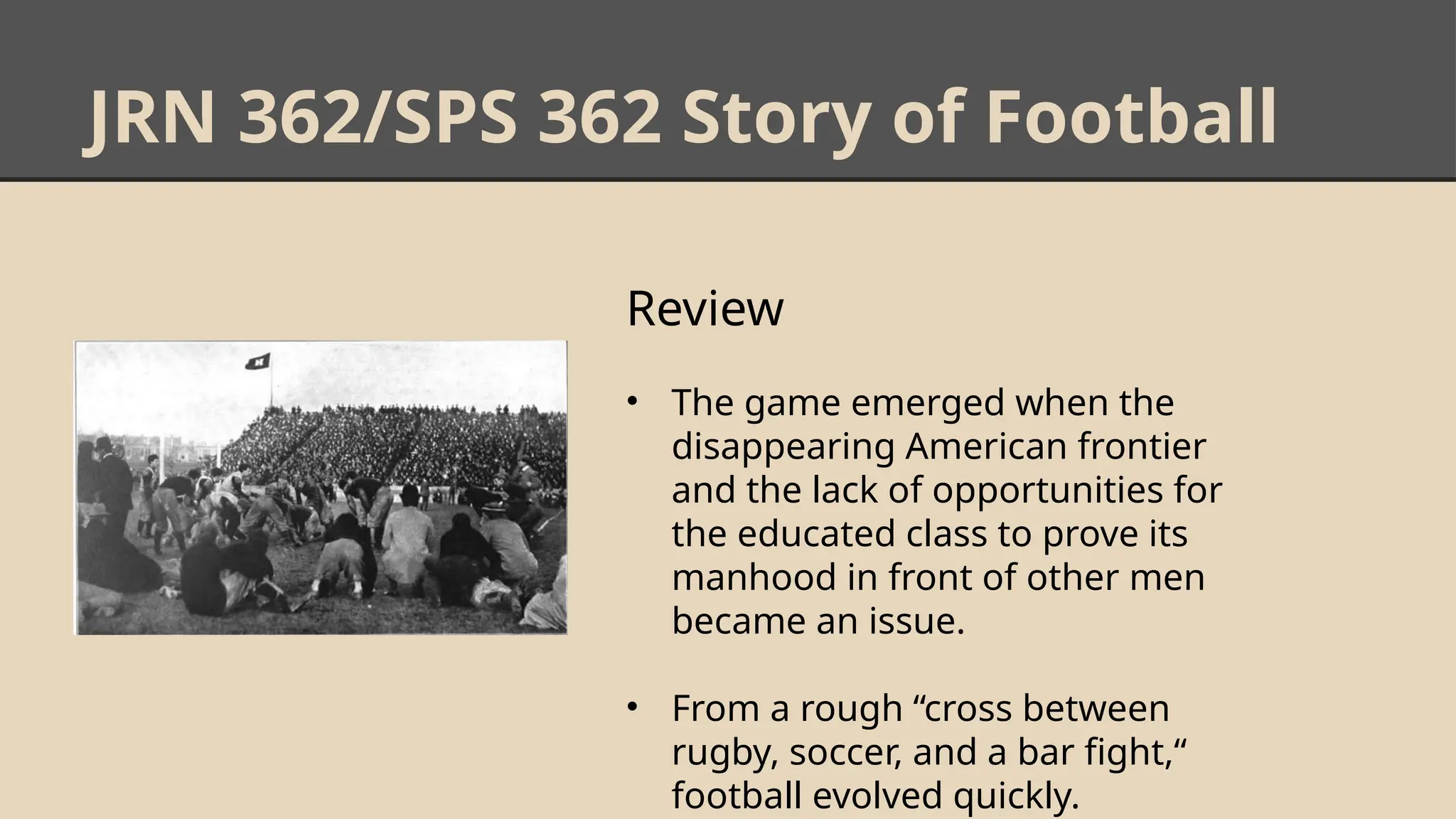
• The game emerged when the
disappearing American frontier
and the lack of opportunities for
the educated class to prove its
manhood in front of other men
became an issue.
• From a rough “cross between
rugby, soccer, and a bar fight,“
football evolved quickly.
JRN 362/SPS 362 Story of Football
Review
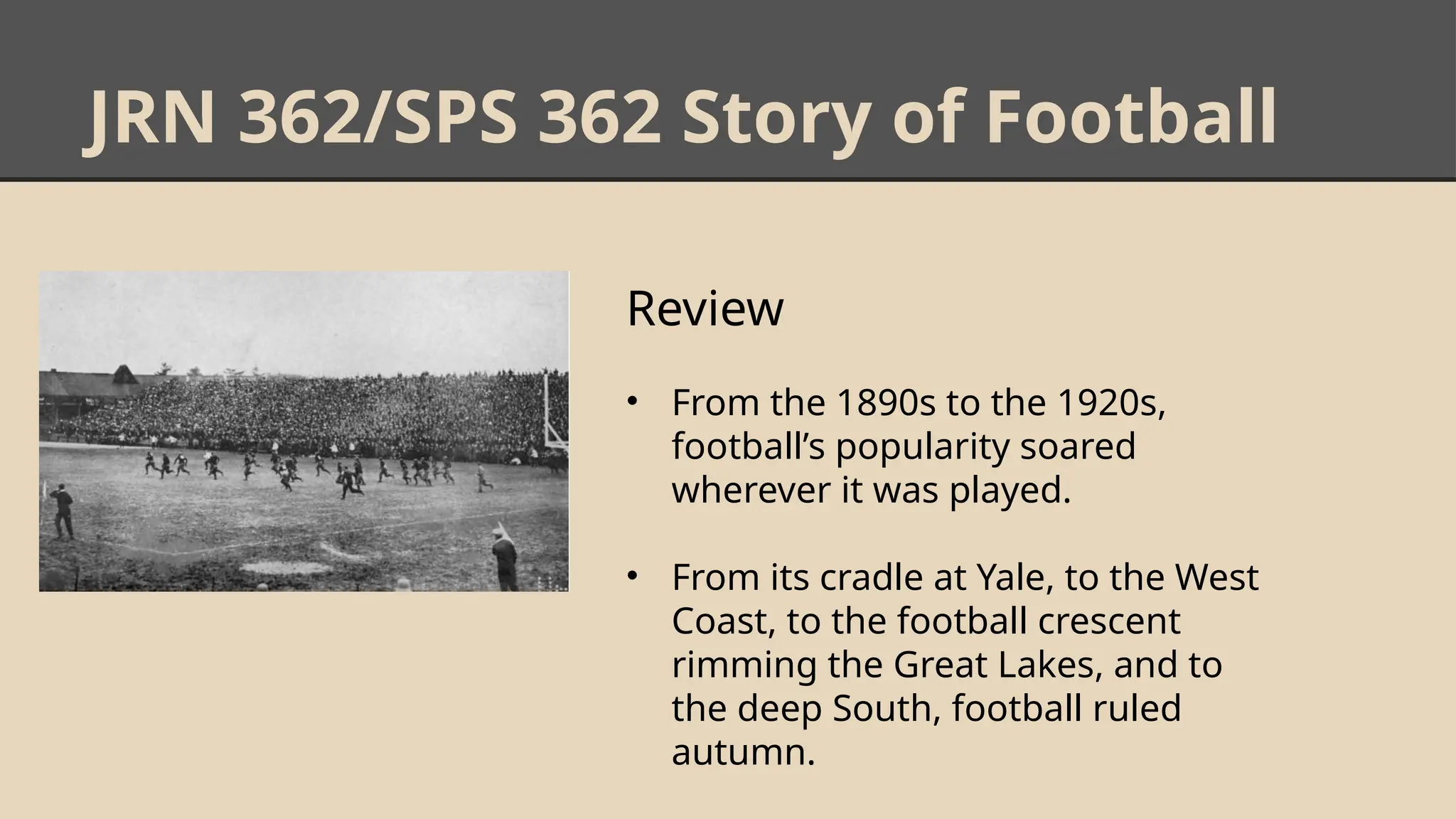
• From the 1890s to the 1920s,
football’s popularity soared
wherever it was played.
• From its cradle at Yale, to the West
Coast, to the football crescent
rimming the Great Lakes, and to
the deep South, football ruled
autumn.
JRN 362/SPS 362 Story of Football
Review
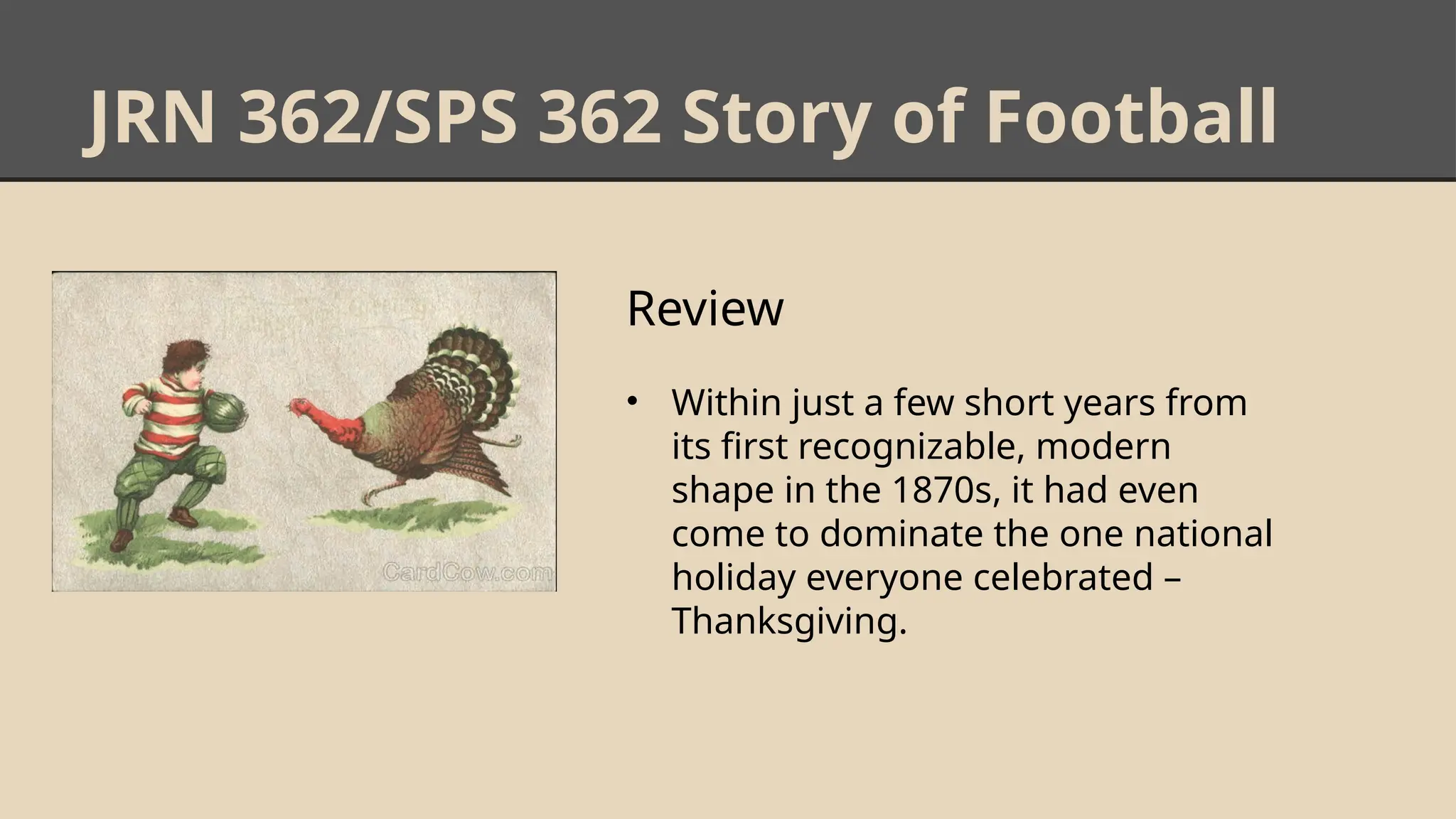
• Within just a few short years from
its first recognizable, modern
shape in the 1870s, it had even
come to dominate the one national
holiday everyone celebrated –
Thanksgiving.
JRN 362/SPS 362 Story of Football
Review
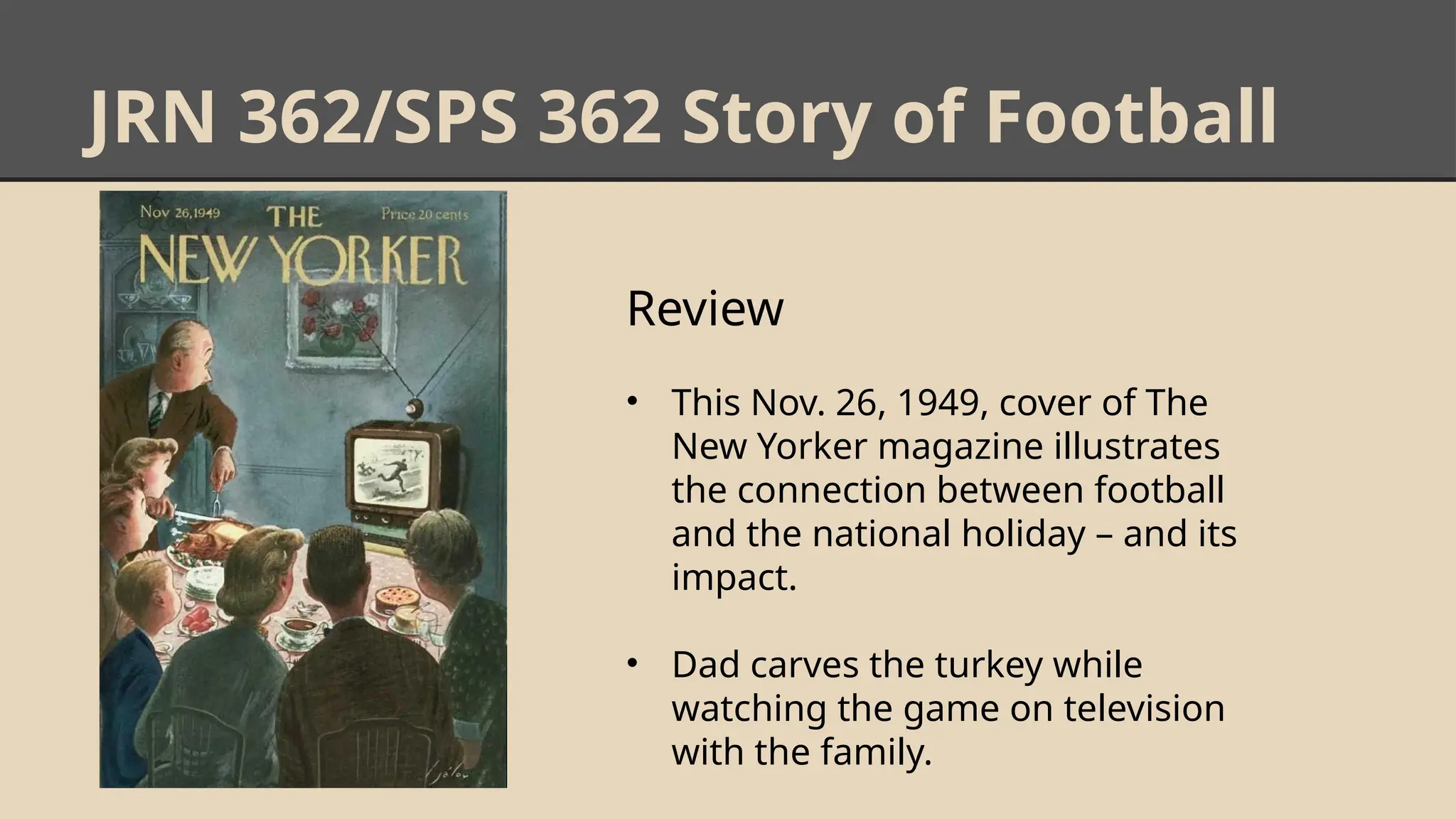
• This Nov. 26, 1949, cover of The
New Yorker magazine illustrates
the connection between football
and the national holiday – and its
impact.
• Dad carves the turkey while
watching the game on television
with the family.
JRN 362/SPS 362 Story of Football
Review
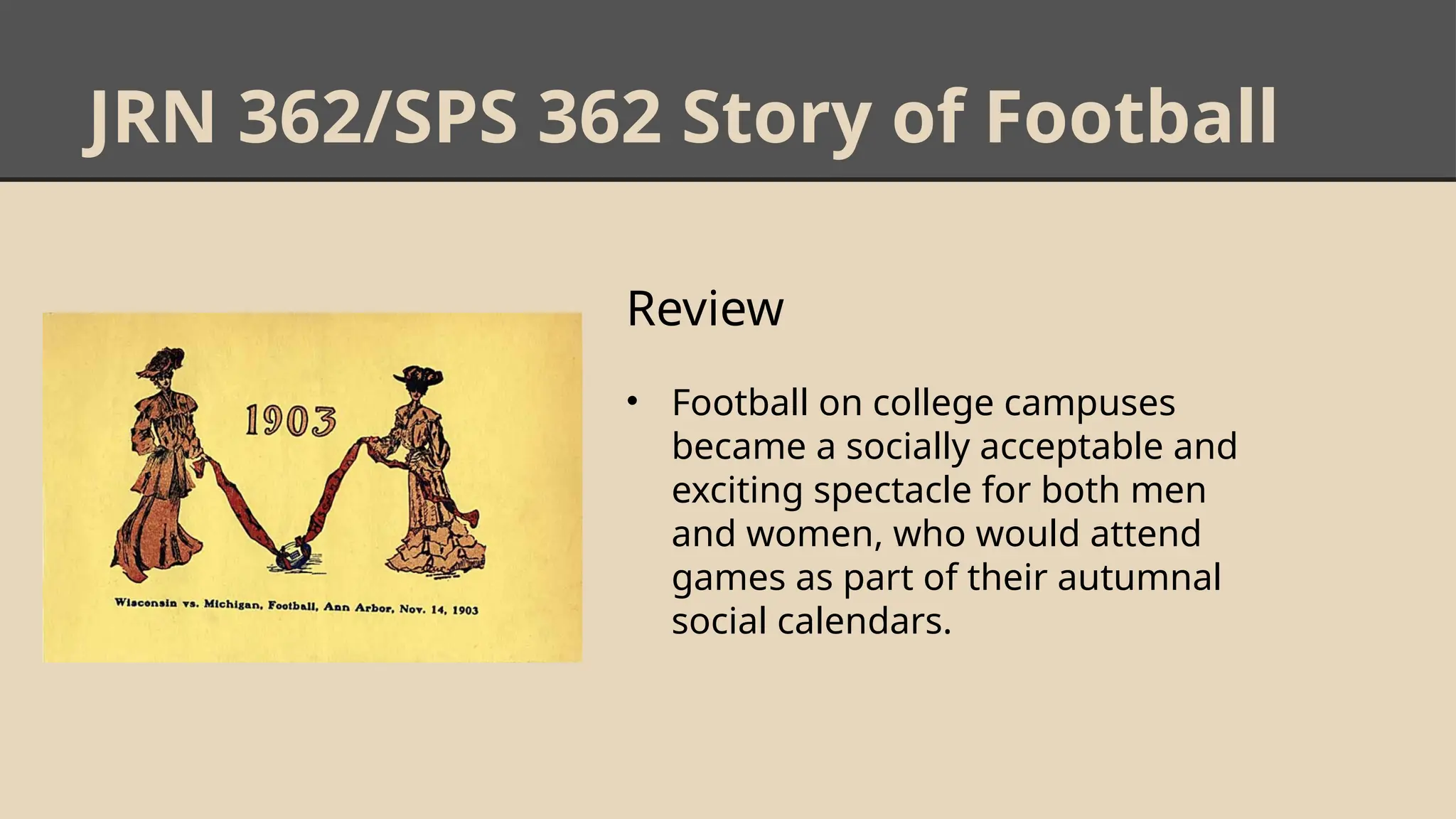
• Football on college campuses
became a socially acceptable and
exciting spectacle for both men
and women, who would attend
games as part of their autumnal
social calendars.
JRN 362/SPS 362 Story of Football
Review
• And the sport produced lots of
stars for the emerging electric
media age of radio, film and, after
World War II, television and
eventually the internet.
JRN 362/SPS 362 Story of Football
Review
• Red Grange of Illinois became the
first immortal star of the electric
age, running for Illinois and the
Chicago Bears.
• His appearance in a NFL game in
1925 gave the professional game
the credibility that it needed to
grow.
JRN 362/SPS 362 Story of Football
Review
• Knute Rockne, an immigrant from
Norway, transformed a small
college in Indiana called Notre
Dame into a national football
power with his understanding of
publicity and relentless road trips
that took the team to the West
Coast and to the South.
JRN 362/SPS 362 Story of Football
Review
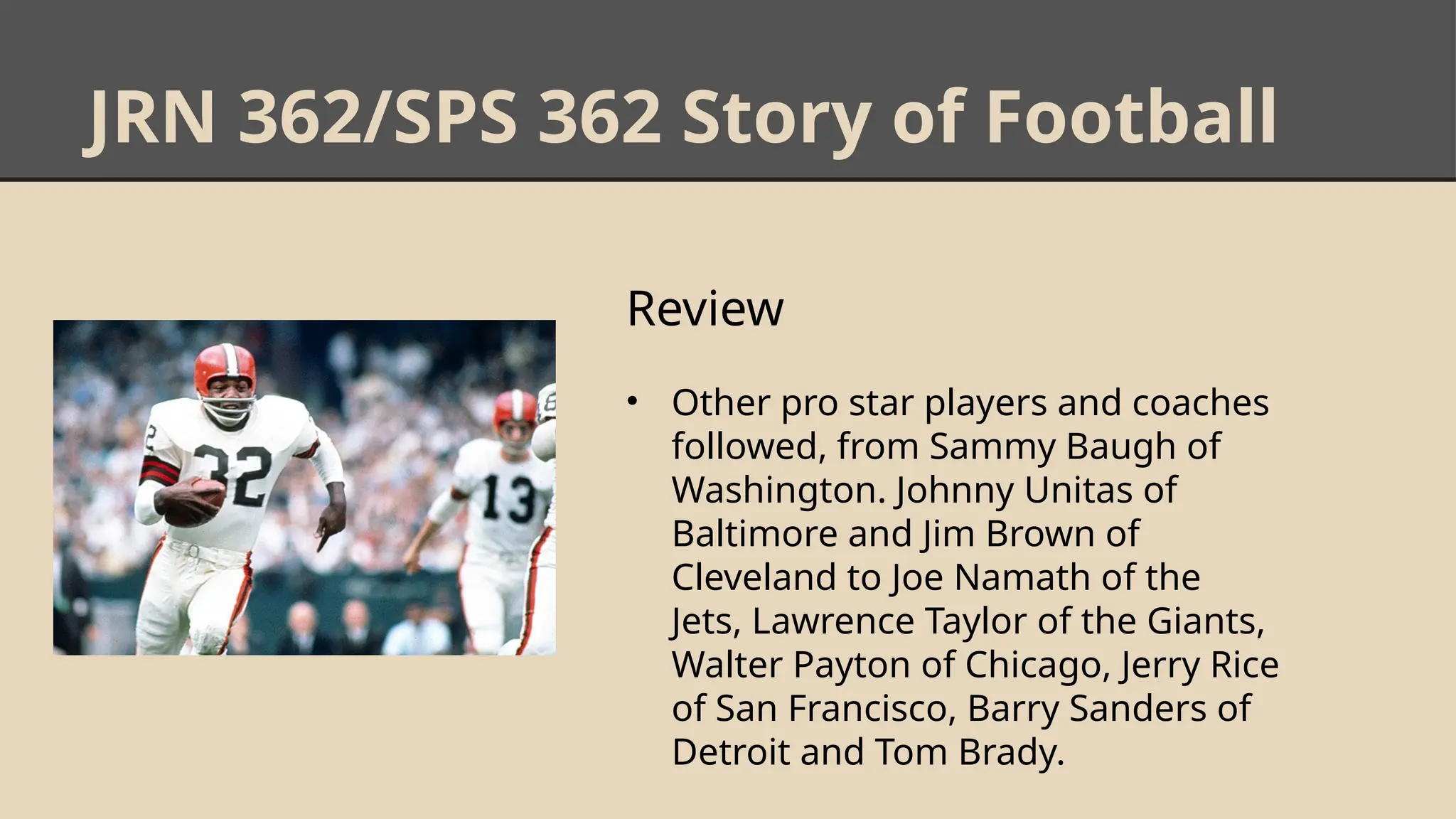
• Other pro star players and coaches
followed, from Sammy Baugh of
Washington. Johnny Unitas of
Baltimore and Jim Brown of
Cleveland to Joe Namath of the
Jets, Lawrence Taylor of the Giants,
Walter Payton of Chicago, Jerry Rice
of San Francisco, Barry Sanders of
Detroit and Tom Brady.
JRN 362/SPS 362 Story of Football
Review
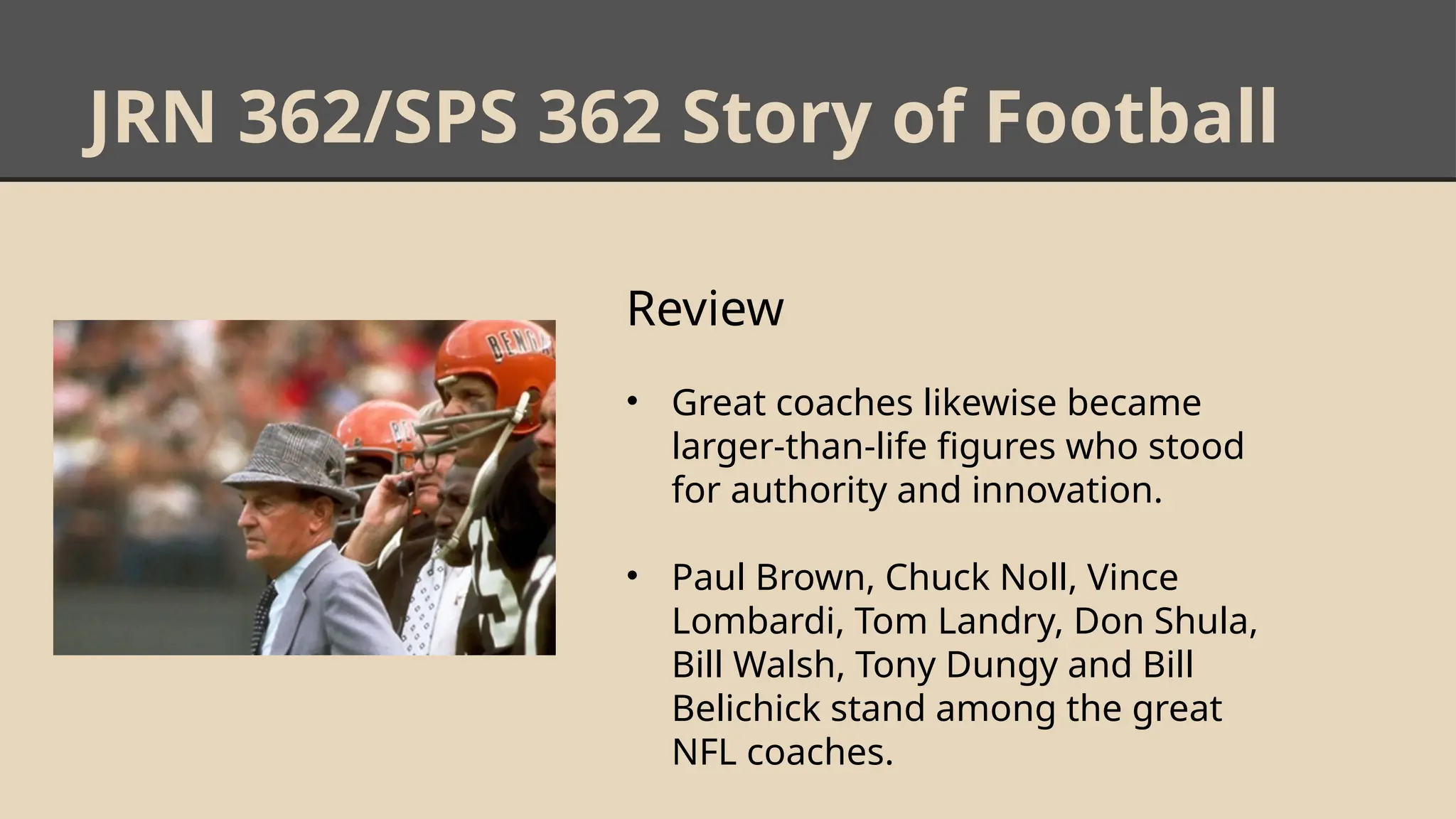
• Great coaches likewise became
larger-than-life figures who stood
for authority and innovation.
• Paul Brown, Chuck Noll, Vince
Lombardi, Tom Landry, Don Shula,
Bill Walsh, Tony Dungy and Bill
Belichick stand among the great
NFL coaches.
JRN 362/SPS 362 Story of Football
Review
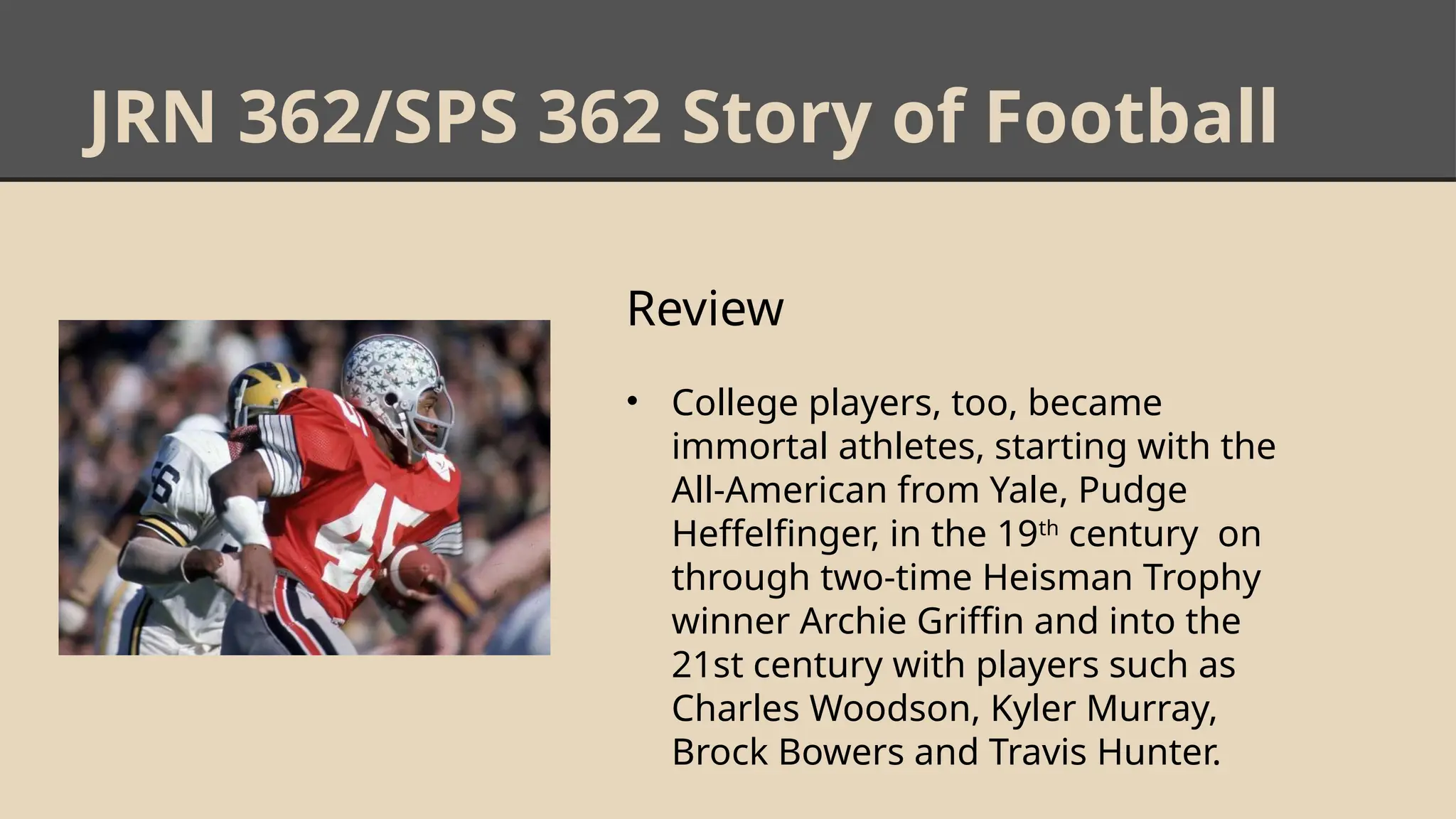
• College players, too, became
immortal athletes, starting with the
All-American from Yale, Pudge
Heffelfinger, in the 19th
century on
through two-time Heisman Trophy
winner Archie Griffin and into the
21st century with players such as
Charles Woodson, Kyler Murray,
Brock Bowers and Travis Hunter.
JRN 362/SPS 362 Story of Football
Review
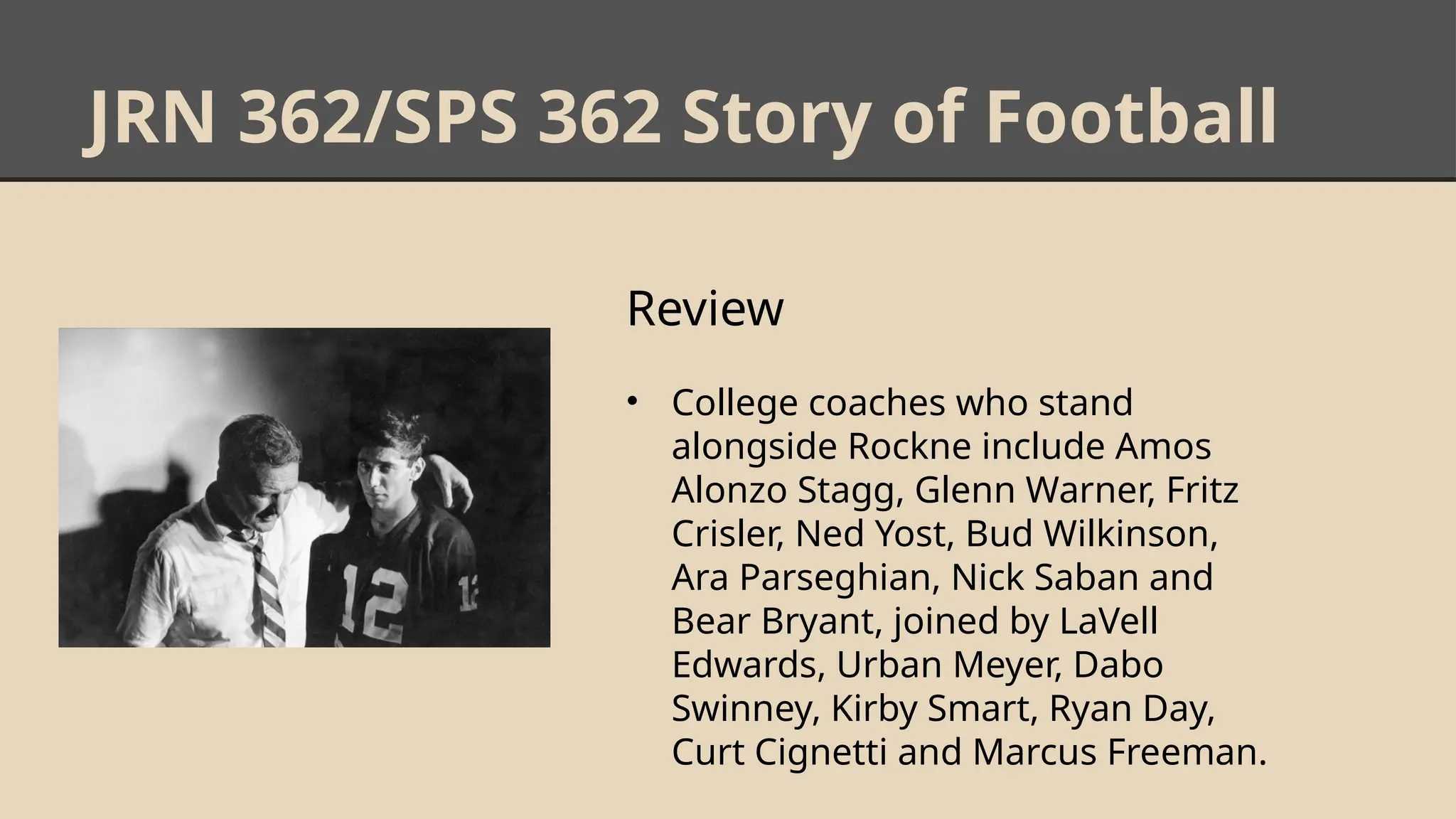
• College coaches who stand
alongside Rockne include Amos
Alonzo Stagg, Glenn Warner, Fritz
Crisler, Ned Yost, Bud Wilkinson,
Ara Parseghian, Nick Saban and
Bear Bryant, joined by LaVell
Edwards, Urban Meyer, Dabo
Swinney, Kirby Smart, Ryan Day,
Curt Cignetti and Marcus Freeman.
JRN 362/SPS 362 Story of Football
Review
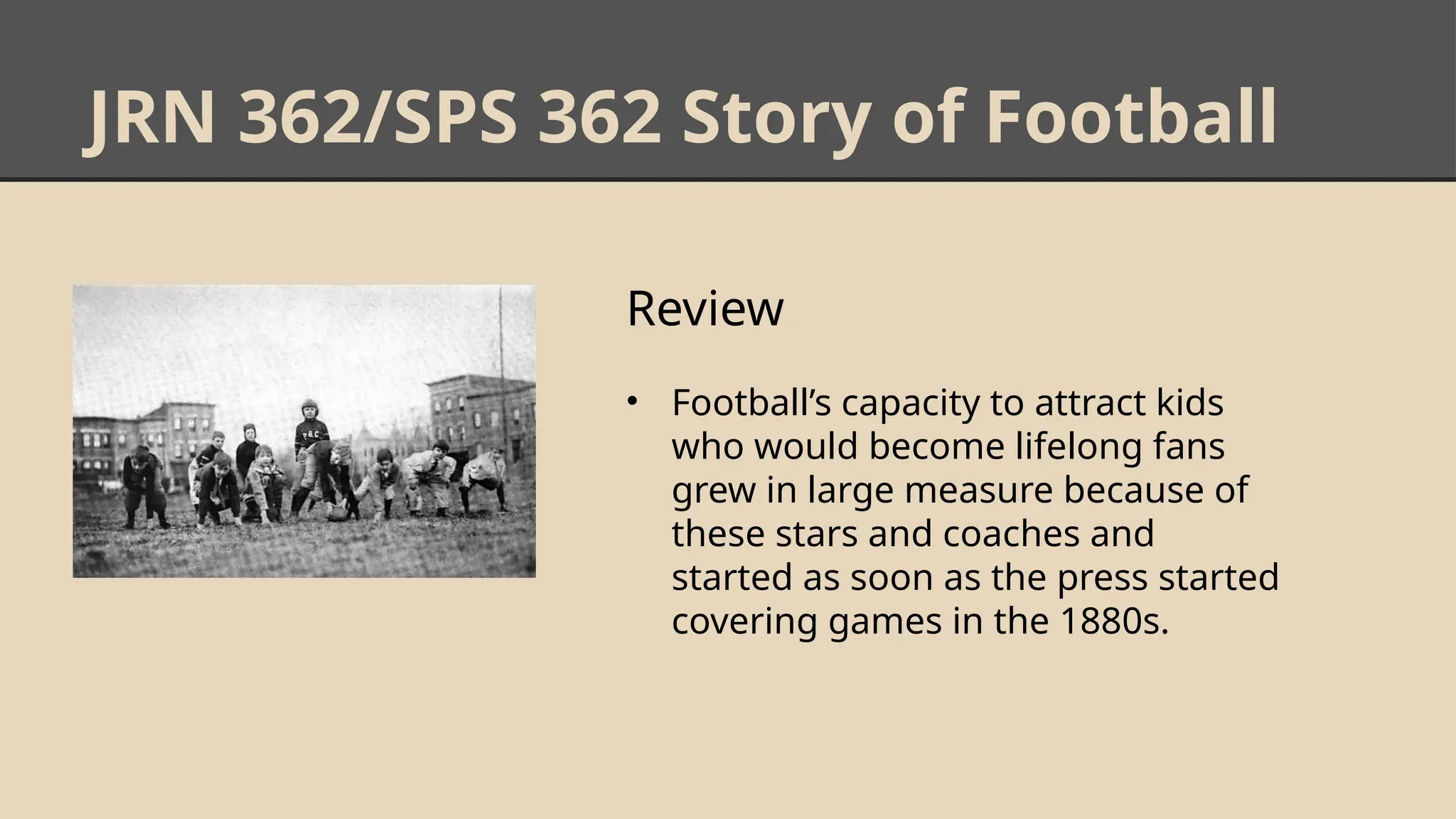
• Football’s capacity to attract kids
who would become lifelong fans
grew in large measure because of
these stars and coaches and
started as soon as the press started
covering games in the 1880s.
JRN 362/SPS 362 Story of Football
Review
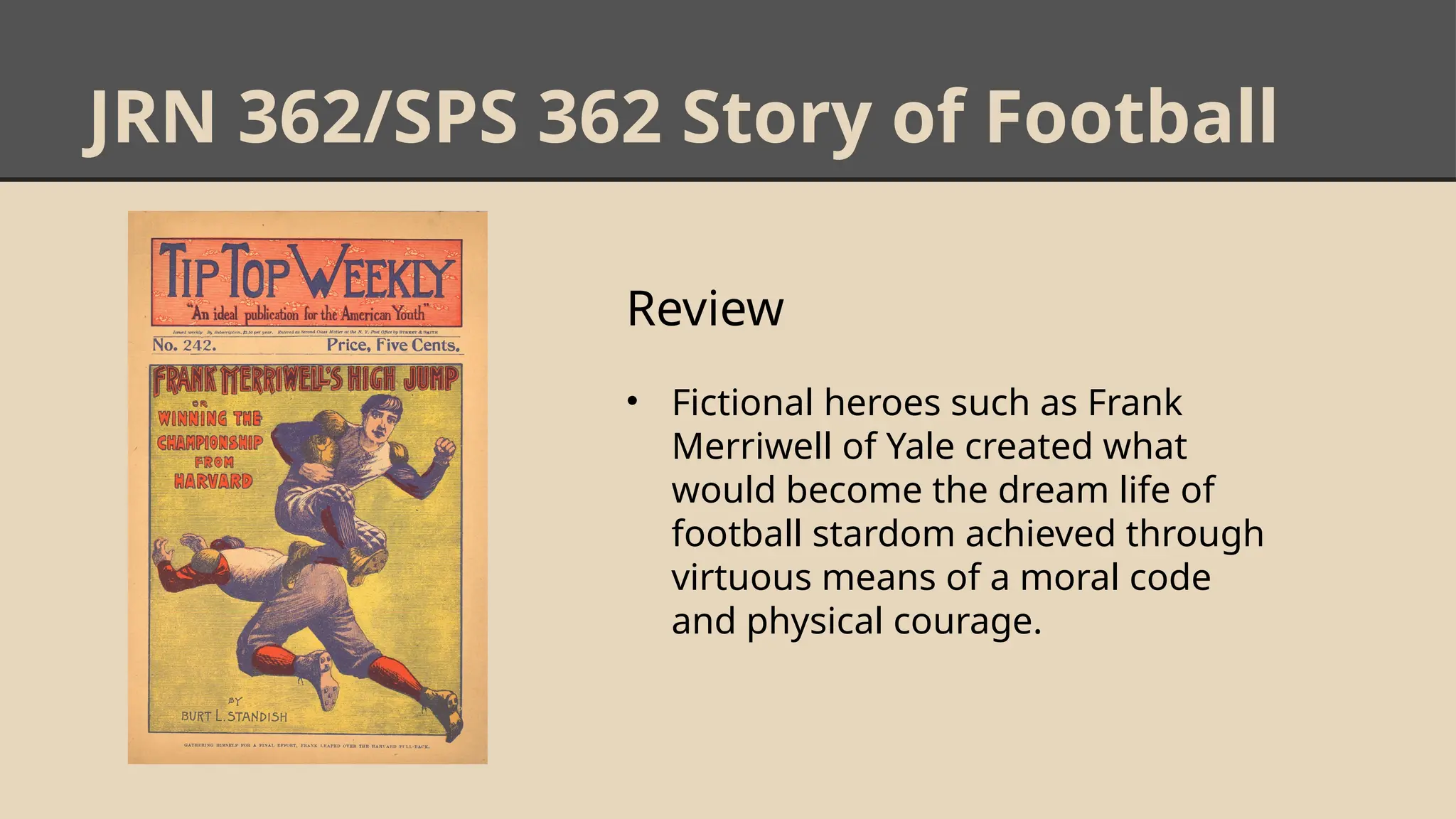
• Fictional heroes such as Frank
Merriwell of Yale created what
would become the dream life of
football stardom achieved through
virtuous means of a moral code
and physical courage.
JRN 362/SPS 362 Story of Football
Review
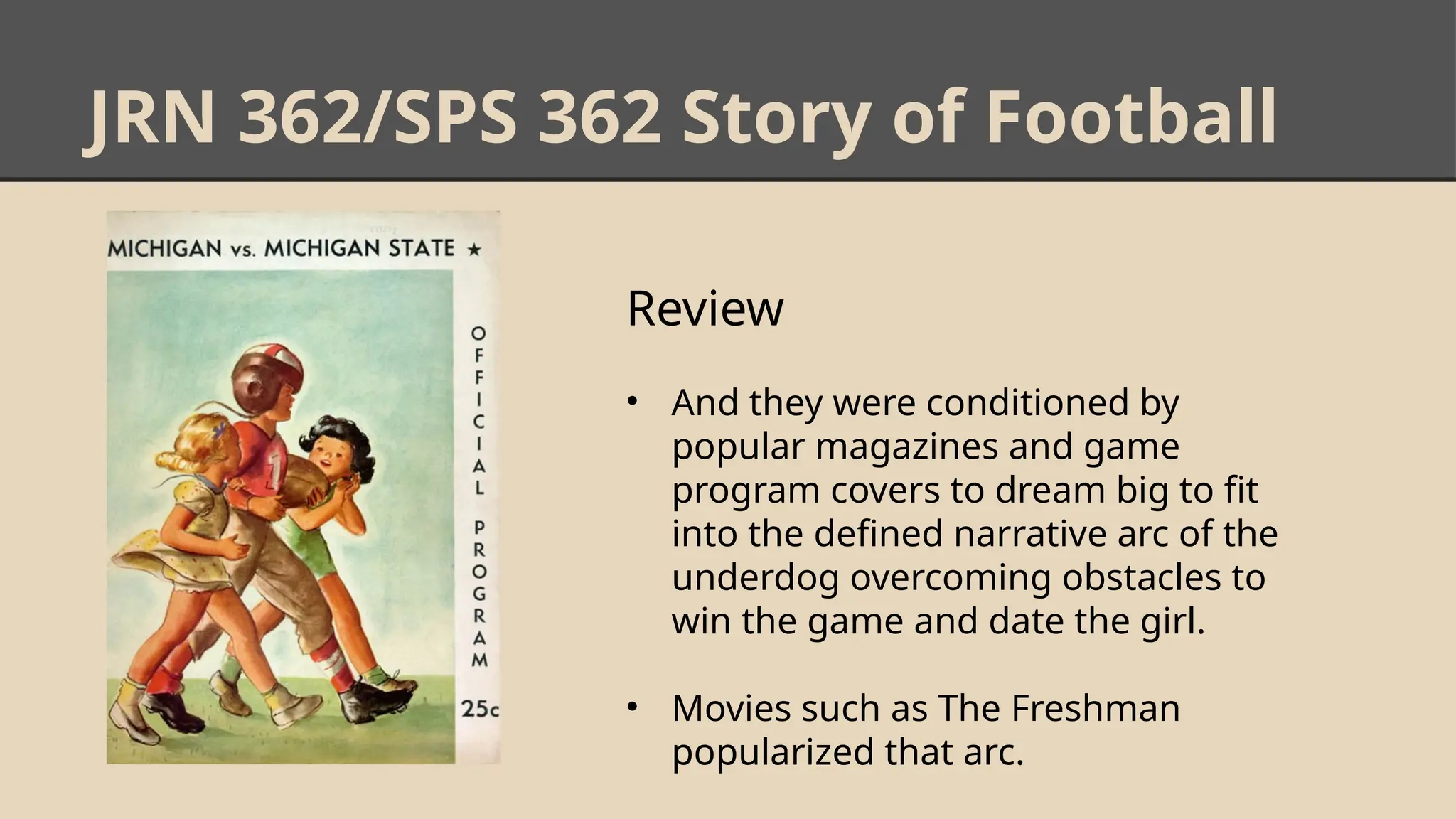
• And they were conditioned by
popular magazines and game
program covers to dream big to fit
into the defined narrative arc of the
underdog overcoming obstacles to
win the game and date the girl.
• Movies such as The Freshman
popularized that arc.
JRN 362/SPS 362 Story of Football
Review
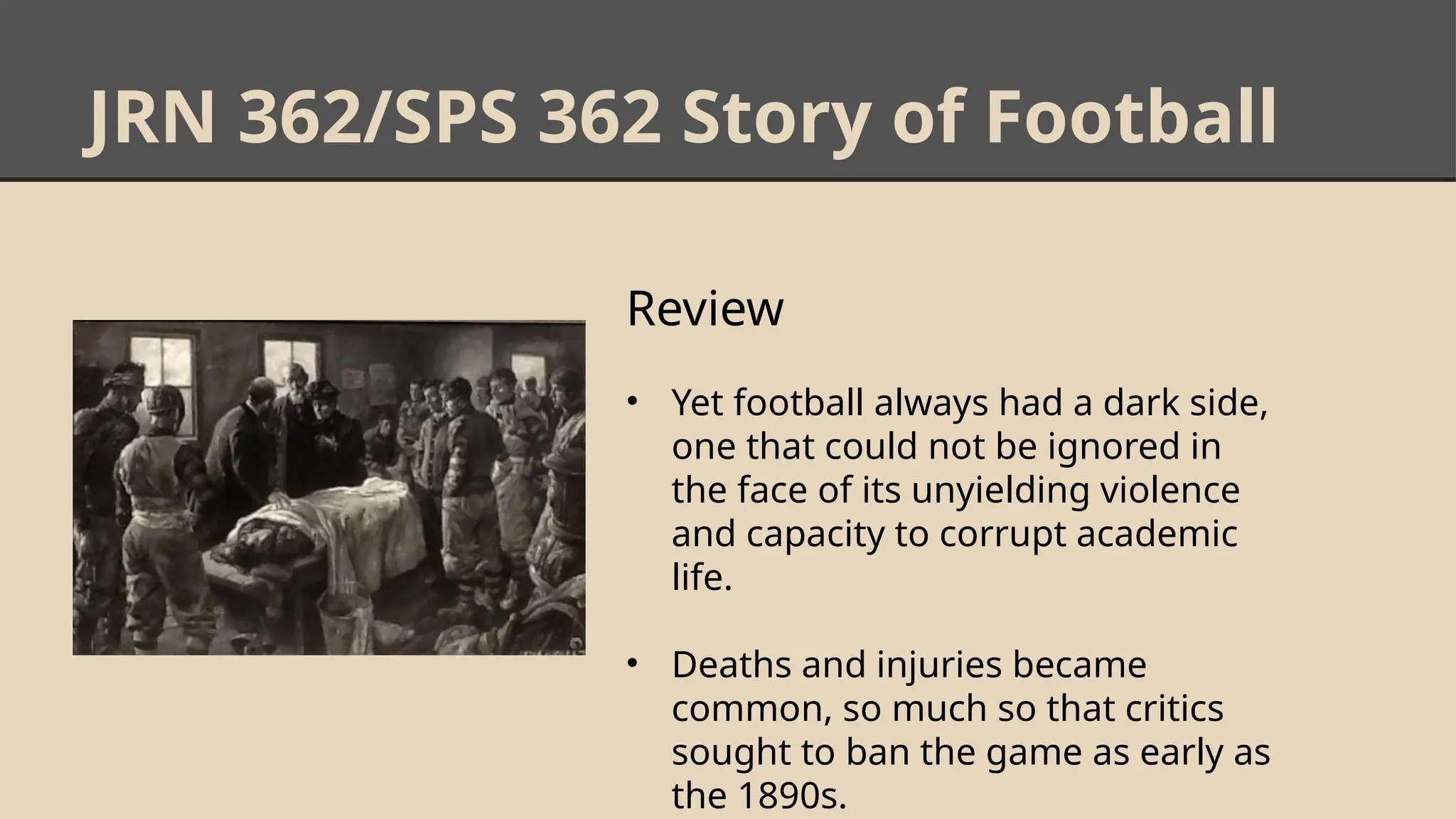
• Yet football always had a dark side,
one that could not be ignored in
the face of its unyielding violence
and capacity to corrupt academic
life.
• Deaths and injuries became
common, so much so that critics
sought to ban the game as early as
the 1890s.
JRN 362/SPS 362 Story of Football
Review
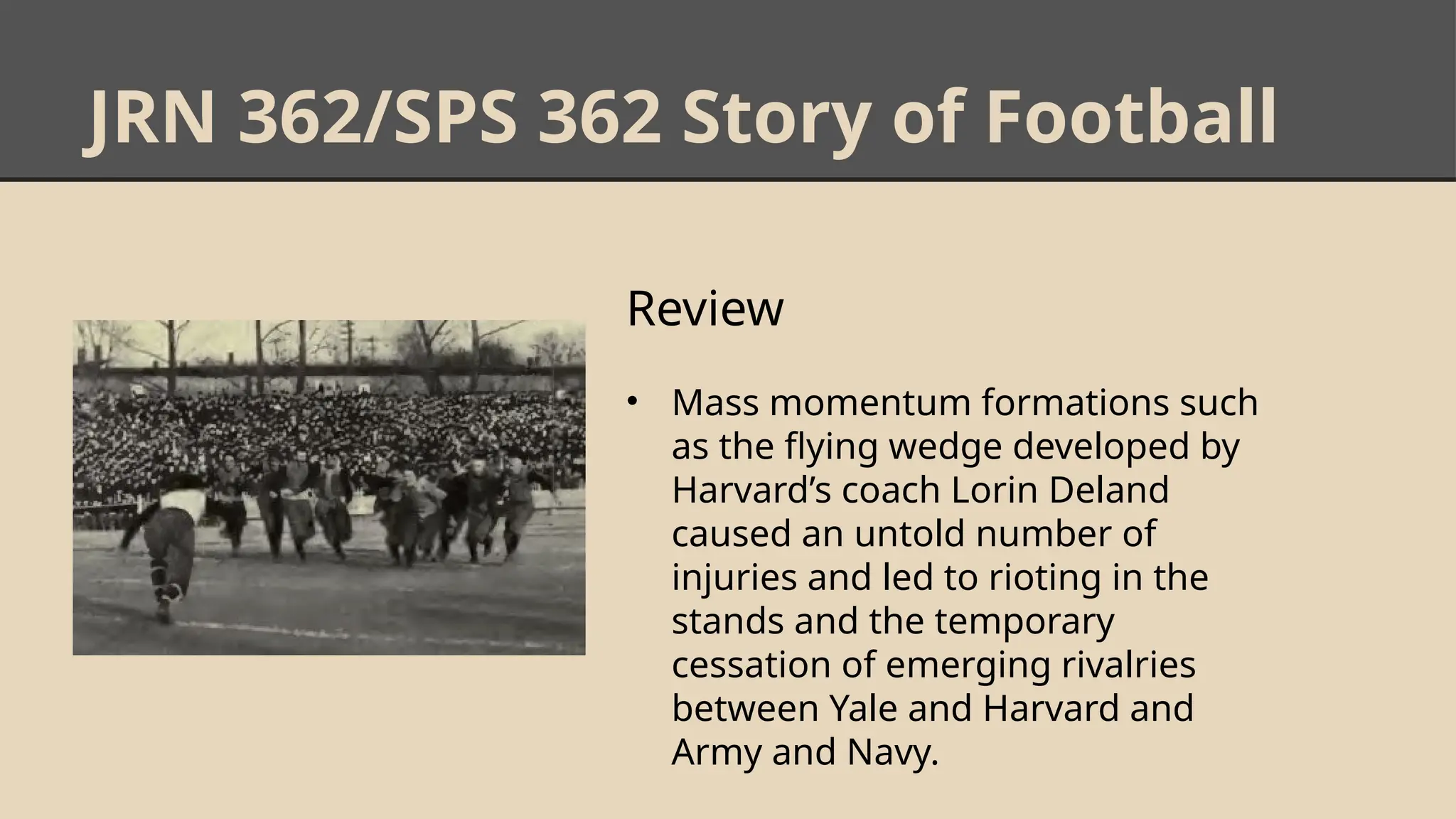
• Mass momentum formations such
as the flying wedge developed by
Harvard’s coach Lorin Deland
caused an untold number of
injuries and led to rioting in the
stands and the temporary
cessation of emerging rivalries
between Yale and Harvard and
Army and Navy.
JRN 362/SPS 362 Story of Football
Review
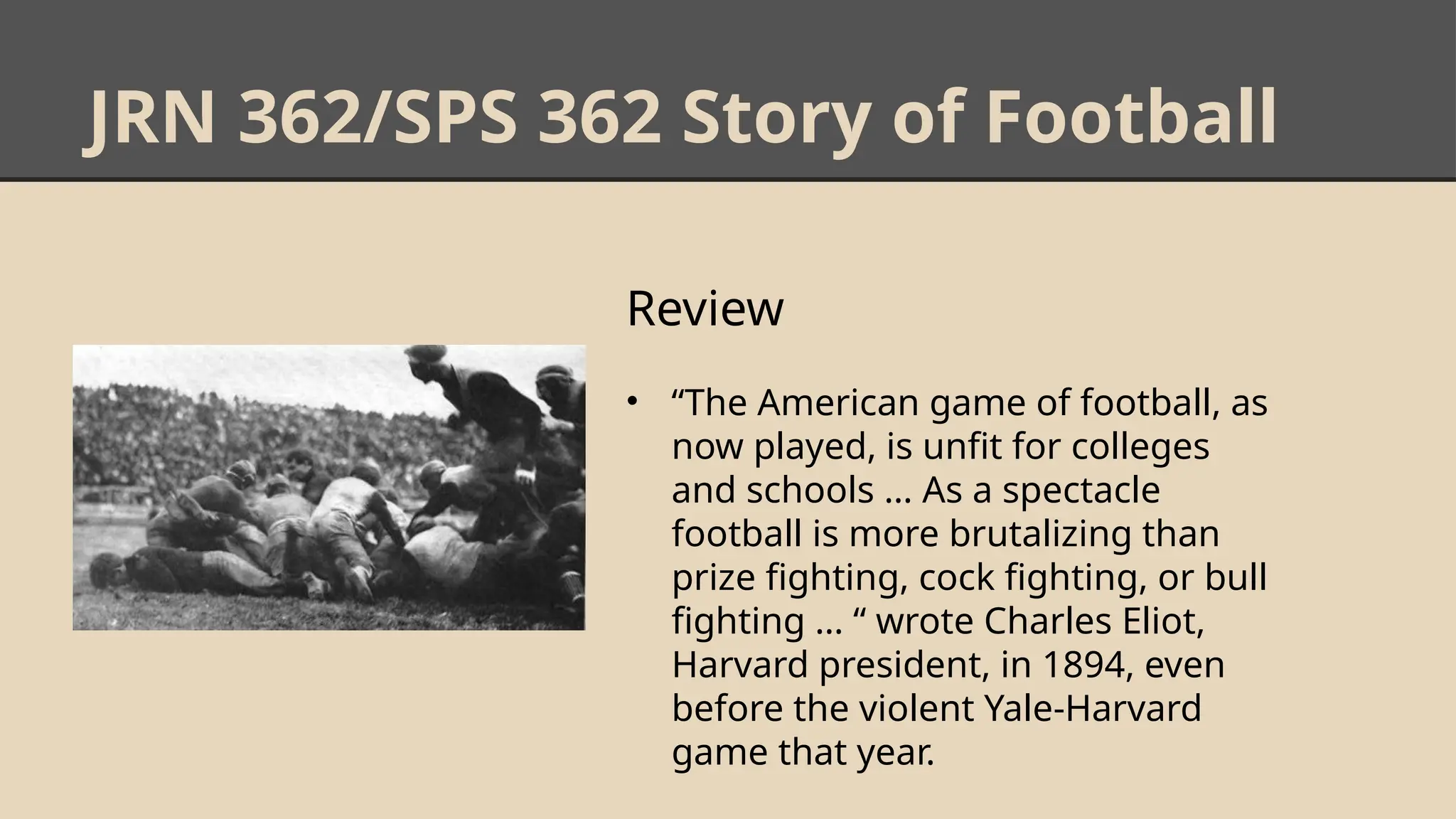
• “The American game of football, as
now played, is unfit for colleges
and schools … As a spectacle
football is more brutalizing than
prize fighting, cock fighting, or bull
fighting … “ wrote Charles Eliot,
Harvard president, in 1894, even
before the violent Yale-Harvard
game that year.
JRN 362/SPS 362 Story of Football
Review
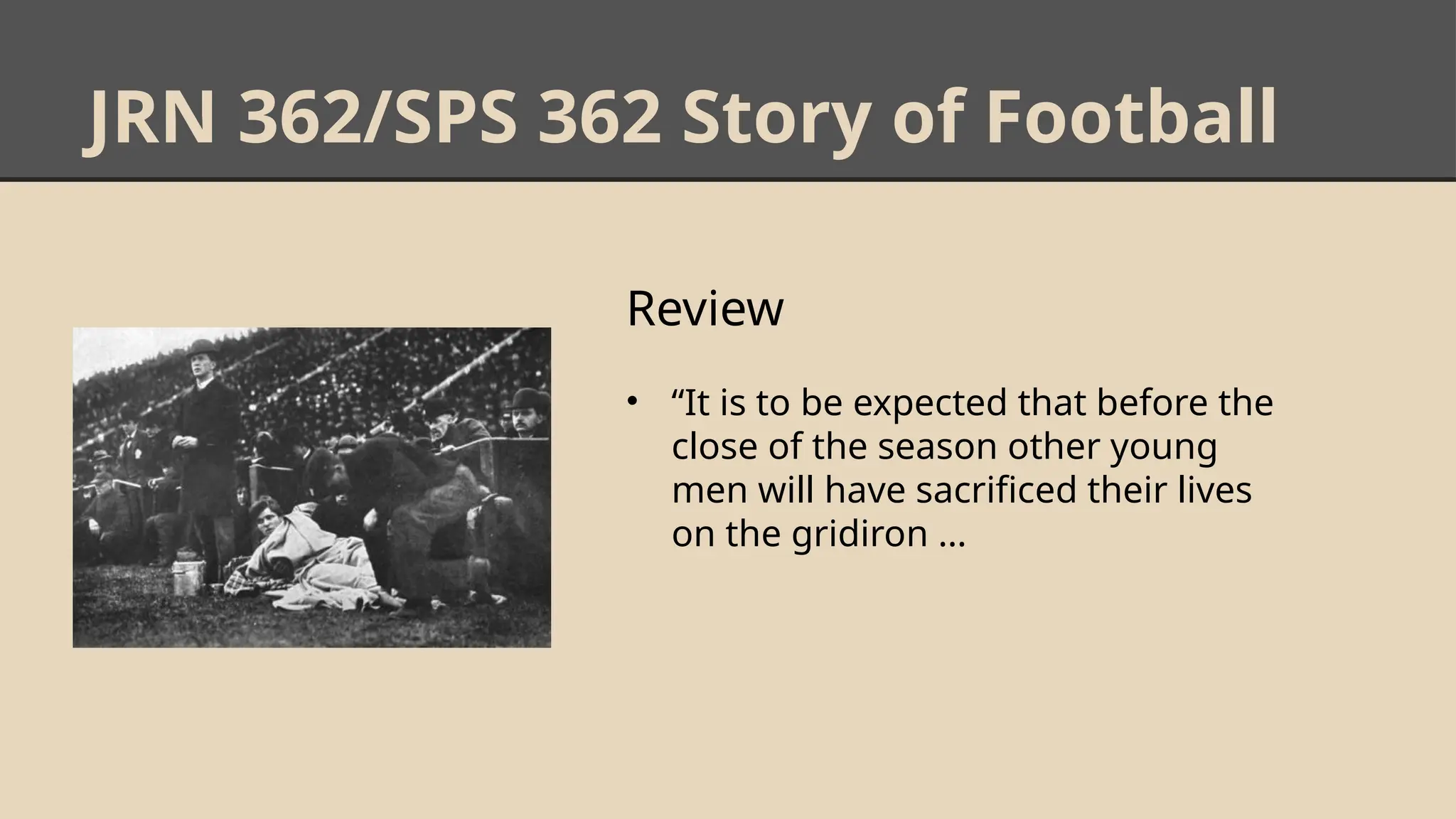
• “It is to be expected that before the
close of the season other young
men will have sacrificed their lives
on the gridiron …
JRN 362/SPS 362 Story of Football
Review
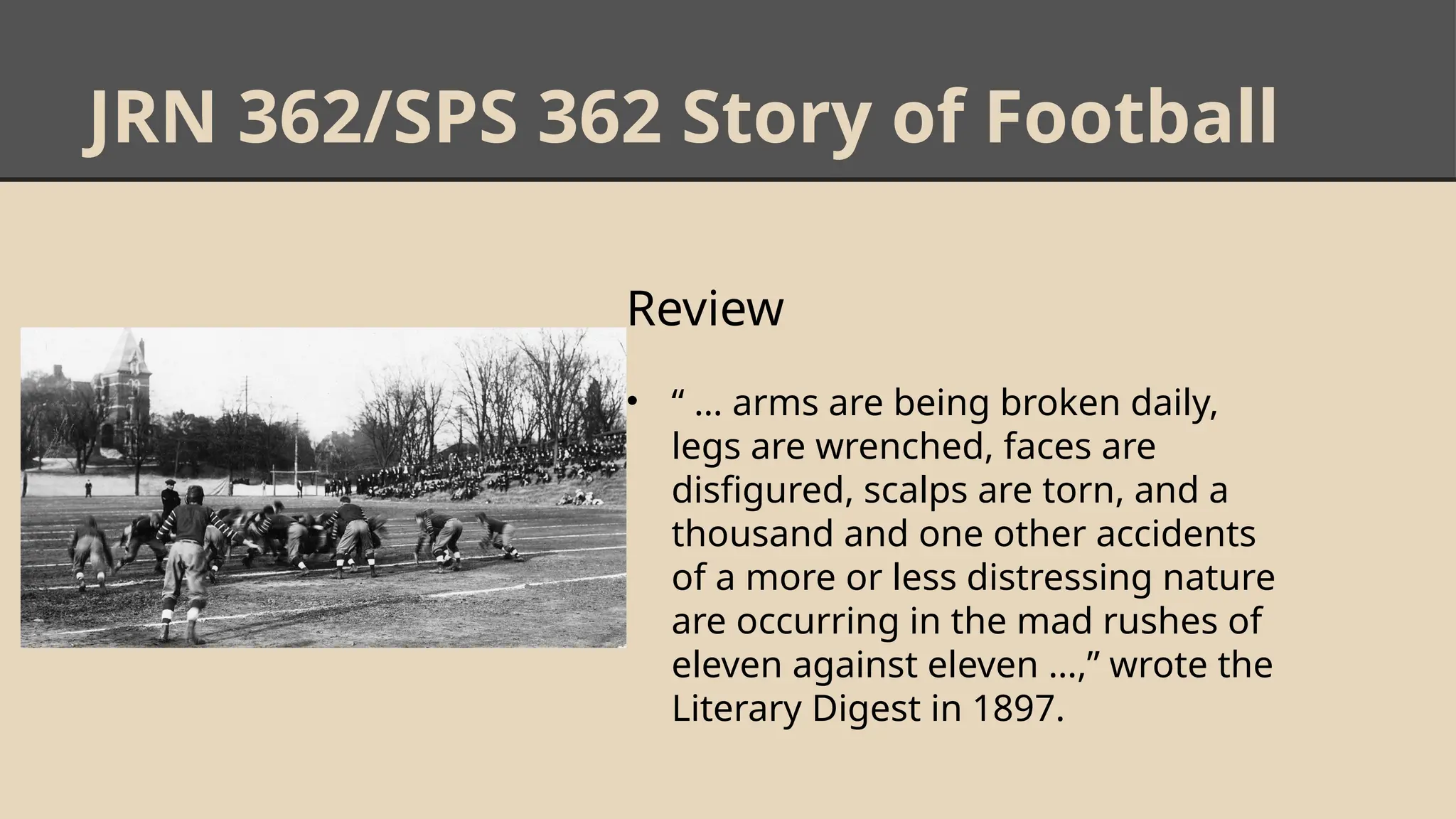
• “ … arms are being broken daily,
legs are wrenched, faces are
disfigured, scalps are torn, and a
thousand and one other accidents
of a more or less distressing nature
are occurring in the mad rushes of
eleven against eleven …,” wrote the
Literary Digest in 1897.
JRN 362/SPS 362 Story of Football
Review
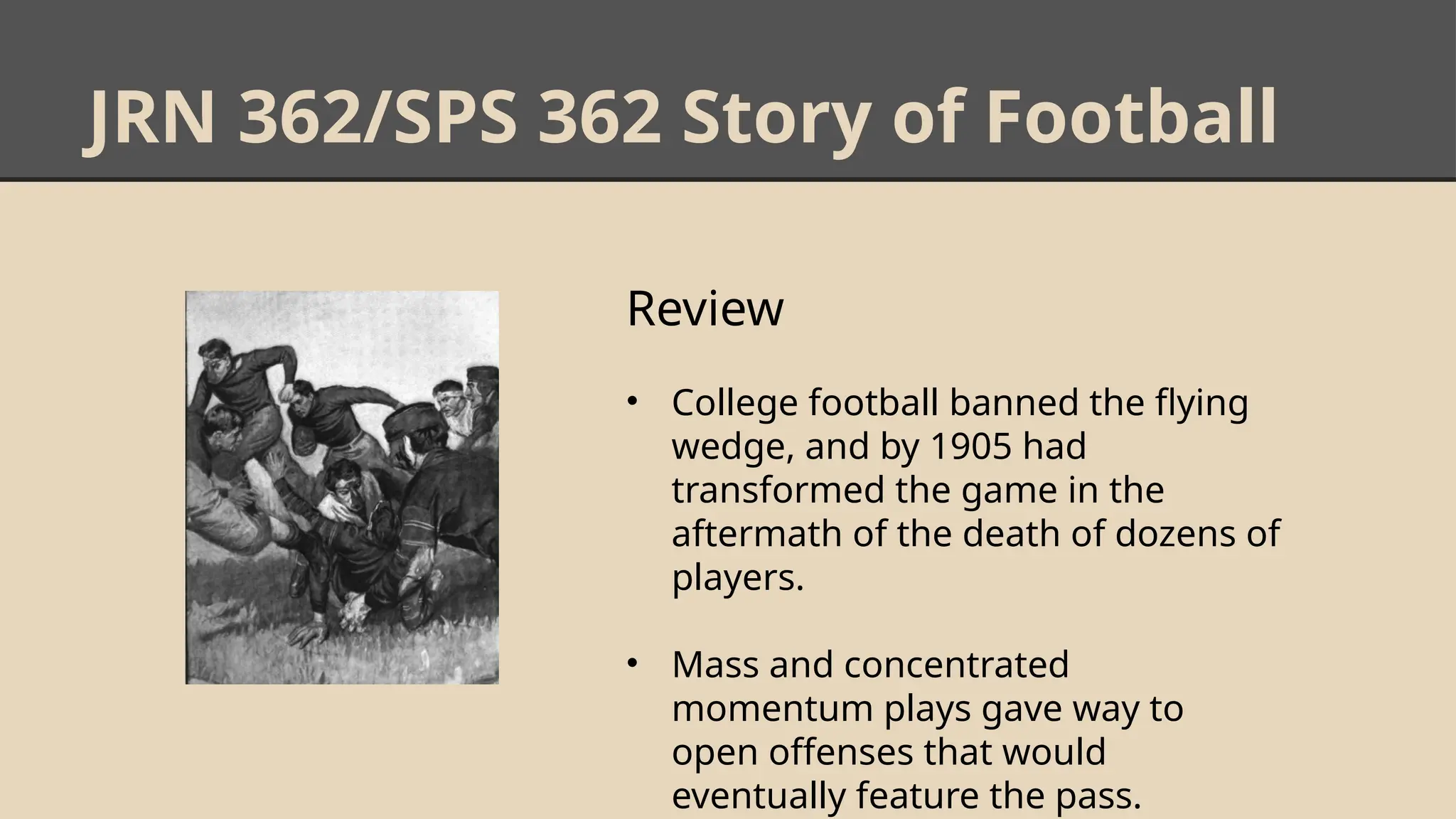
• College football banned the flying
wedge, and by 1905 had
transformed the game in the
aftermath of the death of dozens of
players.
• Mass and concentrated
momentum plays gave way to
open offenses that would
eventually feature the pass.
JRN 362/SPS 362 Story of Football
Review
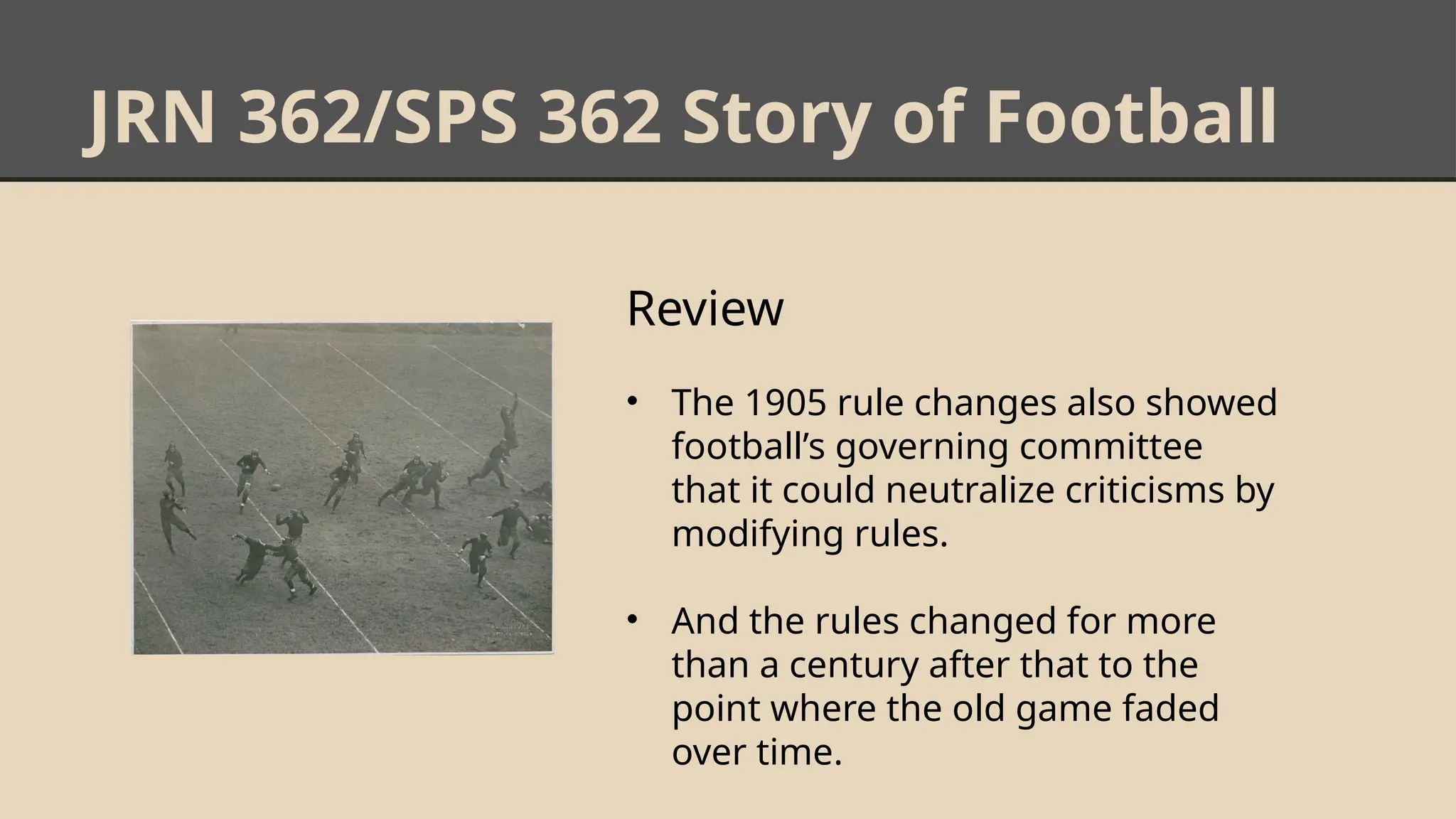
• The 1905 rule changes also showed
football’s governing committee
that it could neutralize criticisms by
modifying rules.
• And the rules changed for more
than a century after that to the
point where the old game faded
over time.
JRN 362/SPS 362 Story of Football
End of Football?
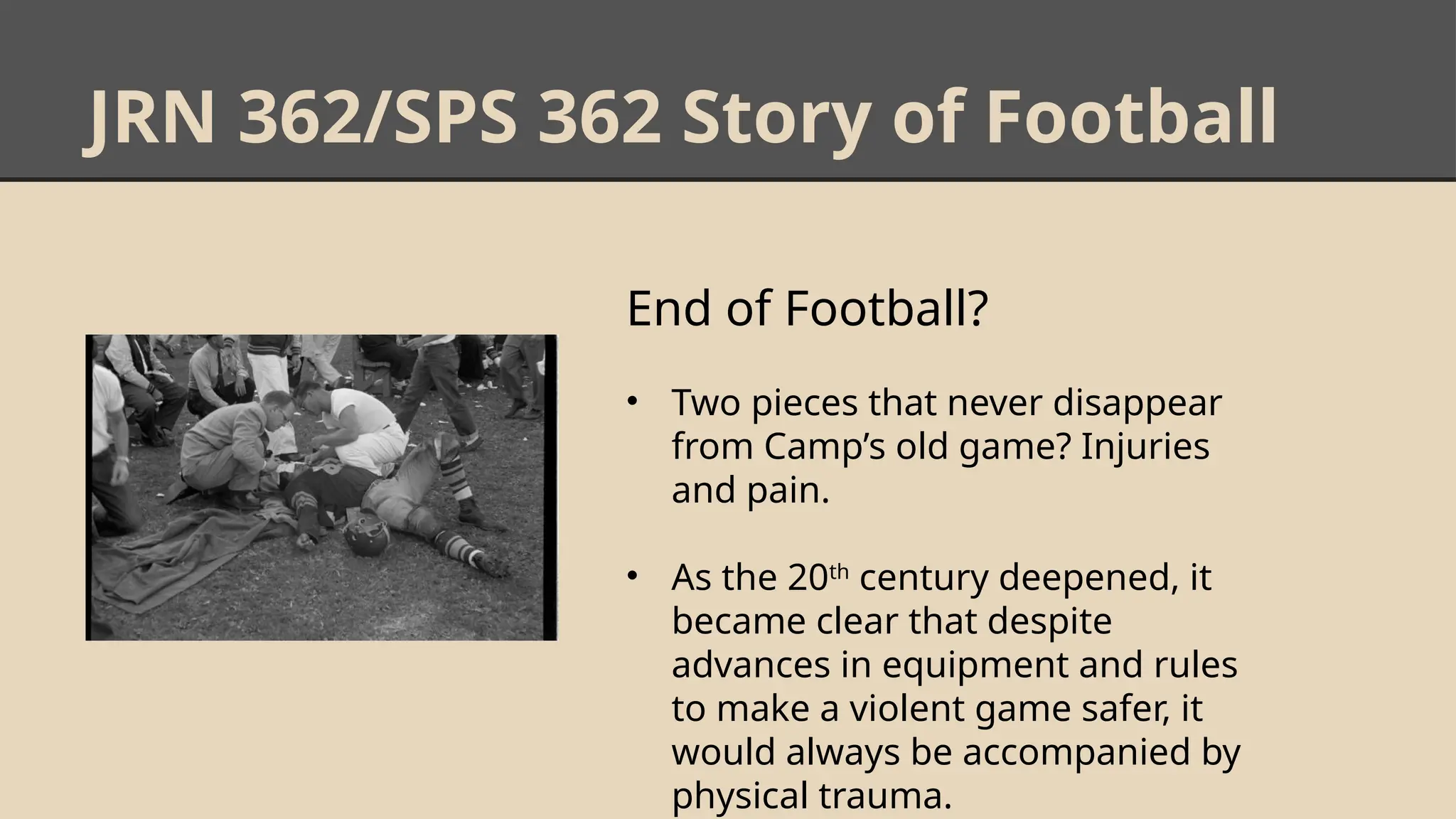
• Two pieces that never disappear
from Camp’s old game? Injuries
and pain.
• As the 20th
century deepened, it
became clear that despite
advances in equipment and rules
to make a violent game safer, it
would always be accompanied by
physical trauma.
JRN 362/SPS 362 Story of Football
End of Football?
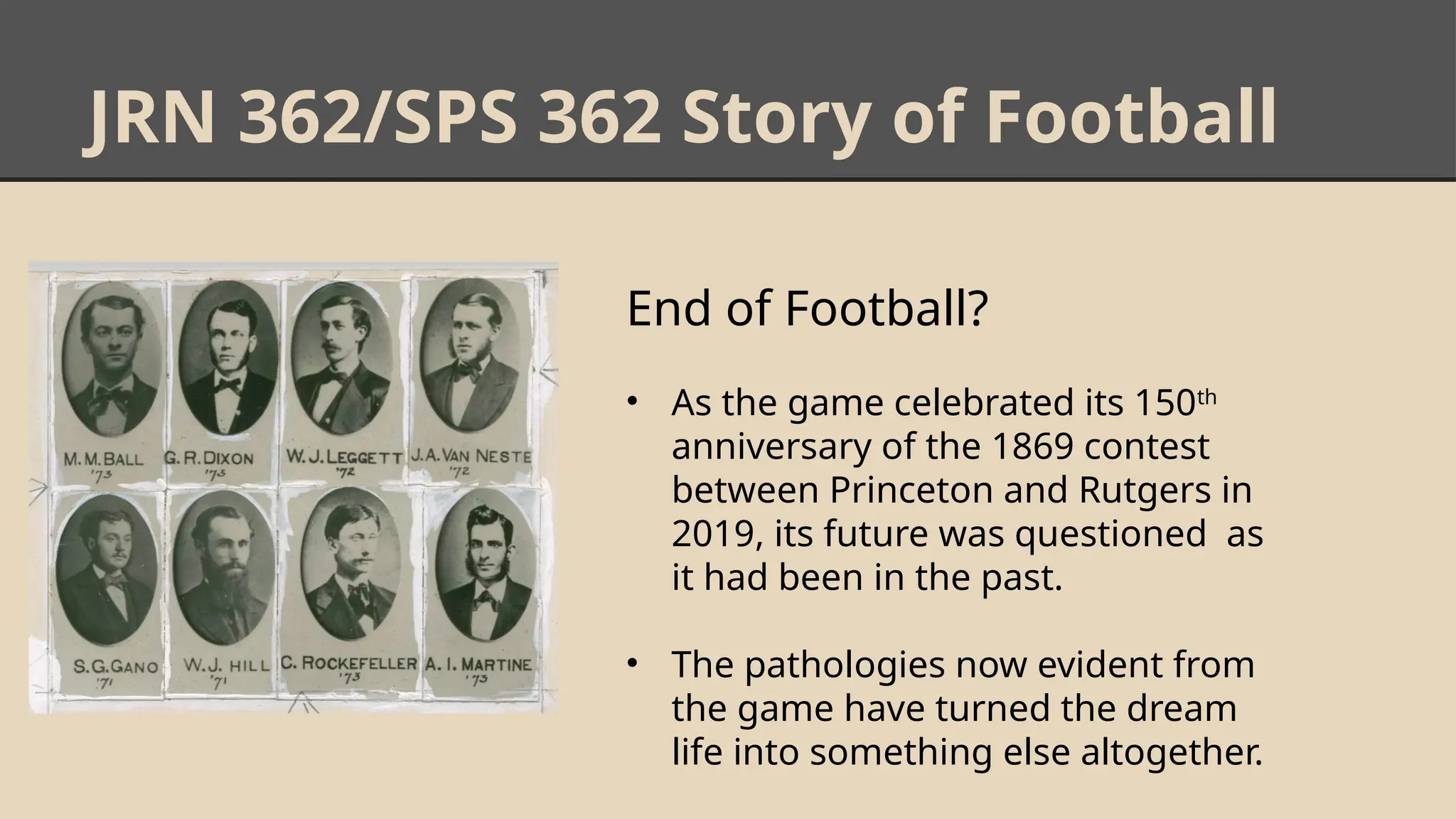
• As the game celebrated its 150th
anniversary of the 1869 contest
between Princeton and Rutgers in
2019, its future was questioned as
it had been in the past.
• The pathologies now evident from
the game have turned the dream
life into something else altogether.
JRN 362/SPS 362 Story of Football
End of Football?
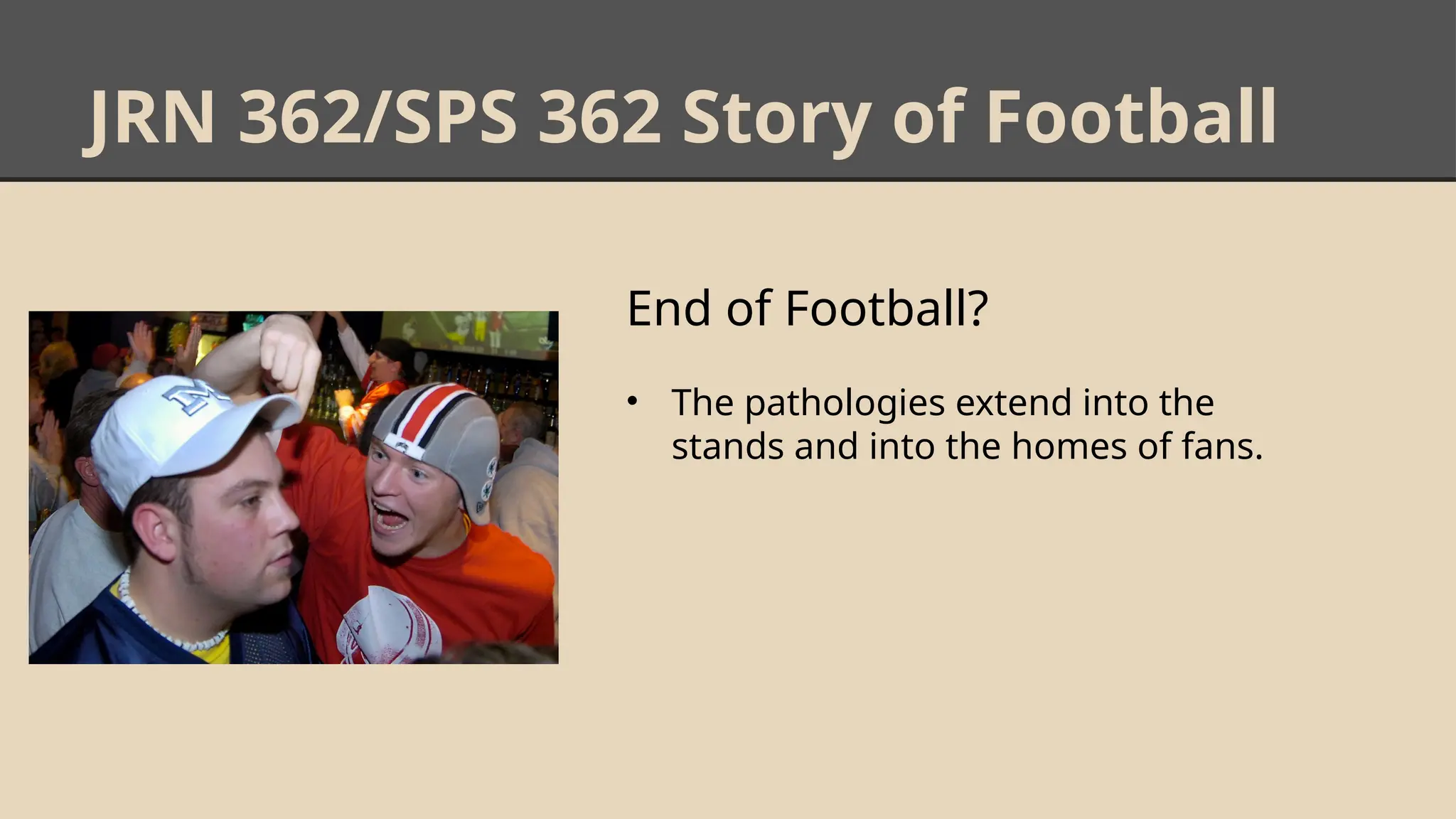
• The pathologies extend into the
stands and into the homes of fans.
JRN 362/SPS 362 Story of Football
End of Football?
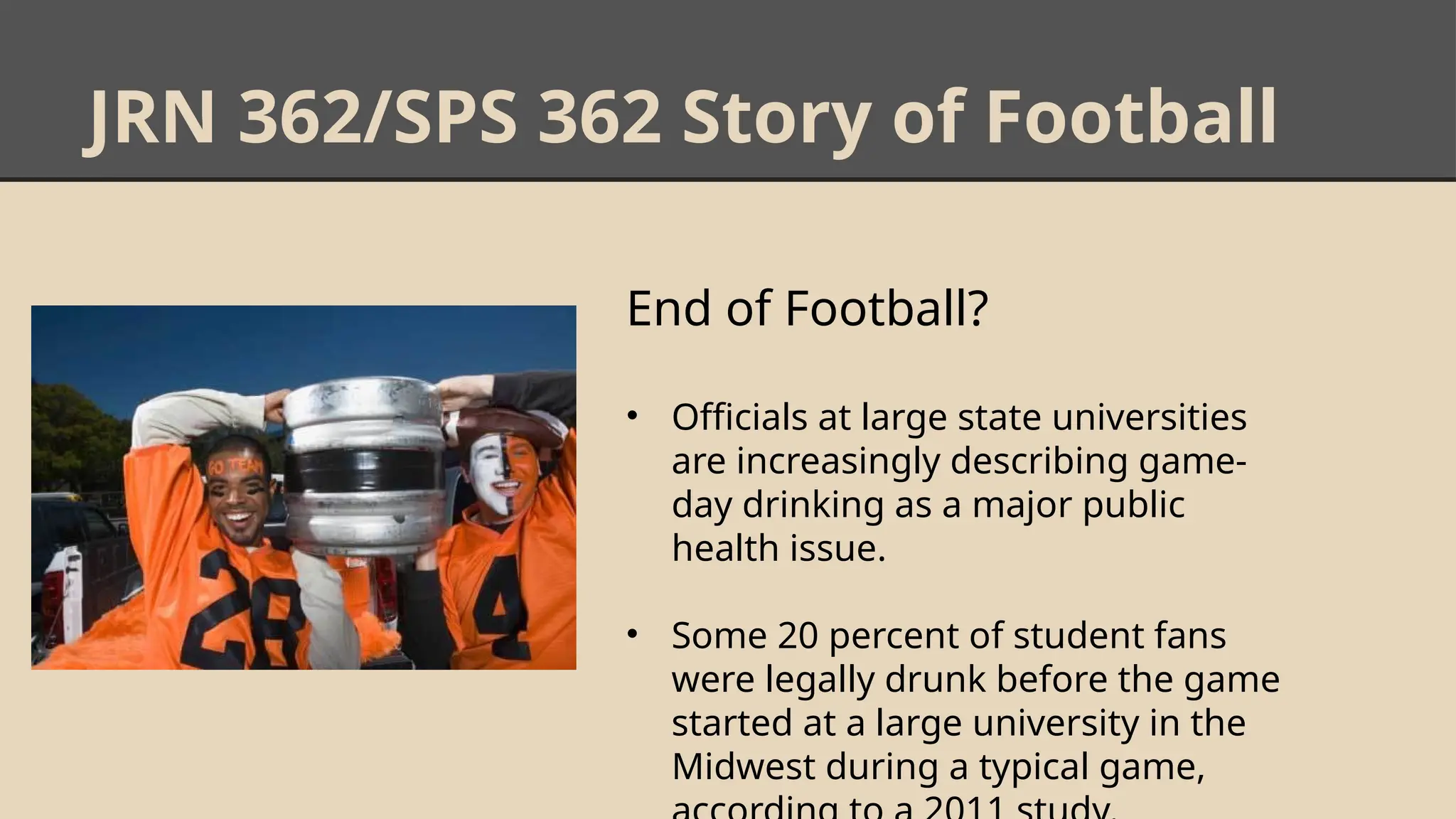
• Officials at large state universities
are increasingly describing game-
day drinking as a major public
health issue.
• Some 20 percent of student fans
were legally drunk before the game
started at a large university in the
Midwest during a typical game,
JRN 362/SPS 362 Story of Football
End of Football?
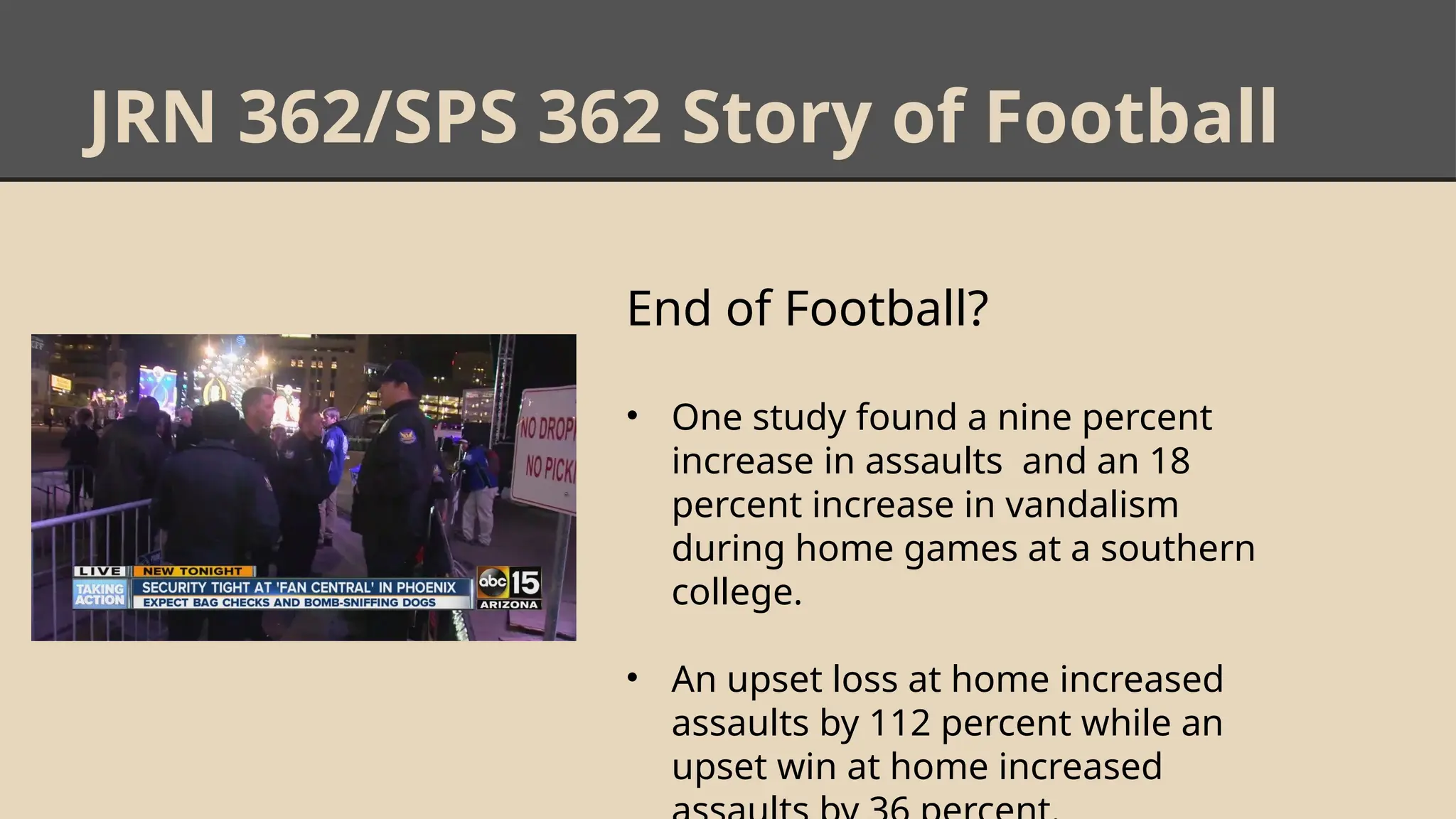
• One study found a nine percent
increase in assaults and an 18
percent increase in vandalism
during home games at a southern
college.
• An upset loss at home increased
assaults by 112 percent while an
upset win at home increased
JRN 362/SPS 362 Story of Football
End of Football?
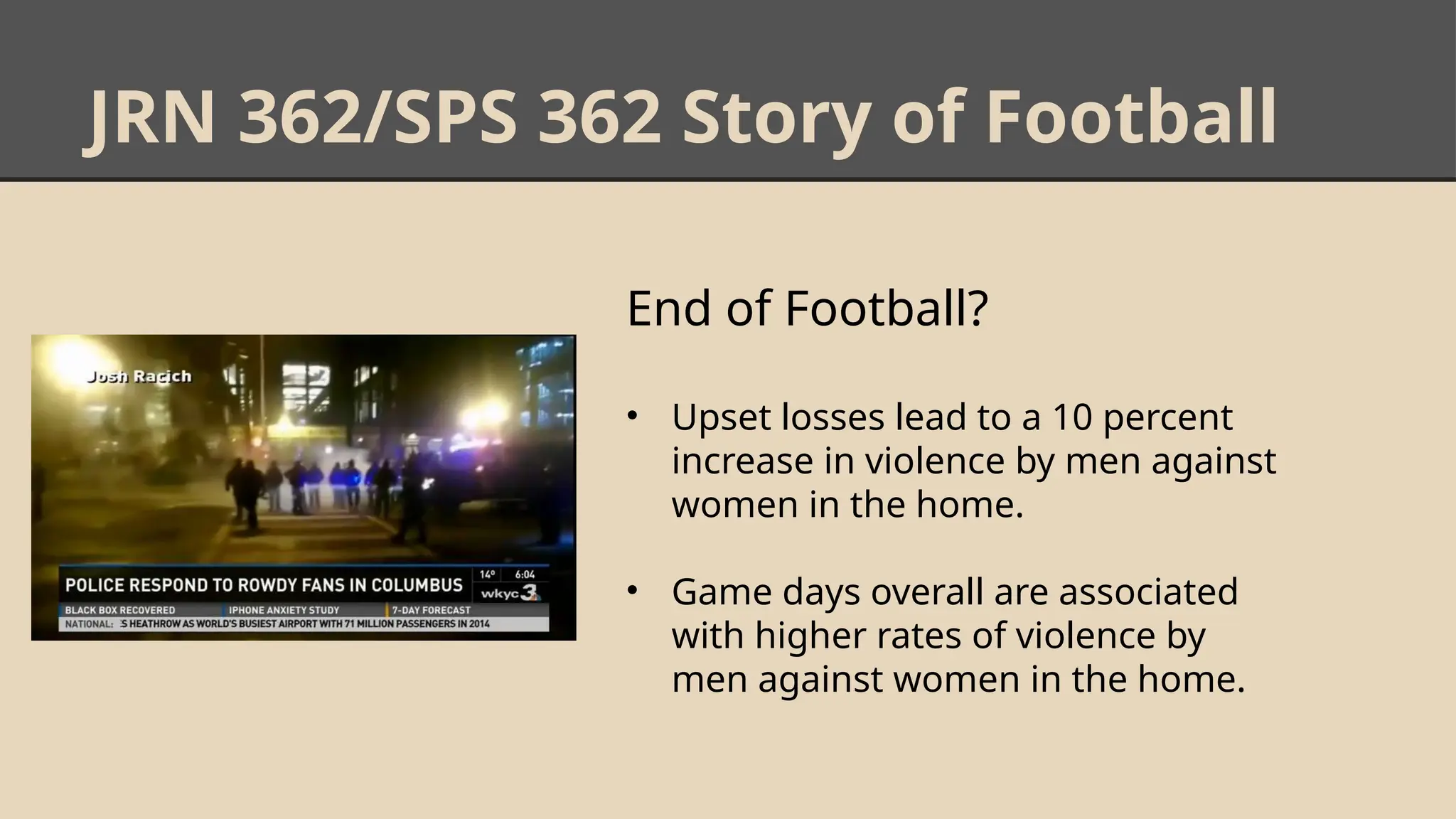
• Upset losses lead to a 10 percent
increase in violence by men against
women in the home.
• Game days overall are associated
with higher rates of violence by
men against women in the home.
JRN 362/SPS 362 Story of Football
End of Football?
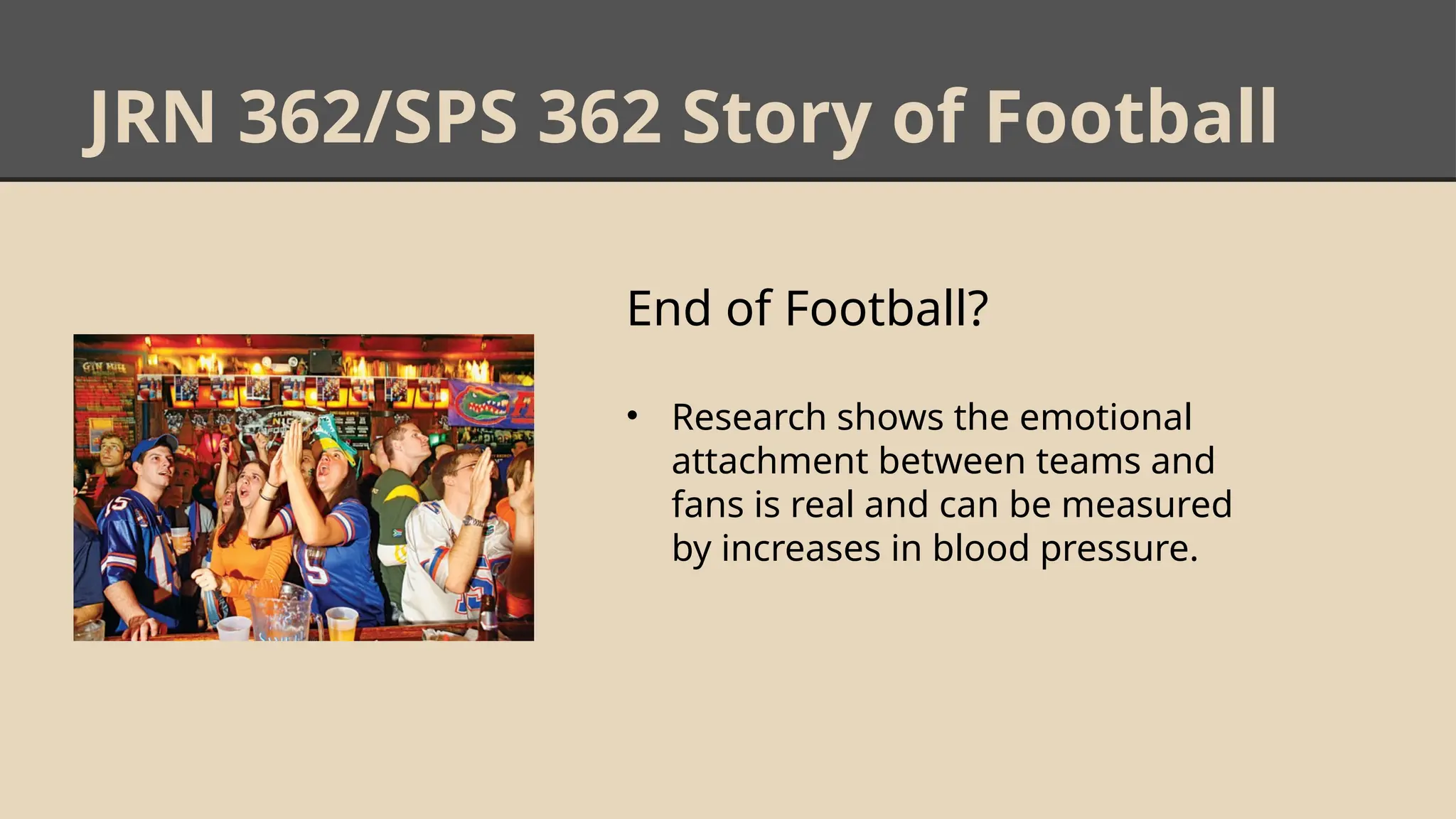
• Research shows the emotional
attachment between teams and
fans is real and can be measured
by increases in blood pressure.
JRN 362/SPS 362 Story of Football
End of Football?
• According to the NFL, up to 68
percent of NFL players may be
injured in a season.
• That leads to “consequences from
an increased risk for more serious
injury and pain,” reported by
researcher Dr. Linda Cottler.
JRN 362/SPS 362 Story of Football
End of Football?
• The Cottler survey of 644 players
who retired before 2009 showed:
- Only 13 percent reported
current excellent health
compared to 88 percent
with excellent health at the
time they signed their first
NFL contract.
JRN 362/SPS 362 Story of Football
End of Football?
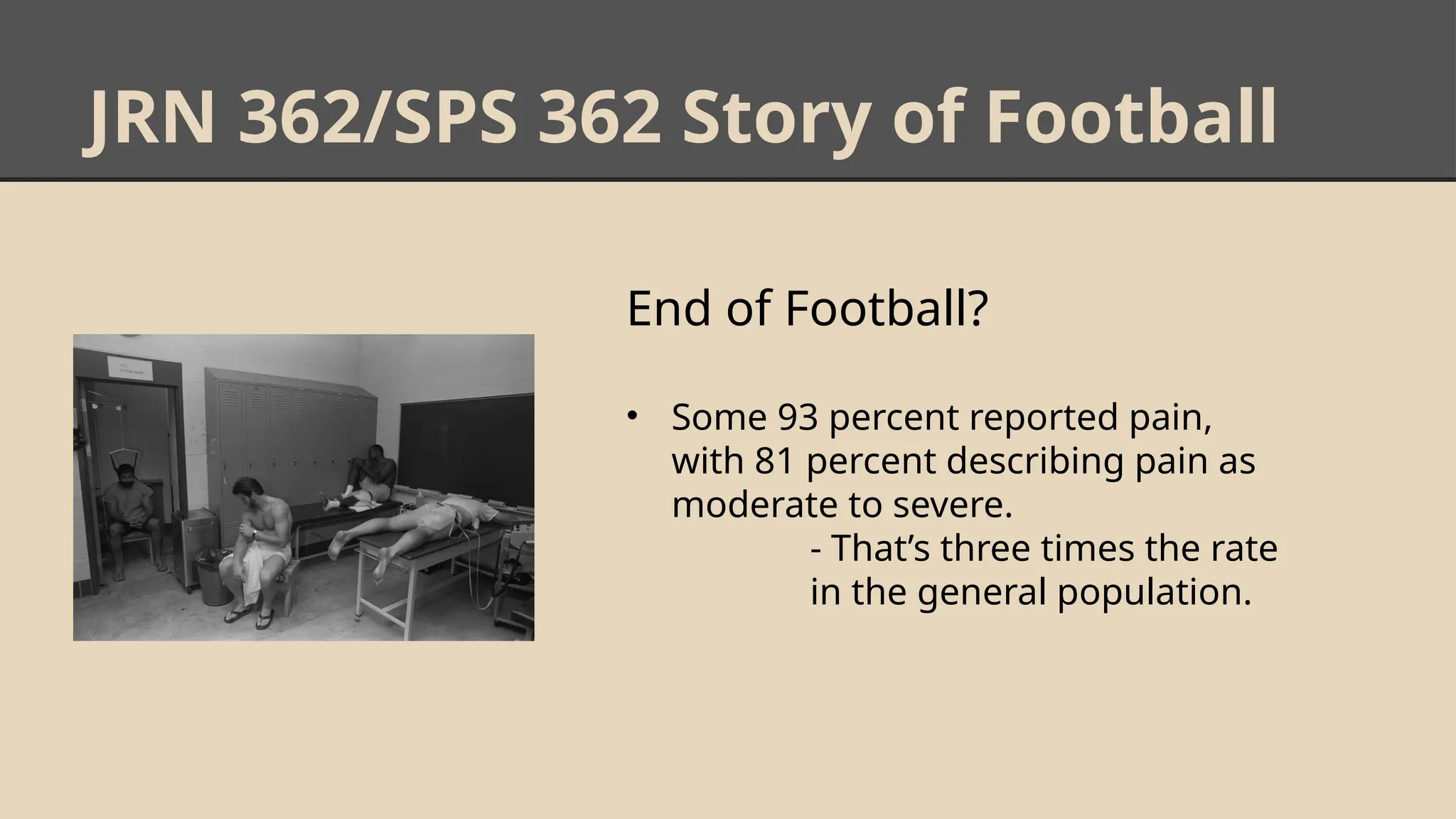
• Some 93 percent reported pain,
with 81 percent describing pain as
moderate to severe.
- That’s three times the rate
in the general population.
JRN 362/SPS 362 Story of Football
End of Football?
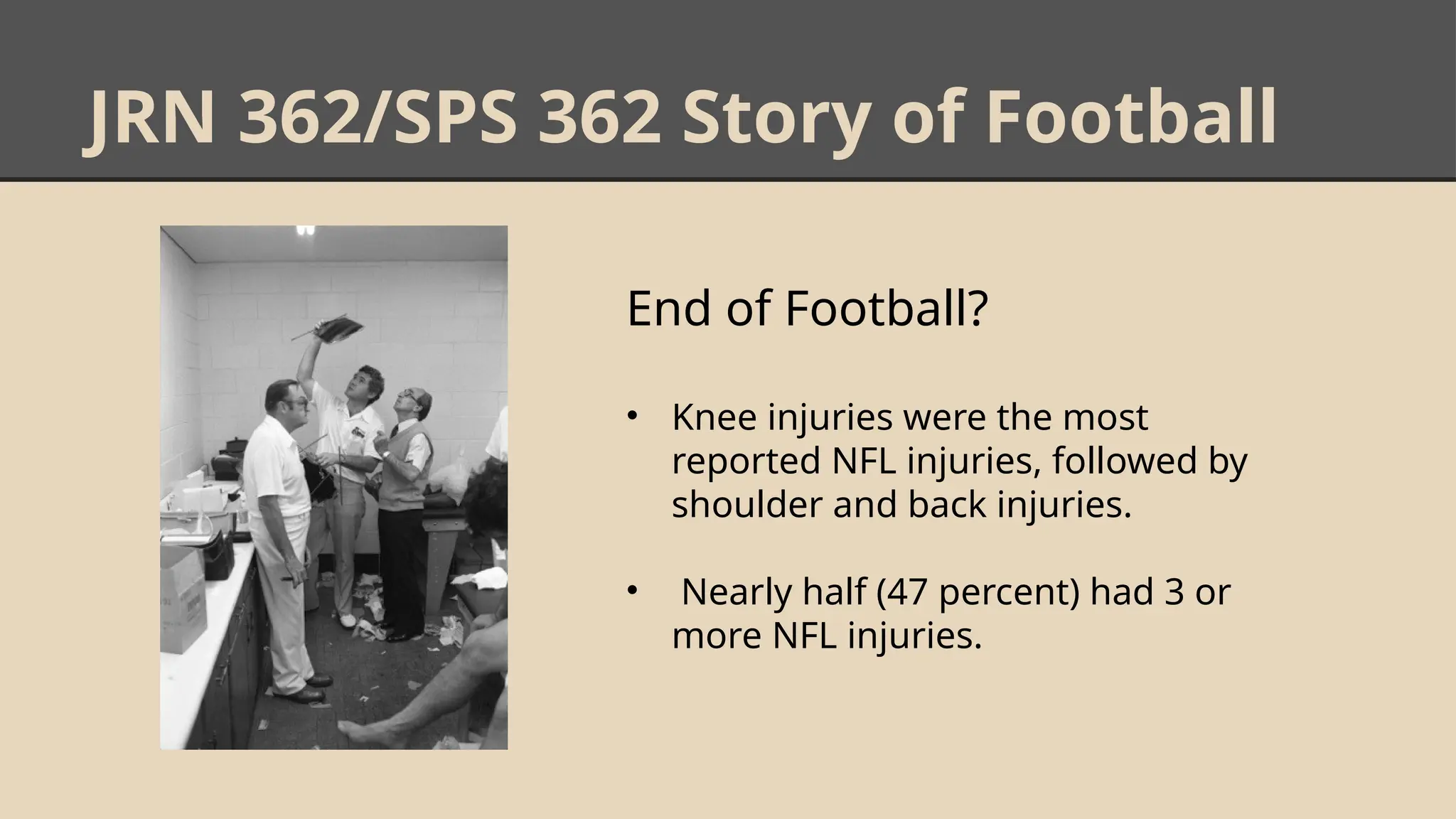
• Knee injuries were the most
reported NFL injuries, followed by
shoulder and back injuries.
• Nearly half (47 percent) had 3 or
more NFL injuries.
JRN 362/SPS 362 Story of Football
End of Football?
• Nearly half (49 percent) reported
diagnosed concussions.
• 81 percent reported undiagnosed
concussions.
• The average number of reported
concussions of either type was 9,
Cottler found.
JRN 362/SPS 362 Story of Football
End of Football?
• The consequences emerged in the
survey results regarding
medication to ease pain. It showed
that:
- 52 percent used opioids
during their careers.
- 71 percent of that group
reported they abused
opioids during their
JRN 362/SPS 362 Story of Football
End of Football?
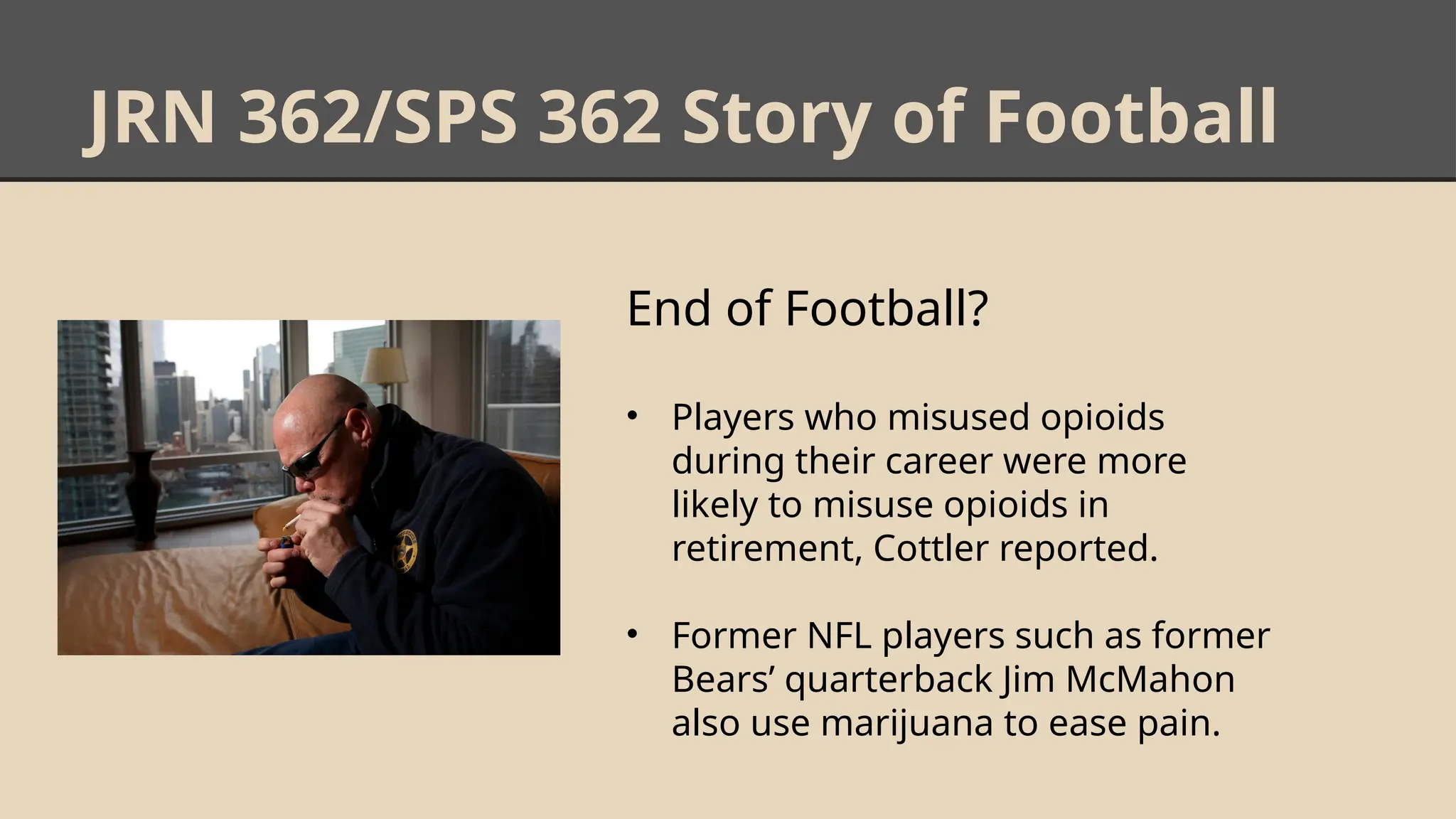
• Players who misused opioids
during their career were more
likely to misuse opioids in
retirement, Cottler reported.
• Former NFL players such as former
Bears’ quarterback Jim McMahon
also use marijuana to ease pain.
JRN 362/SPS 362 Story of Football
End of Football?
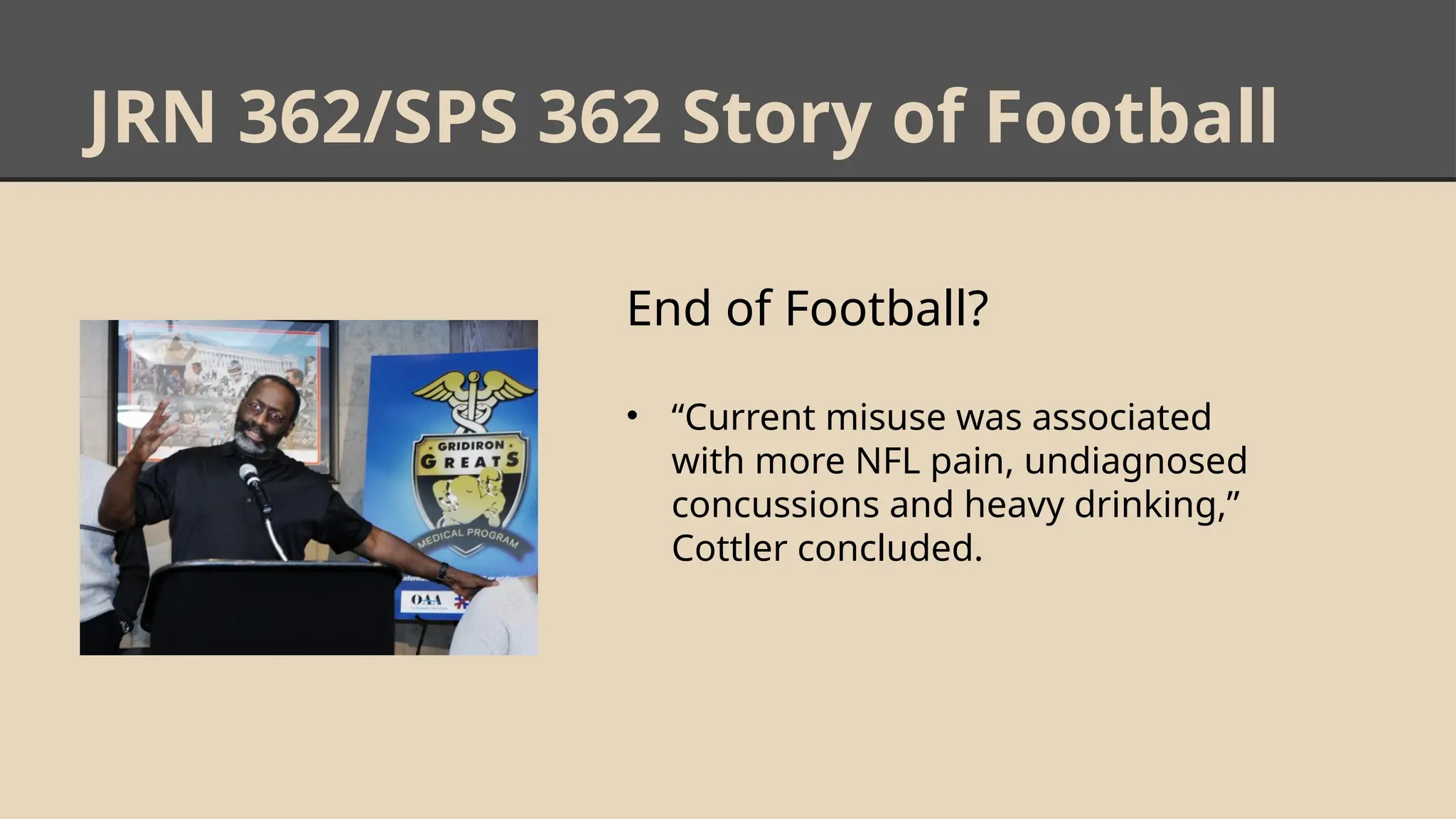
• “Current misuse was associated
with more NFL pain, undiagnosed
concussions and heavy drinking,”
Cottler concluded.
JRN 362/SPS 362 Story of Football
End of Football?
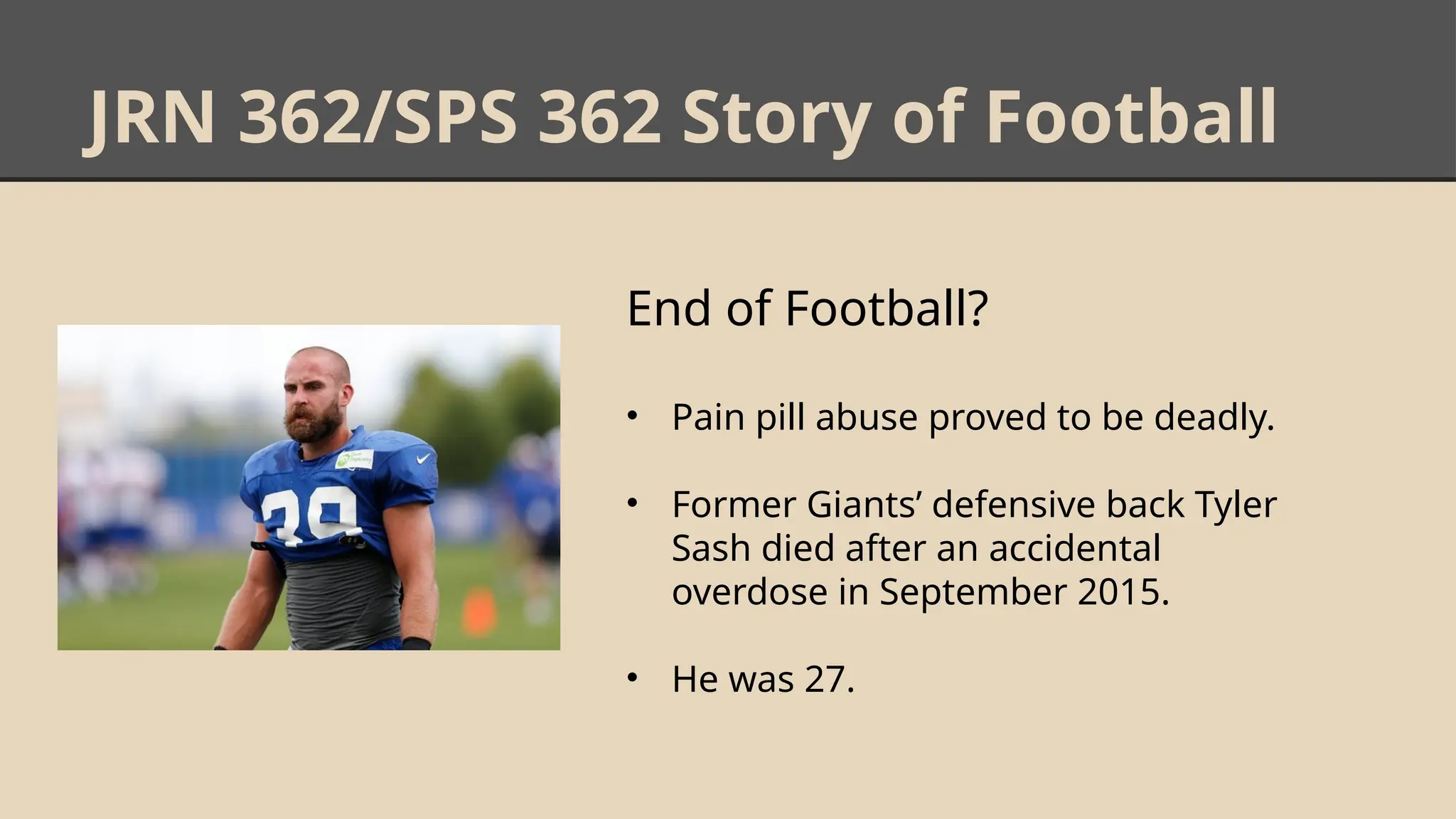
• Pain pill abuse proved to be deadly.
• Former Giants’ defensive back Tyler
Sash died after an accidental
overdose in September 2015.
• He was 27.
JRN 362/SPS 362 Story of Football
End of Football?
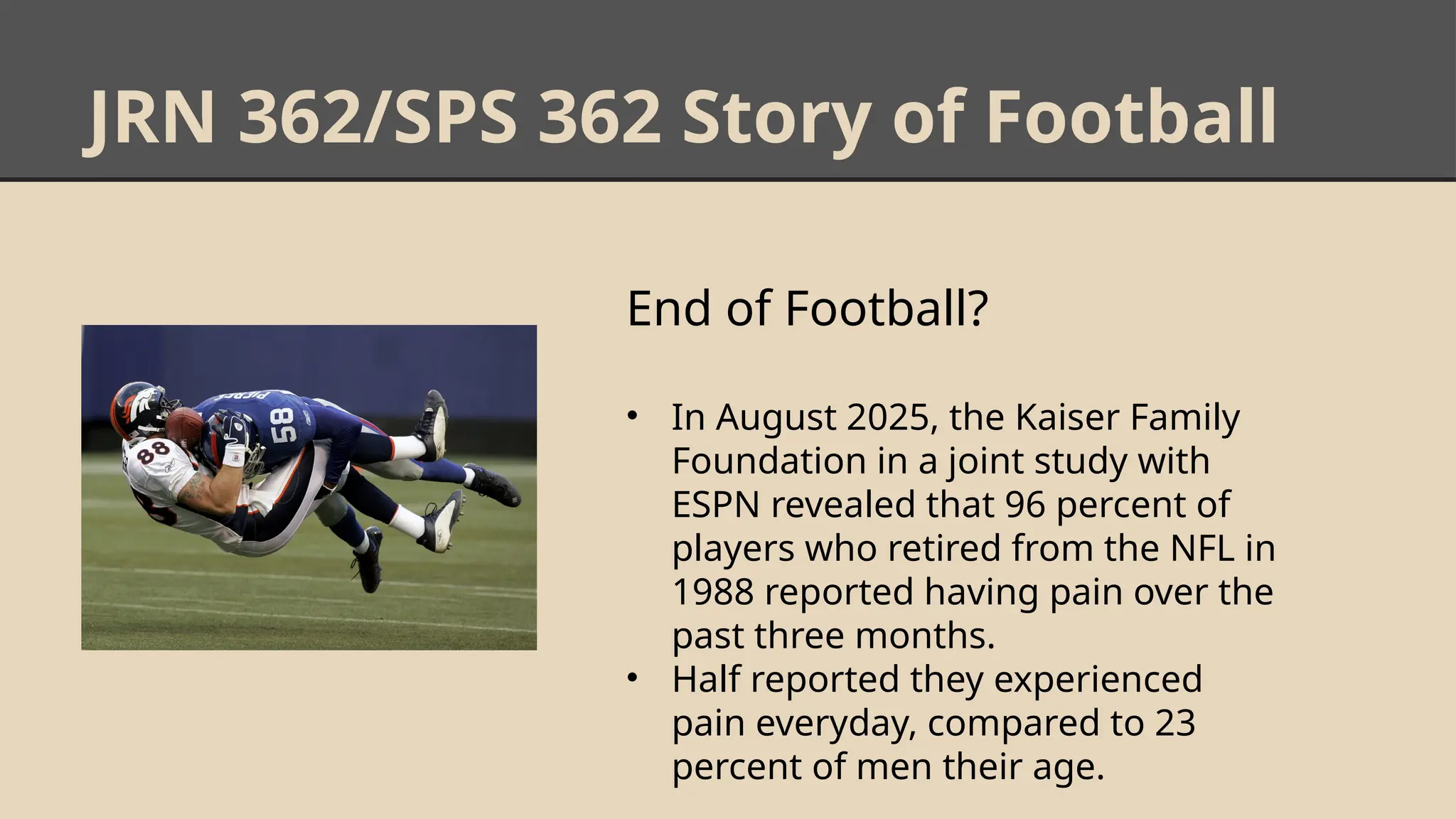
• In August 2025, the Kaiser Family
Foundation in a joint study with
ESPN revealed that 96 percent of
players who retired from the NFL in
1988 reported having pain over the
past three months.
• Half reported they experienced
pain everyday, compared to 23
percent of men their age.
JRN 362/SPS 362 Story of Football
End of Football?
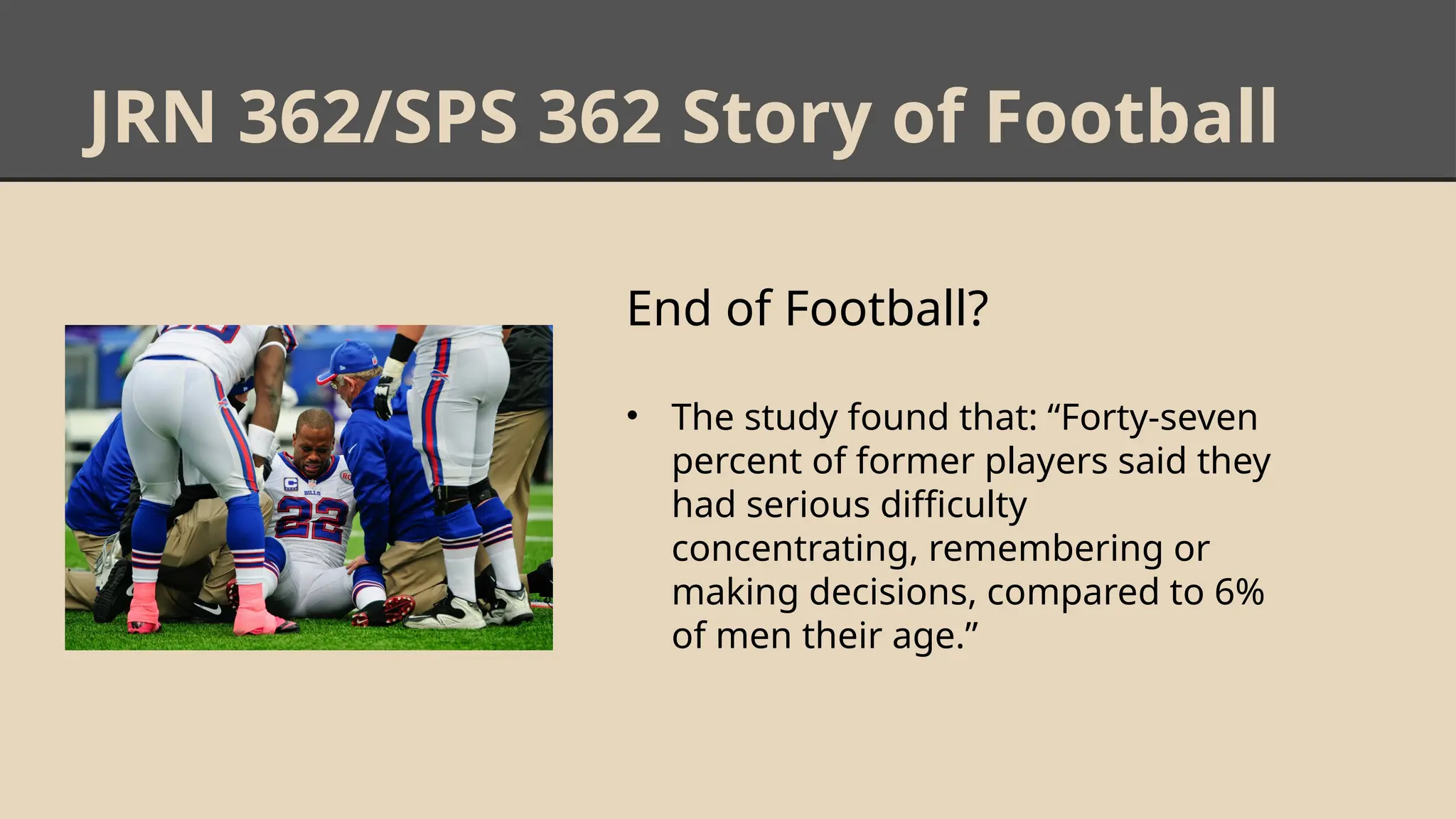
• The study found that: “Forty-seven
percent of former players said they
had serious difficulty
concentrating, remembering or
making decisions, compared to 6%
of men their age.”
JRN 362/SPS 362 Story of Football
End of Football?
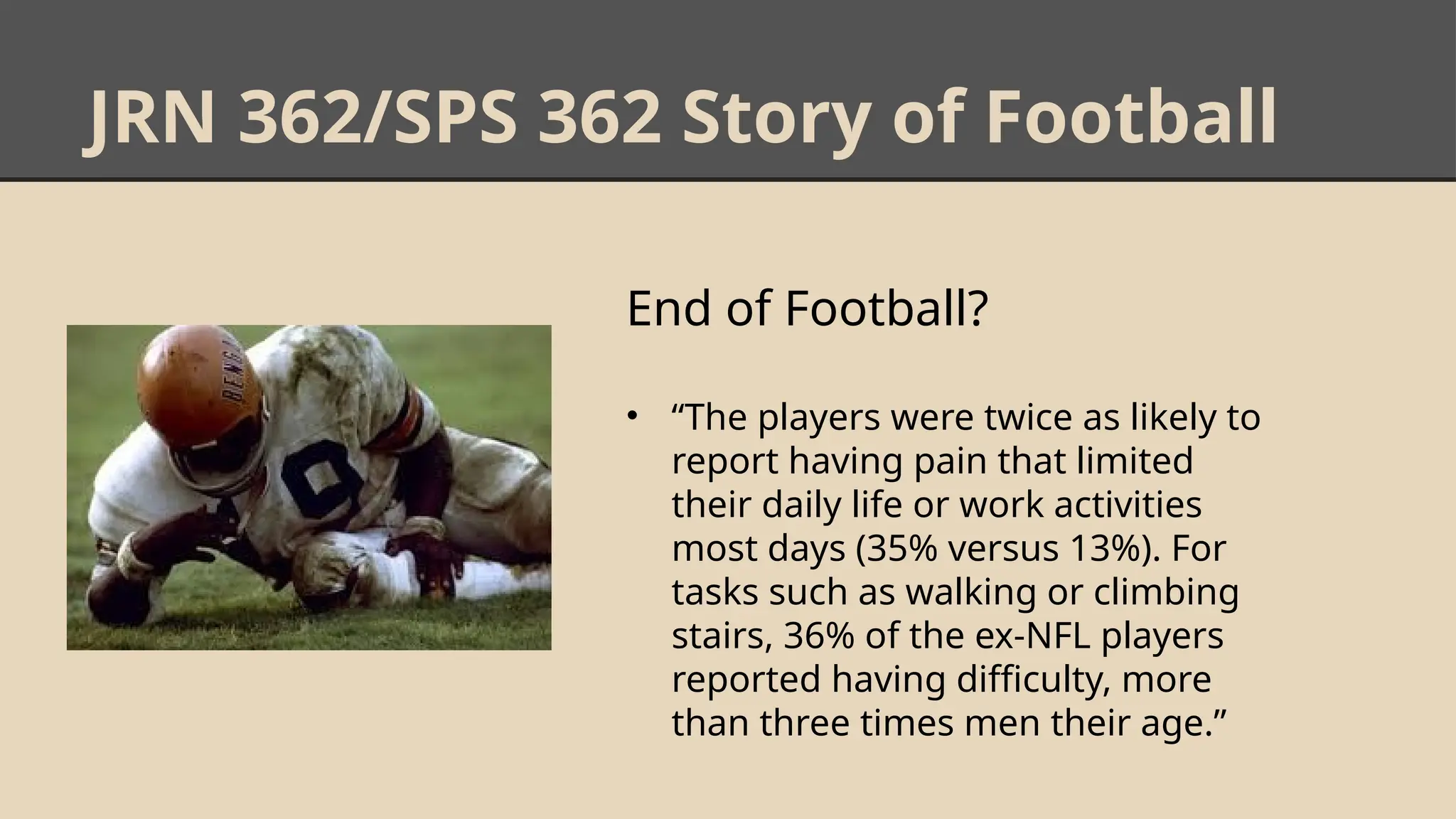
• “The players were twice as likely to
report having pain that limited
their daily life or work activities
most days (35% versus 13%). For
tasks such as walking or climbing
stairs, 36% of the ex-NFL players
reported having difficulty, more
than three times men their age.”
JRN 362/SPS 362 Story of Football
End of Football?
• “Fifteen percent of players reported
being diagnosed with dementia.
According to one study based on
the National Health Interview
Survey, just under 4% of men ages
65 and older have been diagnosed
with dementia.”
JRN 362/SPS 362 Story of Football
End of Football?
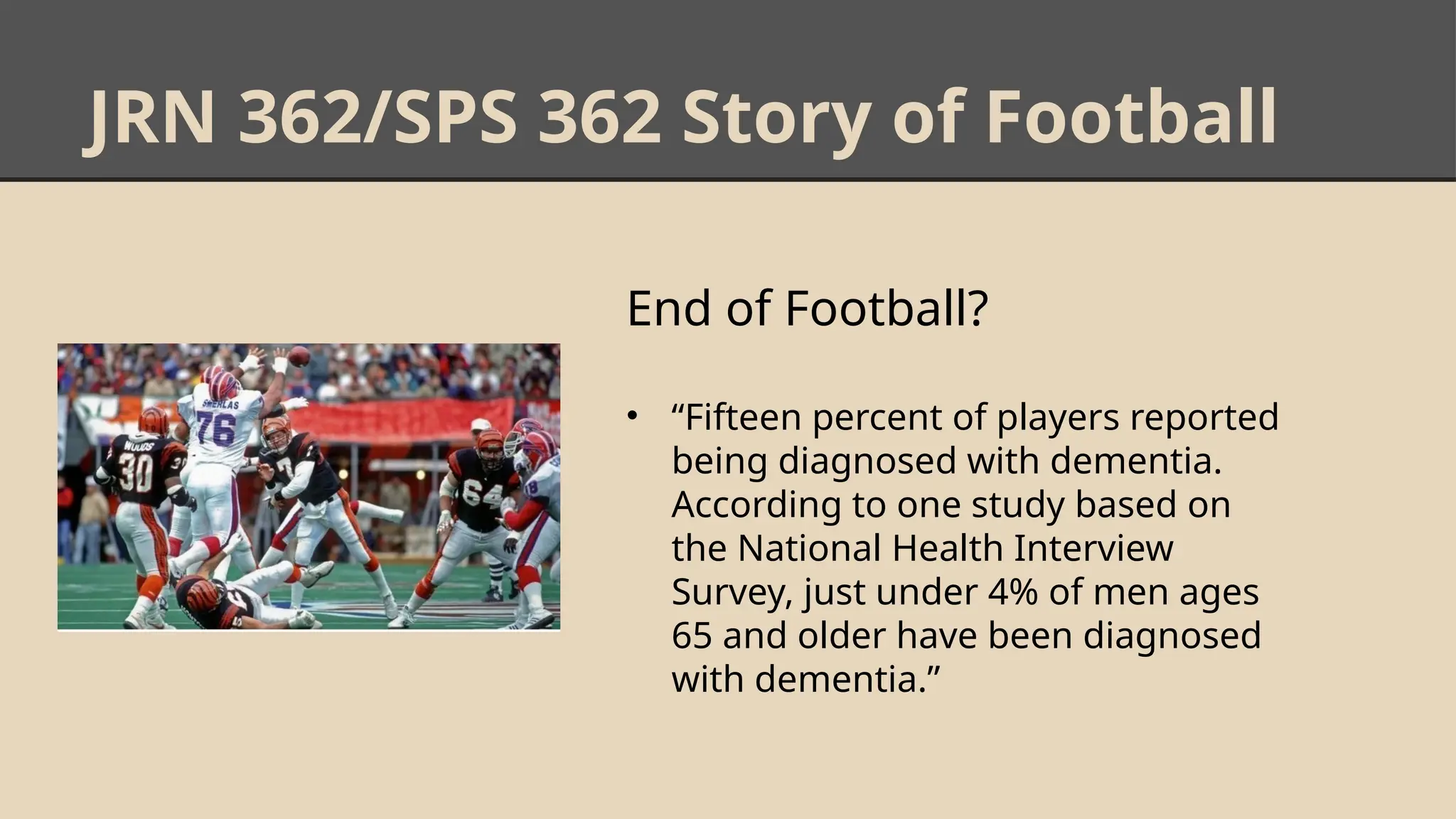
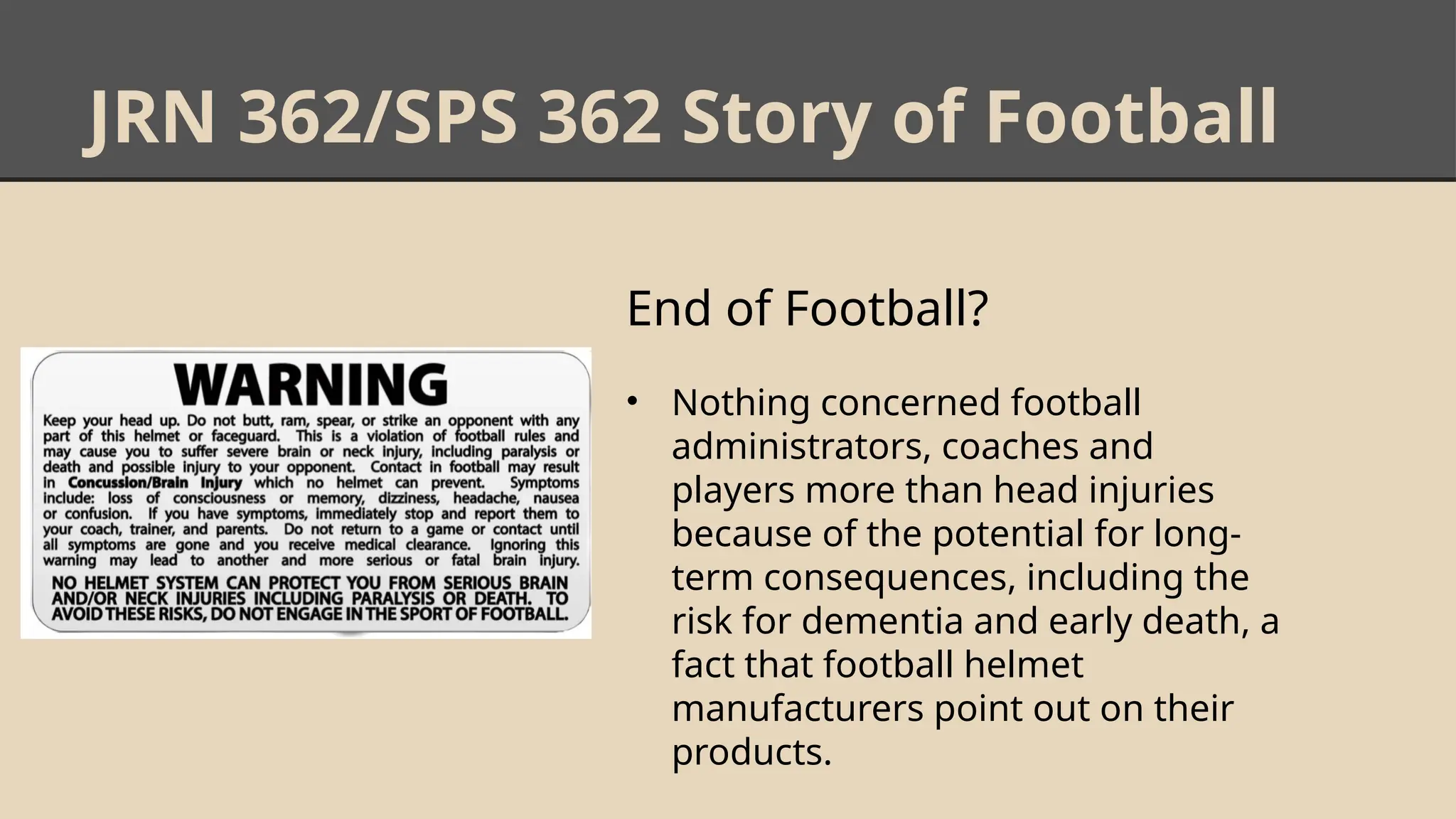
• Nothing concerned football
administrators, coaches and
players more than head injuries
because of the potential for long-
term consequences, including the
risk for dementia and early death, a
fact that football helmet
manufacturers point out on their
products.
JRN 362/SPS 362 Story of Football
End of Football?
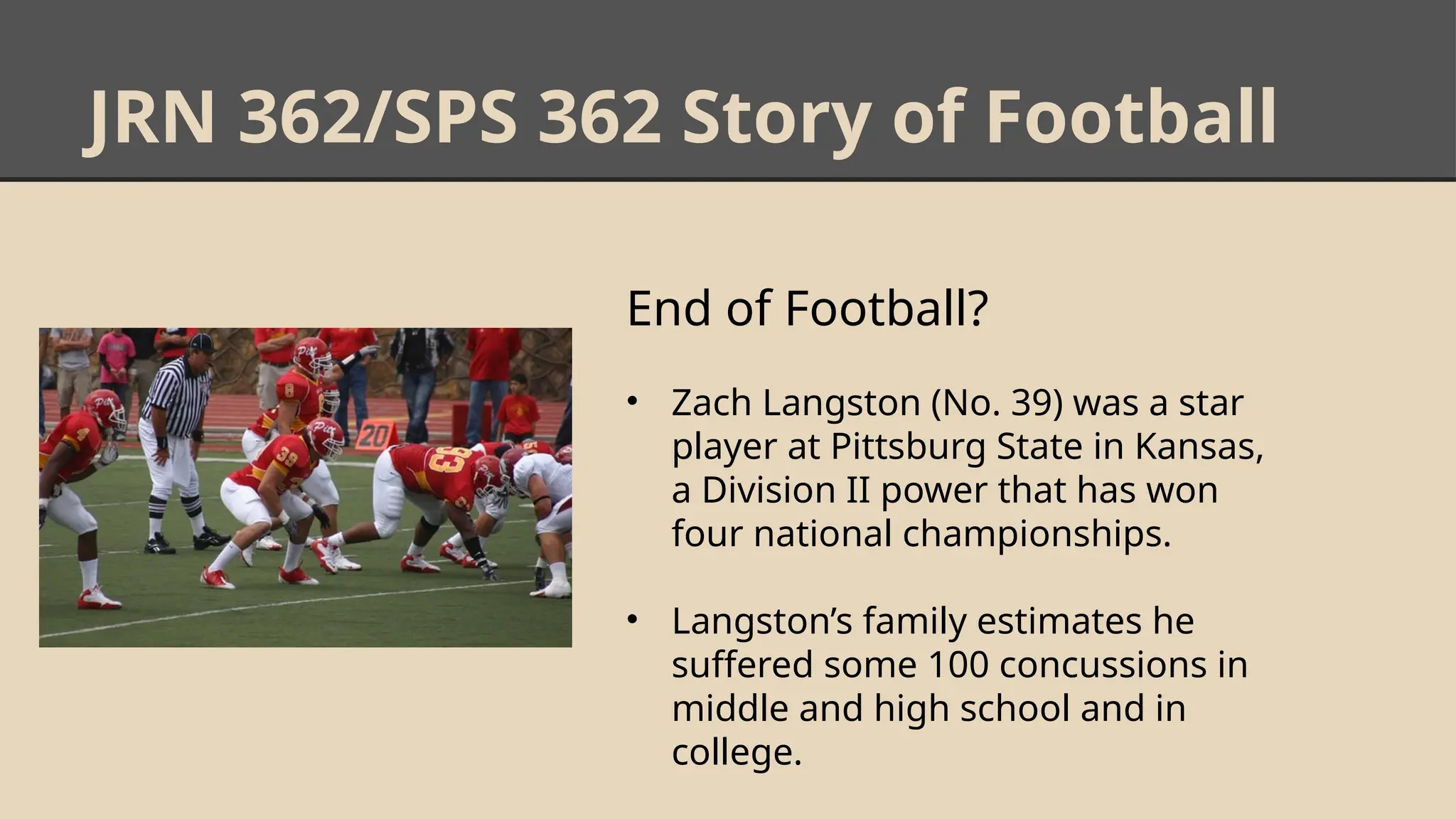
• Zach Langston (No. 39) was a star
player at Pittsburg State in Kansas,
a Division II power that has won
four national championships.
• Langston’s family estimates he
suffered some 100 concussions in
middle and high school and in
college.
JRN 362/SPS 362 Story of Football
End of Football?
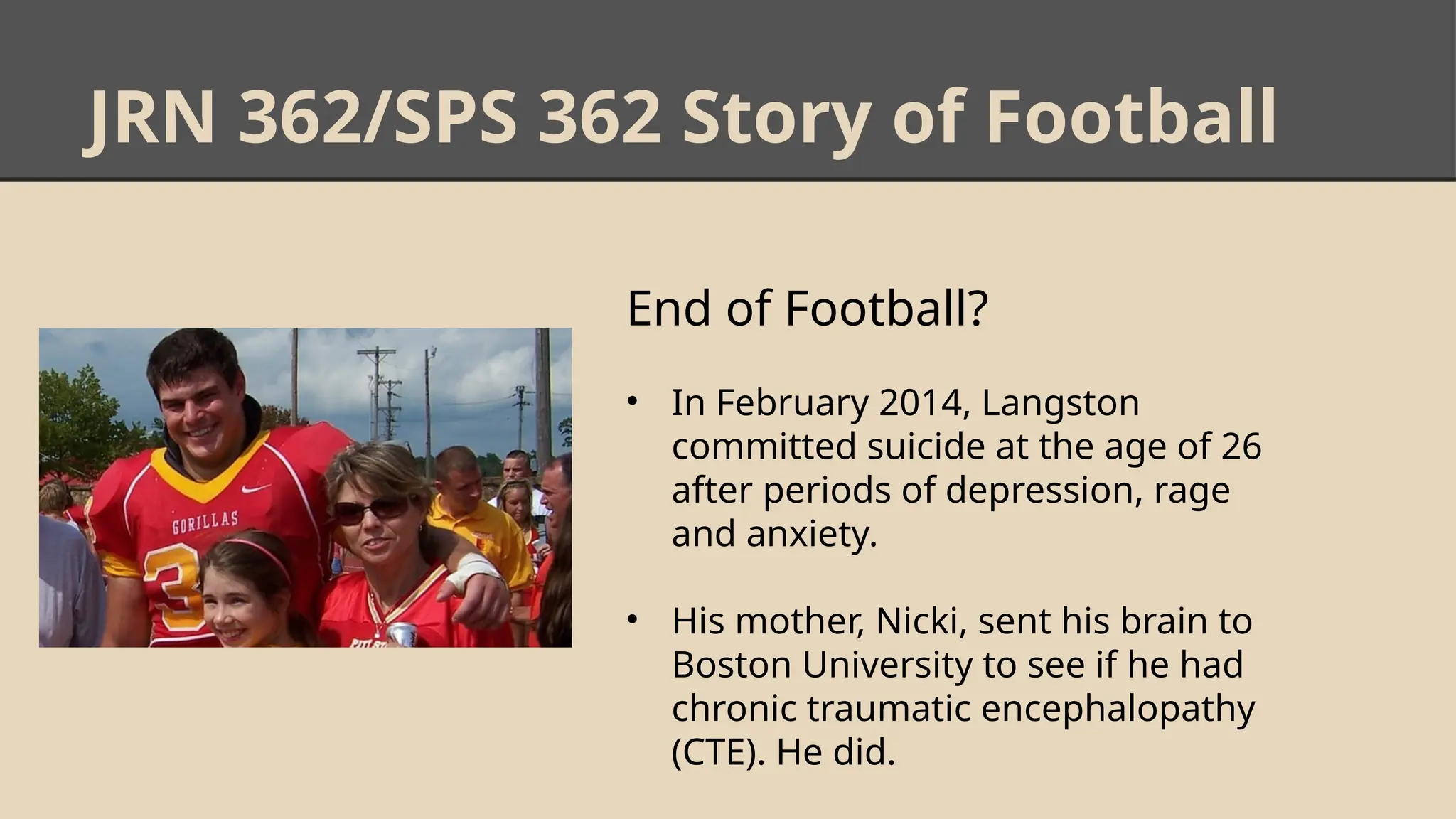
• In February 2014, Langston
committed suicide at the age of 26
after periods of depression, rage
and anxiety.
• His mother, Nicki, sent his brain to
Boston University to see if he had
chronic traumatic encephalopathy
(CTE). He did.
JRN 362/SPS 362 Story of Football
End of Football?
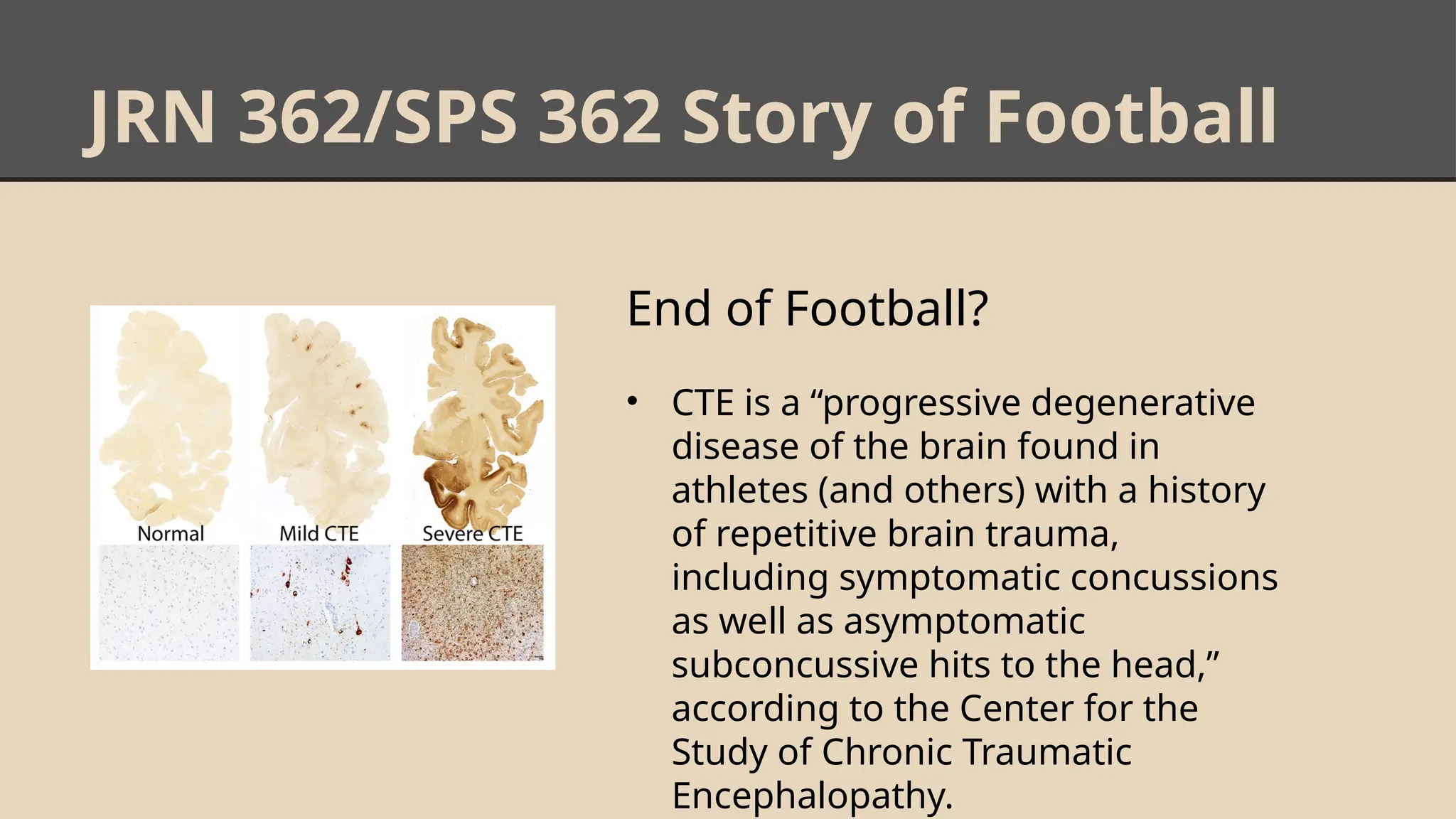
• CTE is a “progressive degenerative
disease of the brain found in
athletes (and others) with a history
of repetitive brain trauma,
including symptomatic concussions
as well as asymptomatic
subconcussive hits to the head,”
according to the Center for the
Study of Chronic Traumatic
Encephalopathy.
JRN 362/SPS 362 Story of Football
End of Football?
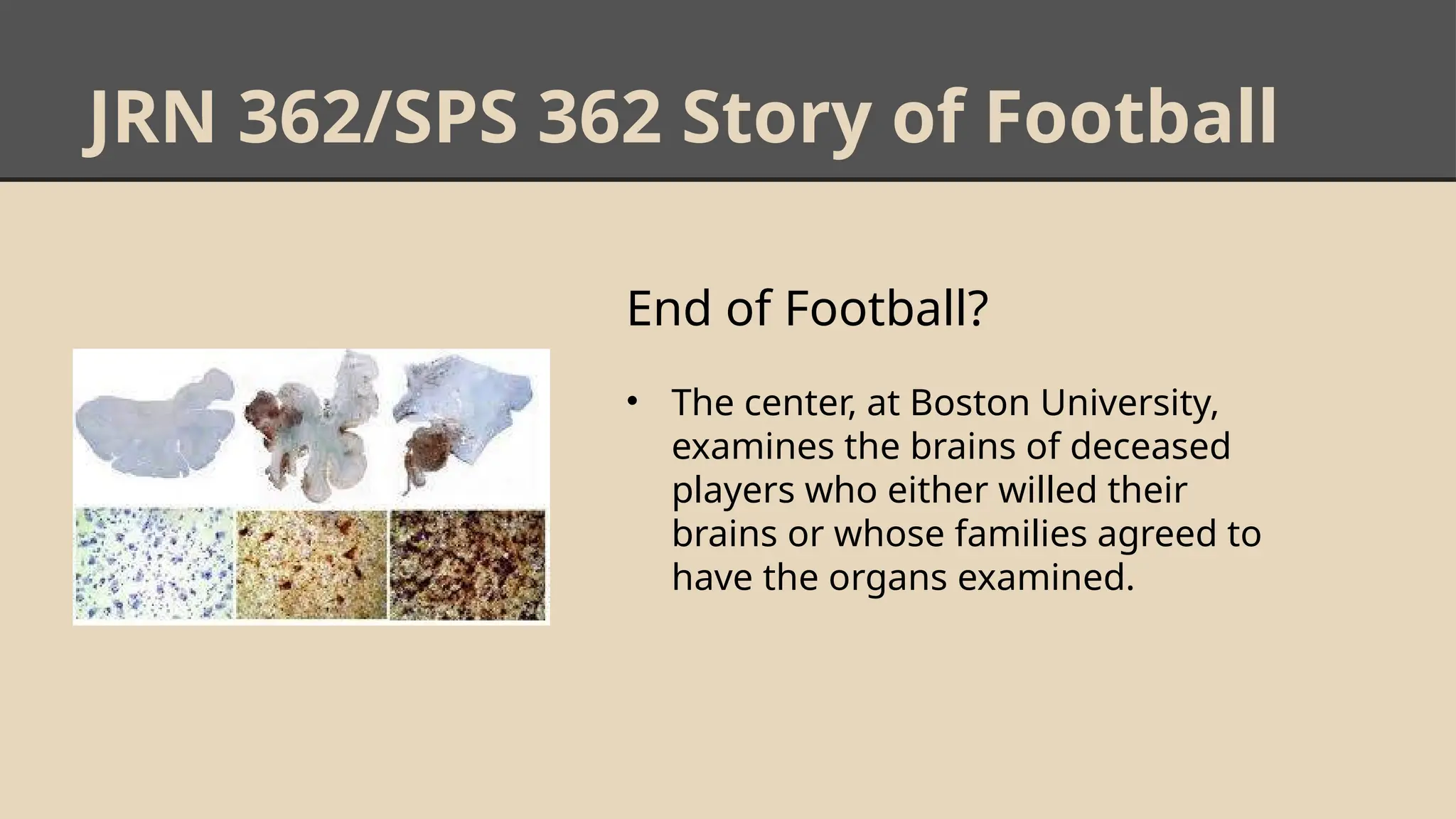
• The center, at Boston University,
examines the brains of deceased
players who either willed their
brains or whose families agreed to
have the organs examined.
JRN 362/SPS 362 Story of Football
End of Football?
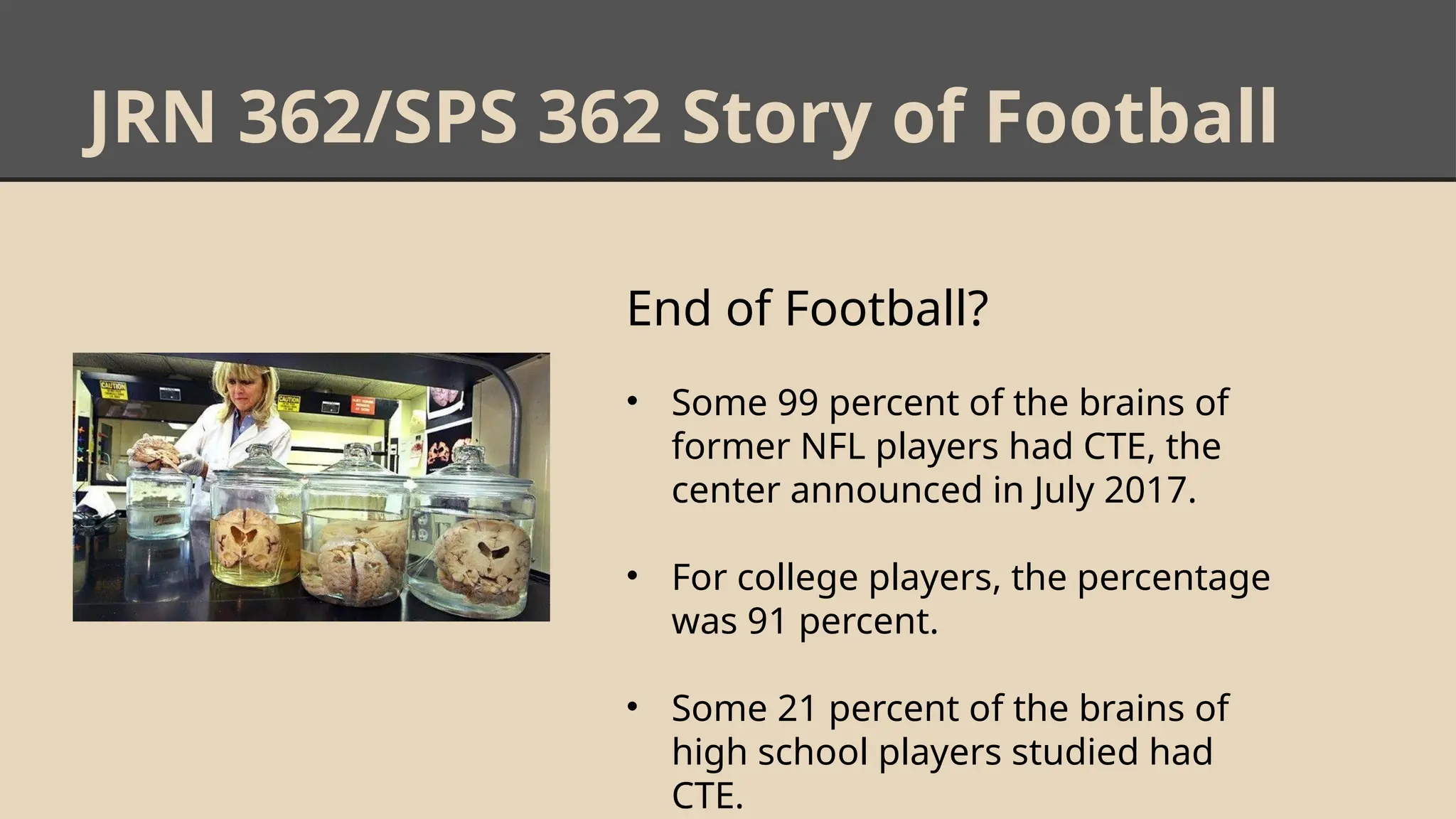
• Some 99 percent of the brains of
former NFL players had CTE, the
center announced in July 2017.
• For college players, the percentage
was 91 percent.
• Some 21 percent of the brains of
high school players studied had
CTE.
JRN 362/SPS 362 Story of Football
End of Football?
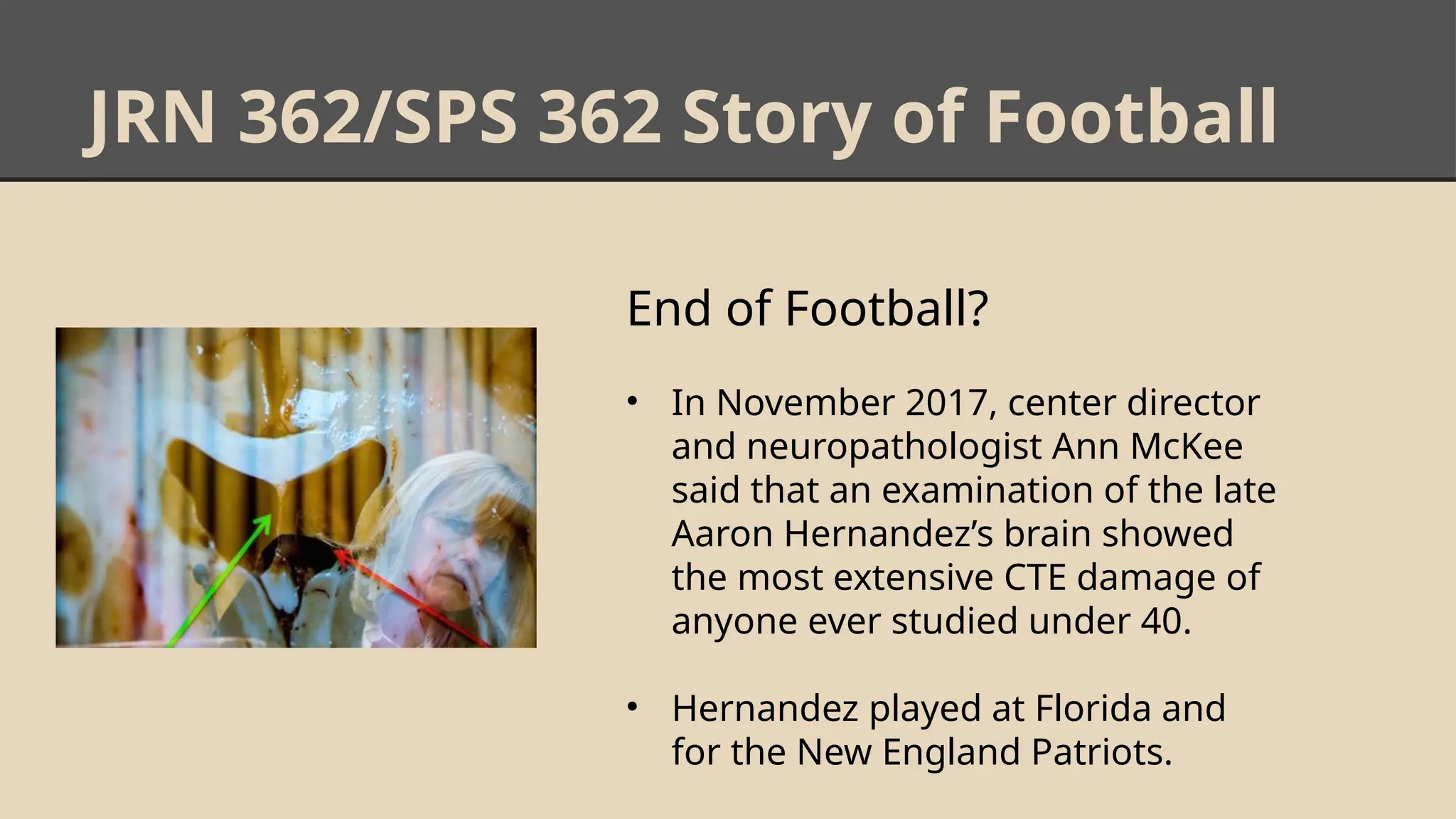
• In November 2017, center director
and neuropathologist Ann McKee
said that an examination of the late
Aaron Hernandez’s brain showed
the most extensive CTE damage of
anyone ever studied under 40.
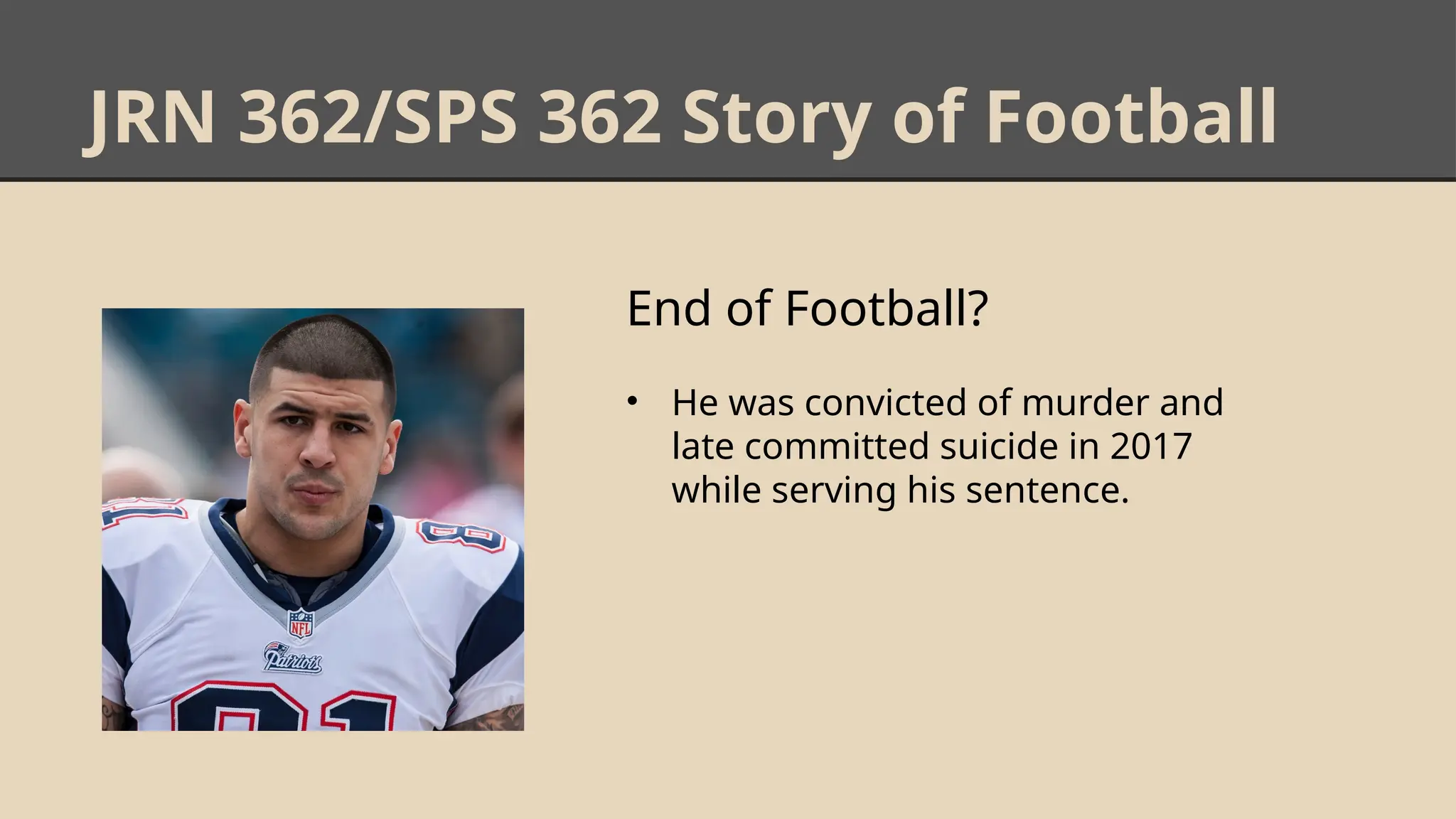
• Hernandez played at Florida and
for the New England Patriots.
JRN 362/SPS 362 Story of Football
End of Football?
• He was convicted of murder and
late committed suicide in 2017
while serving his sentence.
JRN 362/SPS 362 Story of Football
End of Football?
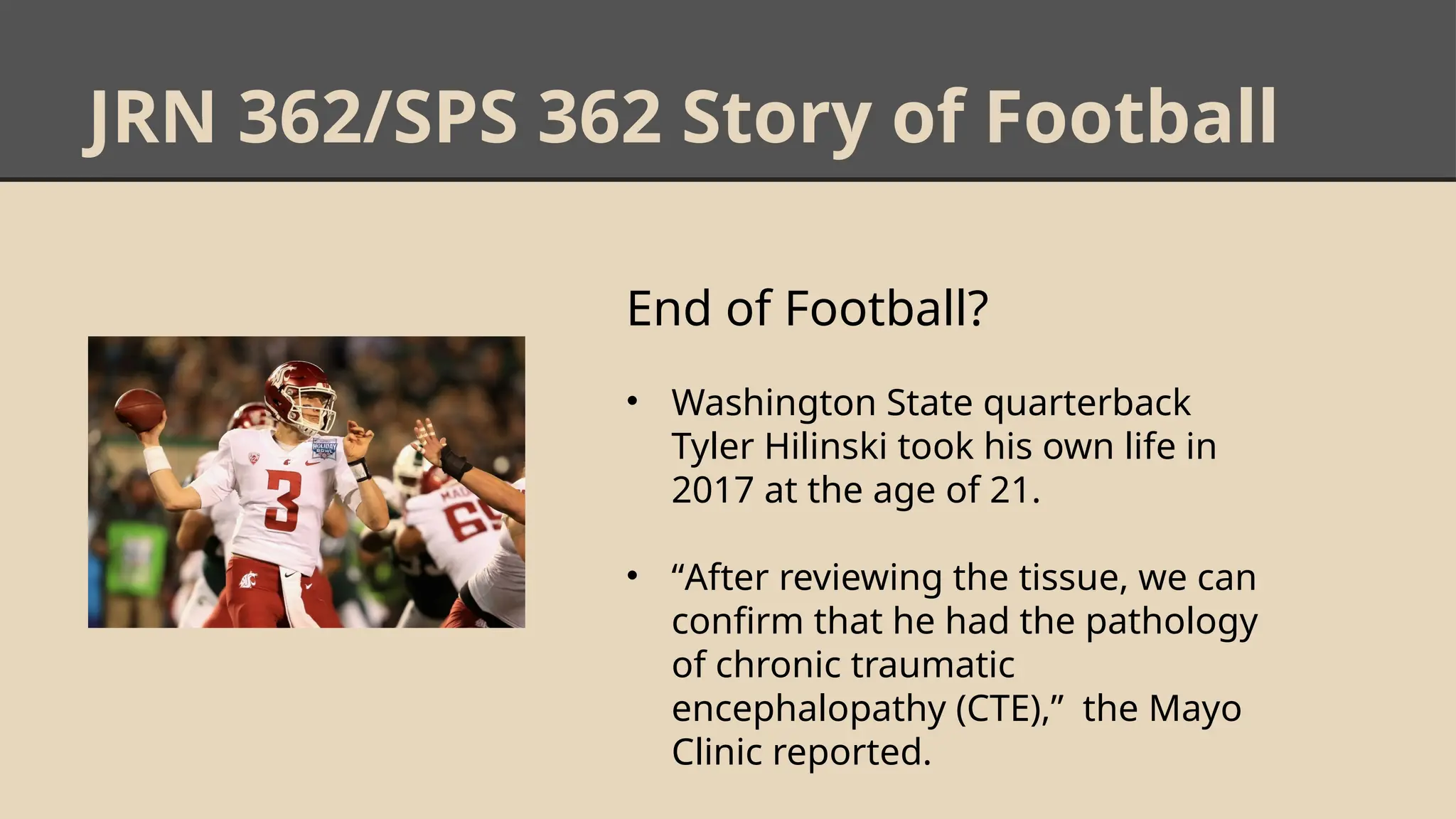
• Washington State quarterback
Tyler Hilinski took his own life in
2017 at the age of 21.
• “After reviewing the tissue, we can
confirm that he had the pathology
of chronic traumatic
encephalopathy (CTE),” the Mayo
Clinic reported.
JRN 362/SPS 362 Story of Football
End of Football?
• The stories of football players
dying before their time persist.
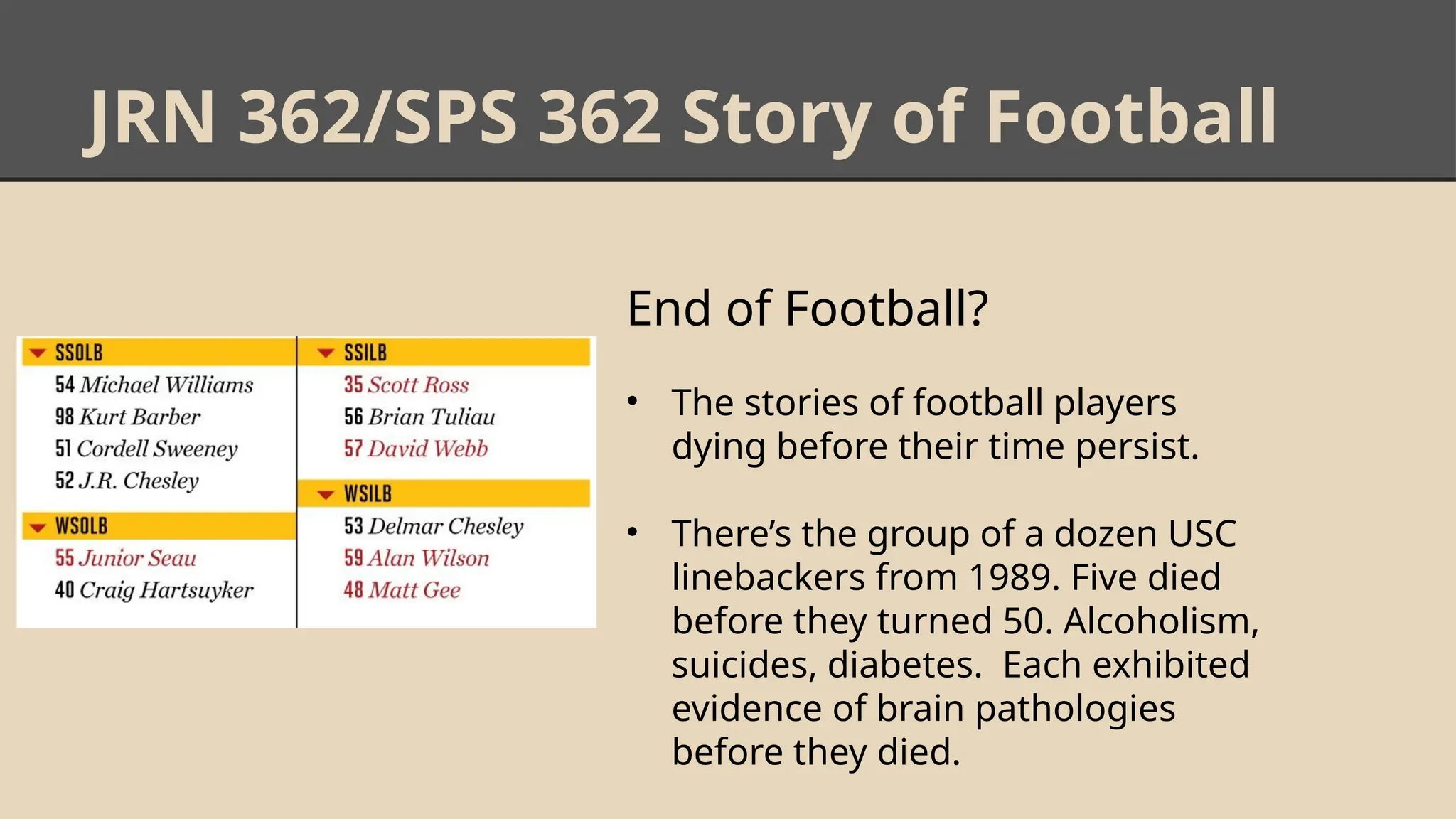
• There’s the group of a dozen USC
linebackers from 1989. Five died
before they turned 50. Alcoholism,
suicides, diabetes. Each exhibited
evidence of brain pathologies
before they died.
JRN 362/SPS 362 Story of Football
End of Football?
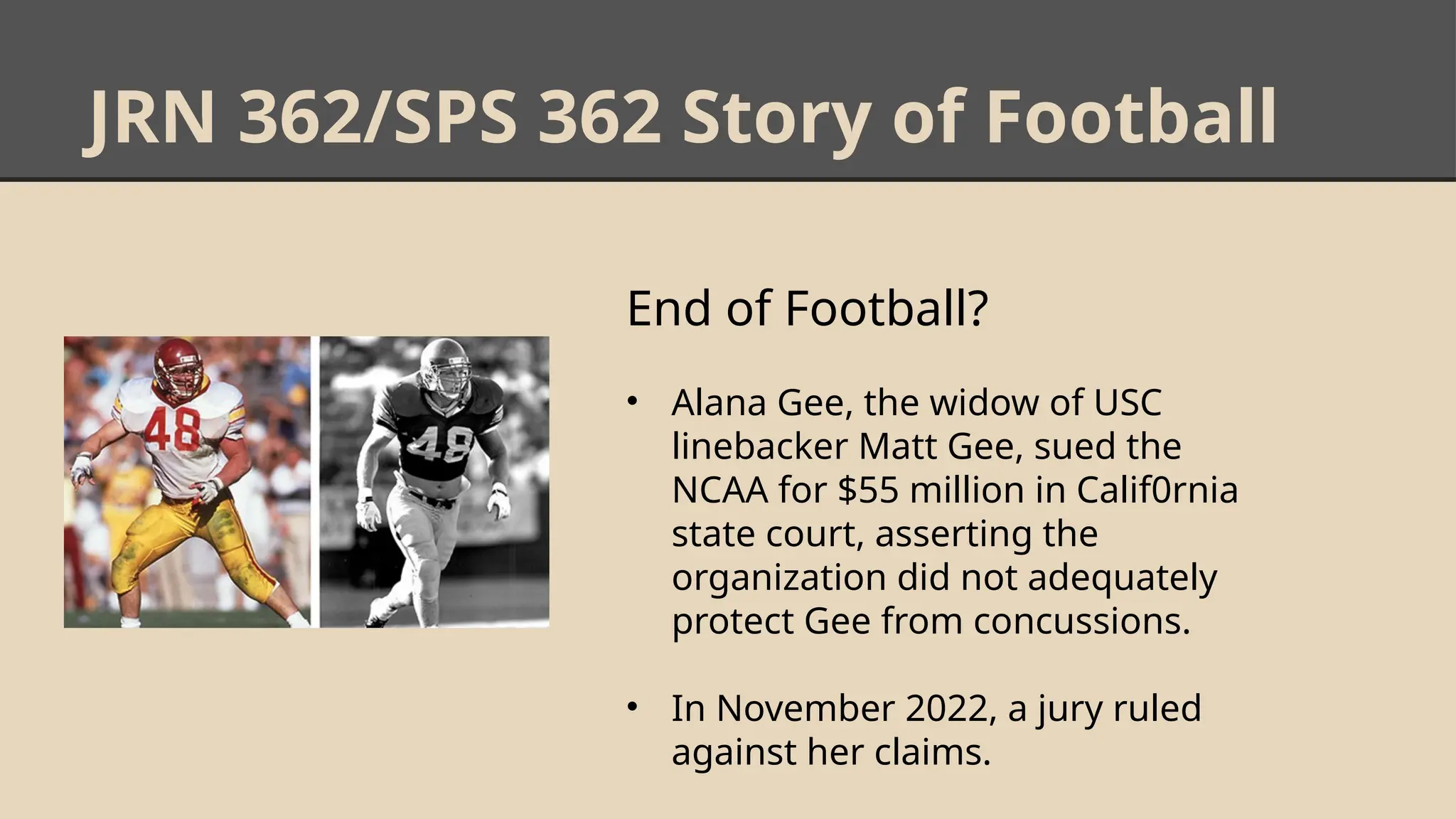
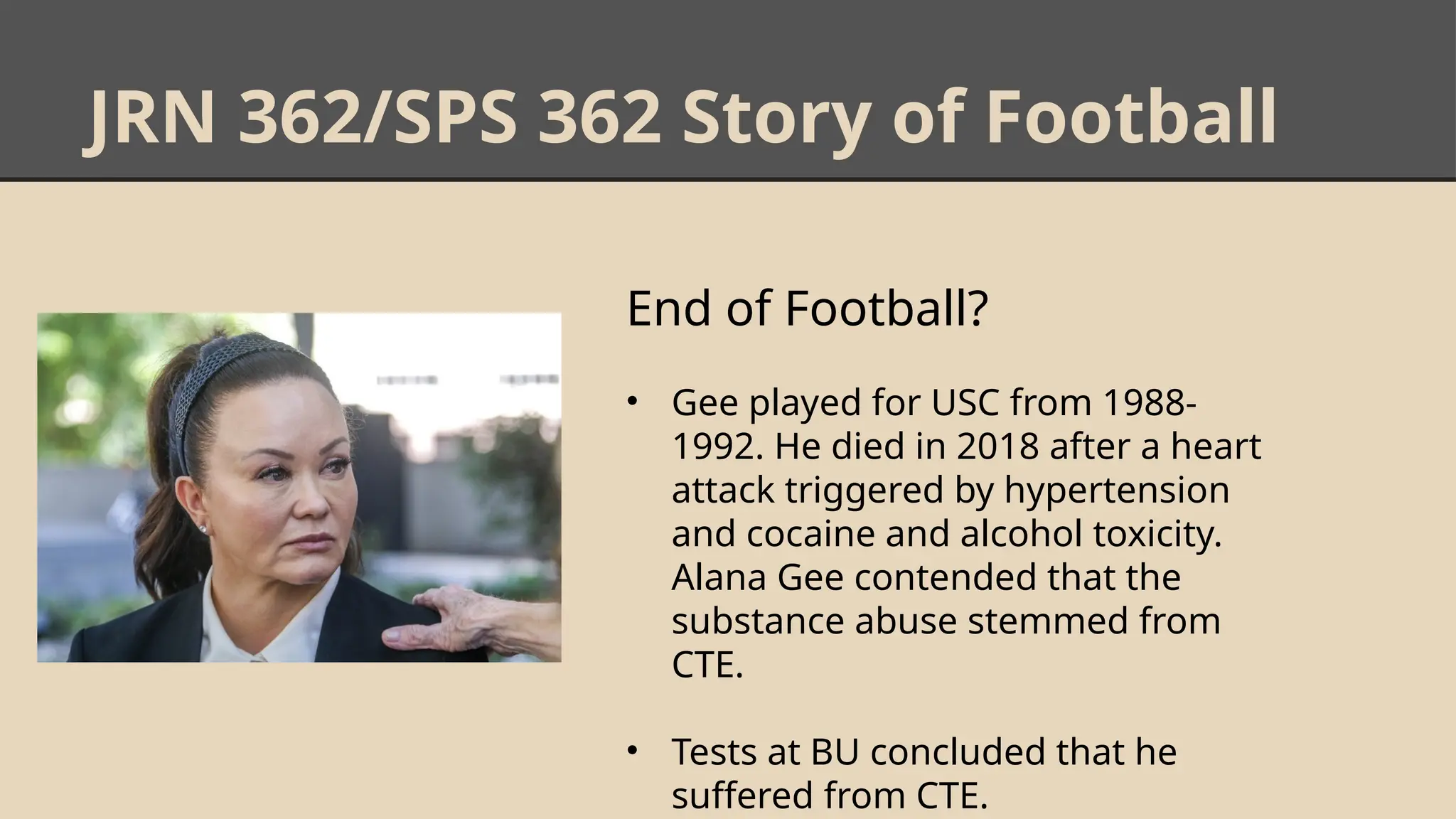
• Alana Gee, the widow of USC
linebacker Matt Gee, sued the
NCAA for $55 million in Calif0rnia
state court, asserting the
organization did not adequately
protect Gee from concussions.
• In November 2022, a jury ruled
against her claims.
JRN 362/SPS 362 Story of Football
End of Football?
• Gee played for USC from 1988-
1992. He died in 2018 after a heart
attack triggered by hypertension
and cocaine and alcohol toxicity.
Alana Gee contended that the
substance abuse stemmed from
CTE.
• Tests at BU concluded that he
suffered from CTE.
JRN 362/SPS 362 Story of Football
End of Football?
• The Gee case was the first CTE case
against the NCAA to reach a jury.
• In 2016, the NCAA settled a class-
action lawsuit. It agreed to pay $70
million over 50 years to monitor
former college athletes’ medical
conditions and $5 million toward
medical research.
JRN 362/SPS 362 Story of Football
End of Football?
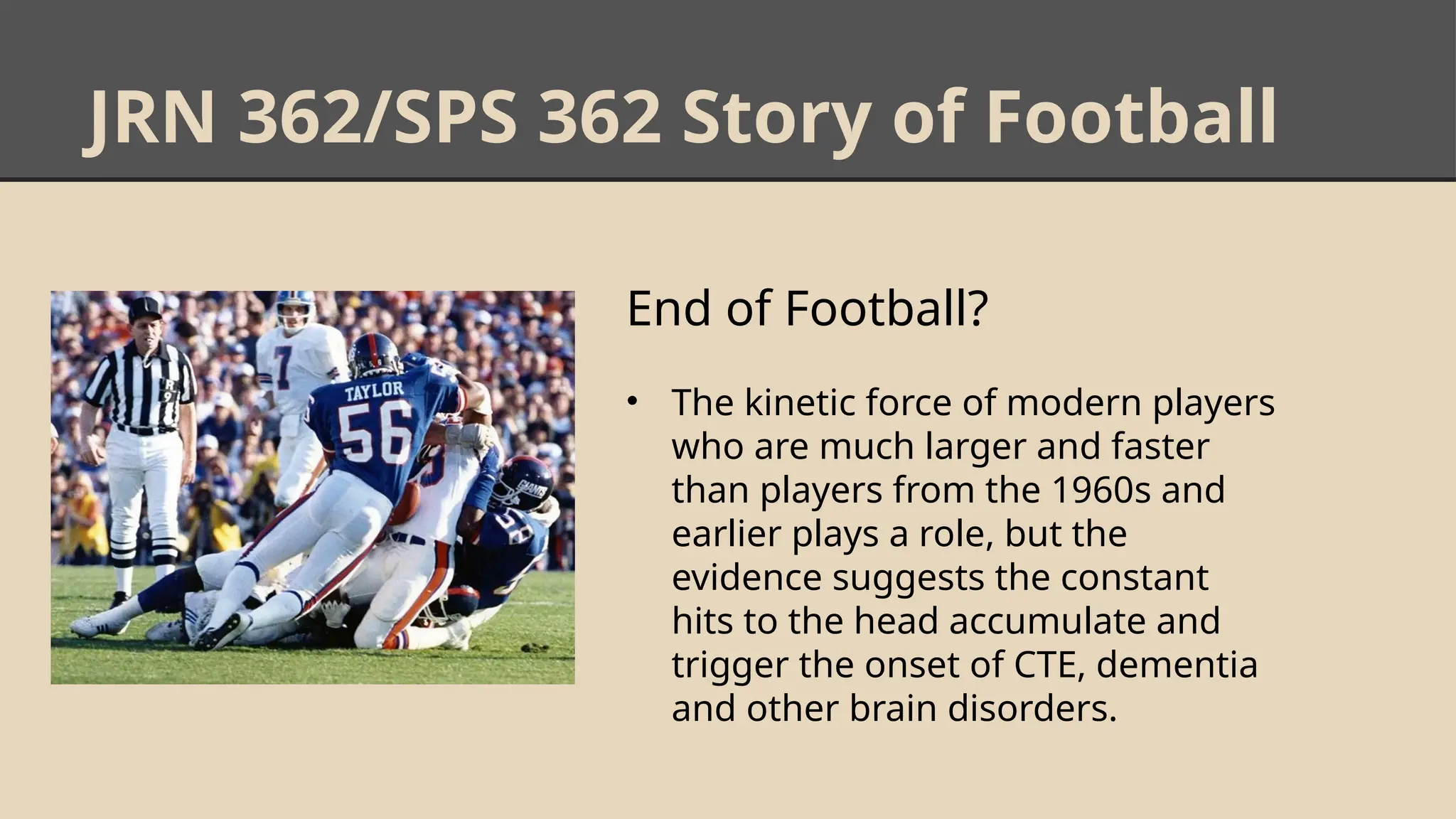
• The kinetic force of modern players
who are much larger and faster
than players from the 1960s and
earlier plays a role, but the
evidence suggests the constant
hits to the head accumulate and
trigger the onset of CTE, dementia
and other brain disorders.
JRN 362/SPS 362 Story of Football
End of Football?
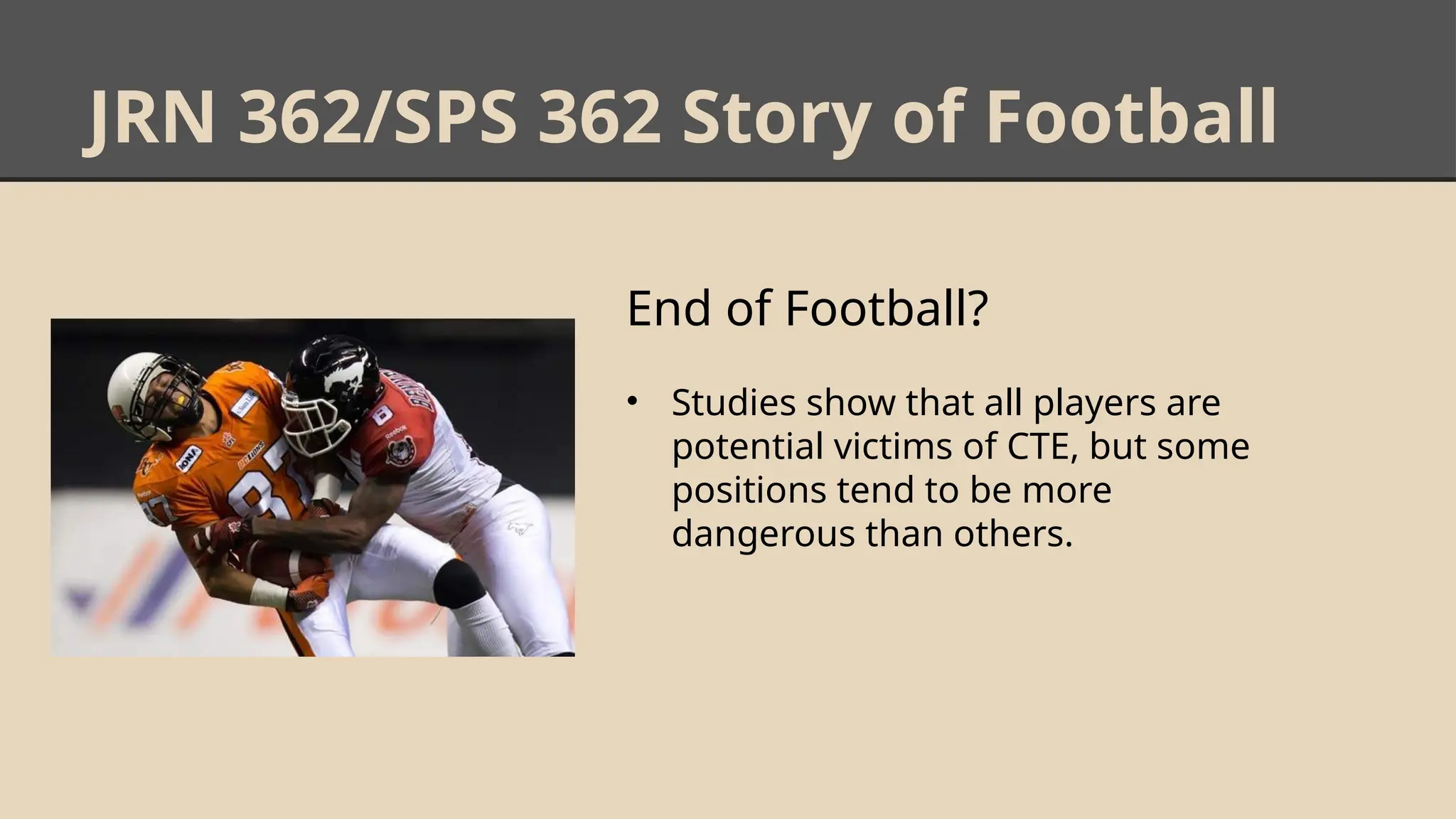
• Studies show that all players are
potential victims of CTE, but some
positions tend to be more
dangerous than others.
JRN 362/SPS 362 Story of Football
End of Football?
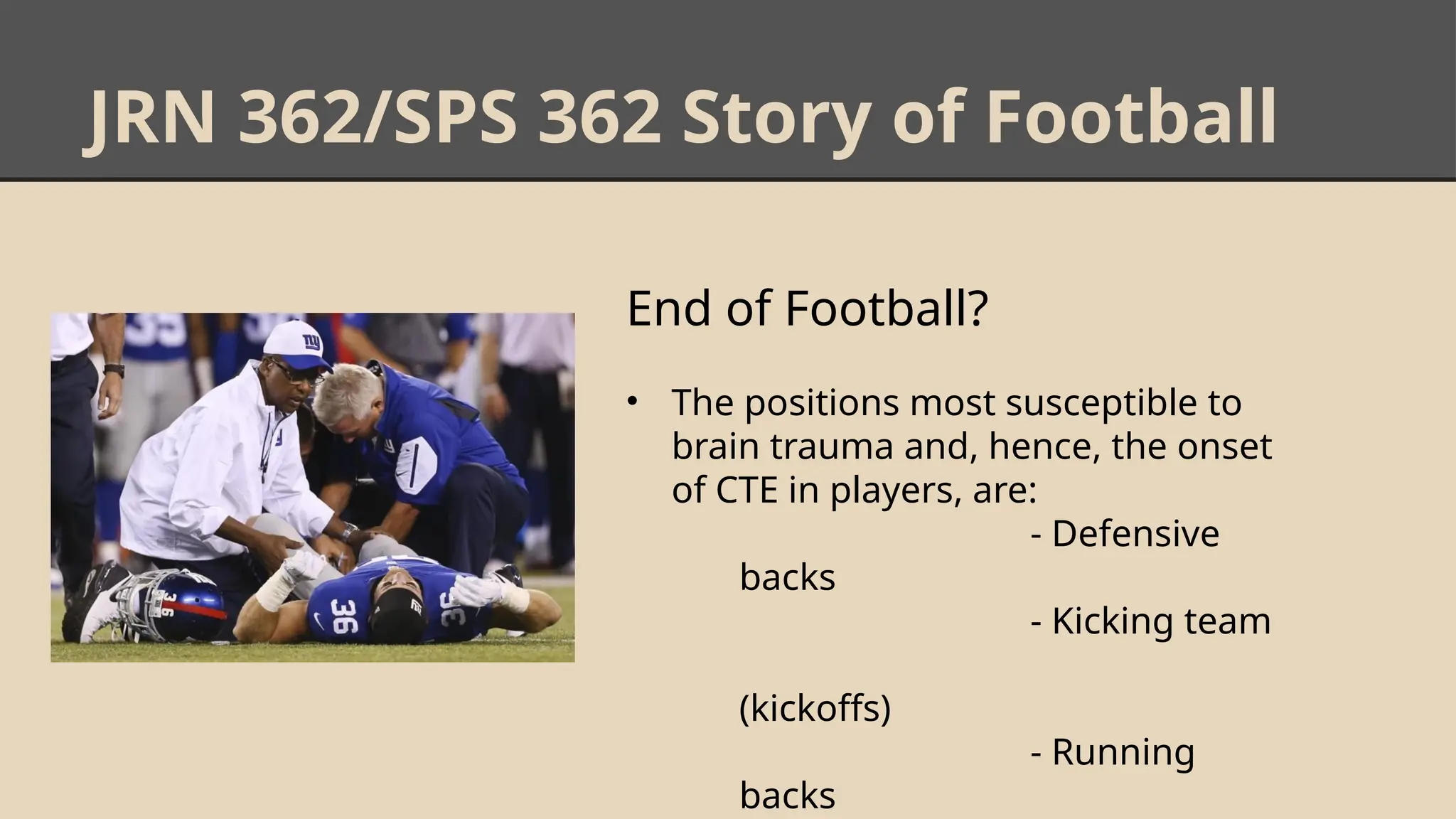
• The positions most susceptible to
brain trauma and, hence, the onset
of CTE in players, are:
- Defensive
backs
- Kicking team
(kickoffs)
- Running
backs
JRN 362/SPS 362 Story of Football
End of Football?
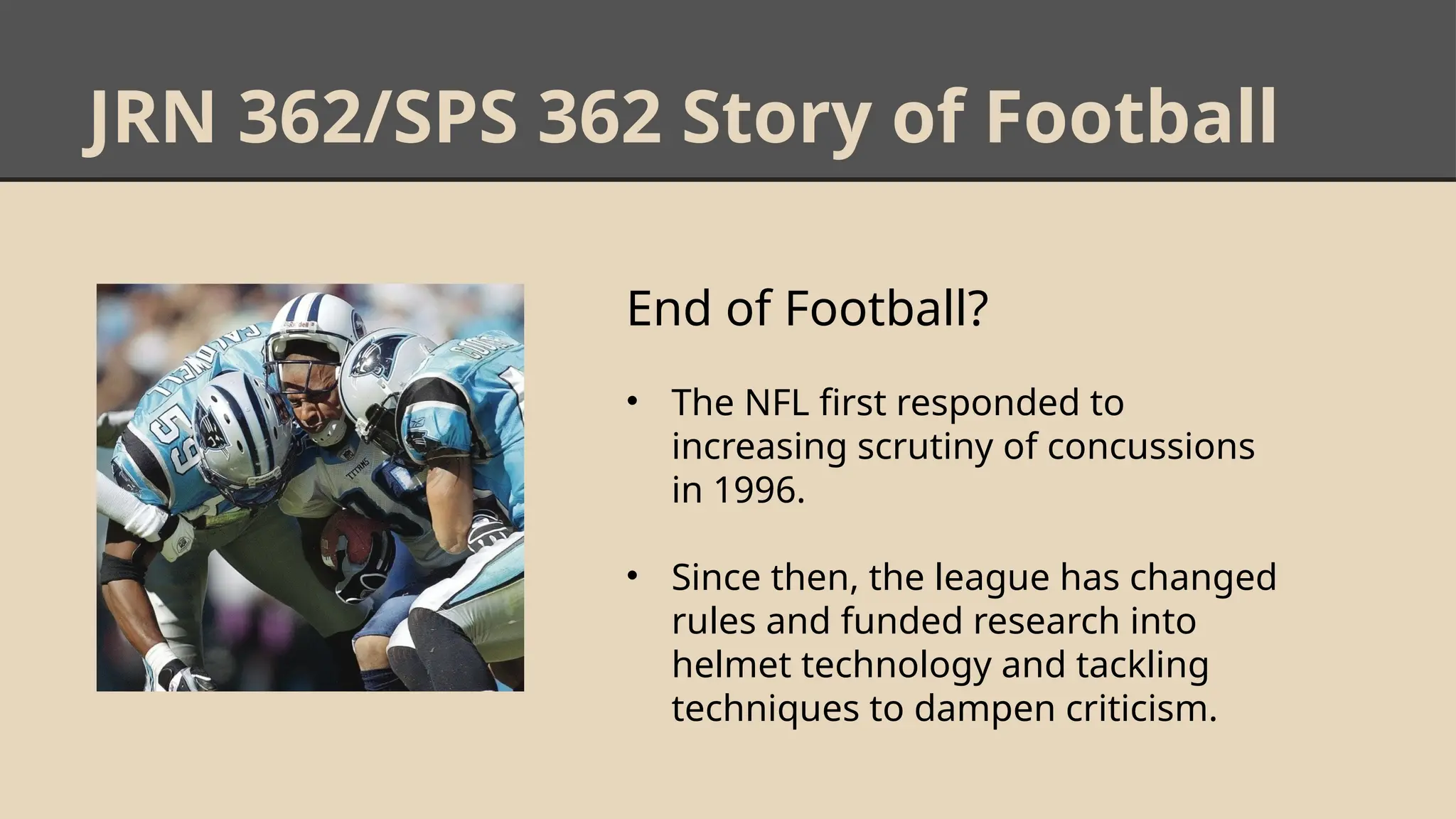
• The NFL first responded to
increasing scrutiny of concussions
in 1996.
• Since then, the league has changed
rules and funded research into
helmet technology and tackling
techniques to dampen criticism.
JRN 362/SPS 362 Story of Football
End of Football?
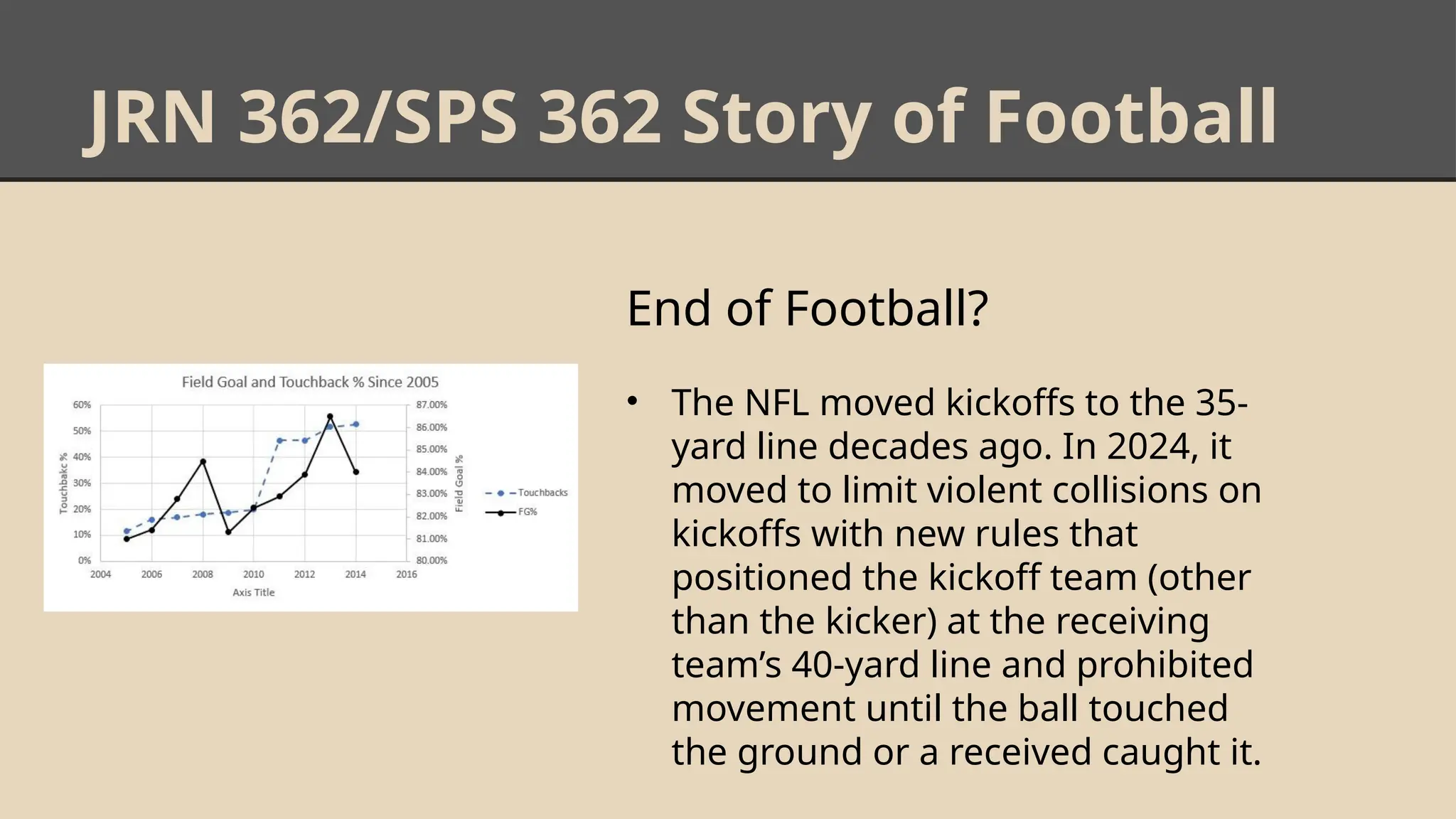
• The NFL moved kickoffs to the 35-
yard line decades ago. In 2024, it
moved to limit violent collisions on
kickoffs with new rules that
positioned the kickoff team (other
than the kicker) at the receiving
team’s 40-yard line and prohibited
movement until the ball touched
the ground or a received caught it.
JRN 362/SPS 362 Story of Football
End of Football?
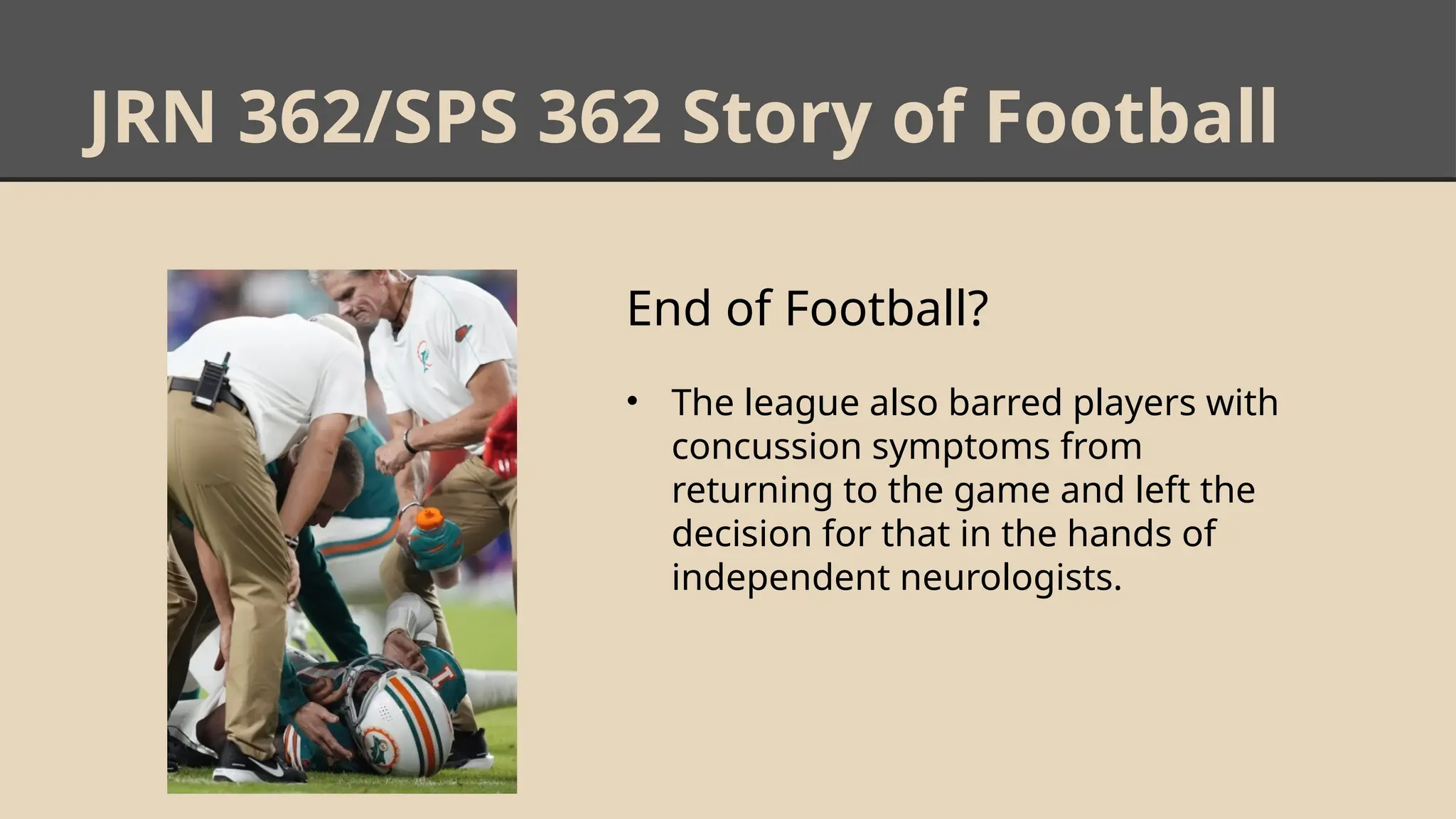
• The league also barred players with
concussion symptoms from
returning to the game and left the
decision for that in the hands of
independent neurologists.
JRN 362/SPS 362 Story of Football
End of Football?
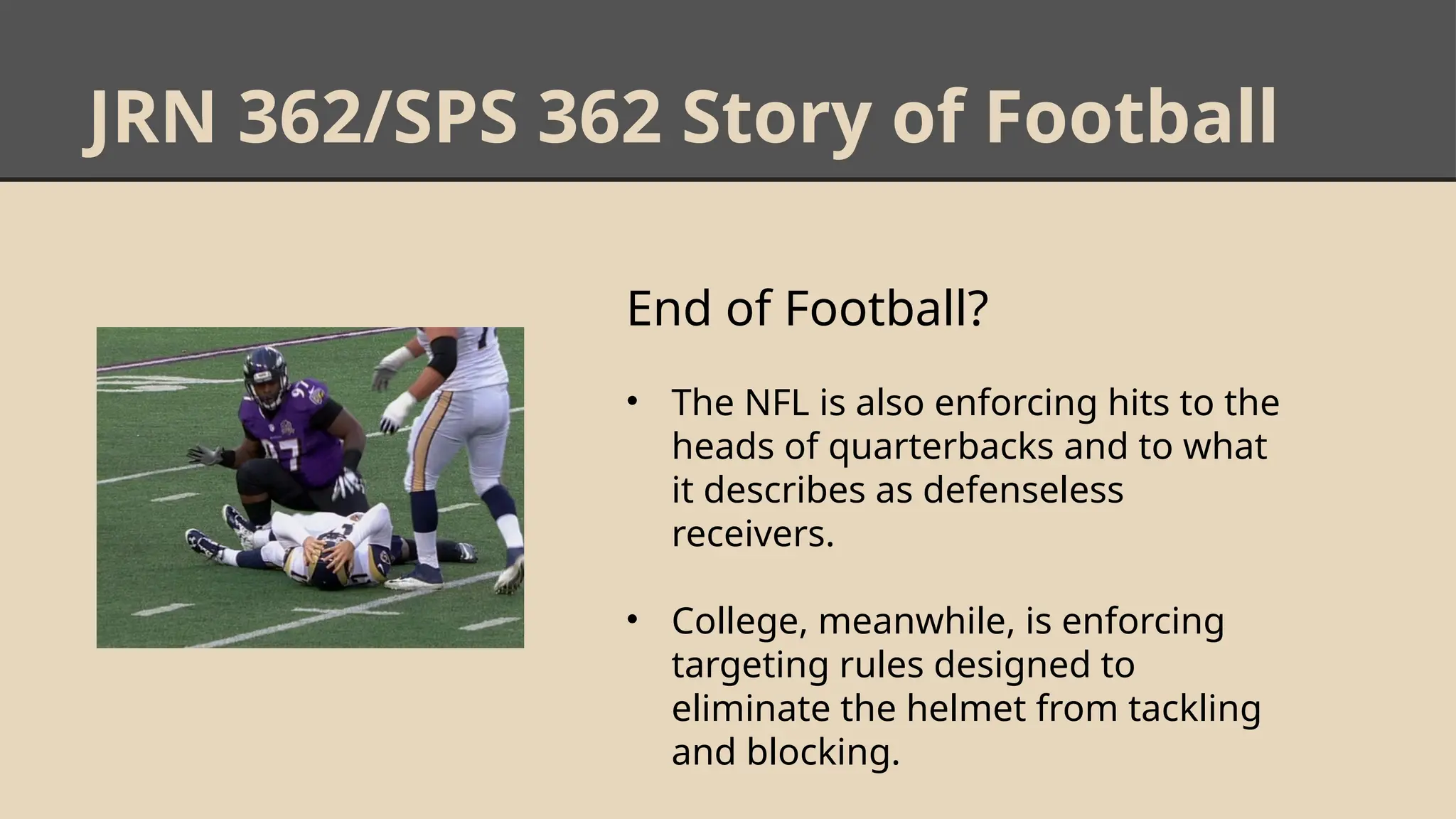
• The NFL is also enforcing hits to the
heads of quarterbacks and to what
it describes as defenseless
receivers.
• College, meanwhile, is enforcing
targeting rules designed to
eliminate the helmet from tackling
and blocking.
JRN 362/SPS 362 Story of Football
End of Football?
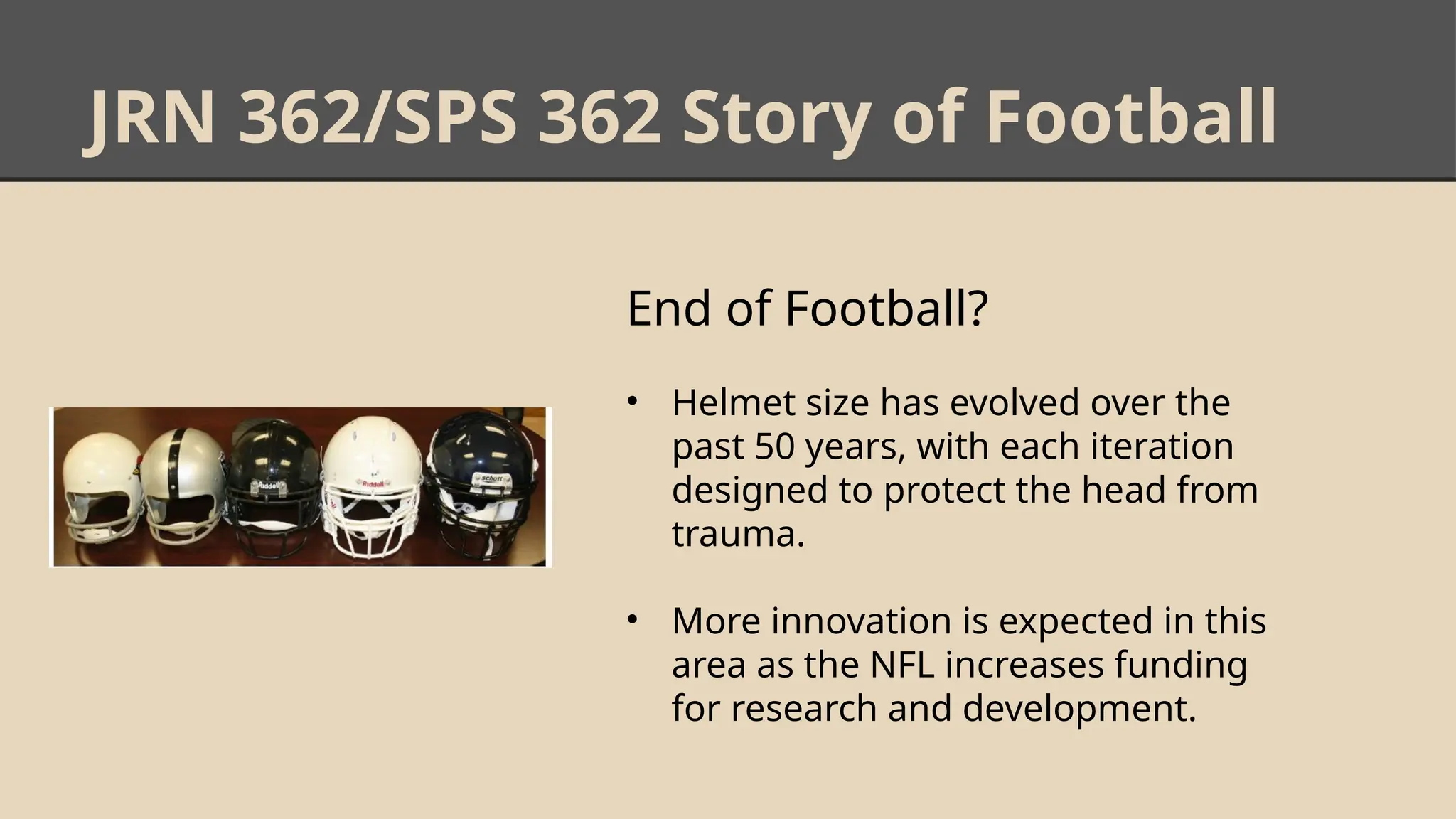
• Helmet size has evolved over the
past 50 years, with each iteration
designed to protect the head from
trauma.
• More innovation is expected in this
area as the NFL increases funding
for research and development.
JRN 362/SPS 362 Story of Football
End of Football?
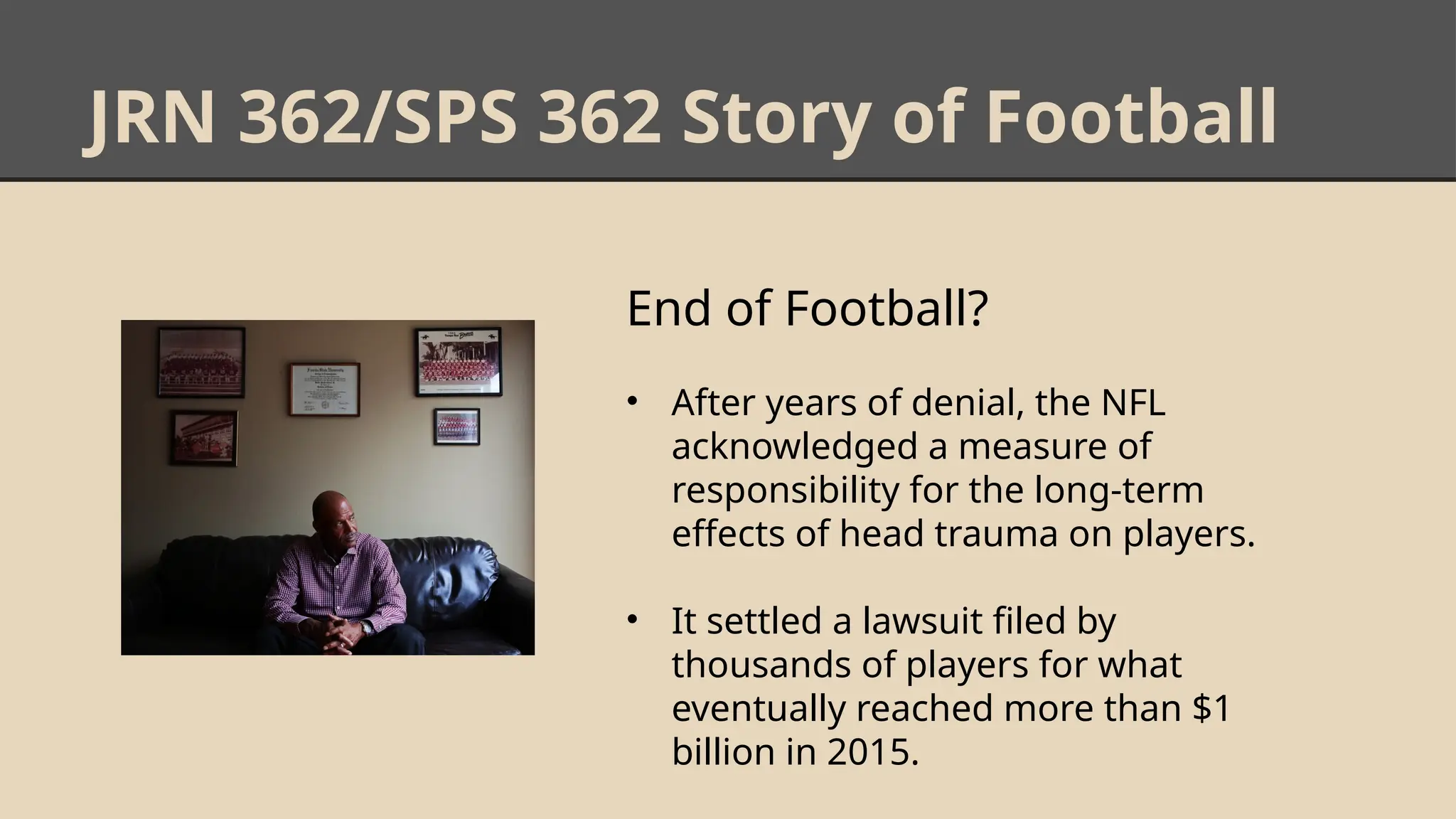
• After years of denial, the NFL
acknowledged a measure of
responsibility for the long-term
effects of head trauma on players.
• It settled a lawsuit filed by
thousands of players for what
eventually reached more than $1
billion in 2015.
JRN 362/SPS 362 Story of Football
End of Football?
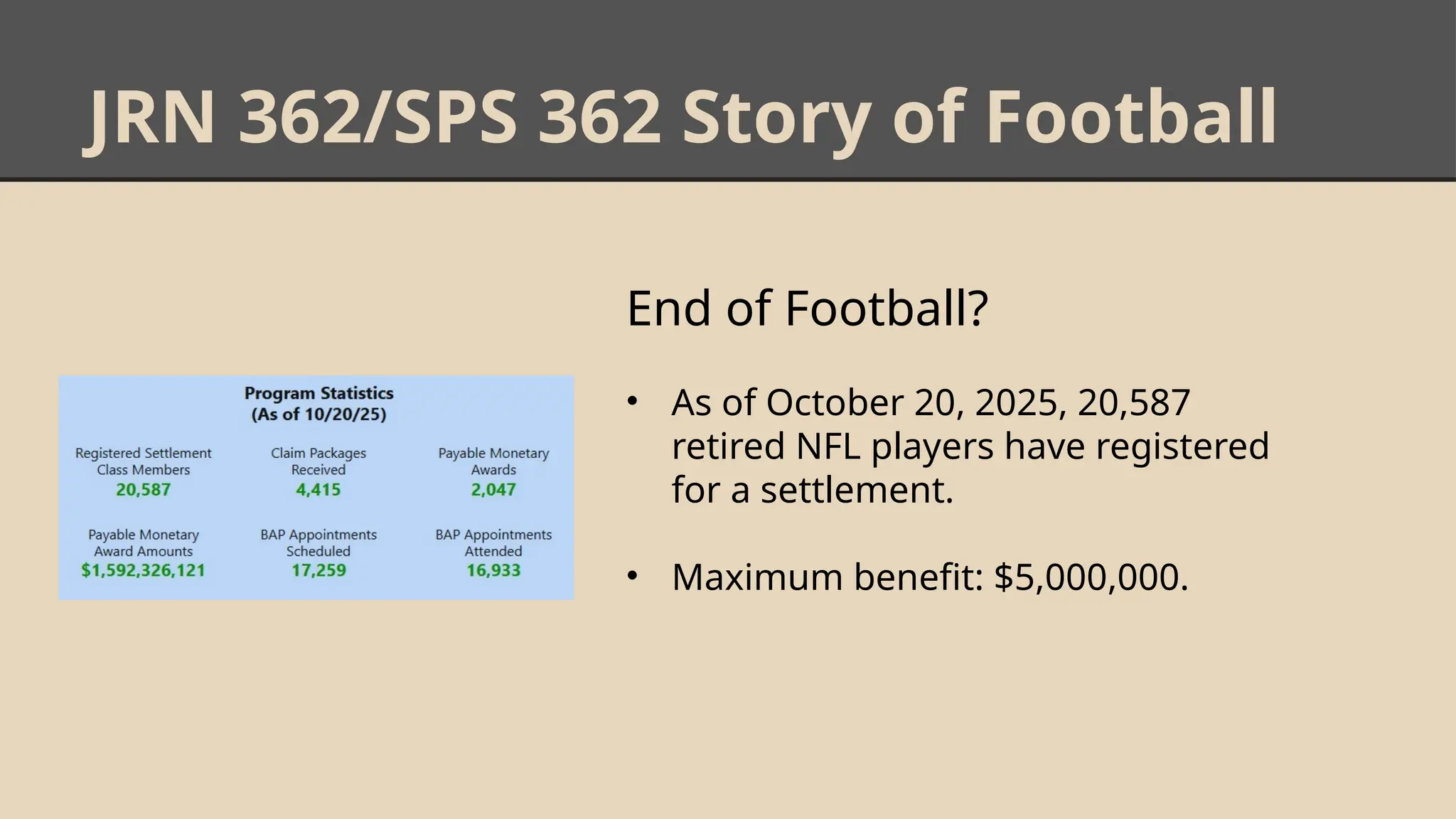
• As of October 20, 2025, 20,587
retired NFL players have registered
for a settlement.
• Maximum benefit: $5,000,000.
JRN 362/SPS 362 Story of Football
End of Football?
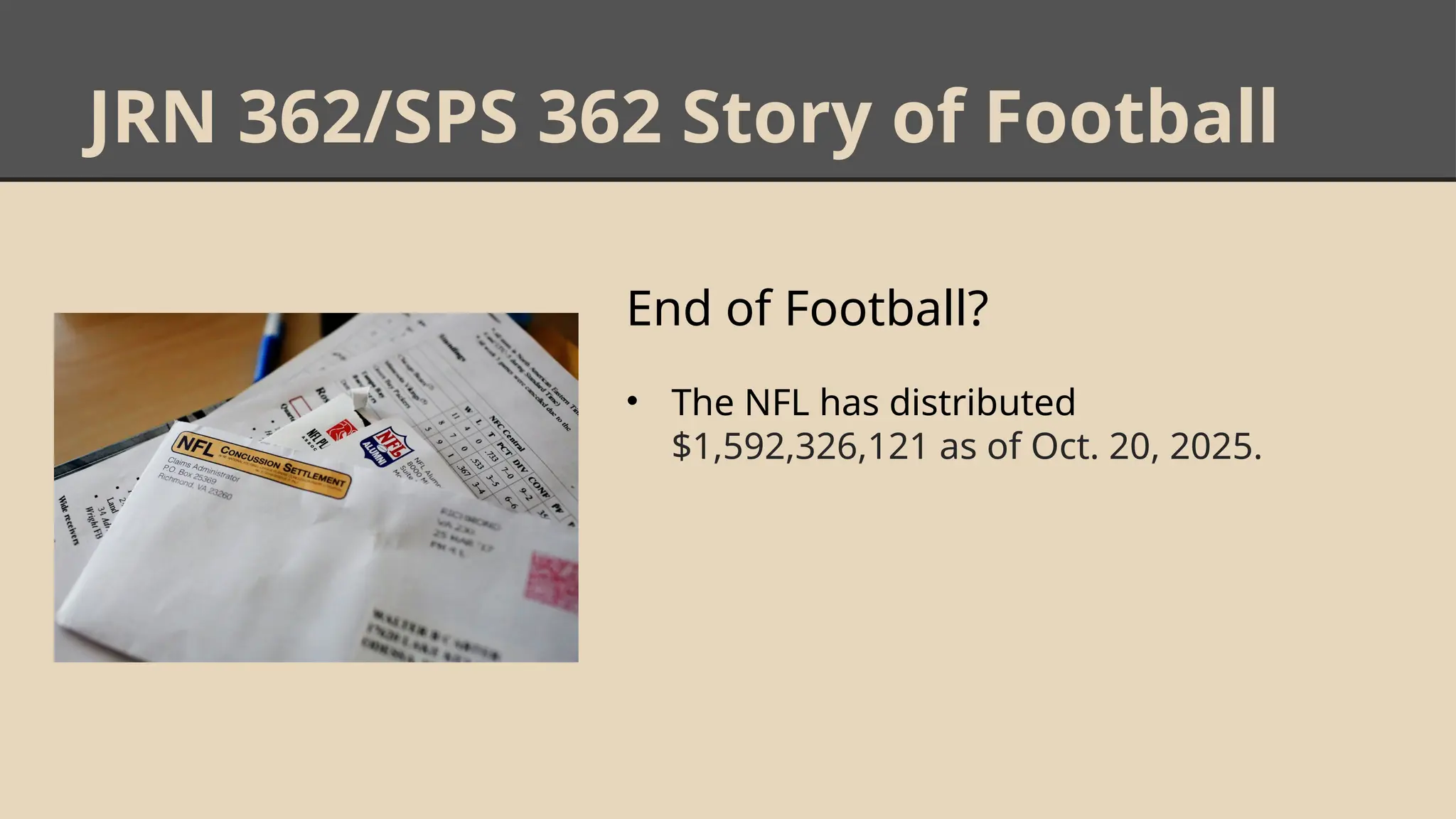
• The NFL has distributed
$1,592,326,121 as of Oct. 20, 2025.
JRN 362/SPS 362 Story of Football
End of Football?
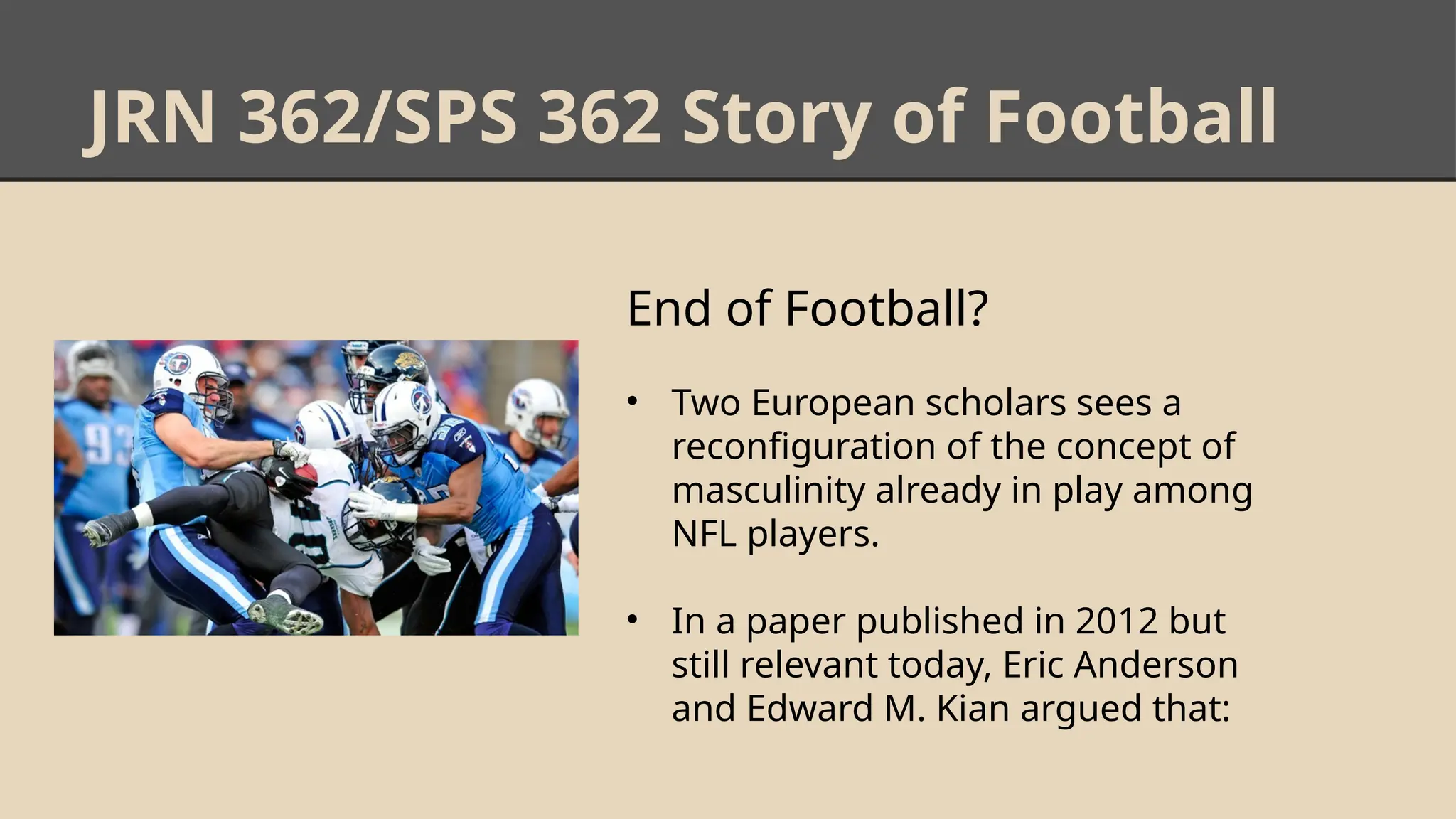
• Two European scholars sees a
reconfiguration of the concept of
masculinity already in play among
NFL players.
• In a paper published in 2012 but
still relevant today, Eric Anderson
and Edward M. Kian argued that:
JRN 362/SPS 362 Story of Football
End of Football?
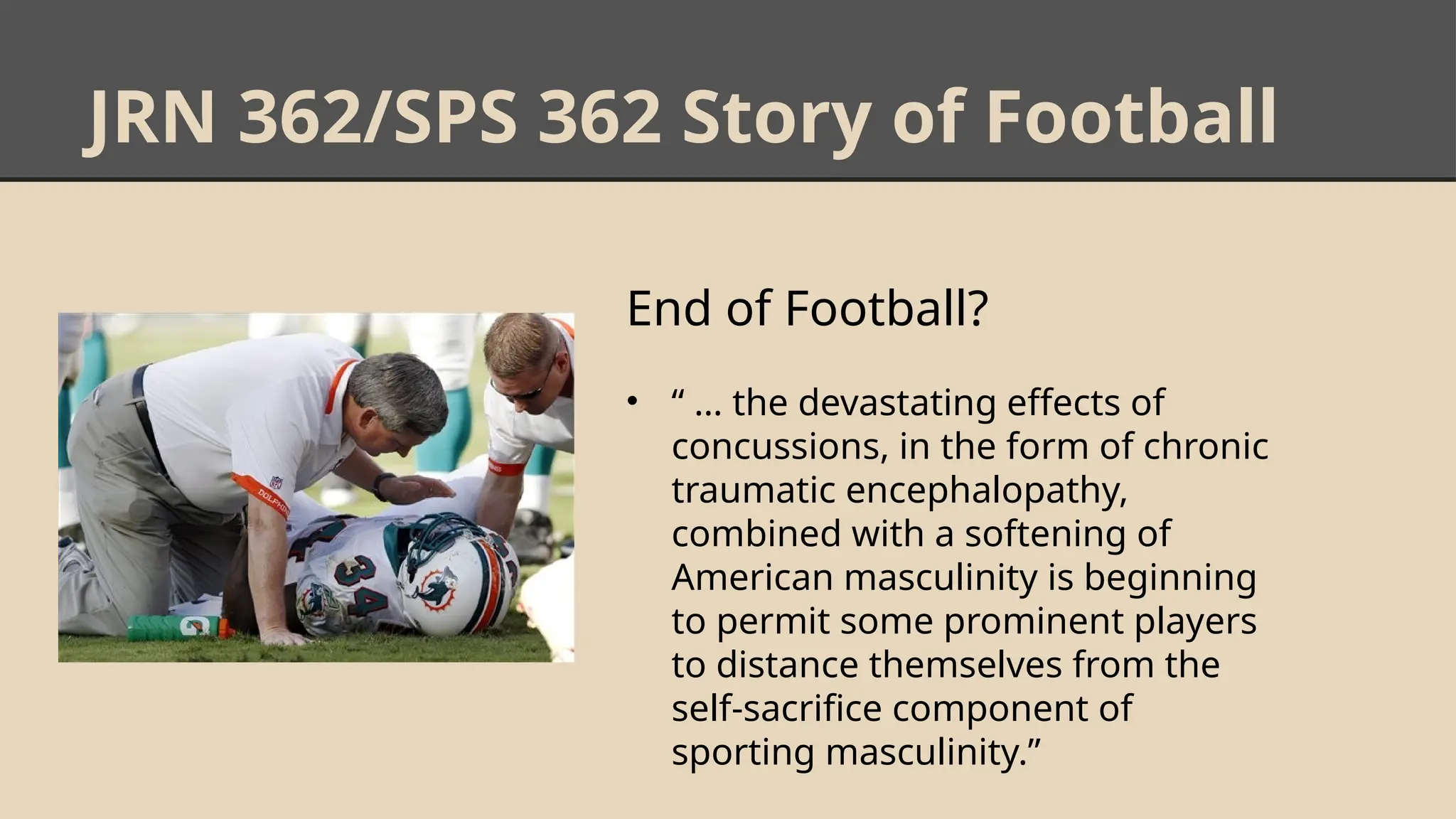
• “ … the devastating effects of
concussions, in the form of chronic
traumatic encephalopathy,
combined with a softening of
American masculinity is beginning
to permit some prominent players
to distance themselves from the
self-sacrifice component of
sporting masculinity.”
JRN 362/SPS 362 Story of Football
End of Football?
• Are players beginning to question
why they play and endure the pain,
which for most lasts a lifetime?
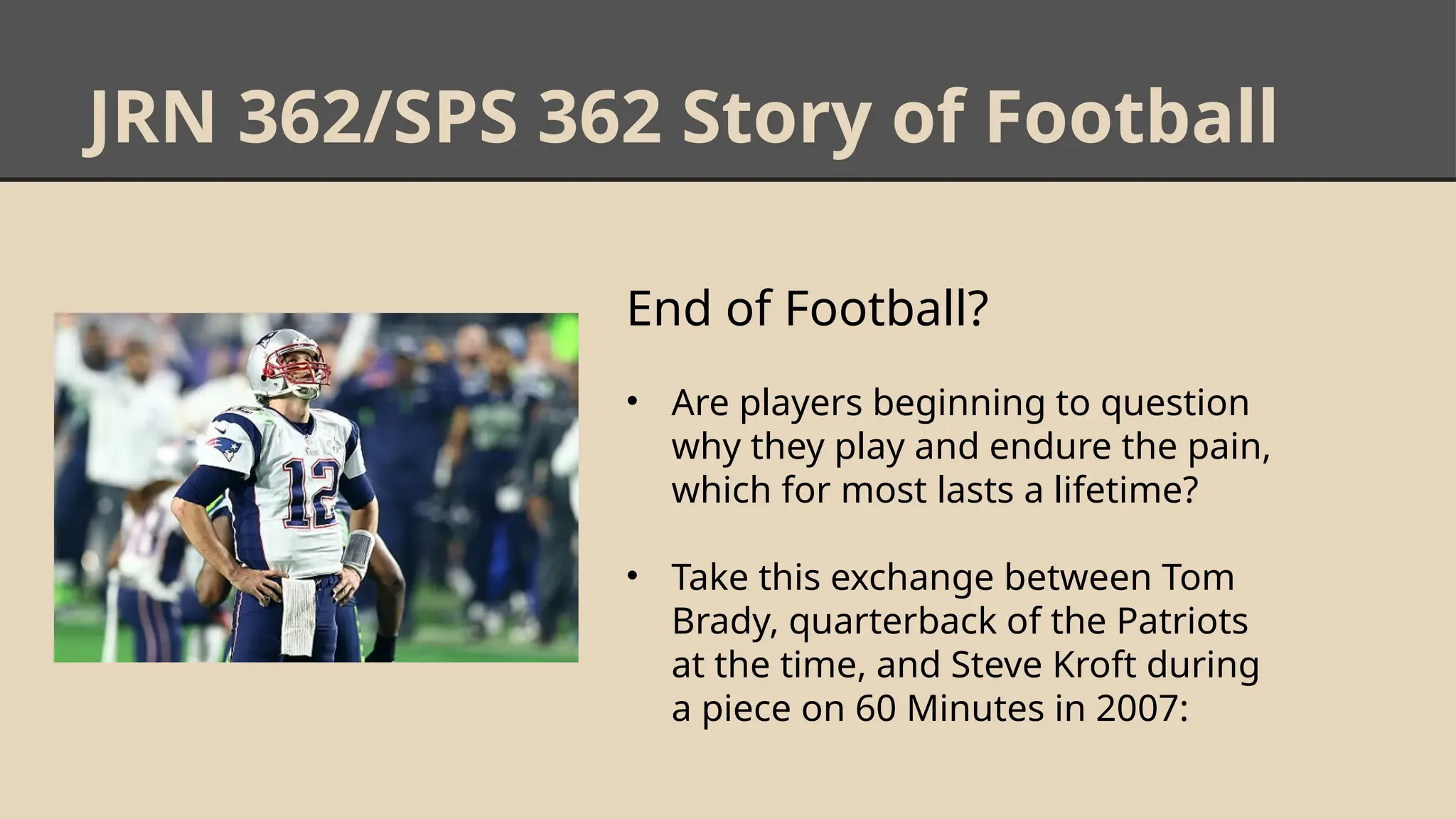
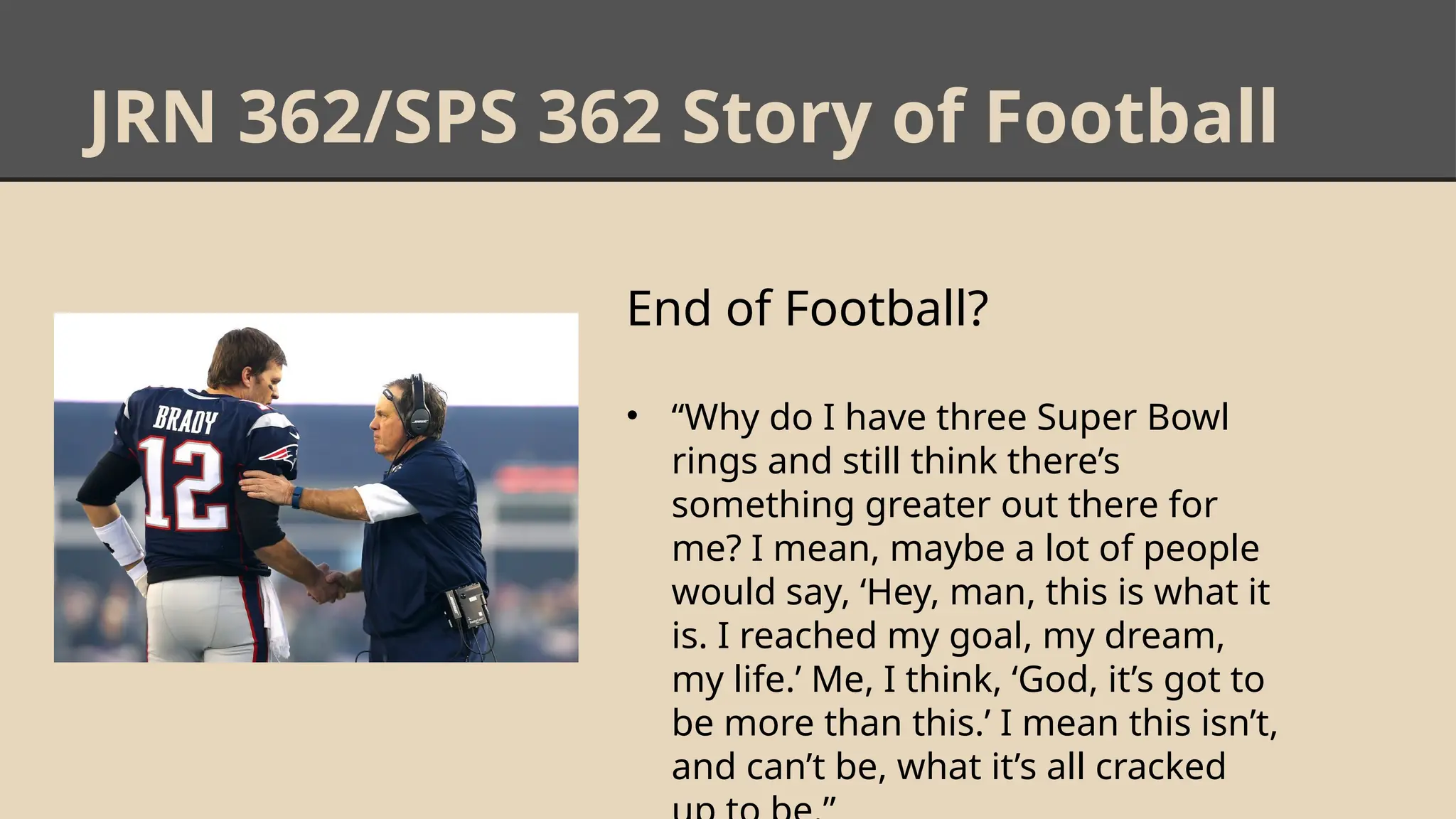
• Take this exchange between Tom
Brady, quarterback of the Patriots
at the time, and Steve Kroft during
a piece on 60 Minutes in 2007:
JRN 362/SPS 362 Story of Football
End of Football?
• “Why do I have three Super Bowl
rings and still think there’s
something greater out there for
me? I mean, maybe a lot of people
would say, ‘Hey, man, this is what it
is. I reached my goal, my dream,
my life.’ Me, I think, ‘God, it’s got to
be more than this.’ I mean this isn’t,
and can’t be, what it’s all cracked
JRN 362/SPS 362 Story of Football
End of Football?
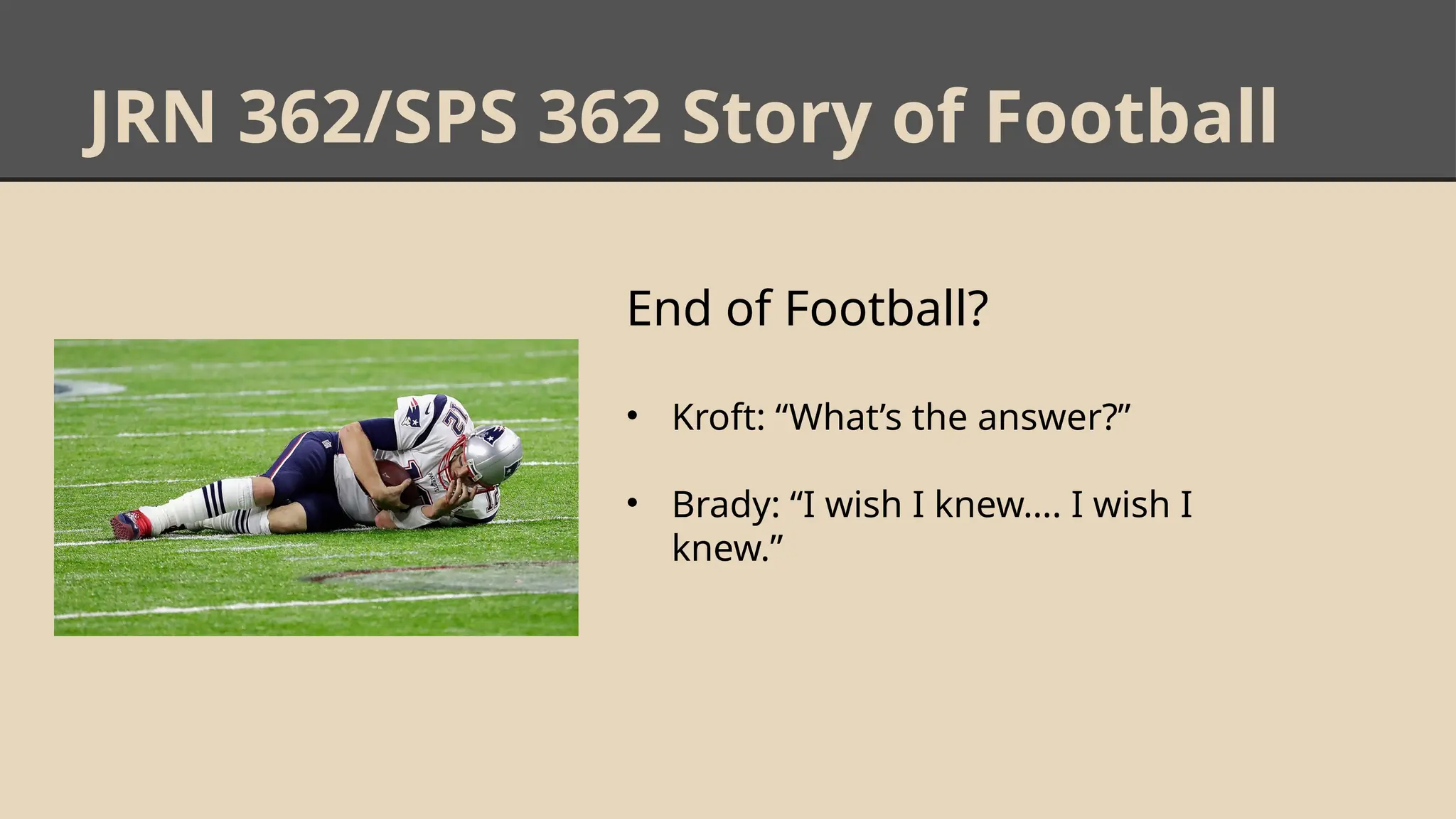
• Kroft: “What’s the answer?”
• Brady: “I wish I knew…. I wish I
knew.”
JRN 362/SPS 362 Story of Football
End of Football?
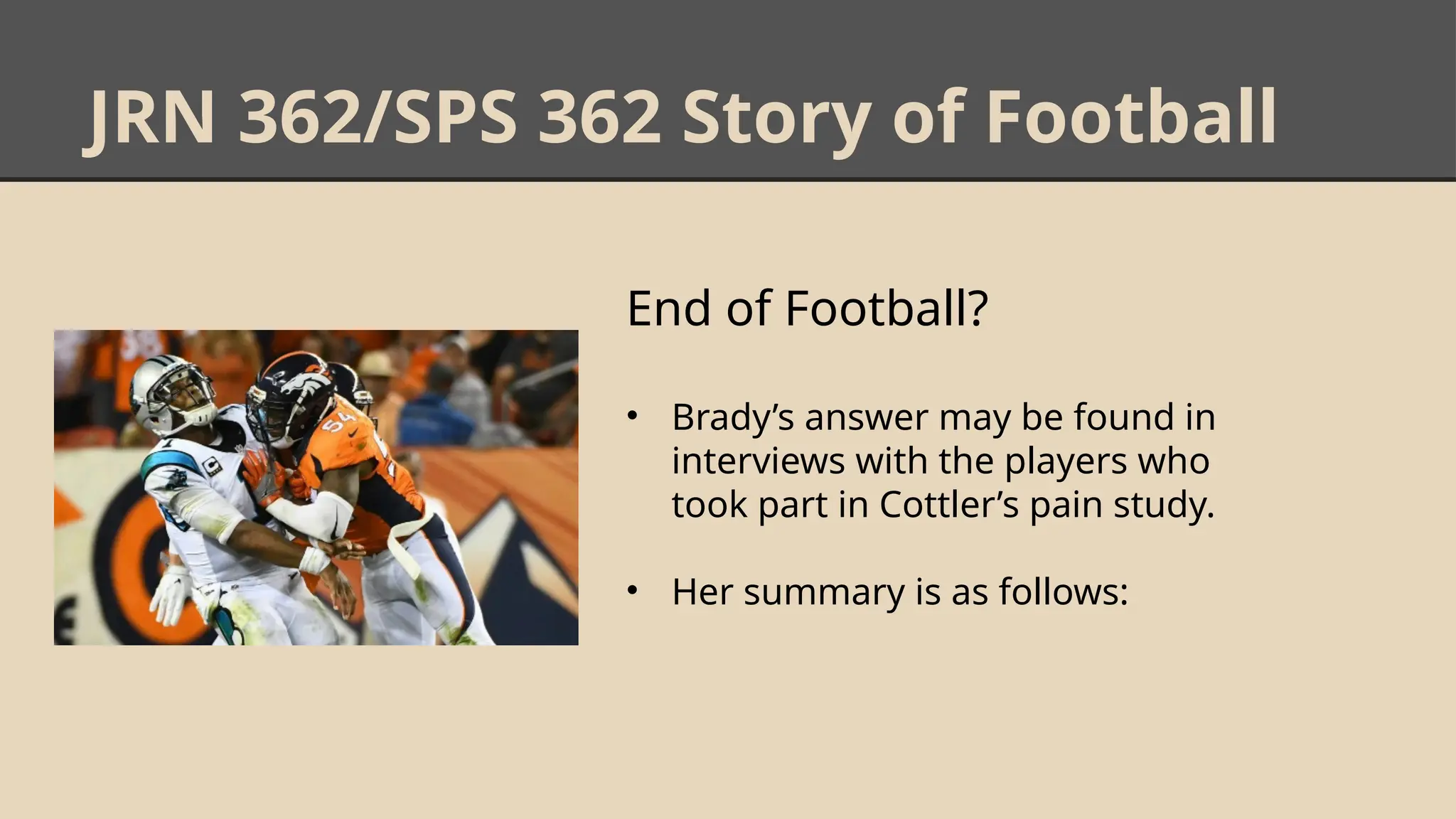
• Brady’s answer may be found in
interviews with the players who
took part in Cottler’s pain study.
• Her summary is as follows:
JRN 362/SPS 362 Story of Football
End of Football?
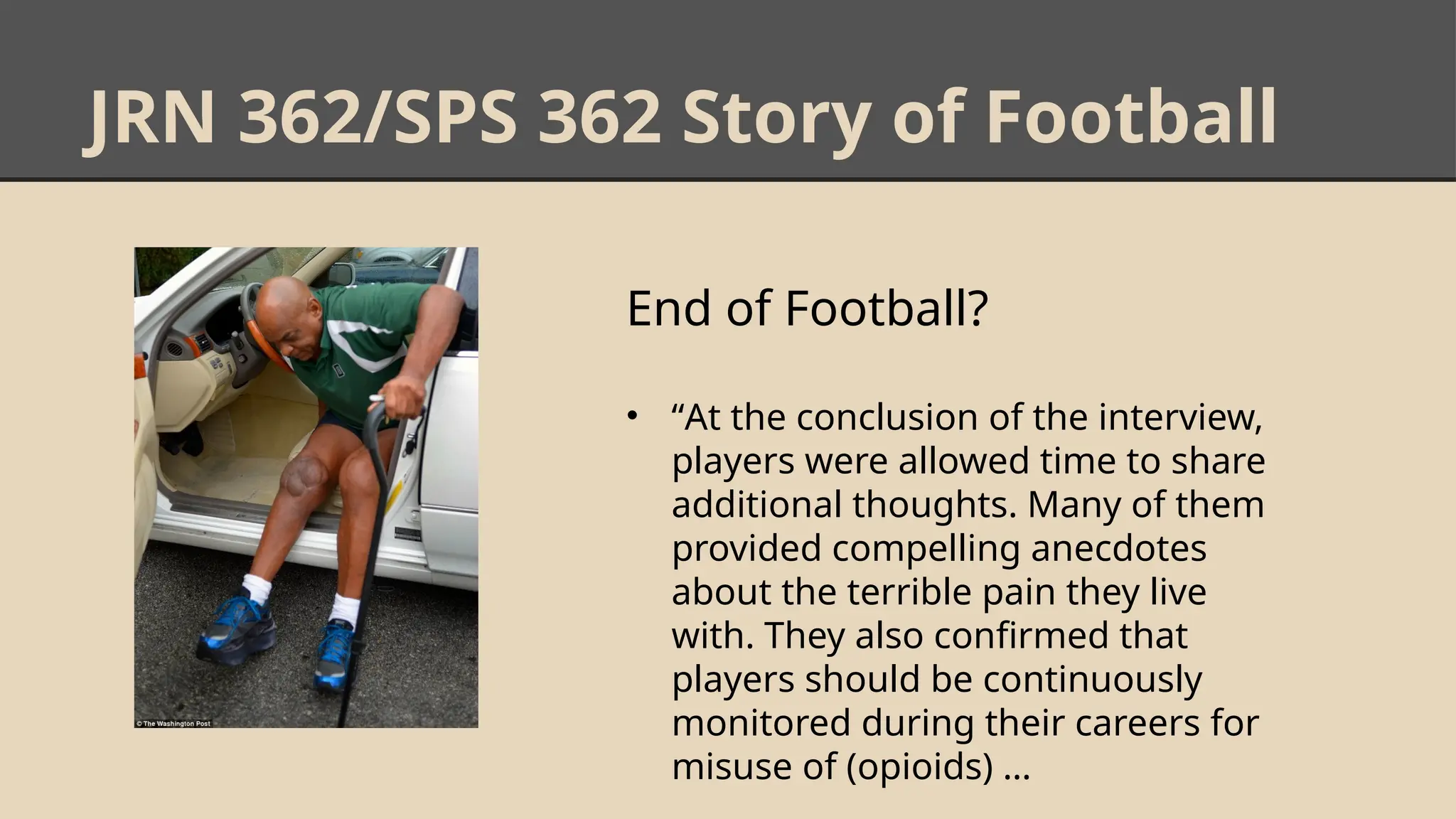
• “At the conclusion of the interview,
players were allowed time to share
additional thoughts. Many of them
provided compelling anecdotes
about the terrible pain they live
with. They also confirmed that
players should be continuously
monitored during their careers for
misuse of (opioids) …
JRN 362/SPS 362 Story of Football
End of Football?
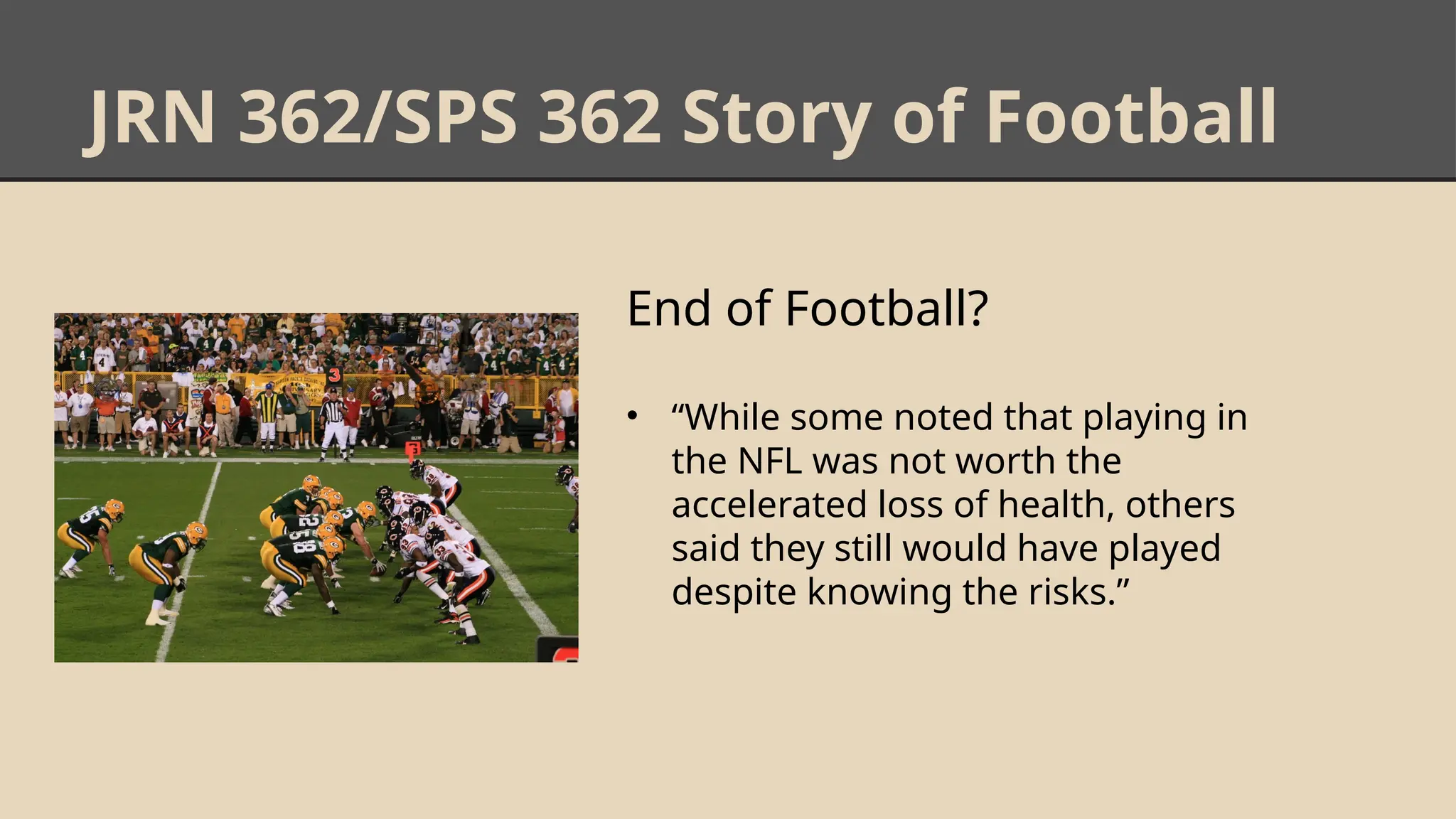
• “While some noted that playing in
the NFL was not worth the
accelerated loss of health, others
said they still would have played
despite knowing the risks.”
JRN 362/SPS 362 Story of Football
End of Football?
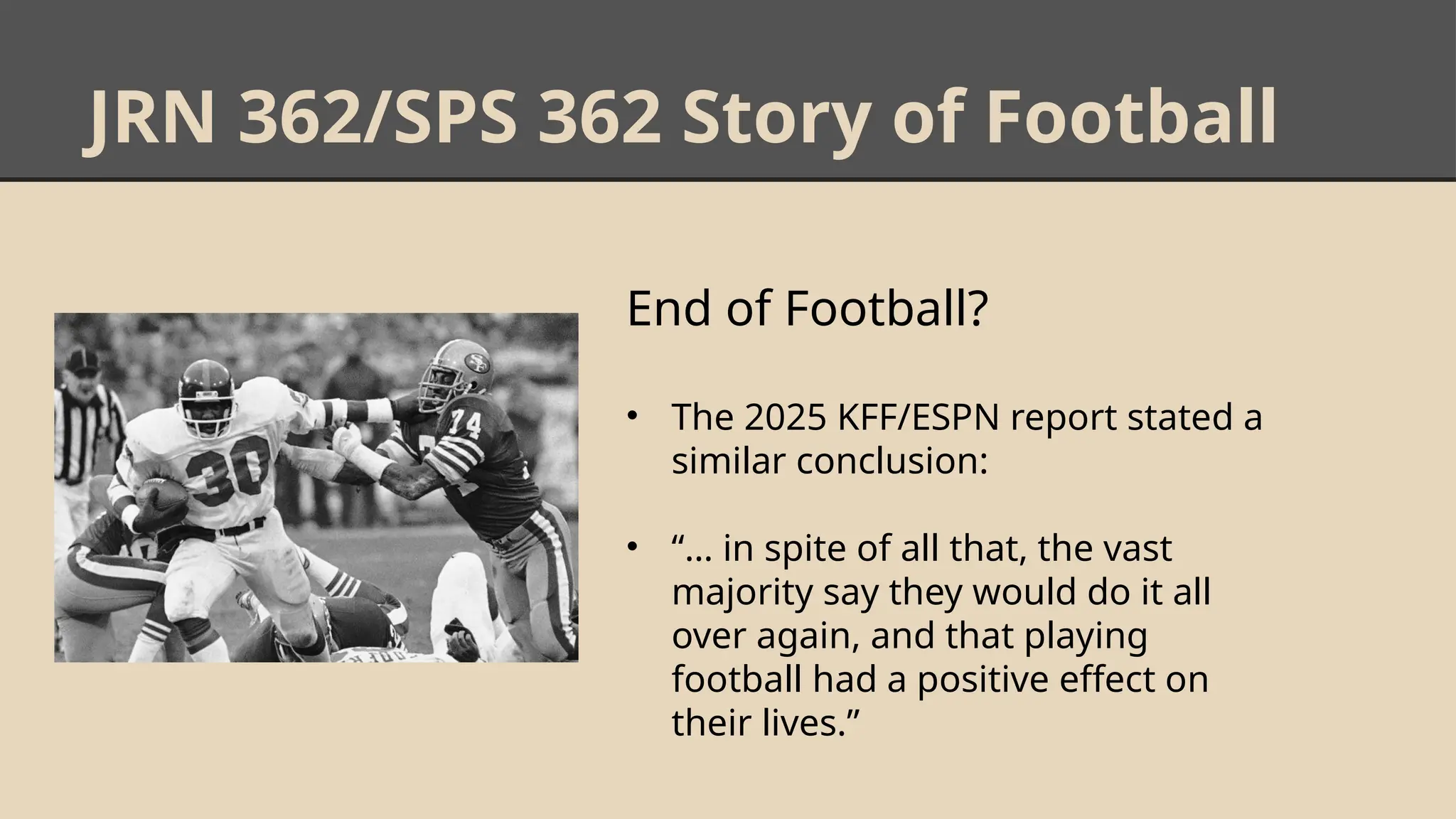
• The 2025 KFF/ESPN report stated a
similar conclusion:
• “… in spite of all that, the vast
majority say they would do it all
over again, and that playing
football had a positive effect on
their lives.”
JRN 362/SPS 362 Story of Football
End of Football?
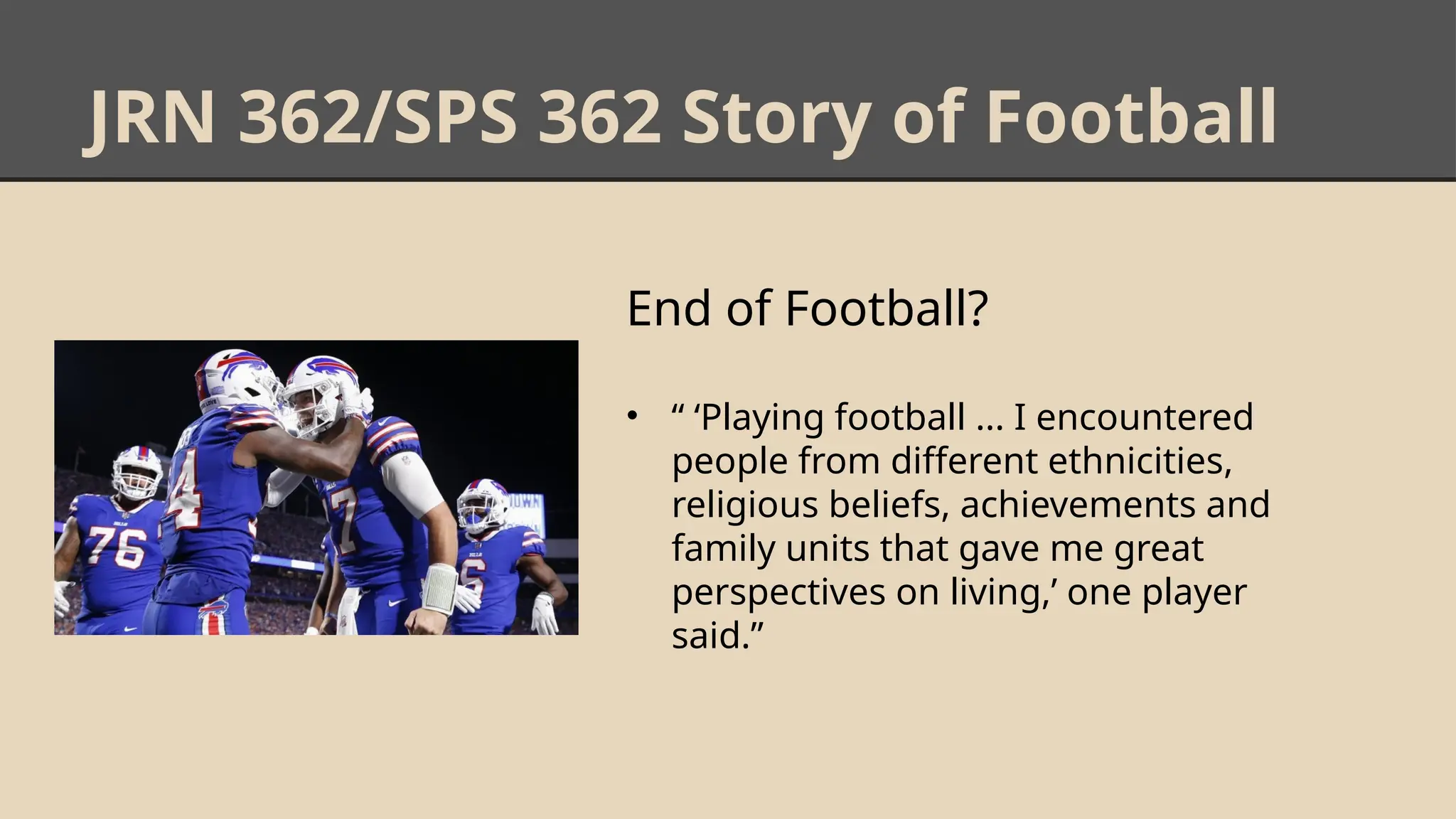
• “ ‘Playing football ... I encountered
people from different ethnicities,
religious beliefs, achievements and
family units that gave me great
perspectives on living,’ one player
said.”
JRN 362/SPS 362 Story of Football
End of Football?
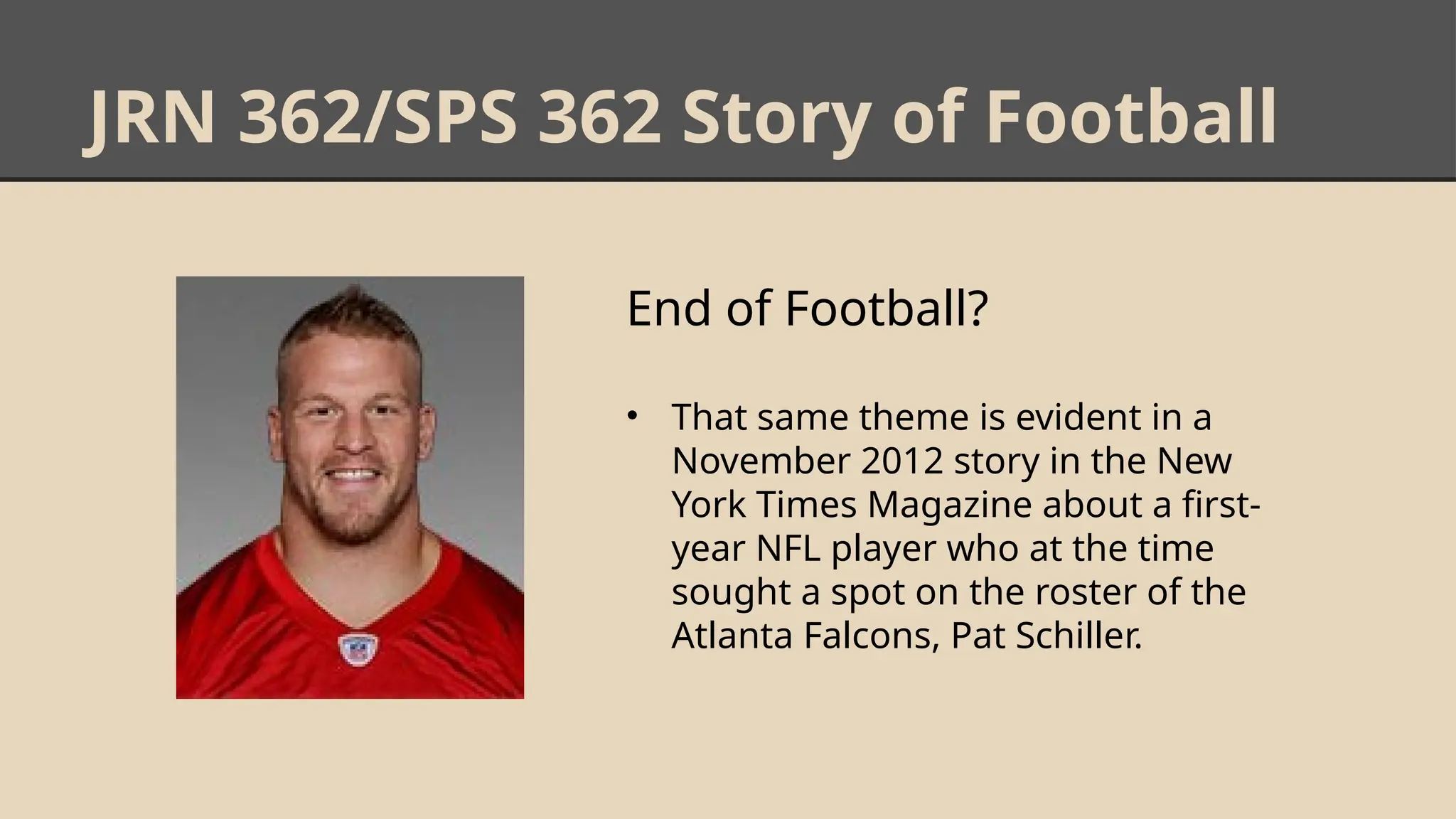
• That same theme is evident in a
November 2012 story in the New
York Times Magazine about a first-
year NFL player who at the time
sought a spot on the roster of the
Atlanta Falcons, Pat Schiller.
JRN 362/SPS 362 Story of Football
End of Football?
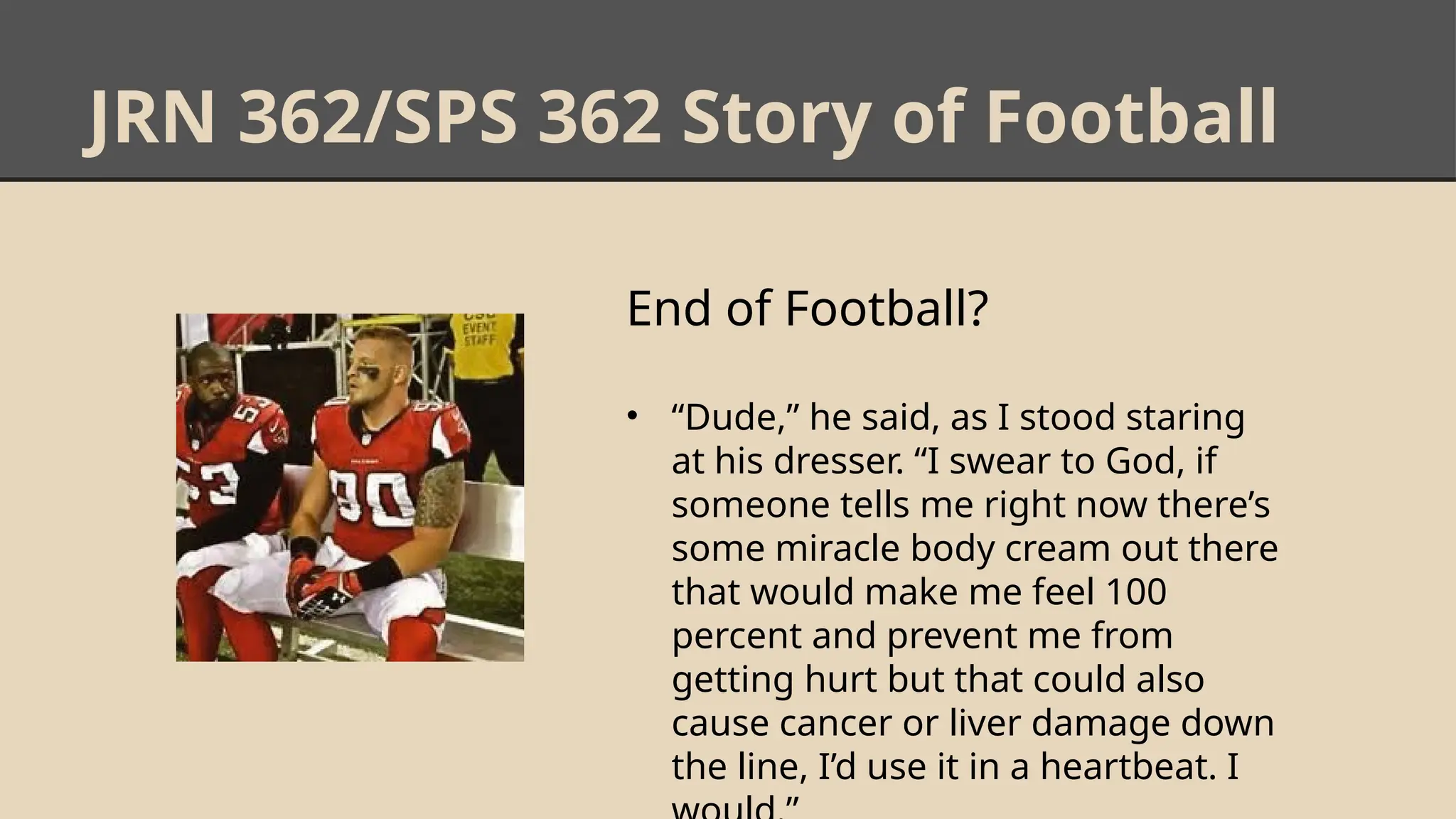
• “Dude,” he said, as I stood staring
at his dresser. “I swear to God, if
someone tells me right now there’s
some miracle body cream out there
that would make me feel 100
percent and prevent me from
getting hurt but that could also
cause cancer or liver damage down
the line, I’d use it in a heartbeat. I
JRN 362/SPS 362 Story of Football
End of Football?
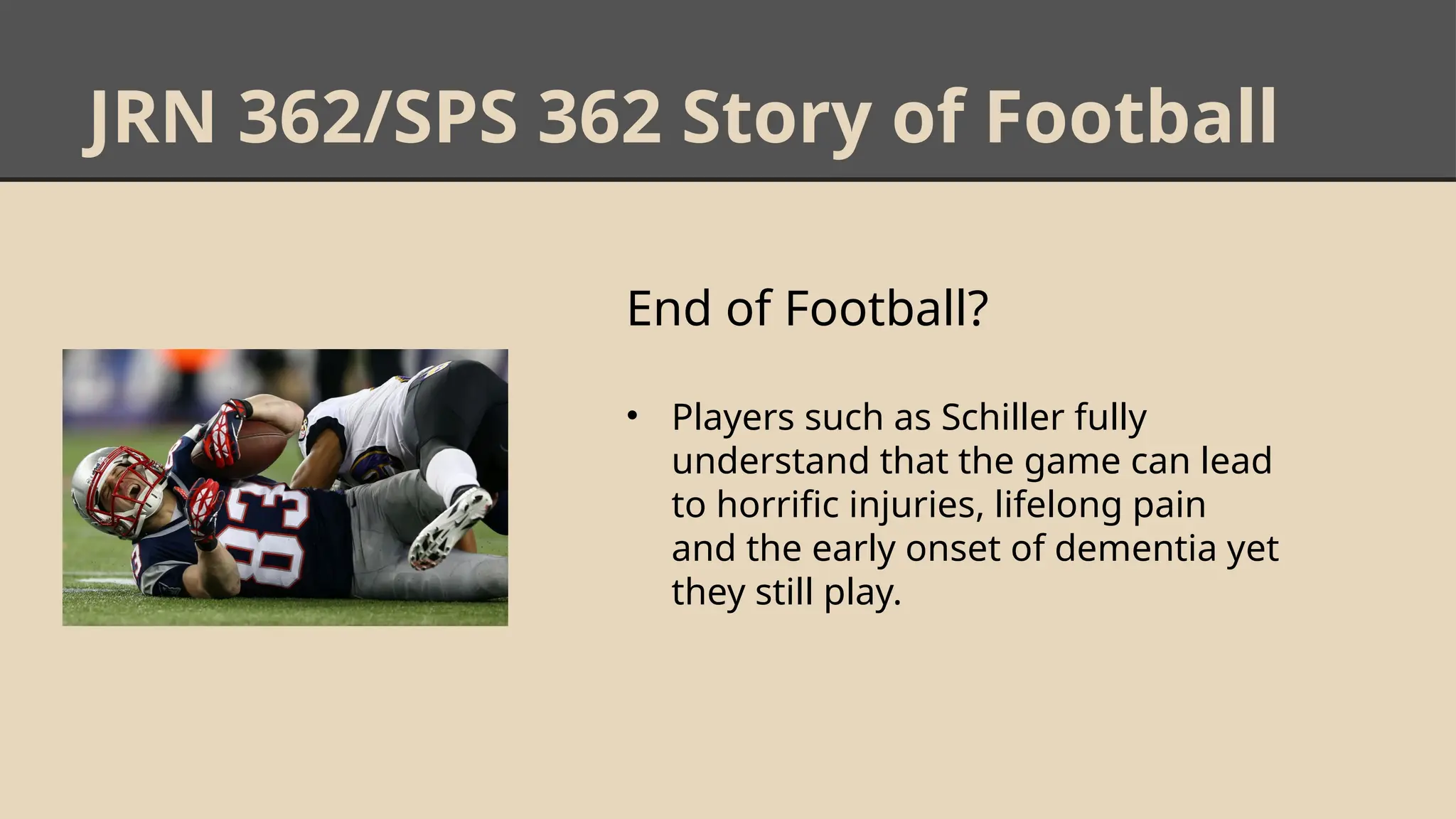
• Players such as Schiller fully
understand that the game can lead
to horrific injuries, lifelong pain
and the early onset of dementia yet
they still play.
JRN 362/SPS 362 Story of Football
End of Football?
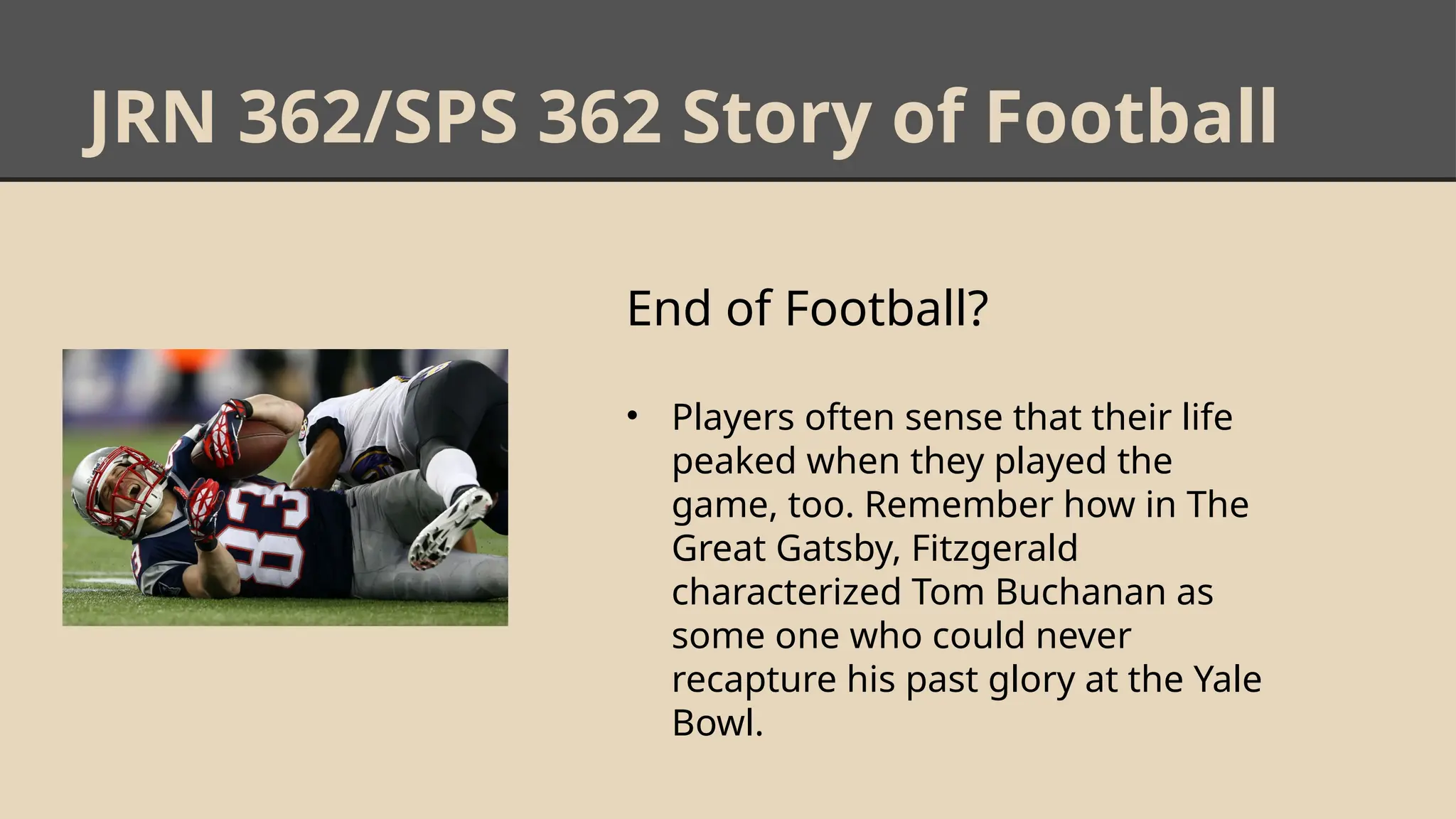
• Players often sense that their life
peaked when they played the
game, too. Remember how in The
Great Gatsby, Fitzgerald
characterized Tom Buchanan as
some one who could never
recapture his past glory at the Yale
Bowl.
JRN 362/SPS 362 Story of Football
End of Football?
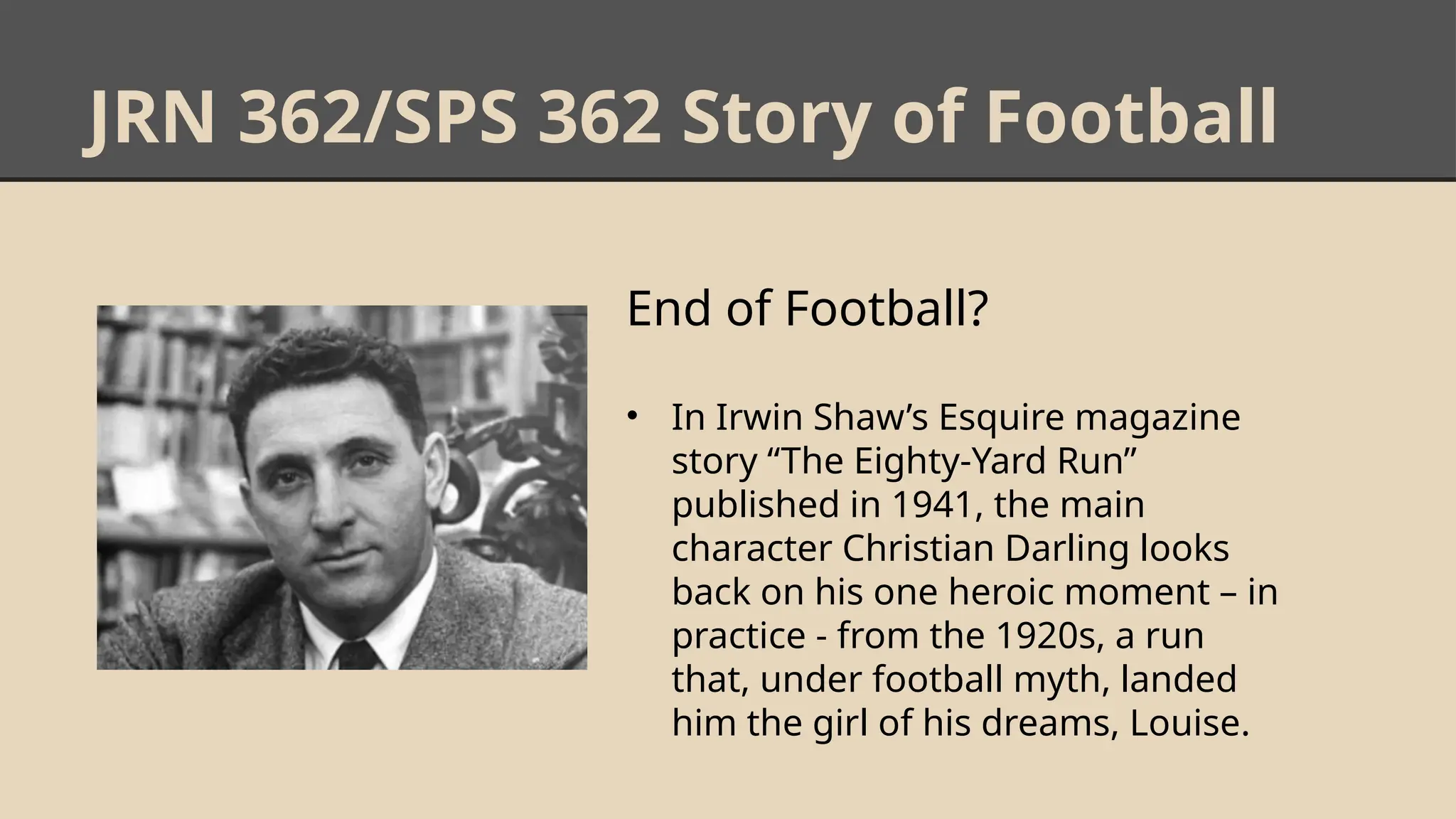
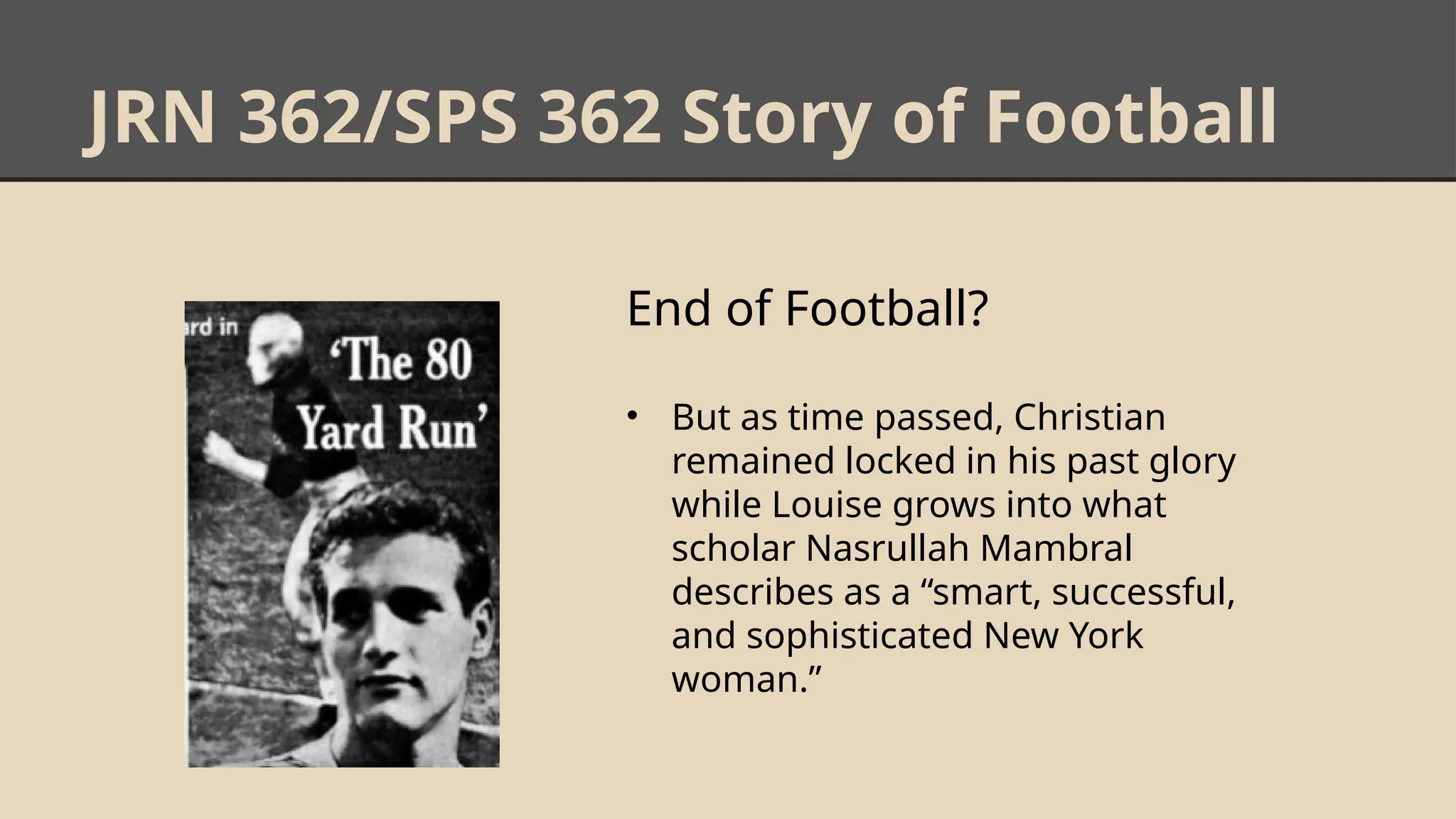
• In Irwin Shaw’s Esquire magazine
story “The Eighty-Yard Run”
published in 1941, the main
character Christian Darling looks
back on his one heroic moment – in
practice - from the 1920s, a run
that, under football myth, landed
him the girl of his dreams, Louise.
JRN 362/SPS 362 Story of Football
End of Football?
• But as time passed, Christian
remained locked in his past glory
while Louise grows into what
scholar Nasrullah Mambral
describes as a “smart, successful,
and sophisticated New York
woman.”
JRN 362/SPS 362 Story of Football
End of Football?
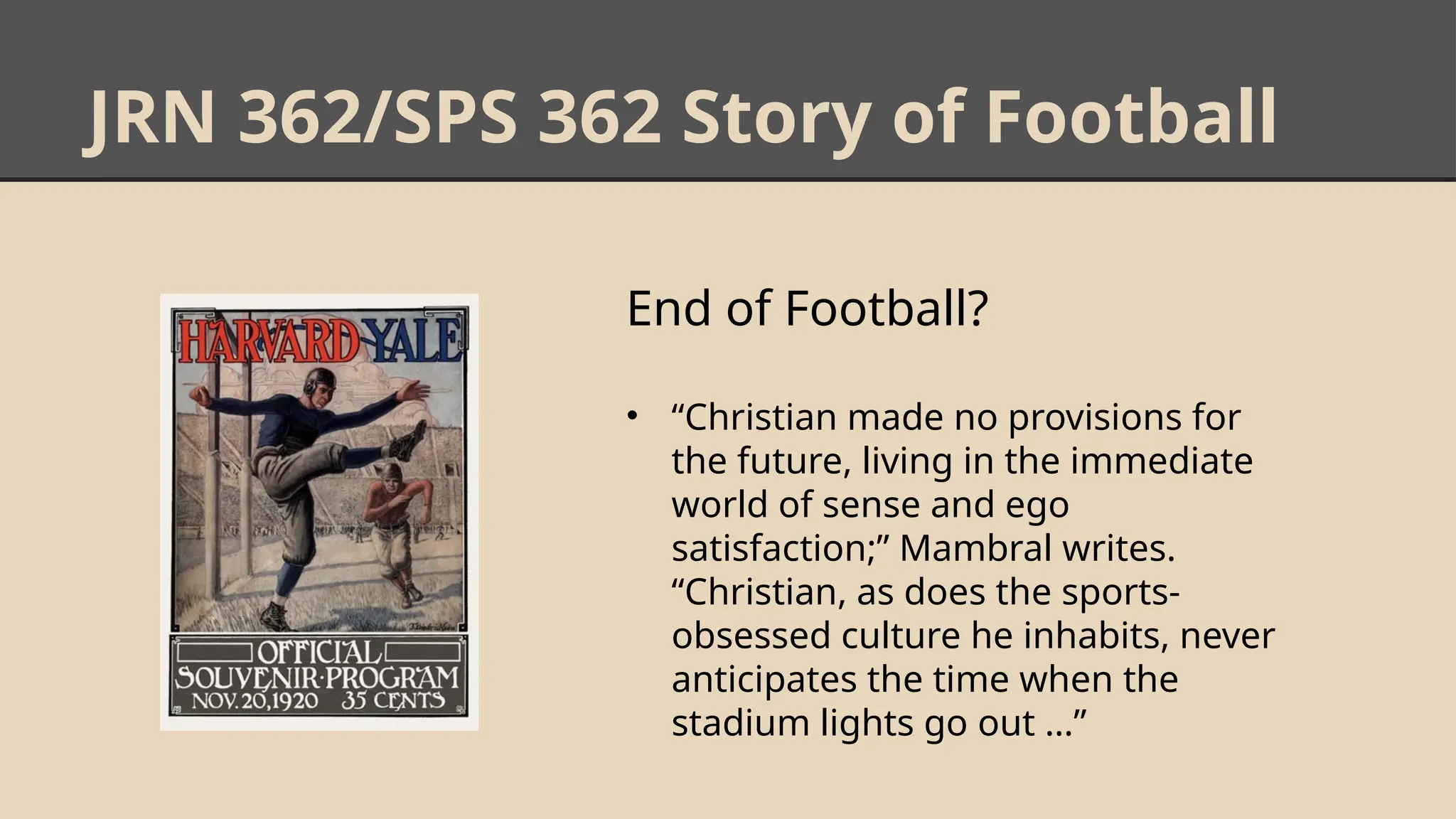
• “Christian made no provisions for
the future, living in the immediate
world of sense and ego
satisfaction;” Mambral writes.
“Christian, as does the sports-
obsessed culture he inhabits, never
anticipates the time when the
stadium lights go out …”
JRN 362/SPS 362 Story of Football
End of Football?
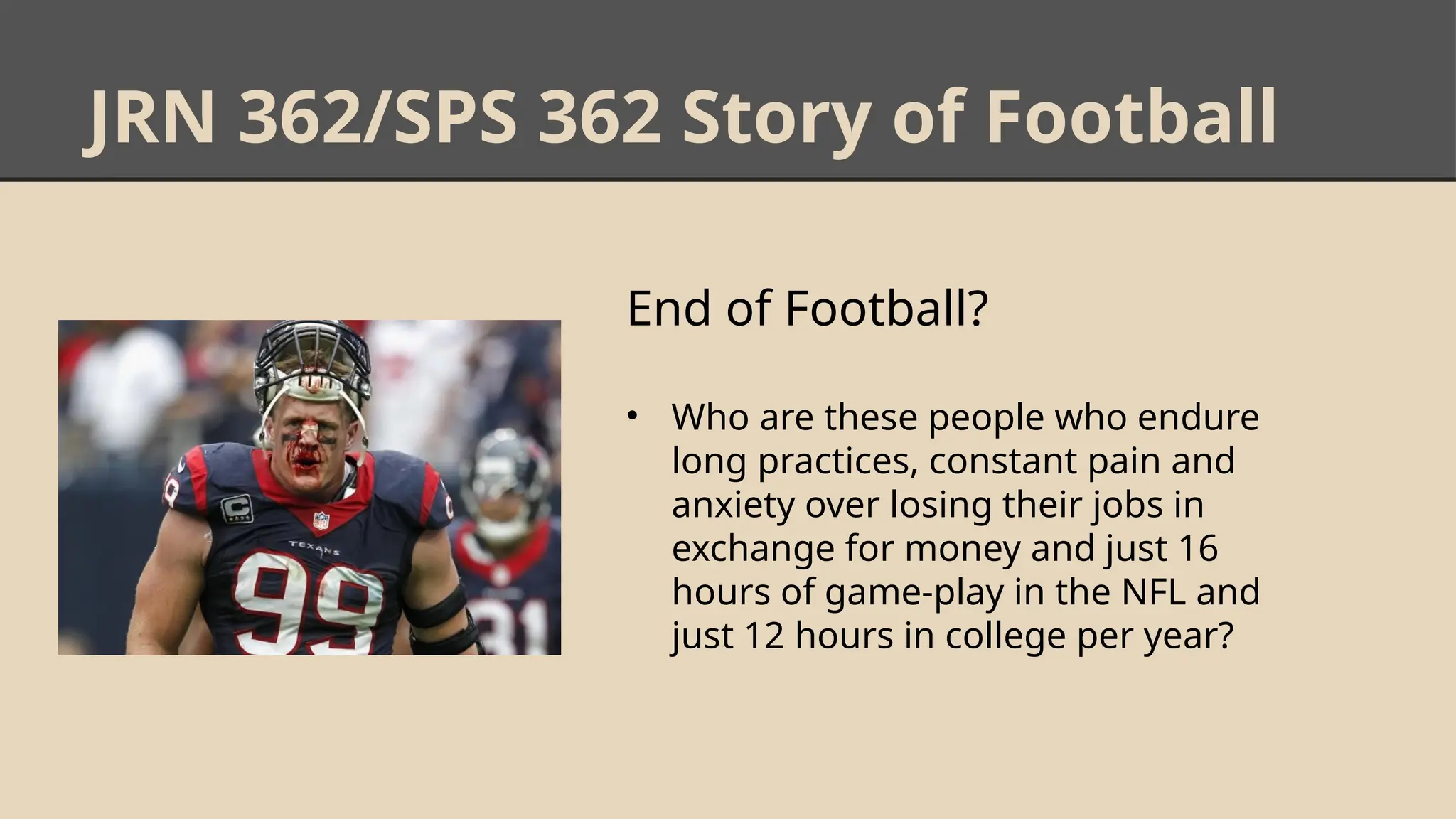
• Who are these people who endure
long practices, constant pain and
anxiety over losing their jobs in
exchange for money and just 16
hours of game-play in the NFL and
just 12 hours in college per year?
JRN 362/SPS 362 Story of Football
End of Football?
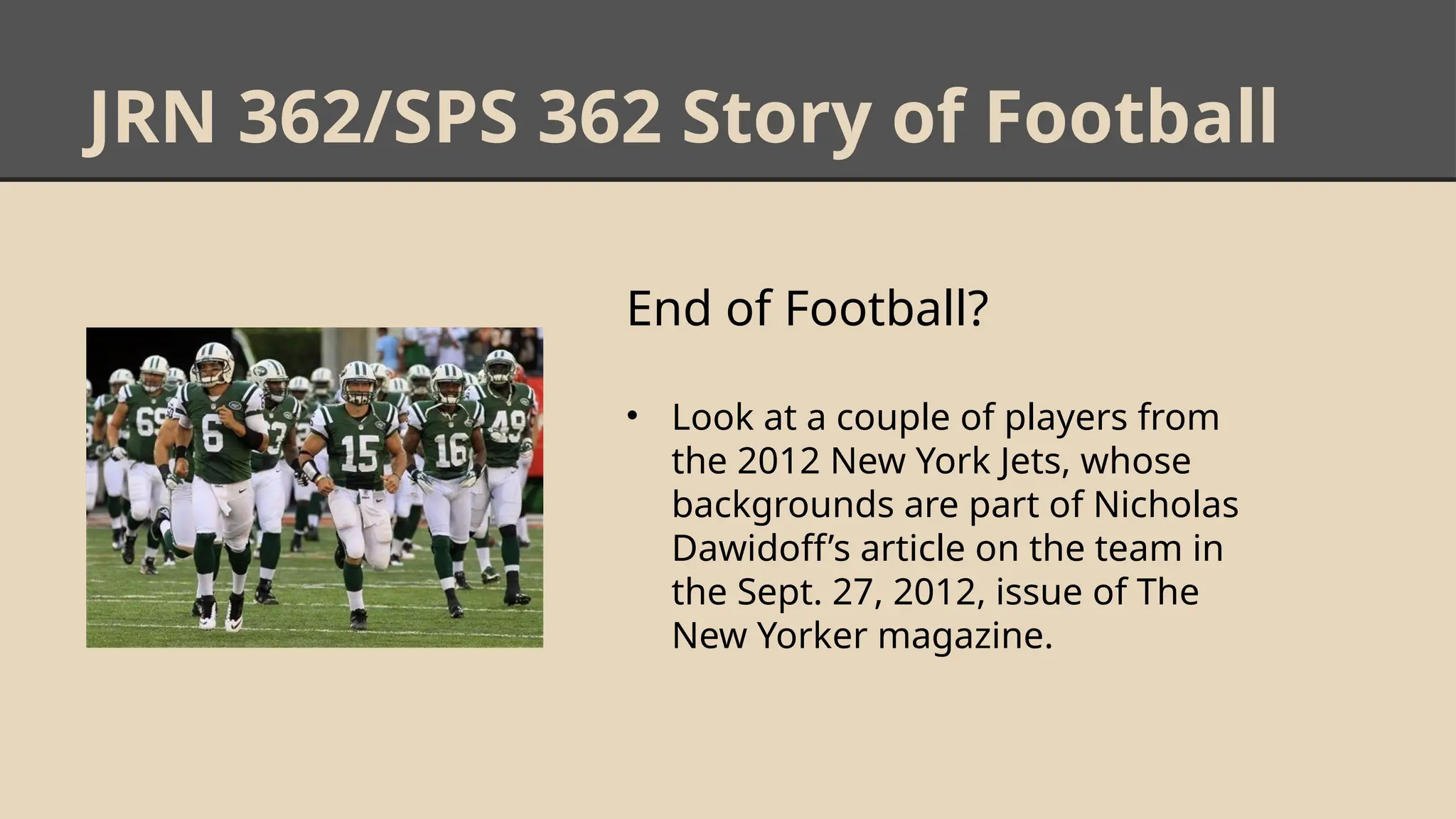
• Look at a couple of players from
the 2012 New York Jets, whose
backgrounds are part of Nicholas
Dawidoff’s article on the team in
the Sept. 27, 2012, issue of The
New Yorker magazine.
JRN 362/SPS 362 Story of Football
End of Football?
• “The Jets, like every team, have
many players who experienced
severe neglect as children – a
mother who died in childbirth, a
father who died of an overdose or
of AIDS.
JRN 362/SPS 362 Story of Football
End of Football?
• “There are Jets players who have
seen murders up close, who have
been shot at or stabbed, who were
abused by relatives, who have been
jailed.
JRN 362/SPS 362 Story of Football
End of Football?
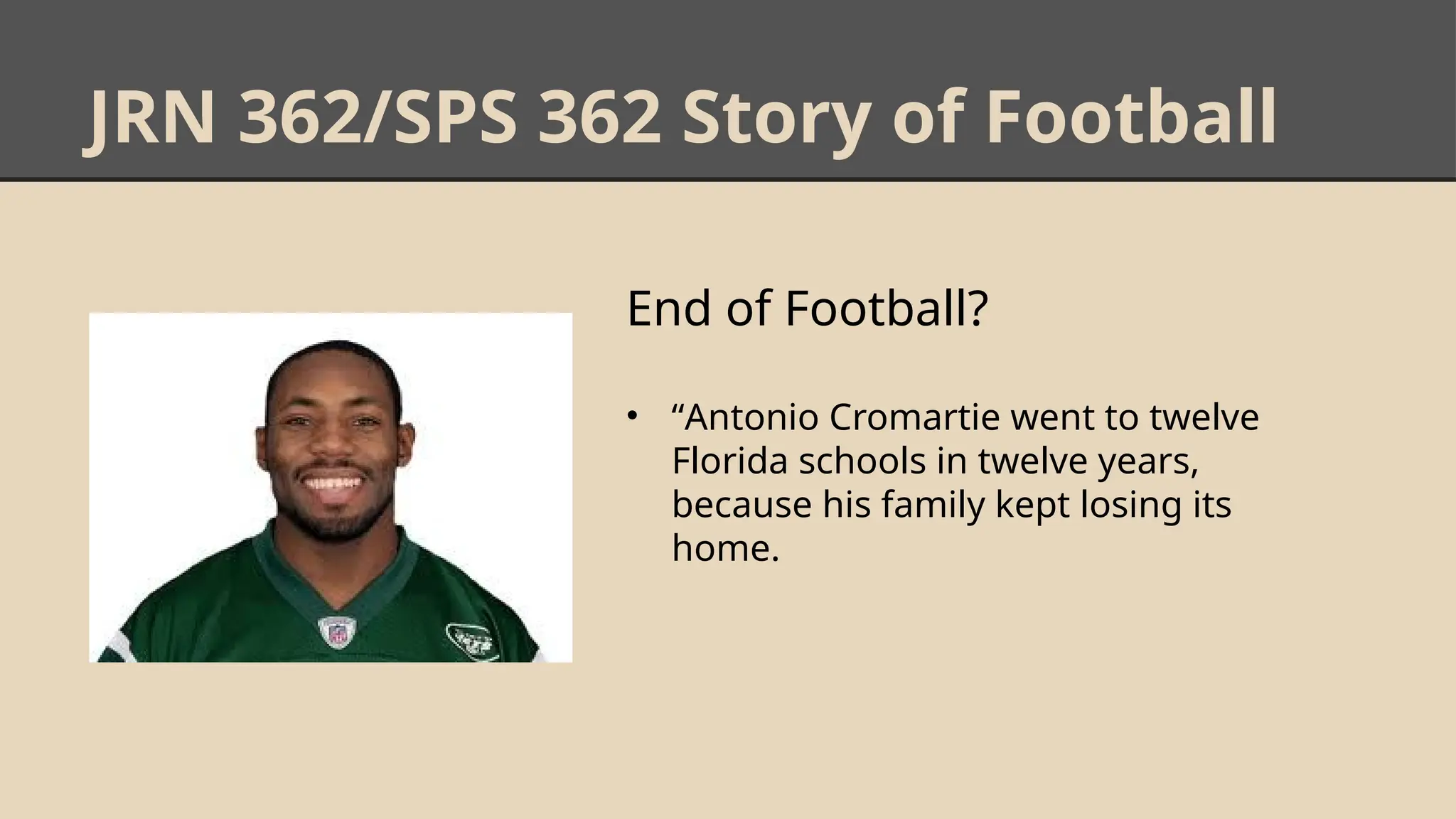
• “Antonio Cromartie went to twelve
Florida schools in twelve years,
because his family kept losing its
home.
JRN 362/SPS 362 Story of Football
End of Football?
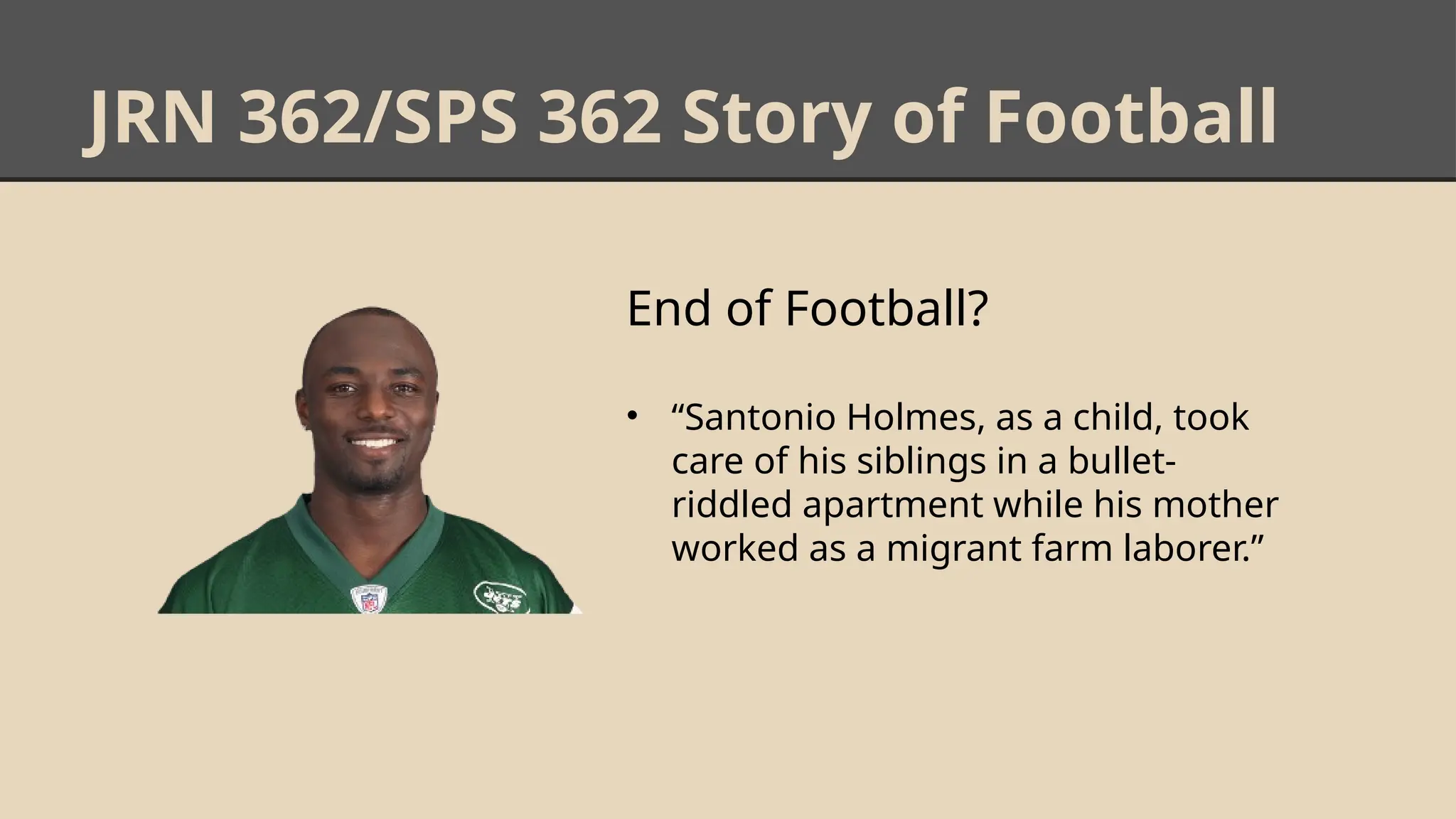
• “Santonio Holmes, as a child, took
care of his siblings in a bullet-
riddled apartment while his mother
worked as a migrant farm laborer.”
JRN 362/SPS 362 Story of Football
End of Football?
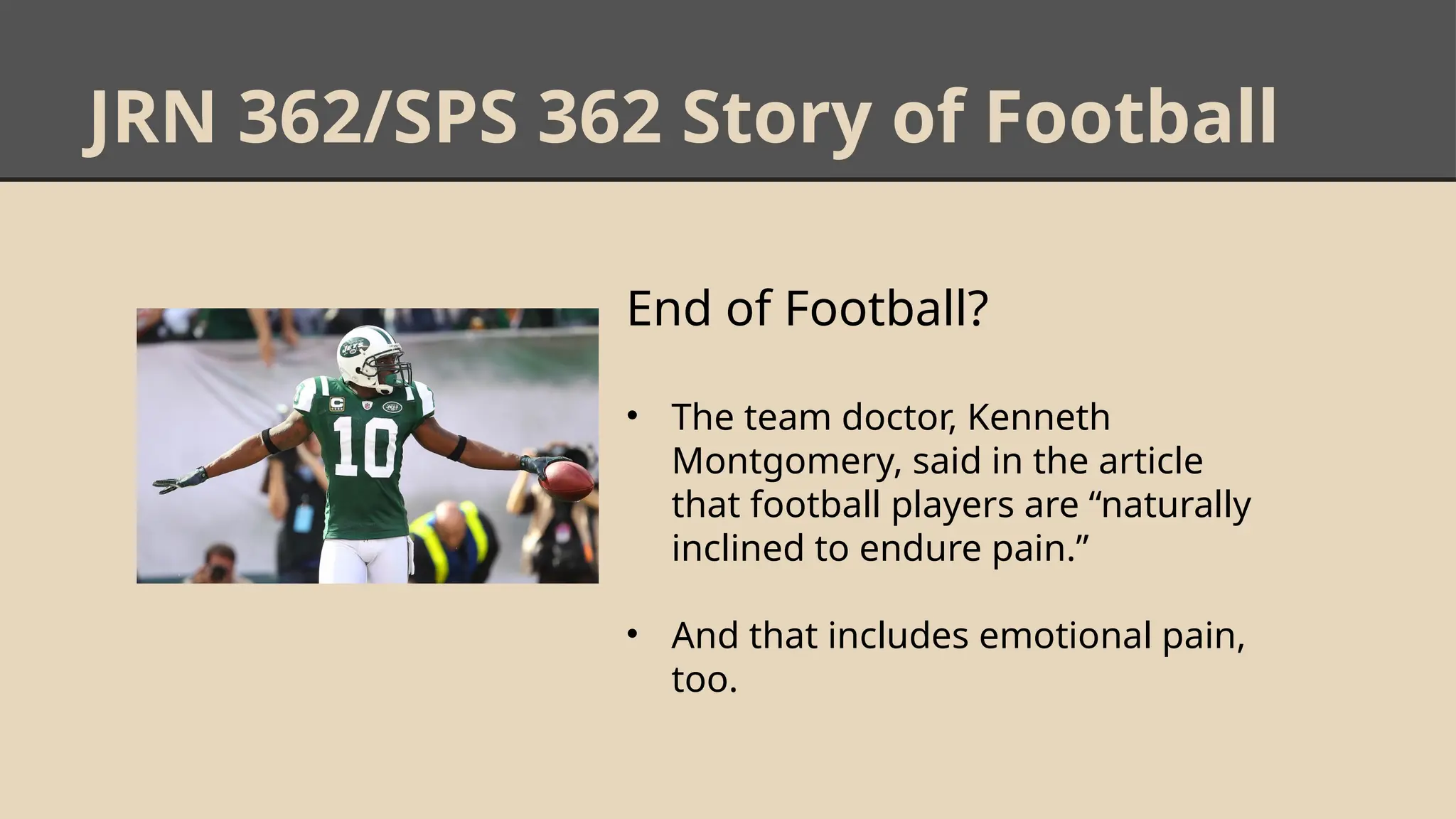
• The team doctor, Kenneth
Montgomery, said in the article
that football players are “naturally
inclined to endure pain.”
• And that includes emotional pain,
too.
JRN 362/SPS 362 Story of Football
End of Football?
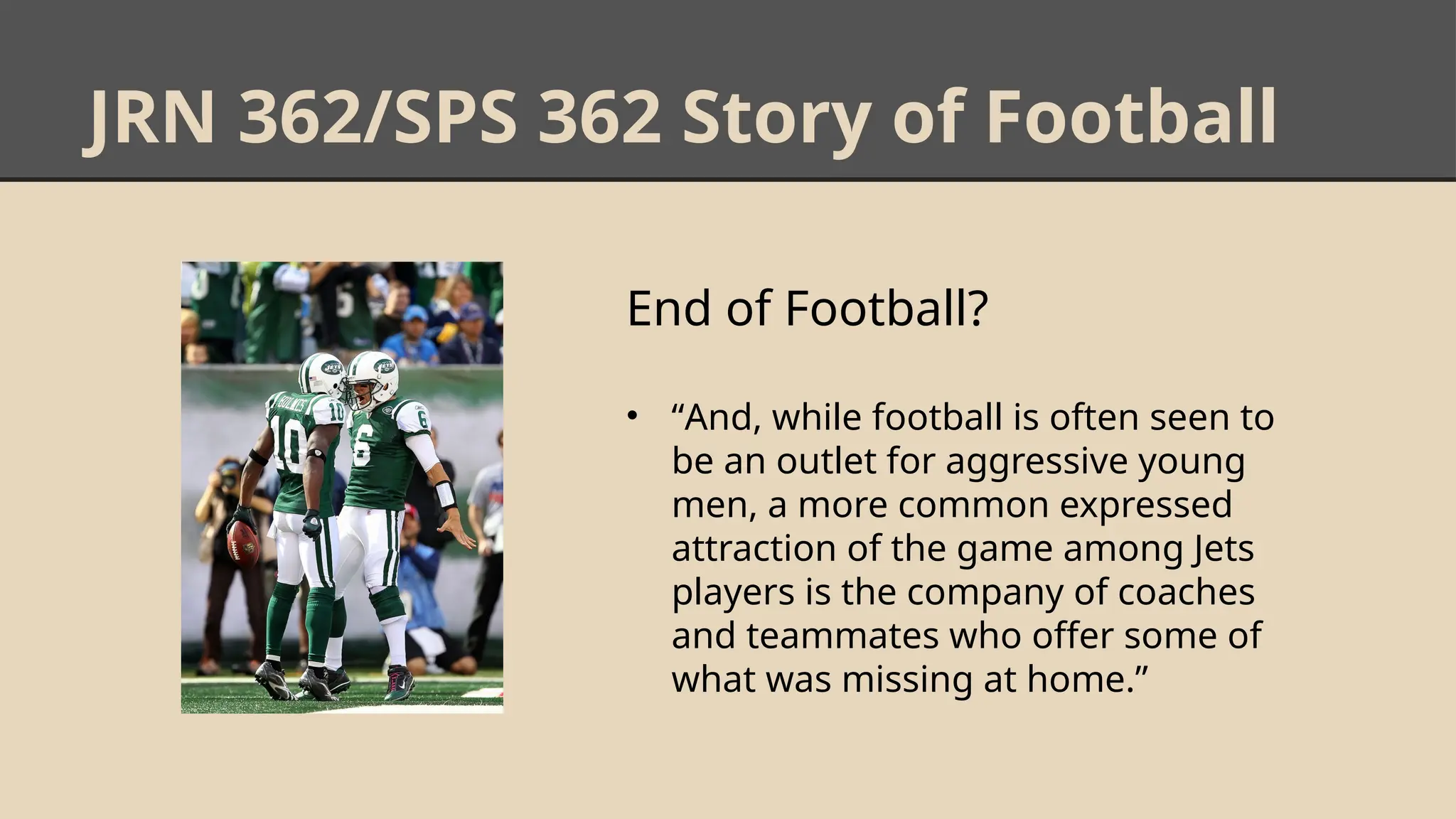
• “And, while football is often seen to
be an outlet for aggressive young
men, a more common expressed
attraction of the game among Jets
players is the company of coaches
and teammates who offer some of
what was missing at home.”
JRN 362/SPS 362 Story of Football
End of Football?
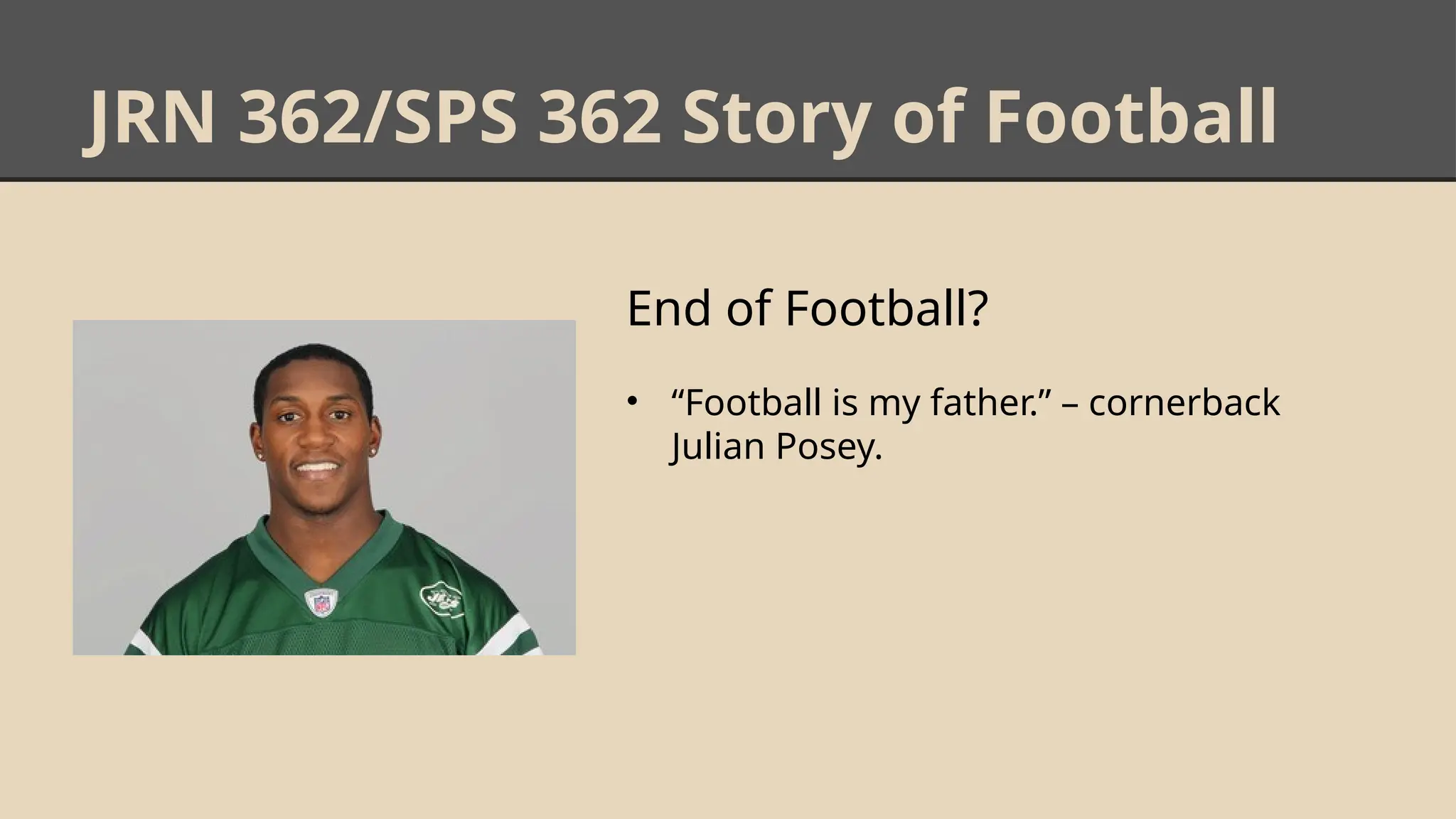
• “Football is my father.” – cornerback
Julian Posey.
JRN 362/SPS 362 Story of Football
End of Football?
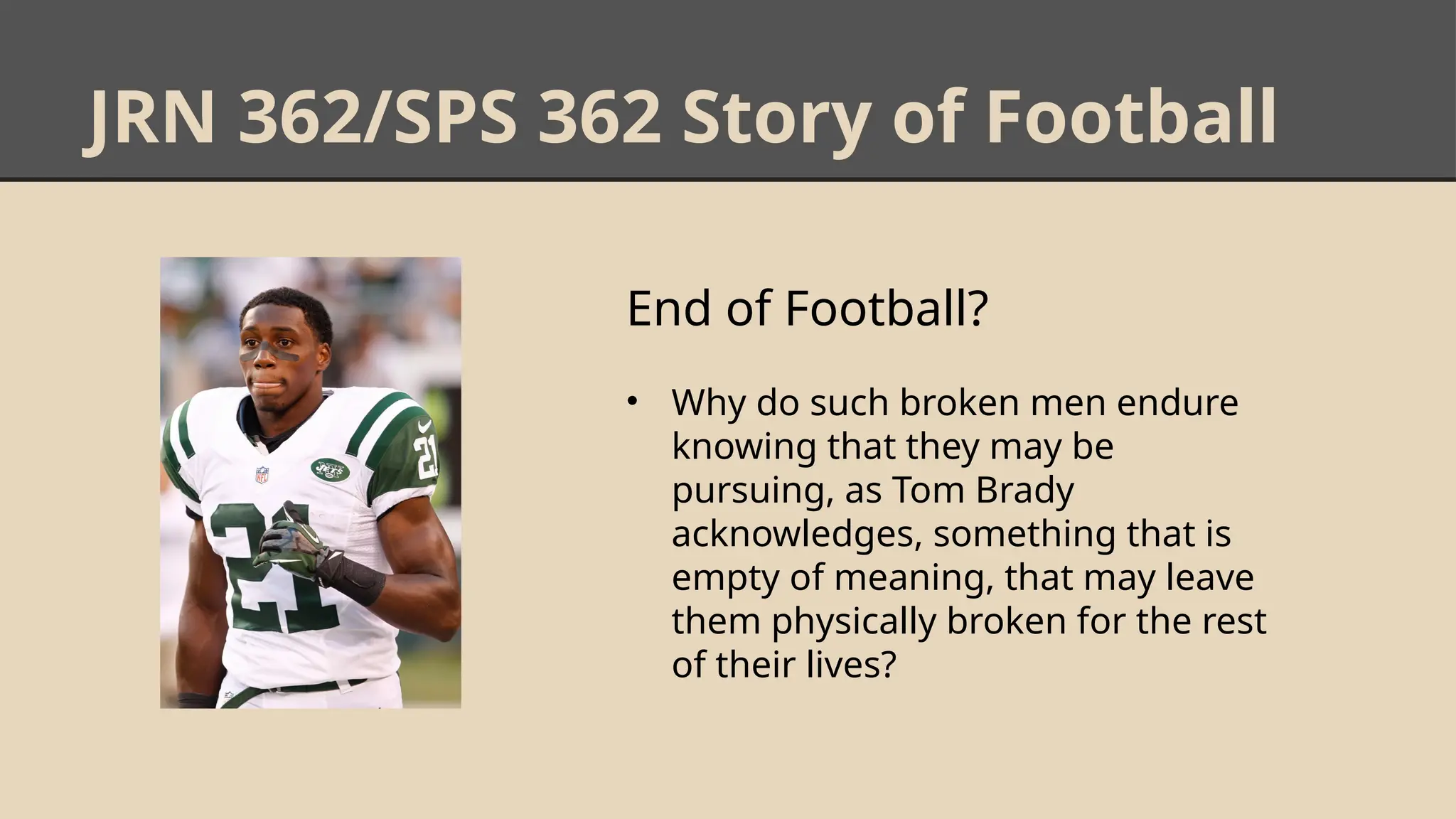
• Why do such broken men endure
knowing that they may be
pursuing, as Tom Brady
acknowledges, something that is
empty of meaning, that may leave
them physically broken for the rest
of their lives?
JRN 362/SPS 362 Story of Football
End of Football?
• Another writer for The New Yorker,
Malcolm Gladwell, searched for an
answer in an article that listed the
recent death roll of former players:
JRN 362/SPS 362 Story of Football
End of Football?
• “Mike Webster, the longtime
Pittsburgh Steeler and one of the
greatest players in N.F.L. history,
ended his life a recluse, sleeping on
the floor of the Pittsburgh Amtrak
station. Another former Pittsburgh
Steeler, Terry Long, drifted into
chaos and killed himself four years
ago by drinking antifreeze …
JRN 362/SPS 362 Story of Football
End of Football?
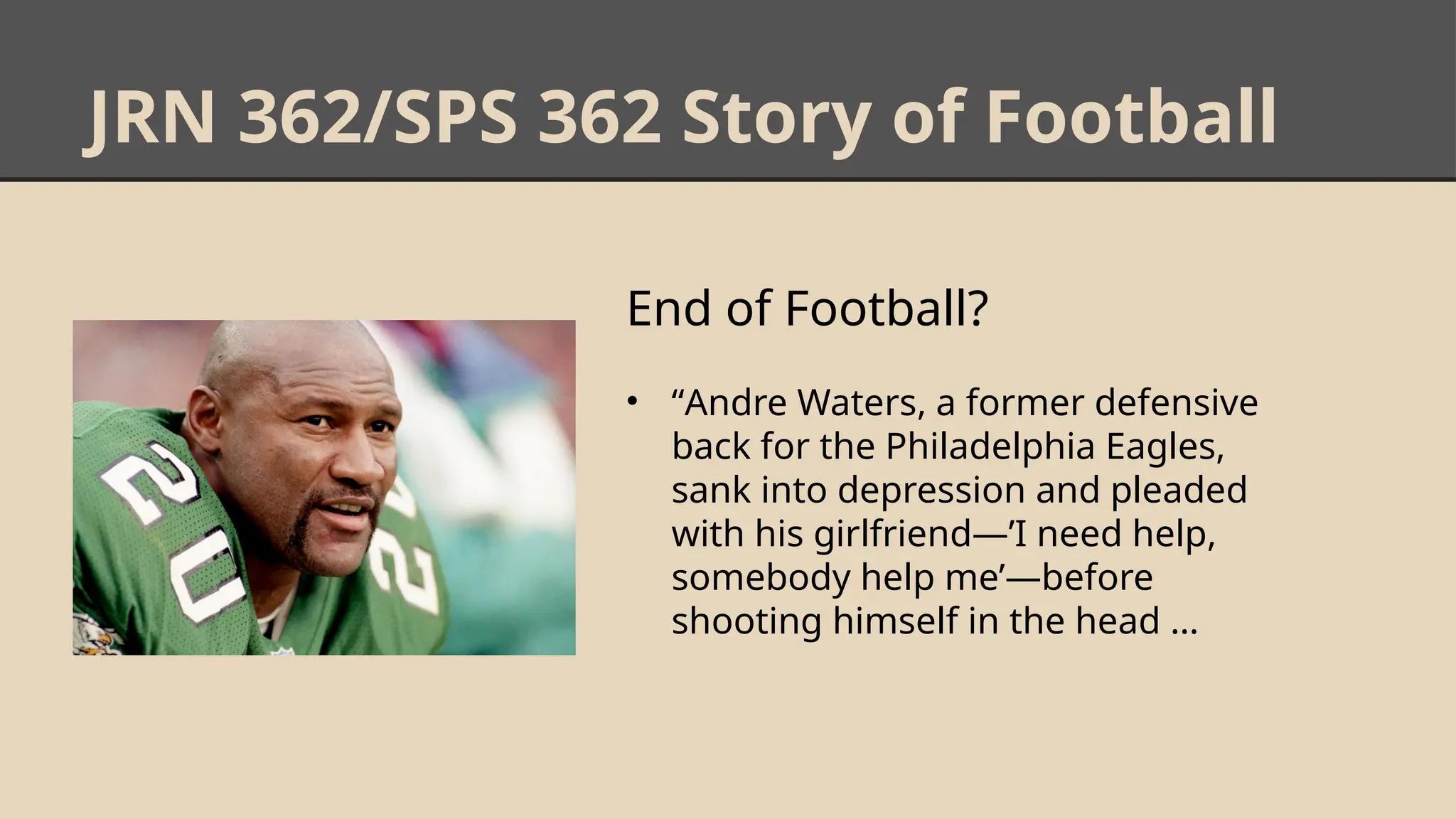
• “Andre Waters, a former defensive
back for the Philadelphia Eagles,
sank into depression and pleaded
with his girlfriend—’I need help,
somebody help me’—before
shooting himself in the head …
JRN 362/SPS 362 Story of Football
End of Football?
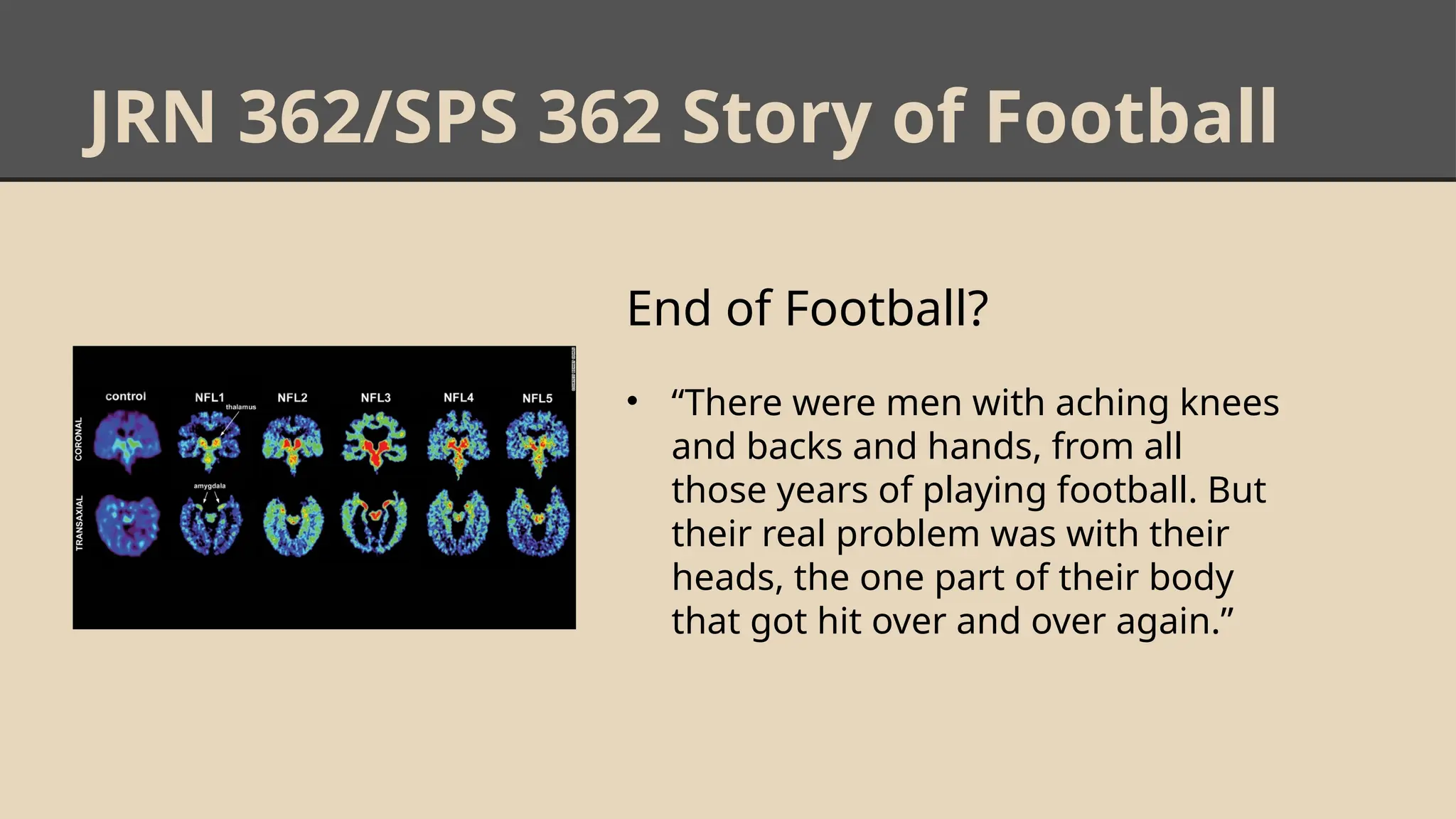
• “There were men with aching knees
and backs and hands, from all
those years of playing football. But
their real problem was with their
heads, the one part of their body
that got hit over and over again.”
JRN 362/SPS 362 Story of Football
End of Football?
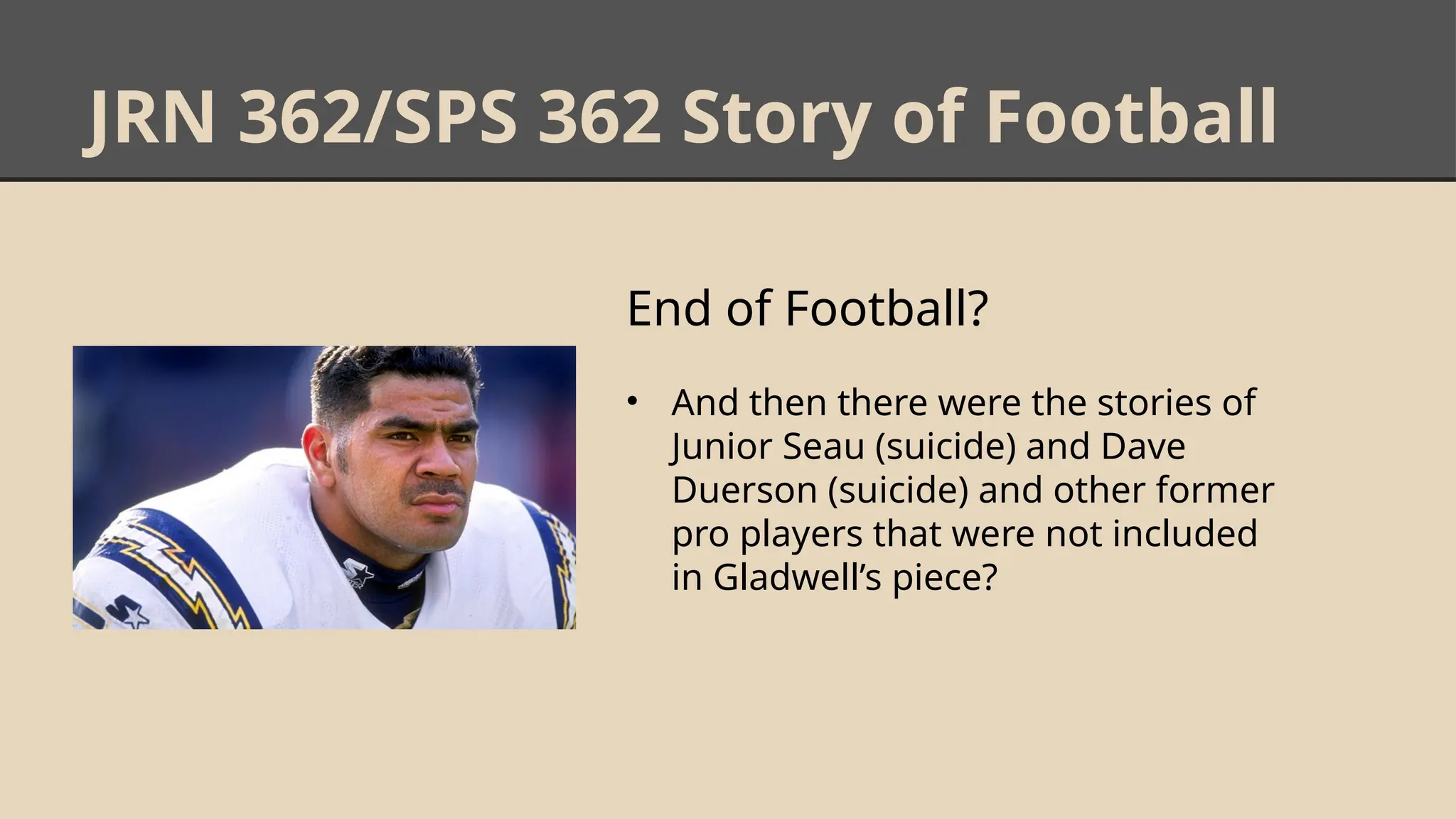
• And then there were the stories of
Junior Seau (suicide) and Dave
Duerson (suicide) and other former
pro players that were not included
in Gladwell’s piece?
JRN 362/SPS 362 Story of Football
End of Football?
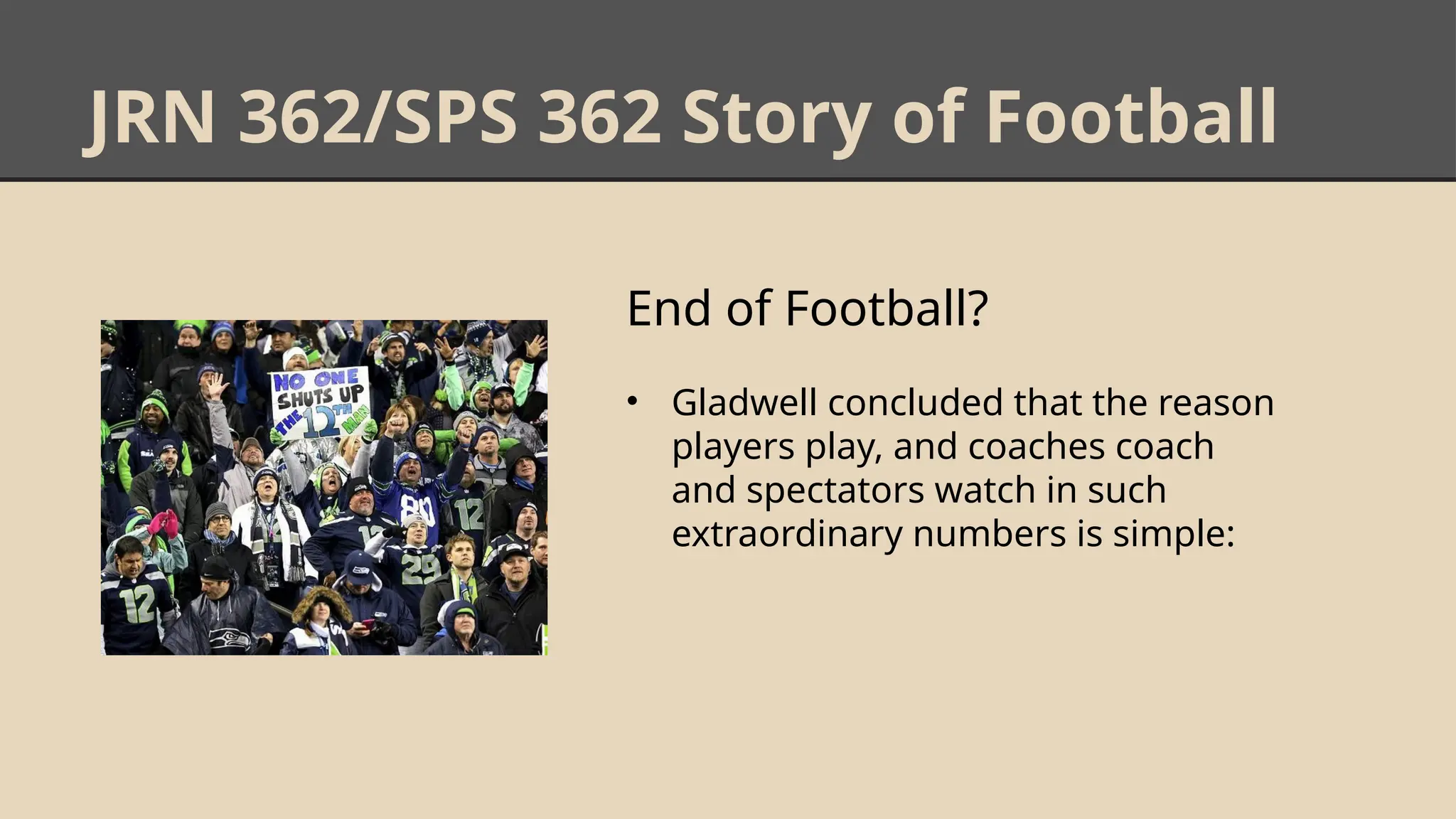
• Gladwell concluded that the reason
players play, and coaches coach
and spectators watch in such
extraordinary numbers is simple:
JRN 362/SPS 362 Story of Football
End of Football?
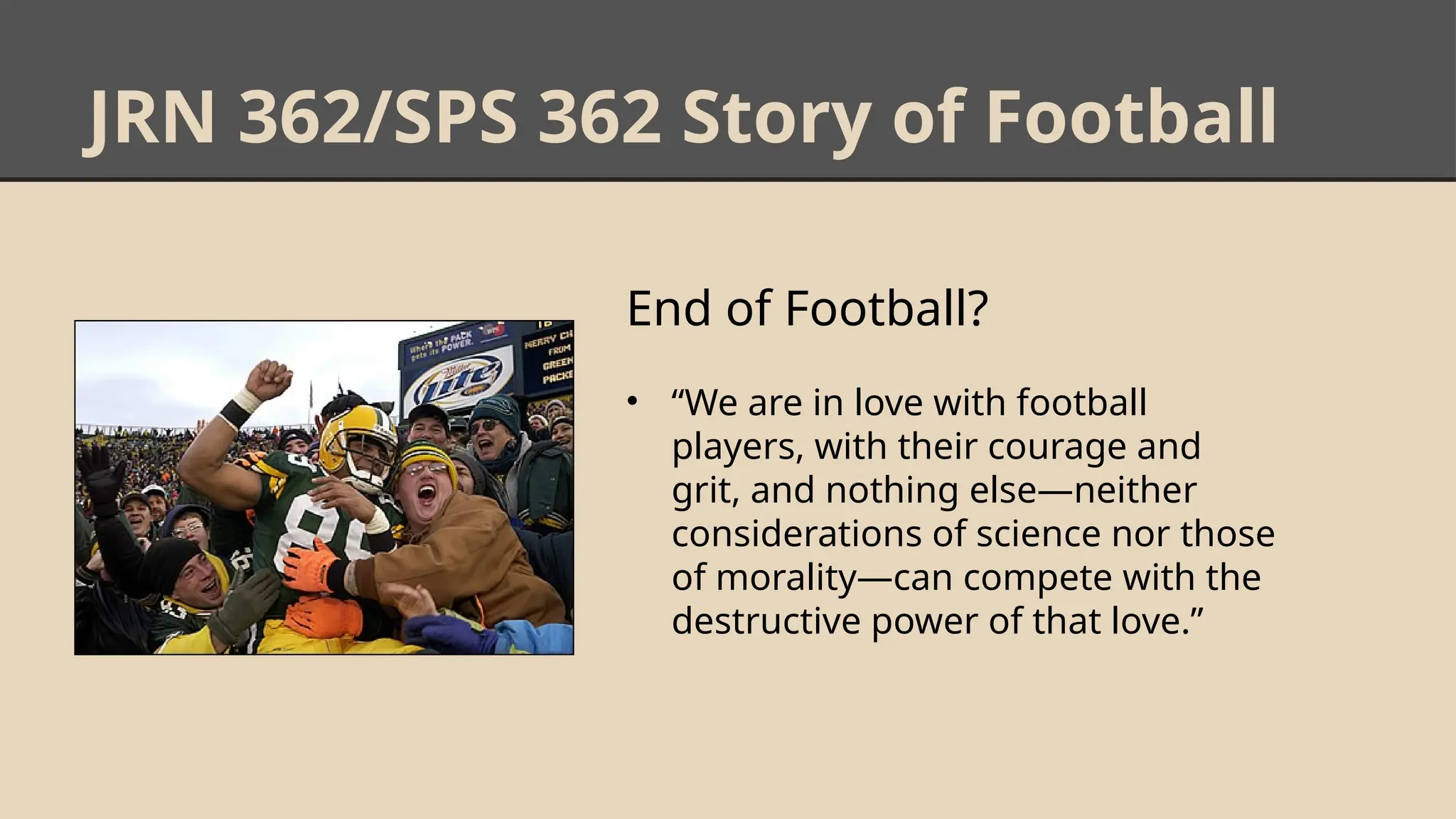
• “We are in love with football
players, with their courage and
grit, and nothing else—neither
considerations of science nor those
of morality—can compete with the
destructive power of that love.”
JRN 362/SPS 362 Story of Football
End of Football?
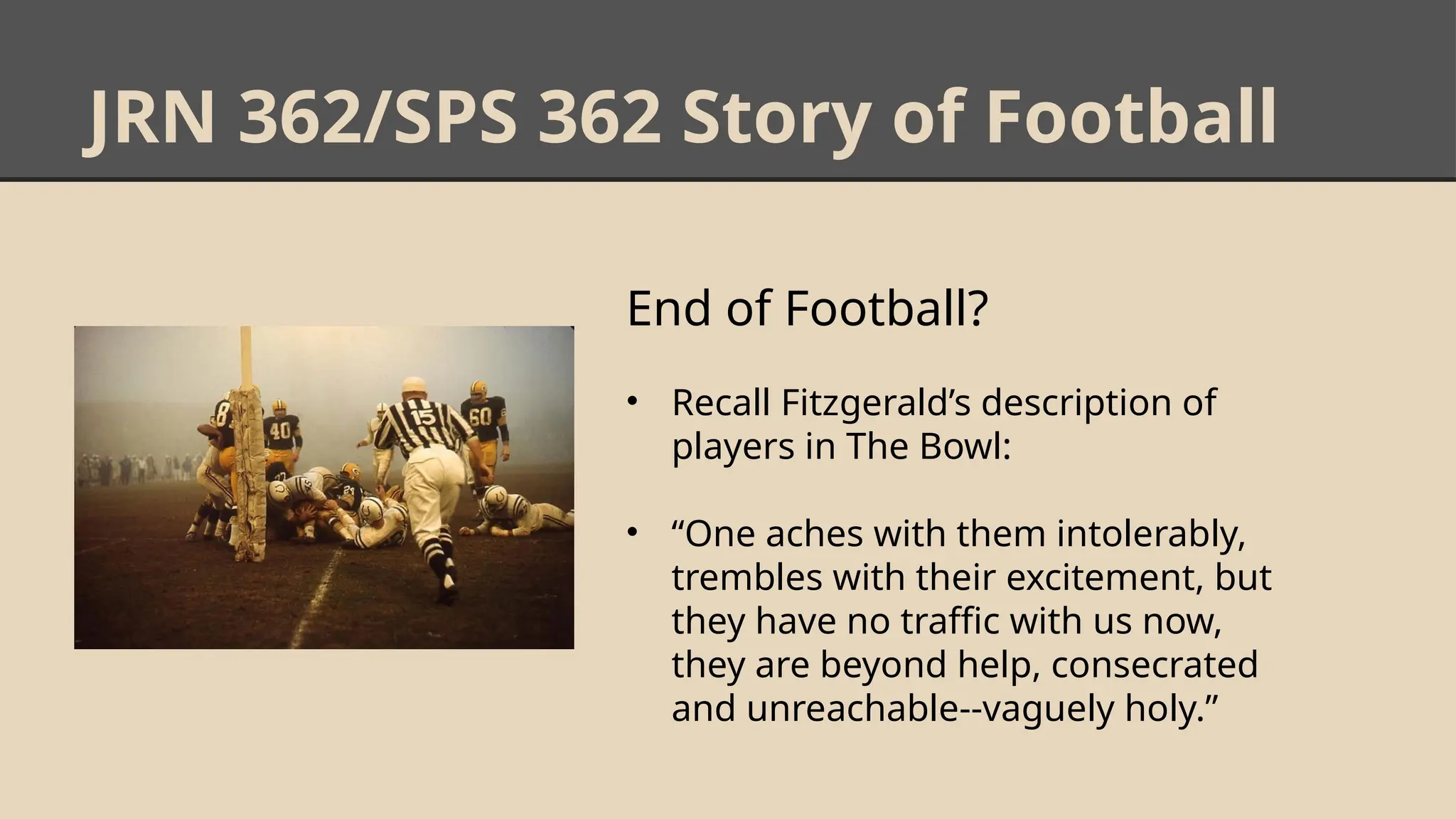
• Recall Fitzgerald’s description of
players in The Bowl:
• “One aches with them intolerably,
trembles with their excitement, but
they have no traffic with us now,
they are beyond help, consecrated
and unreachable--vaguely holy.”
JRN 362/SPS 362 Story of Football
End of Football?
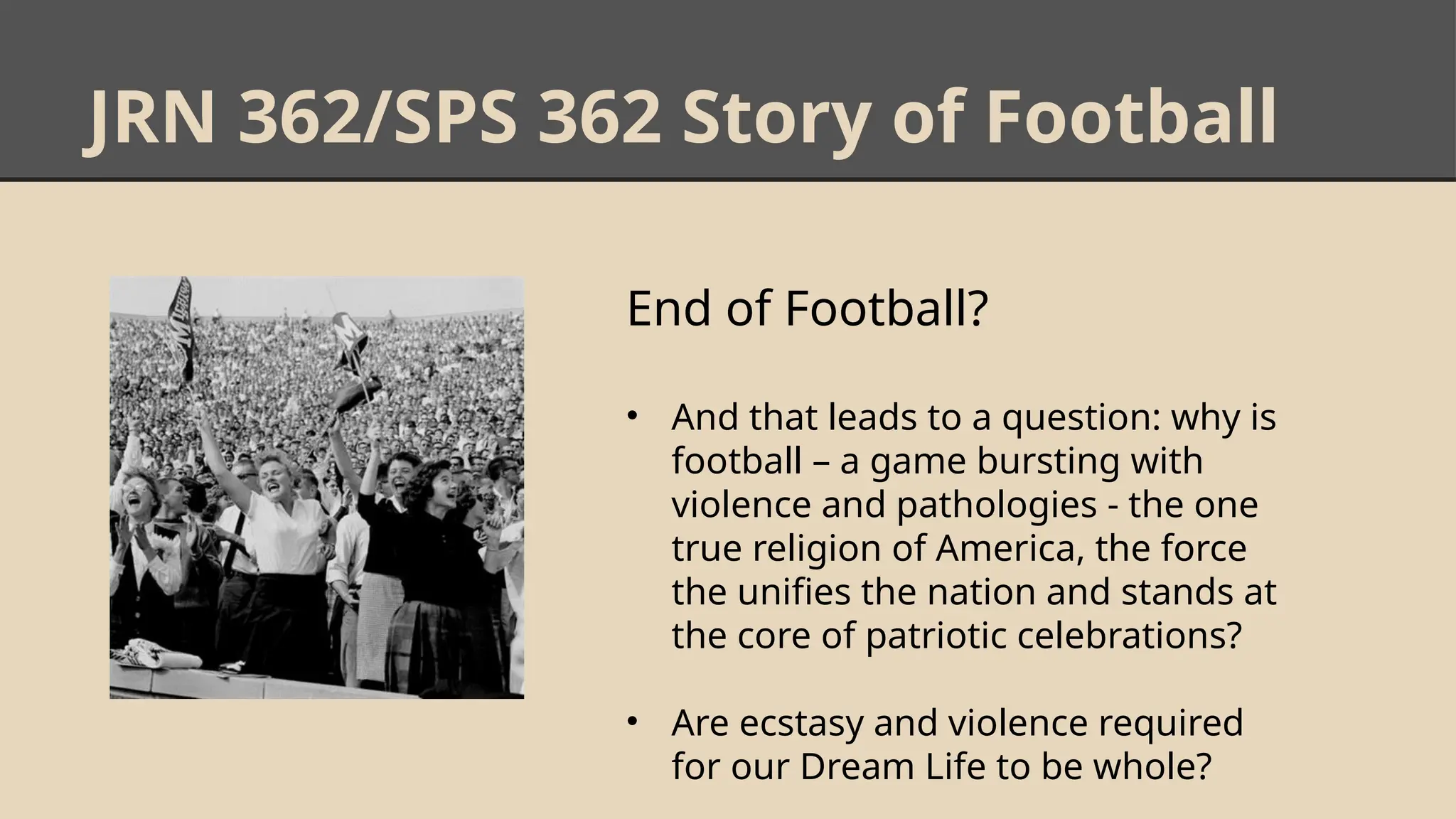
• And that leads to a question: why is
football – a game bursting with
violence and pathologies - the one
true religion of America, the force
the unifies the nation and stands at
the core of patriotic celebrations?
• Are ecstasy and violence required
for our Dream Life to be whole?
JRN 362/SPS 362 Story of Football
End of Football?
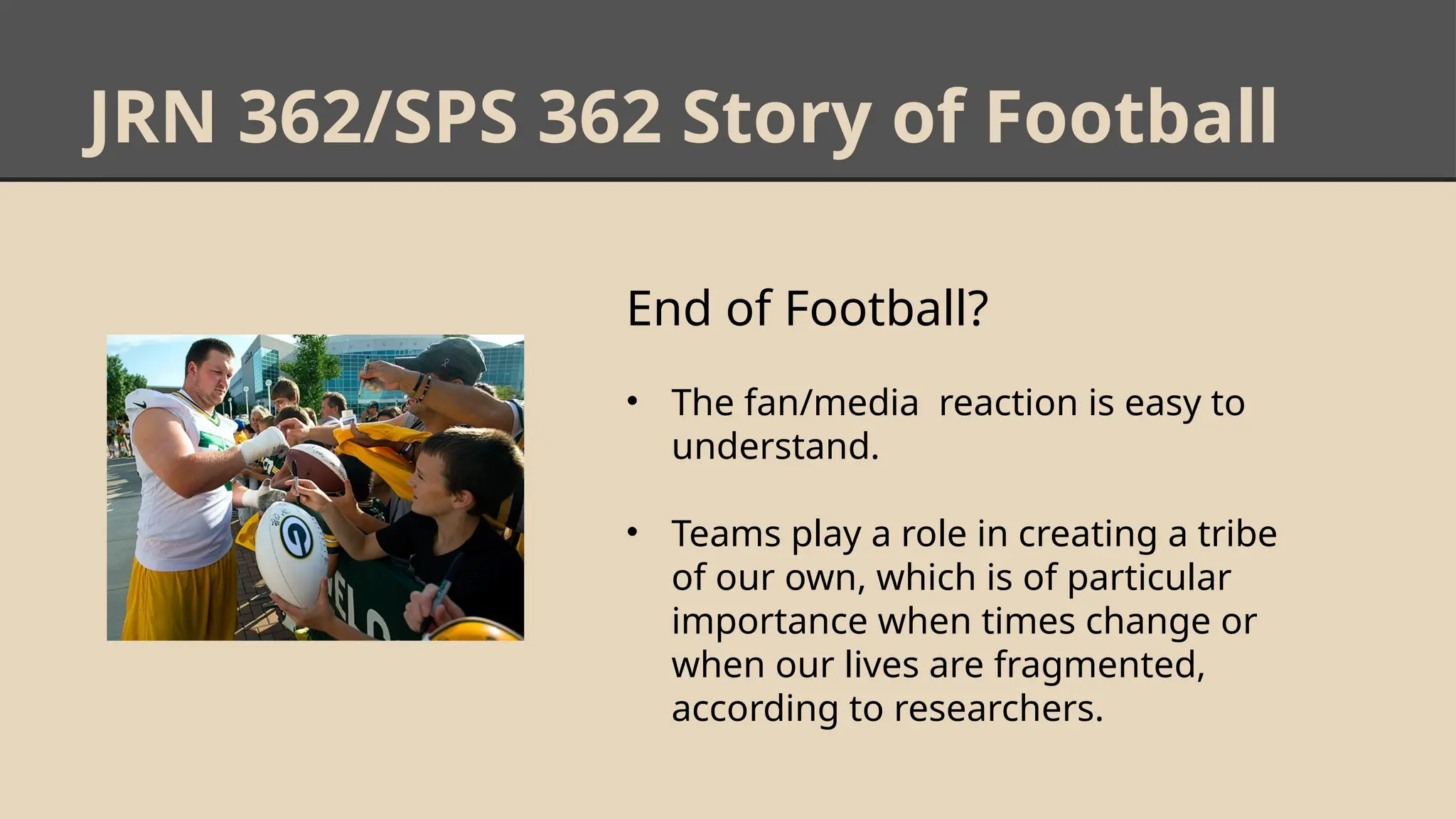
• The fan/media reaction is easy to
understand.
• Teams play a role in creating a tribe
of our own, which is of particular
importance when times change or
when our lives are fragmented,
according to researchers.
JRN 362/SPS 362 Story of Football
End of Football?
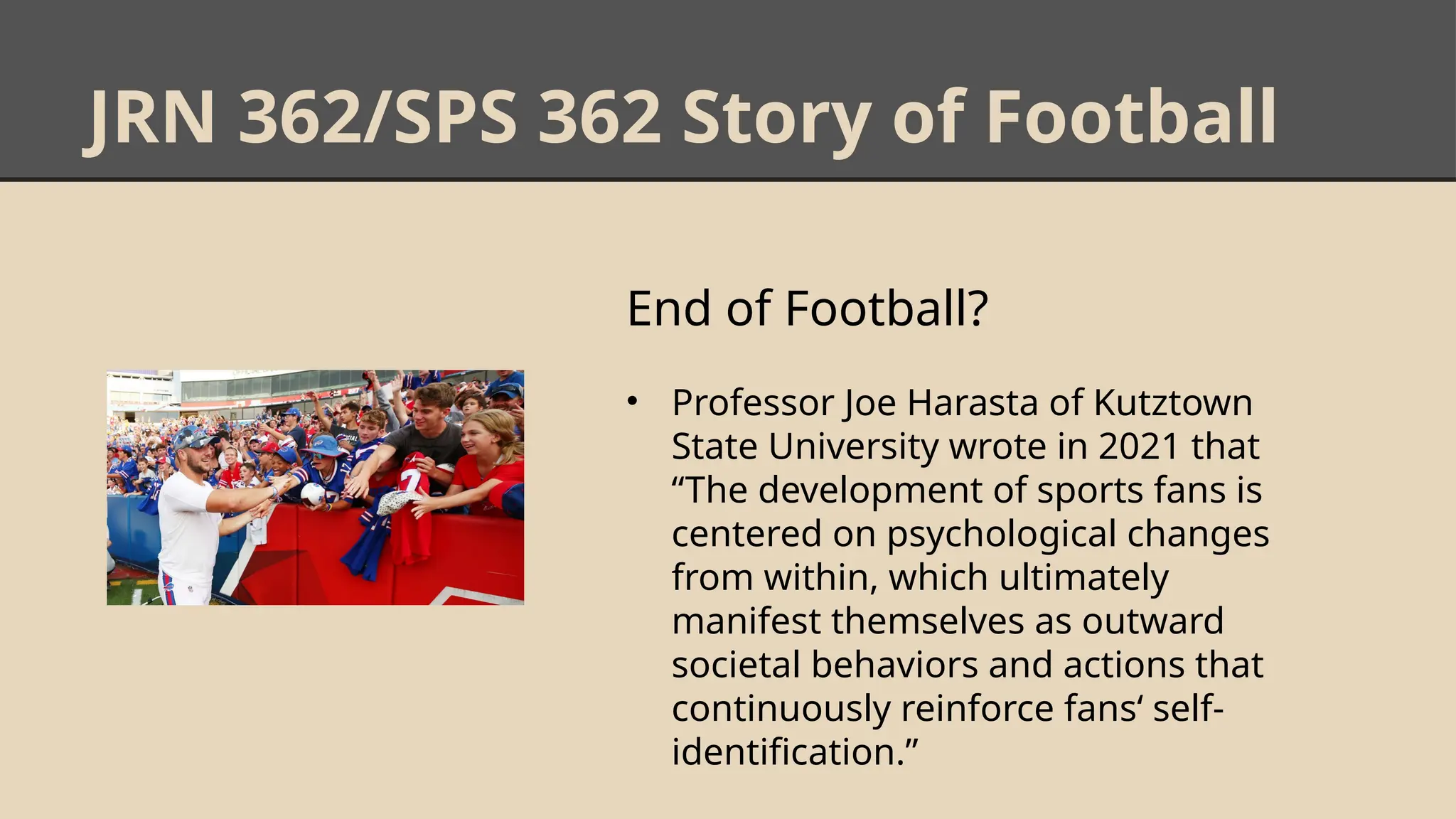
• Professor Joe Harasta of Kutztown
State University wrote in 2021 that
“The development of sports fans is
centered on psychological changes
from within, which ultimately
manifest themselves as outward
societal behaviors and actions that
continuously reinforce fans‘ self-
identification.”
JRN 362/SPS 362 Story of Football
End of Football?
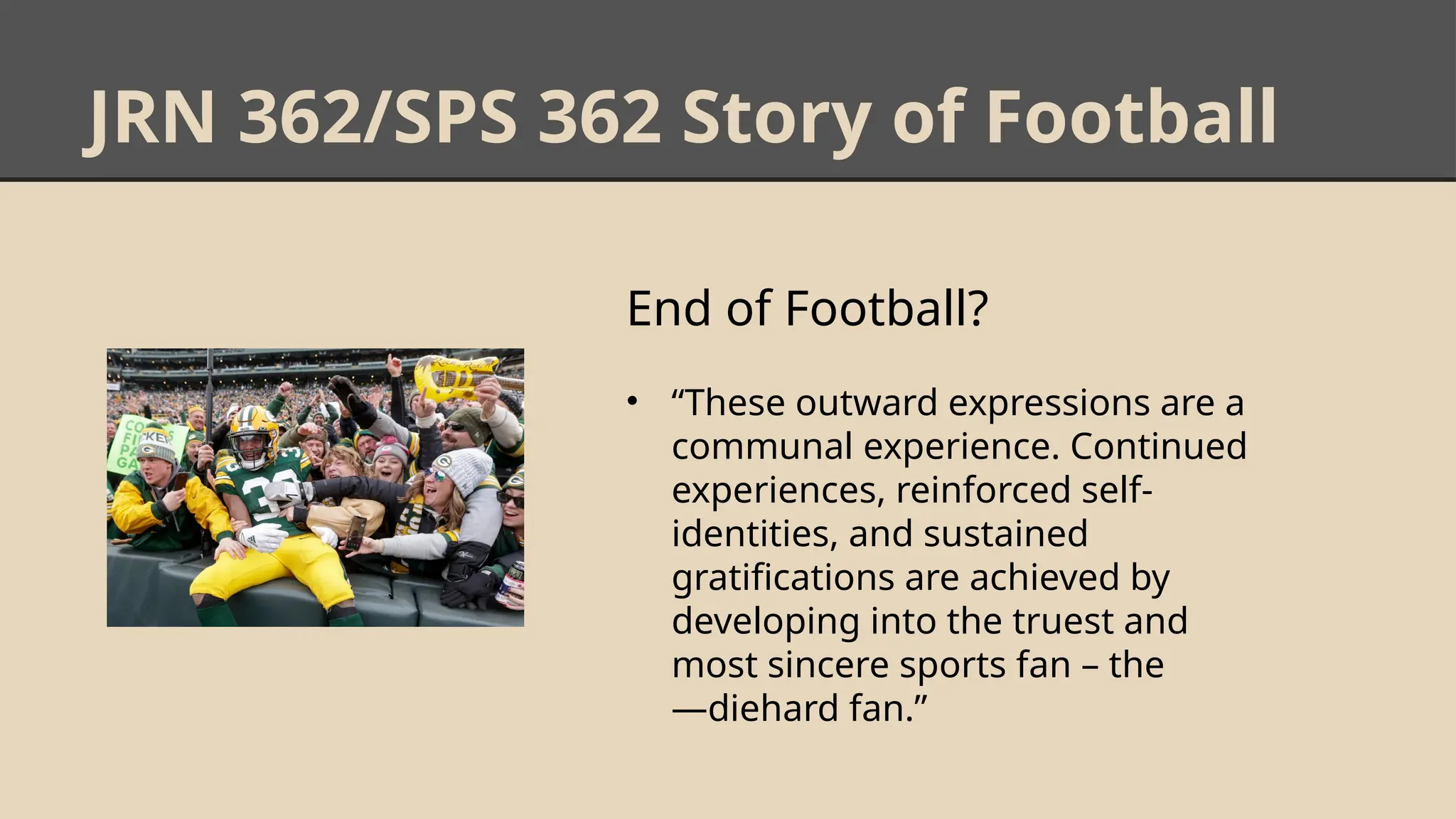
• “These outward expressions are a
communal experience. Continued
experiences, reinforced self-
identities, and sustained
gratifications are achieved by
developing into the truest and
most sincere sports fan – the
―diehard fan.”
JRN 362/SPS 362 Story of Football
End of Football?
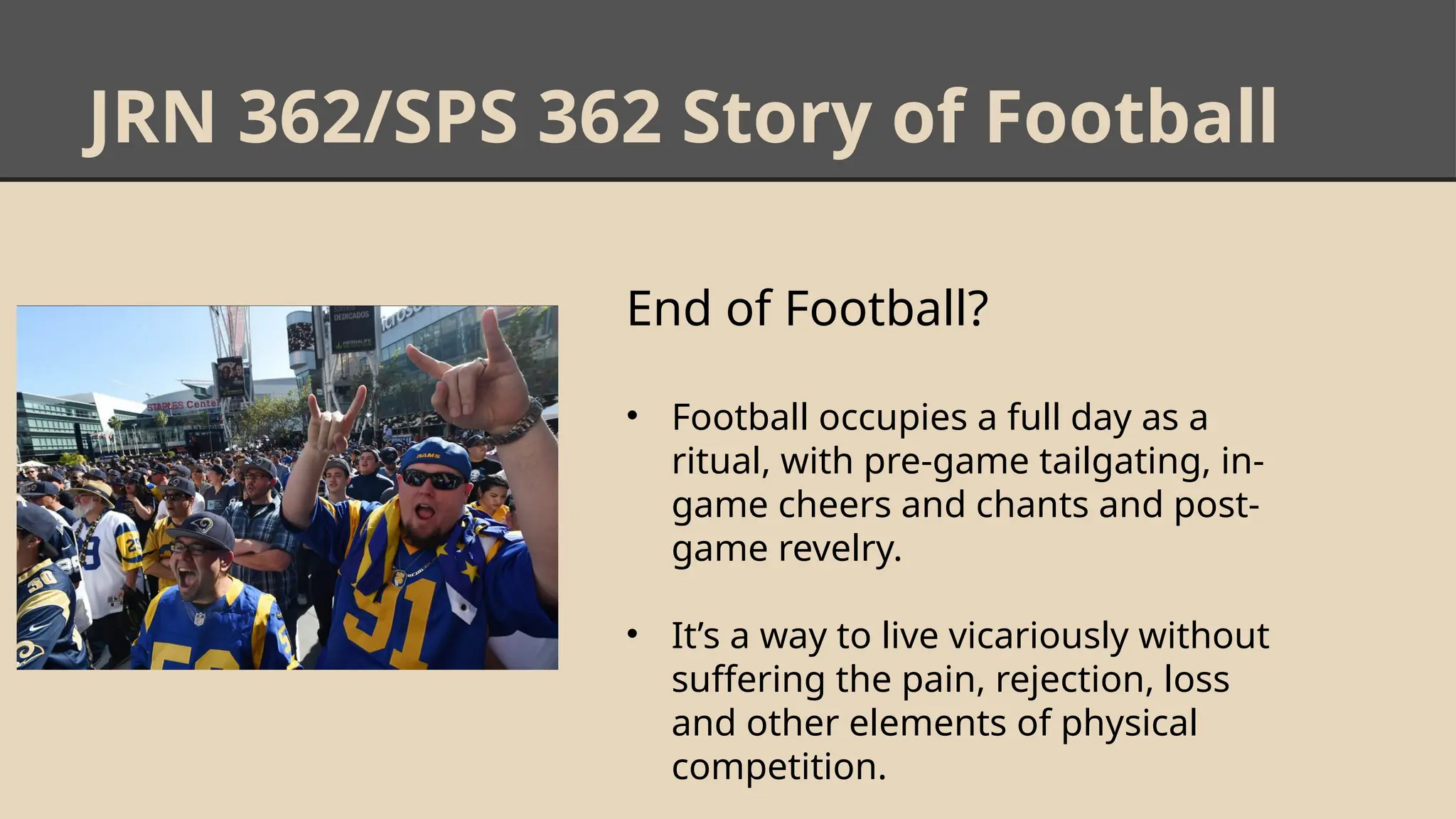
• Football occupies a full day as a
ritual, with pre-game tailgating, in-
game cheers and chants and post-
game revelry.
• It’s a way to live vicariously without
suffering the pain, rejection, loss
and other elements of physical
competition.
JRN 362/SPS 362 Story of Football
End of Football?
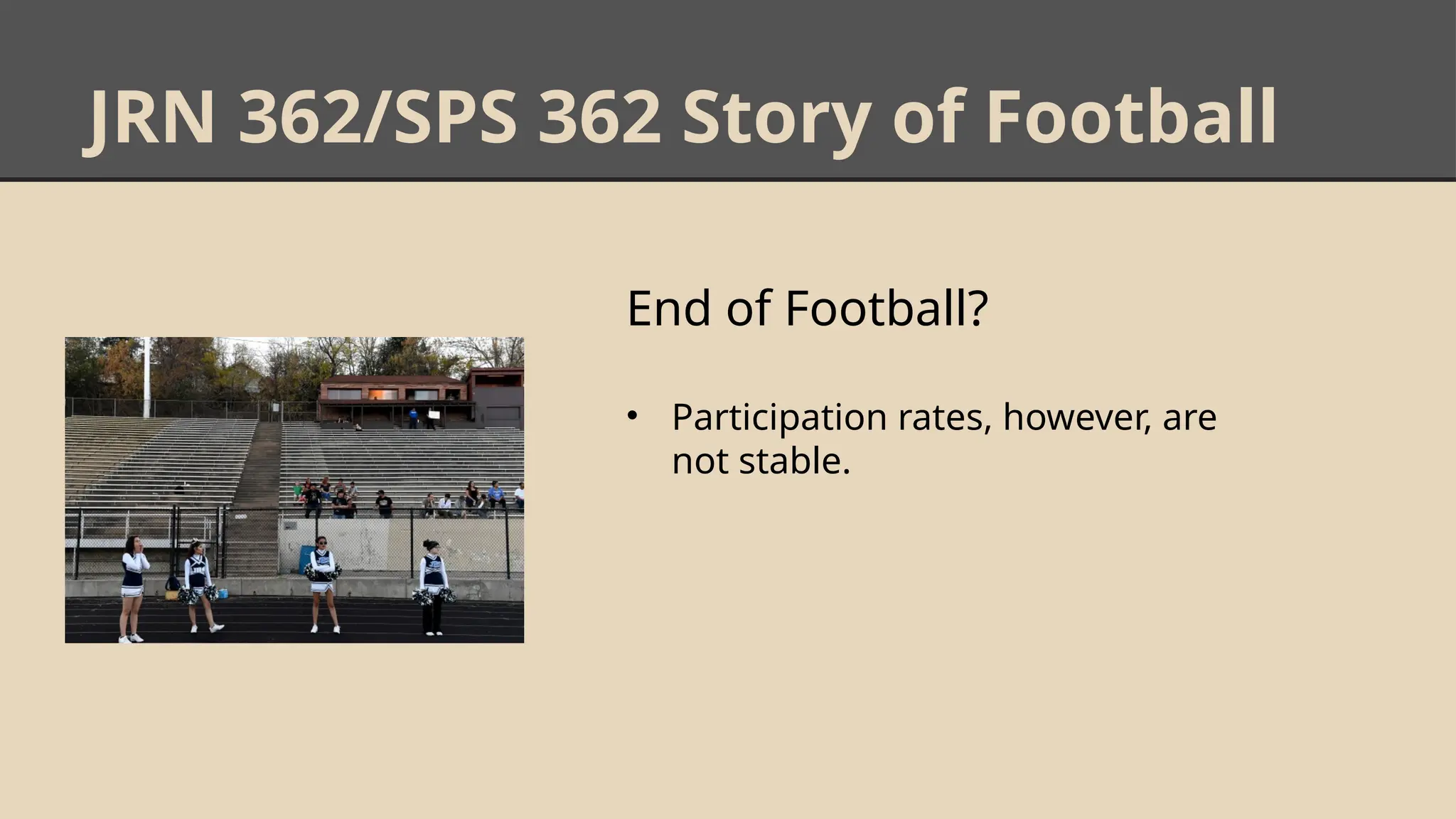
• Participation rates, however, are
not stable.
JRN 362/SPS 362 Story of Football
End of Football?
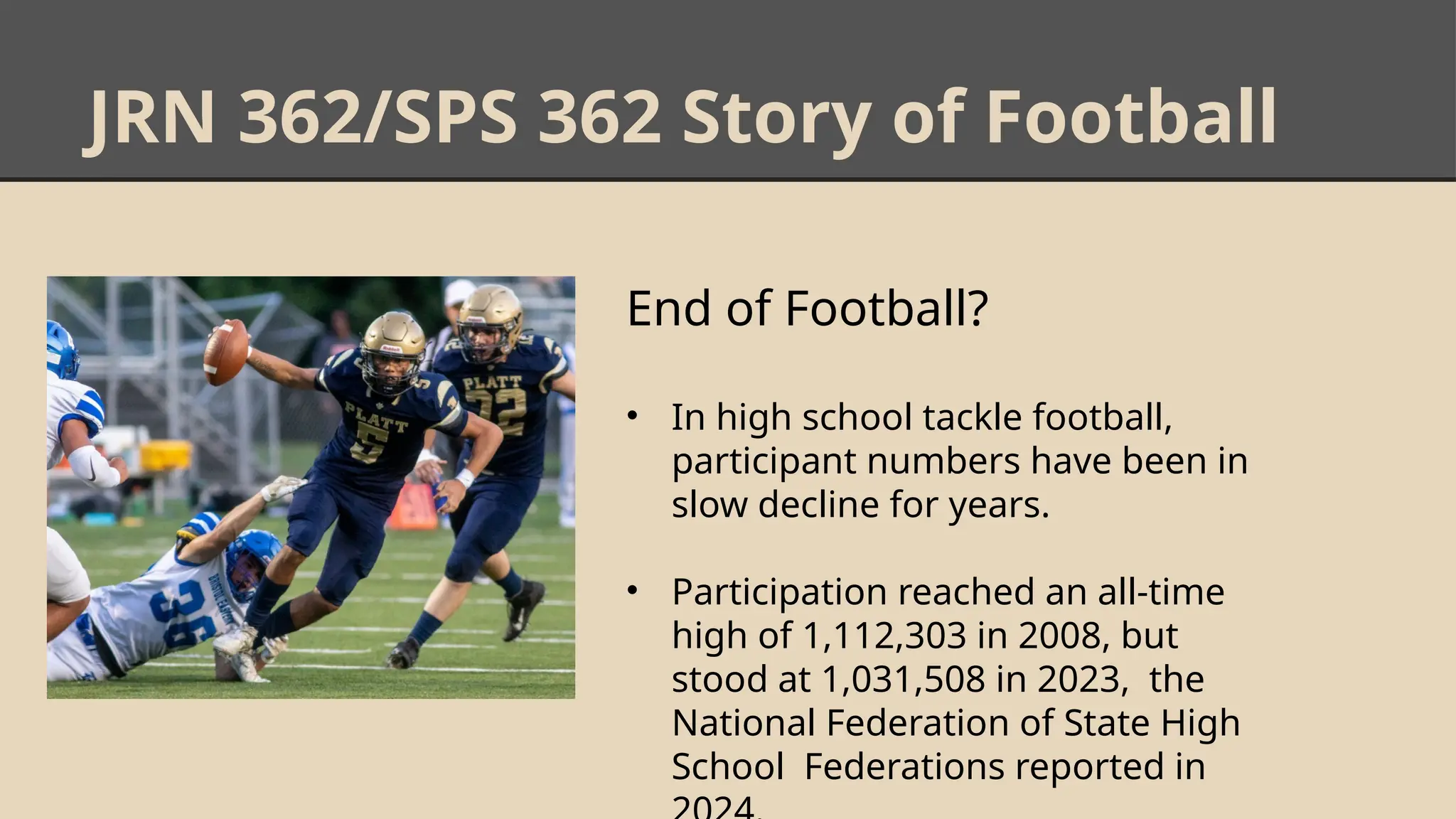
• In high school tackle football,
participant numbers have been in
slow decline for years.
• Participation reached an all-time
high of 1,112,303 in 2008, but
stood at 1,031,508 in 2023, the
National Federation of State High
School Federations reported in
JRN 362/SPS 362 Story of Football
End of Football?
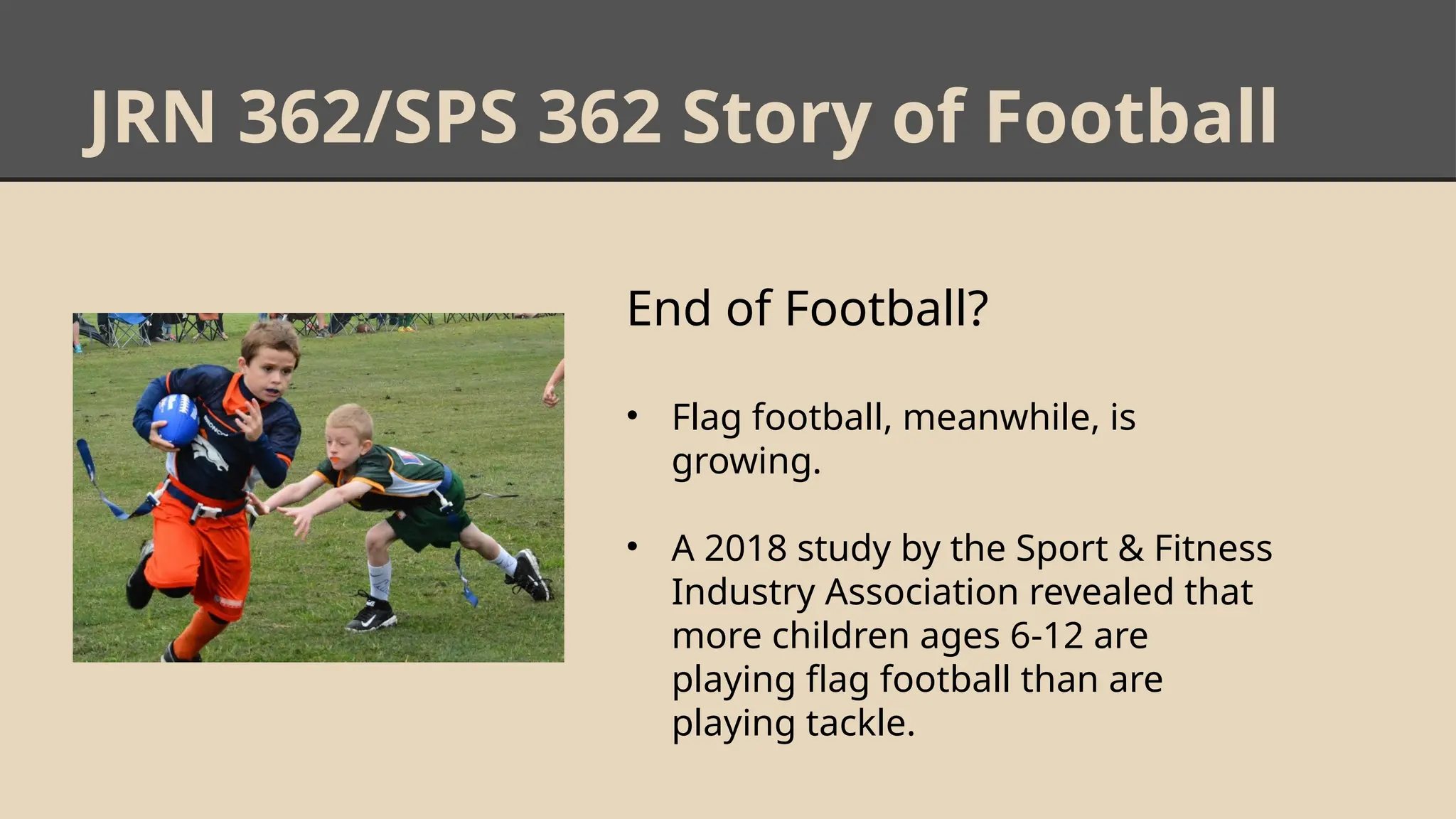
• Flag football, meanwhile, is
growing.
• A 2018 study by the Sport & Fitness
Industry Association revealed that
more children ages 6-12 are
playing flag football than are
playing tackle.
JRN 362/SPS 362 Story of Football
End of Football?
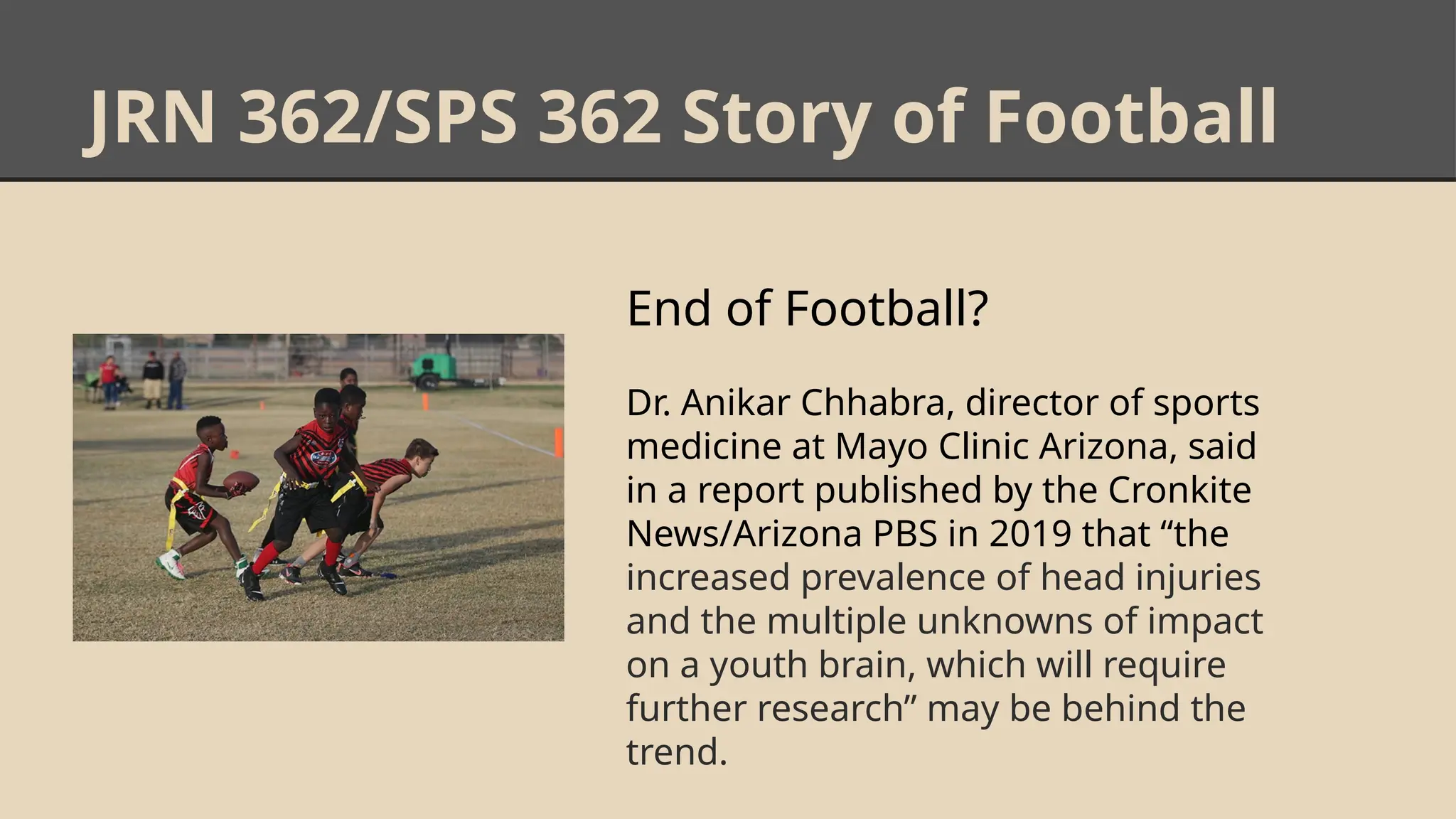
Dr. Anikar Chhabra, director of sports
medicine at Mayo Clinic Arizona, said
in a report published by the Cronkite
News/Arizona PBS in 2019 that “the
increased prevalence of head injuries
and the multiple unknowns of impact
on a youth brain, which will require
further research” may be behind the
trend.
JRN 362/SPS 362 Story of Football
End of Football?
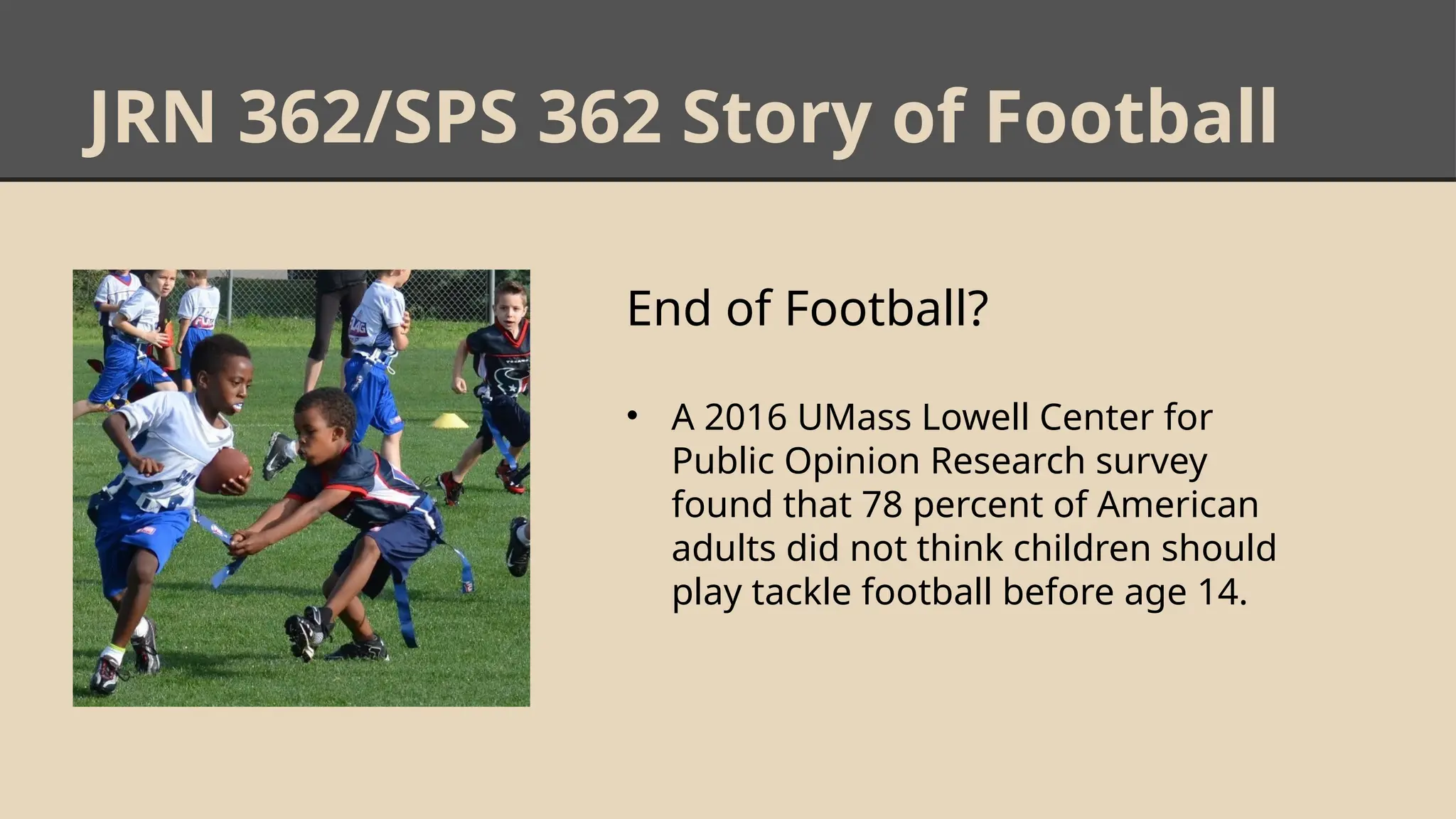
• A 2016 UMass Lowell Center for
Public Opinion Research survey
found that 78 percent of American
adults did not think children should
play tackle football before age 14.
JRN 362/SPS 362 Story of Football
End of Football?
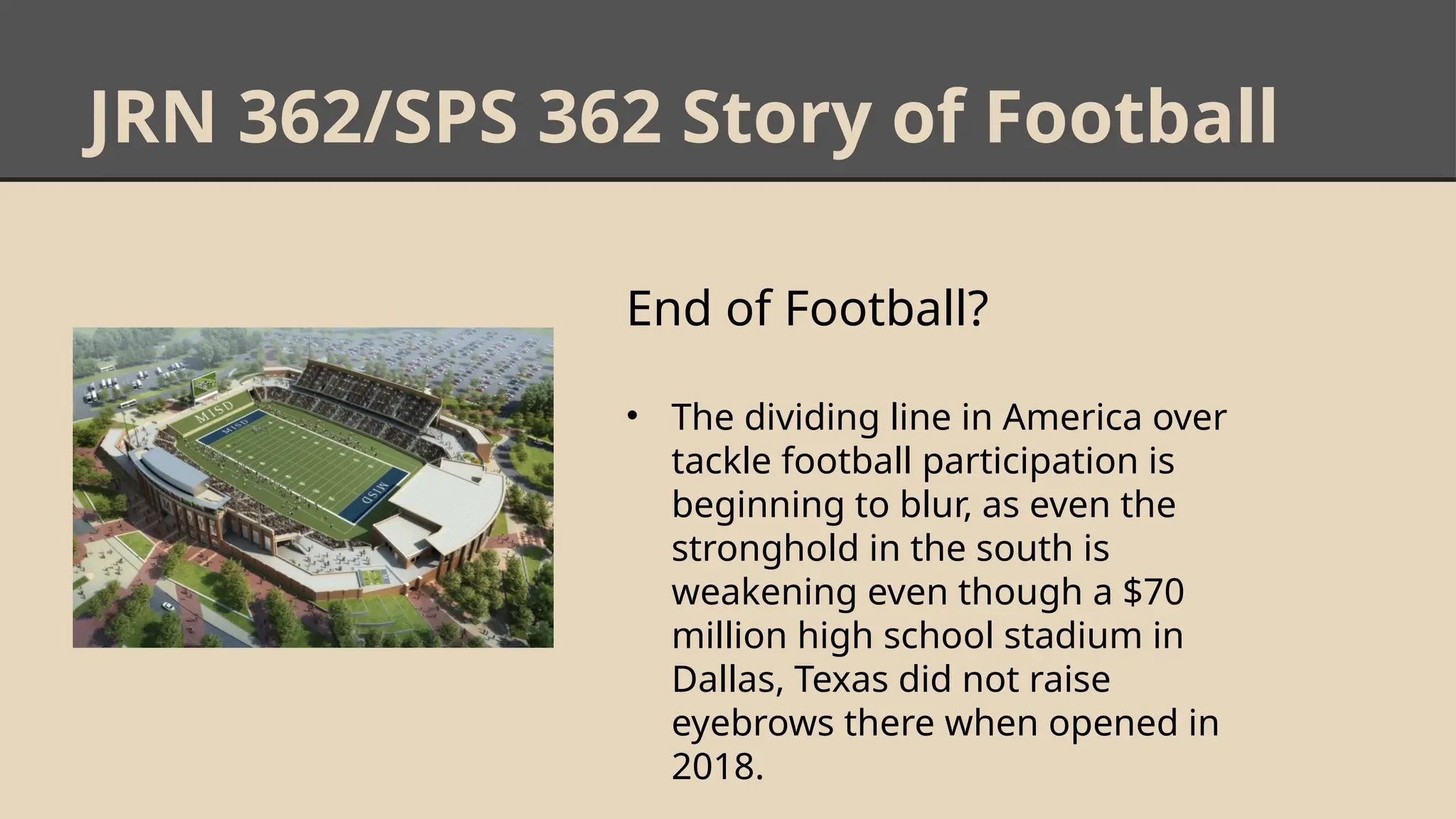
• The dividing line in America over
tackle football participation is
beginning to blur, as even the
stronghold in the south is
weakening even though a $70
million high school stadium in
Dallas, Texas did not raise
eyebrows there when opened in
2018.
JRN/SPS 362 Story of Football
End of Football?
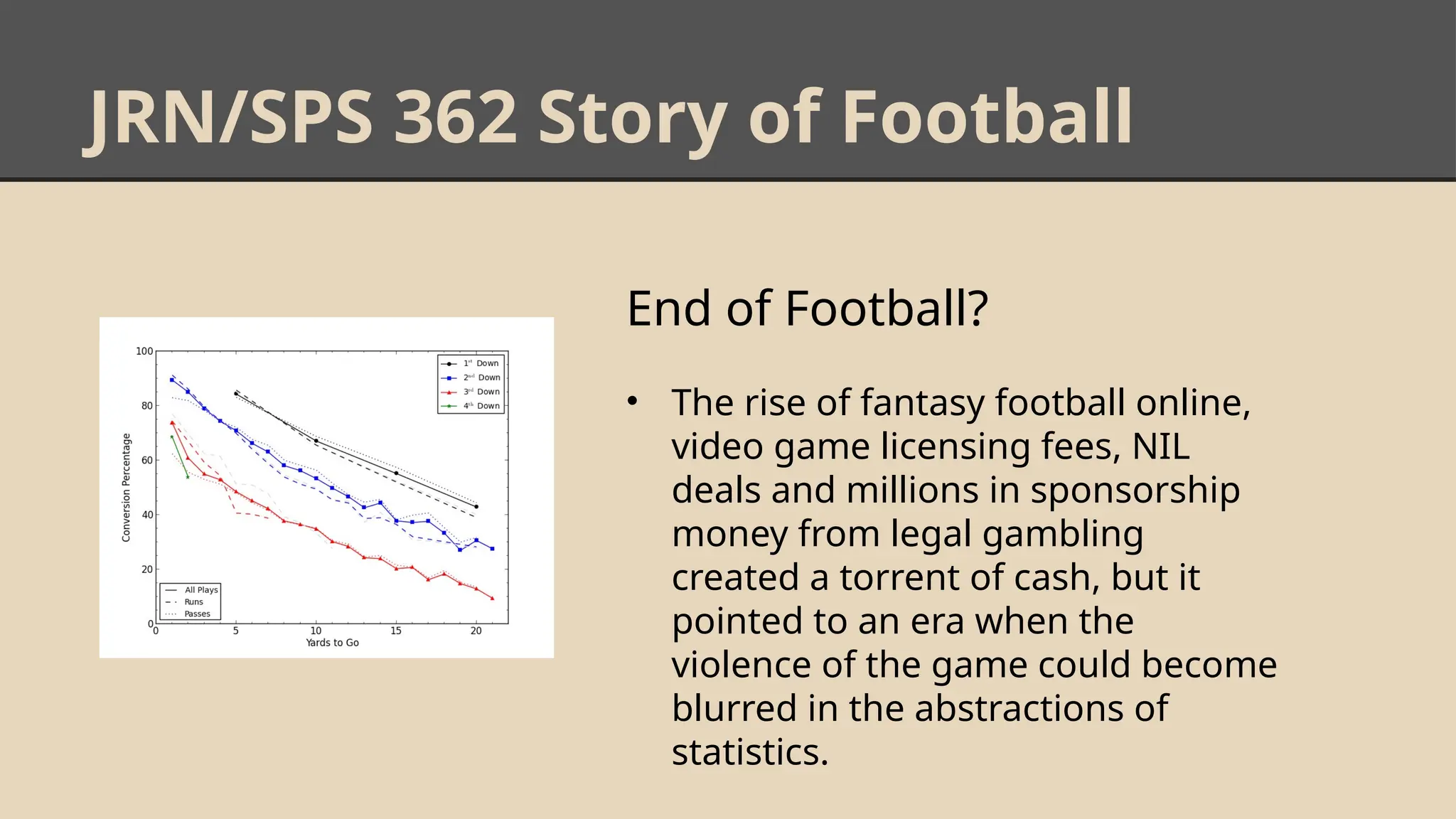
• The rise of fantasy football online,
video game licensing fees, NIL
deals and millions in sponsorship
money from legal gambling
created a torrent of cash, but it
pointed to an era when the
violence of the game could become
blurred in the abstractions of
statistics.
JRN/SPS 362 Story of Football
End of Football?
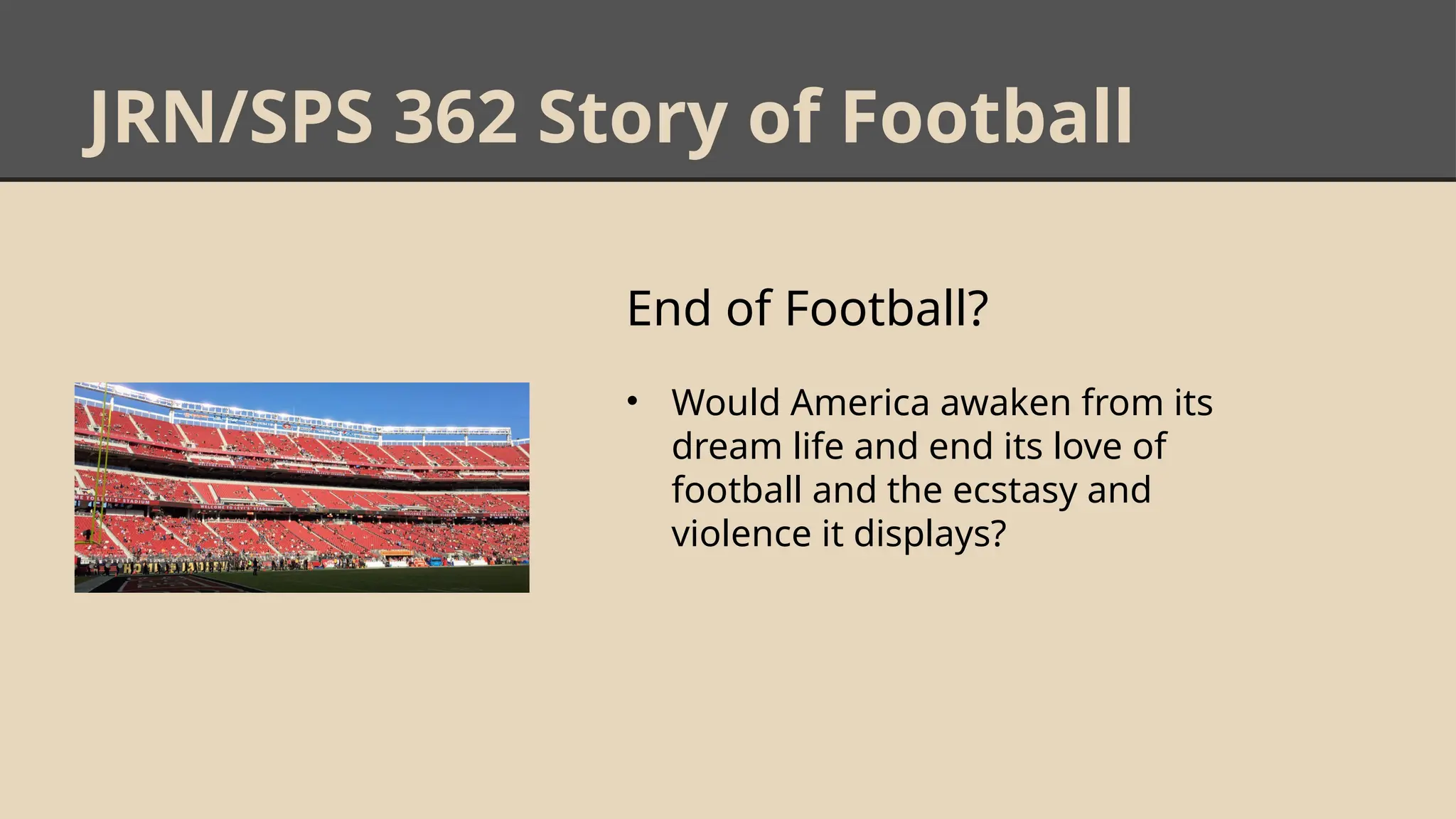
• Would America awaken from its
dream life and end its love of
football and the ecstasy and
violence it displays?
JRN 362/SPS 362 Story of Football
End of Football?
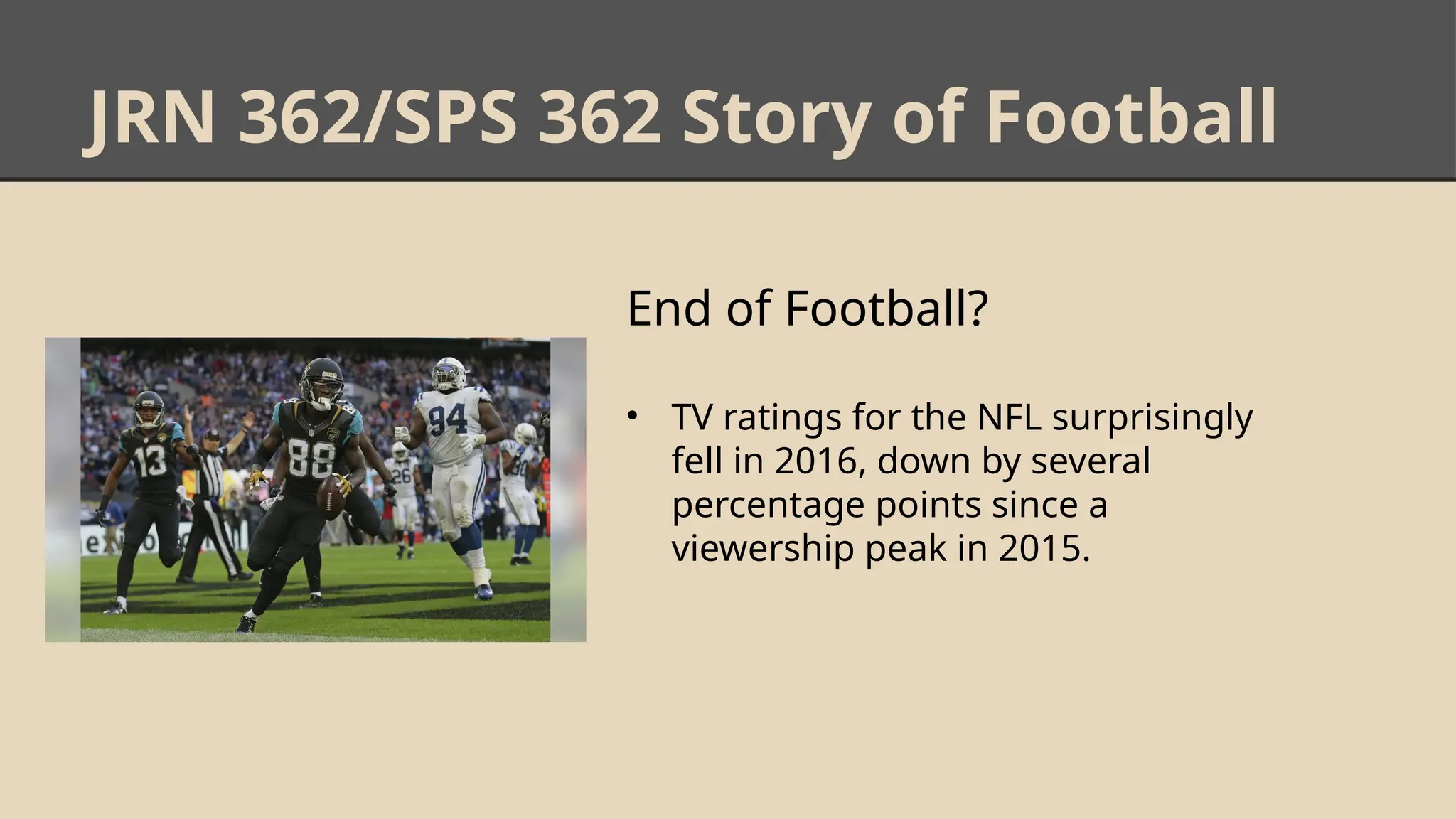
• TV ratings for the NFL surprisingly
fell in 2016, down by several
percentage points since a
viewership peak in 2015.
JRN 362/SPS 362 Story of Football
End of Football?
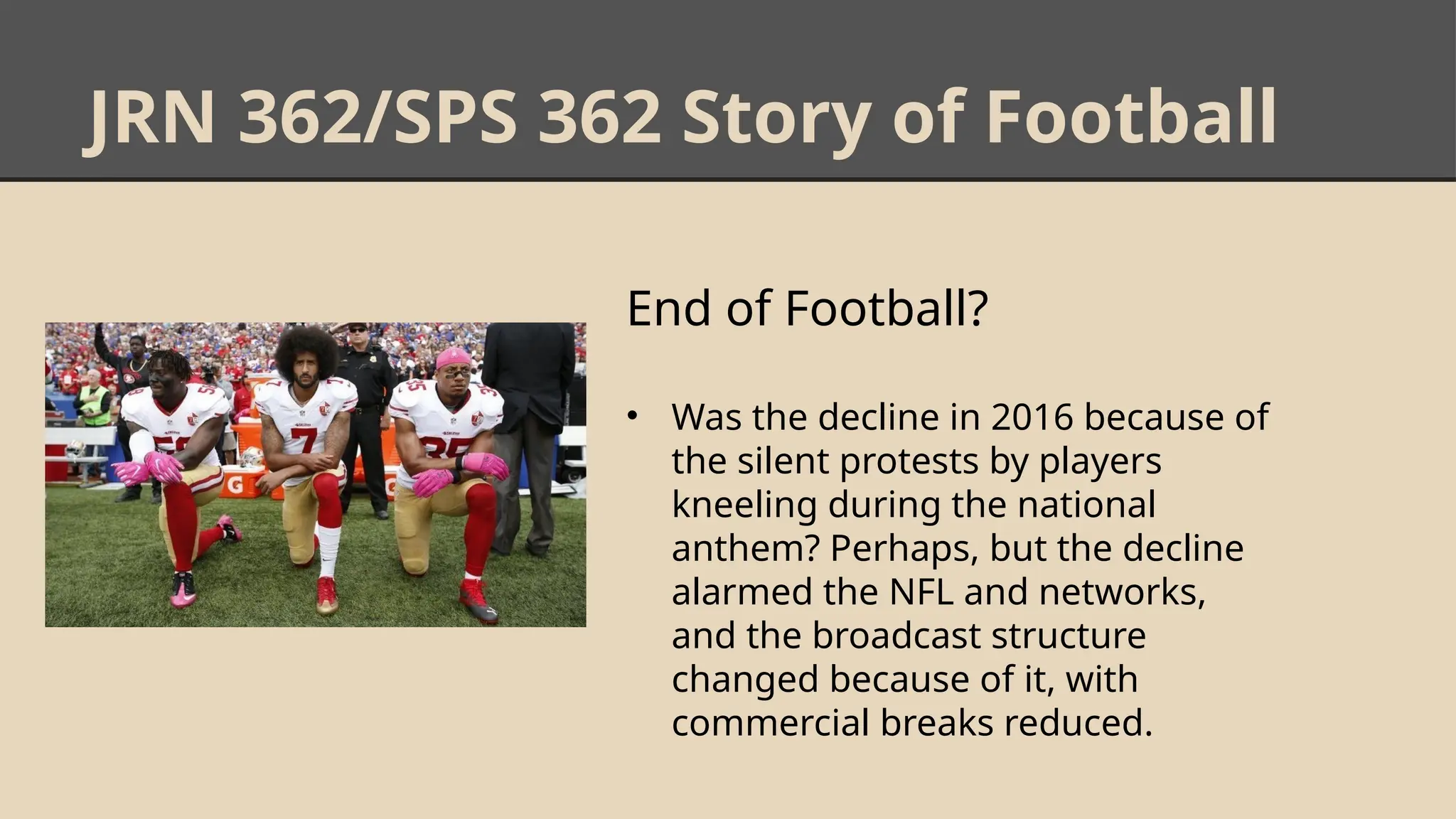
• Was the decline in 2016 because of
the silent protests by players
kneeling during the national
anthem? Perhaps, but the decline
alarmed the NFL and networks,
and the broadcast structure
changed because of it, with
commercial breaks reduced.
JRN 362/SPS 362 Story of Football
End of Football?
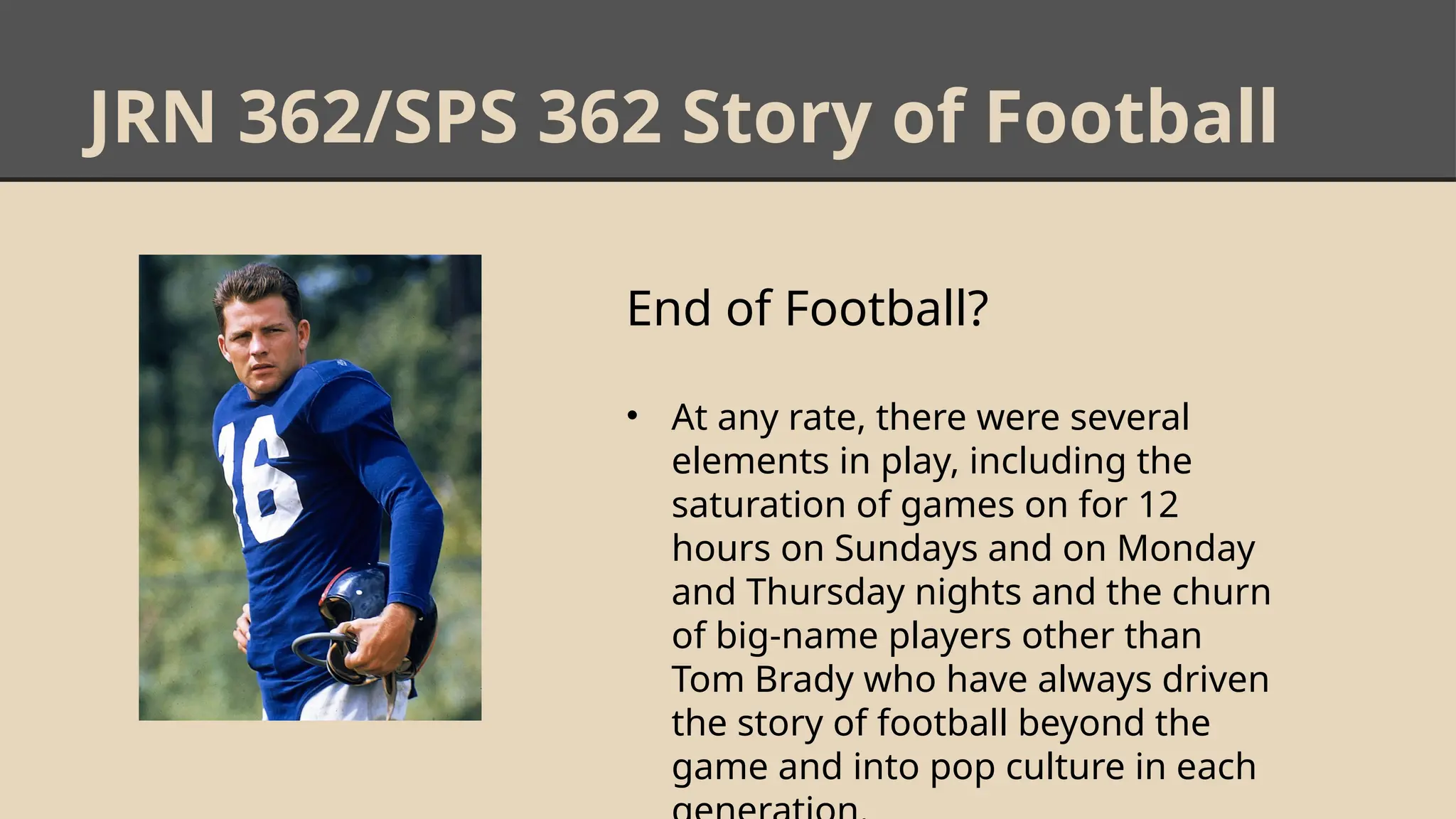
• At any rate, there were several
elements in play, including the
saturation of games on for 12
hours on Sundays and on Monday
and Thursday nights and the churn
of big-name players other than
Tom Brady who have always driven
the story of football beyond the
game and into pop culture in each
JRN 362/SPS 362 Story of Football
End of Football?
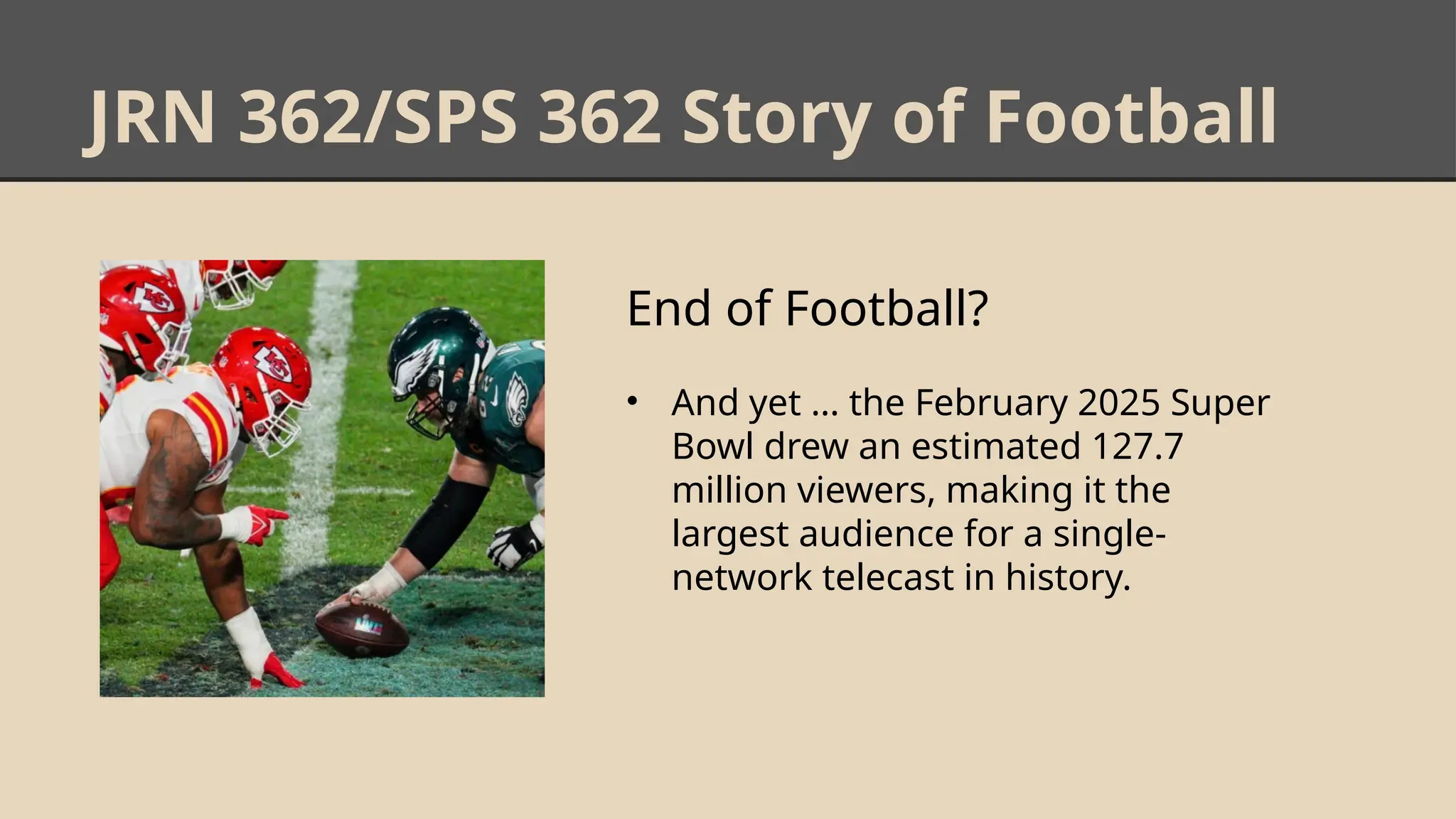
• And yet … the February 2025 Super
Bowl drew an estimated 127.7
million viewers, making it the
largest audience for a single-
network telecast in history.
JRN 362/SPS 362 Story of Football
End of Football?
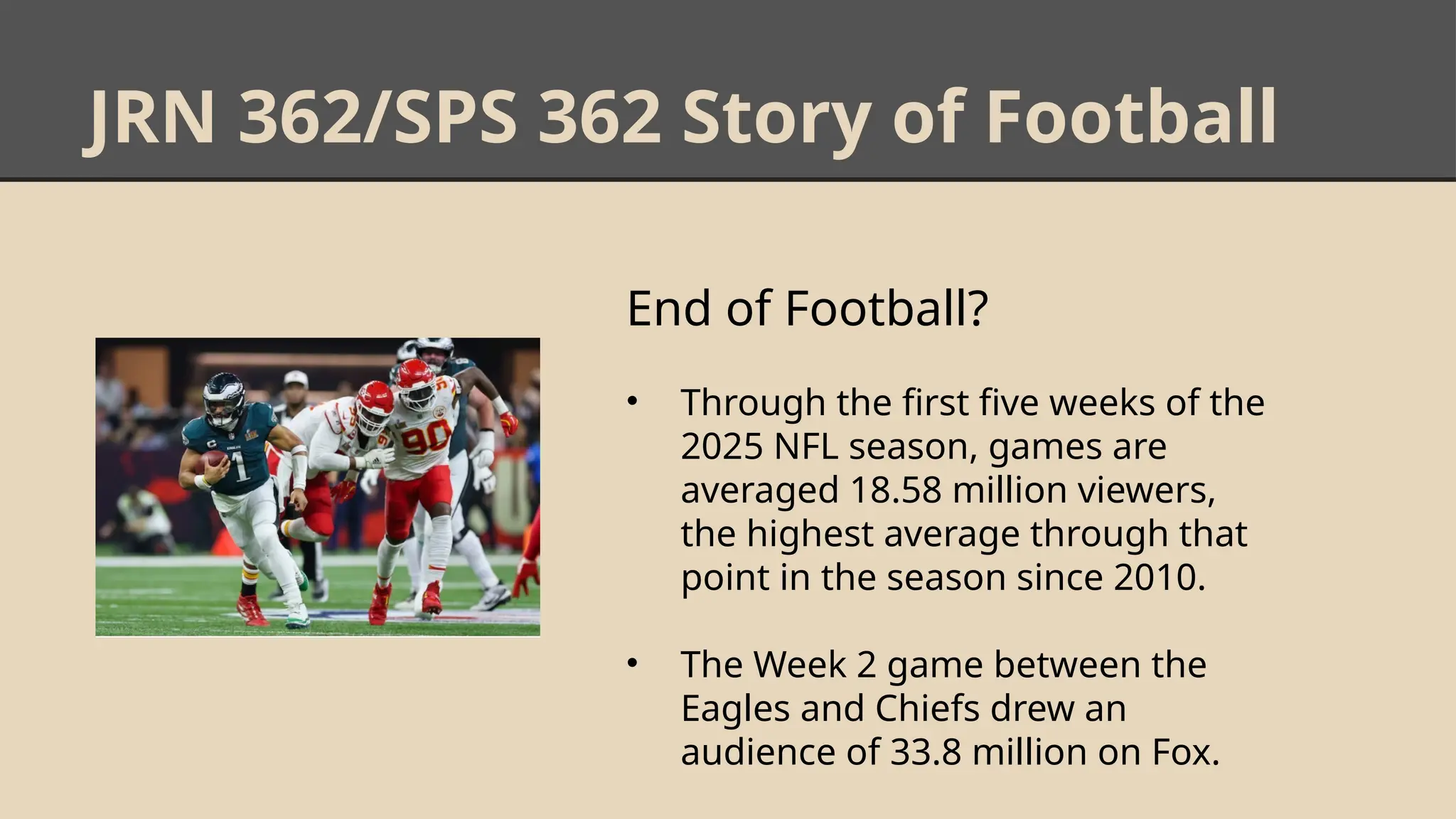
• Through the first five weeks of the
2025 NFL season, games are
averaged 18.58 million viewers,
the highest average through that
point in the season since 2010.
• The Week 2 game between the
Eagles and Chiefs drew an
audience of 33.8 million on Fox.
JRN 362/SPS 362 Story of Football
End of Football?
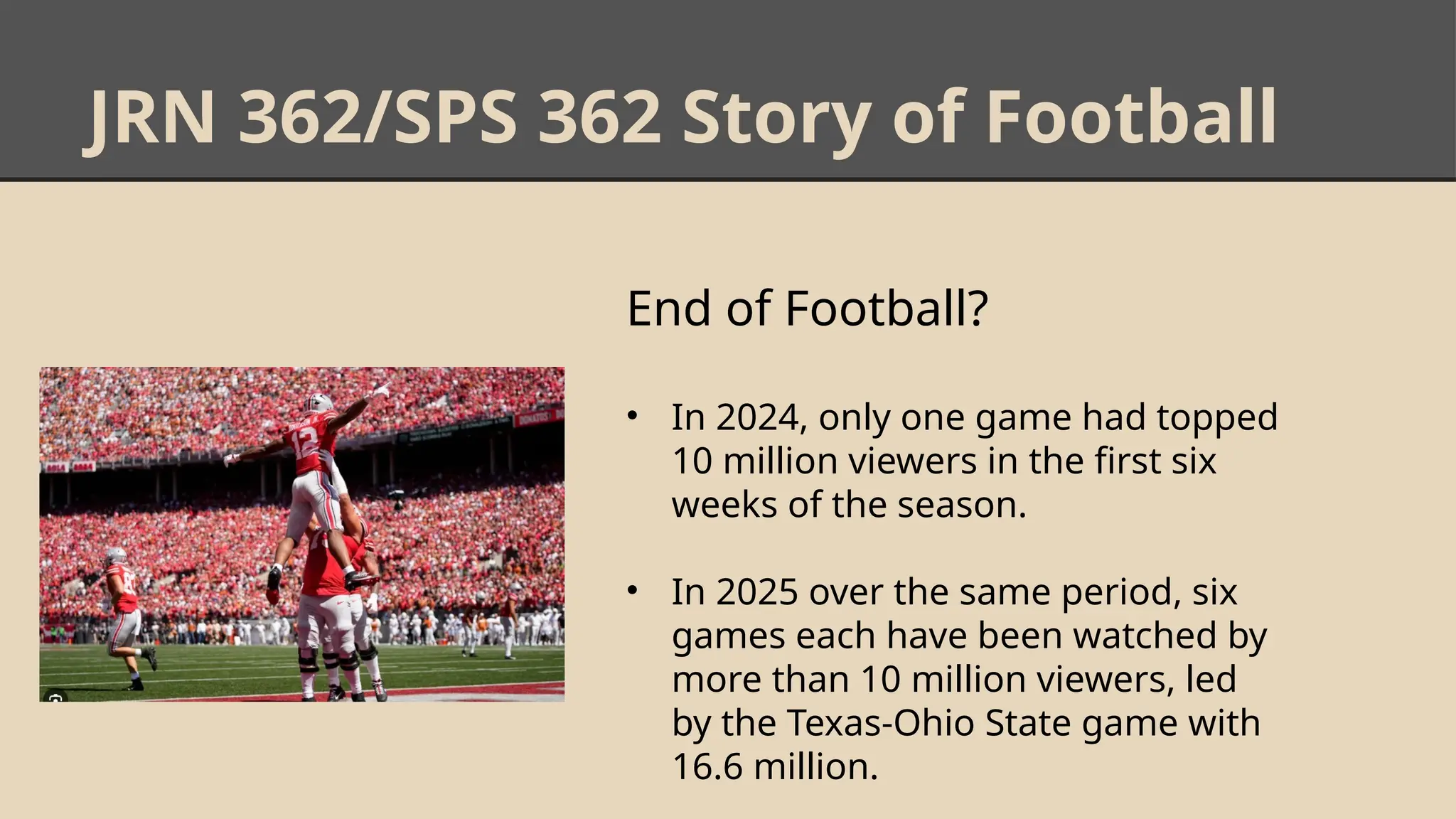
• In 2024, only one game had topped
10 million viewers in the first six
weeks of the season.
• In 2025 over the same period, six
games each have been watched by
more than 10 million viewers, led
by the Texas-Ohio State game with
16.6 million.
JRN 362/SPS 362 Story of Football
End of Football?
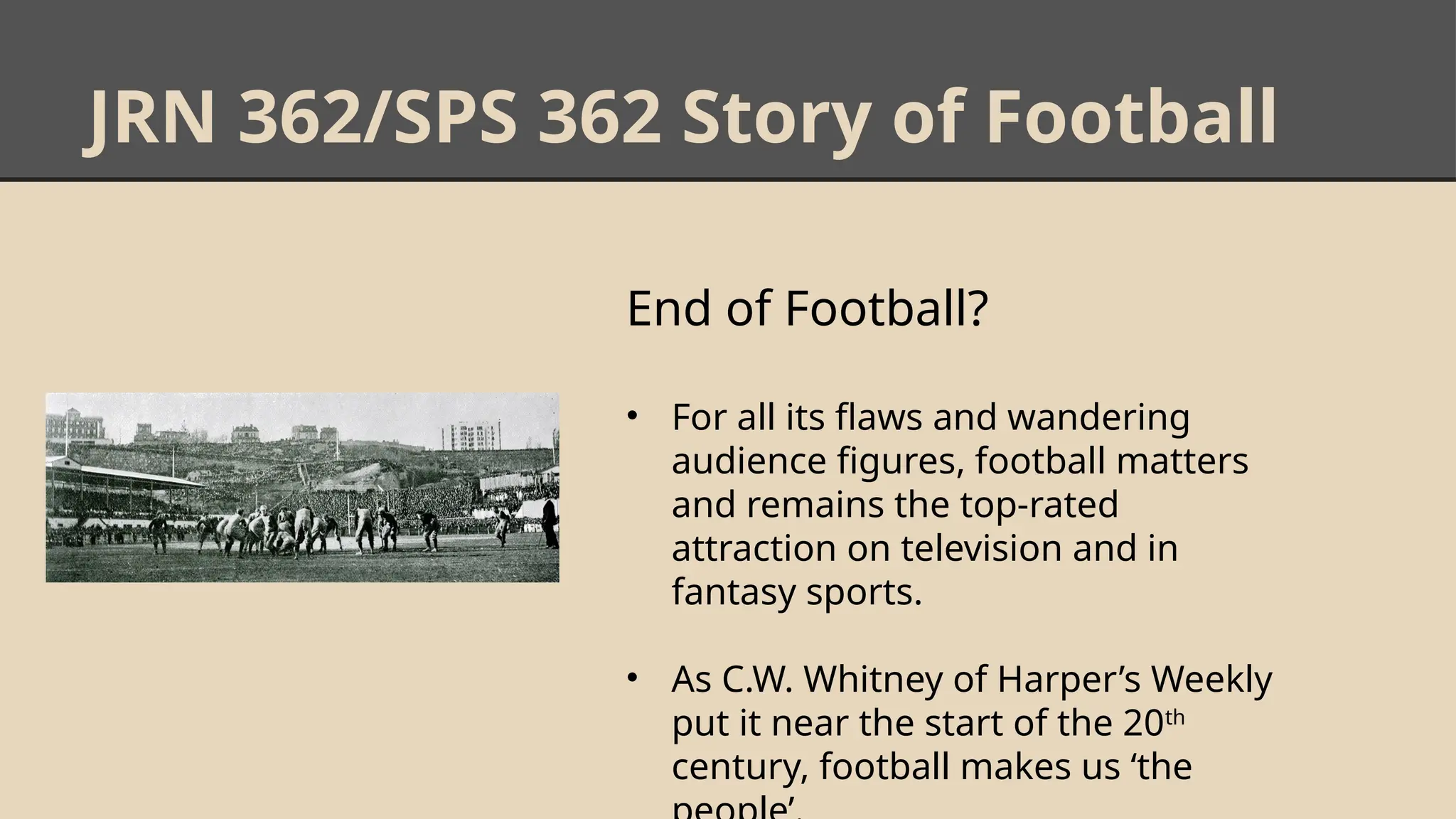
• For all its flaws and wandering
audience figures, football matters
and remains the top-rated
attraction on television and in
fantasy sports.
• As C.W. Whitney of Harper’s Weekly
put it near the start of the 20th
century, football makes us ‘the
JRN 362/SPS 362 Story of Football
End of Football?
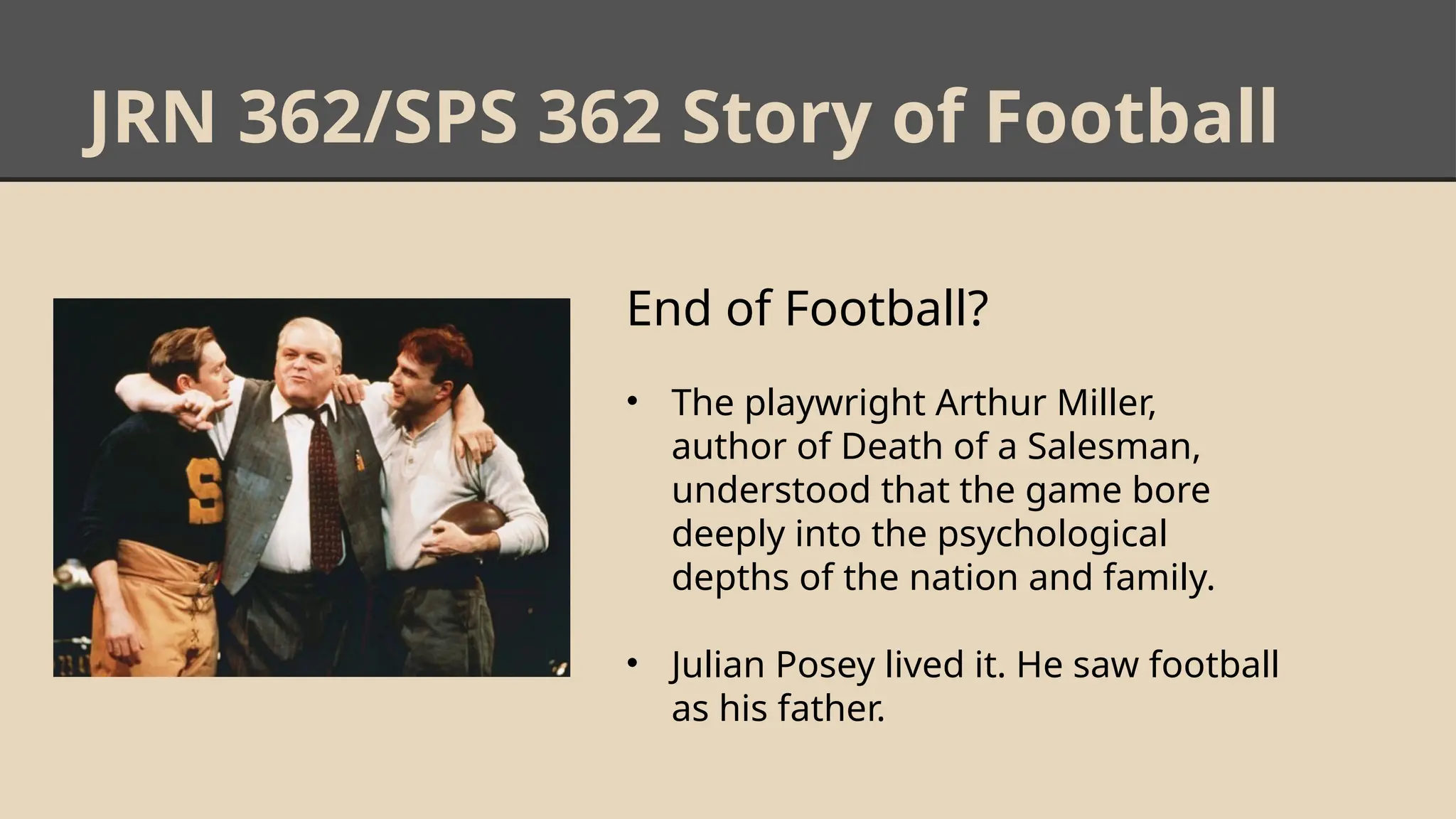
• The playwright Arthur Miller,
author of Death of a Salesman,
understood that the game bore
deeply into the psychological
depths of the nation and family.
• Julian Posey lived it. He saw football
as his father.
JRN 362/SPS 362 Story of Football
End of Football?
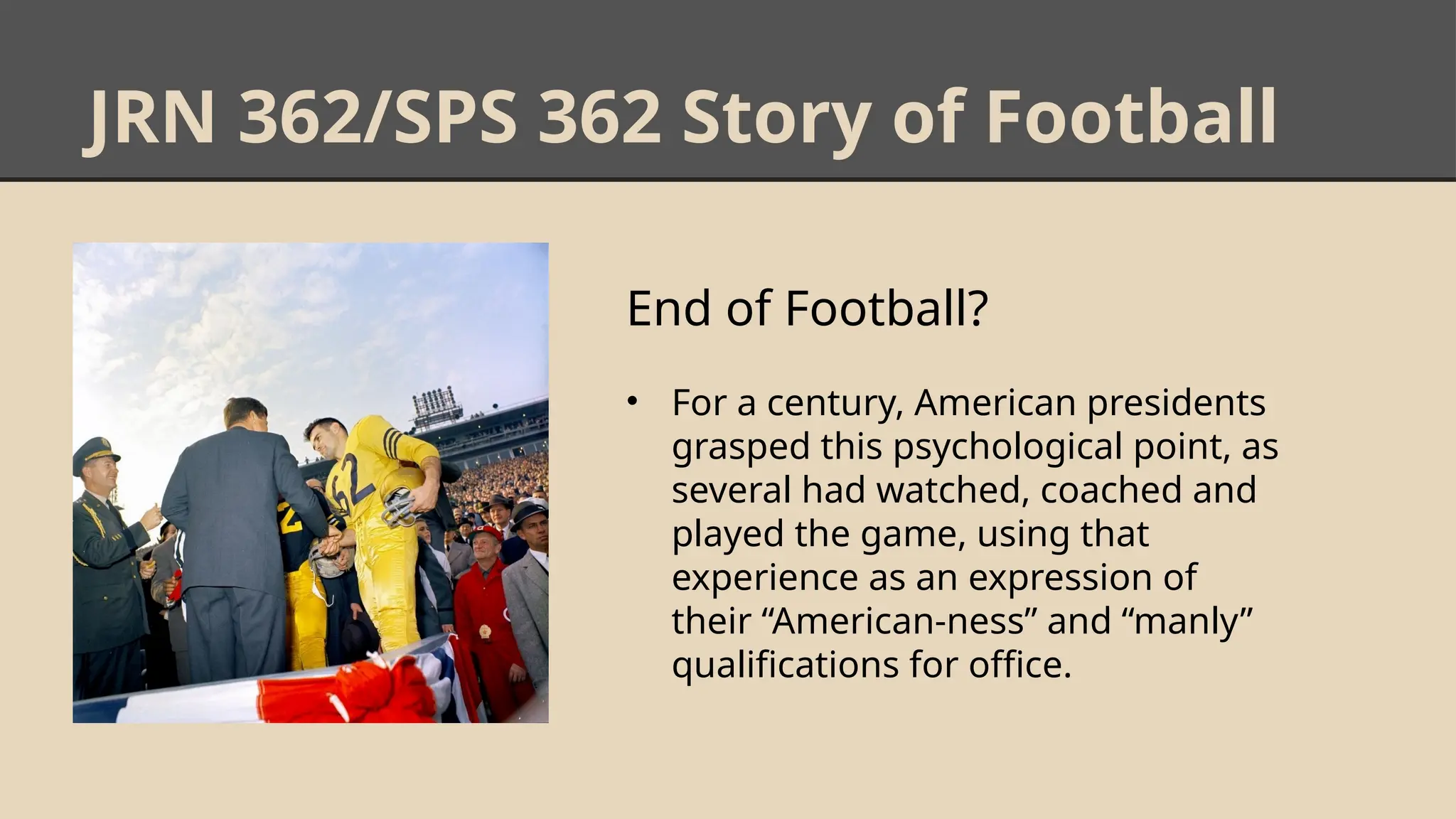
• For a century, American presidents
grasped this psychological point, as
several had watched, coached and
played the game, using that
experience as an expression of
their “American-ness” and “manly”
qualifications for office.
JRN 362/SPS 362 Story of Football
End of Football?
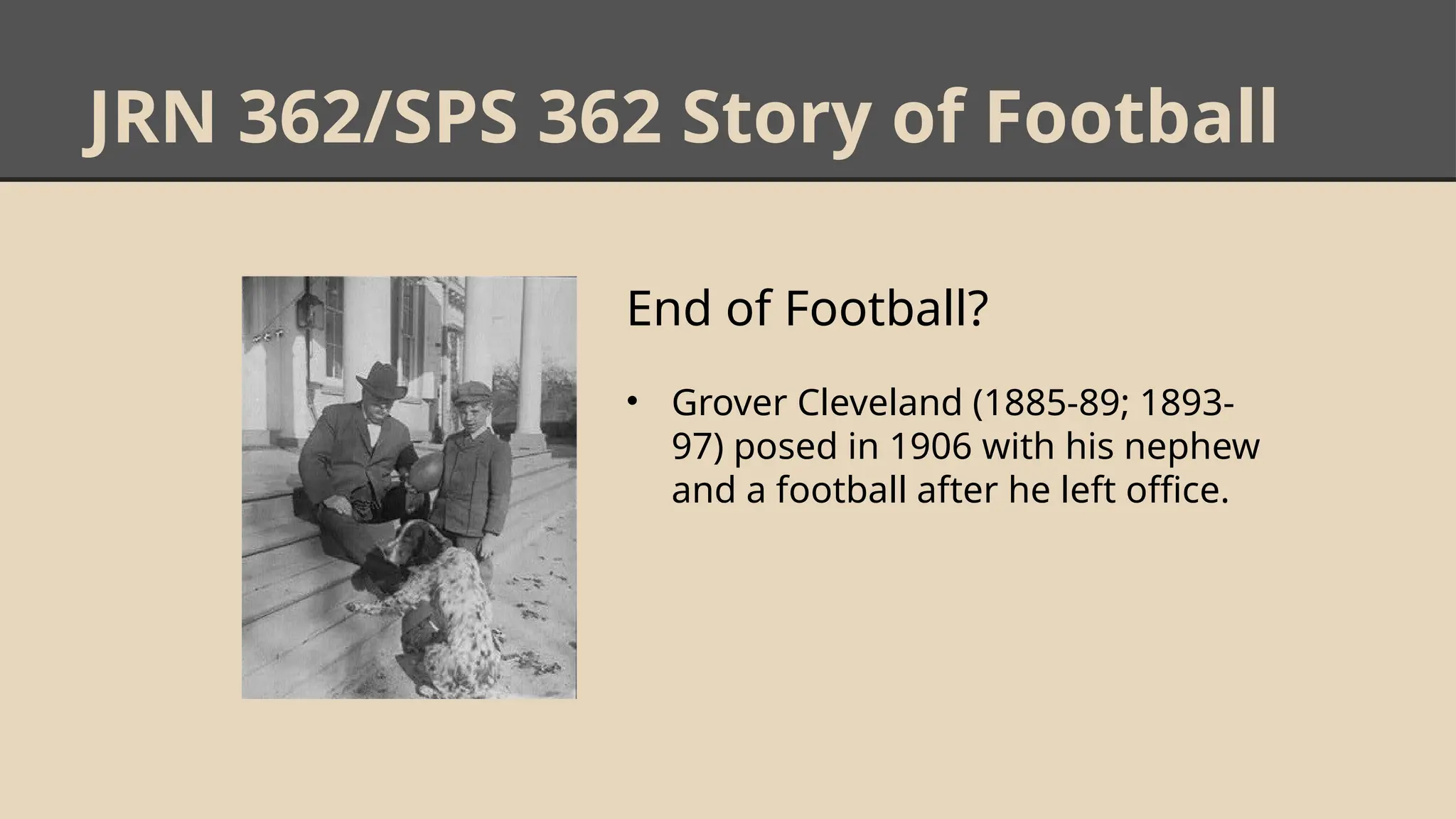
• Grover Cleveland (1885-89; 1893-
97) posed in 1906 with his nephew
and a football after he left office.
JRN 362/SPS 362 Story of Football
End of Football?
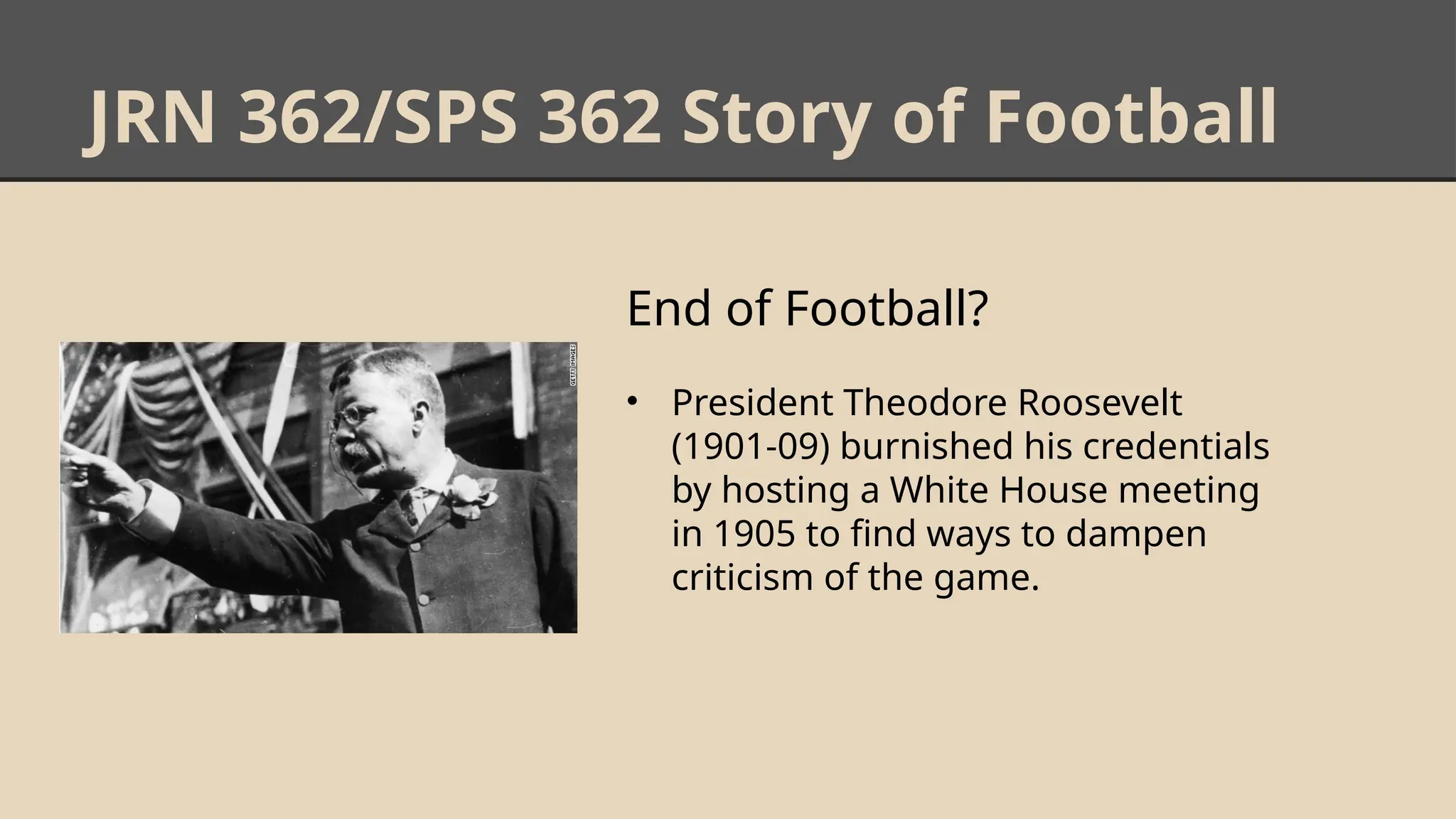
• President Theodore Roosevelt
(1901-09) burnished his credentials
by hosting a White House meeting
in 1905 to find ways to dampen
criticism of the game.
JRN 362/SPS 362 Story of Football
End of Football?
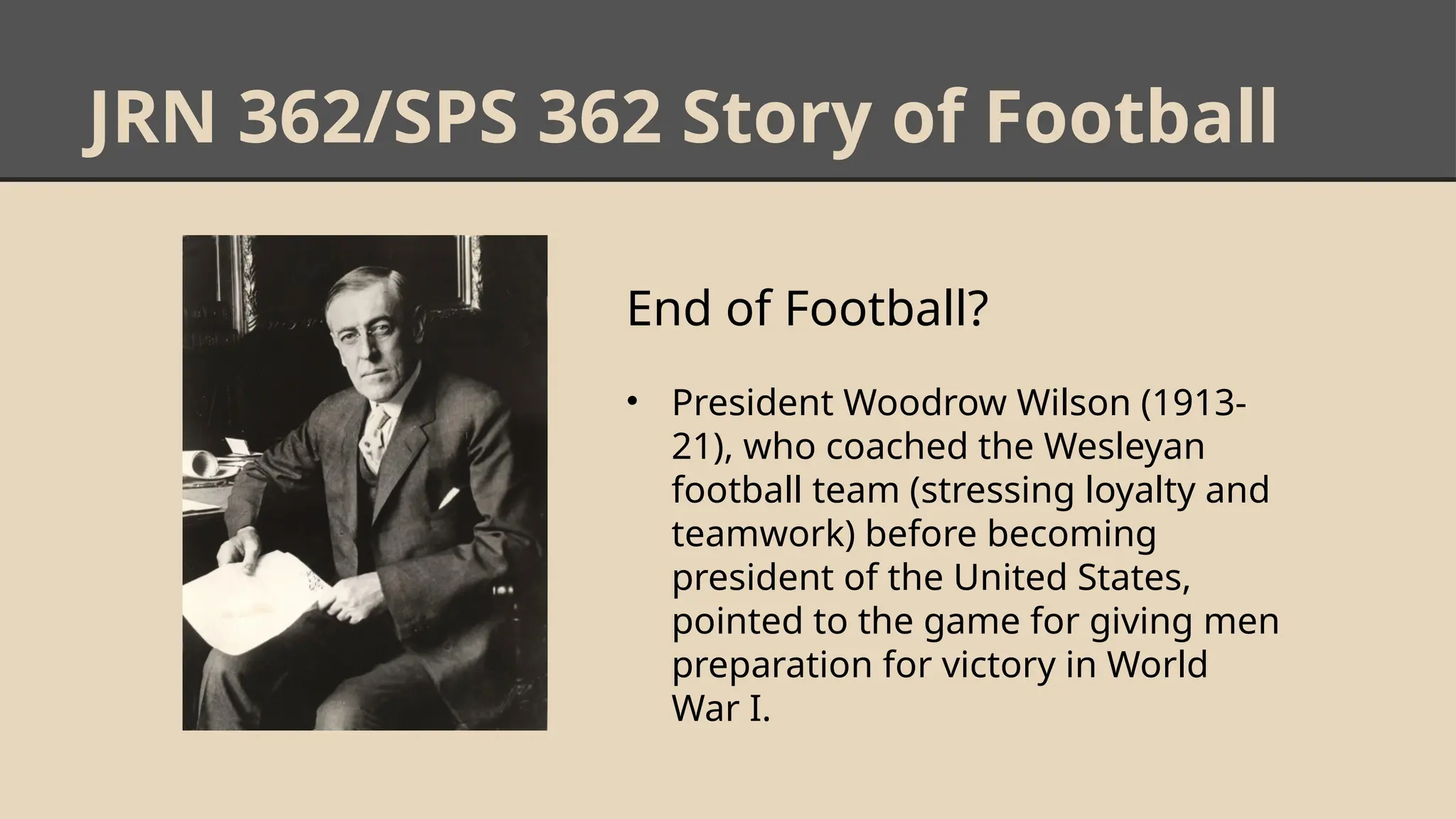
• President Woodrow Wilson (1913-
21), who coached the Wesleyan
football team (stressing loyalty and
teamwork) before becoming
president of the United States,
pointed to the game for giving men
preparation for victory in World
War I.
JRN 362/SPS 362 Story of Football
End of Football?
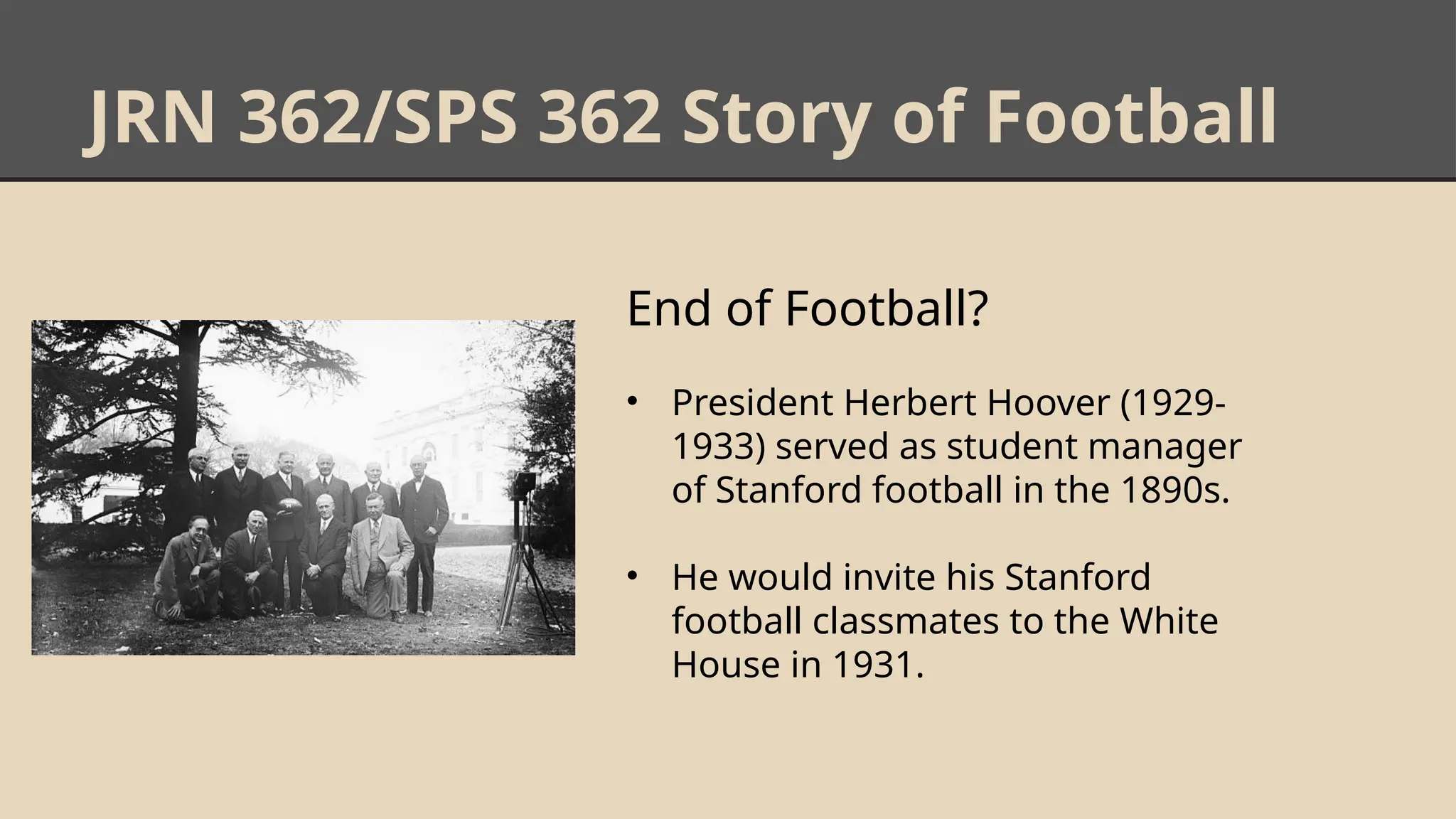
• President Herbert Hoover (1929-
1933) served as student manager
of Stanford football in the 1890s.
• He would invite his Stanford
football classmates to the White
House in 1931.
JRN 362/SPS 362 Story of Football
End of Football?
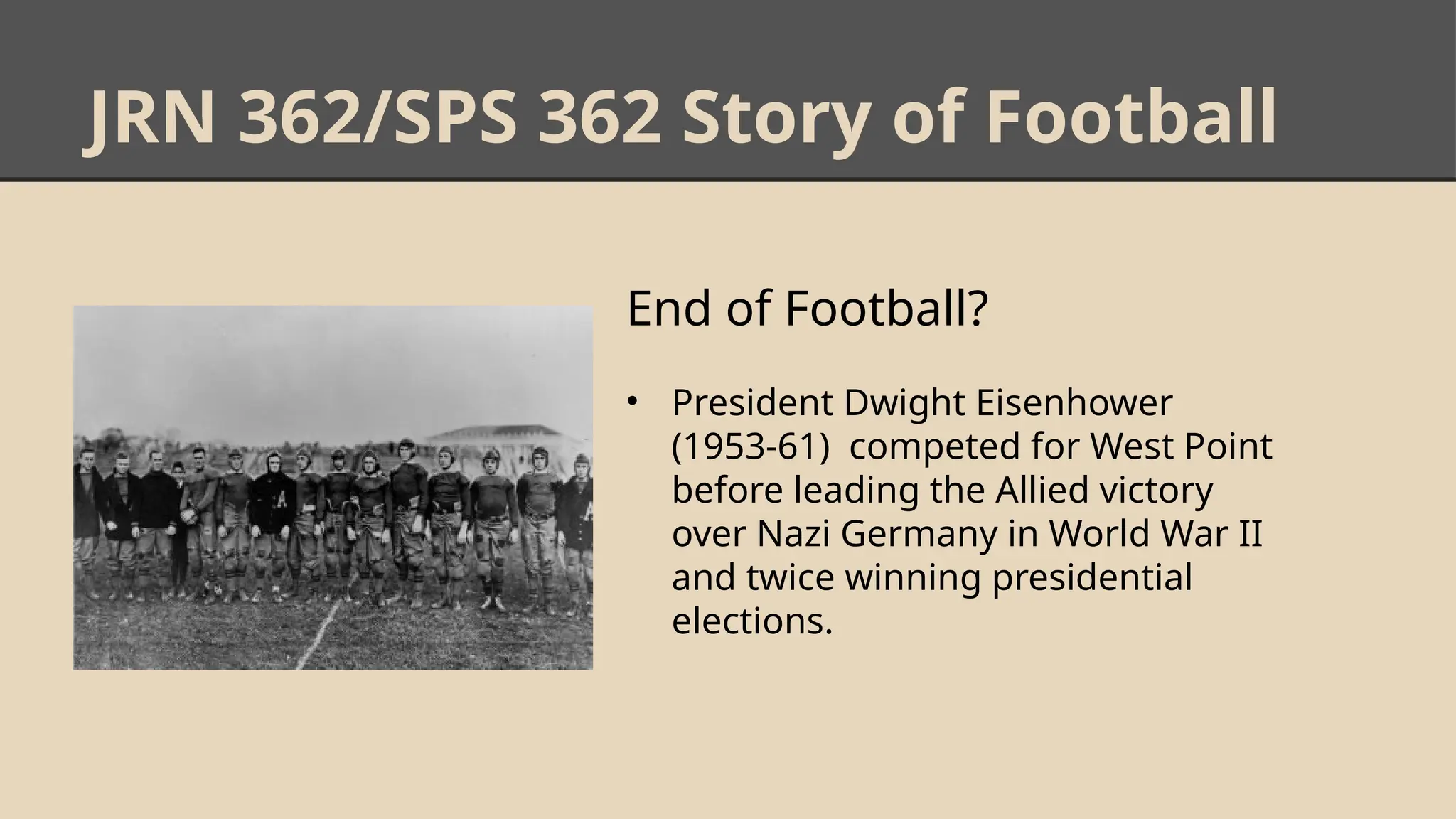
• President Dwight Eisenhower
(1953-61) competed for West Point
before leading the Allied victory
over Nazi Germany in World War II
and twice winning presidential
elections.
JRN 362/SPS 362 Story of Football
End of Football?
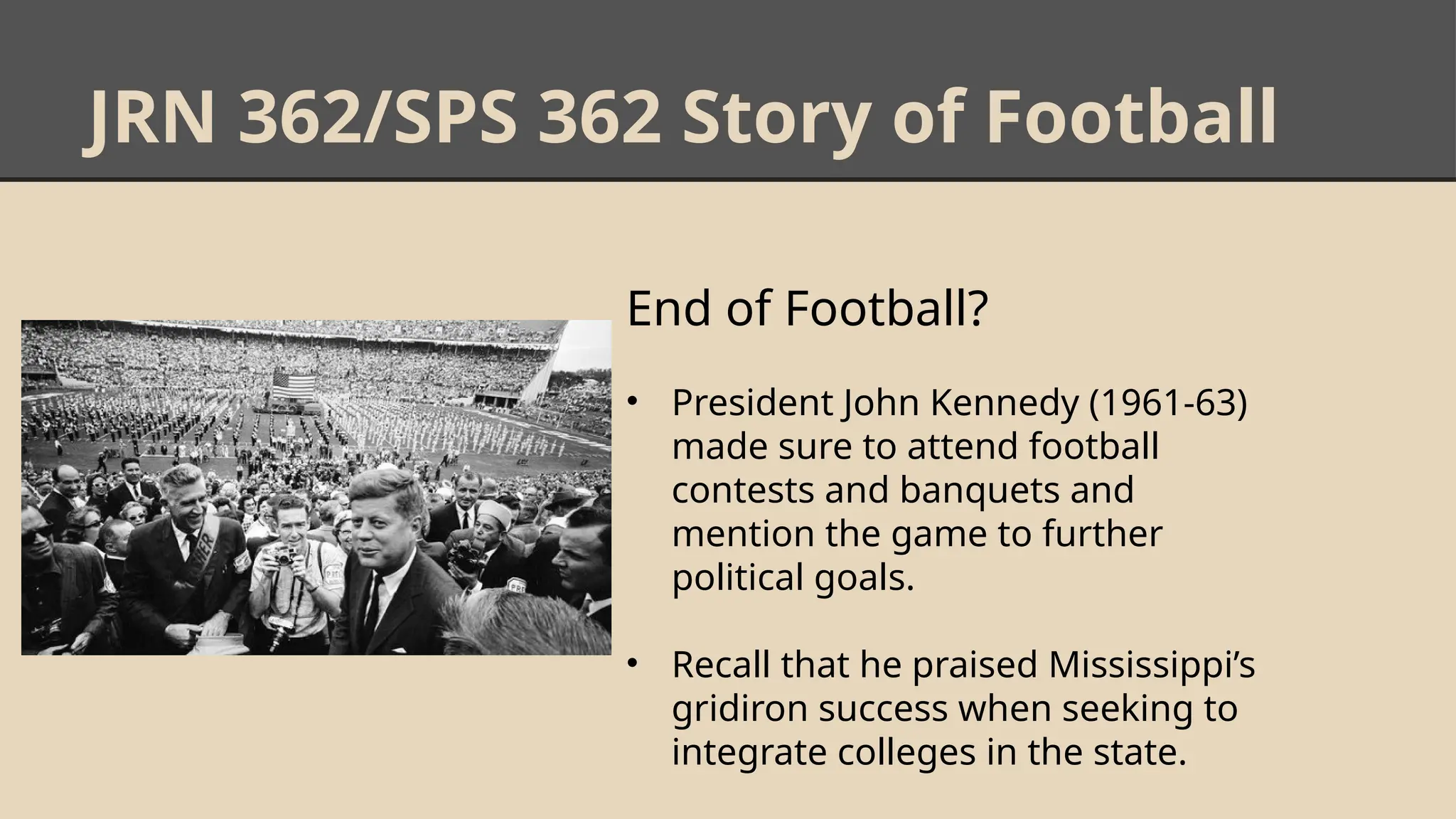
• President John Kennedy (1961-63)
made sure to attend football
contests and banquets and
mention the game to further
political goals.
• Recall that he praised Mississippi’s
gridiron success when seeking to
integrate colleges in the state.
JRN 362/SPS 362 Story of Football
End of Football?
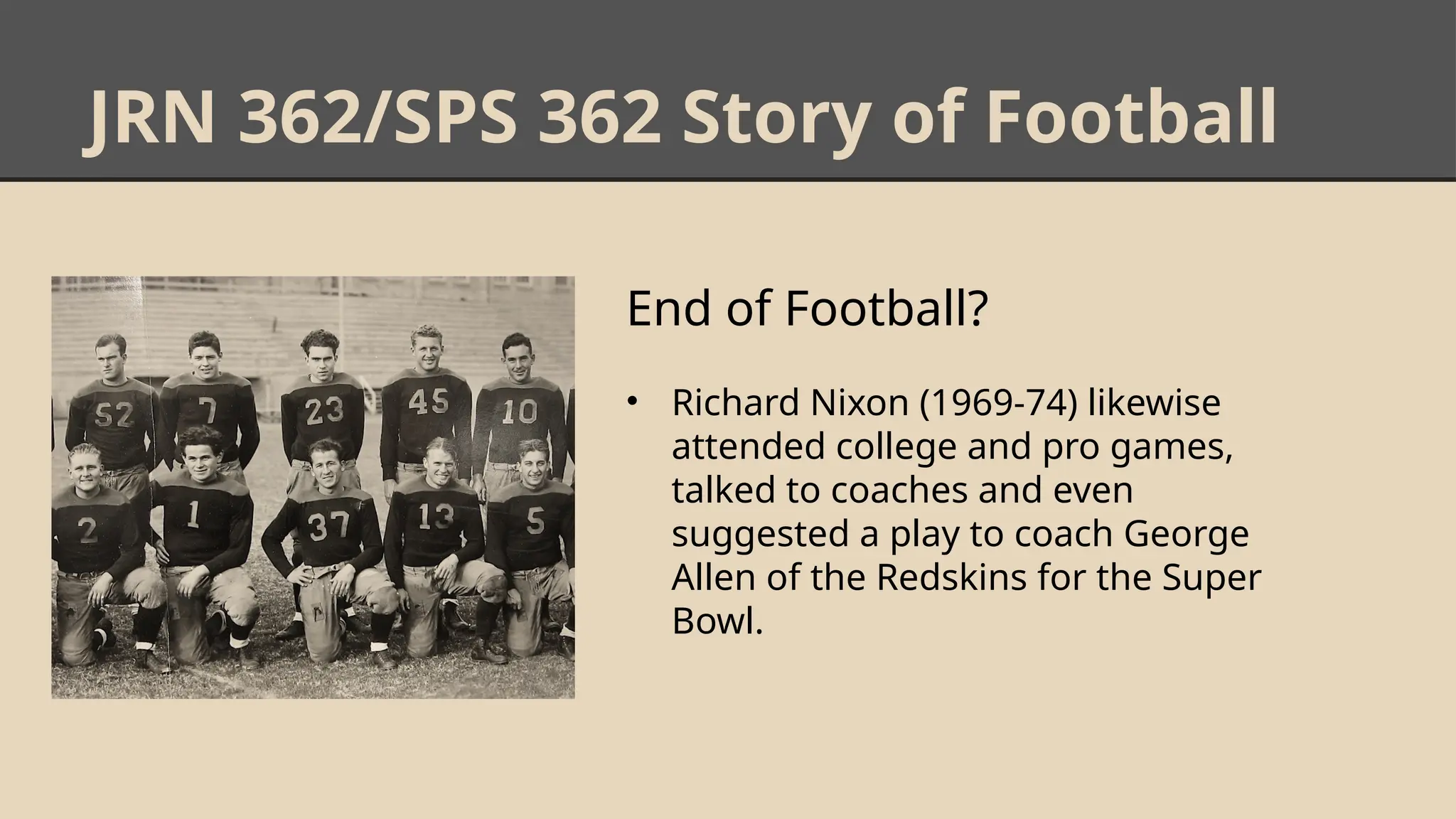
• Richard Nixon (1969-74) likewise
attended college and pro games,
talked to coaches and even
suggested a play to coach George
Allen of the Redskins for the Super
Bowl.
JRN 362/SPS 362 Story of Football
End of Football?
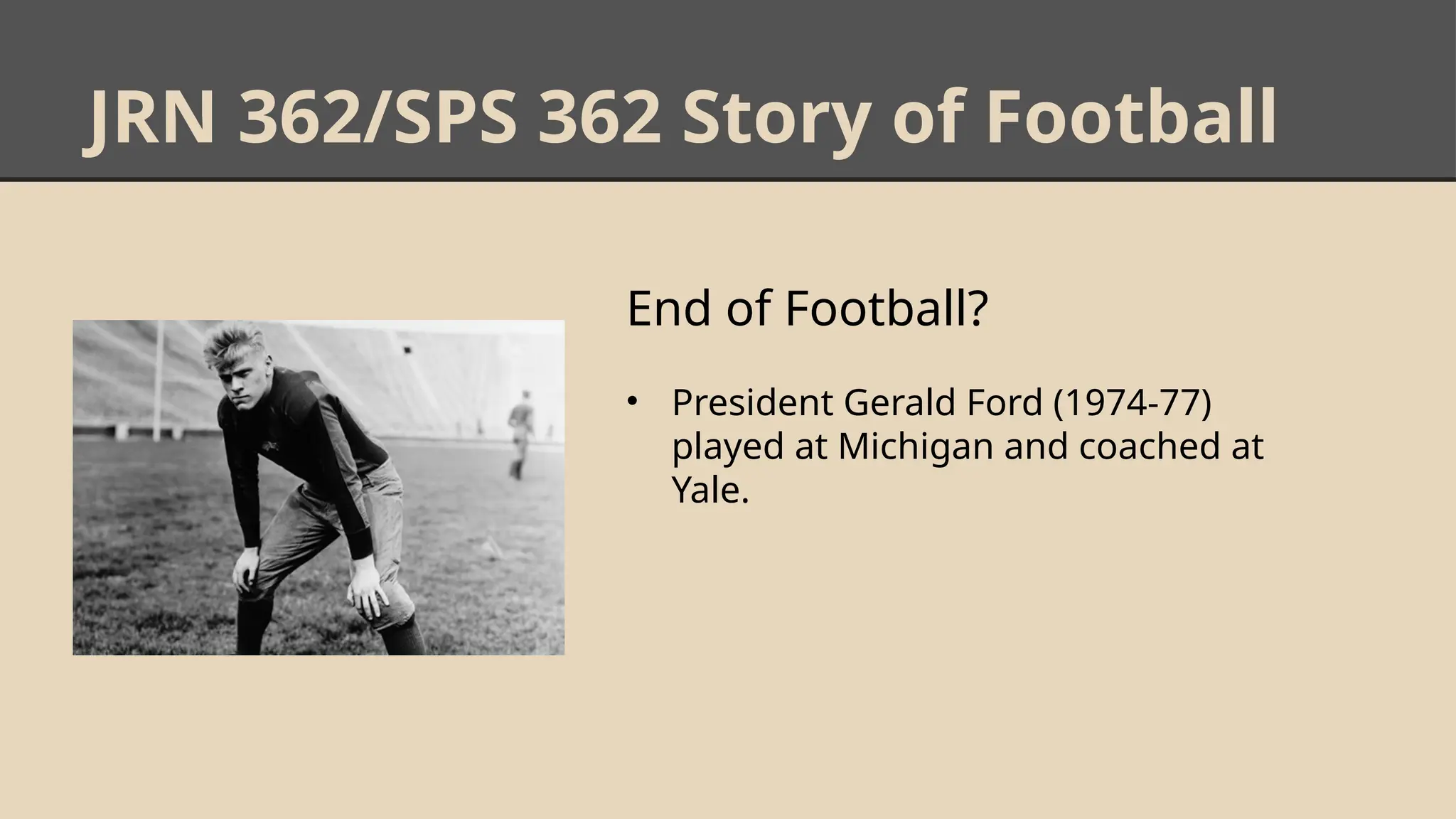
• President Gerald Ford (1974-77)
played at Michigan and coached at
Yale.
JRN 362/SPS 362 Story of Football
End of Football?
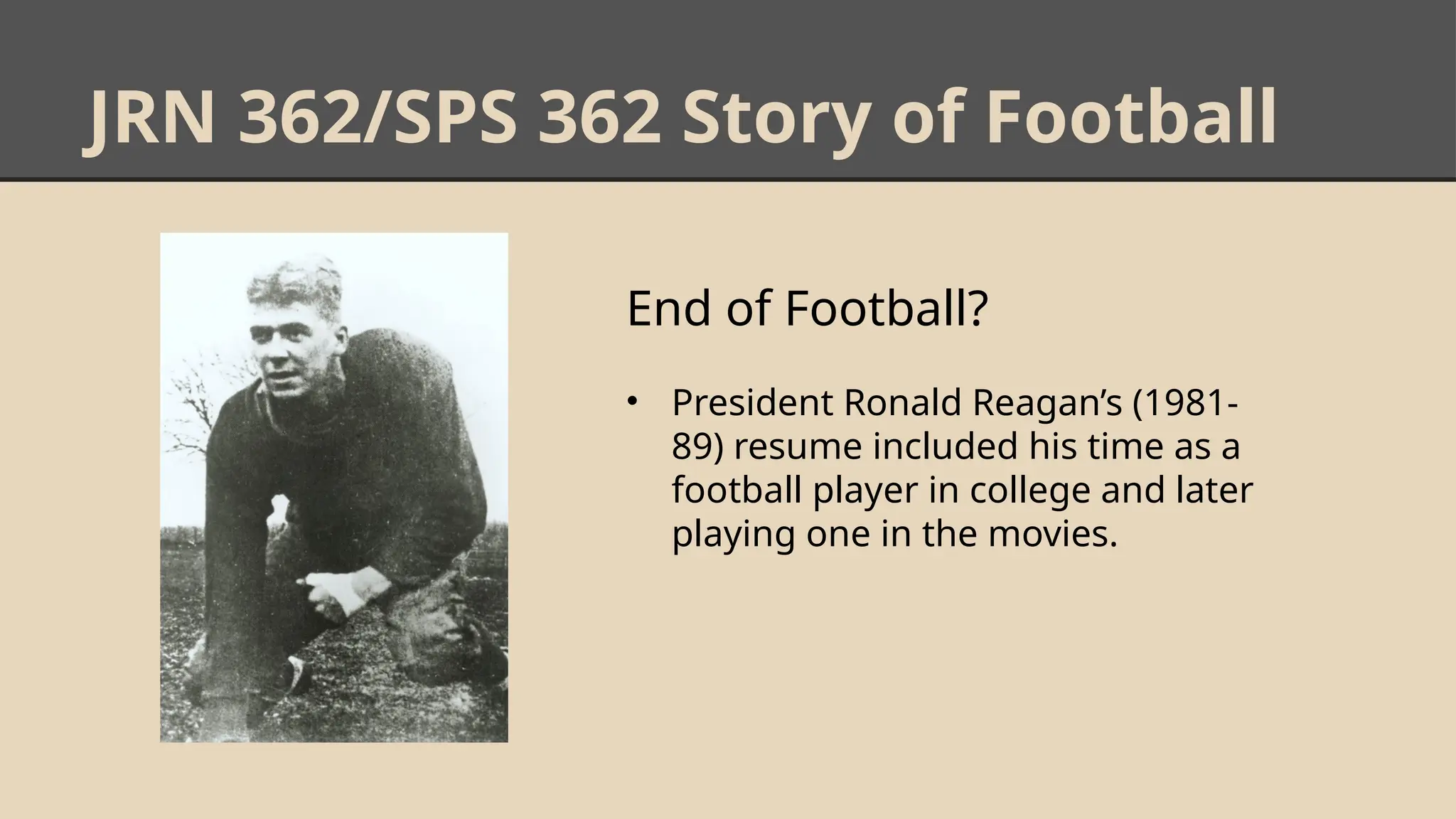
• President Ronald Reagan’s (1981-
89) resume included his time as a
football player in college and later
playing one in the movies.
JRN 362/SPS 362 Story of Football
End of Football?
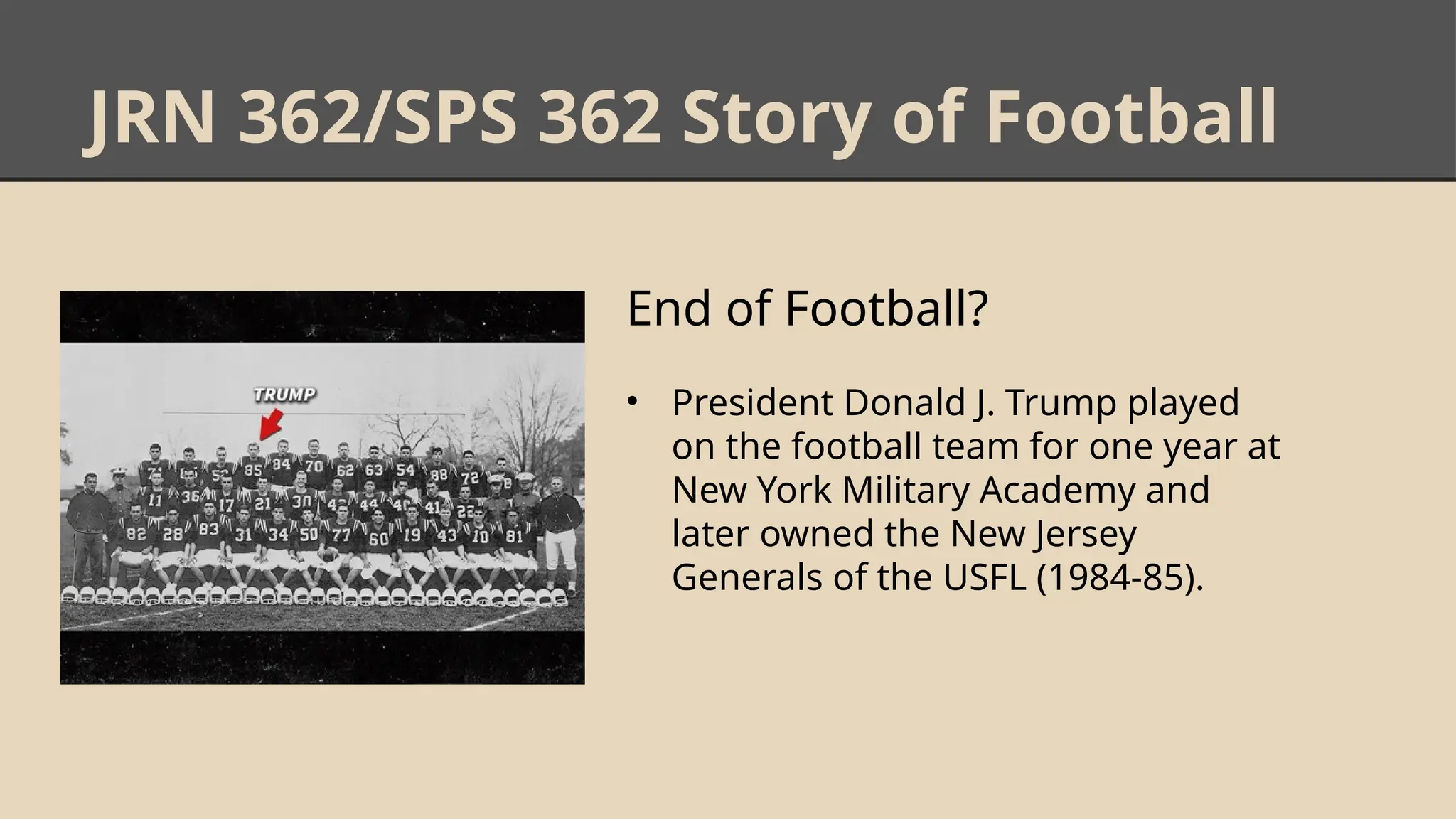
• President Donald J. Trump played
on the football team for one year at
New York Military Academy and
later owned the New Jersey
Generals of the USFL (1984-85).
JRN 362/SPS 362 Story of Football
End of Football?
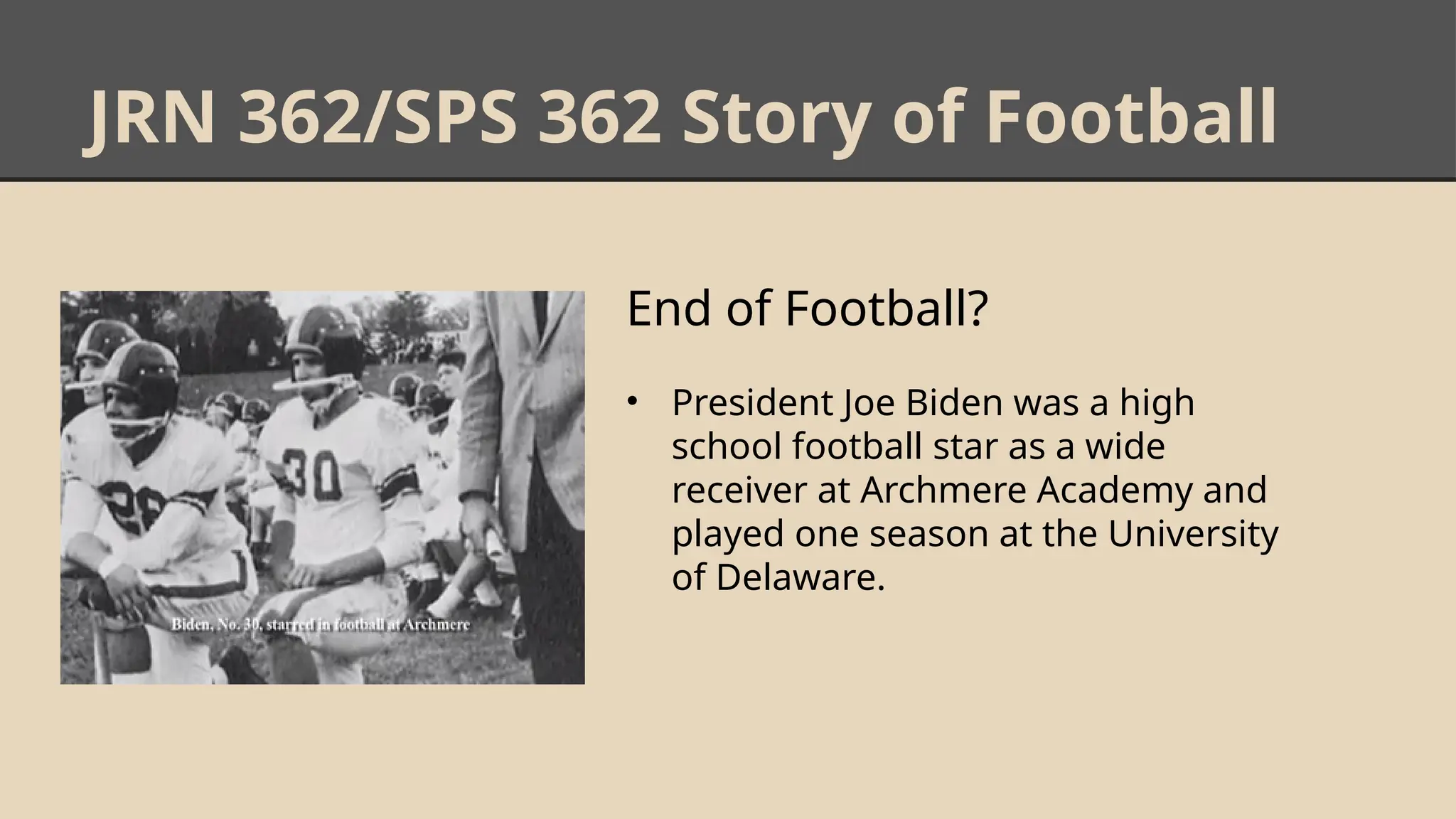
• President Joe Biden was a high
school football star as a wide
receiver at Archmere Academy and
played one season at the University
of Delaware.
JRN 362/SPS 362 Story of Football
End of Football?
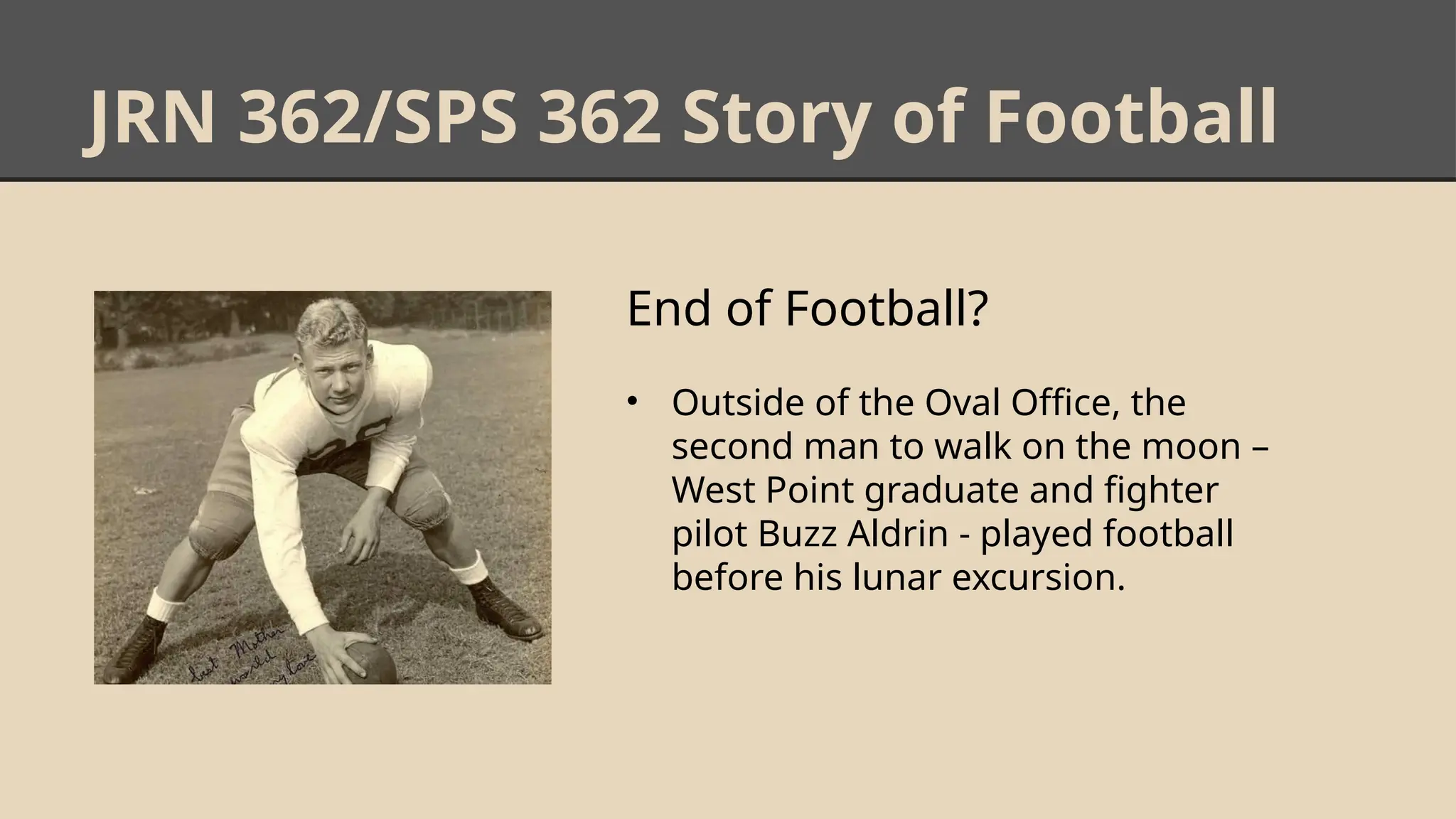
• Outside of the Oval Office, the
second man to walk on the moon –
West Point graduate and fighter
pilot Buzz Aldrin - played football
before his lunar excursion.
JRN 362/SPS 362 Story of Football
End of Football?
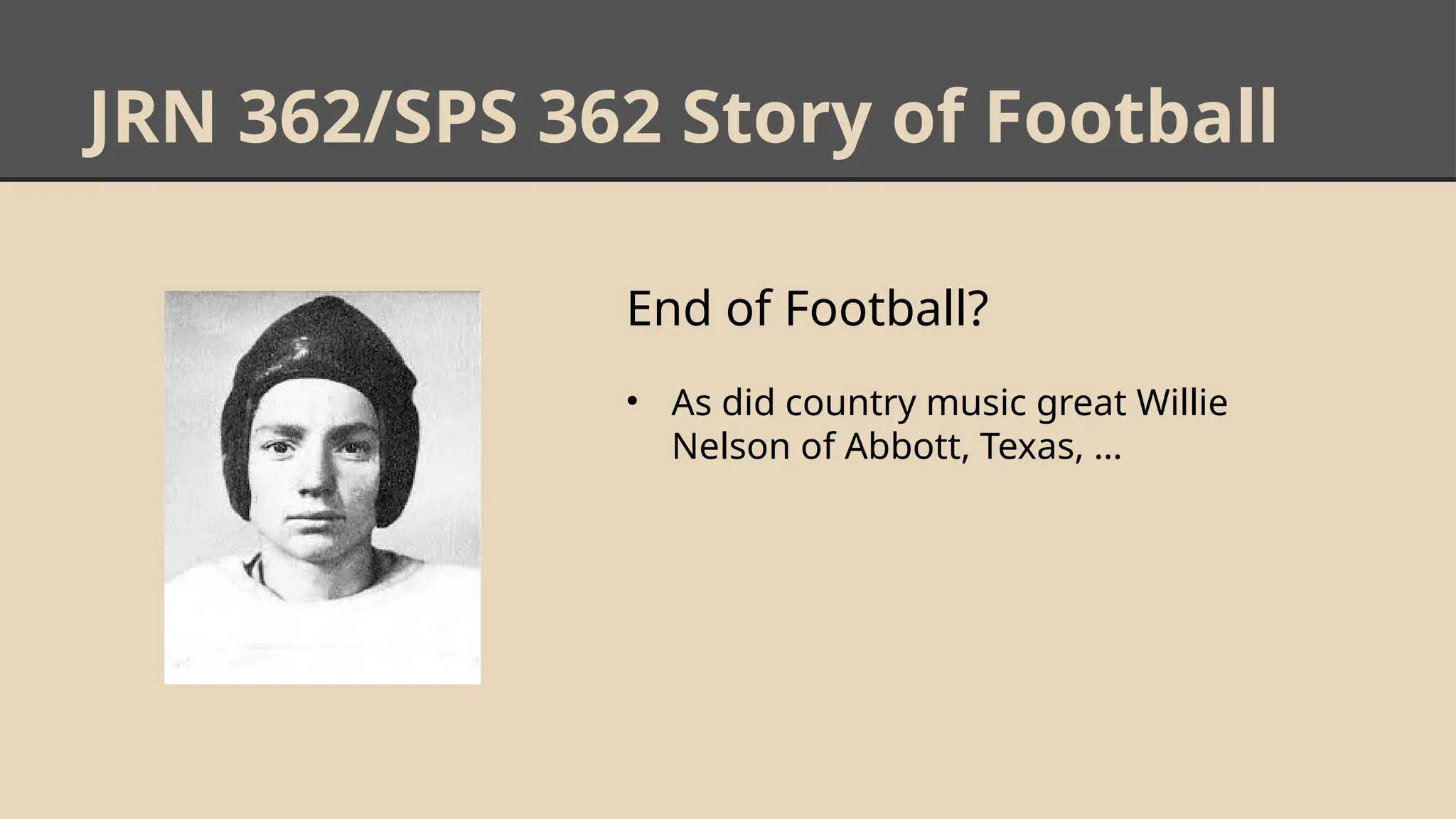
• As did country music great Willie
Nelson of Abbott, Texas, …
JRN 362/SPS 362 Story of Football
End of Football?
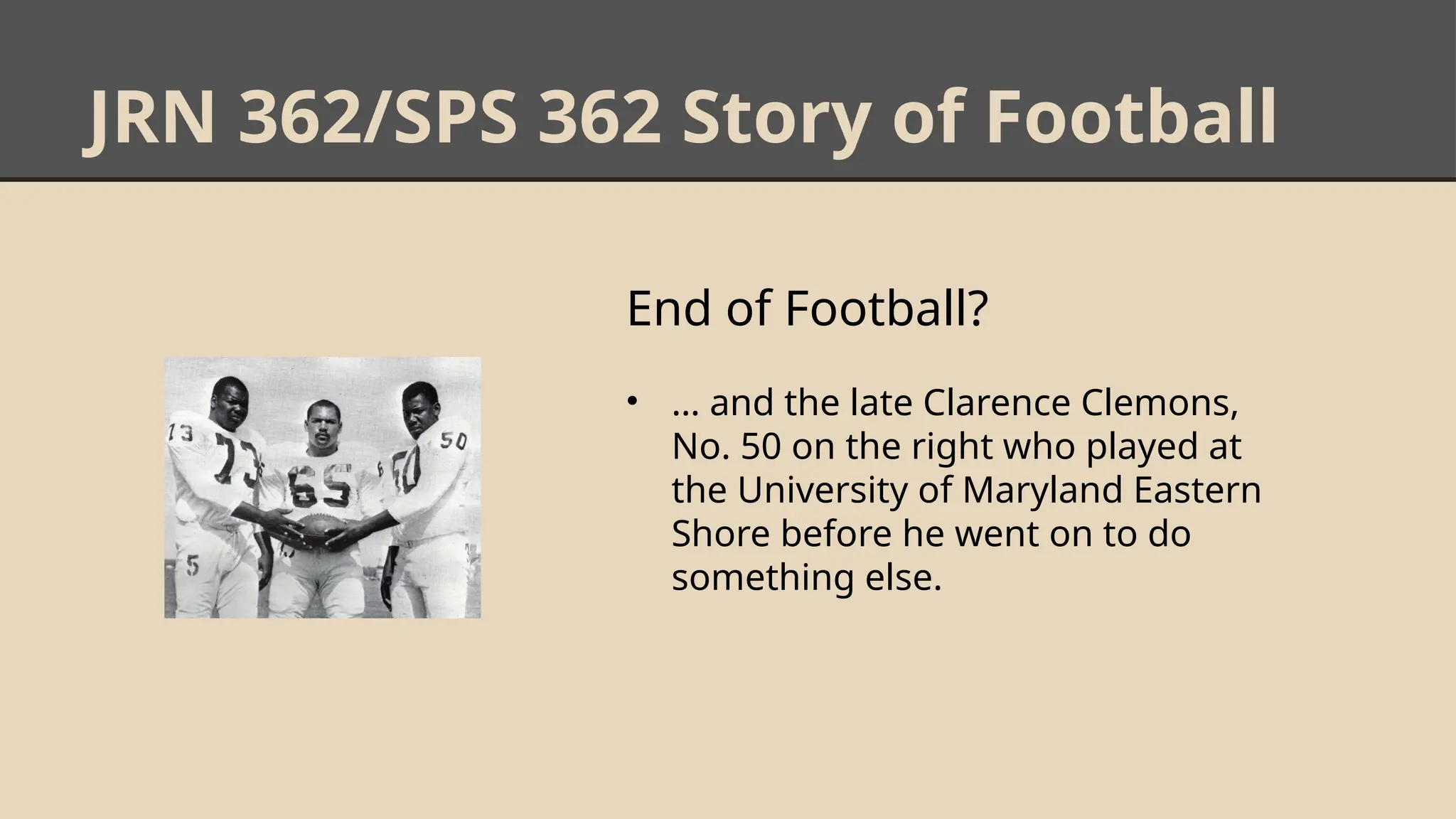
• … and the late Clarence Clemons,
No. 50 on the right who played at
the University of Maryland Eastern
Shore before he went on to do
something else.
JRN 362/SPS 362 Story of Football
End of Football?
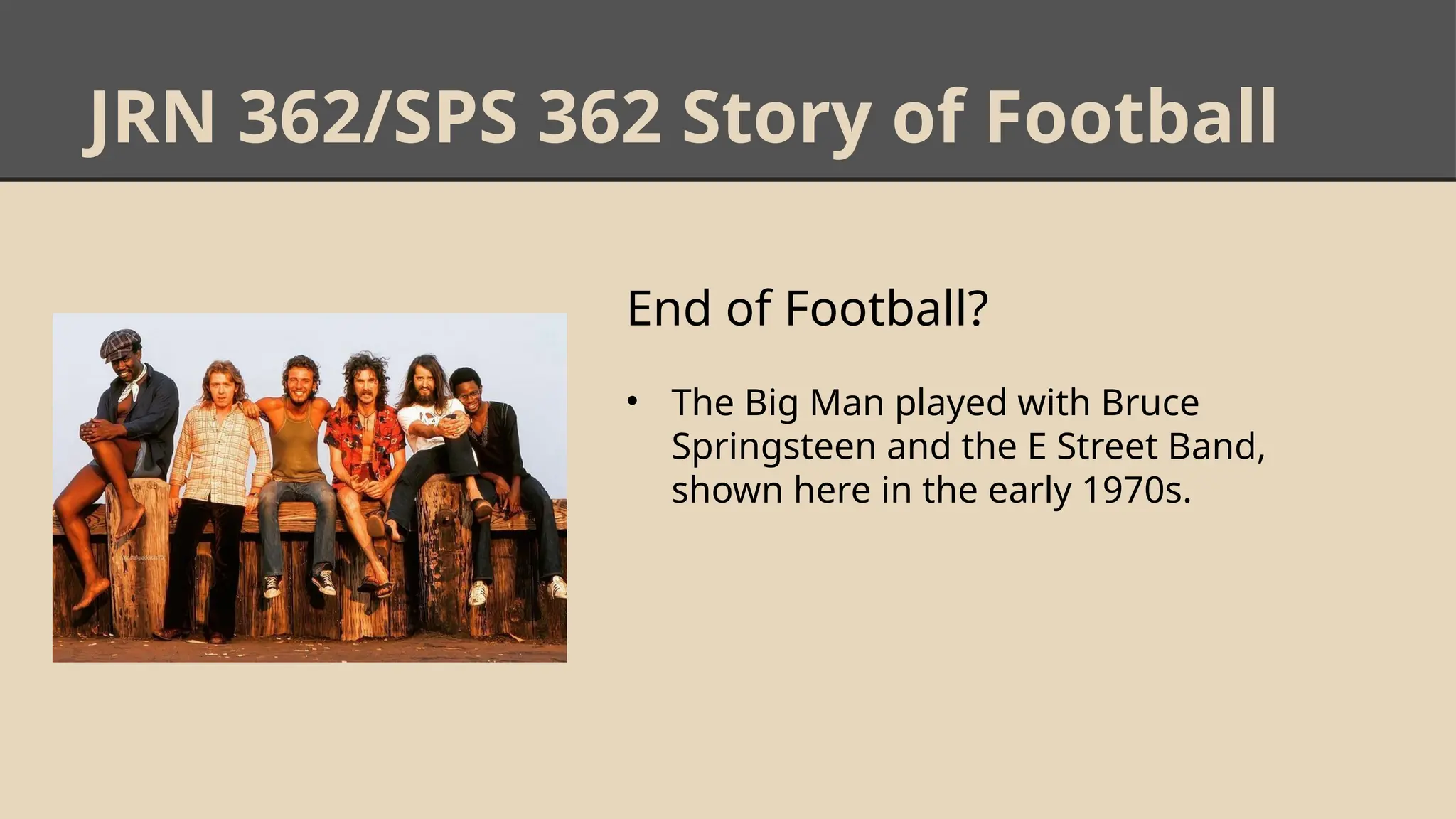
• The Big Man played with Bruce
Springsteen and the E Street Band,
shown here in the early 1970s.
JRN 362/SPS 362 Story of Football
End of Football?
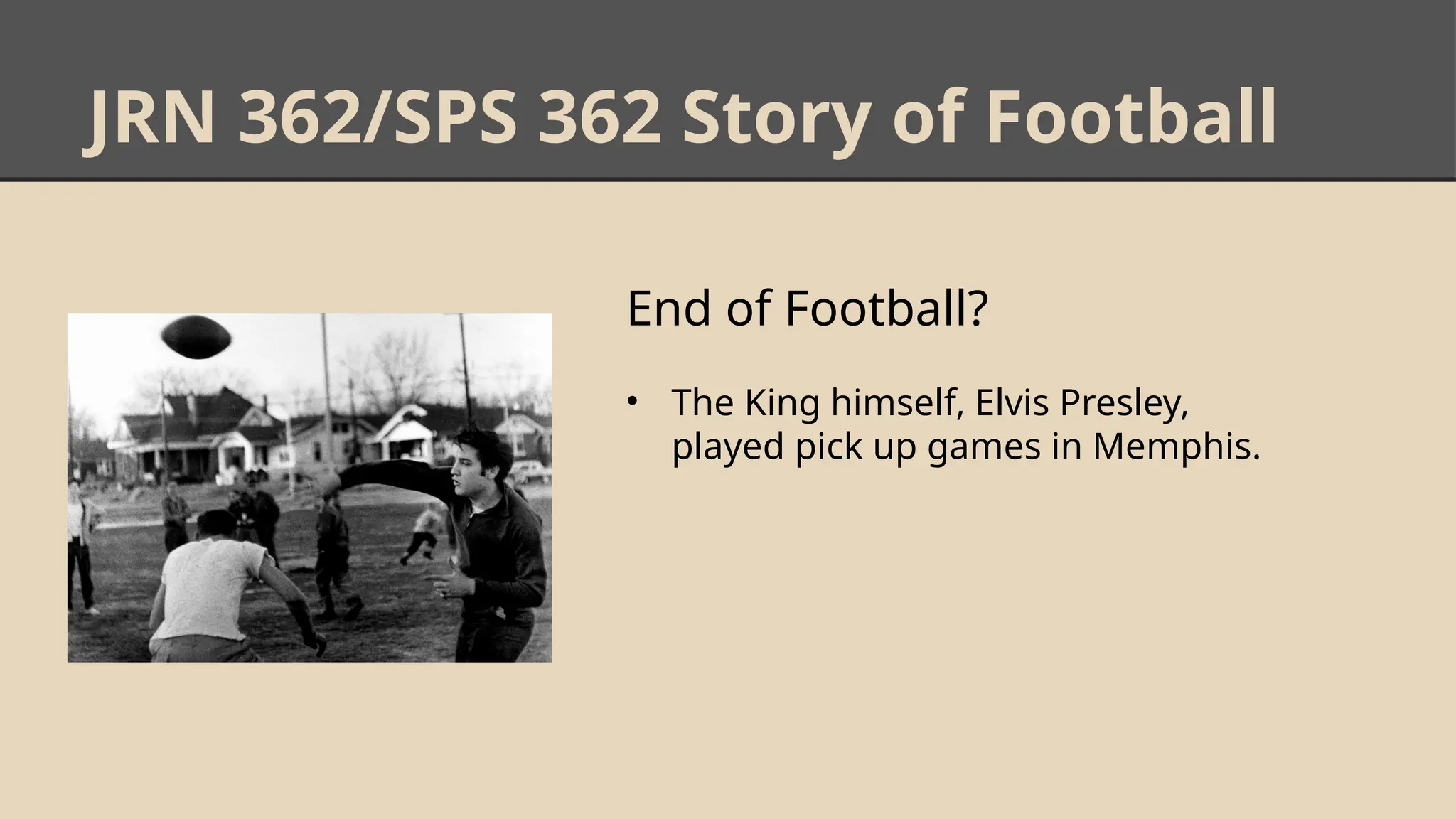
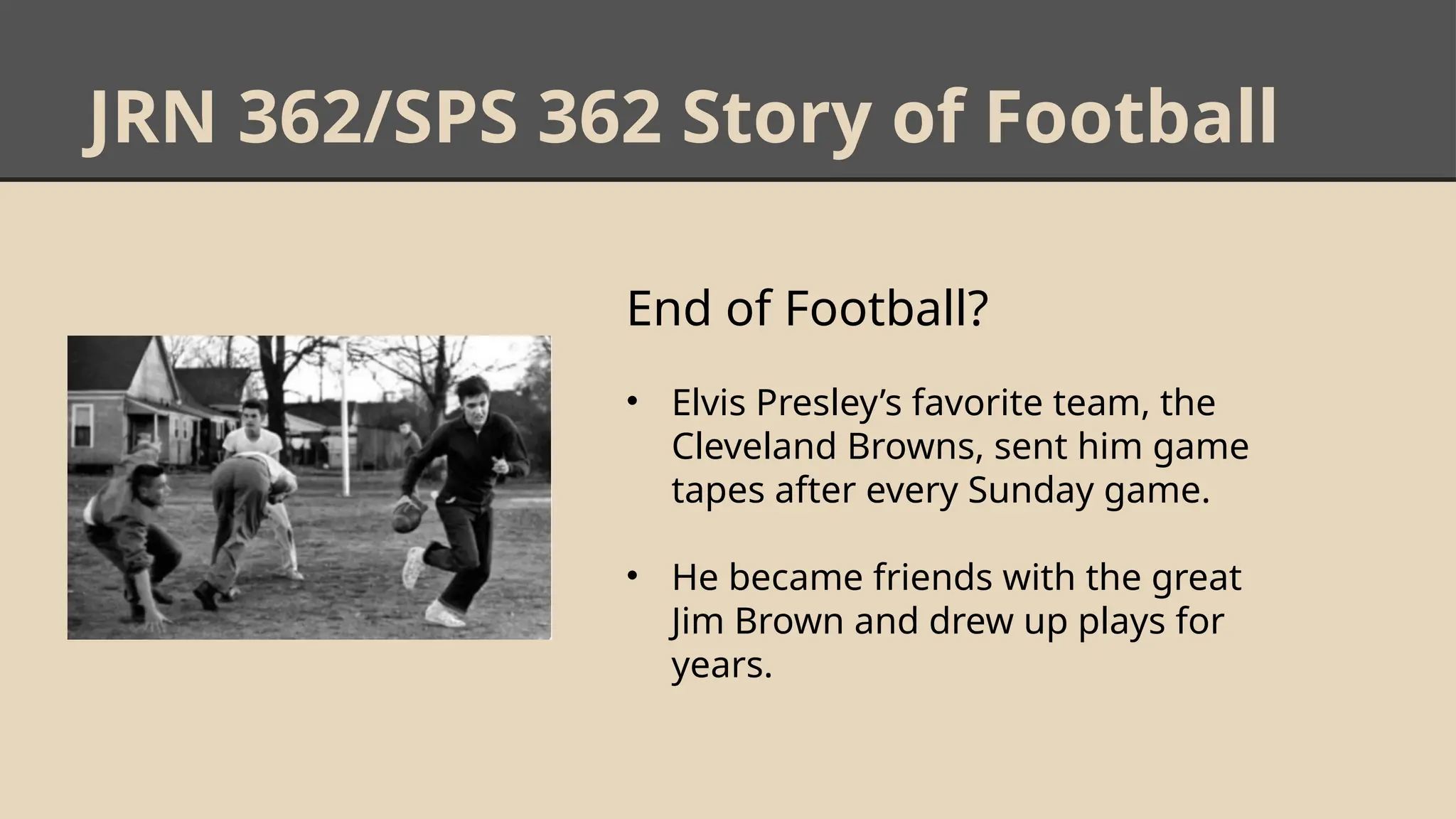
• The King himself, Elvis Presley,
played pick up games in Memphis.
JRN 362/SPS 362 Story of Football
End of Football?
• Elvis Presley’s favorite team, the
Cleveland Browns, sent him game
tapes after every Sunday game.
• He became friends with the great
Jim Brown and drew up plays for
years.
JRN 362/SPS 362 Story of Football
End of Football?
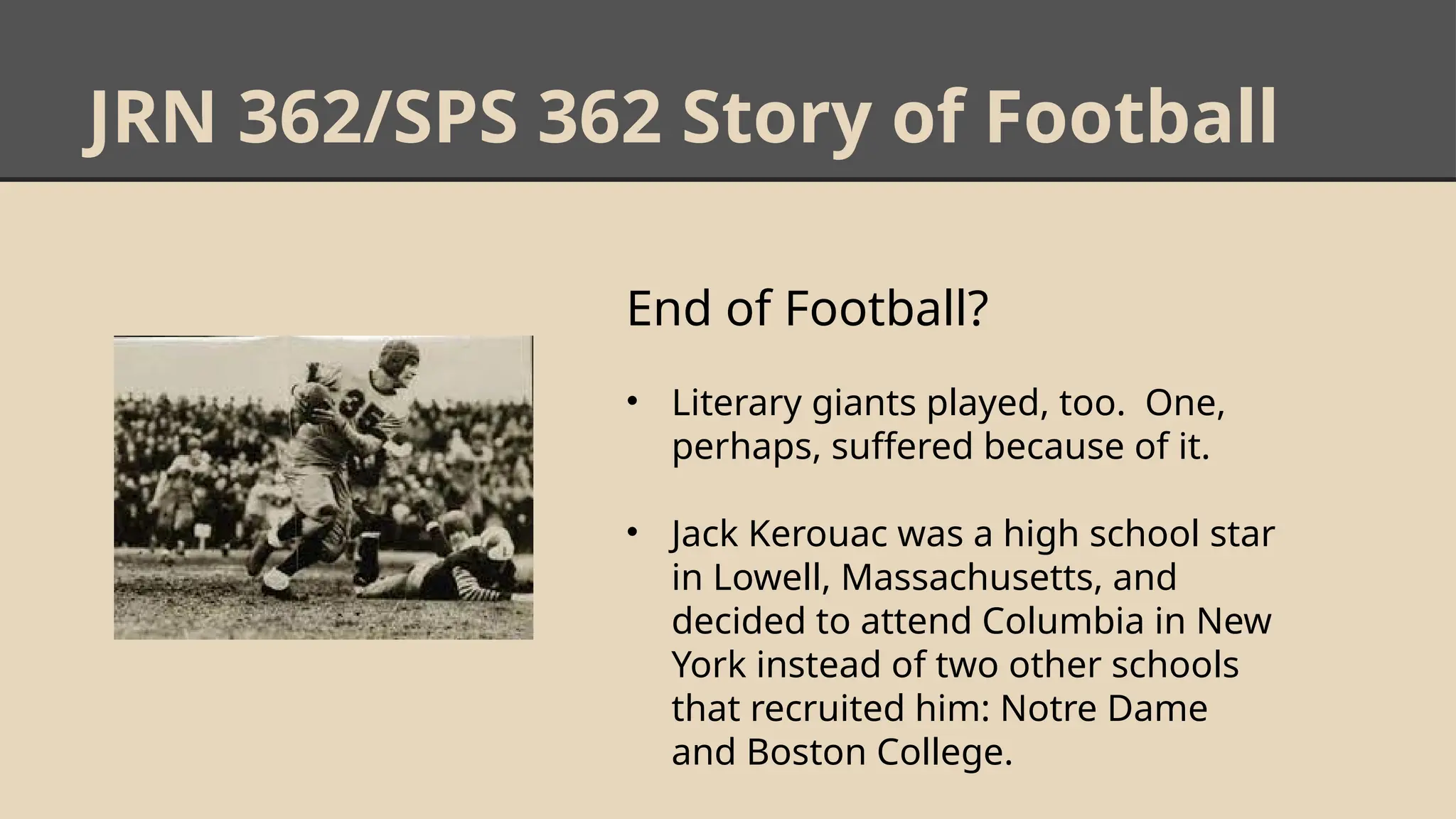
• Literary giants played, too. One,
perhaps, suffered because of it.
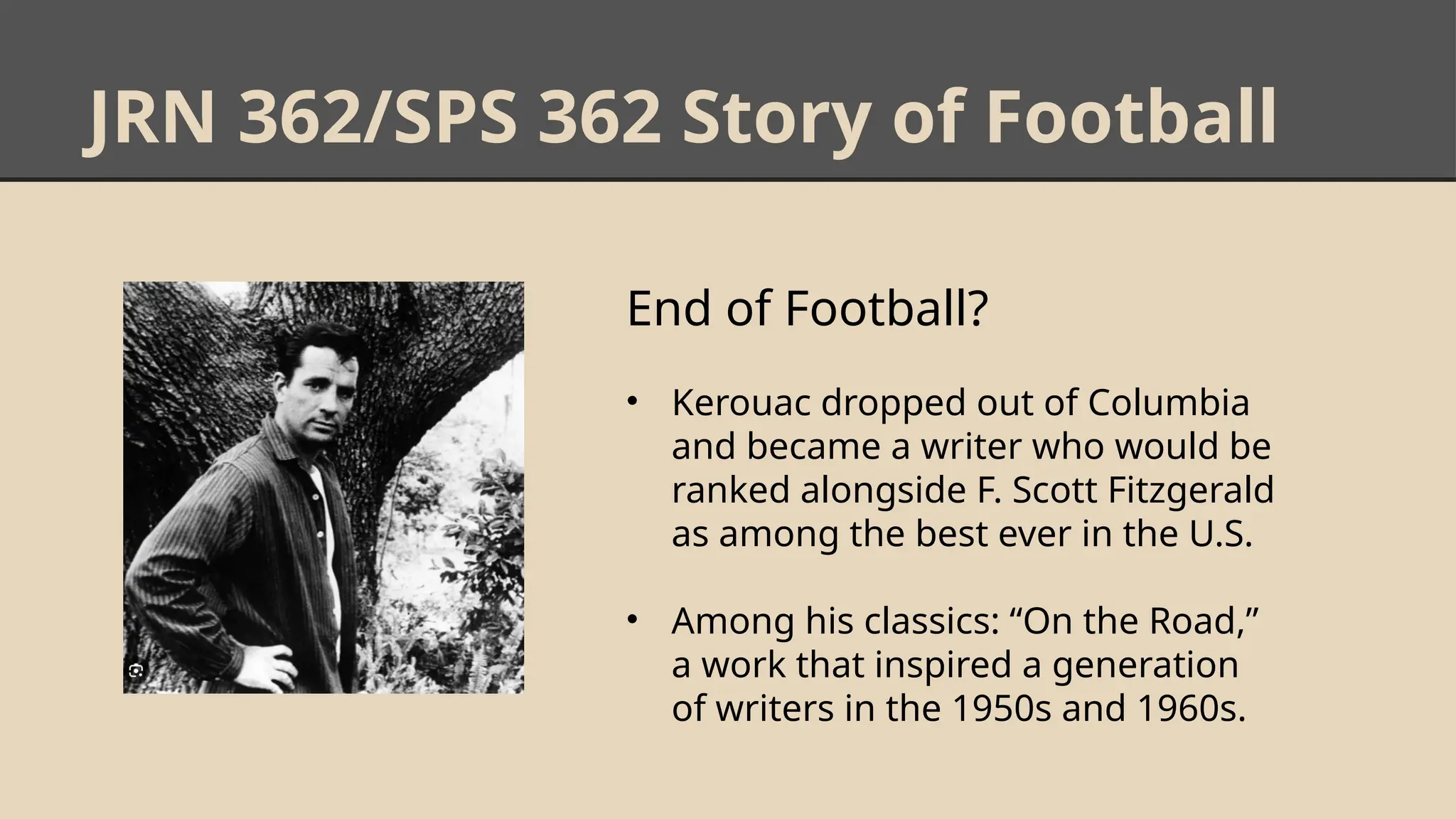
• Jack Kerouac was a high school star
in Lowell, Massachusetts, and
decided to attend Columbia in New
York instead of two other schools
that recruited him: Notre Dame
and Boston College.
JRN 362/SPS 362 Story of Football
End of Football?
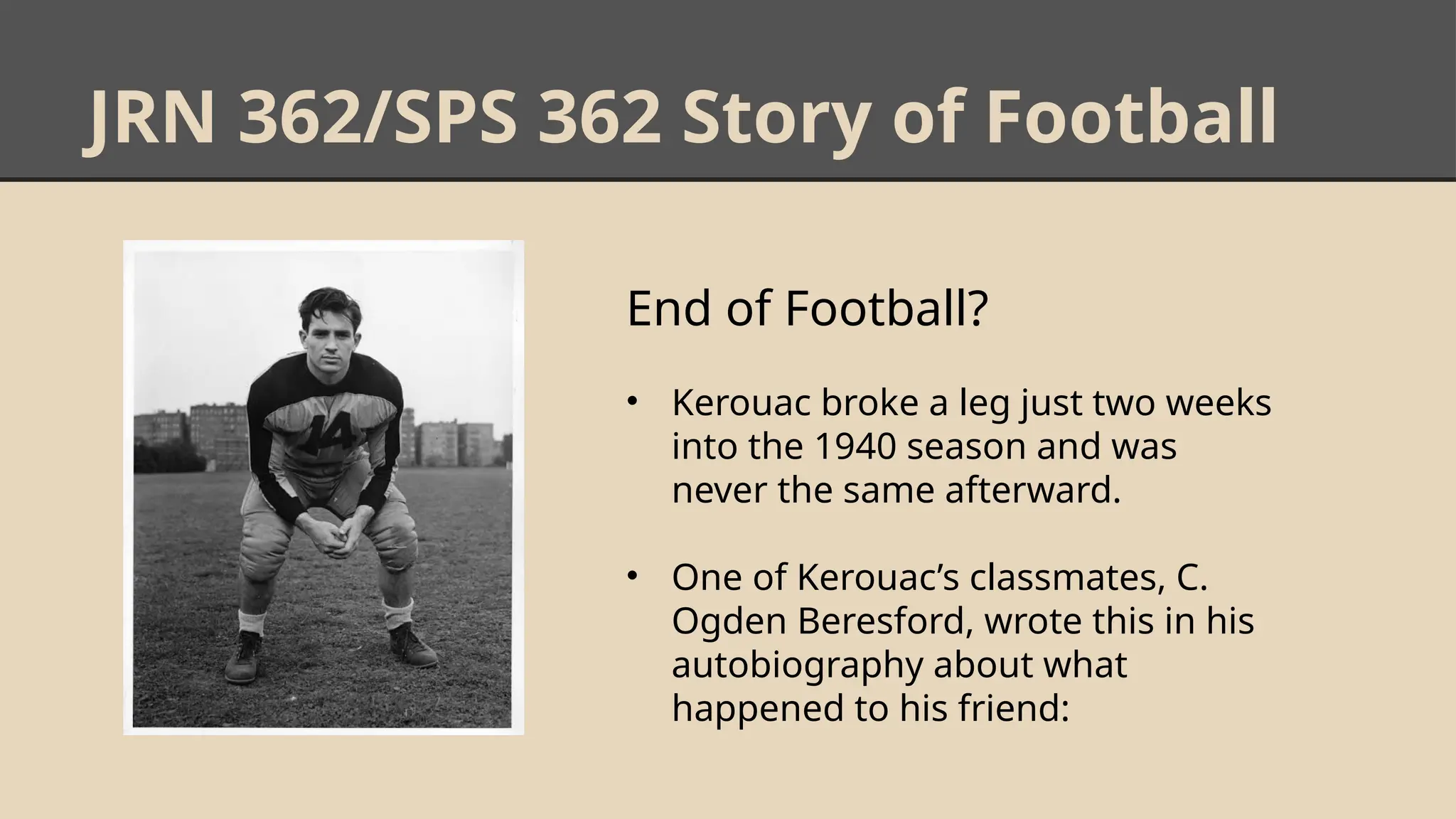
• Kerouac broke a leg just two weeks
into the 1940 season and was
never the same afterward.
• One of Kerouac’s classmates, C.
Ogden Beresford, wrote this in his
autobiography about what
happened to his friend:
JRN 362/SPS 362 Story of Football
End of Football?
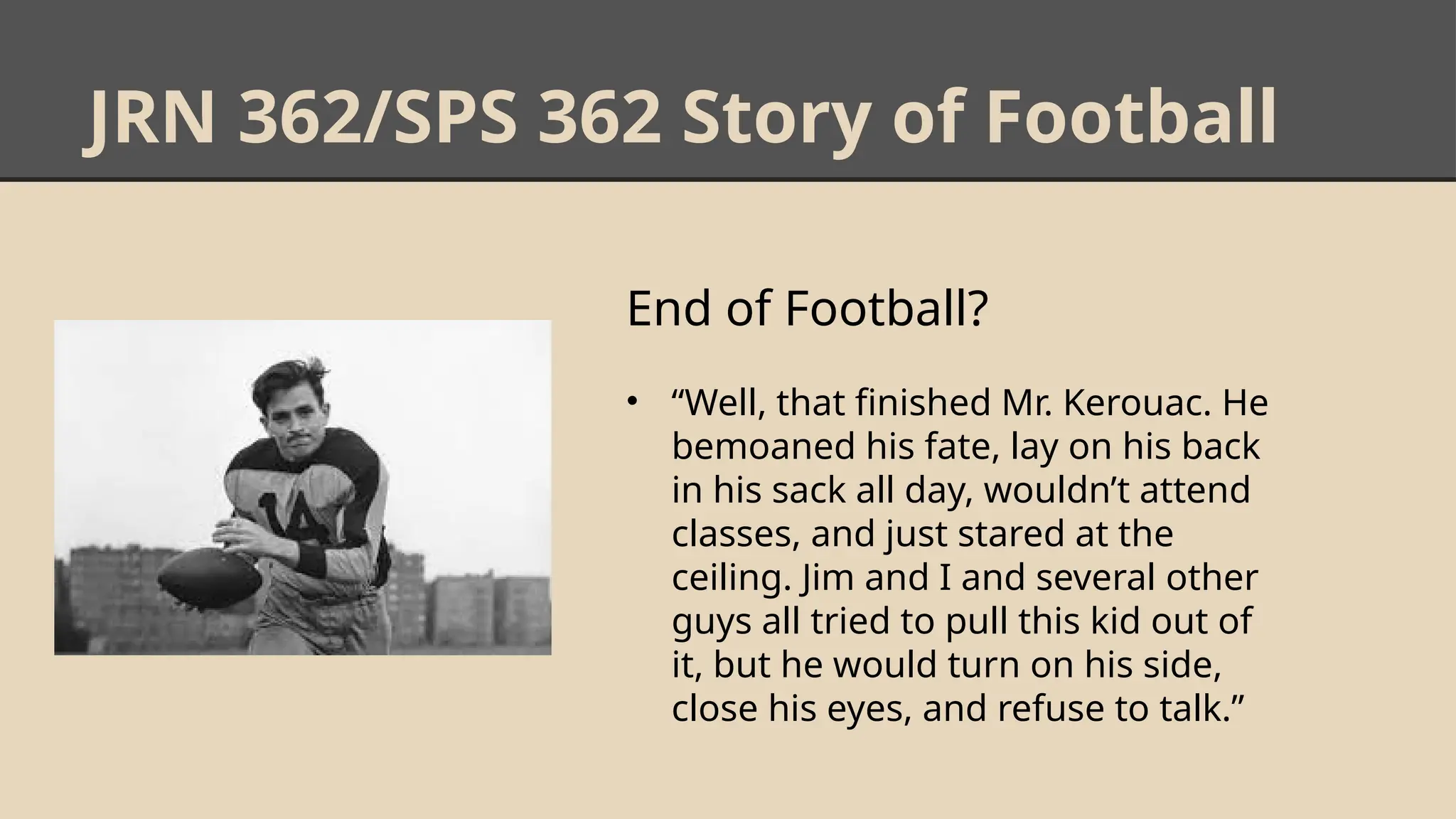
• “Well, that finished Mr. Kerouac. He
bemoaned his fate, lay on his back
in his sack all day, wouldn’t attend
classes, and just stared at the
ceiling. Jim and I and several other
guys all tried to pull this kid out of
it, but he would turn on his side,
close his eyes, and refuse to talk.”
JRN 362/SPS 362 Story of Football
End of Football?
• Kerouac dropped out of Columbia
and became a writer who would be
ranked alongside F. Scott Fitzgerald
as among the best ever in the U.S.
• Among his classics: “On the Road,”
a work that inspired a generation
of writers in the 1950s and 1960s.
JRN 362/SPS 362 Story of Football
End of Football?
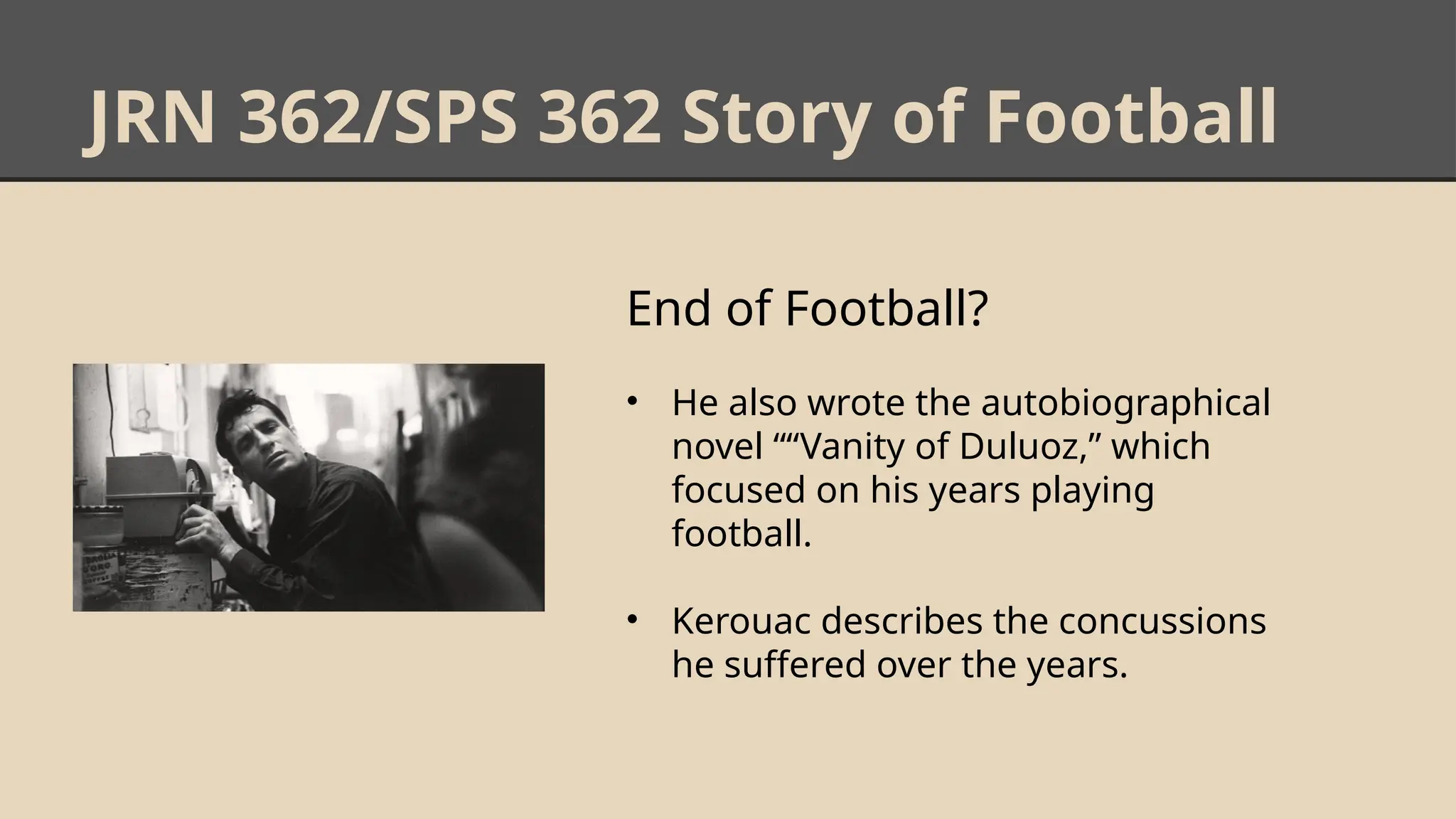
• He also wrote the autobiographical
novel ““Vanity of Duluoz,” which
focused on his years playing
football.
• Kerouac describes the concussions
he suffered over the years.
JRN 362/SPS 362 Story of Football
End of Football?
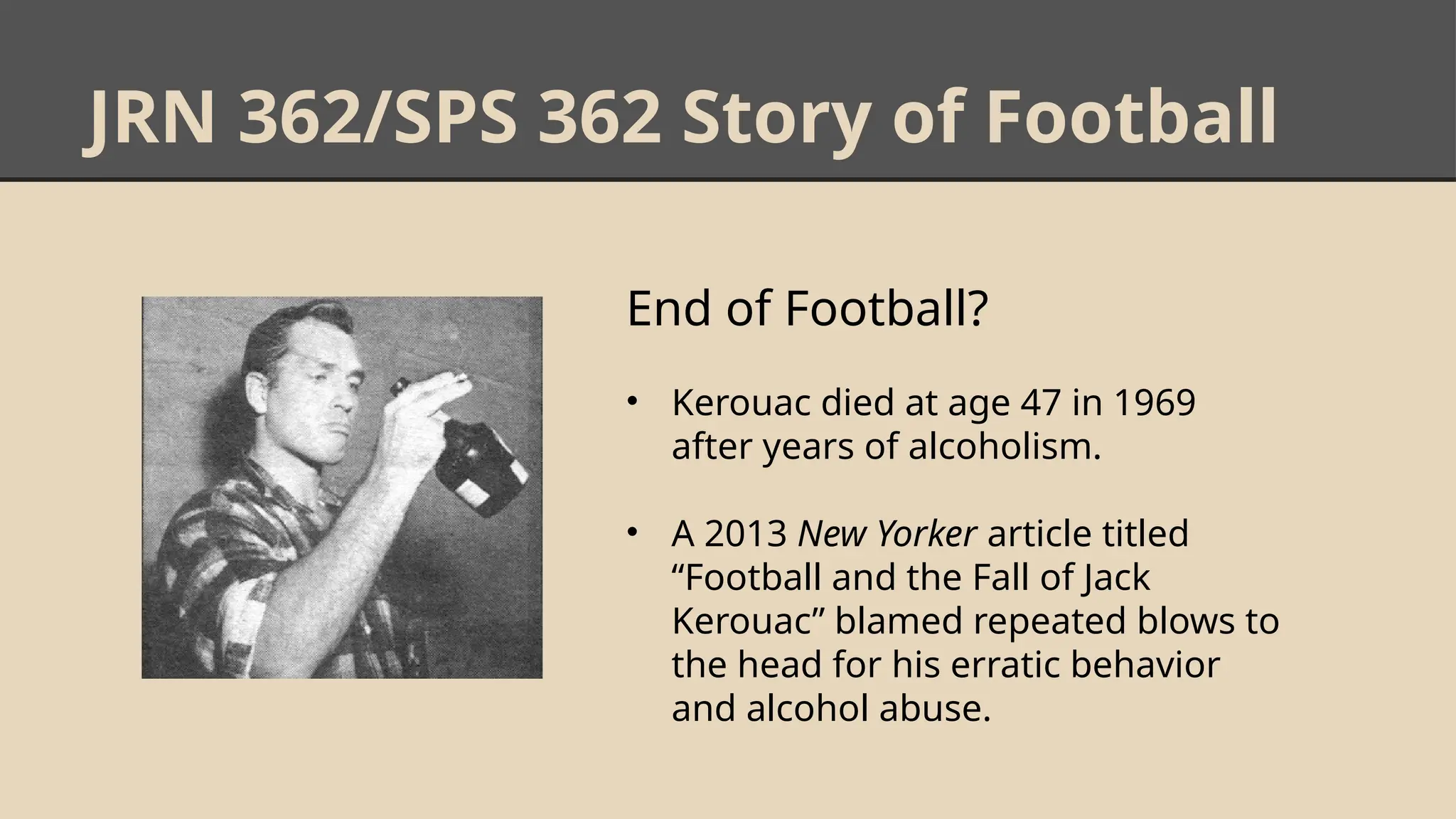
• Kerouac died at age 47 in 1969
after years of alcoholism.
• A 2013 New Yorker article titled
“Football and the Fall of Jack
Kerouac” blamed repeated blows to
the head for his erratic behavior
and alcohol abuse.
JRN 362/SPS 362 Story of Football
End of Football?
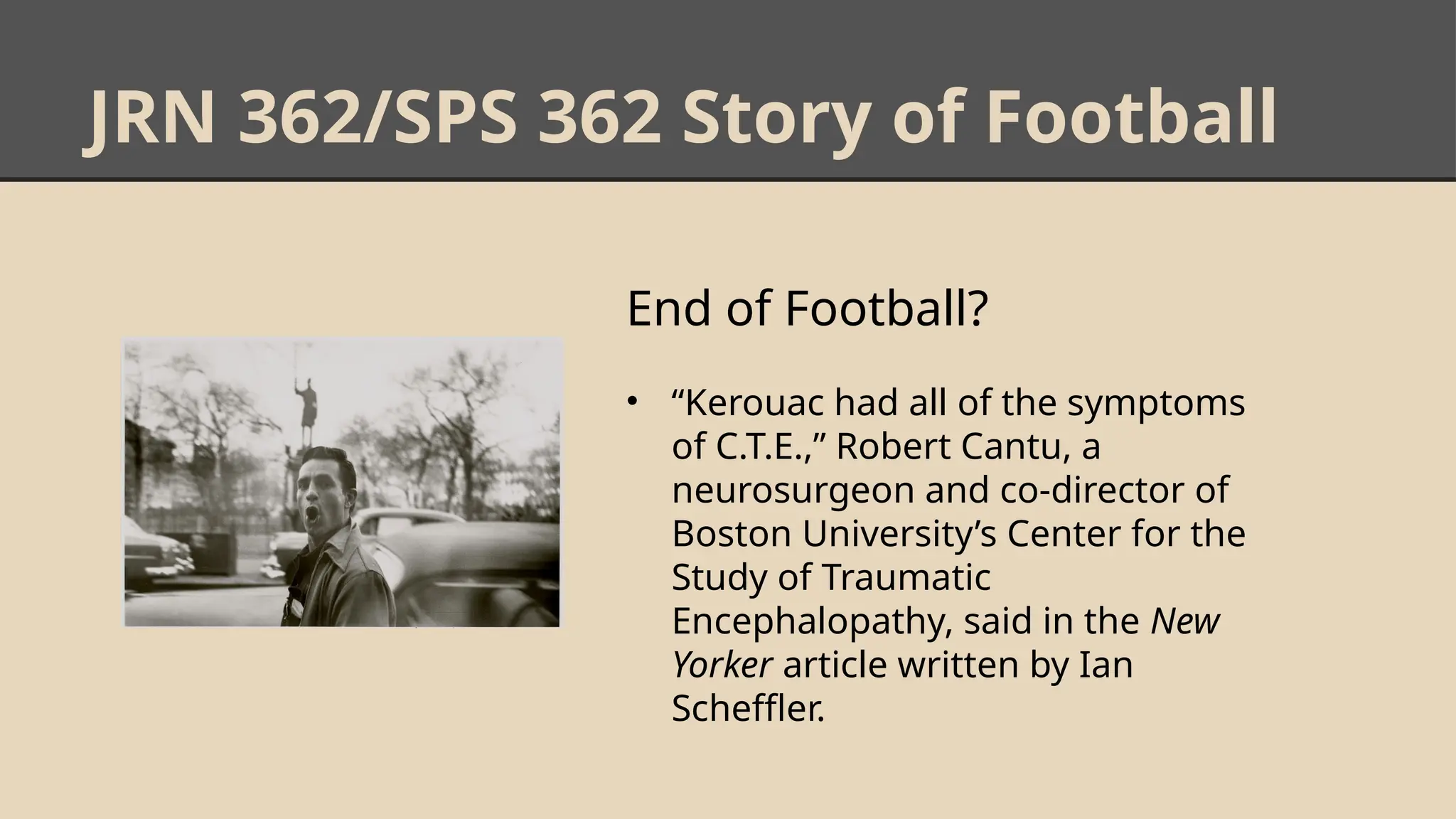
• “Kerouac had all of the symptoms
of C.T.E.,” Robert Cantu, a
neurosurgeon and co-director of
Boston University’s Center for the
Study of Traumatic
Encephalopathy, said in the New
Yorker article written by Ian
Scheffler.
JRN 362/SPS 362 Story of Football
End of Football?
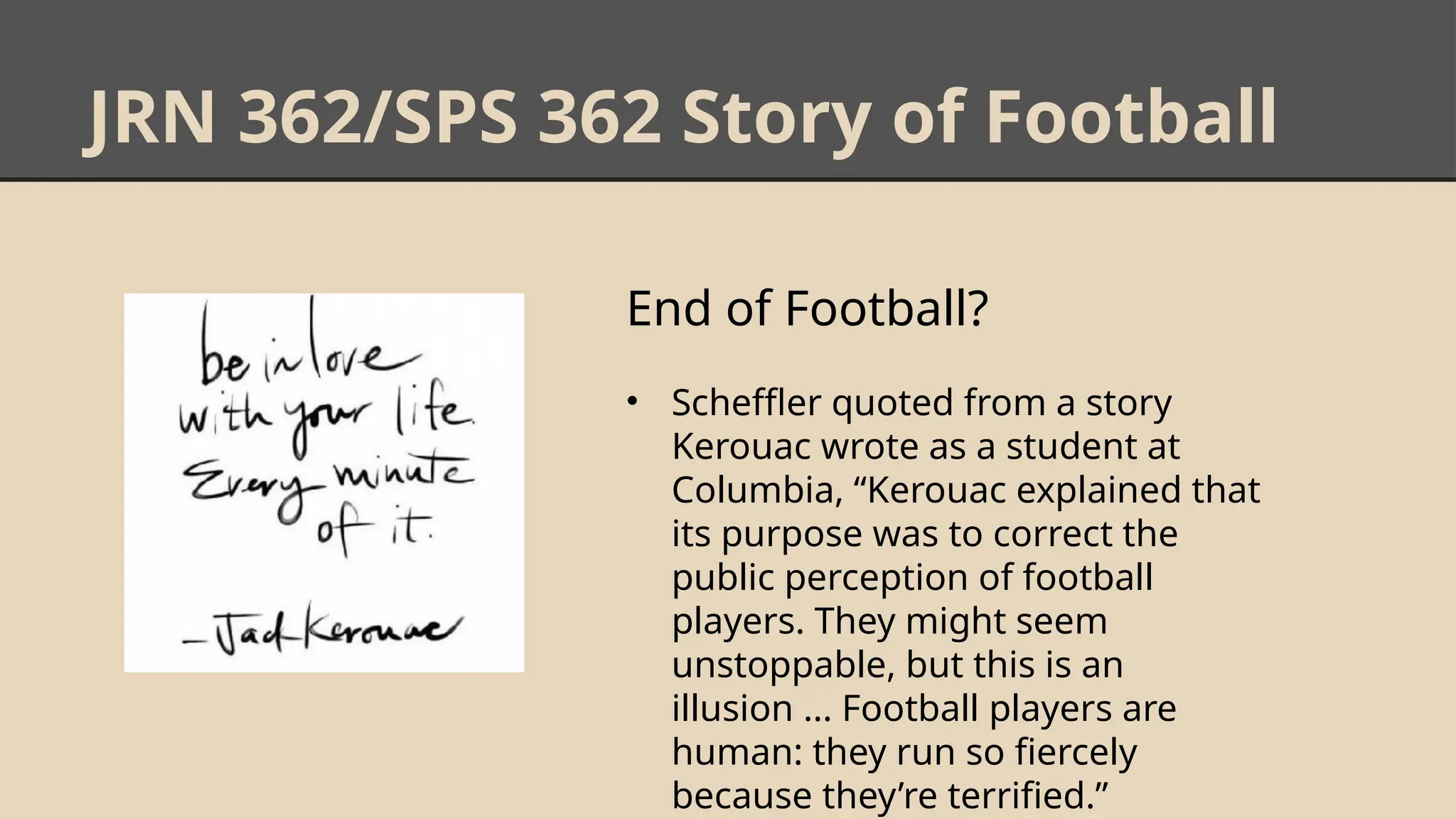
• Scheffler quoted from a story
Kerouac wrote as a student at
Columbia, “Kerouac explained that
its purpose was to correct the
public perception of football
players. They might seem
unstoppable, but this is an
illusion ... Football players are
human: they run so fiercely
because they’re terrified.”
JRN 362/SPS 362 Story of Football
End of Football?
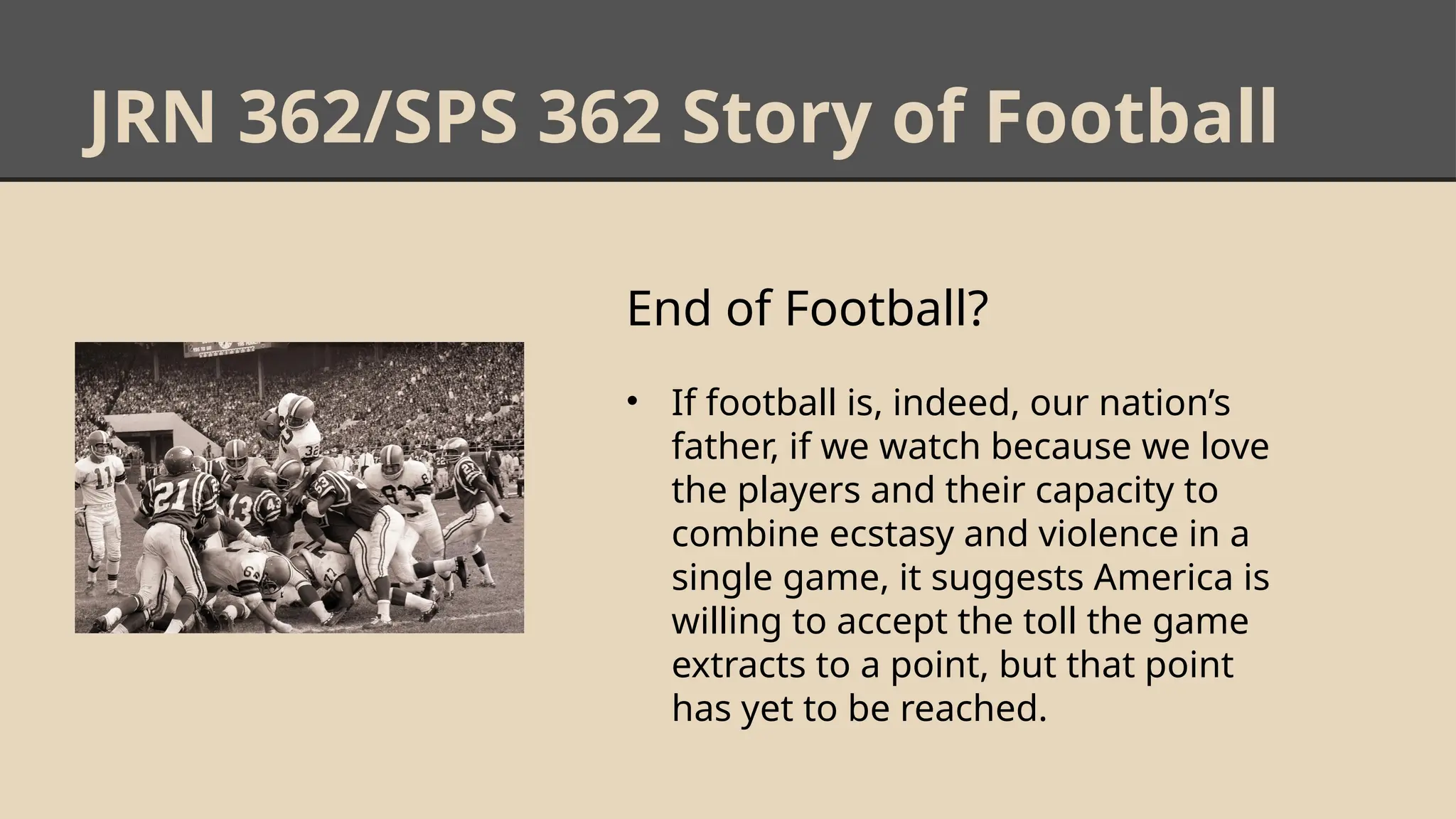
• If football is, indeed, our nation’s
father, if we watch because we love
the players and their capacity to
combine ecstasy and violence in a
single game, it suggests America is
willing to accept the toll the game
extracts to a point, but that point
has yet to be reached.
JRN 362/SPS 362 Story of Football
End of Football?
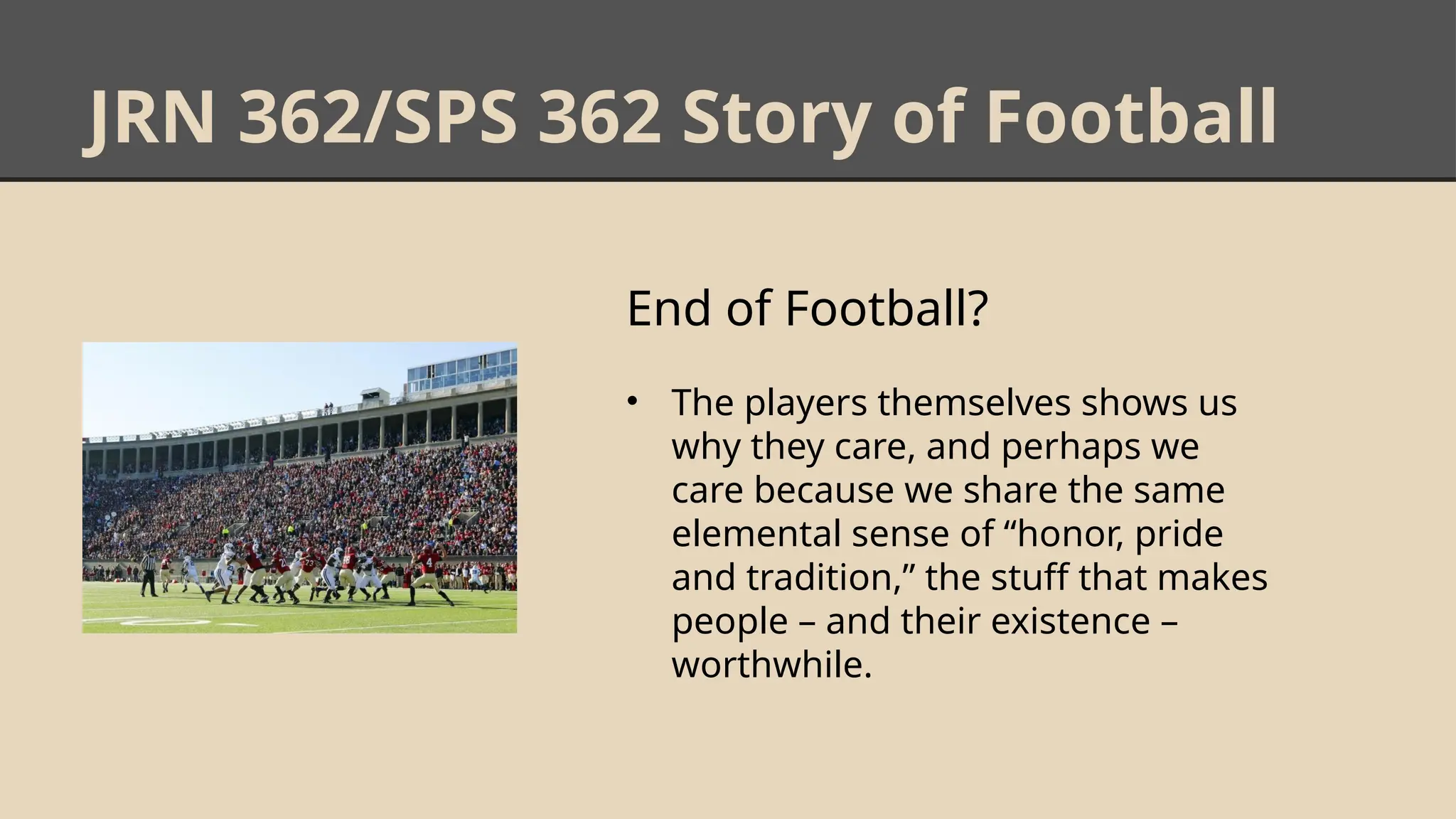
• The players themselves shows us
why they care, and perhaps we
care because we share the same
elemental sense of “honor, pride
and tradition,” the stuff that makes
people – and their existence –
worthwhile.
JRN 362/SPS 362 Story of Football
End of Football?
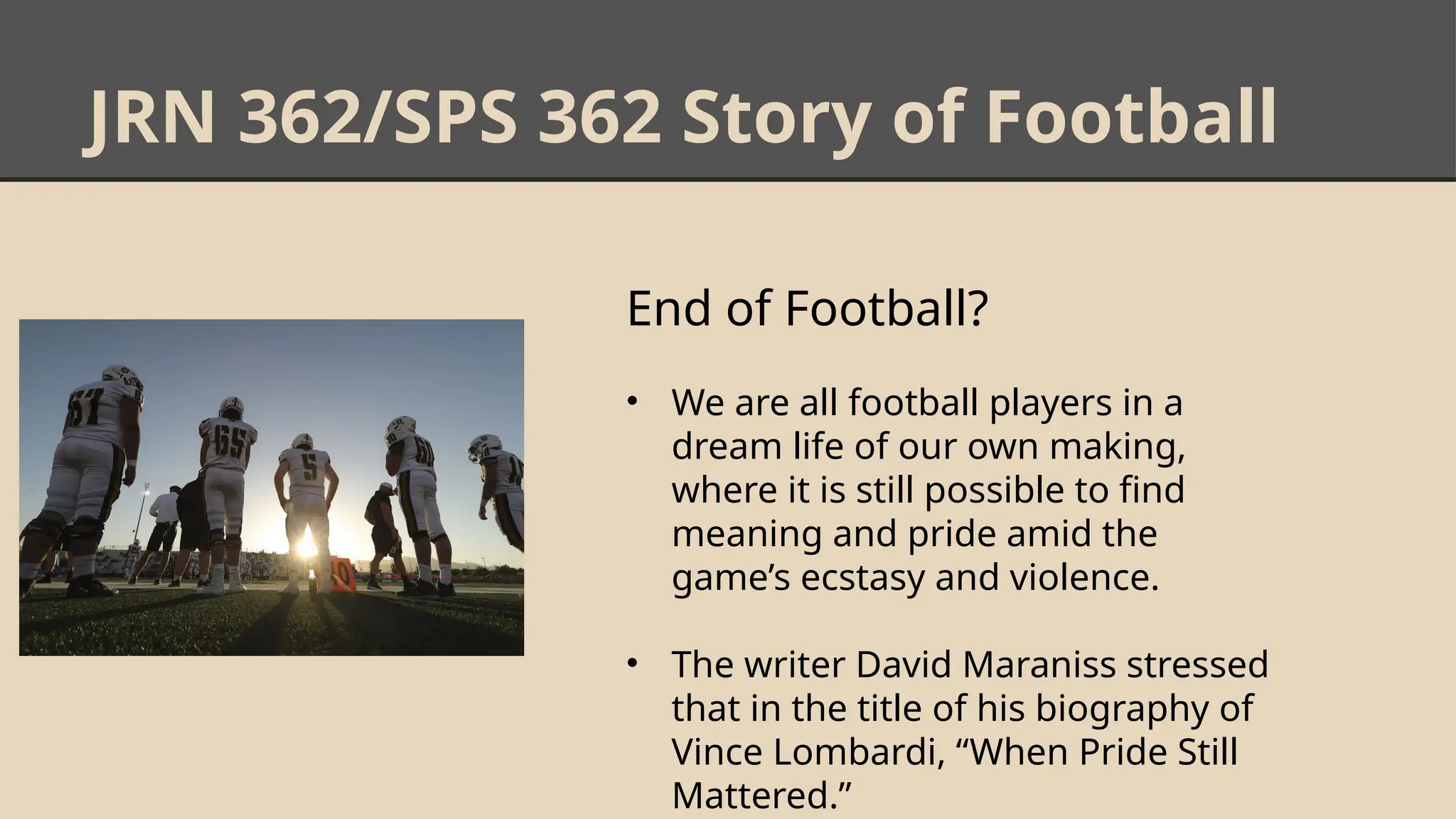
• We are all football players in a
dream life of our own making,
where it is still possible to find
meaning and pride amid the
game’s ecstasy and violence.
• The writer David Maraniss stressed
that in the title of his biography of
Vince Lombardi, “When Pride Still
Mattered.”
JRN 362/SPS 362 Story of Football
End of Football?
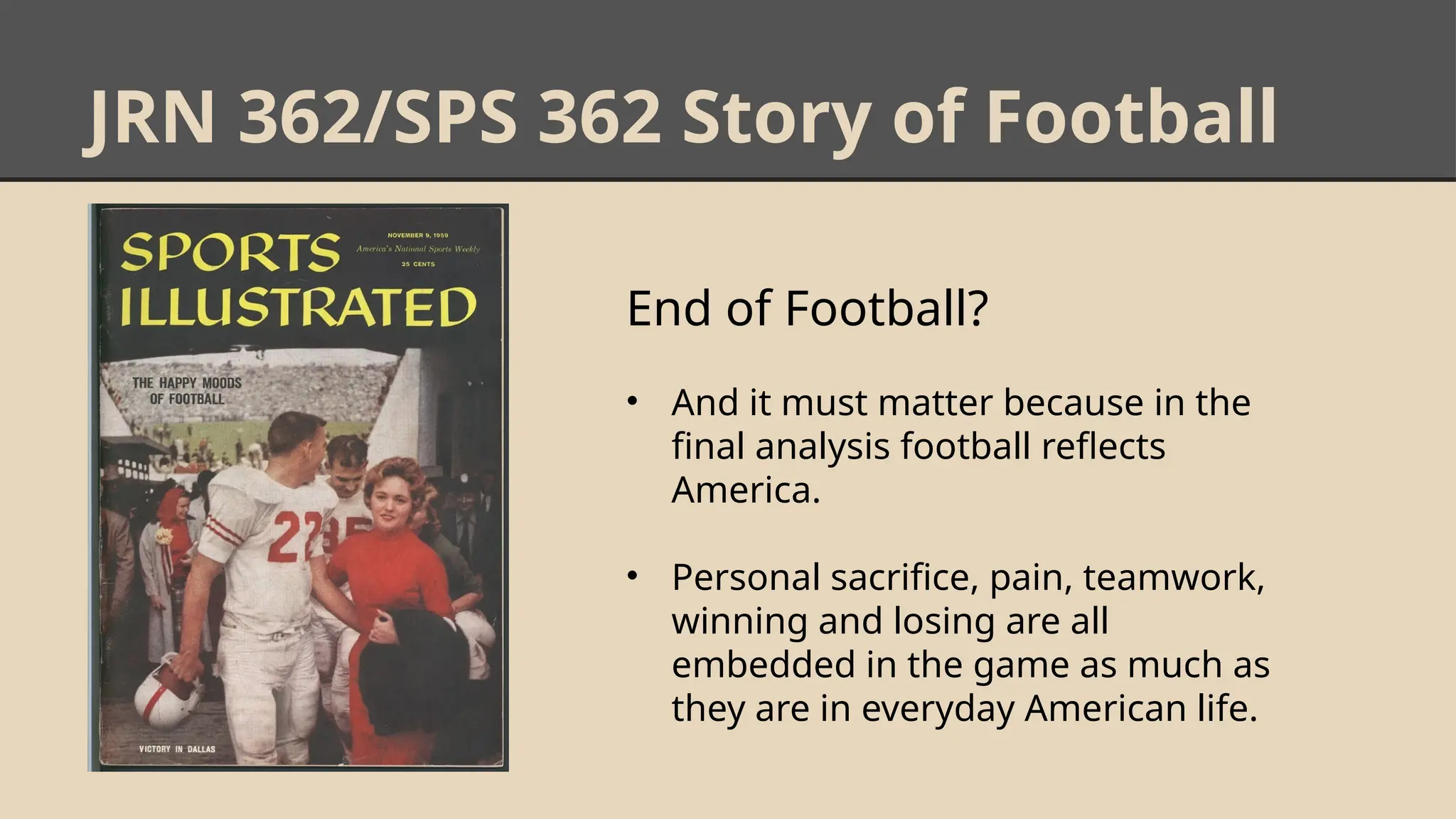
• And it must matter because in the
final analysis football reflects
America.
• Personal sacrifice, pain, teamwork,
winning and losing are all
embedded in the game as much as
they are in everyday American life.
JRN 362/SPS 362 Story of Football
End of Football?
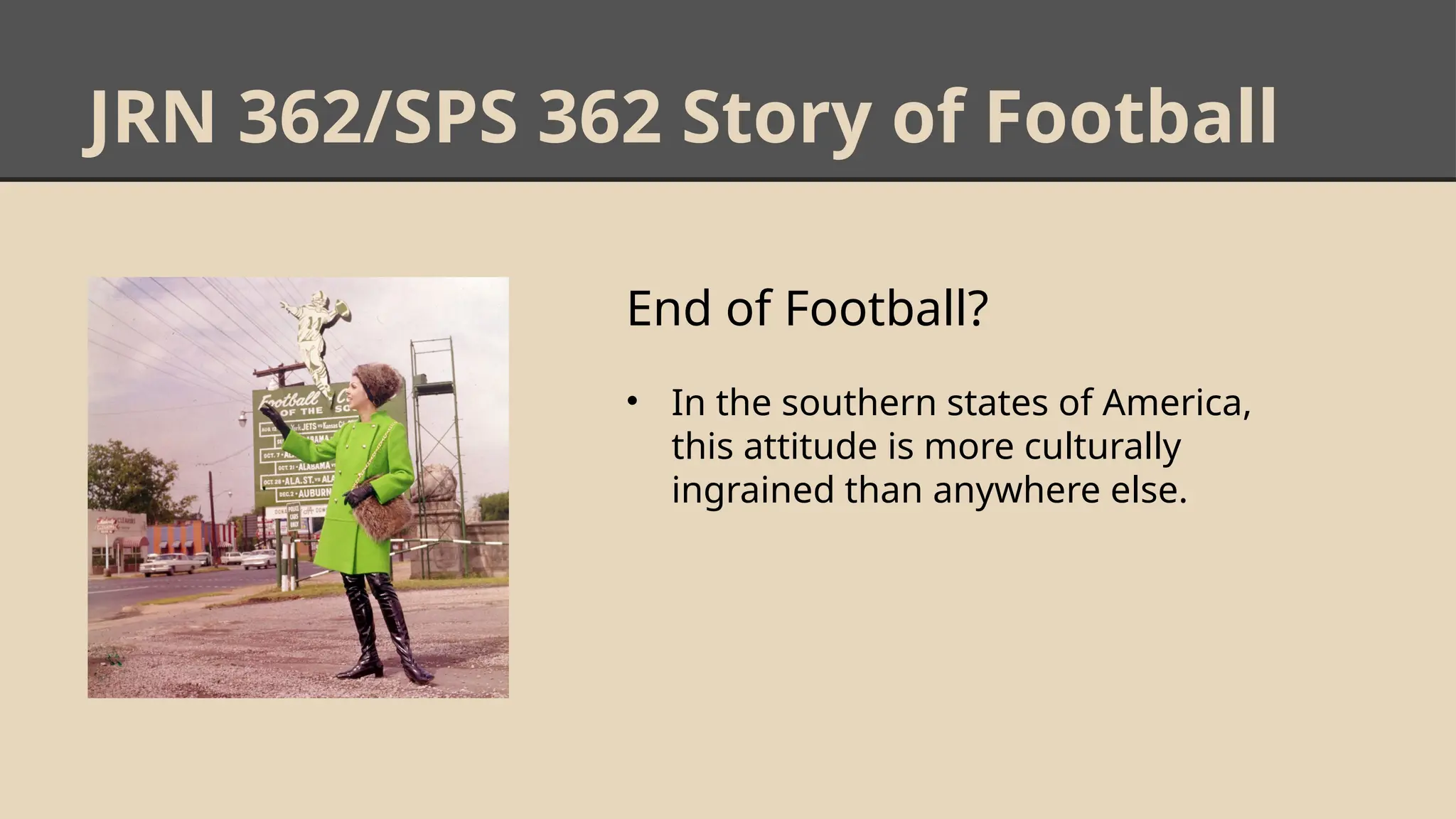
• In the southern states of America,
this attitude is more culturally
ingrained than anywhere else.
JRN 362/SPS 362 Story of Football
End of Football?
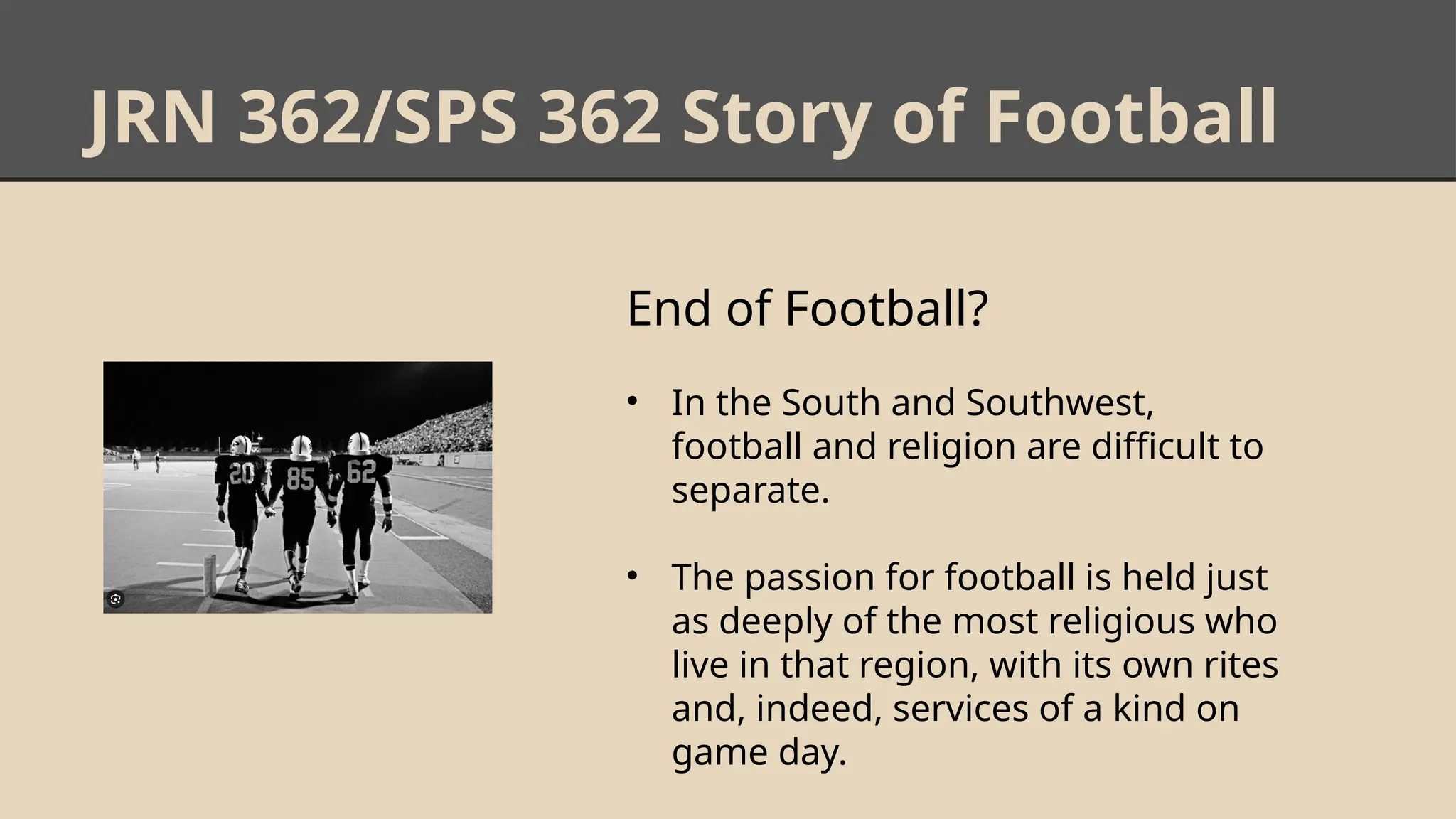
• In the South and Southwest,
football and religion are difficult to
separate.
• The passion for football is held just
as deeply of the most religious who
live in that region, with its own rites
and, indeed, services of a kind on
game day.
JRN 362/SPS 362 Story of Football
End of Football?
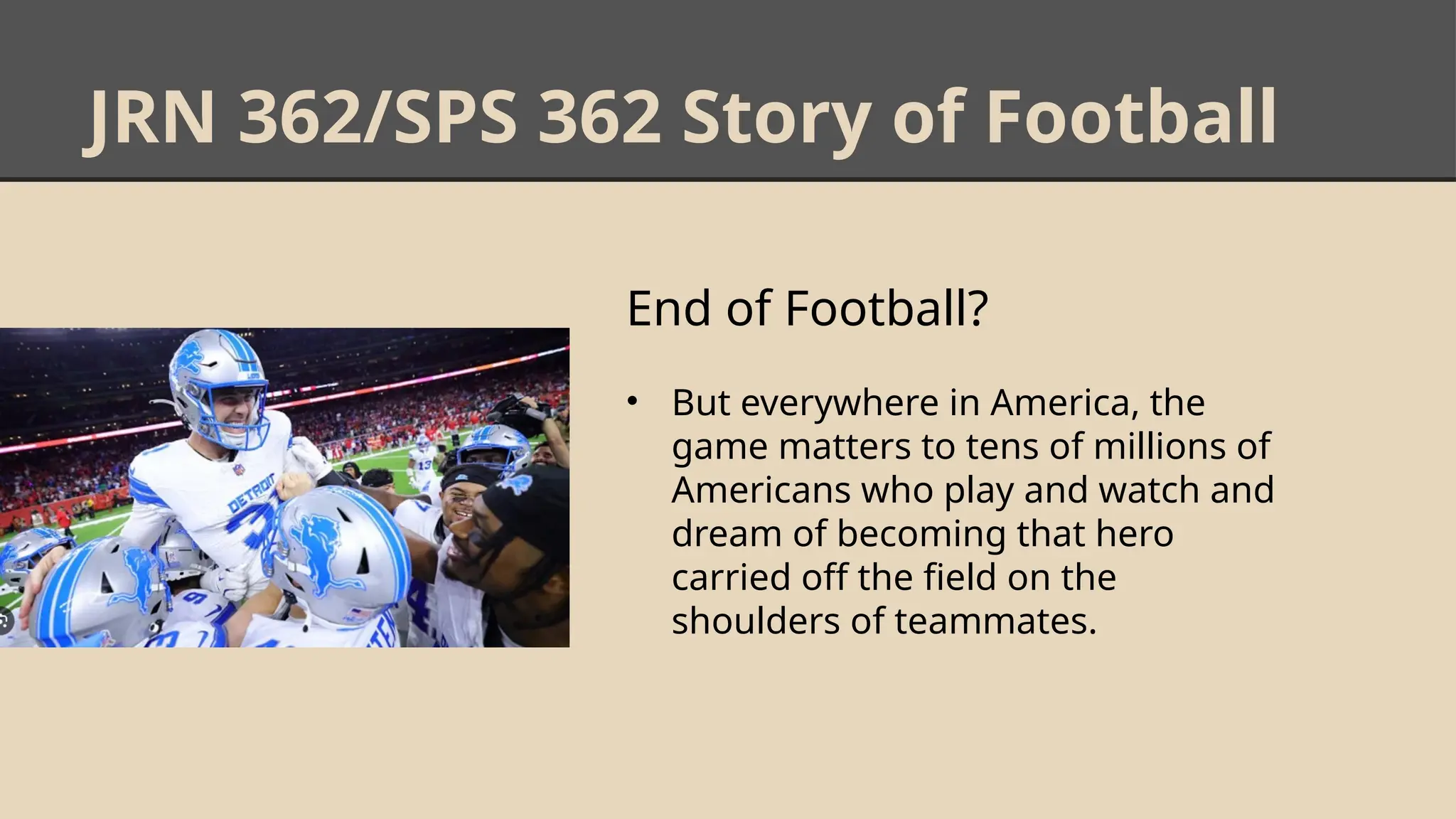
• But everywhere in America, the
game matters to tens of millions of
Americans who play and watch and
dream of becoming that hero
carried off the field on the
shoulders of teammates.
JRN 362/SPS 362 Story of Football
End of Football?
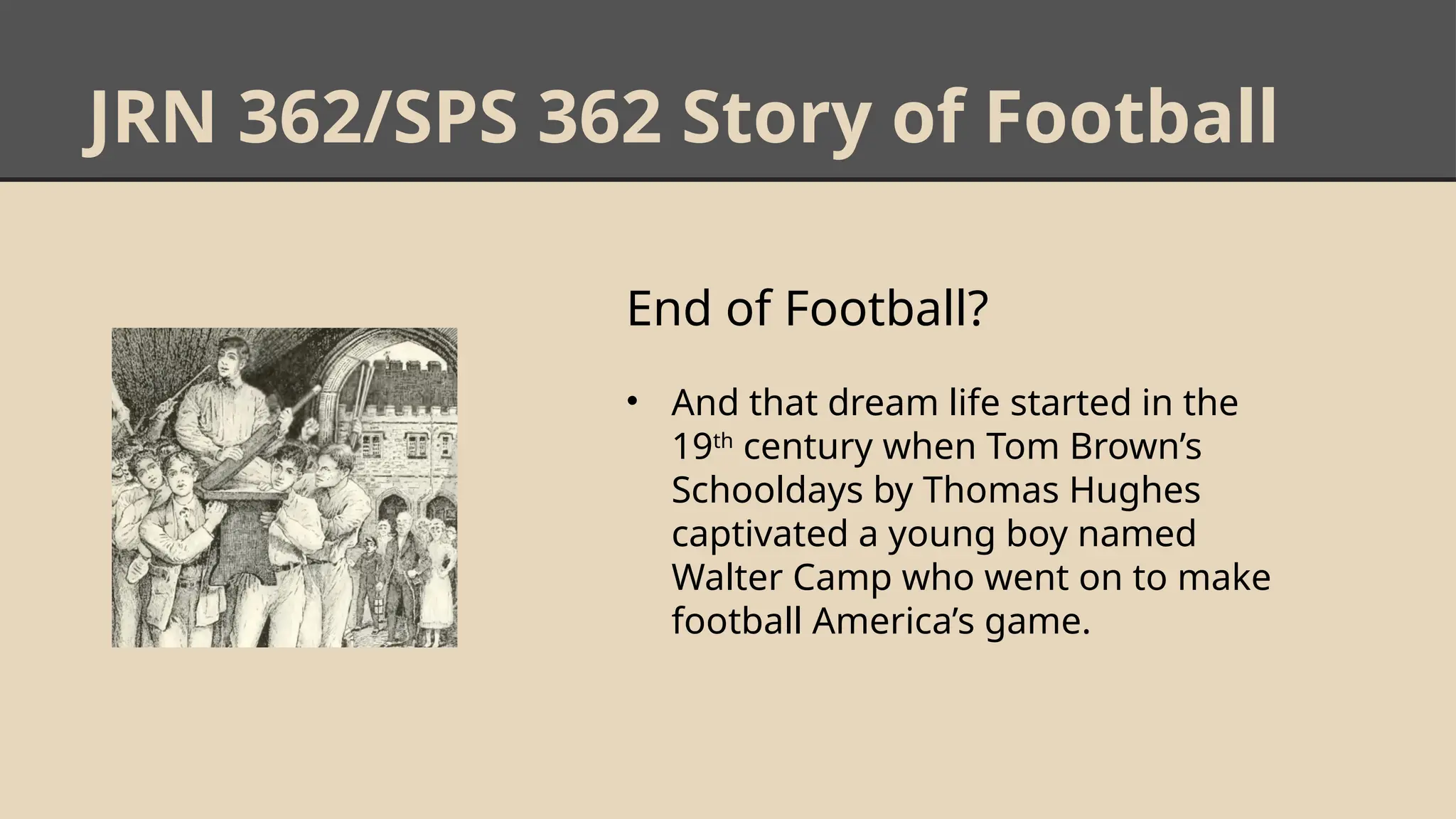
• And that dream life started in the
19th
century when Tom Brown’s
Schooldays by Thomas Hughes
captivated a young boy named
Walter Camp who went on to make
football America’s game.

JRN/SPS 362 - Lecture Twenty-Two (December 3, 2025)

  • 1.
    JRN 362/SPS 362Story of Football Rich Hanley, Professor Emeritus Lecture Twenty-Two
  • 2.
    JRN 362/SPS 362Story of Football Review • “DEDICATED TO THE JOY OF MANLY CONTEST BY THE CLASS OF 1879” reads the Harvard Stadium dedication plaque unveiled in June 1904, less than a year after the stadium opened in November 1903.
  • 3.
    JRN 362/SPS 362Story of Football Review • Sports writers in Boston considered Harvard Stadium to be “sacred ground” that stood as a rival to buildings in the “in the ancient world solely given up to athletic games."
  • 4.
    JRN 362/SPS 362Story of Football Review • Sacred ground is an appropriate description. • Football is America’s national religion, celebrated throughout autumn in rites marked by the ecstasy and violence of the nation’s dream life.
  • 5.
    JRN 362/SPS 362Story of Football Review • The game emerged when the disappearing American frontier and the lack of opportunities for the educated class to prove its manhood in front of other men became an issue. • From a rough “cross between rugby, soccer, and a bar fight,“ football evolved quickly.
  • 6.
    JRN 362/SPS 362Story of Football Review • From the 1890s to the 1920s, football’s popularity soared wherever it was played. • From its cradle at Yale, to the West Coast, to the football crescent rimming the Great Lakes, and to the deep South, football ruled autumn.
  • 7.
    JRN 362/SPS 362Story of Football Review • Within just a few short years from its first recognizable, modern shape in the 1870s, it had even come to dominate the one national holiday everyone celebrated – Thanksgiving.
  • 8.
    JRN 362/SPS 362Story of Football Review • This Nov. 26, 1949, cover of The New Yorker magazine illustrates the connection between football and the national holiday – and its impact. • Dad carves the turkey while watching the game on television with the family.
  • 9.
    JRN 362/SPS 362Story of Football Review • Football on college campuses became a socially acceptable and exciting spectacle for both men and women, who would attend games as part of their autumnal social calendars.
  • 10.
    JRN 362/SPS 362Story of Football Review • And the sport produced lots of stars for the emerging electric media age of radio, film and, after World War II, television and eventually the internet.
  • 11.
    JRN 362/SPS 362Story of Football Review • Red Grange of Illinois became the first immortal star of the electric age, running for Illinois and the Chicago Bears. • His appearance in a NFL game in 1925 gave the professional game the credibility that it needed to grow.
  • 12.
    JRN 362/SPS 362Story of Football Review • Knute Rockne, an immigrant from Norway, transformed a small college in Indiana called Notre Dame into a national football power with his understanding of publicity and relentless road trips that took the team to the West Coast and to the South.
  • 13.
    JRN 362/SPS 362Story of Football Review • Other pro star players and coaches followed, from Sammy Baugh of Washington. Johnny Unitas of Baltimore and Jim Brown of Cleveland to Joe Namath of the Jets, Lawrence Taylor of the Giants, Walter Payton of Chicago, Jerry Rice of San Francisco, Barry Sanders of Detroit and Tom Brady.
  • 14.
    JRN 362/SPS 362Story of Football Review • Great coaches likewise became larger-than-life figures who stood for authority and innovation. • Paul Brown, Chuck Noll, Vince Lombardi, Tom Landry, Don Shula, Bill Walsh, Tony Dungy and Bill Belichick stand among the great NFL coaches.
  • 15.
    JRN 362/SPS 362Story of Football Review • College players, too, became immortal athletes, starting with the All-American from Yale, Pudge Heffelfinger, in the 19th century on through two-time Heisman Trophy winner Archie Griffin and into the 21st century with players such as Charles Woodson, Kyler Murray, Brock Bowers and Travis Hunter.
  • 16.
    JRN 362/SPS 362Story of Football Review • College coaches who stand alongside Rockne include Amos Alonzo Stagg, Glenn Warner, Fritz Crisler, Ned Yost, Bud Wilkinson, Ara Parseghian, Nick Saban and Bear Bryant, joined by LaVell Edwards, Urban Meyer, Dabo Swinney, Kirby Smart, Ryan Day, Curt Cignetti and Marcus Freeman.
  • 17.
    JRN 362/SPS 362Story of Football Review • Football’s capacity to attract kids who would become lifelong fans grew in large measure because of these stars and coaches and started as soon as the press started covering games in the 1880s.
  • 18.
    JRN 362/SPS 362Story of Football Review • Fictional heroes such as Frank Merriwell of Yale created what would become the dream life of football stardom achieved through virtuous means of a moral code and physical courage.
  • 19.
    JRN 362/SPS 362Story of Football Review • And they were conditioned by popular magazines and game program covers to dream big to fit into the defined narrative arc of the underdog overcoming obstacles to win the game and date the girl. • Movies such as The Freshman popularized that arc.
  • 20.
    JRN 362/SPS 362Story of Football Review • Yet football always had a dark side, one that could not be ignored in the face of its unyielding violence and capacity to corrupt academic life. • Deaths and injuries became common, so much so that critics sought to ban the game as early as the 1890s.
  • 21.
    JRN 362/SPS 362Story of Football Review • Mass momentum formations such as the flying wedge developed by Harvard’s coach Lorin Deland caused an untold number of injuries and led to rioting in the stands and the temporary cessation of emerging rivalries between Yale and Harvard and Army and Navy.
  • 22.
    JRN 362/SPS 362Story of Football Review • “The American game of football, as now played, is unfit for colleges and schools … As a spectacle football is more brutalizing than prize fighting, cock fighting, or bull fighting … “ wrote Charles Eliot, Harvard president, in 1894, even before the violent Yale-Harvard game that year.
  • 23.
    JRN 362/SPS 362Story of Football Review • “It is to be expected that before the close of the season other young men will have sacrificed their lives on the gridiron …
  • 24.
    JRN 362/SPS 362Story of Football Review • “ … arms are being broken daily, legs are wrenched, faces are disfigured, scalps are torn, and a thousand and one other accidents of a more or less distressing nature are occurring in the mad rushes of eleven against eleven …,” wrote the Literary Digest in 1897.
  • 25.
    JRN 362/SPS 362Story of Football Review • College football banned the flying wedge, and by 1905 had transformed the game in the aftermath of the death of dozens of players. • Mass and concentrated momentum plays gave way to open offenses that would eventually feature the pass.
  • 26.
    JRN 362/SPS 362Story of Football Review • The 1905 rule changes also showed football’s governing committee that it could neutralize criticisms by modifying rules. • And the rules changed for more than a century after that to the point where the old game faded over time.
  • 27.
    JRN 362/SPS 362Story of Football End of Football? • Two pieces that never disappear from Camp’s old game? Injuries and pain. • As the 20th century deepened, it became clear that despite advances in equipment and rules to make a violent game safer, it would always be accompanied by physical trauma.
  • 28.
    JRN 362/SPS 362Story of Football End of Football? • As the game celebrated its 150th anniversary of the 1869 contest between Princeton and Rutgers in 2019, its future was questioned as it had been in the past. • The pathologies now evident from the game have turned the dream life into something else altogether.
  • 29.
    JRN 362/SPS 362Story of Football End of Football? • The pathologies extend into the stands and into the homes of fans.
  • 30.
    JRN 362/SPS 362Story of Football End of Football? • Officials at large state universities are increasingly describing game- day drinking as a major public health issue. • Some 20 percent of student fans were legally drunk before the game started at a large university in the Midwest during a typical game,
  • 31.
    JRN 362/SPS 362Story of Football End of Football? • One study found a nine percent increase in assaults and an 18 percent increase in vandalism during home games at a southern college. • An upset loss at home increased assaults by 112 percent while an upset win at home increased
  • 32.
    JRN 362/SPS 362Story of Football End of Football? • Upset losses lead to a 10 percent increase in violence by men against women in the home. • Game days overall are associated with higher rates of violence by men against women in the home.
  • 33.
    JRN 362/SPS 362Story of Football End of Football? • Research shows the emotional attachment between teams and fans is real and can be measured by increases in blood pressure.
  • 34.
    JRN 362/SPS 362Story of Football End of Football? • According to the NFL, up to 68 percent of NFL players may be injured in a season. • That leads to “consequences from an increased risk for more serious injury and pain,” reported by researcher Dr. Linda Cottler.
  • 35.
    JRN 362/SPS 362Story of Football End of Football? • The Cottler survey of 644 players who retired before 2009 showed: - Only 13 percent reported current excellent health compared to 88 percent with excellent health at the time they signed their first NFL contract.
  • 36.
    JRN 362/SPS 362Story of Football End of Football? • Some 93 percent reported pain, with 81 percent describing pain as moderate to severe. - That’s three times the rate in the general population.
  • 37.
    JRN 362/SPS 362Story of Football End of Football? • Knee injuries were the most reported NFL injuries, followed by shoulder and back injuries. • Nearly half (47 percent) had 3 or more NFL injuries.
  • 38.
    JRN 362/SPS 362Story of Football End of Football? • Nearly half (49 percent) reported diagnosed concussions. • 81 percent reported undiagnosed concussions. • The average number of reported concussions of either type was 9, Cottler found.
  • 39.
    JRN 362/SPS 362Story of Football End of Football? • The consequences emerged in the survey results regarding medication to ease pain. It showed that: - 52 percent used opioids during their careers. - 71 percent of that group reported they abused opioids during their
  • 40.
    JRN 362/SPS 362Story of Football End of Football? • Players who misused opioids during their career were more likely to misuse opioids in retirement, Cottler reported. • Former NFL players such as former Bears’ quarterback Jim McMahon also use marijuana to ease pain.
  • 41.
    JRN 362/SPS 362Story of Football End of Football? • “Current misuse was associated with more NFL pain, undiagnosed concussions and heavy drinking,” Cottler concluded.
  • 42.
    JRN 362/SPS 362Story of Football End of Football? • Pain pill abuse proved to be deadly. • Former Giants’ defensive back Tyler Sash died after an accidental overdose in September 2015. • He was 27.
  • 43.
    JRN 362/SPS 362Story of Football End of Football? • In August 2025, the Kaiser Family Foundation in a joint study with ESPN revealed that 96 percent of players who retired from the NFL in 1988 reported having pain over the past three months. • Half reported they experienced pain everyday, compared to 23 percent of men their age.
  • 44.
    JRN 362/SPS 362Story of Football End of Football? • The study found that: “Forty-seven percent of former players said they had serious difficulty concentrating, remembering or making decisions, compared to 6% of men their age.”
  • 45.
    JRN 362/SPS 362Story of Football End of Football? • “The players were twice as likely to report having pain that limited their daily life or work activities most days (35% versus 13%). For tasks such as walking or climbing stairs, 36% of the ex-NFL players reported having difficulty, more than three times men their age.”
  • 46.
    JRN 362/SPS 362Story of Football End of Football? • “Fifteen percent of players reported being diagnosed with dementia. According to one study based on the National Health Interview Survey, just under 4% of men ages 65 and older have been diagnosed with dementia.”
  • 47.
    JRN 362/SPS 362Story of Football End of Football? • Nothing concerned football administrators, coaches and players more than head injuries because of the potential for long- term consequences, including the risk for dementia and early death, a fact that football helmet manufacturers point out on their products.
  • 48.
    JRN 362/SPS 362Story of Football End of Football? • Zach Langston (No. 39) was a star player at Pittsburg State in Kansas, a Division II power that has won four national championships. • Langston’s family estimates he suffered some 100 concussions in middle and high school and in college.
  • 49.
    JRN 362/SPS 362Story of Football End of Football? • In February 2014, Langston committed suicide at the age of 26 after periods of depression, rage and anxiety. • His mother, Nicki, sent his brain to Boston University to see if he had chronic traumatic encephalopathy (CTE). He did.
  • 50.
    JRN 362/SPS 362Story of Football End of Football? • CTE is a “progressive degenerative disease of the brain found in athletes (and others) with a history of repetitive brain trauma, including symptomatic concussions as well as asymptomatic subconcussive hits to the head,” according to the Center for the Study of Chronic Traumatic Encephalopathy.
  • 51.
    JRN 362/SPS 362Story of Football End of Football? • The center, at Boston University, examines the brains of deceased players who either willed their brains or whose families agreed to have the organs examined.
  • 52.
    JRN 362/SPS 362Story of Football End of Football? • Some 99 percent of the brains of former NFL players had CTE, the center announced in July 2017. • For college players, the percentage was 91 percent. • Some 21 percent of the brains of high school players studied had CTE.
  • 53.
    JRN 362/SPS 362Story of Football End of Football? • In November 2017, center director and neuropathologist Ann McKee said that an examination of the late Aaron Hernandez’s brain showed the most extensive CTE damage of anyone ever studied under 40. • Hernandez played at Florida and for the New England Patriots.
  • 54.
    JRN 362/SPS 362Story of Football End of Football? • He was convicted of murder and late committed suicide in 2017 while serving his sentence.
  • 55.
    JRN 362/SPS 362Story of Football End of Football? • Washington State quarterback Tyler Hilinski took his own life in 2017 at the age of 21. • “After reviewing the tissue, we can confirm that he had the pathology of chronic traumatic encephalopathy (CTE),” the Mayo Clinic reported.
  • 56.
    JRN 362/SPS 362Story of Football End of Football? • The stories of football players dying before their time persist. • There’s the group of a dozen USC linebackers from 1989. Five died before they turned 50. Alcoholism, suicides, diabetes. Each exhibited evidence of brain pathologies before they died.
  • 57.
    JRN 362/SPS 362Story of Football End of Football? • Alana Gee, the widow of USC linebacker Matt Gee, sued the NCAA for $55 million in Calif0rnia state court, asserting the organization did not adequately protect Gee from concussions. • In November 2022, a jury ruled against her claims.
  • 58.
    JRN 362/SPS 362Story of Football End of Football? • Gee played for USC from 1988- 1992. He died in 2018 after a heart attack triggered by hypertension and cocaine and alcohol toxicity. Alana Gee contended that the substance abuse stemmed from CTE. • Tests at BU concluded that he suffered from CTE.
  • 59.
    JRN 362/SPS 362Story of Football End of Football? • The Gee case was the first CTE case against the NCAA to reach a jury. • In 2016, the NCAA settled a class- action lawsuit. It agreed to pay $70 million over 50 years to monitor former college athletes’ medical conditions and $5 million toward medical research.
  • 60.
    JRN 362/SPS 362Story of Football End of Football? • The kinetic force of modern players who are much larger and faster than players from the 1960s and earlier plays a role, but the evidence suggests the constant hits to the head accumulate and trigger the onset of CTE, dementia and other brain disorders.
  • 61.
    JRN 362/SPS 362Story of Football End of Football? • Studies show that all players are potential victims of CTE, but some positions tend to be more dangerous than others.
  • 62.
    JRN 362/SPS 362Story of Football End of Football? • The positions most susceptible to brain trauma and, hence, the onset of CTE in players, are: - Defensive backs - Kicking team (kickoffs) - Running backs
  • 63.
    JRN 362/SPS 362Story of Football End of Football? • The NFL first responded to increasing scrutiny of concussions in 1996. • Since then, the league has changed rules and funded research into helmet technology and tackling techniques to dampen criticism.
  • 64.
    JRN 362/SPS 362Story of Football End of Football? • The NFL moved kickoffs to the 35- yard line decades ago. In 2024, it moved to limit violent collisions on kickoffs with new rules that positioned the kickoff team (other than the kicker) at the receiving team’s 40-yard line and prohibited movement until the ball touched the ground or a received caught it.
  • 65.
    JRN 362/SPS 362Story of Football End of Football? • The league also barred players with concussion symptoms from returning to the game and left the decision for that in the hands of independent neurologists.
  • 66.
    JRN 362/SPS 362Story of Football End of Football? • The NFL is also enforcing hits to the heads of quarterbacks and to what it describes as defenseless receivers. • College, meanwhile, is enforcing targeting rules designed to eliminate the helmet from tackling and blocking.
  • 67.
    JRN 362/SPS 362Story of Football End of Football? • Helmet size has evolved over the past 50 years, with each iteration designed to protect the head from trauma. • More innovation is expected in this area as the NFL increases funding for research and development.
  • 68.
    JRN 362/SPS 362Story of Football End of Football? • After years of denial, the NFL acknowledged a measure of responsibility for the long-term effects of head trauma on players. • It settled a lawsuit filed by thousands of players for what eventually reached more than $1 billion in 2015.
  • 69.
    JRN 362/SPS 362Story of Football End of Football? • As of October 20, 2025, 20,587 retired NFL players have registered for a settlement. • Maximum benefit: $5,000,000.
  • 70.
    JRN 362/SPS 362Story of Football End of Football? • The NFL has distributed $1,592,326,121 as of Oct. 20, 2025.
  • 71.
    JRN 362/SPS 362Story of Football End of Football? • Two European scholars sees a reconfiguration of the concept of masculinity already in play among NFL players. • In a paper published in 2012 but still relevant today, Eric Anderson and Edward M. Kian argued that:
  • 72.
    JRN 362/SPS 362Story of Football End of Football? • “ … the devastating effects of concussions, in the form of chronic traumatic encephalopathy, combined with a softening of American masculinity is beginning to permit some prominent players to distance themselves from the self-sacrifice component of sporting masculinity.”
  • 73.
    JRN 362/SPS 362Story of Football End of Football? • Are players beginning to question why they play and endure the pain, which for most lasts a lifetime? • Take this exchange between Tom Brady, quarterback of the Patriots at the time, and Steve Kroft during a piece on 60 Minutes in 2007:
  • 74.
    JRN 362/SPS 362Story of Football End of Football? • “Why do I have three Super Bowl rings and still think there’s something greater out there for me? I mean, maybe a lot of people would say, ‘Hey, man, this is what it is. I reached my goal, my dream, my life.’ Me, I think, ‘God, it’s got to be more than this.’ I mean this isn’t, and can’t be, what it’s all cracked
  • 75.
    JRN 362/SPS 362Story of Football End of Football? • Kroft: “What’s the answer?” • Brady: “I wish I knew…. I wish I knew.”
  • 76.
    JRN 362/SPS 362Story of Football End of Football? • Brady’s answer may be found in interviews with the players who took part in Cottler’s pain study. • Her summary is as follows:
  • 77.
    JRN 362/SPS 362Story of Football End of Football? • “At the conclusion of the interview, players were allowed time to share additional thoughts. Many of them provided compelling anecdotes about the terrible pain they live with. They also confirmed that players should be continuously monitored during their careers for misuse of (opioids) …
  • 78.
    JRN 362/SPS 362Story of Football End of Football? • “While some noted that playing in the NFL was not worth the accelerated loss of health, others said they still would have played despite knowing the risks.”
  • 79.
    JRN 362/SPS 362Story of Football End of Football? • The 2025 KFF/ESPN report stated a similar conclusion: • “… in spite of all that, the vast majority say they would do it all over again, and that playing football had a positive effect on their lives.”
  • 80.
    JRN 362/SPS 362Story of Football End of Football? • “ ‘Playing football ... I encountered people from different ethnicities, religious beliefs, achievements and family units that gave me great perspectives on living,’ one player said.”
  • 81.
    JRN 362/SPS 362Story of Football End of Football? • That same theme is evident in a November 2012 story in the New York Times Magazine about a first- year NFL player who at the time sought a spot on the roster of the Atlanta Falcons, Pat Schiller.
  • 82.
    JRN 362/SPS 362Story of Football End of Football? • “Dude,” he said, as I stood staring at his dresser. “I swear to God, if someone tells me right now there’s some miracle body cream out there that would make me feel 100 percent and prevent me from getting hurt but that could also cause cancer or liver damage down the line, I’d use it in a heartbeat. I
  • 83.
    JRN 362/SPS 362Story of Football End of Football? • Players such as Schiller fully understand that the game can lead to horrific injuries, lifelong pain and the early onset of dementia yet they still play.
  • 84.
    JRN 362/SPS 362Story of Football End of Football? • Players often sense that their life peaked when they played the game, too. Remember how in The Great Gatsby, Fitzgerald characterized Tom Buchanan as some one who could never recapture his past glory at the Yale Bowl.
  • 85.
    JRN 362/SPS 362Story of Football End of Football? • In Irwin Shaw’s Esquire magazine story “The Eighty-Yard Run” published in 1941, the main character Christian Darling looks back on his one heroic moment – in practice - from the 1920s, a run that, under football myth, landed him the girl of his dreams, Louise.
  • 86.
    JRN 362/SPS 362Story of Football End of Football? • But as time passed, Christian remained locked in his past glory while Louise grows into what scholar Nasrullah Mambral describes as a “smart, successful, and sophisticated New York woman.”
  • 87.
    JRN 362/SPS 362Story of Football End of Football? • “Christian made no provisions for the future, living in the immediate world of sense and ego satisfaction;” Mambral writes. “Christian, as does the sports- obsessed culture he inhabits, never anticipates the time when the stadium lights go out …”
  • 88.
    JRN 362/SPS 362Story of Football End of Football? • Who are these people who endure long practices, constant pain and anxiety over losing their jobs in exchange for money and just 16 hours of game-play in the NFL and just 12 hours in college per year?
  • 89.
    JRN 362/SPS 362Story of Football End of Football? • Look at a couple of players from the 2012 New York Jets, whose backgrounds are part of Nicholas Dawidoff’s article on the team in the Sept. 27, 2012, issue of The New Yorker magazine.
  • 90.
    JRN 362/SPS 362Story of Football End of Football? • “The Jets, like every team, have many players who experienced severe neglect as children – a mother who died in childbirth, a father who died of an overdose or of AIDS.
  • 91.
    JRN 362/SPS 362Story of Football End of Football? • “There are Jets players who have seen murders up close, who have been shot at or stabbed, who were abused by relatives, who have been jailed.
  • 92.
    JRN 362/SPS 362Story of Football End of Football? • “Antonio Cromartie went to twelve Florida schools in twelve years, because his family kept losing its home.
  • 93.
    JRN 362/SPS 362Story of Football End of Football? • “Santonio Holmes, as a child, took care of his siblings in a bullet- riddled apartment while his mother worked as a migrant farm laborer.”
  • 94.
    JRN 362/SPS 362Story of Football End of Football? • The team doctor, Kenneth Montgomery, said in the article that football players are “naturally inclined to endure pain.” • And that includes emotional pain, too.
  • 95.
    JRN 362/SPS 362Story of Football End of Football? • “And, while football is often seen to be an outlet for aggressive young men, a more common expressed attraction of the game among Jets players is the company of coaches and teammates who offer some of what was missing at home.”
  • 96.
    JRN 362/SPS 362Story of Football End of Football? • “Football is my father.” – cornerback Julian Posey.
  • 97.
    JRN 362/SPS 362Story of Football End of Football? • Why do such broken men endure knowing that they may be pursuing, as Tom Brady acknowledges, something that is empty of meaning, that may leave them physically broken for the rest of their lives?
  • 98.
    JRN 362/SPS 362Story of Football End of Football? • Another writer for The New Yorker, Malcolm Gladwell, searched for an answer in an article that listed the recent death roll of former players:
  • 99.
    JRN 362/SPS 362Story of Football End of Football? • “Mike Webster, the longtime Pittsburgh Steeler and one of the greatest players in N.F.L. history, ended his life a recluse, sleeping on the floor of the Pittsburgh Amtrak station. Another former Pittsburgh Steeler, Terry Long, drifted into chaos and killed himself four years ago by drinking antifreeze …
  • 100.
    JRN 362/SPS 362Story of Football End of Football? • “Andre Waters, a former defensive back for the Philadelphia Eagles, sank into depression and pleaded with his girlfriend—’I need help, somebody help me’—before shooting himself in the head …
  • 101.
    JRN 362/SPS 362Story of Football End of Football? • “There were men with aching knees and backs and hands, from all those years of playing football. But their real problem was with their heads, the one part of their body that got hit over and over again.”
  • 102.
    JRN 362/SPS 362Story of Football End of Football? • And then there were the stories of Junior Seau (suicide) and Dave Duerson (suicide) and other former pro players that were not included in Gladwell’s piece?
  • 103.
    JRN 362/SPS 362Story of Football End of Football? • Gladwell concluded that the reason players play, and coaches coach and spectators watch in such extraordinary numbers is simple:
  • 104.
    JRN 362/SPS 362Story of Football End of Football? • “We are in love with football players, with their courage and grit, and nothing else—neither considerations of science nor those of morality—can compete with the destructive power of that love.”
  • 105.
    JRN 362/SPS 362Story of Football End of Football? • Recall Fitzgerald’s description of players in The Bowl: • “One aches with them intolerably, trembles with their excitement, but they have no traffic with us now, they are beyond help, consecrated and unreachable--vaguely holy.”
  • 106.
    JRN 362/SPS 362Story of Football End of Football? • And that leads to a question: why is football – a game bursting with violence and pathologies - the one true religion of America, the force the unifies the nation and stands at the core of patriotic celebrations? • Are ecstasy and violence required for our Dream Life to be whole?
  • 107.
    JRN 362/SPS 362Story of Football End of Football? • The fan/media reaction is easy to understand. • Teams play a role in creating a tribe of our own, which is of particular importance when times change or when our lives are fragmented, according to researchers.
  • 108.
    JRN 362/SPS 362Story of Football End of Football? • Professor Joe Harasta of Kutztown State University wrote in 2021 that “The development of sports fans is centered on psychological changes from within, which ultimately manifest themselves as outward societal behaviors and actions that continuously reinforce fans‘ self- identification.”
  • 109.
    JRN 362/SPS 362Story of Football End of Football? • “These outward expressions are a communal experience. Continued experiences, reinforced self- identities, and sustained gratifications are achieved by developing into the truest and most sincere sports fan – the ―diehard fan.”
  • 110.
    JRN 362/SPS 362Story of Football End of Football? • Football occupies a full day as a ritual, with pre-game tailgating, in- game cheers and chants and post- game revelry. • It’s a way to live vicariously without suffering the pain, rejection, loss and other elements of physical competition.
  • 111.
    JRN 362/SPS 362Story of Football End of Football? • Participation rates, however, are not stable.
  • 112.
    JRN 362/SPS 362Story of Football End of Football? • In high school tackle football, participant numbers have been in slow decline for years. • Participation reached an all-time high of 1,112,303 in 2008, but stood at 1,031,508 in 2023, the National Federation of State High School Federations reported in
  • 113.
    JRN 362/SPS 362Story of Football End of Football? • Flag football, meanwhile, is growing. • A 2018 study by the Sport & Fitness Industry Association revealed that more children ages 6-12 are playing flag football than are playing tackle.
  • 114.
    JRN 362/SPS 362Story of Football End of Football? Dr. Anikar Chhabra, director of sports medicine at Mayo Clinic Arizona, said in a report published by the Cronkite News/Arizona PBS in 2019 that “the increased prevalence of head injuries and the multiple unknowns of impact on a youth brain, which will require further research” may be behind the trend.
  • 115.
    JRN 362/SPS 362Story of Football End of Football? • A 2016 UMass Lowell Center for Public Opinion Research survey found that 78 percent of American adults did not think children should play tackle football before age 14.
  • 116.
    JRN 362/SPS 362Story of Football End of Football? • The dividing line in America over tackle football participation is beginning to blur, as even the stronghold in the south is weakening even though a $70 million high school stadium in Dallas, Texas did not raise eyebrows there when opened in 2018.
  • 117.
    JRN/SPS 362 Storyof Football End of Football? • The rise of fantasy football online, video game licensing fees, NIL deals and millions in sponsorship money from legal gambling created a torrent of cash, but it pointed to an era when the violence of the game could become blurred in the abstractions of statistics.
  • 118.
    JRN/SPS 362 Storyof Football End of Football? • Would America awaken from its dream life and end its love of football and the ecstasy and violence it displays?
  • 119.
    JRN 362/SPS 362Story of Football End of Football? • TV ratings for the NFL surprisingly fell in 2016, down by several percentage points since a viewership peak in 2015.
  • 120.
    JRN 362/SPS 362Story of Football End of Football? • Was the decline in 2016 because of the silent protests by players kneeling during the national anthem? Perhaps, but the decline alarmed the NFL and networks, and the broadcast structure changed because of it, with commercial breaks reduced.
  • 121.
    JRN 362/SPS 362Story of Football End of Football? • At any rate, there were several elements in play, including the saturation of games on for 12 hours on Sundays and on Monday and Thursday nights and the churn of big-name players other than Tom Brady who have always driven the story of football beyond the game and into pop culture in each
  • 122.
    JRN 362/SPS 362Story of Football End of Football? • And yet … the February 2025 Super Bowl drew an estimated 127.7 million viewers, making it the largest audience for a single- network telecast in history.
  • 123.
    JRN 362/SPS 362Story of Football End of Football? • Through the first five weeks of the 2025 NFL season, games are averaged 18.58 million viewers, the highest average through that point in the season since 2010. • The Week 2 game between the Eagles and Chiefs drew an audience of 33.8 million on Fox.
  • 124.
    JRN 362/SPS 362Story of Football End of Football? • In 2024, only one game had topped 10 million viewers in the first six weeks of the season. • In 2025 over the same period, six games each have been watched by more than 10 million viewers, led by the Texas-Ohio State game with 16.6 million.
  • 125.
    JRN 362/SPS 362Story of Football End of Football? • For all its flaws and wandering audience figures, football matters and remains the top-rated attraction on television and in fantasy sports. • As C.W. Whitney of Harper’s Weekly put it near the start of the 20th century, football makes us ‘the
  • 126.
    JRN 362/SPS 362Story of Football End of Football? • The playwright Arthur Miller, author of Death of a Salesman, understood that the game bore deeply into the psychological depths of the nation and family. • Julian Posey lived it. He saw football as his father.
  • 127.
    JRN 362/SPS 362Story of Football End of Football? • For a century, American presidents grasped this psychological point, as several had watched, coached and played the game, using that experience as an expression of their “American-ness” and “manly” qualifications for office.
  • 128.
    JRN 362/SPS 362Story of Football End of Football? • Grover Cleveland (1885-89; 1893- 97) posed in 1906 with his nephew and a football after he left office.
  • 129.
    JRN 362/SPS 362Story of Football End of Football? • President Theodore Roosevelt (1901-09) burnished his credentials by hosting a White House meeting in 1905 to find ways to dampen criticism of the game.
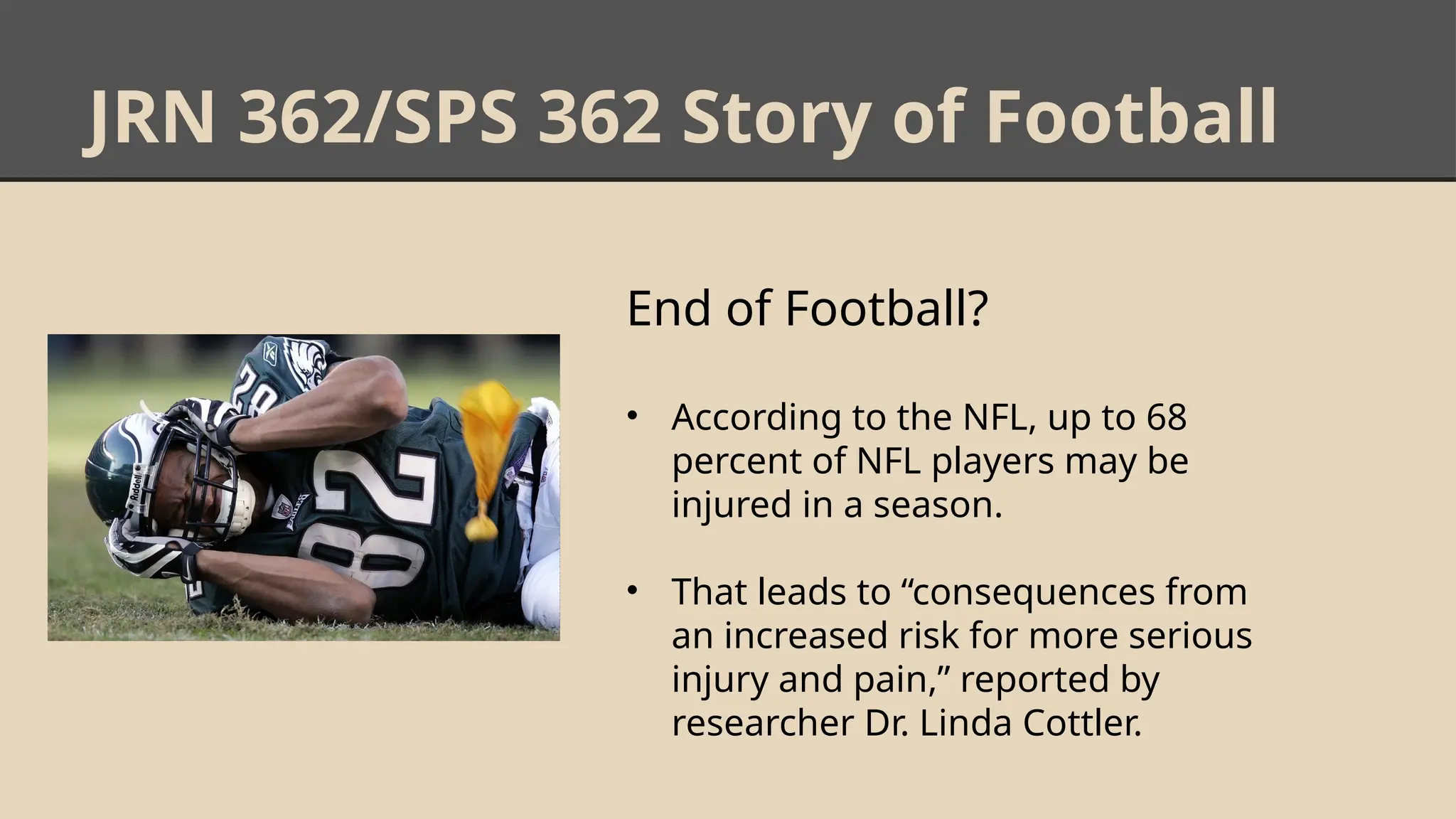
  • 130.
    JRN 362/SPS 362Story of Football End of Football? • President Woodrow Wilson (1913- 21), who coached the Wesleyan football team (stressing loyalty and teamwork) before becoming president of the United States, pointed to the game for giving men preparation for victory in World War I.
  • 131.
    JRN 362/SPS 362Story of Football End of Football? • President Herbert Hoover (1929- 1933) served as student manager of Stanford football in the 1890s. • He would invite his Stanford football classmates to the White House in 1931.
  • 132.
    JRN 362/SPS 362Story of Football End of Football? • President Dwight Eisenhower (1953-61) competed for West Point before leading the Allied victory over Nazi Germany in World War II and twice winning presidential elections.
  • 133.
    JRN 362/SPS 362Story of Football End of Football? • President John Kennedy (1961-63) made sure to attend football contests and banquets and mention the game to further political goals. • Recall that he praised Mississippi’s gridiron success when seeking to integrate colleges in the state.
  • 134.
    JRN 362/SPS 362Story of Football End of Football? • Richard Nixon (1969-74) likewise attended college and pro games, talked to coaches and even suggested a play to coach George Allen of the Redskins for the Super Bowl.
  • 135.
    JRN 362/SPS 362Story of Football End of Football? • President Gerald Ford (1974-77) played at Michigan and coached at Yale.
  • 136.
    JRN 362/SPS 362Story of Football End of Football? • President Ronald Reagan’s (1981- 89) resume included his time as a football player in college and later playing one in the movies.
  • 137.
    JRN 362/SPS 362Story of Football End of Football? • President Donald J. Trump played on the football team for one year at New York Military Academy and later owned the New Jersey Generals of the USFL (1984-85).
  • 138.
    JRN 362/SPS 362Story of Football End of Football? • President Joe Biden was a high school football star as a wide receiver at Archmere Academy and played one season at the University of Delaware.
  • 139.
    JRN 362/SPS 362Story of Football End of Football? • Outside of the Oval Office, the second man to walk on the moon – West Point graduate and fighter pilot Buzz Aldrin - played football before his lunar excursion.
  • 140.
    JRN 362/SPS 362Story of Football End of Football? • As did country music great Willie Nelson of Abbott, Texas, …
  • 141.
    JRN 362/SPS 362Story of Football End of Football? • … and the late Clarence Clemons, No. 50 on the right who played at the University of Maryland Eastern Shore before he went on to do something else.
  • 142.
    JRN 362/SPS 362Story of Football End of Football? • The Big Man played with Bruce Springsteen and the E Street Band, shown here in the early 1970s.
  • 143.
    JRN 362/SPS 362Story of Football End of Football? • The King himself, Elvis Presley, played pick up games in Memphis.
  • 144.
    JRN 362/SPS 362Story of Football End of Football? • Elvis Presley’s favorite team, the Cleveland Browns, sent him game tapes after every Sunday game. • He became friends with the great Jim Brown and drew up plays for years.
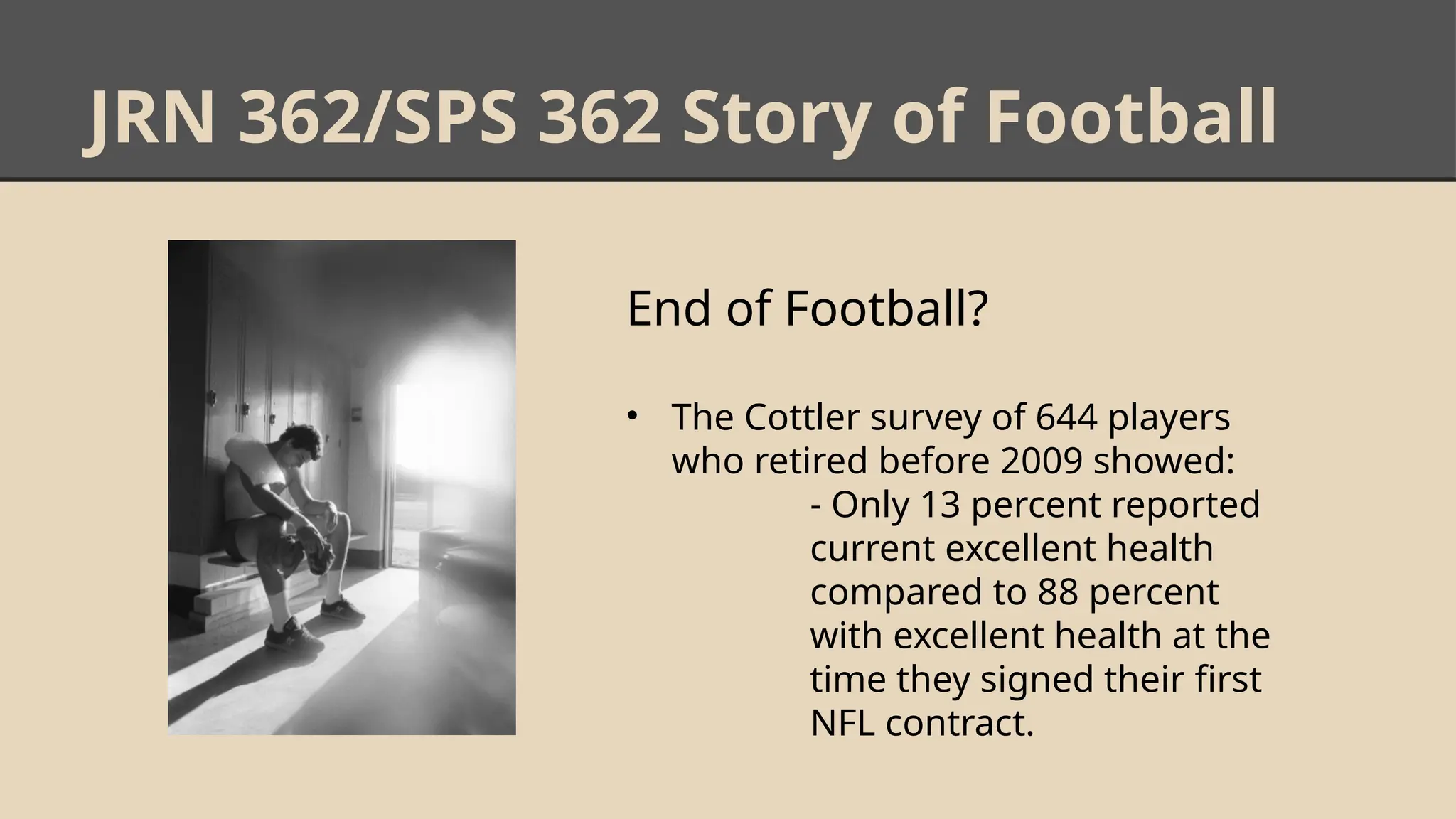
  • 145.
    JRN 362/SPS 362Story of Football End of Football? • Literary giants played, too. One, perhaps, suffered because of it. • Jack Kerouac was a high school star in Lowell, Massachusetts, and decided to attend Columbia in New York instead of two other schools that recruited him: Notre Dame and Boston College.
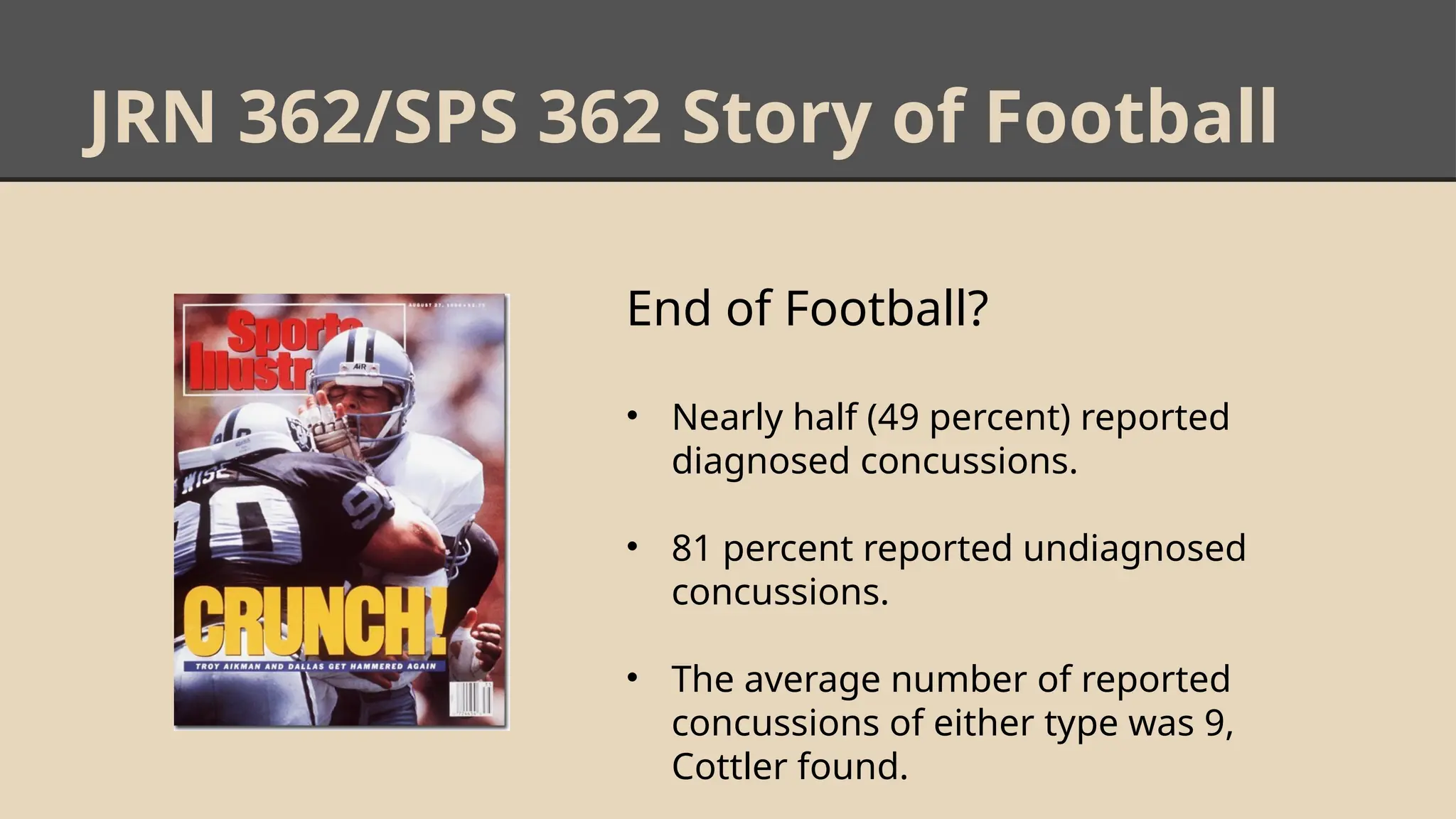
  • 146.
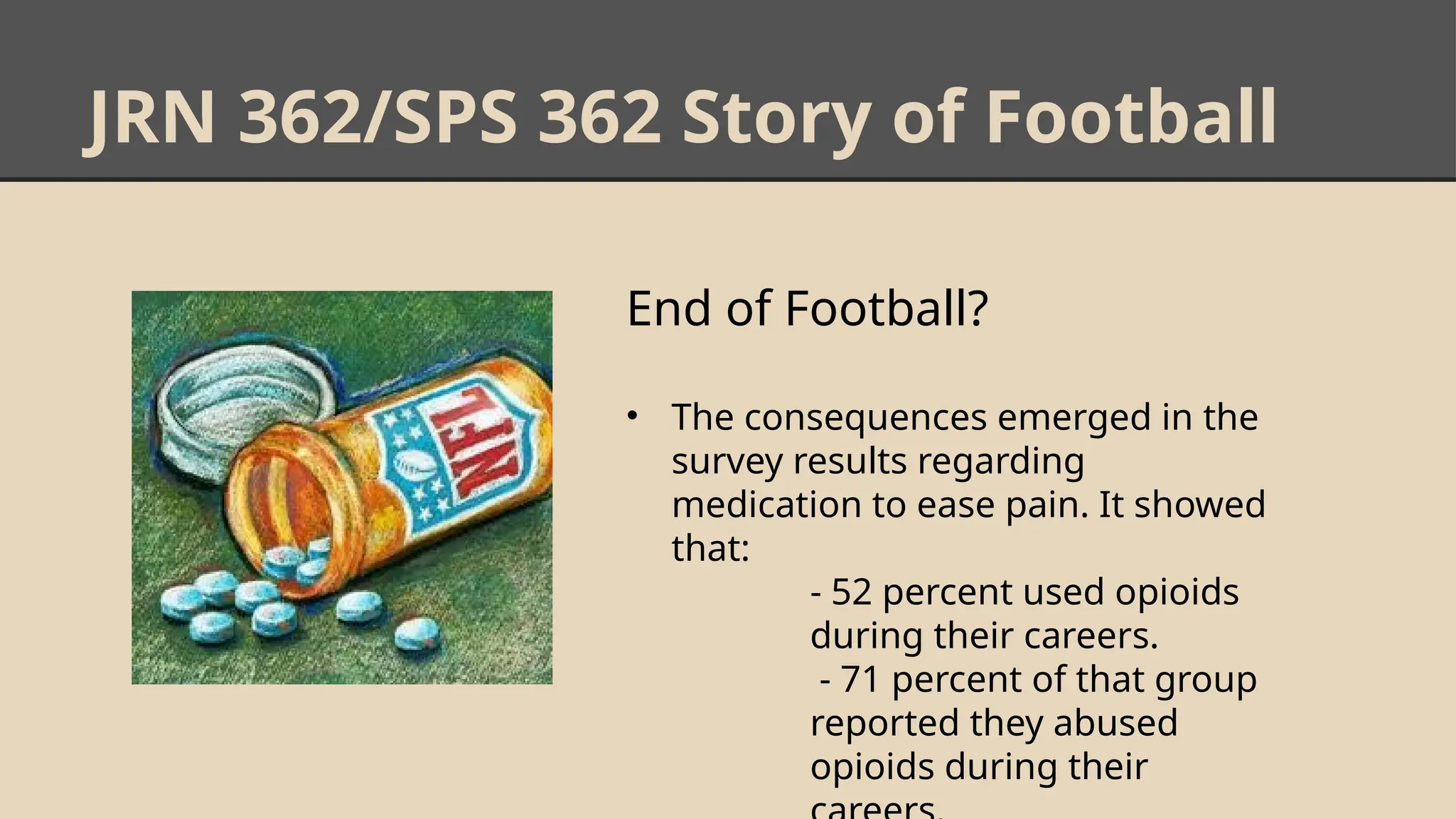
    JRN 362/SPS 362Story of Football End of Football? • Kerouac broke a leg just two weeks into the 1940 season and was never the same afterward. • One of Kerouac’s classmates, C. Ogden Beresford, wrote this in his autobiography about what happened to his friend:
  • 147.
    JRN 362/SPS 362Story of Football End of Football? • “Well, that finished Mr. Kerouac. He bemoaned his fate, lay on his back in his sack all day, wouldn’t attend classes, and just stared at the ceiling. Jim and I and several other guys all tried to pull this kid out of it, but he would turn on his side, close his eyes, and refuse to talk.”
  • 148.
    JRN 362/SPS 362Story of Football End of Football? • Kerouac dropped out of Columbia and became a writer who would be ranked alongside F. Scott Fitzgerald as among the best ever in the U.S. • Among his classics: “On the Road,” a work that inspired a generation of writers in the 1950s and 1960s.
  • 149.
    JRN 362/SPS 362Story of Football End of Football? • He also wrote the autobiographical novel ““Vanity of Duluoz,” which focused on his years playing football. • Kerouac describes the concussions he suffered over the years.
  • 150.
    JRN 362/SPS 362Story of Football End of Football? • Kerouac died at age 47 in 1969 after years of alcoholism. • A 2013 New Yorker article titled “Football and the Fall of Jack Kerouac” blamed repeated blows to the head for his erratic behavior and alcohol abuse.
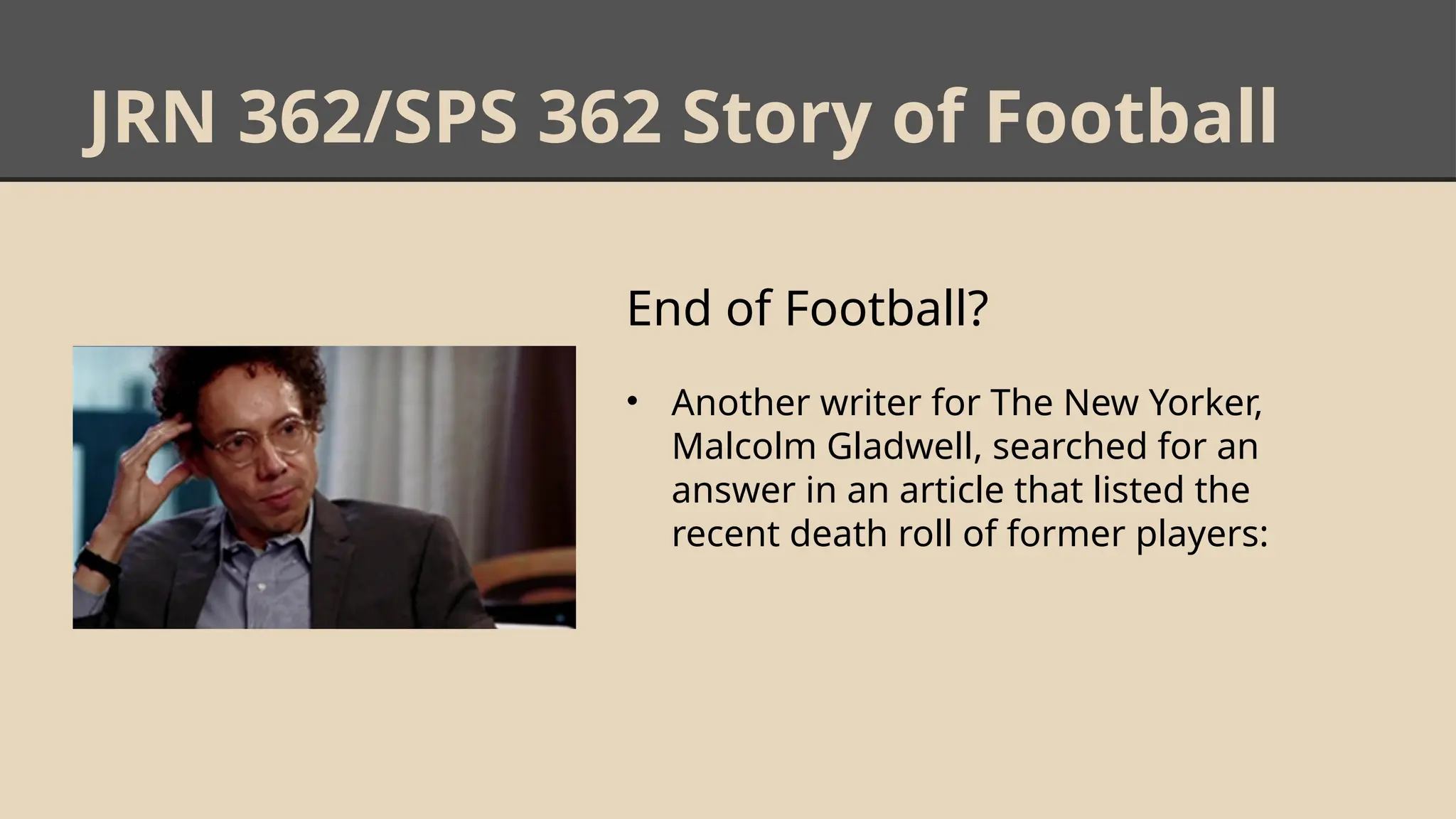
  • 151.
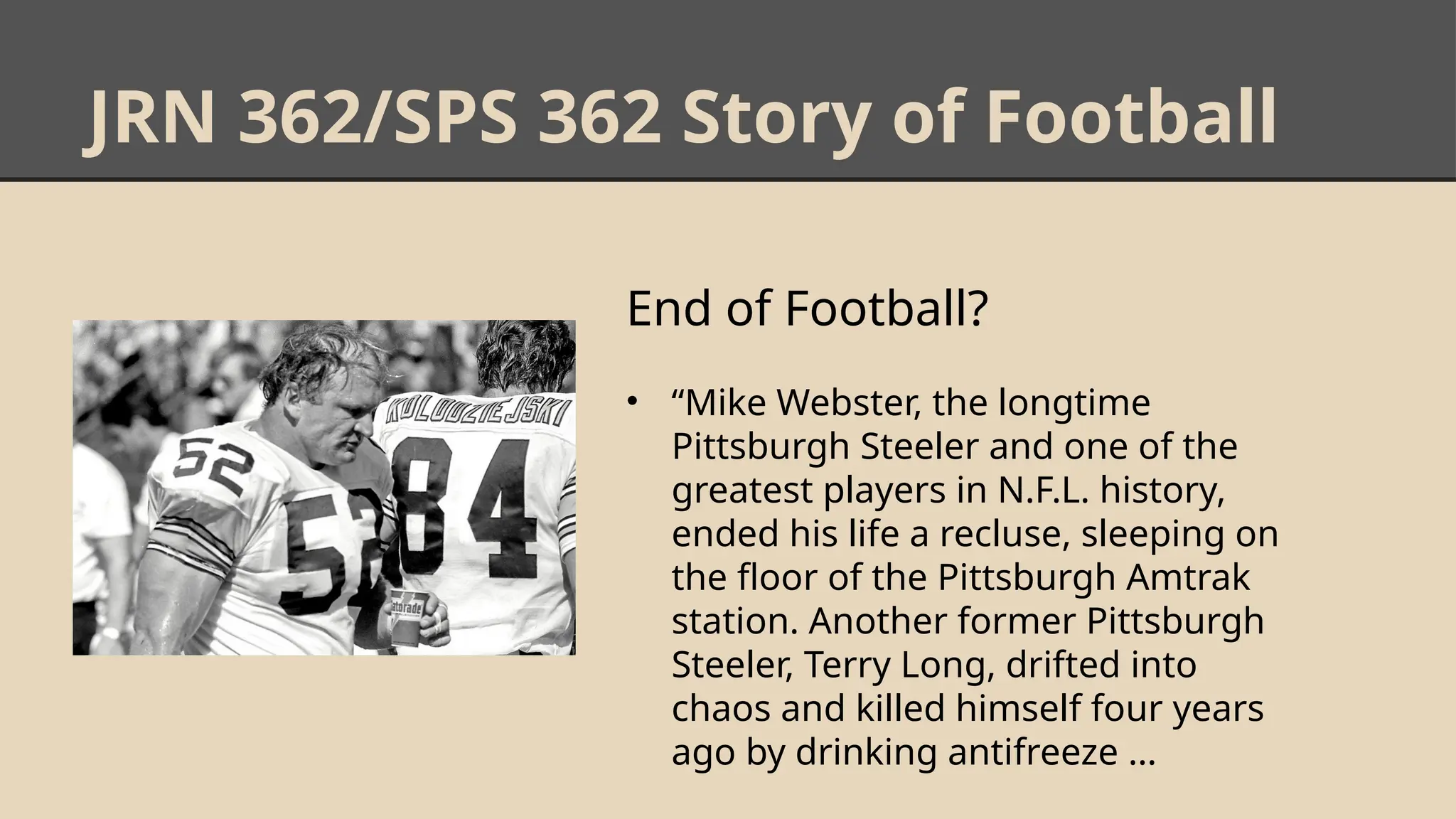
    JRN 362/SPS 362Story of Football End of Football? • “Kerouac had all of the symptoms of C.T.E.,” Robert Cantu, a neurosurgeon and co-director of Boston University’s Center for the Study of Traumatic Encephalopathy, said in the New Yorker article written by Ian Scheffler.
  • 152.
    JRN 362/SPS 362Story of Football End of Football? • Scheffler quoted from a story Kerouac wrote as a student at Columbia, “Kerouac explained that its purpose was to correct the public perception of football players. They might seem unstoppable, but this is an illusion ... Football players are human: they run so fiercely because they’re terrified.”
  • 153.
    JRN 362/SPS 362Story of Football End of Football? • If football is, indeed, our nation’s father, if we watch because we love the players and their capacity to combine ecstasy and violence in a single game, it suggests America is willing to accept the toll the game extracts to a point, but that point has yet to be reached.
  • 154.
    JRN 362/SPS 362Story of Football End of Football? • The players themselves shows us why they care, and perhaps we care because we share the same elemental sense of “honor, pride and tradition,” the stuff that makes people – and their existence – worthwhile.
  • 155.
    JRN 362/SPS 362Story of Football End of Football? • We are all football players in a dream life of our own making, where it is still possible to find meaning and pride amid the game’s ecstasy and violence. • The writer David Maraniss stressed that in the title of his biography of Vince Lombardi, “When Pride Still Mattered.”
  • 156.
    JRN 362/SPS 362Story of Football End of Football? • And it must matter because in the final analysis football reflects America. • Personal sacrifice, pain, teamwork, winning and losing are all embedded in the game as much as they are in everyday American life.
  • 157.
    JRN 362/SPS 362Story of Football End of Football? • In the southern states of America, this attitude is more culturally ingrained than anywhere else.
  • 158.
    JRN 362/SPS 362Story of Football End of Football? • In the South and Southwest, football and religion are difficult to separate. • The passion for football is held just as deeply of the most religious who live in that region, with its own rites and, indeed, services of a kind on game day.
  • 159.
    JRN 362/SPS 362Story of Football End of Football? • But everywhere in America, the game matters to tens of millions of Americans who play and watch and dream of becoming that hero carried off the field on the shoulders of teammates.
  • 160.
    JRN 362/SPS 362Story of Football End of Football? • And that dream life started in the 19th century when Tom Brown’s Schooldays by Thomas Hughes captivated a young boy named Walter Camp who went on to make football America’s game.