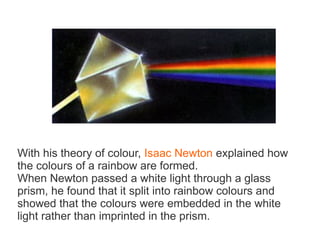
Color has an immediate psychological and physiological effect on humans. Objects appear colored because they absorb some wavelengths of light and reflect others. Isaac Newton discovered that white light is made up of the colors of the rainbow, which are not inherent to prisms but embedded in the white light. There are three primary subtractive colors - cyan, magenta, and yellow - which when mixed together can create other colors. Color has properties of hue, lightness, and saturation. The color wheel arranges pure hues in a logical sequence, and complementary colors directly across from each other on the wheel create maximum contrast and stability.