Colorectal Liver Metastases
What the IO Needs to Know
Michael C. Soulen, MD FSIR FCIRSE
Professor of Radiology & Surgery
University of Pennsylvania
Metastatic Colon CancerMetastatic Colon Cancer
The OptionsThe Options
No therapyNo therapy
median survival 7-8 monthsmedian survival 7-8 months
ResectionResection
25%-40% 5-year survival25%-40% 5-year survival
Systemic TherapySystemic Therapy
• 18-20 month median survival with sequential FOLFOX-18-20 month median survival with sequential FOLFOX-
FOLFIRI and Avastin, +/- EGFR inhibitor.FOLFIRI and Avastin, +/- EGFR inhibitor.
• Longer for liver-only disease (including downstaging).Longer for liver-only disease (including downstaging).
Metastatic Colon CancerMetastatic Colon Cancer
NCCN/ESMO GuidelinesNCCN/ESMO Guidelines
www.nccn.org/professionals/physician_gls/pdf/colon.pdfwww.nccn.org/professionals/physician_gls/pdf/colon.pdf
www.esmo.org/Guidelines-Practice/Clinical-Practice-www.esmo.org/Guidelines-Practice/Clinical-Practice-
Guidelines/Gastrointestinal-Cancers/Advanced-Colorectal-CancerGuidelines/Gastrointestinal-Cancers/Advanced-Colorectal-Cancer
www.esmo.org/Guidelines-Practice/Clinical-Practice-www.esmo.org/Guidelines-Practice/Clinical-Practice-
Guidelines/Gastrointestinal-Cancers/Advanced-Colorectal-CancerGuidelines/Gastrointestinal-Cancers/Advanced-Colorectal-Cancer• Need to know these!Need to know these!
– ““talk the talk” at tumor boardstalk the talk” at tumor boards
– Advise patients of all options for disease progressionAdvise patients of all options for disease progression
– Recognize impact on IO and surgical proceduresRecognize impact on IO and surgical procedures
• 11stst
-line:-line: FOLFOX or FOLFIRI, +/- AvastinFOLFOX or FOLFIRI, +/- Avastin
(bevacizumab)(bevacizumab)
• Vectibix (panitumumab)/Erbitux (cetuximab) forVectibix (panitumumab)/Erbitux (cetuximab) for
KRAS/BRAF wild-type genotypeKRAS/BRAF wild-type genotype
– approx. 40% KRAS mutant, another 5%-10% BRAF mutantapprox. 40% KRAS mutant, another 5%-10% BRAF mutant
• 22ndnd
-line:-line: the other triplet, +/- EGFR inhibitor +/-the other triplet, +/- EGFR inhibitor +/-
AvastinAvastin
Systemic ChemotherapySystemic Chemotherapy
Need to know the benefitNeed to know the benefit
•Response rates 40%-60%Response rates 40%-60%
– Downstaging to resectability in 20%-25%!Downstaging to resectability in 20%-25%!
– 5-year survival after downstaging to resection 33%!!5-year survival after downstaging to resection 33%!!
•PFS 1st-line 7-9 monthsPFS 1st-line 7-9 months
•PFS 2nd-line 3-5 monthsPFS 2nd-line 3-5 months
•OS unresected 18-21 monthsOS unresected 18-21 months
•Adam R, Delvart V, Pascal G, et al: Rescue surgery for unresectable colorectal liverAdam R, Delvart V, Pascal G, et al: Rescue surgery for unresectable colorectal liver
metastases down-staged by chemotherapy: A model to predict long-term survival. Ann Surgmetastases down-staged by chemotherapy: A model to predict long-term survival. Ann Surg
240:644-657, 2004240:644-657, 2004
•Delaunoit T, Alberts SR, Sargent DJ, et al: Chemotherapy permits resection of metastaticDelaunoit T, Alberts SR, Sargent DJ, et al: Chemotherapy permits resection of metastatic
colorectal cancer: Experience from Intergroup N9741. Ann Oncol 16:425-429, 2005colorectal cancer: Experience from Intergroup N9741. Ann Oncol 16:425-429, 2005
Systemic ChemotherapySystemic Chemotherapy
• Need to know the toxicitiesNeed to know the toxicities
– Oxaliplatin: neuropathy, “blue” liver, marrowOxaliplatin: neuropathy, “blue” liver, marrow
– Irinotecan : diarrhea, “yellow” liver, marrowIrinotecan : diarrhea, “yellow” liver, marrow
– 5-FU: mucositis, diarrhea, marrow5-FU: mucositis, diarrhea, marrow
– cetuximab - rashcetuximab - rash
– bevacizumab - HTN, proteinuria, wound healing,bevacizumab - HTN, proteinuria, wound healing,
bowel perforation, bleeding, thrombosisbowel perforation, bleeding, thrombosis
– >6 months chemo increases risk of liver failure with>6 months chemo increases risk of liver failure with
resectionresection
required FLR increases from 25% to 40%required FLR increases from 25% to 40%
– Avastin : Hold two weeks for chest portsAvastin : Hold two weeks for chest ports
Probably unimportant for embolizationProbably unimportant for embolization
Colorectal Liver MetastasesColorectal Liver Metastases
Colorectal MetastasesColorectal Metastases
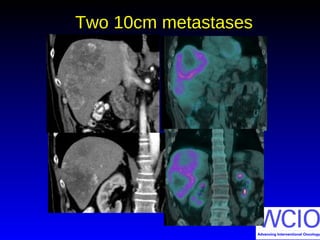
Two 10cm metastases
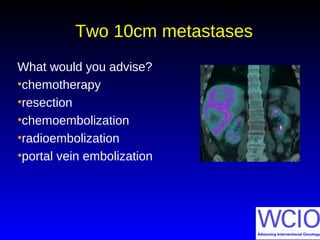
Two 10cm metastases
What would you advise?
•chemotherapy
•resection
•chemoembolization
•radioembolization
•portal vein embolization
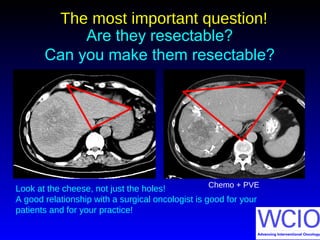
The most important question!The most important question!
Are they resectable?
Can you make them resectable?
Look at the cheese, not just the holes!
A good relationship with a surgical oncologist is good for your
patients and for your practice!
Chemo + PVE
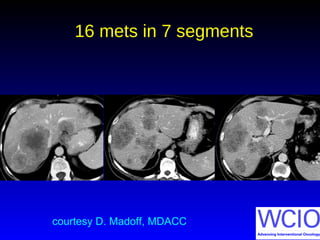
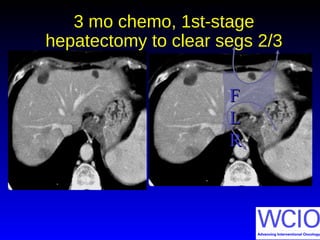
16 mets in 7 segments
courtesy D. Madoff, MDACC
3 mo chemo, 1st-stage
hepatectomy to clear segs 2/3
FF
LL
RR
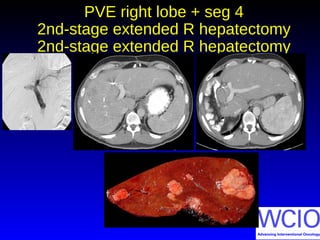
PVE right lobe + seg 4
2nd-stage extended R hepatectomy
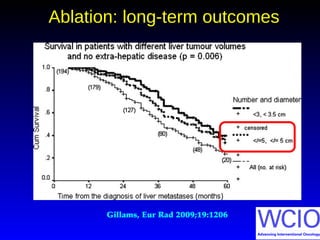
Ablation: long-term outcomesAblation: long-term outcomes
Gillams, Eur Rad 2009;19:1206
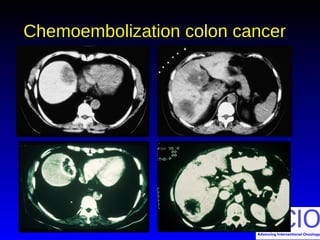
Chemoembolization colon cancerChemoembolization colon cancer
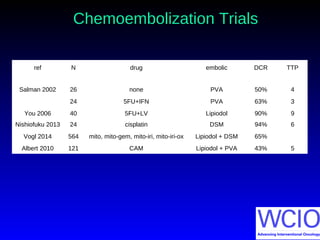
Chemoembolization TrialsChemoembolization Trials
ref N drug embolic DCR TTP
Salman 2002 26 none PVA 50% 4
24 5FU+IFN PVA 63% 3
You 2006 40 5FU+LV Lipiodol 90% 9
Nishiofuku 2013 24 cisplatin DSM 94% 6
Vogl 2014 564 mito, mito-gem, mito-iri, mito-iri-ox Lipiodol + DSM 65%
Albert 2010 121 CAM Lipiodol + PVA 43% 5
Chemoembolization TrialsChemoembolization Trials
ref N median survival 1yr 2yr 3yr
from chemoembolization
Salman 2002 26 15 [8-17]
24 10 [8-11]
You 2006 40 16 90% 15%
Nishiofuku 2013 24 21 [8-24] 67% 42%
Vogl 2014 564 14.3 62% 28% 7%
Albert 2010 121 9 36% 13%
Hong 2009 21 7.7 43% 10%
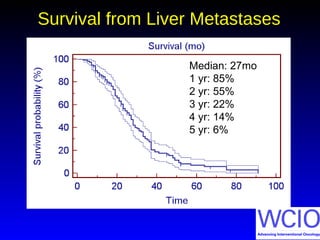
Survival from Liver MetastasesSurvival from Liver Metastases
Median: 27mo
1 yr: 85%
2 yr: 55%
3 yr: 22%
4 yr: 14%
5 yr: 6%
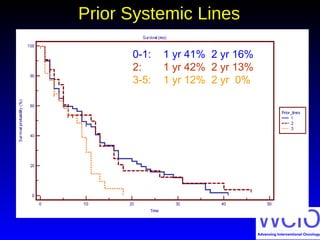
Prior Systemic LinesPrior Systemic Lines
0-1: 1 yr 41% 2 yr 16%
2: 1 yr 42% 2 yr 13%
3-5: 1 yr 12% 2 yr 0%
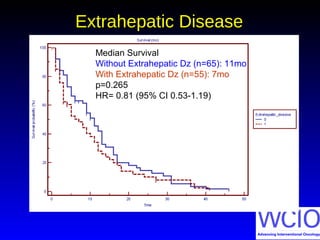
Extrahepatic DiseaseExtrahepatic Disease
Median Survival
Without Extrahepatic Dz (n=65): 11mo
With Extrahepatic Dz (n=55): 7mo
p=0.265
HR= 0.81 (95% CI 0.53-1.19)
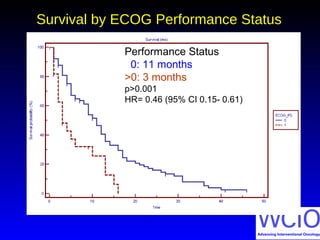
Survival by ECOG Performance StatusSurvival by ECOG Performance Status
Performance Status
0: 11 months
>0: 3 months
p>0.001
HR= 0.46 (95% CI 0.15- 0.61)
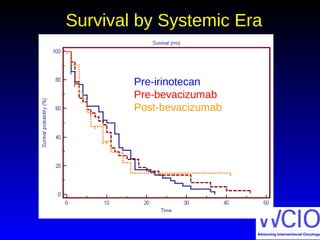
Survival by Systemic EraSurvival by Systemic Era
Pre-irinotecan
Pre-bevacizumab
Post-bevacizumab
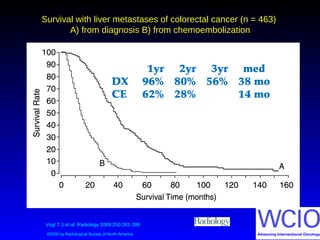
Survival with liver metastases of colorectal cancer (n = 463)
A) from diagnosis B) from chemoembolization
Vogl T J et al. Radiology 2009;250:281-289
©2009 by Radiological Society of North America
1yr 2yr 3yr med
DX 96% 80% 56% 38 mo
CE 62% 28% 14 mo
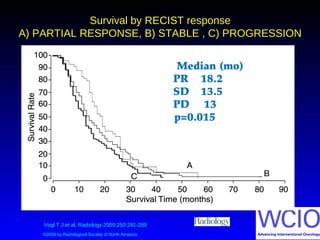
Survival by RECIST response
A) PARTIAL RESPONSE, B) STABLE , C) PROGRESSION
Vogl T J et al. Radiology 2009;250:281-289
©2009 by Radiological Society of North America
Median (mo)
PR 18.2
SD 13.5
PD 13
p=0.015
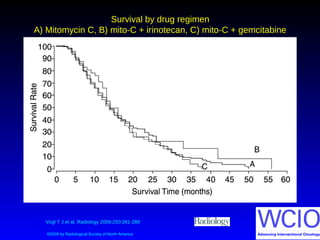
Survival by drug regimen
A) Mitomycin C, B) mito-C + irinotecan, C) mito-C + gemcitabine
Vogl T J et al. Radiology 2009;250:281-289
©2009 by Radiological Society of North America
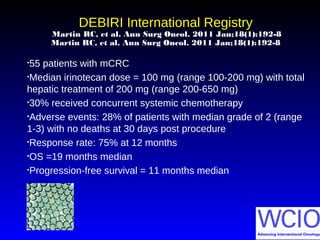
DEBIRI International RegistryDEBIRI International Registry
Martin RC, et al. Ann Surg Oncol. 2011 Jan;18(1):192-8
•55 patients with mCRC
•Median irinotecan dose = 100 mg (range 100-200 mg) with total
hepatic treatment of 200 mg (range 200-650 mg)
•30% received concurrent systemic chemotherapy
•Adverse events: 28% of patients with median grade of 2 (range
1-3) with no deaths at 30 days post procedure
•Response rate: 75% at 12 months
•OS =19 months median
•Progression-free survival = 11 months median
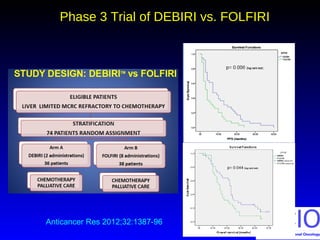
Phase 3 Trial of DEBIRI vs. FOLFIRIPhase 3 Trial of DEBIRI vs. FOLFIRI
Anticancer Res 2012;32:1387-96
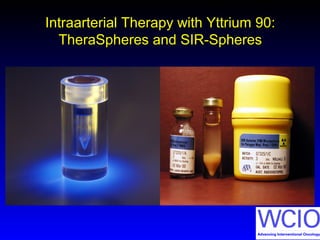
Intraarterial Therapy with Yttrium 90:Intraarterial Therapy with Yttrium 90:
TheraSpheres and SIR-SpheresTheraSpheres and SIR-Spheres
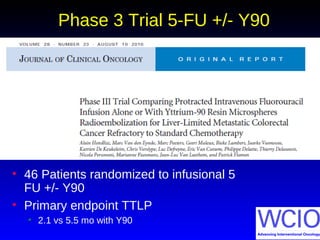
Phase 3 Trial 5-FU +/- Y90
• 46 Patients randomized to infusional 5
FU +/- Y90
• Primary endpoint TTLP
• 2.1 vs 5.5 mo with Y90
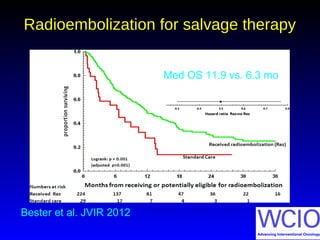
Med OS 11.9 vs. 6.3 mo
Bester et al. JVIR 2012
Radioembolization for salvage therapy
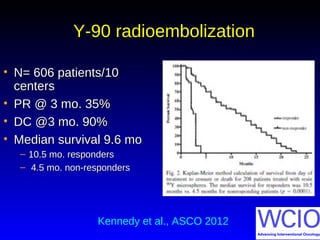
Y-90 radioembolizationY-90 radioembolization
• N= 606 patients/10N= 606 patients/10
centerscenters
• PR @ 3 mo. 35%PR @ 3 mo. 35%
• DC @3 mo. 90%DC @3 mo. 90%
• Median survival 9.6 moMedian survival 9.6 mo
– 10.5 mo. responders10.5 mo. responders
– 4.5 mo. non-responders4.5 mo. non-responders
Kennedy et al., ASCO 2012
(Goldberg 2002) FOLFOX
(Goldberg 2002) IFL
FOLFIRI
FOLFOX
IFL/Saltz
5-FU/LV (de Gramont 2000)
5-FU/LV (Douillard 2000)
5-FU/LV (Saltz 2000)
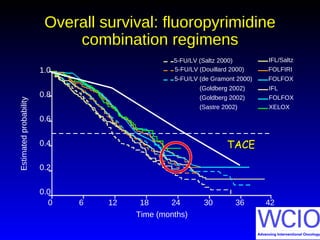
Overall survival: fluoropyrimidineOverall survival: fluoropyrimidine
combination regimenscombination regimens
Time (months)
Estimatedprobability
1.0
0.8
0.6
0.4
0.2
0.0
0 6 12 18 24 30 36 42
(Sastre 2002) XELOX
TACETACE
ConclusionConclusion
• The Interventional Oncologist is an essentialThe Interventional Oncologist is an essential
member of the colorectal cancer teammember of the colorectal cancer team
• IO procedures can increase the potential forIO procedures can increase the potential for
curative resectioncurative resection
• Adding intra-arterial therapies providesAdding intra-arterial therapies provides
survival better than expected from systemicsurvival better than expected from systemic
therapy alonetherapy alone
• Integration with other therapeutic modalitiesIntegration with other therapeutic modalities
key to maximizing long-term outcomes.key to maximizing long-term outcomes.
COLON CANCER

COLON CANCER

  • 1.
    Colorectal Liver Metastases Whatthe IO Needs to Know Michael C. Soulen, MD FSIR FCIRSE Professor of Radiology & Surgery University of Pennsylvania
  • 2.
    Metastatic Colon CancerMetastaticColon Cancer The OptionsThe Options No therapyNo therapy median survival 7-8 monthsmedian survival 7-8 months ResectionResection 25%-40% 5-year survival25%-40% 5-year survival Systemic TherapySystemic Therapy • 18-20 month median survival with sequential FOLFOX-18-20 month median survival with sequential FOLFOX- FOLFIRI and Avastin, +/- EGFR inhibitor.FOLFIRI and Avastin, +/- EGFR inhibitor. • Longer for liver-only disease (including downstaging).Longer for liver-only disease (including downstaging).
  • 3.
    Metastatic Colon CancerMetastaticColon Cancer NCCN/ESMO GuidelinesNCCN/ESMO Guidelines www.nccn.org/professionals/physician_gls/pdf/colon.pdfwww.nccn.org/professionals/physician_gls/pdf/colon.pdf www.esmo.org/Guidelines-Practice/Clinical-Practice-www.esmo.org/Guidelines-Practice/Clinical-Practice- Guidelines/Gastrointestinal-Cancers/Advanced-Colorectal-CancerGuidelines/Gastrointestinal-Cancers/Advanced-Colorectal-Cancer www.esmo.org/Guidelines-Practice/Clinical-Practice-www.esmo.org/Guidelines-Practice/Clinical-Practice- Guidelines/Gastrointestinal-Cancers/Advanced-Colorectal-CancerGuidelines/Gastrointestinal-Cancers/Advanced-Colorectal-Cancer• Need to know these!Need to know these! – ““talk the talk” at tumor boardstalk the talk” at tumor boards – Advise patients of all options for disease progressionAdvise patients of all options for disease progression – Recognize impact on IO and surgical proceduresRecognize impact on IO and surgical procedures • 11stst -line:-line: FOLFOX or FOLFIRI, +/- AvastinFOLFOX or FOLFIRI, +/- Avastin (bevacizumab)(bevacizumab) • Vectibix (panitumumab)/Erbitux (cetuximab) forVectibix (panitumumab)/Erbitux (cetuximab) for KRAS/BRAF wild-type genotypeKRAS/BRAF wild-type genotype – approx. 40% KRAS mutant, another 5%-10% BRAF mutantapprox. 40% KRAS mutant, another 5%-10% BRAF mutant • 22ndnd -line:-line: the other triplet, +/- EGFR inhibitor +/-the other triplet, +/- EGFR inhibitor +/- AvastinAvastin
  • 4.
    Systemic ChemotherapySystemic Chemotherapy Needto know the benefitNeed to know the benefit •Response rates 40%-60%Response rates 40%-60% – Downstaging to resectability in 20%-25%!Downstaging to resectability in 20%-25%! – 5-year survival after downstaging to resection 33%!!5-year survival after downstaging to resection 33%!! •PFS 1st-line 7-9 monthsPFS 1st-line 7-9 months •PFS 2nd-line 3-5 monthsPFS 2nd-line 3-5 months •OS unresected 18-21 monthsOS unresected 18-21 months •Adam R, Delvart V, Pascal G, et al: Rescue surgery for unresectable colorectal liverAdam R, Delvart V, Pascal G, et al: Rescue surgery for unresectable colorectal liver metastases down-staged by chemotherapy: A model to predict long-term survival. Ann Surgmetastases down-staged by chemotherapy: A model to predict long-term survival. Ann Surg 240:644-657, 2004240:644-657, 2004 •Delaunoit T, Alberts SR, Sargent DJ, et al: Chemotherapy permits resection of metastaticDelaunoit T, Alberts SR, Sargent DJ, et al: Chemotherapy permits resection of metastatic colorectal cancer: Experience from Intergroup N9741. Ann Oncol 16:425-429, 2005colorectal cancer: Experience from Intergroup N9741. Ann Oncol 16:425-429, 2005
  • 5.
    Systemic ChemotherapySystemic Chemotherapy •Need to know the toxicitiesNeed to know the toxicities – Oxaliplatin: neuropathy, “blue” liver, marrowOxaliplatin: neuropathy, “blue” liver, marrow – Irinotecan : diarrhea, “yellow” liver, marrowIrinotecan : diarrhea, “yellow” liver, marrow – 5-FU: mucositis, diarrhea, marrow5-FU: mucositis, diarrhea, marrow – cetuximab - rashcetuximab - rash – bevacizumab - HTN, proteinuria, wound healing,bevacizumab - HTN, proteinuria, wound healing, bowel perforation, bleeding, thrombosisbowel perforation, bleeding, thrombosis – >6 months chemo increases risk of liver failure with>6 months chemo increases risk of liver failure with resectionresection required FLR increases from 25% to 40%required FLR increases from 25% to 40% – Avastin : Hold two weeks for chest portsAvastin : Hold two weeks for chest ports Probably unimportant for embolizationProbably unimportant for embolization
  • 6.
  • 7.
  • 8.
  • 9.
    Two 10cm metastases Whatwould you advise? •chemotherapy •resection •chemoembolization •radioembolization •portal vein embolization
  • 10.
    The most importantquestion!The most important question! Are they resectable? Can you make them resectable? Look at the cheese, not just the holes! A good relationship with a surgical oncologist is good for your patients and for your practice! Chemo + PVE
  • 11.
    16 mets in7 segments courtesy D. Madoff, MDACC
  • 12.
    3 mo chemo,1st-stage hepatectomy to clear segs 2/3 FF LL RR
  • 13.
    PVE right lobe+ seg 4 2nd-stage extended R hepatectomy 2nd-stage extended R hepatectomy
  • 14.
    Ablation: long-term outcomesAblation:long-term outcomes Gillams, Eur Rad 2009;19:1206
  • 15.
  • 16.
    Chemoembolization TrialsChemoembolization Trials refN drug embolic DCR TTP Salman 2002 26 none PVA 50% 4 24 5FU+IFN PVA 63% 3 You 2006 40 5FU+LV Lipiodol 90% 9 Nishiofuku 2013 24 cisplatin DSM 94% 6 Vogl 2014 564 mito, mito-gem, mito-iri, mito-iri-ox Lipiodol + DSM 65% Albert 2010 121 CAM Lipiodol + PVA 43% 5
  • 17.
    Chemoembolization TrialsChemoembolization Trials refN median survival 1yr 2yr 3yr from chemoembolization Salman 2002 26 15 [8-17] 24 10 [8-11] You 2006 40 16 90% 15% Nishiofuku 2013 24 21 [8-24] 67% 42% Vogl 2014 564 14.3 62% 28% 7% Albert 2010 121 9 36% 13% Hong 2009 21 7.7 43% 10%
  • 18.
    Survival from LiverMetastasesSurvival from Liver Metastases Median: 27mo 1 yr: 85% 2 yr: 55% 3 yr: 22% 4 yr: 14% 5 yr: 6%
  • 19.
    Prior Systemic LinesPriorSystemic Lines 0-1: 1 yr 41% 2 yr 16% 2: 1 yr 42% 2 yr 13% 3-5: 1 yr 12% 2 yr 0%
  • 20.
    Extrahepatic DiseaseExtrahepatic Disease MedianSurvival Without Extrahepatic Dz (n=65): 11mo With Extrahepatic Dz (n=55): 7mo p=0.265 HR= 0.81 (95% CI 0.53-1.19)
  • 21.
    Survival by ECOGPerformance StatusSurvival by ECOG Performance Status Performance Status 0: 11 months >0: 3 months p>0.001 HR= 0.46 (95% CI 0.15- 0.61)
  • 22.
    Survival by SystemicEraSurvival by Systemic Era Pre-irinotecan Pre-bevacizumab Post-bevacizumab
  • 23.
    Survival with livermetastases of colorectal cancer (n = 463) A) from diagnosis B) from chemoembolization Vogl T J et al. Radiology 2009;250:281-289 ©2009 by Radiological Society of North America 1yr 2yr 3yr med DX 96% 80% 56% 38 mo CE 62% 28% 14 mo
  • 24.
    Survival by RECISTresponse A) PARTIAL RESPONSE, B) STABLE , C) PROGRESSION Vogl T J et al. Radiology 2009;250:281-289 ©2009 by Radiological Society of North America Median (mo) PR 18.2 SD 13.5 PD 13 p=0.015
  • 25.
    Survival by drugregimen A) Mitomycin C, B) mito-C + irinotecan, C) mito-C + gemcitabine Vogl T J et al. Radiology 2009;250:281-289 ©2009 by Radiological Society of North America
  • 26.
    DEBIRI International RegistryDEBIRIInternational Registry Martin RC, et al. Ann Surg Oncol. 2011 Jan;18(1):192-8 Martin RC, et al. Ann Surg Oncol. 2011 Jan;18(1):192-8 •55 patients with mCRC •Median irinotecan dose = 100 mg (range 100-200 mg) with total hepatic treatment of 200 mg (range 200-650 mg) •30% received concurrent systemic chemotherapy •Adverse events: 28% of patients with median grade of 2 (range 1-3) with no deaths at 30 days post procedure •Response rate: 75% at 12 months •OS =19 months median •Progression-free survival = 11 months median
  • 27.
    Phase 3 Trialof DEBIRI vs. FOLFIRIPhase 3 Trial of DEBIRI vs. FOLFIRI Anticancer Res 2012;32:1387-96
  • 28.
    Intraarterial Therapy withYttrium 90:Intraarterial Therapy with Yttrium 90: TheraSpheres and SIR-SpheresTheraSpheres and SIR-Spheres
  • 29.
    Phase 3 Trial5-FU +/- Y90 • 46 Patients randomized to infusional 5 FU +/- Y90 • Primary endpoint TTLP • 2.1 vs 5.5 mo with Y90
  • 30.
    Med OS 11.9vs. 6.3 mo Bester et al. JVIR 2012 Radioembolization for salvage therapy
  • 31.
    Y-90 radioembolizationY-90 radioembolization •N= 606 patients/10N= 606 patients/10 centerscenters • PR @ 3 mo. 35%PR @ 3 mo. 35% • DC @3 mo. 90%DC @3 mo. 90% • Median survival 9.6 moMedian survival 9.6 mo – 10.5 mo. responders10.5 mo. responders – 4.5 mo. non-responders4.5 mo. non-responders Kennedy et al., ASCO 2012
  • 32.
    (Goldberg 2002) FOLFOX (Goldberg2002) IFL FOLFIRI FOLFOX IFL/Saltz 5-FU/LV (de Gramont 2000) 5-FU/LV (Douillard 2000) 5-FU/LV (Saltz 2000) Overall survival: fluoropyrimidineOverall survival: fluoropyrimidine combination regimenscombination regimens Time (months) Estimatedprobability 1.0 0.8 0.6 0.4 0.2 0.0 0 6 12 18 24 30 36 42 (Sastre 2002) XELOX TACETACE
  • 33.
    ConclusionConclusion • The InterventionalOncologist is an essentialThe Interventional Oncologist is an essential member of the colorectal cancer teammember of the colorectal cancer team • IO procedures can increase the potential forIO procedures can increase the potential for curative resectioncurative resection • Adding intra-arterial therapies providesAdding intra-arterial therapies provides survival better than expected from systemicsurvival better than expected from systemic therapy alonetherapy alone • Integration with other therapeutic modalitiesIntegration with other therapeutic modalities key to maximizing long-term outcomes.key to maximizing long-term outcomes.

Editor's Notes

  • #17 1st 4 US trials, all same response and survival
  • #19 Median survival time from diagnosis of liver metastases
  • #20 Survival was significantly better when chemoembolization was performed following first- or second-line systemic therapy than as rescue therapy after 3-5th lines of chemotherapy (p=0.03). 1 year survival dropped from 41% and 42% after 0, 1, 2 lines of systemic chemo to 12% after 3 or more lines.
  • #21 Subgroup analysis was performed based on the presence of extrahepatic disease at the time Of first CE There was no difference in survival between patients with or without extrahepatic metastases (p=0.265). Median survival time for those without extrahepatic disease was 11 months from time of initial chemoembolization, For those with extrahepatic metastases, mean survival was 7 months.
  • #22 As may be expected, survival time was longer in those with better performance status. Median survival time for those with an ECOG status of 0 at the time of their first chemoembolization was 11 months, as compared to 3 months for those with ECOG status of >0
  • #24 Survival data (Kaplan-Meier method) of patients with liver metastases of colorectal cancer (n = 463). Curve A: Median survival time from diagnosis of liver metastases was 38 months. Curve B: Median survival time was 14 months from the start of transarterial chemoembolization therapy.
  • #25 Kaplan-Meier survival curve. Local control results (RECIST criteria) were partial response, 14.7% of patients; stable disease, 48.2%; and progressive disease, 37.1%. Curve A: In patients with partial response, median survival was 18.2 months. Curve B: In patients with stable disease, median survival was 13.5 months. Curve C: In patients with progressive disease, median survival was 13 months.
  • #26 Kaplan-Meier survival curve. Curve A: Survival data of 243 patients with liver metastases after transarterial chemoembolization with mitomycin C. Median survival was 14 months. Curve B: In 67 patients treated with mitomycin C and irinotecan, median survival was 14 months. Curve C: In 153 patients treated with mitomycin C and gemcitabine, median survival was 13.9 months.