MRF
CURE-OM
6th
Annual
Patient and
Caregiver
Symposium
3.11.17
LIVER DIRECTED THERAPY
FOR METASTATIC UVEAL
MELANOMA
Marlana Orloff, MD
Assistant Professor
Department of Medical Oncology
Thomas Jefferson University
Sidney Kimmel Cancer Center
Approximate 5 year survival 70-80%
About 50% of patients will develop metastatic disease
One year survival 13-15%*
Median survival after development of metastatic disease ranges 2-15
months*
Liver most common site of metastases
 About 50% of patients with metastatic disease may have liver only disease for
majority of their disease course
UVEAL MELANOMA
* In the literature though not necessarily reflective of more current clinical experience
SITE OF METASTASES
J G Lorigan et al 1991
Patients presenting with varied disease presentations
 Liver only : small disease burden
 Liver only : large disease burden
 Liver predominant but extra-hepatic present
 Extra-hepatic only
 Metastatic disease at time of eye diagnosis
 Recurrence during adjuvant treatment
 Recurrence >15+ years after eye diagnosis
 Treatment naïve
 Heavily pre-treated
 Some tumors grow very fast
 Some tumors grow slower
 … And everything in between
PATIENT PRESENTATIONS
RAPID GROWTH
MRI normal 6 months prior
RAPID GROWTH
12/17/2013
4/30/2014 6/2/2014
SLOW GROWTH
12/30/15 12/20/16
MERITS OF TRANS-ARTERIAL CATHETER-
DIRECTED TREATMENT OF LIVER TUMORS
Liver tumors obtain the majority of their blood supply from
the hepatic artery.
Normal liver parenchyma has a dual blood supply
 Portal vein (~75%)
 Hepatic artery (~25%)
Trans-arterial catheter-directed therapies allow localized
treatment to liver tumors while sparing normal liver
parenchyma
Delivery of medication to liver tumors at a higher
concentration could be achieved while minimizing systemic
toxicity
Melanoma in
the liver
Embolization
drugs
administered
through
catheter
Melanoma
 Bland embolization
 Immunoembolization
 GM-CSF +/- IL-2
 Radioactive microspheres
 SirSpheres
 Chemoembolization
 BCNU
 Chemoembolization with Drug-Eluding Beads
 DEBDOX
 DEBIRI
 Hepatic arterial infusion
 Fotemustine
 BCNU
 Percutaneous Hepatic Perfusion (PHP)
 Melphalan
 Isolated Hepatic Perfusion (IHP)
 Melphalan
 *Surgical Resection / Ablation
TYPES OF LIVER DIRECTED TREATMENTS
IMMUNOEMBOLIZATION
Destruction of tumor by embolization could control tumor
progression locally and provide tumor antigens to the local
immune system
Concurrent use of GM-CSF and IL-2 induces an inflammatory
response in the tumor and surrounding tissue which may
improve the anti-cancer immune response
Local stimulation of the immune system may result in the
development of a systemic immune response against tumor
cells which may suppress the growth of distant tumors
IMMUNOEMBOLIZATION
RATIONALE
Purpose was to investigate feasibility and safety
2000 – 2004, single institution
34 of 39 patients had MUM
<50% tumor involvement, unresectable
Lobar hepatic artery embolization every 4 weeks using escalating dose of
GM-CSF (25-2000 mcg) emulsifiedwith Ethiodol followed by Gelfoam, for
6 treatments
Imaging (CT, MRI) and clinical assessment after every other treatment to
assess response (RECIST)
Primary end-points were dose-limiting toxicity and maximum tolerated
dose
IMMUNOEMBOLIZATION
PHASE 1
JCO 2008 26:5436-5442
6 procedures/patient (median, range 1-14)
32% responded (2 CR, 8 PR)
32% stable disease
OS: 14.4 months (median)
 (33.7 months for CR/PR, 12.4 months SD/PD)
Survival: 1 yr. 62%, 2 yr. 26%
PFS-liver: 4.8 months (median)
PFS-systemic: 10.4 months (median)
1 patient remains alive > 10 years
IMMUNOEMBOLIZATION
PHASE 1
JCO 2008 26:5436-5442
IMMUNOEMBOLIZATION
2 months laterInitial
IMMUNOEMBOLIZATION
2 months laterInitial
High dose IE (>1500mcg) vs historic data from Phase II TACE with BCNU
 Excluded those with >50% liver involvement
Longer OS (20.4 vs. 9.8 months, median)*
Longer PFS-L (9.3 vs. 6.4 months, median)
Longer PFS-S (12.4 vs. 4.8 months, median)*
Systemic progression was delayed in the high-dose IE group, suggesting
an induction of a systemic immune response against the melanoma cells
IMMUNOEMBOLIZATION
COMPARED TO HISTORIC PHASE II TACE WITH BCNU
* P < 0.5
Radiology 2009; 252:290-298
About 10% of patients have an amazing response to immunoembolization
 After receiving a few treatments stabilization, sometimes shrinkage, and decreased
viability
 Treatment breaks for months to years
 Embolic agent transient so repeated procedures possible
EXCEPTIONAL RESPONDERS
10/2010 1/2017
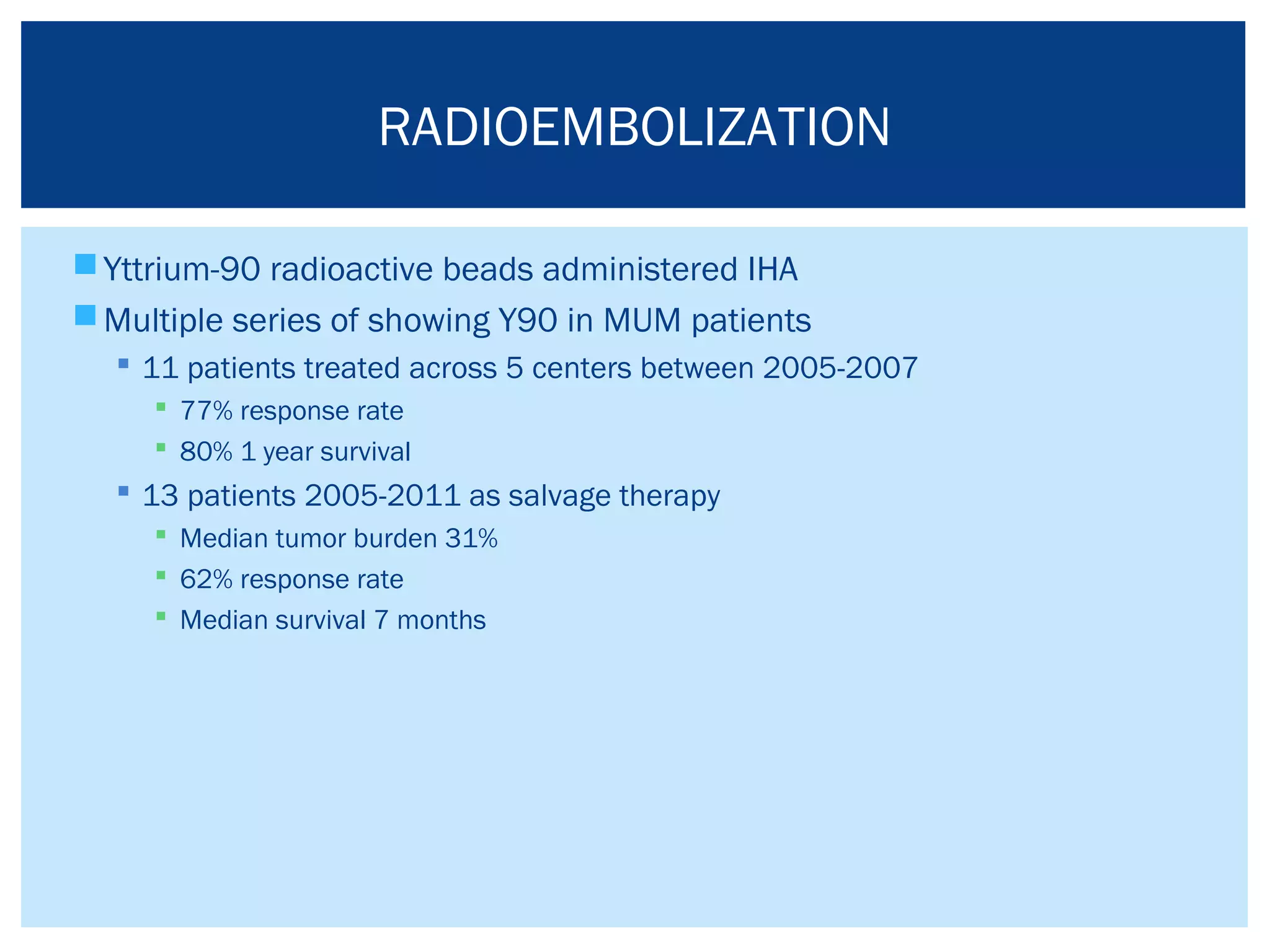
RADIOEMBOLIZATION
Yttrium-90 radioactive beads administered IHA
Multiple series of showing Y90 in MUM patients
 11 patients treated across 5 centers between 2005-2007
 77% response rate
 80% 1 year survival
 13 patients 2005-2011 as salvage therapy
 Median tumor burden 31%
 62% response rate
 Median survival 7 months
RADIOEMBOLIZATION
Retrospective
 71 patients, 82% salvage; 2007 - 2012
 Median PFS-L 5.9 months
 Median OS after treatment 12.3 months
 Median OS following diagnosis of liver mets 23.9 months (range, 6.2 – 69
months)
Current Prospective Trial
 Just finished accrual
 48 patients – half first line and half post IE
 11/2011 - 3/2017
 Biomarker correlates and pre-treatment biopsies
 Data pending
RADIOEMBOLIZATION
JEFFERSON EXPERIENCE
Am JCO; 2016;39:189-195
RADIOEMBOLIZATION
Pre: 7/21/16 Post: 2/7/17
CHEMOEMBOLIZATION
CHEMOEMBOLIZATION
Author Pt # Drug (s) OS Resp* OS Non-Resp Median OS
Mavligit ’88 30 Cisplatin 14 6 11
Cantore ’94 8 Carboplatin -- -- 15
Bedikian ’95 44 Cisplatin 14.5 5 6
Sato ’95 14 Cisplatin -- -- 6.6
Patel ’05 24 BCNU (100mg) 21.9 3.3 5.2
Huppert ’09 14 Cisplatin/Carboplatin 14.5 10 11.5
Vogl ’07 12 Mitomycin C 21 16.5 21
Dayani ’09 21 Mitomycin C, Cisplatin,
Doxorubicin
12.7 3.7 7.6 (mean)
Gupta ’10 125 Mostly Cisplatin 15.8 6.1 6.7
MD Anderson experience
 125 patients (Jan 1992-Dec 2005)
 122 received cisplatin
 65 also received vinblastine or vinblastine/dacarbazine
Overall Survival 6.7 months (median, n=113):
 < 25% 14 months
 25-50% 5.1
 >50-75% 5.5
 >75% 2.4
Recommend against treatment when >75% tumor replacement
CHEMOEMBOLIZATION
50 patients with >50% tumor replacement at presentation (Jan 2004 –
Nov 2011)
200 mg BCNU
Median survival 7.1 months
22% 1 yr. survival
Neither pre-treatment LDH (> or < 500) nor tumor burden (50-59%, 60-
75%, > 75%) had effect on survival
CHEMOEMBOLIZATION
JEFFERSON EXPERIENCE
AJR 2015; 205:429-433
CHEMOEMBOLIZATION WITH BCNU
2/19/2016 1/22/201
7
10 patients 2007-2008
 100-200 mg Irinotecan administered in 2-4 ml of 100-300/300-500
micron DC Beads
 All 10 patients had objective response
Single Arm Phase 2 trial
 52 patients Jan 2007-Feb 2010
 Median treatments per patient 1.6
 100mg in 10 patients, remainder 200mg
 Tumor reduction by imaging (“necrosis and reduction of contrast
enhancement”):
 > 90% (n=17)
 80-90% (n=30)
 60-80% (n=3)
 PFS-L 7.5 months, OS 13.9 months (both median)
CHEMOEMBOLIZATION
WITH DRUG ELUDING BEADS: IRINOTECAN
In Vivo. 2009 Jan0Feb;23(1):131-7
Annals G & H 2012; 3:9-14
19 patients, no prior treatments
July 2011 – January 2013, retrospective review
Poor candidates for other liver-directed therapies
 (Tumors > 5 cm, > 50% tumor burden, rapid growth)
< 4 ml 100-300 micron LC Beads/150 mg adriamycin
 (14/36 treatments received full dose)
13/19 patients proceeded to BCNU chemoembolization
Based on disparate response, patients divided into “nodular” vs.
“infiltrative” pattern, based on MRI appearance
CHEMOEMBOLIZATION
DEBDOX FOLLOWED BY BCNU
JEFFERSON EXPERIENCE
JVIR 2014; 25: S45
CHEMOEMBOLIZATION
DEBDOX FOLLOWED BY BCNU
SURVIVAL BY TUMOR TYPE
Nodular vs Infiltrative Disease
Nodular
Infiltrative
Time (months)
SurvivalProbability(%)
 Nodular (n=11): 3 PR, 7 SD, 1 PD
 Infiltrative (n=8): 1 PR, 3 SD, 4 PD
Survival
Mean
(mos) 95% CI
Median
(mos) 95% CI
Nodular 22.8 15.7 - 29.8 --- ---
Infiltrative 4.7 1.6 - 7.9 2.9 1.8 -7.9
Overall 16.0 11.6 - 20.4 9.1 2.9 -12.8
Chi-square = 8.4
p value = 0.0037
CHEMOEMBOLIZATION
DEBDOX FOLLOWED BY BCNU
JEFFERSON EXPERIENCE
CHEMOEMBOLIZATION
DEBDOX FOLLOWED BY BCNU
JEFFERSON EXPERIENCE
Initial
15
months
later
PERCUTANEOUS AND
ISOLATED HEPATIC
PERFUSION
AKA PHP: Closed circuit perfusion of high doses of chemotherapy
 “Chemosaturation”
Melphalan is drug of choice at 3mg/kg
 Whole liver infused at each treatment
 Every 6 weeks for up to 6 treatments
DELCATH catheter system
Prior clinical trial followed by expanded access study
PERCUTANEOUS HEPATIC PERFUSION
Infusion catheter
Venous Return
Filter
Blood post liver and pre-filter
PERCUTANEOUS HEPATIC PERFUSION
"Percutaneous Hepatic Perfusion for Unresectable Metastatic
Ocular Melanoma to the Liver: A Multi-Institutional Report of
Outcomes." 
 Recent presentation on 49 patients treated between 2008 and 2016 at either
Moffitt Cancer Center or University Hospital Southampton
 Total of 115 treatments
 Median treatments per patient was 2
 Hepatic response on 46 patients
 45% CR or PR
 37% with SD
 Median overall survival predicted to be 657 days in all comers
 1,207 days (3.4 years) in responders
 Common side effects anemia, thrombocytopenia, and neutropenia
Presented at Regional Cancer Therapies 12th
International Symposium February 21, 2017
“Hepatic Progression-free and Overall Survival After Regional
Therapy to the Liver for Metastatic Melanoma”
 Retrospective review of 30 patients treated with either PHP or other liver
directed treatment
 12 patients PHP
 6 patients radioembolization
 12 patients chemoembolization
 Median Hepatic PFS 361 versus 80 versus 54 days
 Median OS 608 versus 295 versus 265
PERCUTANEOUS HEPATIC PERFUSION
AM J Clin Onc. 2017 Jan 04
FOCUS Phase III trial of PHP versus Best
Alternative Care
 1:1 Randomized trial
 BAC options include chemoembolization,
ipilimumab, pembrolizumab, or dacarbazine
 Many active US sites
 Multidisciplinary team required
PERCUTANEOUS HEPATIC
PERFUSION
AKA IHP: Surgical procedure resulting in closed circuit to allow perfusion
of high doses of chemotherapy
In a trial of 34 patients
 OS with IHP was 24 months
Retrospective 10 year long single center experience in 91 patients from
2003-2012 (UM/CM = 32)
 Response rate for melanoma 51.7%
Phase III versus BAC ongoing in Europe
ISOLATED HEPATIC PERFUSION
Ann Surg Onc 2014; 21:466-72
Ann Surg 2014 May;259(5):953-9
SURGICAL RESECTION AND
ABLATION
Reserved for limited clinical situations
Solitary metastases or true oligometastatic disease in patients often >5
years from primary eye diagnosis
 Known different tumor velocity the longer one is from their primary eye
diagnosis
In early metastatic situations often see “peppering” at the time of the
initial surgical attempt
 Rarely get true negative surgical margin due to micrometastatic disease
Ablation is a less invasive approach to attack on solitary metastases
 Radiofrequency
 Cryoablation
 Other techniques
SURGICAL RESECTION AND ABLATION
Multiple liver metastases seen
during attempted resection of
solitary liver lesion
 Imaging only noted solitary lesion
SURGICAL RESECTION AND ABLATION
ABLATION
ABLATION
6/3/2015 12/8/2016
LIVER DIRECTED THERAPY
PROGRAM AT THOMAS
JEFFERSON
National referral center (+ Canada)
3/4 of our patients live outside of PA, NJ, DE
Weekly MUM multidisciplinary conference
Weekly MUM multidisciplinary clinic with two medical oncologist, three
interventional radiologists, radiation oncology, and surgery
> 600 hepatic embolization procedures per year
All discussed treatment options are offered except IHP
 Immunoembolization (60%)
 Radioactive microspheres (10%)
 Chemoembolization, (30%)
 Drug-eluting beads
 Percutaneous Hepatic Perfusion
CURRENT LIVER DIRECTED PROGRAM AT
THOMAS JEFFERSON UNIVERSITY
Uveal Melanoma with
Metastases
Solitary or Oligometastatic disease
greater than 5 (+/-) years after primary
uveal melanoma treatment
Consider Surgery,
RFA, Cryoablation
Liver Only or Liver Dominant
Liver
Directed
Treatment†
Systemic
Therapy
Options
Yes No
Immunoembolization*
Radioembolization*
Chemoembolization*
Drug-Eluting Beads
Percutaneous Hepatic
Perfusion (On Trial)
IHP (referral)
Ipilimumab*
Keytruda*
Opdivo*
VPA*
Other HDACi*
Clinical Trial
IMC-gp100 (HLA A2)
BET Inhibitor
Referral
+/-
*Combination
liver directed
and systemic
when
appropriate
†
Liver directed
options often based
on disease burden
after consideration
for clinical trial
•<50% and limited
extrahepatic
consider IE or RE
•If <50% largest
tumor > 5-6cm and
nodular consider
DEBDOX followed
by BCNU
•If >50% liver
involvement with
liver dominant CE
•Progression after
IE consider RE or
CE
Certainly there are patients in whom it does not control hepatic disease
despite best efforts
Occasional anatomy issues exclude patients from certain treatments
 Notably Radioembolization and PHP
Extra-hepatic disease is always a concern
 Combination systemic and hepatic strategies
Need better tools to predict who more likely to be an “exceptional
responder” and to what upfront therapy
Requires skilled interventional radiologists
LIVER DIRECTED THERAPY
LIMITATIONS AND CONSIDERATIONS
THANK YOU

Liver Directed Therapy - Marlana Orloff, MD

  • 1.
    MRF CURE-OM 6th Annual Patient and Caregiver Symposium 3.11.17 LIVER DIRECTEDTHERAPY FOR METASTATIC UVEAL MELANOMA Marlana Orloff, MD Assistant Professor Department of Medical Oncology Thomas Jefferson University Sidney Kimmel Cancer Center
  • 2.
    Approximate 5 yearsurvival 70-80% About 50% of patients will develop metastatic disease One year survival 13-15%* Median survival after development of metastatic disease ranges 2-15 months* Liver most common site of metastases  About 50% of patients with metastatic disease may have liver only disease for majority of their disease course UVEAL MELANOMA * In the literature though not necessarily reflective of more current clinical experience
  • 3.
    SITE OF METASTASES JG Lorigan et al 1991
  • 4.
    Patients presenting withvaried disease presentations  Liver only : small disease burden  Liver only : large disease burden  Liver predominant but extra-hepatic present  Extra-hepatic only  Metastatic disease at time of eye diagnosis  Recurrence during adjuvant treatment  Recurrence >15+ years after eye diagnosis  Treatment naïve  Heavily pre-treated  Some tumors grow very fast  Some tumors grow slower  … And everything in between PATIENT PRESENTATIONS
  • 5.
  • 6.
  • 7.
  • 8.
    MERITS OF TRANS-ARTERIALCATHETER- DIRECTED TREATMENT OF LIVER TUMORS Liver tumors obtain the majority of their blood supply from the hepatic artery. Normal liver parenchyma has a dual blood supply  Portal vein (~75%)  Hepatic artery (~25%) Trans-arterial catheter-directed therapies allow localized treatment to liver tumors while sparing normal liver parenchyma Delivery of medication to liver tumors at a higher concentration could be achieved while minimizing systemic toxicity
  • 9.
  • 10.
     Bland embolization Immunoembolization  GM-CSF +/- IL-2  Radioactive microspheres  SirSpheres  Chemoembolization  BCNU  Chemoembolization with Drug-Eluding Beads  DEBDOX  DEBIRI  Hepatic arterial infusion  Fotemustine  BCNU  Percutaneous Hepatic Perfusion (PHP)  Melphalan  Isolated Hepatic Perfusion (IHP)  Melphalan  *Surgical Resection / Ablation TYPES OF LIVER DIRECTED TREATMENTS
  • 11.
  • 12.
    Destruction of tumorby embolization could control tumor progression locally and provide tumor antigens to the local immune system Concurrent use of GM-CSF and IL-2 induces an inflammatory response in the tumor and surrounding tissue which may improve the anti-cancer immune response Local stimulation of the immune system may result in the development of a systemic immune response against tumor cells which may suppress the growth of distant tumors IMMUNOEMBOLIZATION RATIONALE
  • 13.
    Purpose was toinvestigate feasibility and safety 2000 – 2004, single institution 34 of 39 patients had MUM <50% tumor involvement, unresectable Lobar hepatic artery embolization every 4 weeks using escalating dose of GM-CSF (25-2000 mcg) emulsifiedwith Ethiodol followed by Gelfoam, for 6 treatments Imaging (CT, MRI) and clinical assessment after every other treatment to assess response (RECIST) Primary end-points were dose-limiting toxicity and maximum tolerated dose IMMUNOEMBOLIZATION PHASE 1 JCO 2008 26:5436-5442
  • 14.
    6 procedures/patient (median,range 1-14) 32% responded (2 CR, 8 PR) 32% stable disease OS: 14.4 months (median)  (33.7 months for CR/PR, 12.4 months SD/PD) Survival: 1 yr. 62%, 2 yr. 26% PFS-liver: 4.8 months (median) PFS-systemic: 10.4 months (median) 1 patient remains alive > 10 years IMMUNOEMBOLIZATION PHASE 1 JCO 2008 26:5436-5442
  • 15.
  • 16.
  • 17.
    High dose IE(>1500mcg) vs historic data from Phase II TACE with BCNU  Excluded those with >50% liver involvement Longer OS (20.4 vs. 9.8 months, median)* Longer PFS-L (9.3 vs. 6.4 months, median) Longer PFS-S (12.4 vs. 4.8 months, median)* Systemic progression was delayed in the high-dose IE group, suggesting an induction of a systemic immune response against the melanoma cells IMMUNOEMBOLIZATION COMPARED TO HISTORIC PHASE II TACE WITH BCNU * P < 0.5 Radiology 2009; 252:290-298
  • 18.
    About 10% ofpatients have an amazing response to immunoembolization  After receiving a few treatments stabilization, sometimes shrinkage, and decreased viability  Treatment breaks for months to years  Embolic agent transient so repeated procedures possible EXCEPTIONAL RESPONDERS 10/2010 1/2017
  • 19.
  • 20.
    Yttrium-90 radioactive beadsadministered IHA Multiple series of showing Y90 in MUM patients  11 patients treated across 5 centers between 2005-2007  77% response rate  80% 1 year survival  13 patients 2005-2011 as salvage therapy  Median tumor burden 31%  62% response rate  Median survival 7 months RADIOEMBOLIZATION
  • 21.
    Retrospective  71 patients,82% salvage; 2007 - 2012  Median PFS-L 5.9 months  Median OS after treatment 12.3 months  Median OS following diagnosis of liver mets 23.9 months (range, 6.2 – 69 months) Current Prospective Trial  Just finished accrual  48 patients – half first line and half post IE  11/2011 - 3/2017  Biomarker correlates and pre-treatment biopsies  Data pending RADIOEMBOLIZATION JEFFERSON EXPERIENCE Am JCO; 2016;39:189-195
  • 22.
  • 23.
  • 24.
    CHEMOEMBOLIZATION Author Pt #Drug (s) OS Resp* OS Non-Resp Median OS Mavligit ’88 30 Cisplatin 14 6 11 Cantore ’94 8 Carboplatin -- -- 15 Bedikian ’95 44 Cisplatin 14.5 5 6 Sato ’95 14 Cisplatin -- -- 6.6 Patel ’05 24 BCNU (100mg) 21.9 3.3 5.2 Huppert ’09 14 Cisplatin/Carboplatin 14.5 10 11.5 Vogl ’07 12 Mitomycin C 21 16.5 21 Dayani ’09 21 Mitomycin C, Cisplatin, Doxorubicin 12.7 3.7 7.6 (mean) Gupta ’10 125 Mostly Cisplatin 15.8 6.1 6.7
  • 25.
    MD Anderson experience 125 patients (Jan 1992-Dec 2005)  122 received cisplatin  65 also received vinblastine or vinblastine/dacarbazine Overall Survival 6.7 months (median, n=113):  < 25% 14 months  25-50% 5.1  >50-75% 5.5  >75% 2.4 Recommend against treatment when >75% tumor replacement CHEMOEMBOLIZATION
  • 26.
    50 patients with>50% tumor replacement at presentation (Jan 2004 – Nov 2011) 200 mg BCNU Median survival 7.1 months 22% 1 yr. survival Neither pre-treatment LDH (> or < 500) nor tumor burden (50-59%, 60- 75%, > 75%) had effect on survival CHEMOEMBOLIZATION JEFFERSON EXPERIENCE AJR 2015; 205:429-433
  • 27.
  • 28.
    10 patients 2007-2008 100-200 mg Irinotecan administered in 2-4 ml of 100-300/300-500 micron DC Beads  All 10 patients had objective response Single Arm Phase 2 trial  52 patients Jan 2007-Feb 2010  Median treatments per patient 1.6  100mg in 10 patients, remainder 200mg  Tumor reduction by imaging (“necrosis and reduction of contrast enhancement”):  > 90% (n=17)  80-90% (n=30)  60-80% (n=3)  PFS-L 7.5 months, OS 13.9 months (both median) CHEMOEMBOLIZATION WITH DRUG ELUDING BEADS: IRINOTECAN In Vivo. 2009 Jan0Feb;23(1):131-7 Annals G & H 2012; 3:9-14
  • 29.
    19 patients, noprior treatments July 2011 – January 2013, retrospective review Poor candidates for other liver-directed therapies  (Tumors > 5 cm, > 50% tumor burden, rapid growth) < 4 ml 100-300 micron LC Beads/150 mg adriamycin  (14/36 treatments received full dose) 13/19 patients proceeded to BCNU chemoembolization Based on disparate response, patients divided into “nodular” vs. “infiltrative” pattern, based on MRI appearance CHEMOEMBOLIZATION DEBDOX FOLLOWED BY BCNU JEFFERSON EXPERIENCE JVIR 2014; 25: S45
  • 30.
    CHEMOEMBOLIZATION DEBDOX FOLLOWED BYBCNU SURVIVAL BY TUMOR TYPE Nodular vs Infiltrative Disease Nodular Infiltrative Time (months) SurvivalProbability(%)
  • 31.
     Nodular (n=11):3 PR, 7 SD, 1 PD  Infiltrative (n=8): 1 PR, 3 SD, 4 PD Survival Mean (mos) 95% CI Median (mos) 95% CI Nodular 22.8 15.7 - 29.8 --- --- Infiltrative 4.7 1.6 - 7.9 2.9 1.8 -7.9 Overall 16.0 11.6 - 20.4 9.1 2.9 -12.8 Chi-square = 8.4 p value = 0.0037 CHEMOEMBOLIZATION DEBDOX FOLLOWED BY BCNU JEFFERSON EXPERIENCE
  • 32.
    CHEMOEMBOLIZATION DEBDOX FOLLOWED BYBCNU JEFFERSON EXPERIENCE Initial 15 months later
  • 33.
  • 34.
    AKA PHP: Closedcircuit perfusion of high doses of chemotherapy  “Chemosaturation” Melphalan is drug of choice at 3mg/kg  Whole liver infused at each treatment  Every 6 weeks for up to 6 treatments DELCATH catheter system Prior clinical trial followed by expanded access study PERCUTANEOUS HEPATIC PERFUSION
  • 35.
  • 36.
    PERCUTANEOUS HEPATIC PERFUSION "PercutaneousHepatic Perfusion for Unresectable Metastatic Ocular Melanoma to the Liver: A Multi-Institutional Report of Outcomes."   Recent presentation on 49 patients treated between 2008 and 2016 at either Moffitt Cancer Center or University Hospital Southampton  Total of 115 treatments  Median treatments per patient was 2  Hepatic response on 46 patients  45% CR or PR  37% with SD  Median overall survival predicted to be 657 days in all comers  1,207 days (3.4 years) in responders  Common side effects anemia, thrombocytopenia, and neutropenia Presented at Regional Cancer Therapies 12th International Symposium February 21, 2017
  • 37.
    “Hepatic Progression-free andOverall Survival After Regional Therapy to the Liver for Metastatic Melanoma”  Retrospective review of 30 patients treated with either PHP or other liver directed treatment  12 patients PHP  6 patients radioembolization  12 patients chemoembolization  Median Hepatic PFS 361 versus 80 versus 54 days  Median OS 608 versus 295 versus 265 PERCUTANEOUS HEPATIC PERFUSION AM J Clin Onc. 2017 Jan 04
  • 38.
    FOCUS Phase IIItrial of PHP versus Best Alternative Care  1:1 Randomized trial  BAC options include chemoembolization, ipilimumab, pembrolizumab, or dacarbazine  Many active US sites  Multidisciplinary team required PERCUTANEOUS HEPATIC PERFUSION
  • 39.
    AKA IHP: Surgicalprocedure resulting in closed circuit to allow perfusion of high doses of chemotherapy In a trial of 34 patients  OS with IHP was 24 months Retrospective 10 year long single center experience in 91 patients from 2003-2012 (UM/CM = 32)  Response rate for melanoma 51.7% Phase III versus BAC ongoing in Europe ISOLATED HEPATIC PERFUSION Ann Surg Onc 2014; 21:466-72 Ann Surg 2014 May;259(5):953-9
  • 40.
  • 41.
    Reserved for limitedclinical situations Solitary metastases or true oligometastatic disease in patients often >5 years from primary eye diagnosis  Known different tumor velocity the longer one is from their primary eye diagnosis In early metastatic situations often see “peppering” at the time of the initial surgical attempt  Rarely get true negative surgical margin due to micrometastatic disease Ablation is a less invasive approach to attack on solitary metastases  Radiofrequency  Cryoablation  Other techniques SURGICAL RESECTION AND ABLATION
  • 42.
    Multiple liver metastasesseen during attempted resection of solitary liver lesion  Imaging only noted solitary lesion SURGICAL RESECTION AND ABLATION
  • 43.
  • 44.
  • 45.
    LIVER DIRECTED THERAPY PROGRAMAT THOMAS JEFFERSON
  • 46.
    National referral center(+ Canada) 3/4 of our patients live outside of PA, NJ, DE Weekly MUM multidisciplinary conference Weekly MUM multidisciplinary clinic with two medical oncologist, three interventional radiologists, radiation oncology, and surgery > 600 hepatic embolization procedures per year All discussed treatment options are offered except IHP  Immunoembolization (60%)  Radioactive microspheres (10%)  Chemoembolization, (30%)  Drug-eluting beads  Percutaneous Hepatic Perfusion CURRENT LIVER DIRECTED PROGRAM AT THOMAS JEFFERSON UNIVERSITY
  • 47.
    Uveal Melanoma with Metastases Solitaryor Oligometastatic disease greater than 5 (+/-) years after primary uveal melanoma treatment Consider Surgery, RFA, Cryoablation Liver Only or Liver Dominant Liver Directed Treatment† Systemic Therapy Options Yes No Immunoembolization* Radioembolization* Chemoembolization* Drug-Eluting Beads Percutaneous Hepatic Perfusion (On Trial) IHP (referral) Ipilimumab* Keytruda* Opdivo* VPA* Other HDACi* Clinical Trial IMC-gp100 (HLA A2) BET Inhibitor Referral +/- *Combination liver directed and systemic when appropriate † Liver directed options often based on disease burden after consideration for clinical trial •<50% and limited extrahepatic consider IE or RE •If <50% largest tumor > 5-6cm and nodular consider DEBDOX followed by BCNU •If >50% liver involvement with liver dominant CE •Progression after IE consider RE or CE
  • 48.
    Certainly there arepatients in whom it does not control hepatic disease despite best efforts Occasional anatomy issues exclude patients from certain treatments  Notably Radioembolization and PHP Extra-hepatic disease is always a concern  Combination systemic and hepatic strategies Need better tools to predict who more likely to be an “exceptional responder” and to what upfront therapy Requires skilled interventional radiologists LIVER DIRECTED THERAPY LIMITATIONS AND CONSIDERATIONS
  • 49.