LastBenchPharmacist.blogspot.com
Learning Objectives
• At the end of this lecture, student will be able to
 Classify colloids with examples
 Compare different forms of colloidal sols
LastBenchPharmacist.blogspot.com 1
Faculty of Pharmacy © Ramaiah University of Applied Sciences
 Explain the types of colloids
L
a
s
t
B
e
n
c
h
P
h
a
r
m
a
c
i
s
t
.
b
l
o
g
s
p
o
t
.
c
o
m
LastBenchPharmacist.blogspot.com
Dispersed Systems
• What are dispersed systems?
• Main components of a dispersed system?
• Examples of dispersed system
LastBenchPharmacist.blogspot.com 2
Faculty of Pharmacy © Ramaiah University of Applied Sciences
Dispersed systems consist of particulate matter, known as the
dispersed phase, distributed throughout a continuous or dispersion
medium.
L
a
s
t
B
e
n
c
h
P
h
a
r
m
a
c
i
s
t
.
b
l
o
g
s
p
o
t
.
c
o
m
LastBenchPharmacist.blogspot.com
Dispersed System
LastBenchPharmacist.blogspot.com 3
Faculty of Pharmacy © Ramaiah University of Applied Sciences
L
a
s
t
B
e
n
c
h
P
h
a
r
m
a
c
i
s
t
.
b
l
o
g
s
p
o
t
.
c
o
m
LastBenchPharmacist.blogspot.com
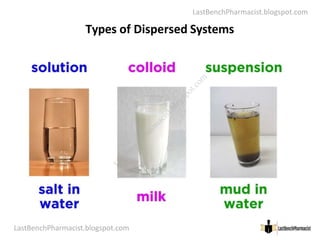
Types of Dispersed Systems
LastBenchPharmacist.blogspot.com 4
Faculty of Pharmacy © Ramaiah University of Applied Sciences
L
a
s
t
B
e
n
c
h
P
h
a
r
m
a
c
i
s
t
.
b
l
o
g
s
p
o
t
.
c
o
m
LastBenchPharmacist.blogspot.com
Types of Dispersed Systems
Based on the size of dispersed particles
LastBenchPharmacist.blogspot.com
Molecular dispersion Coarse dispersion
Colloidal dispersion
5
Faculty of Pharmacy © Ramaiah University of Applied Sciences
L
a
s
t
B
e
n
c
h
P
h
a
r
m
a
c
i
s
t
.
b
l
o
g
s
p
o
t
.
c
o
m
LastBenchPharmacist.blogspot.com
Comparison of Dispersed Systems
CLASS
PARTICLE
SIZE
CHARACTERISTIC OF SYSTEM EXAMPLES
Molecular
dispersion
Less
than1
nm
Invisible in electron microscope
Pass through ultrafilter and semipermeable
membrane
Undergo rapid diffusion
Oxygen molecules,
ordinary ions,
glucose
Colloidal
dispersion
From 1
nm to
Not resolved by ordinary microscope
(although may be detected under
Colloidal silver sols,
natural and synthetic
LastBenchPharmacist.blogspot.com 6
Faculty of Pharmacy © Ramaiah University of Applied Sciences
dispersion nm to
0.5 μm
(although may be detected under
ultramicroscope)
Visible in electron microscope
Pass through filter paper
Do not pass semipermeable membrane
Diffuse very slowly
natural and synthetic
polymers, cheese,
butter, jelly, paint,
milk, shaving cream,
etc.
Coarse
dispersion
Greater
than 0.5
μm
Visible under microscope
Do not pass through normal filter paper
Do not dialyze through semipermeable
membrane
Do not diffuse
Grains of sand,most
pharmaceutical
emulsions and
suspensions, red
blood cells
L
a
s
t
B
e
n
c
h
P
h
a
r
m
a
c
i
s
t
.
b
l
o
g
s
p
o
t
.
c
o
m
LastBenchPharmacist.blogspot.com
Components of a Colloidal System
LastBenchPharmacist.blogspot.com
Solid Liquid Gas
Solid Liquid Gas
7
Faculty of Pharmacy © Ramaiah University of Applied Sciences
L
a
s
t
B
e
n
c
h
P
h
a
r
m
a
c
i
s
t
.
b
l
o
g
s
p
o
t
.
c
o
m
LastBenchPharmacist.blogspot.com
© Ramaiah University of Applied SciencesFaculty ofPharmacy
10
8
©M. S. Ramaiah University of Applied Sciences
LastBenchPharmacist.blogspot.com
L
a
s
t
B
e
n
c
h
P
h
a
r
m
a
c
i
s
t
.
b
l
o
g
s
p
o
t
.
c
o
m
LastBenchPharmacist.blogspot.com
© Ramaiah University of Applied SciencesFaculty ofPharmacy
10
9
©M. S. Ramaiah University of Applied Sciences
LastBenchPharmacist.blogspot.com
L
a
s
t
B
e
n
c
h
P
h
a
r
m
a
c
i
s
t
.
b
l
o
g
s
p
o
t
.
c
o
m
LastBenchPharmacist.blogspot.com
© Ramaiah University of Applied SciencesFaculty ofPharmacy
10
10
©M. S. Ramaiah University of Applied Sciences
LastBenchPharmacist.blogspot.com
L
a
s
t
B
e
n
c
h
P
h
a
r
m
a
c
i
s
t
.
b
l
o
g
s
p
o
t
.
c
o
m
LastBenchPharmacist.blogspot.com
© Ramaiah University of Applied SciencesFaculty ofPharmacy
10
11
©M. S. Ramaiah University of Applied Sciences
LastBenchPharmacist.blogspot.com
L
a
s
t
B
e
n
c
h
P
h
a
r
m
a
c
i
s
t
.
b
l
o
g
s
p
o
t
.
c
o
m
LastBenchPharmacist.blogspot.com
Shapes of colloids
a) Spheres and globules
b) Short rods and prolate ellipsoids
c) Oblate ellipsoids and flakes
LastBenchPharmacist.blogspot.com
d) Long rods and threads
e) Loosely coiled threads
f) Branched threads
12
Faculty of Pharmacy © Ramaiah University of Applied Sciences
L
a
s
t
B
e
n
c
h
P
h
a
r
m
a
c
i
s
t
.
b
l
o
g
s
p
o
t
.
c
o
m
LastBenchPharmacist.blogspot.com
Surface area of colloids and its significance
A cube having a 1-cm edge and a volume
of 1 cm3 has a total surface area of 6 cm2
LastBenchPharmacist.blogspot.com 13
Faculty of Pharmacy © Ramaiah University of Applied Sciences
If the same cube is subdivided into smaller
cubes each having an edge of 100 μm, the
total volume remains the same, but the total
surface area increases to 600,000 cm2
L
a
s
t
B
e
n
c
h
P
h
a
r
m
a
c
i
s
t
.
b
l
o
g
s
p
o
t
.
c
o
m
LastBenchPharmacist.blogspot.com
Significance of large surface area in colloids
The possession of a large specific surface results in many of the unique
properties of colloidal dispersions
platinum is effective as a catalyst only when in the colloidal form
as platinum black
LastBenchPharmacist.blogspot.com 14
Faculty of Pharmacy © Ramaiah University of Applied Sciences
as platinum black
• This is because catalysts act by adsorbing the reactants onto their
surface. Hence, their catalytic activity is related to their specific
surface
L
a
s
t
B
e
n
c
h
P
h
a
r
m
a
c
i
s
t
.
b
l
o
g
s
p
o
t
.
c
o
m
LastBenchPharmacist.blogspot.com
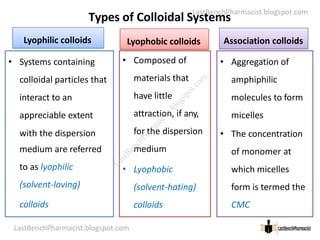
Types of Colloidal Systems
Lyophilic colloids
• Systems containing
colloidal particles that
interact to an
appreciable extent
Lyophobic colloids
• Composed of
materials that
have little
attraction, if any,
Association colloids
• Aggregation of
amphiphilic
molecules to form
micelles
LastBenchPharmacist.blogspot.com
appreciable extent
with the dispersion
medium are referred
to as lyophilic
(solvent-loving)
colloids
for the dispersion
medium
• Lyophobic
(solvent-hating)
colloids
micelles
• The concentration
of monomer at
which micelles
form is termed the
CMC
15
Faculty of Pharmacy © Ramaiah University of Applied Sciences
L
a
s
t
B
e
n
c
h
P
h
a
r
m
a
c
i
s
t
.
b
l
o
g
s
p
o
t
.
c
o
m
LastBenchPharmacist.blogspot.com
Types of Colloidal Systems
Lyophilic colloids
• Systems containing colloidal particles that interact to an
appreciable extent with the dispersion medium arereferred
L
•
LastBenchPharmacist.blogspot.com
to as lyophilic (solvent-loving) colloids
16
Faculty of Pharmacy © Ramaiah University of Applied Sciences
•
L
a
s
t
B
e
n
c
h
P
h
a
r
m
a
c
i
s
t
.
b
l
o
g
s
p
o
t
.
c
o
m
LastBenchPharmacist.blogspot.com
Types of Colloidal Systems
ds
ning
les
an
tent
Lyophobic colloids
• Composed of materials that have little
attraction, if any, for the dispersion medium
LastBenchPharmacist.blogspot.com
tent
rsion
ferred
)
17
Faculty of Pharmacy © Ramaiah University of Applied Sciences
• Lyophobic (solvent-hating) colloids
L
a
s
t
B
e
n
c
h
P
h
a
r
m
a
c
i
s
t
.
b
l
o
g
s
p
o
t
.
c
o
m
Types of Colloidal Systems
bic colloids
osed of
rials that
little
tion, if any,
Association colloids
• Aggregation of amphiphilic molecules to form
micelles
LastBenchPharmacist.blogspot.com
Faculty of Pharmacy
tion, if any,
e
rsion
um
obic
nt-hating)
18
© Ramaiah University of Applied Sciences
• The concentration of monomer atwhich
micelles form is termed the CMC
LastBenchPharmacist.blogspot.com
L
a
s
t
B
e
n
c
h
P
h
a
r
m
a
c
i
s
t
.
b
l
o
g
s
p
o
t
.
c
o
m
LastBenchPharmacist.blogspot.com
Lyophilic colloids
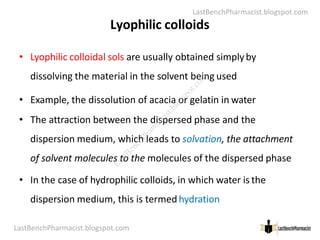
• Lyophilic colloidal sols are usually obtained simplyby
dissolving the material in the solvent being used
• Example, the dissolution of acacia or gelatin in water
• The attraction between the dispersed phase and the
LastBenchPharmacist.blogspot.com 19
Faculty of Pharmacy © Ramaiah University of Applied Sciences
• The attraction between the dispersed phase and the
dispersion medium, which leads to solvation, the attachment
of solvent molecules to the molecules of the dispersed phase
• In the case of hydrophilic colloids, in which water is the
dispersion medium, this is termedhydration
L
a
s
t
B
e
n
c
h
P
h
a
r
m
a
c
i
s
t
.
b
l
o
g
s
p
o
t
.
c
o
m
LastBenchPharmacist.blogspot.com
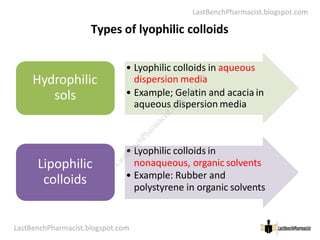
Types of lyophilic colloids
• Lyophilic colloids in aqueous
dispersion media
• Example; Gelatin and acacia in
aqueous dispersion media
Hydrophilic
sols
LastBenchPharmacist.blogspot.com
• Lyophilic colloids in
nonaqueous, organic solvents
• Example: Rubber and
polystyrene in organic solvents
Lipophilic
colloids
20
Faculty of Pharmacy © Ramaiah University of Applied Sciences
L
a
s
t
B
e
n
c
h
P
h
a
r
m
a
c
i
s
t
.
b
l
o
g
s
p
o
t
.
c
o
m
LastBenchPharmacist.blogspot.com
Preparation of Lyophilic colloids
• The dispersed phase is directly added to dispersion mediumin
cold or by warming
• Colloidal solutions of starch, gelatin, etc, in water can be
prepared by this method
LastBenchPharmacist.blogspot.com 21
Faculty of Pharmacy © Ramaiah University of Applied Sciences
prepared by this method
L
a
s
t
B
e
n
c
h
P
h
a
r
m
a
c
i
s
t
.
b
l
o
g
s
p
o
t
.
c
o
m
LastBenchPharmacist.blogspot.com
Lyophobic Colloids
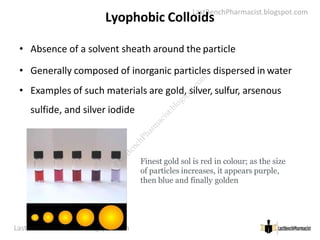
• Absence of a solvent sheath around the particle
• Generally composed of inorganic particles dispersed in water
• Examples of such materials are gold, silver, sulfur, arsenous
sulfide, and silver iodide
LastBenchPharmacist.blogspot.com 22
Faculty of Pharmacy © Ramaiah University of Applied Sciences
Finest gold sol is red in colour; as the size
of particles increases, it appears purple,
then blue and finally golden
L
a
s
t
B
e
n
c
h
P
h
a
r
m
a
c
i
s
t
.
b
l
o
g
s
p
o
t
.
c
o
m
LastBenchPharmacist.blogspot.com
Preparation of Lyophobic colloids
• Dispersion
• Condensation
– Chemical Methods
LastBenchPharmacist.blogspot.com 23
Faculty of Pharmacy © Ramaiah University of Applied Sciences
– Exchange solventmethod
– Change of physical state
L
a
s
t
B
e
n
c
h
P
h
a
r
m
a
c
i
s
t
.
b
l
o
g
s
p
o
t
.
c
o
m
LastBenchPharmacist.blogspot.com
Lyophobic Colloids
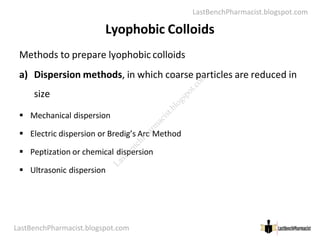
Methods to prepare lyophobic colloids
a) Dispersion methods, in which coarse particles are reduced in
size
 Mechanical dispersion
LastBenchPharmacist.blogspot.com 24
Faculty of Pharmacy © Ramaiah University of Applied Sciences
 Mechanical dispersion
 Electric dispersion or Bredig’s Arc Method
 Peptization or chemical dispersion
 Ultrasonic dispersion
L
a
s
t
B
e
n
c
h
P
h
a
r
m
a
c
i
s
t
.
b
l
o
g
s
p
o
t
.
c
o
m
LastBenchPharmacist.blogspot.com
Dispersion methods
• Use of high-intensity ultrasonic generators operatingat
frequencies in excess of 20,000 cycles per second
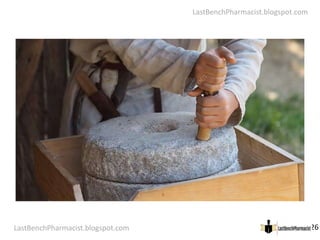
• Colloid mills - in which the material is sheared between two
LastBenchPharmacist.blogspot.com 25
Faculty of Pharmacy © Ramaiah University of Applied Sciences
rapidly rotating plates set close together, reduce only a small
amount of the total particles to the colloidal sizerange
L
a
s
t
B
e
n
c
h
P
h
a
r
m
a
c
i
s
t
.
b
l
o
g
s
p
o
t
.
c
o
m
LastBenchPharmacist.blogspot.com
© Ramaiah University of Applied SciencesFaculty ofPharmacy
28
26
©M. S. Ramaiah University of Applied Sciences
LastBenchPharmacist.blogspot.com
L
a
s
t
B
e
n
c
h
P
h
a
r
m
a
c
i
s
t
.
b
l
o
g
s
p
o
t
.
c
o
m
LastBenchPharmacist.blogspot.com
Colloid Mill
LastBenchPharmacist.blogspot.com
Colloid mill works on the rotor-stator principle. The equipment breaks
down materials by forming dispersion of materials in a liquid.Shearing
takes place in a narrow gap between a static cone (the stator) and a
rapidly rotating cone (the rotor).
27
Faculty of Pharmacy © Ramaiah University of Applied Sciences
L
a
s
t
B
e
n
c
h
P
h
a
r
m
a
c
i
s
t
.
b
l
o
g
s
p
o
t
.
c
o
m
LastBenchPharmacist.blogspot.com
Bredig’s Arc Method
Production of an electric arc
within a liquid. Owing to the
intense heat generated by the
arc, some of the metal of the
LastBenchPharmacist.blogspot.com
arc, some of the metal of the
electrodes is dispersed as vapor,
which condenses to form
colloidal particles
28
Faculty of Pharmacy © Ramaiah University of Applied Sciences
L
a
s
t
B
e
n
c
h
P
h
a
r
m
a
c
i
s
t
.
b
l
o
g
s
p
o
t
.
c
o
m
LastBenchPharmacist.blogspot.com
Peptization or Chemical Dispersion
• Redispersion of freshly prepared precipitate into the sol by
adding an electrolyte containing common ion is called
peptization electrolyte used is called peptizing agent
• The peptization action is due to the preferential adsorptionof
one of the ions of the electrolyte on the precipitate
LastBenchPharmacist.blogspot.com
• Example:
29
Faculty of Pharmacy © Ramaiah University of Applied Sciences
L
a
s
t
B
e
n
c
h
P
h
a
r
m
a
c
i
s
t
.
b
l
o
g
s
p
o
t
.
c
o
m
LastBenchPharmacist.blogspot.com
Ultrasonic Dispersion
• Use of high intensity ultrasonicwaves
• These high energy waves propagate through dispersion
medium
• Result in alternating high pressure and low pressurecycles
LastBenchPharmacist.blogspot.com 30
Faculty of Pharmacy © Ramaiah University of Applied Sciences
• This mechanical stress causes ultrasonic cavitation and high
speed liquid jets in liquids.
• This results in breakdown of bigger particles into colloidal
range particles
• Example : oils, mercury, sulphides, metal oxides
L
a
s
t
B
e
n
c
h
P
h
a
r
m
a
c
i
s
t
.
b
l
o
g
s
p
o
t
.
c
o
m
LastBenchPharmacist.blogspot.com
Condensation Methods
LastBenchPharmacist.blogspot.com 31
Faculty of Pharmacy © Ramaiah University of Applied Sciences
L
a
s
t
B
e
n
c
h
P
h
a
r
m
a
c
i
s
t
.
b
l
o
g
s
p
o
t
.
c
o
m
LastBenchPharmacist.blogspot.com
Condensation Methods
 Materials of subcolloidal dimensions are caused to aggregate
into particles within the colloidal size range
 These methods involve chemical reactions such as reduction,
LastBenchPharmacist.blogspot.com 32
Faculty of Pharmacy © Ramaiah University of Applied Sciences
 These methods involve chemical reactions such as reduction,
oxidation, hydrolysis and double decomposition
L
a
s
t
B
e
n
c
h
P
h
a
r
m
a
c
i
s
t
.
b
l
o
g
s
p
o
t
.
c
o
m
LastBenchPharmacist.blogspot.com
Condensation Methods
• Involve chemical reactions
• Need to maintain factors like temperature, pressure,
concentration, etc.
LastBenchPharmacist.blogspot.com 33
Faculty of Pharmacy © Ramaiah University of Applied Sciences
• Final purification for removal of unwanted ions shouldbe
done by dialysis
L
a
s
t
B
e
n
c
h
P
h
a
r
m
a
c
i
s
t
.
b
l
o
g
s
p
o
t
.
c
o
m
LastBenchPharmacist.blogspot.com
Oxidation Methods
Preparation of colloidal sulphur
• When aqueous solution of H2S is exposed to air, it slowly gets
oxidises to sulphur. The sulphur so formed remains in water in
the colloidal state.
LastBenchPharmacist.blogspot.com
the colloidal state.
34
Faculty of Pharmacy © Ramaiah University of Applied Sciences
L
a
s
t
B
e
n
c
h
P
h
a
r
m
a
c
i
s
t
.
b
l
o
g
s
p
o
t
.
c
o
m
LastBenchPharmacist.blogspot.com
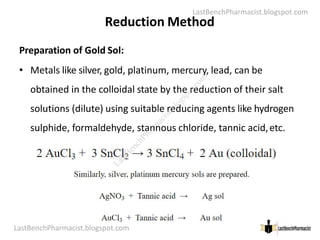
Reduction Method
Preparation of Gold Sol:
• Metals like silver, gold, platinum, mercury, lead, can be
obtained in the colloidal state by the reduction of their salt
solutions (dilute) using suitable reducing agents like hydrogen
LastBenchPharmacist.blogspot.com
sulphide, formaldehyde, stannous chloride, tannic acid,etc.
35
Faculty of Pharmacy © Ramaiah University of Applied Sciences
L
a
s
t
B
e
n
c
h
P
h
a
r
m
a
c
i
s
t
.
b
l
o
g
s
p
o
t
.
c
o
m
LastBenchPharmacist.blogspot.com
Hydrolysis Method
Preparation of Ferric Hydroxide Sol
• Colloidal solution of ferric hydroxide is obtained by boilinga
dilute solution of ferric chloride
LastBenchPharmacist.blogspot.com 36
Faculty of Pharmacy © Ramaiah University of Applied Sciences
L
a
s
t
B
e
n
c
h
P
h
a
r
m
a
c
i
s
t
.
b
l
o
g
s
p
o
t
.
c
o
m
LastBenchPharmacist.blogspot.com
Exchange Solvent Method
• Involves taking a solution of the substance in one solventand
pouring it into another solvent in which the substance is
relatively less soluble
LastBenchPharmacist.blogspot.com 37
Faculty of Pharmacy © Ramaiah University of Applied Sciences
• Example: Preparation of sulphur or PhosphorousSol
L
a
s
t
B
e
n
c
h
P
h
a
r
m
a
c
i
s
t
.
b
l
o
g
s
p
o
t
.
c
o
m
LastBenchPharmacist.blogspot.com
Change of Physical State
• Colloidal solution of certain elements such as mercury and
sulphur are obtained by passing their vapours through cold
water containing a stabilizer (an ammonium salt orcitrate)
LastBenchPharmacist.blogspot.com 38
Faculty of Pharmacy © Ramaiah University of Applied Sciences
L
a
s
t
B
e
n
c
h
P
h
a
r
m
a
c
i
s
t
.
b
l
o
g
s
p
o
t
.
c
o
m
LastBenchPharmacist.blogspot.com
Summary
•
•
•
Colloidal dispersion - From 1 nm to 0.5 μm
Not resolved by ordinary microscope (although may be
detected under
ultramicroscope) Visible in electron microscope Pass through
filter paper Do not pass semipermeable membrane Diffuse
LastBenchPharmacist.blogspot.com 39
Faculty of Pharmacy © Ramaiah University of Applied Sciences
•
filter paper Do not pass semipermeable membrane Diffuse
very slowly
Examples - Colloidal silver sols, natural and synthetic
polymers, cheese, butter, jelly, paint, milk, shaving cream, etc.
• Types – Lyophillic, lyophobic and association colloids
• Preparation of lyophobic colloids - dispersion methodsand
condensation methods
L
a
s
t
B
e
n
c
h
P
h
a
r
m
a
c
i
s
t
.
b
l
o
g
s
p
o
t
.
c
o
m

Colloids: A Comprehensive Overview -Lecture 1

  • 1.
    LastBenchPharmacist.blogspot.com Learning Objectives • Atthe end of this lecture, student will be able to  Classify colloids with examples  Compare different forms of colloidal sols LastBenchPharmacist.blogspot.com 1 Faculty of Pharmacy © Ramaiah University of Applied Sciences  Explain the types of colloids L a s t B e n c h P h a r m a c i s t . b l o g s p o t . c o m
  • 2.
    LastBenchPharmacist.blogspot.com Dispersed Systems • Whatare dispersed systems? • Main components of a dispersed system? • Examples of dispersed system LastBenchPharmacist.blogspot.com 2 Faculty of Pharmacy © Ramaiah University of Applied Sciences Dispersed systems consist of particulate matter, known as the dispersed phase, distributed throughout a continuous or dispersion medium. L a s t B e n c h P h a r m a c i s t . b l o g s p o t . c o m
  • 3.
    LastBenchPharmacist.blogspot.com Dispersed System LastBenchPharmacist.blogspot.com 3 Facultyof Pharmacy © Ramaiah University of Applied Sciences L a s t B e n c h P h a r m a c i s t . b l o g s p o t . c o m
  • 4.
    LastBenchPharmacist.blogspot.com Types of DispersedSystems LastBenchPharmacist.blogspot.com 4 Faculty of Pharmacy © Ramaiah University of Applied Sciences L a s t B e n c h P h a r m a c i s t . b l o g s p o t . c o m
  • 5.
    LastBenchPharmacist.blogspot.com Types of DispersedSystems Based on the size of dispersed particles LastBenchPharmacist.blogspot.com Molecular dispersion Coarse dispersion Colloidal dispersion 5 Faculty of Pharmacy © Ramaiah University of Applied Sciences L a s t B e n c h P h a r m a c i s t . b l o g s p o t . c o m
  • 6.
    LastBenchPharmacist.blogspot.com Comparison of DispersedSystems CLASS PARTICLE SIZE CHARACTERISTIC OF SYSTEM EXAMPLES Molecular dispersion Less than1 nm Invisible in electron microscope Pass through ultrafilter and semipermeable membrane Undergo rapid diffusion Oxygen molecules, ordinary ions, glucose Colloidal dispersion From 1 nm to Not resolved by ordinary microscope (although may be detected under Colloidal silver sols, natural and synthetic LastBenchPharmacist.blogspot.com 6 Faculty of Pharmacy © Ramaiah University of Applied Sciences dispersion nm to 0.5 μm (although may be detected under ultramicroscope) Visible in electron microscope Pass through filter paper Do not pass semipermeable membrane Diffuse very slowly natural and synthetic polymers, cheese, butter, jelly, paint, milk, shaving cream, etc. Coarse dispersion Greater than 0.5 μm Visible under microscope Do not pass through normal filter paper Do not dialyze through semipermeable membrane Do not diffuse Grains of sand,most pharmaceutical emulsions and suspensions, red blood cells L a s t B e n c h P h a r m a c i s t . b l o g s p o t . c o m
  • 7.
    LastBenchPharmacist.blogspot.com Components of aColloidal System LastBenchPharmacist.blogspot.com Solid Liquid Gas Solid Liquid Gas 7 Faculty of Pharmacy © Ramaiah University of Applied Sciences L a s t B e n c h P h a r m a c i s t . b l o g s p o t . c o m
  • 8.
    LastBenchPharmacist.blogspot.com © Ramaiah Universityof Applied SciencesFaculty ofPharmacy 10 8 ©M. S. Ramaiah University of Applied Sciences LastBenchPharmacist.blogspot.com L a s t B e n c h P h a r m a c i s t . b l o g s p o t . c o m
  • 9.
    LastBenchPharmacist.blogspot.com © Ramaiah Universityof Applied SciencesFaculty ofPharmacy 10 9 ©M. S. Ramaiah University of Applied Sciences LastBenchPharmacist.blogspot.com L a s t B e n c h P h a r m a c i s t . b l o g s p o t . c o m
  • 10.
    LastBenchPharmacist.blogspot.com © Ramaiah Universityof Applied SciencesFaculty ofPharmacy 10 10 ©M. S. Ramaiah University of Applied Sciences LastBenchPharmacist.blogspot.com L a s t B e n c h P h a r m a c i s t . b l o g s p o t . c o m
  • 11.
    LastBenchPharmacist.blogspot.com © Ramaiah Universityof Applied SciencesFaculty ofPharmacy 10 11 ©M. S. Ramaiah University of Applied Sciences LastBenchPharmacist.blogspot.com L a s t B e n c h P h a r m a c i s t . b l o g s p o t . c o m
  • 12.
    LastBenchPharmacist.blogspot.com Shapes of colloids a)Spheres and globules b) Short rods and prolate ellipsoids c) Oblate ellipsoids and flakes LastBenchPharmacist.blogspot.com d) Long rods and threads e) Loosely coiled threads f) Branched threads 12 Faculty of Pharmacy © Ramaiah University of Applied Sciences L a s t B e n c h P h a r m a c i s t . b l o g s p o t . c o m
  • 13.
    LastBenchPharmacist.blogspot.com Surface area ofcolloids and its significance A cube having a 1-cm edge and a volume of 1 cm3 has a total surface area of 6 cm2 LastBenchPharmacist.blogspot.com 13 Faculty of Pharmacy © Ramaiah University of Applied Sciences If the same cube is subdivided into smaller cubes each having an edge of 100 μm, the total volume remains the same, but the total surface area increases to 600,000 cm2 L a s t B e n c h P h a r m a c i s t . b l o g s p o t . c o m
  • 14.
    LastBenchPharmacist.blogspot.com Significance of largesurface area in colloids The possession of a large specific surface results in many of the unique properties of colloidal dispersions platinum is effective as a catalyst only when in the colloidal form as platinum black LastBenchPharmacist.blogspot.com 14 Faculty of Pharmacy © Ramaiah University of Applied Sciences as platinum black • This is because catalysts act by adsorbing the reactants onto their surface. Hence, their catalytic activity is related to their specific surface L a s t B e n c h P h a r m a c i s t . b l o g s p o t . c o m
  • 15.
    LastBenchPharmacist.blogspot.com Types of ColloidalSystems Lyophilic colloids • Systems containing colloidal particles that interact to an appreciable extent Lyophobic colloids • Composed of materials that have little attraction, if any, Association colloids • Aggregation of amphiphilic molecules to form micelles LastBenchPharmacist.blogspot.com appreciable extent with the dispersion medium are referred to as lyophilic (solvent-loving) colloids for the dispersion medium • Lyophobic (solvent-hating) colloids micelles • The concentration of monomer at which micelles form is termed the CMC 15 Faculty of Pharmacy © Ramaiah University of Applied Sciences L a s t B e n c h P h a r m a c i s t . b l o g s p o t . c o m
  • 16.
    LastBenchPharmacist.blogspot.com Types of ColloidalSystems Lyophilic colloids • Systems containing colloidal particles that interact to an appreciable extent with the dispersion medium arereferred L • LastBenchPharmacist.blogspot.com to as lyophilic (solvent-loving) colloids 16 Faculty of Pharmacy © Ramaiah University of Applied Sciences • L a s t B e n c h P h a r m a c i s t . b l o g s p o t . c o m
  • 17.
    LastBenchPharmacist.blogspot.com Types of ColloidalSystems ds ning les an tent Lyophobic colloids • Composed of materials that have little attraction, if any, for the dispersion medium LastBenchPharmacist.blogspot.com tent rsion ferred ) 17 Faculty of Pharmacy © Ramaiah University of Applied Sciences • Lyophobic (solvent-hating) colloids L a s t B e n c h P h a r m a c i s t . b l o g s p o t . c o m
  • 18.
    Types of ColloidalSystems bic colloids osed of rials that little tion, if any, Association colloids • Aggregation of amphiphilic molecules to form micelles LastBenchPharmacist.blogspot.com Faculty of Pharmacy tion, if any, e rsion um obic nt-hating) 18 © Ramaiah University of Applied Sciences • The concentration of monomer atwhich micelles form is termed the CMC LastBenchPharmacist.blogspot.com L a s t B e n c h P h a r m a c i s t . b l o g s p o t . c o m
  • 19.
    LastBenchPharmacist.blogspot.com Lyophilic colloids • Lyophiliccolloidal sols are usually obtained simplyby dissolving the material in the solvent being used • Example, the dissolution of acacia or gelatin in water • The attraction between the dispersed phase and the LastBenchPharmacist.blogspot.com 19 Faculty of Pharmacy © Ramaiah University of Applied Sciences • The attraction between the dispersed phase and the dispersion medium, which leads to solvation, the attachment of solvent molecules to the molecules of the dispersed phase • In the case of hydrophilic colloids, in which water is the dispersion medium, this is termedhydration L a s t B e n c h P h a r m a c i s t . b l o g s p o t . c o m
  • 20.
    LastBenchPharmacist.blogspot.com Types of lyophiliccolloids • Lyophilic colloids in aqueous dispersion media • Example; Gelatin and acacia in aqueous dispersion media Hydrophilic sols LastBenchPharmacist.blogspot.com • Lyophilic colloids in nonaqueous, organic solvents • Example: Rubber and polystyrene in organic solvents Lipophilic colloids 20 Faculty of Pharmacy © Ramaiah University of Applied Sciences L a s t B e n c h P h a r m a c i s t . b l o g s p o t . c o m
  • 21.
    LastBenchPharmacist.blogspot.com Preparation of Lyophiliccolloids • The dispersed phase is directly added to dispersion mediumin cold or by warming • Colloidal solutions of starch, gelatin, etc, in water can be prepared by this method LastBenchPharmacist.blogspot.com 21 Faculty of Pharmacy © Ramaiah University of Applied Sciences prepared by this method L a s t B e n c h P h a r m a c i s t . b l o g s p o t . c o m
  • 22.
    LastBenchPharmacist.blogspot.com Lyophobic Colloids • Absenceof a solvent sheath around the particle • Generally composed of inorganic particles dispersed in water • Examples of such materials are gold, silver, sulfur, arsenous sulfide, and silver iodide LastBenchPharmacist.blogspot.com 22 Faculty of Pharmacy © Ramaiah University of Applied Sciences Finest gold sol is red in colour; as the size of particles increases, it appears purple, then blue and finally golden L a s t B e n c h P h a r m a c i s t . b l o g s p o t . c o m
  • 23.
    LastBenchPharmacist.blogspot.com Preparation of Lyophobiccolloids • Dispersion • Condensation – Chemical Methods LastBenchPharmacist.blogspot.com 23 Faculty of Pharmacy © Ramaiah University of Applied Sciences – Exchange solventmethod – Change of physical state L a s t B e n c h P h a r m a c i s t . b l o g s p o t . c o m
  • 24.
    LastBenchPharmacist.blogspot.com Lyophobic Colloids Methods toprepare lyophobic colloids a) Dispersion methods, in which coarse particles are reduced in size  Mechanical dispersion LastBenchPharmacist.blogspot.com 24 Faculty of Pharmacy © Ramaiah University of Applied Sciences  Mechanical dispersion  Electric dispersion or Bredig’s Arc Method  Peptization or chemical dispersion  Ultrasonic dispersion L a s t B e n c h P h a r m a c i s t . b l o g s p o t . c o m
  • 25.
    LastBenchPharmacist.blogspot.com Dispersion methods • Useof high-intensity ultrasonic generators operatingat frequencies in excess of 20,000 cycles per second • Colloid mills - in which the material is sheared between two LastBenchPharmacist.blogspot.com 25 Faculty of Pharmacy © Ramaiah University of Applied Sciences rapidly rotating plates set close together, reduce only a small amount of the total particles to the colloidal sizerange L a s t B e n c h P h a r m a c i s t . b l o g s p o t . c o m
  • 26.
    LastBenchPharmacist.blogspot.com © Ramaiah Universityof Applied SciencesFaculty ofPharmacy 28 26 ©M. S. Ramaiah University of Applied Sciences LastBenchPharmacist.blogspot.com L a s t B e n c h P h a r m a c i s t . b l o g s p o t . c o m
  • 27.
    LastBenchPharmacist.blogspot.com Colloid Mill LastBenchPharmacist.blogspot.com Colloid millworks on the rotor-stator principle. The equipment breaks down materials by forming dispersion of materials in a liquid.Shearing takes place in a narrow gap between a static cone (the stator) and a rapidly rotating cone (the rotor). 27 Faculty of Pharmacy © Ramaiah University of Applied Sciences L a s t B e n c h P h a r m a c i s t . b l o g s p o t . c o m
  • 28.
    LastBenchPharmacist.blogspot.com Bredig’s Arc Method Productionof an electric arc within a liquid. Owing to the intense heat generated by the arc, some of the metal of the LastBenchPharmacist.blogspot.com arc, some of the metal of the electrodes is dispersed as vapor, which condenses to form colloidal particles 28 Faculty of Pharmacy © Ramaiah University of Applied Sciences L a s t B e n c h P h a r m a c i s t . b l o g s p o t . c o m
  • 29.
    LastBenchPharmacist.blogspot.com Peptization or ChemicalDispersion • Redispersion of freshly prepared precipitate into the sol by adding an electrolyte containing common ion is called peptization electrolyte used is called peptizing agent • The peptization action is due to the preferential adsorptionof one of the ions of the electrolyte on the precipitate LastBenchPharmacist.blogspot.com • Example: 29 Faculty of Pharmacy © Ramaiah University of Applied Sciences L a s t B e n c h P h a r m a c i s t . b l o g s p o t . c o m
  • 30.
    LastBenchPharmacist.blogspot.com Ultrasonic Dispersion • Useof high intensity ultrasonicwaves • These high energy waves propagate through dispersion medium • Result in alternating high pressure and low pressurecycles LastBenchPharmacist.blogspot.com 30 Faculty of Pharmacy © Ramaiah University of Applied Sciences • This mechanical stress causes ultrasonic cavitation and high speed liquid jets in liquids. • This results in breakdown of bigger particles into colloidal range particles • Example : oils, mercury, sulphides, metal oxides L a s t B e n c h P h a r m a c i s t . b l o g s p o t . c o m
  • 31.
    LastBenchPharmacist.blogspot.com Condensation Methods LastBenchPharmacist.blogspot.com 31 Facultyof Pharmacy © Ramaiah University of Applied Sciences L a s t B e n c h P h a r m a c i s t . b l o g s p o t . c o m
  • 32.
    LastBenchPharmacist.blogspot.com Condensation Methods  Materialsof subcolloidal dimensions are caused to aggregate into particles within the colloidal size range  These methods involve chemical reactions such as reduction, LastBenchPharmacist.blogspot.com 32 Faculty of Pharmacy © Ramaiah University of Applied Sciences  These methods involve chemical reactions such as reduction, oxidation, hydrolysis and double decomposition L a s t B e n c h P h a r m a c i s t . b l o g s p o t . c o m
  • 33.
    LastBenchPharmacist.blogspot.com Condensation Methods • Involvechemical reactions • Need to maintain factors like temperature, pressure, concentration, etc. LastBenchPharmacist.blogspot.com 33 Faculty of Pharmacy © Ramaiah University of Applied Sciences • Final purification for removal of unwanted ions shouldbe done by dialysis L a s t B e n c h P h a r m a c i s t . b l o g s p o t . c o m
  • 34.
    LastBenchPharmacist.blogspot.com Oxidation Methods Preparation ofcolloidal sulphur • When aqueous solution of H2S is exposed to air, it slowly gets oxidises to sulphur. The sulphur so formed remains in water in the colloidal state. LastBenchPharmacist.blogspot.com the colloidal state. 34 Faculty of Pharmacy © Ramaiah University of Applied Sciences L a s t B e n c h P h a r m a c i s t . b l o g s p o t . c o m
  • 35.
    LastBenchPharmacist.blogspot.com Reduction Method Preparation ofGold Sol: • Metals like silver, gold, platinum, mercury, lead, can be obtained in the colloidal state by the reduction of their salt solutions (dilute) using suitable reducing agents like hydrogen LastBenchPharmacist.blogspot.com sulphide, formaldehyde, stannous chloride, tannic acid,etc. 35 Faculty of Pharmacy © Ramaiah University of Applied Sciences L a s t B e n c h P h a r m a c i s t . b l o g s p o t . c o m
  • 36.
    LastBenchPharmacist.blogspot.com Hydrolysis Method Preparation ofFerric Hydroxide Sol • Colloidal solution of ferric hydroxide is obtained by boilinga dilute solution of ferric chloride LastBenchPharmacist.blogspot.com 36 Faculty of Pharmacy © Ramaiah University of Applied Sciences L a s t B e n c h P h a r m a c i s t . b l o g s p o t . c o m
  • 37.
    LastBenchPharmacist.blogspot.com Exchange Solvent Method •Involves taking a solution of the substance in one solventand pouring it into another solvent in which the substance is relatively less soluble LastBenchPharmacist.blogspot.com 37 Faculty of Pharmacy © Ramaiah University of Applied Sciences • Example: Preparation of sulphur or PhosphorousSol L a s t B e n c h P h a r m a c i s t . b l o g s p o t . c o m
  • 38.
    LastBenchPharmacist.blogspot.com Change of PhysicalState • Colloidal solution of certain elements such as mercury and sulphur are obtained by passing their vapours through cold water containing a stabilizer (an ammonium salt orcitrate) LastBenchPharmacist.blogspot.com 38 Faculty of Pharmacy © Ramaiah University of Applied Sciences L a s t B e n c h P h a r m a c i s t . b l o g s p o t . c o m
  • 39.
    LastBenchPharmacist.blogspot.com Summary • • • Colloidal dispersion -From 1 nm to 0.5 μm Not resolved by ordinary microscope (although may be detected under ultramicroscope) Visible in electron microscope Pass through filter paper Do not pass semipermeable membrane Diffuse LastBenchPharmacist.blogspot.com 39 Faculty of Pharmacy © Ramaiah University of Applied Sciences • filter paper Do not pass semipermeable membrane Diffuse very slowly Examples - Colloidal silver sols, natural and synthetic polymers, cheese, butter, jelly, paint, milk, shaving cream, etc. • Types – Lyophillic, lyophobic and association colloids • Preparation of lyophobic colloids - dispersion methodsand condensation methods L a s t B e n c h P h a r m a c i s t . b l o g s p o t . c o m