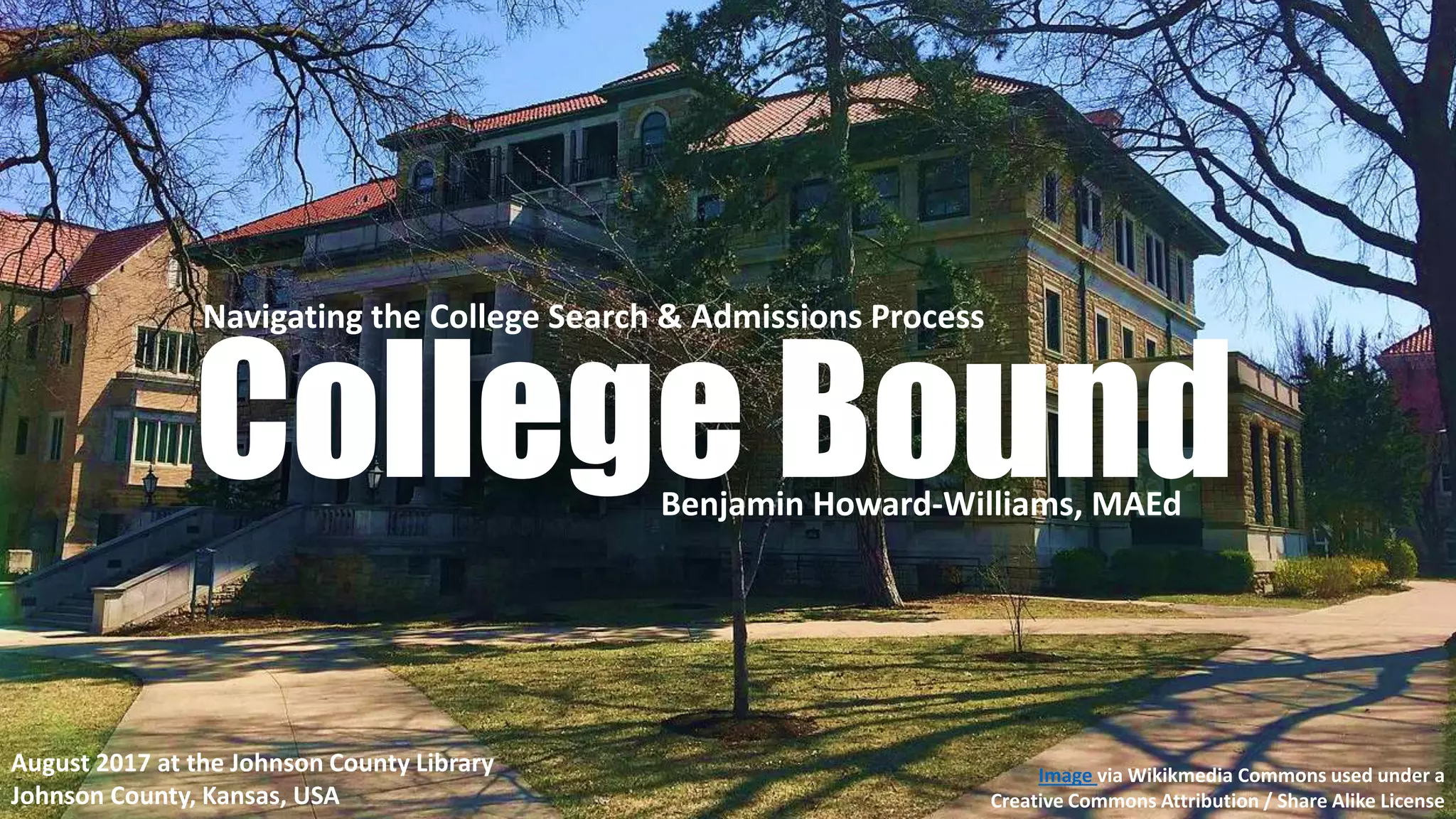
College Bound
Navigating the College Search & Admissions Process
August 2017 at the Johnson County Library
Johnson County, Kansas, USA
Image via Wikikmedia Commons used under a
Creative Commons Attribution / Share Alike License
Benjamin Howard-Williams, MAEd
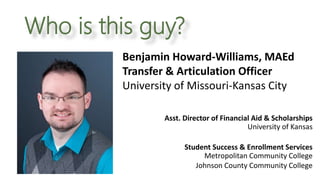
Who is this guy?
Asst. Director of Financial Aid​ & Scholarships
University of Kansas​
Student Success & Enrollment Services
Metropolitan Community College
Johnson County Community College
Benjamin Howard-Williams, MAEd
Transfer & Articulation Officer
University of Missouri-Kansas City
Agenda
DISCLAIMER: This information is presented by a private citizen on a
matter of public concern as a free community resource. The information
presented is intended as a general overview and should not be interpreted
as an official document or publication of any institution of higher
education or the US Department of Education. Any errors or omissions are
unintentional. No guarantee of admission is intended or implied.
• The College Search: Figuring out where you Fit
• College Application Standards: What’s required?
• Preparing for Admission: What are they looking for?
• The Personal Statement: How to talk about yourself
• Q&A
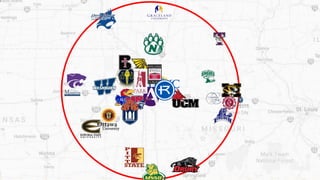
The College Search
Where do you fit?
Open Admission
•Open to all students.
•Strongest focus on
teaching.
•Public & Private.
•4 year & 2 year.
Research Universities
• Focused on the creation and
curation of knowledge.
• Biggest name recognition.
• Most well-known faculty.
• Largest number of major
options.
• Well connected alumni.
• Largest class sizes.
• Greatest likelihood of being
taught by a graduate assistant.
Regional Universities
• Compromise between Research
& Open Admission.
• Balance of research
opportunities and strong
teaching emphasis.
• Smaller class sizes.
• Fewer major options.
• Less name recognition.
Liberal Arts Colleges
• Most focused on the
“student experience”.
• Small class sizes.
• Strong faculty connections.
• Strong campus
communities.
• Highest cost (usually).
• Least name recognition.
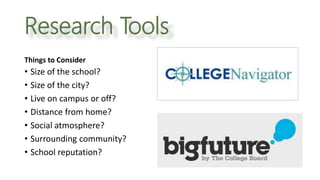
Things to Consider
• Size of the school?
• Size of the city?
• Live on campus or off?
• Distance from home?
• Social atmosphere?
• Surrounding community?
• School reputation?
Research Tools
Admissions
Standards
What are they
looking for?
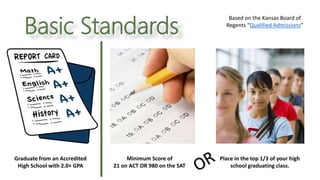
Basic Standards
Graduate from an Accredited
High School with 2.0+ GPA
Minimum Score of
21 on ACT OR 980 on the SAT
Place in the top 1/3 of your high
school graduating class.
Based on the Kansas Board of
Regents “Qualified Admissions”
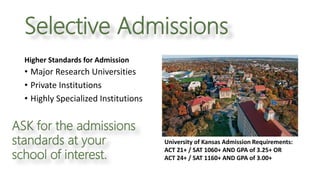
Selective Admissions
Higher Standards for Admission
• Major Research Universities
• Private Institutions
• Highly Specialized Institutions
University of Kansas Admission Requirements:
ACT 21+ / SAT 1060+ AND GPA of 3.25+ OR
ACT 24+ / SAT 1160+ AND GPA of 3.00+
ASK for the admissions
standards at your
school of interest.
Competitive / Scholarship
Common Elements
• Resume
• Personal Statement
• Interview
Talking about
yourself.
Resumes and
Personal Statements
What are they asking?
Are you likely to retain and
graduate?
• What do you have to offer
beyond your grades and test
scores?
• Do you have something unique
to contribute to this community
/ organization?
• Will you be a good fit for our
institution?
The Skills-Based Resume
Talk about what you can DO, not
where you’ve worked.
• Skills, talents, and interests
supported by specific examples
• Volunteer Work
• Travel Experiences
• Social Groups
• Religious Functions
• Athletics
• Performance / Fine Arts
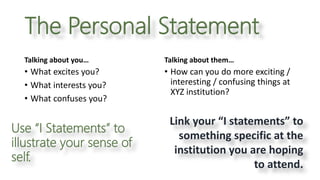
The Personal Statement
Talking about you…
• What excites you?
• What interests you?
• What confuses you?
Talking about them…
• How can you do more exciting /
interesting / confusing things at
XYZ institution?
Use “I Statements” to
illustrate your sense of
self.
Link your “I statements” to
something specific at the
institution you are hoping
to attend.
Questions?
Thank you!

College Bound - Navigating the College Search & Admissions Process

  • 1.
    College Bound Navigating theCollege Search & Admissions Process August 2017 at the Johnson County Library Johnson County, Kansas, USA Image via Wikikmedia Commons used under a Creative Commons Attribution / Share Alike License Benjamin Howard-Williams, MAEd
  • 2.
    Who is thisguy? Asst. Director of Financial Aid​ & Scholarships University of Kansas​ Student Success & Enrollment Services Metropolitan Community College Johnson County Community College Benjamin Howard-Williams, MAEd Transfer & Articulation Officer University of Missouri-Kansas City
  • 3.
    Agenda DISCLAIMER: This informationis presented by a private citizen on a matter of public concern as a free community resource. The information presented is intended as a general overview and should not be interpreted as an official document or publication of any institution of higher education or the US Department of Education. Any errors or omissions are unintentional. No guarantee of admission is intended or implied. • The College Search: Figuring out where you Fit • College Application Standards: What’s required? • Preparing for Admission: What are they looking for? • The Personal Statement: How to talk about yourself • Q&A
  • 4.
  • 6.
    Open Admission •Open toall students. •Strongest focus on teaching. •Public & Private. •4 year & 2 year.
  • 7.
    Research Universities • Focusedon the creation and curation of knowledge. • Biggest name recognition. • Most well-known faculty. • Largest number of major options. • Well connected alumni. • Largest class sizes. • Greatest likelihood of being taught by a graduate assistant.
  • 8.
    Regional Universities • Compromisebetween Research & Open Admission. • Balance of research opportunities and strong teaching emphasis. • Smaller class sizes. • Fewer major options. • Less name recognition.
  • 9.
    Liberal Arts Colleges •Most focused on the “student experience”. • Small class sizes. • Strong faculty connections. • Strong campus communities. • Highest cost (usually). • Least name recognition.
  • 10.
    Things to Consider •Size of the school? • Size of the city? • Live on campus or off? • Distance from home? • Social atmosphere? • Surrounding community? • School reputation? Research Tools
  • 11.
  • 12.
    Basic Standards Graduate froman Accredited High School with 2.0+ GPA Minimum Score of 21 on ACT OR 980 on the SAT Place in the top 1/3 of your high school graduating class. Based on the Kansas Board of Regents “Qualified Admissions”
  • 13.
    Selective Admissions Higher Standardsfor Admission • Major Research Universities • Private Institutions • Highly Specialized Institutions University of Kansas Admission Requirements: ACT 21+ / SAT 1060+ AND GPA of 3.25+ OR ACT 24+ / SAT 1160+ AND GPA of 3.00+ ASK for the admissions standards at your school of interest.
  • 14.
    Competitive / Scholarship CommonElements • Resume • Personal Statement • Interview
  • 15.
  • 16.
    What are theyasking? Are you likely to retain and graduate? • What do you have to offer beyond your grades and test scores? • Do you have something unique to contribute to this community / organization? • Will you be a good fit for our institution?
  • 17.
    The Skills-Based Resume Talkabout what you can DO, not where you’ve worked. • Skills, talents, and interests supported by specific examples • Volunteer Work • Travel Experiences • Social Groups • Religious Functions • Athletics • Performance / Fine Arts
  • 18.
    The Personal Statement Talkingabout you… • What excites you? • What interests you? • What confuses you? Talking about them… • How can you do more exciting / interesting / confusing things at XYZ institution? Use “I Statements” to illustrate your sense of self. Link your “I statements” to something specific at the institution you are hoping to attend.
  • 19.