


Collective
ownership in agile
teams
Kapil R Nakhwa.
http://jyaasa.com
Question:
What is Collective
ownership ?
Types of ownerships
- Strong Ownership
- Weak Ownership
- Collective Ownership.
Jyaasa : We Design, Build and Develop Products
Why collective ownership?
● Mitigate truck number risk.
● Everyone is expected to fix the problem they find.
Expected benefits
● knowledge sharing
● Code quality and better coding style.
● Reduced dependency on individual.
● Efficient and useful code reviews.
● Great learning scope.
● Agile/Scrum Principles.
Common shortcomings
● Not my responsibility.
● No enforced motivation.
● Team’s technically capability.
● Specialization VS generalization.
Do not let specialization prevent you
from learning other things. If your
speciality is AI and team is doing user
interfaces this week. Pick a UI task It
will only improve your skills
Making it work.
● Let go of the ego .
● Take pride in team’s work not on your own.
● Stop pushing your design vision and discuss design
possibilities.
● Commitment from each members to produce good
code.
● When you see a problem you fix it
● When writing new code, Do not do a half assed job half
heartedly.
● Do not assume somebody else will fix the mistake.
● Write the best code you can
On other hand.
● Does not mean you have to be perfect.
● If you’ve produced code that works with reasonable
quality and not sure on how to improve it. Let it go . You
will improve it when you know more and when needed.
Working with Unfamiliar
codebase.
● If you are working on knowledge silos . You may be
afraid. Very afraid.
● But to begin : Pair program or rubber duck debug.
● Or ask expert to help you out .
● Rely on inference skills
● Rely on test suites as a safety net to test your
assumptions.
● As you work look for opportunities to refactor .
Last words:
● Proceed with caution unless you use test-driven
development, simple design, and agree on coding
standards.
● To take advantage of collective ownership's ability to
improve code quality, the team must practice relentless
refactoring.
● To coordinate changes, you must use continuous
integration and a concurrent model of version control.
● "shared responsibility is no responsibility at all." Don't
let that happen to your code.
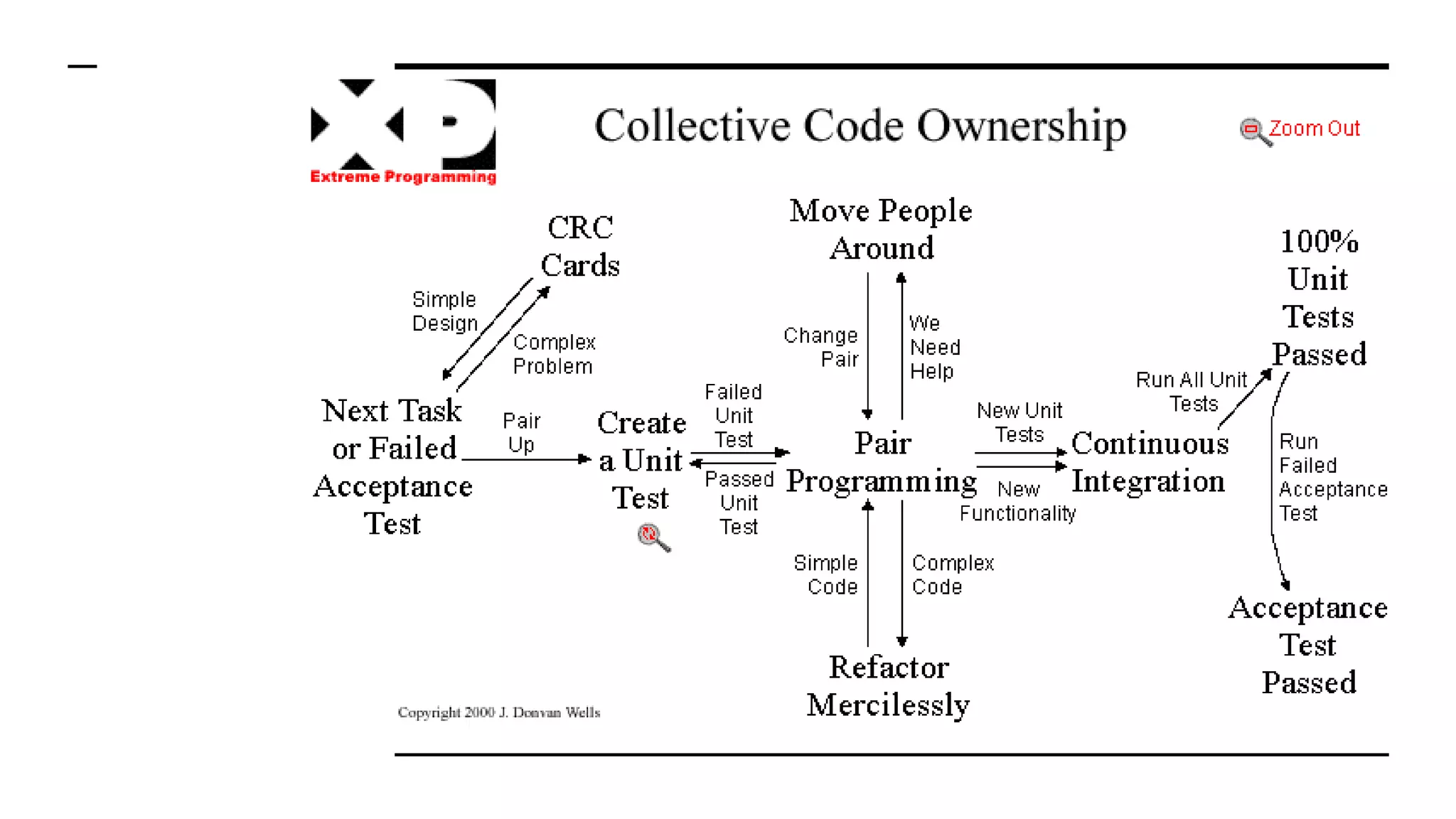
● Collective code ownership requires good
communication. Without it, the team cannot maintain a
shared vision, and code quality will suffer. Several XP
practices help provide this communication: a team that
includes experienced designers, sitting together, and
pair programming.
● good design and tests make collective code ownership is
easier.
Last words:
References:
http://www.extremeprogramming.or
g/rules/collective.html
http://www.jamesshore.com/Agile-
Book/collective_code_ownership.ht
ml

Collective ownership in agile teams

  • 1.
    Collective ownership in agile teams KapilR Nakhwa. http://jyaasa.com
  • 2.
  • 3.
    Types of ownerships -Strong Ownership - Weak Ownership - Collective Ownership. Jyaasa : We Design, Build and Develop Products
  • 4.
    Why collective ownership? ●Mitigate truck number risk. ● Everyone is expected to fix the problem they find.
  • 5.
    Expected benefits ● knowledgesharing ● Code quality and better coding style. ● Reduced dependency on individual. ● Efficient and useful code reviews. ● Great learning scope. ● Agile/Scrum Principles.
  • 6.
    Common shortcomings ● Notmy responsibility. ● No enforced motivation. ● Team’s technically capability. ● Specialization VS generalization.
  • 7.
    Do not letspecialization prevent you from learning other things. If your speciality is AI and team is doing user interfaces this week. Pick a UI task It will only improve your skills
  • 8.
    Making it work. ●Let go of the ego . ● Take pride in team’s work not on your own. ● Stop pushing your design vision and discuss design possibilities. ● Commitment from each members to produce good code. ● When you see a problem you fix it ● When writing new code, Do not do a half assed job half heartedly. ● Do not assume somebody else will fix the mistake. ● Write the best code you can
  • 9.
    On other hand. ●Does not mean you have to be perfect. ● If you’ve produced code that works with reasonable quality and not sure on how to improve it. Let it go . You will improve it when you know more and when needed.
  • 10.
    Working with Unfamiliar codebase. ●If you are working on knowledge silos . You may be afraid. Very afraid. ● But to begin : Pair program or rubber duck debug. ● Or ask expert to help you out . ● Rely on inference skills ● Rely on test suites as a safety net to test your assumptions. ● As you work look for opportunities to refactor .
  • 11.
    Last words: ● Proceedwith caution unless you use test-driven development, simple design, and agree on coding standards. ● To take advantage of collective ownership's ability to improve code quality, the team must practice relentless refactoring. ● To coordinate changes, you must use continuous integration and a concurrent model of version control.
  • 12.
    ● "shared responsibilityis no responsibility at all." Don't let that happen to your code. ● Collective code ownership requires good communication. Without it, the team cannot maintain a shared vision, and code quality will suffer. Several XP practices help provide this communication: a team that includes experienced designers, sitting together, and pair programming. ● good design and tests make collective code ownership is easier. Last words:
  • 14.