G325: Critical Perspectives
         in Media
     Section A: Theoretical Evaluation of
                  Production
    Section B: Contemporary Media Issues


                                            1
Critical Perspectives in Media
  G325: Critical Perspectives in Media
• The purpose of this unit is to assess candidates' knowledge and
  understanding of media concepts, contexts and critical debates,
  through their understanding of one contemporary media issue
  and their ability to evaluate their own practical work in reflective
  and theoretical ways.
• The examination is two hours. Candidates are required to
  answer two compulsory questions, on their own production
  work, and one question from a choice of six topic areas. The unit
  is marked out of a total of 100, with the two questions on
  production work marked out of 25 each, and the media theory
  question marked out of 50.
            There are two sections to this paper:
   Section A: Theoretical Evaluation of Production (50 marks)
       Section B: Contemporary Media Issues (50 marks)
                                                                     2
Section B: Contemporary Media
   Section B: Contemporary Media
                Issues
                Issues
• One question to be answered from a choice of six topic areas
  offered by OCR. There will be two questions from each topic
  area.
• The topic areas require understanding of contemporary media
  texts, industries, audiences and debates.
• Candidates must choose one of the following topic areas, in
  advance of the examination and, through specific case
  studies, texts, debates and research of the candidates' choice,
  prepare to demonstrate understanding of the contemporary
  issue. This understanding must combine knowledge of at least
  two media and a range of texts, industries, audiences and
  debates, but these are to be selected by the centre /
  candidate


                                                                3
Section B: ContemporaryMedia
     Section B: Contemporary Media
                  Issues
                  Issues
•   Contemporary Media Regulation
•   Global Media
•   Media and Collective Identity
•   Media in the Online Age
•   Post-mordern Media
•   ‘We Media’ and Democracy


                                     4
Section B: Contemporary Media
   Section B: Contemporary Media
                Issues
                Issues
• Each topic is accompanied by four prompt
  questions, and candidates must be prepared
  to answer an exam question that relates to
  one or more of these four prompts. There
  should be emphasis on the historical, the
  contemporary and the future in relation to the
  chosen topic, with most attention on the
  present

                                               5
Media and Collective Identity
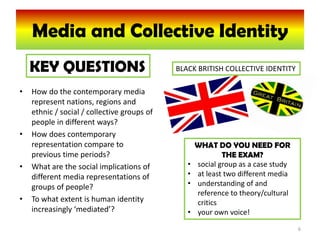
    KEY QUESTIONS                            BLACK BRITISH COLLECTIVE IDENTITY

•   How do the contemporary media
    represent nations, regions and
    ethnic / social / collective groups of
    people in different ways?
•   How does contemporary
    representation compare to                       WHAT DO YOU NEED FOR
    previous time periods?                                  THE EXAM?
•   What are the social implications of         •   social group as a case study
    different media representations of          •   at least two different media
    groups of people?                           •   understanding of and
                                                    reference to theory/cultural
•   To what extent is human identity                critics
    increasingly ‘mediated’?                    •   your own voice!
                                                                                   6
Consider at a ‘macro’ level how ‘the media’ represent people and ideas
But more importantly discuss on a ‘micro’ level how people give meaning
        To particular kinds of media in relation to their identity


                                                                          7
Representations of Black Britain
  Representations of Black Britain
• In order to be fully prepared for the specific requirements of
  the question, the material studied by candidates must cover
  these three elements:
 Historical - dependent on the requirements of the topic,
candidates must summarise the development of the media
         forms in question in theoretical contexts.

      Contemporary - current issues within the topic area.


          Future - candidates must demonstrate personal
            engagement with debates about the future of
          the media forms / issues that the topic relates to.
                                                                   8
Representations of Black Britain
  Representations of Black Britain
• We will be focusing on film and music – the texts that we will
  be looking at are:
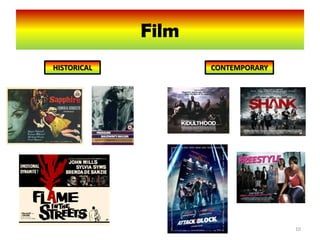
• Sapphire, Basil Dearden (1959)
• Flame in the Streets, Roy Ward Baker (1962)
• Pressure, Horace Ove (1976)
• Kidulthood, Menhaj Huda (2006)
• Freestyle, Kolton Lee (2010)
• Shank, Mo Ali (2010)
• Attack The Block (Joe Cornish, 2011)


                                                                   9
Film
HISTORICAL          CONTEMPORARY


                                   10
Representations of BlackBritain
  Representations of Black Britain
• We will be focusing on film and music – the texts that we will
  be looking at are:
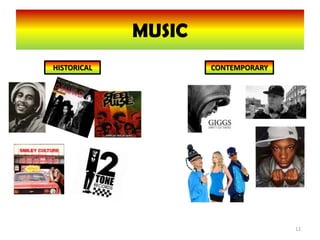
• 2 Tone and The Specials
• Reggae and Smiley Culture
• Grime & UK Hip Hop – Dizzie Rascal, Bashy, N-Dubz, Professor
  Green


• We will be considering the use of the term ‘Urban’
• And music as a subculture – representative of something
  much bigger

                                                               11
MUSIC
HISTORICAL           CONTEMPORARY


                                    12
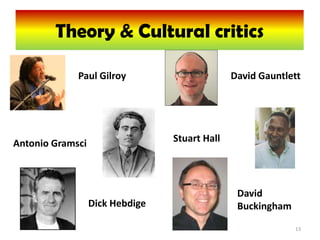
Theory & Culturalcritics
         Theory & Cultural critics

             Paul Gilroy                       David Gauntlett


Antonio Gramsci                  Stuart Hall


                                                David
                  Dick Hebdige                  Buckingham
                                                             13
Let’s review
                Let’s review
• What do you need for the exam?
• social group as a case study- examples
• at least two different media
• understanding of and reference to
  theory/cultural critics
• your own voice!


                                           14
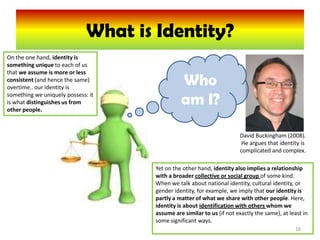
What is Identity?
Brainstorm what
makes you you? If
we were to pick                 Who
you apart what
would you say are               am I?
the building blocks
of you?


                                        15
What is Identity?
On the one hand, identity is
something unique to each of us
that we assume is more or less
consistent (and hence the same)
overtime.. our identity is
                                               Who
something we uniquely possess: it
is what distinguishes us from
other people.
                                               am I?

                                                                       David Buckingham (2008).
                                                                        He argues that identity is
                                                                       complicated and complex.

                                     Yet on the other hand, identity also implies a relationship
                                     with a broader collective or social group of some kind.
                                     When we talk about national identity, cultural identity, or
                                     gender identity, for example, we imply that our identity is
                                     partly a matter of what we share with other people. Here,
                                     identity is about identification with others whom we
                                     assume are similar to us (if not exactly the same), at least in
                                     some significant ways.
                                                                                              16
What is Identity?
                                                                                           “The term [identity] (by
“people's concepts of who
                                                                                           convention) references mutually
they are, of what sort of                                                                  constructed and evolving images
people they are, and how                                                                   of self and other" (Katzenstein
they relate to others" (Hogg                                                               1996, 59).
and Abrams 1988, 2).

“the way individuals and groups                                                              “Identity emerges as a kind of
define themselves and are                                                                    unsettled space, or an unresolved
defined by others on the basis                                                               question in that space,
of race, ethnicity, religion,                                                                between a number of intersecting
                                                                                             discourses. ... [Until recently, we
language, and culture" (Deng                                                                 have incorrectly thought that
1995, 1).                                                                                    identity is] a kind of fixed point of
                                                                                             thought and being, a ground of
“refers to the ways in which                                                                 action ... the logic of something
individuals and collectivities are                                                           like a `true self.' ... [But] Identity is
                                                                                             a process, identity is split. Identity
distinguished in
                                                                                             is not a fixed point but an
their social relations with other                                                            ambivalent point. Identity is also
individuals and collectivities"                                                              the relationship of the Other to
(Jenkins 1996, 4).                                                                           oneself" (Hall 1989)
                                                                                                                                17
                                     http://www.stanford.edu/~jfearon/papers/iden1v2.pdf
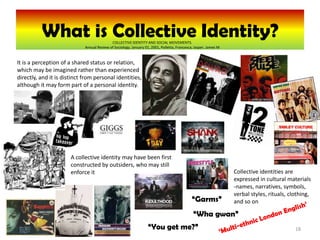
What is Collective Identity?      COLLECTIVE IDENTITY AND SOCIAL MOVEMENTS.
                             Annual Review of Sociology, January 01, 2001, Polletta, Francesca; Jasper, James M


It is a perception of a shared status or relation,
which may be imagined rather than experienced
directly, and it is distinct from personal identities,
although it may form part of a personal identity.


                       A collective identity may have been first
                       constructed by outsiders, who may still
                       enforce it                                                                                 Collective identities are
                                                                                                                  expressed in cultural materials
                                                                                                                  -names, narratives, symbols,
                                                                                                                  verbal styles, rituals, clothing,
                                                                                              “Garms”             and so on

                                                                                              “Wha gwan”
                                                                   “You get me?”                                                            18
What’s this got to do with media?
 Think about how we form our identities and where the              How does the media
 information comes from. The influence of mass media              aid identity formation?
 shapes our concepts of who we are, what is important
 to us and how we live our lives. Everything concerning
 our lives is seen to be ‘media saturated’.


                                  Identity is something that is constructed over a period
                                  of time and can be updated or changed completely.


In today’s world the choosing of one’s identity is a multi
layered experience, consciously and unconsciously
influenced by countless factors
                                                                 IDENTITY ISN’T SIMPLE?

                                                                                       19
Contextualising Sapphire
• In order to fully understand the
  representations and the construction of
  representations presented in Sapphire it’s
  necessary to contextualise the film.
• Researching the socio-political context of the
  production will allow for better understanding
  when discussing issues of collective identity
  among Black Britons
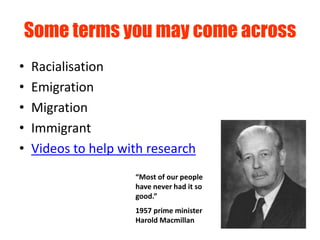
Some terms you may come across
•   Racialisation
•   Emigration
•   Migration
•   Immigrant
•   Videos to help with research
                     “Most of our people
                     have never had it so
                     good.”
                     1957 prime minister
                     Harold Macmillan
Research
• Investigate what was happening in Britain between
  1948 – 1962
• How was the social landscape changing?
• How did the changing social landscape lead to a
  ‘racialisation’ of British politics?
• Representation works through construction – how
  were black people represented in the film?
• Considering your research and film analysis - How
  does the film put across a sense of collective identity
  of Black British people?

Collective ID - Week 1

  • 1.
    G325: Critical Perspectives in Media Section A: Theoretical Evaluation of Production Section B: Contemporary Media Issues 1
  • 2.
    Critical Perspectives inMedia G325: Critical Perspectives in Media • The purpose of this unit is to assess candidates' knowledge and understanding of media concepts, contexts and critical debates, through their understanding of one contemporary media issue and their ability to evaluate their own practical work in reflective and theoretical ways. • The examination is two hours. Candidates are required to answer two compulsory questions, on their own production work, and one question from a choice of six topic areas. The unit is marked out of a total of 100, with the two questions on production work marked out of 25 each, and the media theory question marked out of 50. There are two sections to this paper: Section A: Theoretical Evaluation of Production (50 marks) Section B: Contemporary Media Issues (50 marks) 2
  • 3.
    Section B: ContemporaryMedia Section B: Contemporary Media Issues Issues • One question to be answered from a choice of six topic areas offered by OCR. There will be two questions from each topic area. • The topic areas require understanding of contemporary media texts, industries, audiences and debates. • Candidates must choose one of the following topic areas, in advance of the examination and, through specific case studies, texts, debates and research of the candidates' choice, prepare to demonstrate understanding of the contemporary issue. This understanding must combine knowledge of at least two media and a range of texts, industries, audiences and debates, but these are to be selected by the centre / candidate 3
  • 4.
    Section B: ContemporaryMedia Section B: Contemporary Media Issues Issues • Contemporary Media Regulation • Global Media • Media and Collective Identity • Media in the Online Age • Post-mordern Media • ‘We Media’ and Democracy 4
  • 5.
    Section B: ContemporaryMedia Section B: Contemporary Media Issues Issues • Each topic is accompanied by four prompt questions, and candidates must be prepared to answer an exam question that relates to one or more of these four prompts. There should be emphasis on the historical, the contemporary and the future in relation to the chosen topic, with most attention on the present 5
  • 6.
    Media and CollectiveIdentity KEY QUESTIONS BLACK BRITISH COLLECTIVE IDENTITY • How do the contemporary media represent nations, regions and ethnic / social / collective groups of people in different ways? • How does contemporary representation compare to WHAT DO YOU NEED FOR previous time periods? THE EXAM? • What are the social implications of • social group as a case study different media representations of • at least two different media groups of people? • understanding of and reference to theory/cultural • To what extent is human identity critics increasingly ‘mediated’? • your own voice! 6
  • 7.
    Consider at a‘macro’ level how ‘the media’ represent people and ideas But more importantly discuss on a ‘micro’ level how people give meaning To particular kinds of media in relation to their identity 7
  • 8.
    Representations of BlackBritain Representations of Black Britain • In order to be fully prepared for the specific requirements of the question, the material studied by candidates must cover these three elements: Historical - dependent on the requirements of the topic, candidates must summarise the development of the media forms in question in theoretical contexts. Contemporary - current issues within the topic area. Future - candidates must demonstrate personal engagement with debates about the future of the media forms / issues that the topic relates to. 8
  • 9.
    Representations of BlackBritain Representations of Black Britain • We will be focusing on film and music – the texts that we will be looking at are: • Sapphire, Basil Dearden (1959) • Flame in the Streets, Roy Ward Baker (1962) • Pressure, Horace Ove (1976) • Kidulthood, Menhaj Huda (2006) • Freestyle, Kolton Lee (2010) • Shank, Mo Ali (2010) • Attack The Block (Joe Cornish, 2011) 9
  • 10.
    Film HISTORICAL CONTEMPORARY 10
  • 11.
    Representations of BlackBritain Representations of Black Britain • We will be focusing on film and music – the texts that we will be looking at are: • 2 Tone and The Specials • Reggae and Smiley Culture • Grime & UK Hip Hop – Dizzie Rascal, Bashy, N-Dubz, Professor Green • We will be considering the use of the term ‘Urban’ • And music as a subculture – representative of something much bigger 11
  • 12.
    MUSIC HISTORICAL CONTEMPORARY 12
  • 13.
    Theory & Culturalcritics Theory & Cultural critics Paul Gilroy David Gauntlett Antonio Gramsci Stuart Hall David Dick Hebdige Buckingham 13
  • 14.
    Let’s review Let’s review • What do you need for the exam? • social group as a case study- examples • at least two different media • understanding of and reference to theory/cultural critics • your own voice! 14
  • 15.
    What is Identity? Brainstormwhat makes you you? If we were to pick Who you apart what would you say are am I? the building blocks of you? 15
  • 16.
    What is Identity? Onthe one hand, identity is something unique to each of us that we assume is more or less consistent (and hence the same) overtime.. our identity is Who something we uniquely possess: it is what distinguishes us from other people. am I? David Buckingham (2008). He argues that identity is complicated and complex. Yet on the other hand, identity also implies a relationship with a broader collective or social group of some kind. When we talk about national identity, cultural identity, or gender identity, for example, we imply that our identity is partly a matter of what we share with other people. Here, identity is about identification with others whom we assume are similar to us (if not exactly the same), at least in some significant ways. 16
  • 17.
    What is Identity? “The term [identity] (by “people's concepts of who convention) references mutually they are, of what sort of constructed and evolving images people they are, and how of self and other" (Katzenstein they relate to others" (Hogg 1996, 59). and Abrams 1988, 2). “the way individuals and groups “Identity emerges as a kind of define themselves and are unsettled space, or an unresolved defined by others on the basis question in that space, of race, ethnicity, religion, between a number of intersecting discourses. ... [Until recently, we language, and culture" (Deng have incorrectly thought that 1995, 1). identity is] a kind of fixed point of thought and being, a ground of “refers to the ways in which action ... the logic of something individuals and collectivities are like a `true self.' ... [But] Identity is a process, identity is split. Identity distinguished in is not a fixed point but an their social relations with other ambivalent point. Identity is also individuals and collectivities" the relationship of the Other to (Jenkins 1996, 4). oneself" (Hall 1989) 17 http://www.stanford.edu/~jfearon/papers/iden1v2.pdf
  • 18.
    What is CollectiveIdentity? COLLECTIVE IDENTITY AND SOCIAL MOVEMENTS. Annual Review of Sociology, January 01, 2001, Polletta, Francesca; Jasper, James M It is a perception of a shared status or relation, which may be imagined rather than experienced directly, and it is distinct from personal identities, although it may form part of a personal identity. A collective identity may have been first constructed by outsiders, who may still enforce it Collective identities are expressed in cultural materials -names, narratives, symbols, verbal styles, rituals, clothing, “Garms” and so on “Wha gwan” “You get me?” 18
  • 19.
    What’s this gotto do with media? Think about how we form our identities and where the How does the media information comes from. The influence of mass media aid identity formation? shapes our concepts of who we are, what is important to us and how we live our lives. Everything concerning our lives is seen to be ‘media saturated’. Identity is something that is constructed over a period of time and can be updated or changed completely. In today’s world the choosing of one’s identity is a multi layered experience, consciously and unconsciously influenced by countless factors IDENTITY ISN’T SIMPLE? 19
  • 21.
    Contextualising Sapphire • Inorder to fully understand the representations and the construction of representations presented in Sapphire it’s necessary to contextualise the film. • Researching the socio-political context of the production will allow for better understanding when discussing issues of collective identity among Black Britons
  • 22.
    Some terms youmay come across • Racialisation • Emigration • Migration • Immigrant • Videos to help with research “Most of our people have never had it so good.” 1957 prime minister Harold Macmillan
  • 23.
    Research • Investigate whatwas happening in Britain between 1948 – 1962 • How was the social landscape changing? • How did the changing social landscape lead to a ‘racialisation’ of British politics? • Representation works through construction – how were black people represented in the film? • Considering your research and film analysis - How does the film put across a sense of collective identity of Black British people?