STRIKES AND
LOCKOUTS
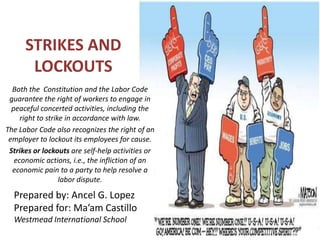
Both the Constitution and the Labor Code
guarantee the right of workers to engage in
peaceful concerted activities, including the
right to strike in accordance with law.
The Labor Code also recognizes the right of an
employer to lockout its employees for cause.
Strikes or lockouts are self-help activities or
economic actions, i.e., the infliction of an
economic pain to a party to help resolve a
labor dispute.

Prepared by: Ancel G. Lopez
Prepared for: Ma’am Castillo
Westmead International School
Q: What is a strike?
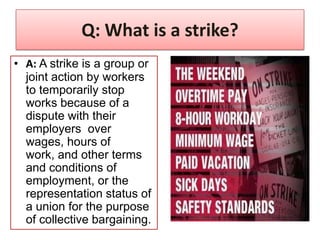
• A: A strike is a group or
joint action by workers
to temporarily stop
works because of a
dispute with their
employers over
wages, hours of
work, and other terms
and conditions of
employment, or the
representation status of
a union for the purpose
of collective bargaining.
Q: What is a lockout?
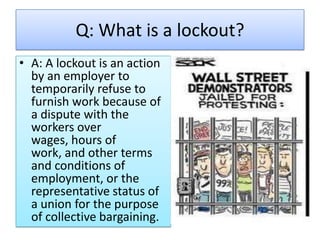
• A: A lockout is an action
by an employer to
temporarily refuse to
furnish work because of
a dispute with the
workers over
wages, hours of
work, and other terms
and conditions of
employment, or the
representative status of
a union for the purpose
of collective bargaining.
Q: Who can declare a strike?
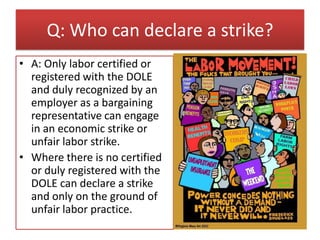
• A: Only labor certified or
registered with the DOLE
and duly recognized by an
employer as a bargaining
representative can engage
in an economic strike or
unfair labor strike.
• Where there is no certified
or duly registered with the
DOLE can declare a strike
and only on the ground of
unfair labor practice.
Q: Who can declare a lockout?

• A: An employer
can declare an
economic lockout
or unfair labor
practice lockout.
Q: How is a strike or lockout classified?
• A: ECONOMIC STRIKE
– is a joint act of workers to force a concession
which the law does not compel an employer
to give.
• UNFAIR LABOR PRACTICE STRIKE (lockout)
– is declared when the cause of the action is an
alleged act of unfair labor practice by an
employer.
Q: What are the requirements for a strike
or lock out as an industrial action?
• 1. Filing of a Notice of an Intent to strike with the Bureau
of Labor Relations or the National Conciliation and
Mediation Board (NCMB);
• 2. taking the vote of the workers or Board of Directors to
undertake the action;
• 3. reporting the results of the strike votes;
• 4. Observing the cooling-off period – fifteen (15) days for
unfair labor practice strike or lockouts, and thirty (30) days
for economic strikes and lockouts; and
• 5. observing the seven (7)-day strike ban period.
Q: Does strike or lockout terminate the
employment of a worker?
• A: NO, a strike or a
lockout is only
temporary in
duration, i.e as long as
the dispute between
the employer and
workers is not resolved.
After the causes of
strike or lockout are
resolved, the workers
return to work.
Q: When is a strike or lockout illegal?
• A: if the purpose or cause is neither economic
nor unfair labor practice, and/or unlawful means
are used by either the employer or the union
during or on the occasion of the strike or lockout,
i.e., the use of force, violence or coercion. This is
called the purpose and means tests.
• The Constitution recognizes the right of workers
to strike only if the action is peaceful and in
accordance with the procedure set by law.
[Constitution, ART. XIII, Sec. 3]
Q: What is the liability of a union
officer when a strike is illegal?
• A: A union officer who knowingly participates
in an illegal strike, or in the commission of
illegal acts or authorizes the acts during the
strike may be terminated from employment.
• The mere participation of a worker in an
unlawful strike is not ground for termination
of employment even when the arrested
worker has been replaced.
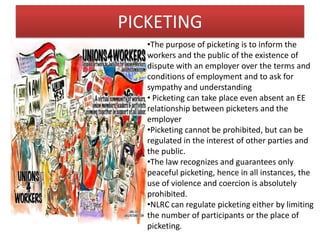
PICKETING
•The purpose of picketing is to inform the
workers and the public of the existence of
dispute with an employer over the terms and
conditions of employment and to ask for
sympathy and understanding
• Picketing can take place even absent an EE
relationship between picketers and the
employer
•Picketing cannot be prohibited, but can be
regulated in the interest of other parties and
the public.
•The law recognizes and guarantees only
peaceful picketing, hence in all instances, the
use of violence and coercion is absolutely
prohibited.
•NLRC can regulate picketing either by limiting
the number of participants or the place of
picketing.
Q: What is the role of the Philippine National
Police during a strike or picketing activity?
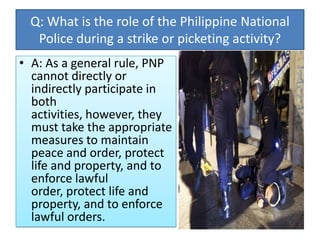
• A: As a general rule, PNP
cannot directly or
indirectly participate in
both
activities, however, they
must take the appropriate
measures to maintain
peace and order, protect
life and property, and to
enforce lawful
order, protect life and
property, and to enforce
lawful orders.
Q: What is a Labor Injunction?
• A: A labor injunction is an order issued by the
National Labor Relations Commission
prohibiting either an employer or a
union, from doing some specified acts or to
correct some wrong or injury on the occasion
of a labor dispute between an employer and
a union.
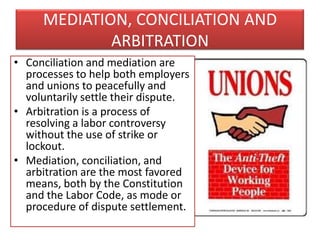
MEDIATION, CONCILIATION AND
ARBITRATION
• Conciliation and mediation are
processes to help both employers
and unions to peacefully and
voluntarily settle their dispute.
• Arbitration is a process of
resolving a labor controversy
without the use of strike or
lockout.
• Mediation, conciliation, and
arbitration are the most favored
means, both by the Constitution
and the Labor Code, as mode or
procedure of dispute settlement.
Q: What is Conciliation and mediation?
• A: Conciliation and mediation are processes or
aids, either by a government or private
agencies, to help or assist the employer and
union solve peacefully their dispute or
controversy.
• NCMB ( a government agency attached to
DOLE) will assist the parties in resolving their
dispute.
Q: What is arbitration as a process of
labor dispute settlement?
• COMPULSORY ARBITRATION – occurs by
automatic operation of law. The employer and
the union must submit their dispute for
resolution to a government agency for a
binding and a final resolution.
• VOLUNTARY ARBITRATION – is a process of
dispute settlement voluntarily agreed upon by
both the employer and the union.
References:
Photos: https://www.facebook.com/Artofresistance2012 https://www.facebook.com/pages/SaveCollective-Bargaining https://www.facebook.com/unions4workers
An Introduction to Labor Laws

and Social Legislation by D.P. Disini, Jr.

Strikes And Lockouts

  • 1.
    STRIKES AND LOCKOUTS Both theConstitution and the Labor Code guarantee the right of workers to engage in peaceful concerted activities, including the right to strike in accordance with law. The Labor Code also recognizes the right of an employer to lockout its employees for cause. Strikes or lockouts are self-help activities or economic actions, i.e., the infliction of an economic pain to a party to help resolve a labor dispute. Prepared by: Ancel G. Lopez Prepared for: Ma’am Castillo Westmead International School
  • 2.
    Q: What isa strike? • A: A strike is a group or joint action by workers to temporarily stop works because of a dispute with their employers over wages, hours of work, and other terms and conditions of employment, or the representation status of a union for the purpose of collective bargaining.
  • 3.
    Q: What isa lockout? • A: A lockout is an action by an employer to temporarily refuse to furnish work because of a dispute with the workers over wages, hours of work, and other terms and conditions of employment, or the representative status of a union for the purpose of collective bargaining.
  • 4.
    Q: Who candeclare a strike? • A: Only labor certified or registered with the DOLE and duly recognized by an employer as a bargaining representative can engage in an economic strike or unfair labor strike. • Where there is no certified or duly registered with the DOLE can declare a strike and only on the ground of unfair labor practice.
  • 5.
    Q: Who candeclare a lockout? • A: An employer can declare an economic lockout or unfair labor practice lockout.
  • 6.
    Q: How isa strike or lockout classified? • A: ECONOMIC STRIKE – is a joint act of workers to force a concession which the law does not compel an employer to give. • UNFAIR LABOR PRACTICE STRIKE (lockout) – is declared when the cause of the action is an alleged act of unfair labor practice by an employer.
  • 7.
    Q: What arethe requirements for a strike or lock out as an industrial action? • 1. Filing of a Notice of an Intent to strike with the Bureau of Labor Relations or the National Conciliation and Mediation Board (NCMB); • 2. taking the vote of the workers or Board of Directors to undertake the action; • 3. reporting the results of the strike votes; • 4. Observing the cooling-off period – fifteen (15) days for unfair labor practice strike or lockouts, and thirty (30) days for economic strikes and lockouts; and • 5. observing the seven (7)-day strike ban period.
  • 8.
    Q: Does strikeor lockout terminate the employment of a worker? • A: NO, a strike or a lockout is only temporary in duration, i.e as long as the dispute between the employer and workers is not resolved. After the causes of strike or lockout are resolved, the workers return to work.
  • 9.
    Q: When isa strike or lockout illegal? • A: if the purpose or cause is neither economic nor unfair labor practice, and/or unlawful means are used by either the employer or the union during or on the occasion of the strike or lockout, i.e., the use of force, violence or coercion. This is called the purpose and means tests. • The Constitution recognizes the right of workers to strike only if the action is peaceful and in accordance with the procedure set by law. [Constitution, ART. XIII, Sec. 3]
  • 10.
    Q: What isthe liability of a union officer when a strike is illegal? • A: A union officer who knowingly participates in an illegal strike, or in the commission of illegal acts or authorizes the acts during the strike may be terminated from employment. • The mere participation of a worker in an unlawful strike is not ground for termination of employment even when the arrested worker has been replaced.
  • 11.
    PICKETING •The purpose ofpicketing is to inform the workers and the public of the existence of dispute with an employer over the terms and conditions of employment and to ask for sympathy and understanding • Picketing can take place even absent an EE relationship between picketers and the employer •Picketing cannot be prohibited, but can be regulated in the interest of other parties and the public. •The law recognizes and guarantees only peaceful picketing, hence in all instances, the use of violence and coercion is absolutely prohibited. •NLRC can regulate picketing either by limiting the number of participants or the place of picketing.
  • 12.
    Q: What isthe role of the Philippine National Police during a strike or picketing activity? • A: As a general rule, PNP cannot directly or indirectly participate in both activities, however, they must take the appropriate measures to maintain peace and order, protect life and property, and to enforce lawful order, protect life and property, and to enforce lawful orders.
  • 13.
    Q: What isa Labor Injunction? • A: A labor injunction is an order issued by the National Labor Relations Commission prohibiting either an employer or a union, from doing some specified acts or to correct some wrong or injury on the occasion of a labor dispute between an employer and a union.
  • 14.
    MEDIATION, CONCILIATION AND ARBITRATION •Conciliation and mediation are processes to help both employers and unions to peacefully and voluntarily settle their dispute. • Arbitration is a process of resolving a labor controversy without the use of strike or lockout. • Mediation, conciliation, and arbitration are the most favored means, both by the Constitution and the Labor Code, as mode or procedure of dispute settlement.
  • 15.
    Q: What isConciliation and mediation? • A: Conciliation and mediation are processes or aids, either by a government or private agencies, to help or assist the employer and union solve peacefully their dispute or controversy. • NCMB ( a government agency attached to DOLE) will assist the parties in resolving their dispute.
  • 16.
    Q: What isarbitration as a process of labor dispute settlement? • COMPULSORY ARBITRATION – occurs by automatic operation of law. The employer and the union must submit their dispute for resolution to a government agency for a binding and a final resolution. • VOLUNTARY ARBITRATION – is a process of dispute settlement voluntarily agreed upon by both the employer and the union.
  • 17.
    References: Photos: https://www.facebook.com/Artofresistance2012 https://www.facebook.com/pages/SaveCollective-Bargaininghttps://www.facebook.com/unions4workers An Introduction to Labor Laws and Social Legislation by D.P. Disini, Jr.