Introduction
Concept and implementation
Evaluation
Conclusions and future work
Collaborative, Context Based Activity Control
Method for Camera Networks
Marek Kraft1 Michał Fularz1 Adam Schmidt1
1Poznań University of Technology
Institute of Control and Information Engineering
November 3, 2015
M. Kraft, M. Fularz, A. Schmidt Collaborative, Context Based Activity Control Method...
Introduction
Concept and implementation
Evaluation
Conclusions and future work
Table of contents
Goal and motivation
1 Introduction
Table of contents
Goal and motivation
2 Concept and implementation
Key concepts
Background subtraction
Node activation
Communication and coordination
3 Evaluation
Hardware platform
Test setup
Results
4 Conclusions and future work
M. Kraft, M. Fularz, A. Schmidt Collaborative, Context Based Activity Control Method...
Introduction
Concept and implementation
Evaluation
Conclusions and future work
Table of contents
Goal and motivation
Goal
Develop a conceptually simple yet effective, collaborative method
for constraining the rate of communication and power consumption
across the whole camera network.
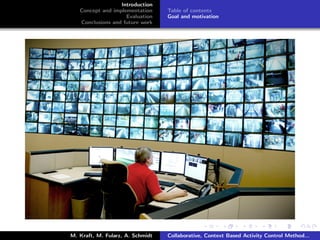
Motivation
As the average number of cameras in a network increases:
automated processing becomes a necessity,
continuous image streaming and data transmission is a serious
burden to the communication infrastructure,
combined power consumption of the camera networks goes up,
most previous work is focused on the design of network nodes
or single node management.
M. Kraft, M. Fularz, A. Schmidt Collaborative, Context Based Activity Control Method...
Introduction
Concept and implementation
Evaluation
Conclusions and future work
Table of contents
Goal and motivation
M. Kraft, M. Fularz, A. Schmidt Collaborative, Context Based Activity Control Method...
Introduction
Concept and implementation
Evaluation
Conclusions and future work
Key concepts
Background subtraction
Node activation
Communication and coordination
Key concepts:
compute the activity level for each individual sensor locally,
based on scene motion level,
scene motion level is calculated based on background
subtraction,
the activation level of each sensor node depends on the local
activity, but also on the activity of its neighbors,
decision on the kind of computation performed by the sensor
node and its other activities are made depending on the
activation level.
M. Kraft, M. Fularz, A. Schmidt Collaborative, Context Based Activity Control Method...
Introduction
Concept and implementation
Evaluation
Conclusions and future work
Key concepts
Background subtraction
Node activation
Communication and coordination
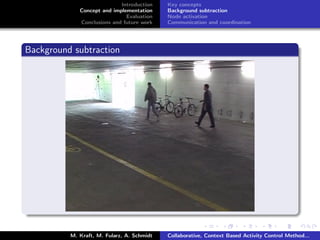
Background subtraction
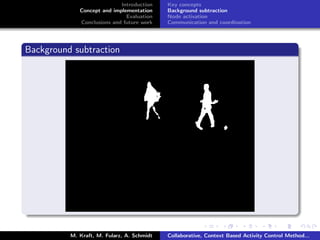
Foreground is the absolute value of the difference between the
current frame and the background model.
Additional post-processing applied to foreground image.
N. J. McFarlane et. al., Segmentation and tracking of piglets in
images. Machine vision and applications, 8(3), pp. 187-193, 1995
S. Brutzer et. al., Evaluation of background subtraction techniques
for video surveillance, IEEE Conf. on Computer Vision and Pattern
Recognition (CVPR) 2011, pp. 1937-1944
M. Kraft, M. Fularz, A. Schmidt Collaborative, Context Based Activity Control Method...
Introduction
Concept and implementation
Evaluation
Conclusions and future work
Key concepts
Background subtraction
Node activation
Communication and coordination
Background subtraction
Background model:
if the intensity value Ix,y of currently investigated pixel of the
current frame I is greater than the value of the corresponding
background model pixel Bx,y , the value of Bx,y is increased,
if the intensity value Ix,y of currently investigated pixel of the
current frame I is smaller than the value of the corresponding
background model pixel Bx,y , the value of Bx,y is decreased,
if the intensity value Ix,y of currently investigated pixel of the
current frame I has the same value as the corresponding
background model pixel Bx,y , the value of Bx,y remains
unchanged.
M. Kraft, M. Fularz, A. Schmidt Collaborative, Context Based Activity Control Method...
Introduction
Concept and implementation
Evaluation
Conclusions and future work
Key concepts
Background subtraction
Node activation
Communication and coordination
Background subtraction
M. Kraft, M. Fularz, A. Schmidt Collaborative, Context Based Activity Control Method...
Introduction
Concept and implementation
Evaluation
Conclusions and future work
Key concepts
Background subtraction
Node activation
Communication and coordination
Background subtraction
M. Kraft, M. Fularz, A. Schmidt Collaborative, Context Based Activity Control Method...
Introduction
Concept and implementation
Evaluation
Conclusions and future work
Key concepts
Background subtraction
Node activation
Communication and coordination
Block schematic of a single node
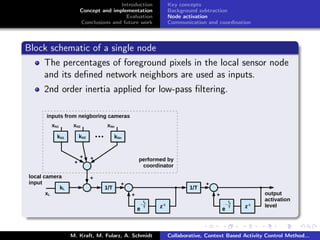
The percentages of foreground pixels in the local sensor node
and its defined network neighbors are used as inputs.
2nd order inertia applied for low-pass filtering.
M. Kraft, M. Fularz, A. Schmidt Collaborative, Context Based Activity Control Method...
Introduction
Concept and implementation
Evaluation
Conclusions and future work
Key concepts
Background subtraction
Node activation
Communication and coordination
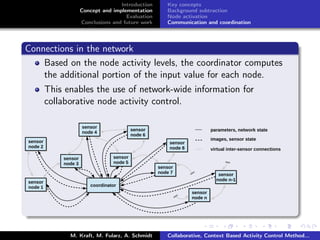
Connections in the network
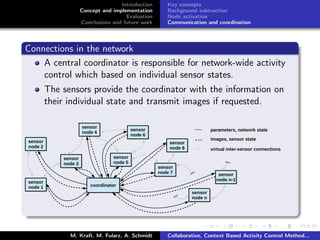
A central coordinator is responsible for network-wide activity
control which based on individual sensor states.
The sensors provide the coordinator with the information on
their individual state and transmit images if requested.
M. Kraft, M. Fularz, A. Schmidt Collaborative, Context Based Activity Control Method...
Introduction
Concept and implementation
Evaluation
Conclusions and future work
Key concepts
Background subtraction
Node activation
Communication and coordination
Connections in the network
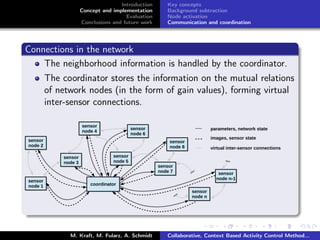
The neighborhood information is handled by the coordinator.
The coordinator stores the information on the mutual relations
of network nodes (in the form of gain values), forming virtual
inter-sensor connections.
M. Kraft, M. Fularz, A. Schmidt Collaborative, Context Based Activity Control Method...
Introduction
Concept and implementation
Evaluation
Conclusions and future work
Key concepts
Background subtraction
Node activation
Communication and coordination
Connections in the network
Based on the node activity levels, the coordinator computes
the additional portion of the input value for each node.
This enables the use of network-wide information for
collaborative node activity control.
M. Kraft, M. Fularz, A. Schmidt Collaborative, Context Based Activity Control Method...
Introduction
Concept and implementation
Evaluation
Conclusions and future work
Hardware platform
Test setup
Results
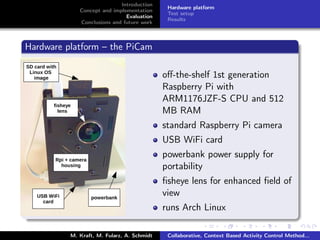
Hardware platform – the PiCam
off-the-shelf 1st generation
Raspberry Pi with
ARM1176JZF-S CPU and 512
MB RAM
standard Raspberry Pi camera
USB WiFi card
powerbank power supply for
portability
fisheye lens for enhanced field of
view
runs Arch Linux
M. Kraft, M. Fularz, A. Schmidt Collaborative, Context Based Activity Control Method...
Introduction
Concept and implementation
Evaluation
Conclusions and future work
Hardware platform
Test setup
Results
PiCam operating modes
Each node was configured for two operating modes.
The node switches to performance mode if activation is above
TA, or switches back to powersave mode otherwise.
The sampling (and processing) frequency is 10 [Hz] in
performance and 1 [Hz] in powersave mode.
parameter performance mode powersave mode
CPU clock [MHz] 1,000 300
RAM clock [MHz] 500 150
GPU clock [MHz] 500 150
Current draw [A] 0.5 0.4
M. Kraft, M. Fularz, A. Schmidt Collaborative, Context Based Activity Control Method...
Introduction
Concept and implementation
Evaluation
Conclusions and future work
Hardware platform
Test setup
Results
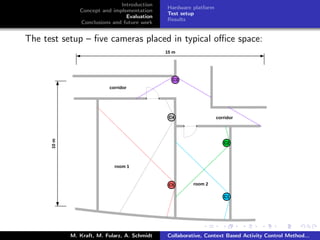
The test setup – five cameras placed in typical office space:
M. Kraft, M. Fularz, A. Schmidt Collaborative, Context Based Activity Control Method...
Introduction
Concept and implementation
Evaluation
Conclusions and future work
Hardware platform
Test setup
Results
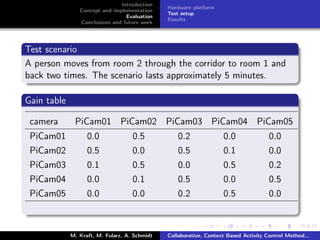
Test scenario
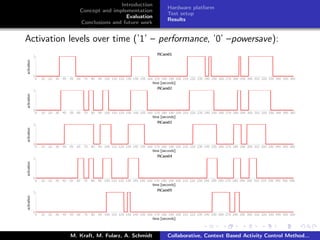
A person moves from room 2 through the corridor to room 1 and
back two times. The scenario lasts approximately 5 minutes.
Gain table
camera PiCam01 PiCam02 PiCam03 PiCam04 PiCam05
PiCam01 0.0 0.5 0.2 0.0 0.0
PiCam02 0.5 0.0 0.5 0.1 0.0
PiCam03 0.1 0.5 0.0 0.5 0.2
PiCam04 0.0 0.1 0.5 0.0 0.5
PiCam05 0.0 0.0 0.2 0.5 0.0
M. Kraft, M. Fularz, A. Schmidt Collaborative, Context Based Activity Control Method...
Introduction
Concept and implementation
Evaluation
Conclusions and future work
Hardware platform
Test setup
Results
Activation levels over time (’1’ – performance, ’0’ –powersave):
M. Kraft, M. Fularz, A. Schmidt Collaborative, Context Based Activity Control Method...
Introduction
Concept and implementation
Evaluation
Conclusions and future work
Hardware platform
Test setup
Results
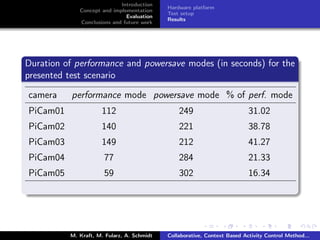
Duration of performance and powersave modes (in seconds) for the
presented test scenario
camera performance mode powersave mode % of perf. mode
PiCam01 112 249 31.02
PiCam02 140 221 38.78
PiCam03 149 212 41.27
PiCam04 77 284 21.33
PiCam05 59 302 16.34
M. Kraft, M. Fularz, A. Schmidt Collaborative, Context Based Activity Control Method...
Introduction
Concept and implementation
Evaluation
Conclusions and future work
Hardware platform
Test setup
Results
So, what do we get from it?
As an example, for PiCam03 (worst case) and Picam05 (best
case) the power consumption w.r.t. the full activity mode by is
reduced 12% and 17%, respectively.
Please keep in mind, that the Raspberry Pi is not particularly
power efficient.
Far less data is transmitted.
Gives easy means of extracting and presenting the images from
the cameras where the action takes place.
M. Kraft, M. Fularz, A. Schmidt Collaborative, Context Based Activity Control Method...
Introduction
Concept and implementation
Evaluation
Conclusions and future work
The presented solution can successfully keep track of the
movement of objects across an environment surveyed by a
multi-camera system.
The solution is capable of reducing the power consumption of
large-scale, automatic surveillance systems without
compromising the accuracy and efficiency in terms of
movement detection.
As many advanced surveillance systems rely on background
subtraction, the presented solution may be an easily
applicable, drop-in extension of their capabilities.
Great potential for future extensions – automatic gain
adaptation, integration of other activity indicators...
Available at https://github.com/sepherro/cam_network
M. Kraft, M. Fularz, A. Schmidt Collaborative, Context Based Activity Control Method...
Introduction
Concept and implementation
Evaluation
Conclusions and future work
Thank you for your attention
(Questions? Comments?)
The project was financed by the National Science Center under the contract decision number
DEC-2011/03/N/ST6/03022,
New concept of the network of smart cameras with enhanced autonomy for automatic surveillance
systems
M. Kraft, M. Fularz, A. Schmidt Collaborative, Context Based Activity Control Method...

Collaborative, Context Based Activity Control Method for Camera Networks

  • 1.
    Introduction Concept and implementation Evaluation Conclusionsand future work Collaborative, Context Based Activity Control Method for Camera Networks Marek Kraft1 Michał Fularz1 Adam Schmidt1 1Poznań University of Technology Institute of Control and Information Engineering November 3, 2015 M. Kraft, M. Fularz, A. Schmidt Collaborative, Context Based Activity Control Method...
  • 2.
    Introduction Concept and implementation Evaluation Conclusionsand future work Table of contents Goal and motivation 1 Introduction Table of contents Goal and motivation 2 Concept and implementation Key concepts Background subtraction Node activation Communication and coordination 3 Evaluation Hardware platform Test setup Results 4 Conclusions and future work M. Kraft, M. Fularz, A. Schmidt Collaborative, Context Based Activity Control Method...
  • 3.
    Introduction Concept and implementation Evaluation Conclusionsand future work Table of contents Goal and motivation Goal Develop a conceptually simple yet effective, collaborative method for constraining the rate of communication and power consumption across the whole camera network. Motivation As the average number of cameras in a network increases: automated processing becomes a necessity, continuous image streaming and data transmission is a serious burden to the communication infrastructure, combined power consumption of the camera networks goes up, most previous work is focused on the design of network nodes or single node management. M. Kraft, M. Fularz, A. Schmidt Collaborative, Context Based Activity Control Method...
  • 4.
    Introduction Concept and implementation Evaluation Conclusionsand future work Table of contents Goal and motivation M. Kraft, M. Fularz, A. Schmidt Collaborative, Context Based Activity Control Method...
  • 5.
    Introduction Concept and implementation Evaluation Conclusionsand future work Key concepts Background subtraction Node activation Communication and coordination Key concepts: compute the activity level for each individual sensor locally, based on scene motion level, scene motion level is calculated based on background subtraction, the activation level of each sensor node depends on the local activity, but also on the activity of its neighbors, decision on the kind of computation performed by the sensor node and its other activities are made depending on the activation level. M. Kraft, M. Fularz, A. Schmidt Collaborative, Context Based Activity Control Method...
  • 6.
    Introduction Concept and implementation Evaluation Conclusionsand future work Key concepts Background subtraction Node activation Communication and coordination Background subtraction Foreground is the absolute value of the difference between the current frame and the background model. Additional post-processing applied to foreground image. N. J. McFarlane et. al., Segmentation and tracking of piglets in images. Machine vision and applications, 8(3), pp. 187-193, 1995 S. Brutzer et. al., Evaluation of background subtraction techniques for video surveillance, IEEE Conf. on Computer Vision and Pattern Recognition (CVPR) 2011, pp. 1937-1944 M. Kraft, M. Fularz, A. Schmidt Collaborative, Context Based Activity Control Method...
  • 7.
    Introduction Concept and implementation Evaluation Conclusionsand future work Key concepts Background subtraction Node activation Communication and coordination Background subtraction Background model: if the intensity value Ix,y of currently investigated pixel of the current frame I is greater than the value of the corresponding background model pixel Bx,y , the value of Bx,y is increased, if the intensity value Ix,y of currently investigated pixel of the current frame I is smaller than the value of the corresponding background model pixel Bx,y , the value of Bx,y is decreased, if the intensity value Ix,y of currently investigated pixel of the current frame I has the same value as the corresponding background model pixel Bx,y , the value of Bx,y remains unchanged. M. Kraft, M. Fularz, A. Schmidt Collaborative, Context Based Activity Control Method...
  • 8.
    Introduction Concept and implementation Evaluation Conclusionsand future work Key concepts Background subtraction Node activation Communication and coordination Background subtraction M. Kraft, M. Fularz, A. Schmidt Collaborative, Context Based Activity Control Method...
  • 9.
    Introduction Concept and implementation Evaluation Conclusionsand future work Key concepts Background subtraction Node activation Communication and coordination Background subtraction M. Kraft, M. Fularz, A. Schmidt Collaborative, Context Based Activity Control Method...
  • 10.
    Introduction Concept and implementation Evaluation Conclusionsand future work Key concepts Background subtraction Node activation Communication and coordination Block schematic of a single node The percentages of foreground pixels in the local sensor node and its defined network neighbors are used as inputs. 2nd order inertia applied for low-pass filtering. M. Kraft, M. Fularz, A. Schmidt Collaborative, Context Based Activity Control Method...
  • 11.
    Introduction Concept and implementation Evaluation Conclusionsand future work Key concepts Background subtraction Node activation Communication and coordination Connections in the network A central coordinator is responsible for network-wide activity control which based on individual sensor states. The sensors provide the coordinator with the information on their individual state and transmit images if requested. M. Kraft, M. Fularz, A. Schmidt Collaborative, Context Based Activity Control Method...
  • 12.
    Introduction Concept and implementation Evaluation Conclusionsand future work Key concepts Background subtraction Node activation Communication and coordination Connections in the network The neighborhood information is handled by the coordinator. The coordinator stores the information on the mutual relations of network nodes (in the form of gain values), forming virtual inter-sensor connections. M. Kraft, M. Fularz, A. Schmidt Collaborative, Context Based Activity Control Method...
  • 13.
    Introduction Concept and implementation Evaluation Conclusionsand future work Key concepts Background subtraction Node activation Communication and coordination Connections in the network Based on the node activity levels, the coordinator computes the additional portion of the input value for each node. This enables the use of network-wide information for collaborative node activity control. M. Kraft, M. Fularz, A. Schmidt Collaborative, Context Based Activity Control Method...
  • 14.
    Introduction Concept and implementation Evaluation Conclusionsand future work Hardware platform Test setup Results Hardware platform – the PiCam off-the-shelf 1st generation Raspberry Pi with ARM1176JZF-S CPU and 512 MB RAM standard Raspberry Pi camera USB WiFi card powerbank power supply for portability fisheye lens for enhanced field of view runs Arch Linux M. Kraft, M. Fularz, A. Schmidt Collaborative, Context Based Activity Control Method...
  • 15.
    Introduction Concept and implementation Evaluation Conclusionsand future work Hardware platform Test setup Results PiCam operating modes Each node was configured for two operating modes. The node switches to performance mode if activation is above TA, or switches back to powersave mode otherwise. The sampling (and processing) frequency is 10 [Hz] in performance and 1 [Hz] in powersave mode. parameter performance mode powersave mode CPU clock [MHz] 1,000 300 RAM clock [MHz] 500 150 GPU clock [MHz] 500 150 Current draw [A] 0.5 0.4 M. Kraft, M. Fularz, A. Schmidt Collaborative, Context Based Activity Control Method...
  • 16.
    Introduction Concept and implementation Evaluation Conclusionsand future work Hardware platform Test setup Results The test setup – five cameras placed in typical office space: M. Kraft, M. Fularz, A. Schmidt Collaborative, Context Based Activity Control Method...
  • 17.
    Introduction Concept and implementation Evaluation Conclusionsand future work Hardware platform Test setup Results Test scenario A person moves from room 2 through the corridor to room 1 and back two times. The scenario lasts approximately 5 minutes. Gain table camera PiCam01 PiCam02 PiCam03 PiCam04 PiCam05 PiCam01 0.0 0.5 0.2 0.0 0.0 PiCam02 0.5 0.0 0.5 0.1 0.0 PiCam03 0.1 0.5 0.0 0.5 0.2 PiCam04 0.0 0.1 0.5 0.0 0.5 PiCam05 0.0 0.0 0.2 0.5 0.0 M. Kraft, M. Fularz, A. Schmidt Collaborative, Context Based Activity Control Method...
  • 18.
    Introduction Concept and implementation Evaluation Conclusionsand future work Hardware platform Test setup Results Activation levels over time (’1’ – performance, ’0’ –powersave): M. Kraft, M. Fularz, A. Schmidt Collaborative, Context Based Activity Control Method...
  • 19.
    Introduction Concept and implementation Evaluation Conclusionsand future work Hardware platform Test setup Results Duration of performance and powersave modes (in seconds) for the presented test scenario camera performance mode powersave mode % of perf. mode PiCam01 112 249 31.02 PiCam02 140 221 38.78 PiCam03 149 212 41.27 PiCam04 77 284 21.33 PiCam05 59 302 16.34 M. Kraft, M. Fularz, A. Schmidt Collaborative, Context Based Activity Control Method...
  • 20.
    Introduction Concept and implementation Evaluation Conclusionsand future work Hardware platform Test setup Results So, what do we get from it? As an example, for PiCam03 (worst case) and Picam05 (best case) the power consumption w.r.t. the full activity mode by is reduced 12% and 17%, respectively. Please keep in mind, that the Raspberry Pi is not particularly power efficient. Far less data is transmitted. Gives easy means of extracting and presenting the images from the cameras where the action takes place. M. Kraft, M. Fularz, A. Schmidt Collaborative, Context Based Activity Control Method...
  • 21.
    Introduction Concept and implementation Evaluation Conclusionsand future work Conclusions and future work The presented solution can successfully keep track of the movement of objects across an environment surveyed by a multi-camera system. The solution is capable of reducing the power consumption of large-scale, automatic surveillance systems without compromising the accuracy and efficiency in terms of movement detection. As many advanced surveillance systems rely on background subtraction, the presented solution may be an easily applicable, drop-in extension of their capabilities. Great potential for future extensions – automatic gain adaptation, integration of other activity indicators... Available at https://github.com/sepherro/cam_network M. Kraft, M. Fularz, A. Schmidt Collaborative, Context Based Activity Control Method...
  • 22.
    Introduction Concept and implementation Evaluation Conclusionsand future work Thank you for your attention (Questions? Comments?) The project was financed by the National Science Center under the contract decision number DEC-2011/03/N/ST6/03022, New concept of the network of smart cameras with enhanced autonomy for automatic surveillance systems M. Kraft, M. Fularz, A. Schmidt Collaborative, Context Based Activity Control Method...