COLGATE MAX FRESH: 
GLOBAL BRAND ROLL-OUT 
CASE STUDY 
GROUP 6 
MEGHA SINHA 
PRATEEK JAIN 
PRIYANKA KANWAR 
RADHIKA SETHI 
NISHANT NEGI
COLGATE PALMOLIVE 
Company Background 
• 10.6$ billion revenue (2005) 
• Operating in 200 countries 
• 70% of sales outside USA 
• Two core product segments: Oral personal & home care; pet nutrition 
segments 
Organization structure 
• Regional presidents with P&L responsibility 
• Global business development groups organized by category 
Year 2004 
• Reported +6.5% unit volume growth 
• +7% sales dollar growth 
• +0.1% point growth in gross profit margin to 55.1%
EVOLUTION 
OF 
TOOTHPASTE 
MARKET
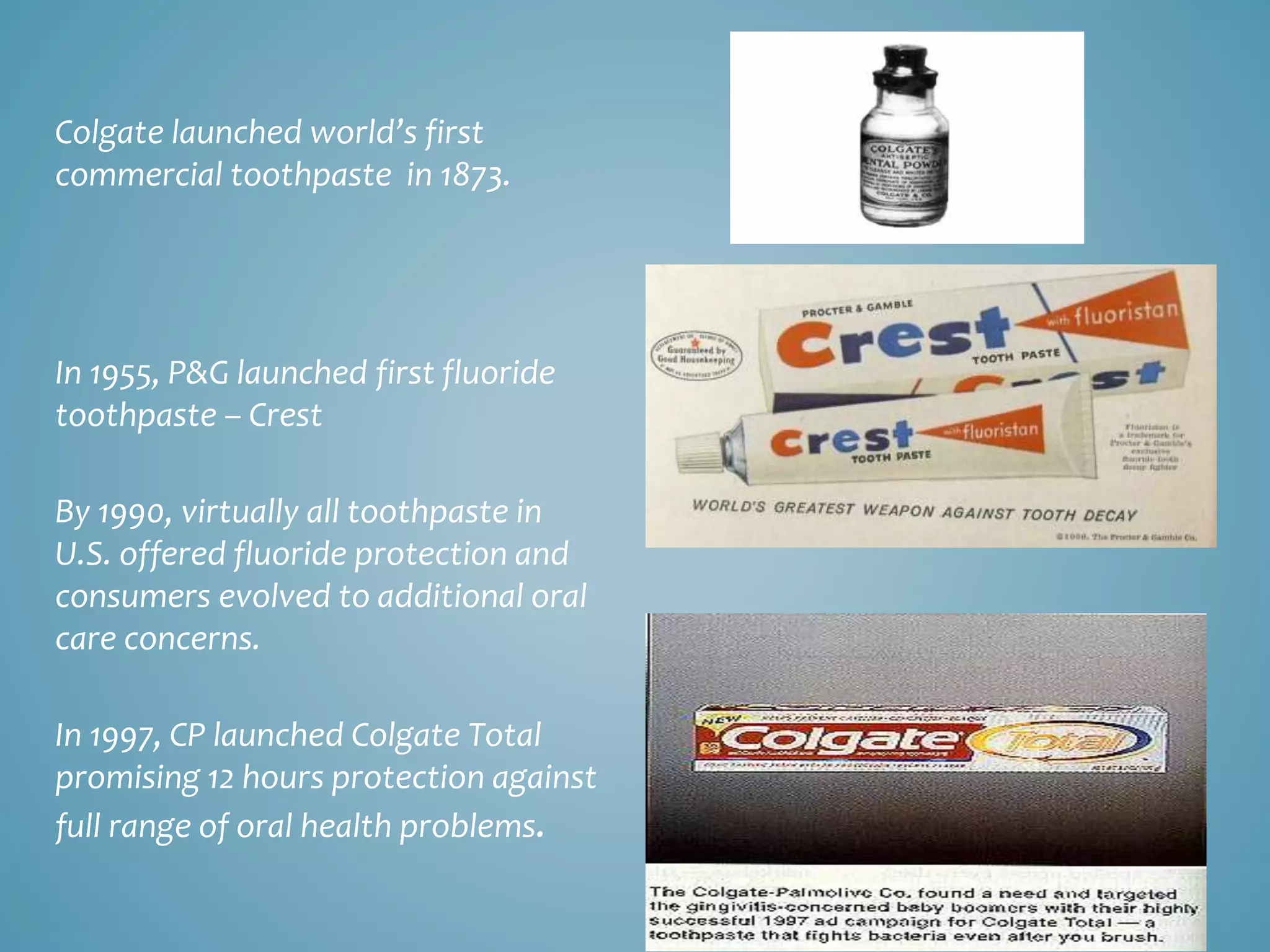
Colgate launched world’s first 
commercial toothpaste in 1873. 
In 1955, P&G launched first fluoride 
toothpaste – Crest 
By 1990, virtually all toothpaste in 
U.S. offered fluoride protection and 
consumers evolved to additional oral 
care concerns. 
In 1997, CP launched Colgate Total 
promising 12 hours protection against 
full range of oral health problems.
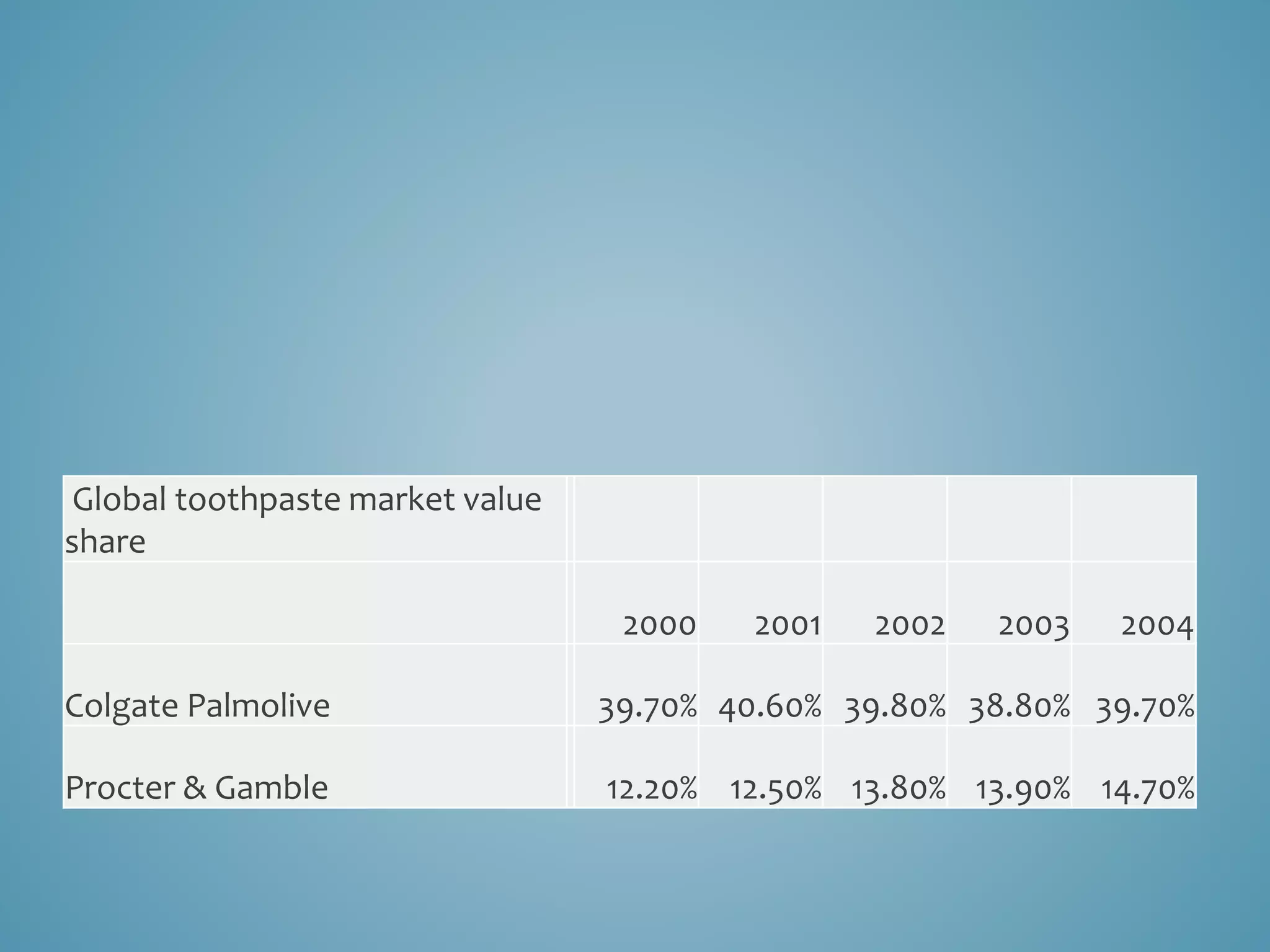
Global toothpaste market value 
share 
2000 2001 2002 2003 2004 
Colgate Palmolive 39.70% 40.60% 39.80% 38.80% 39.70% 
Procter & Gamble 12.20% 12.50% 13.80% 13.90% 14.70%
COLGATE MAX FRESH 
PRODUCT DEVELOPMENT 
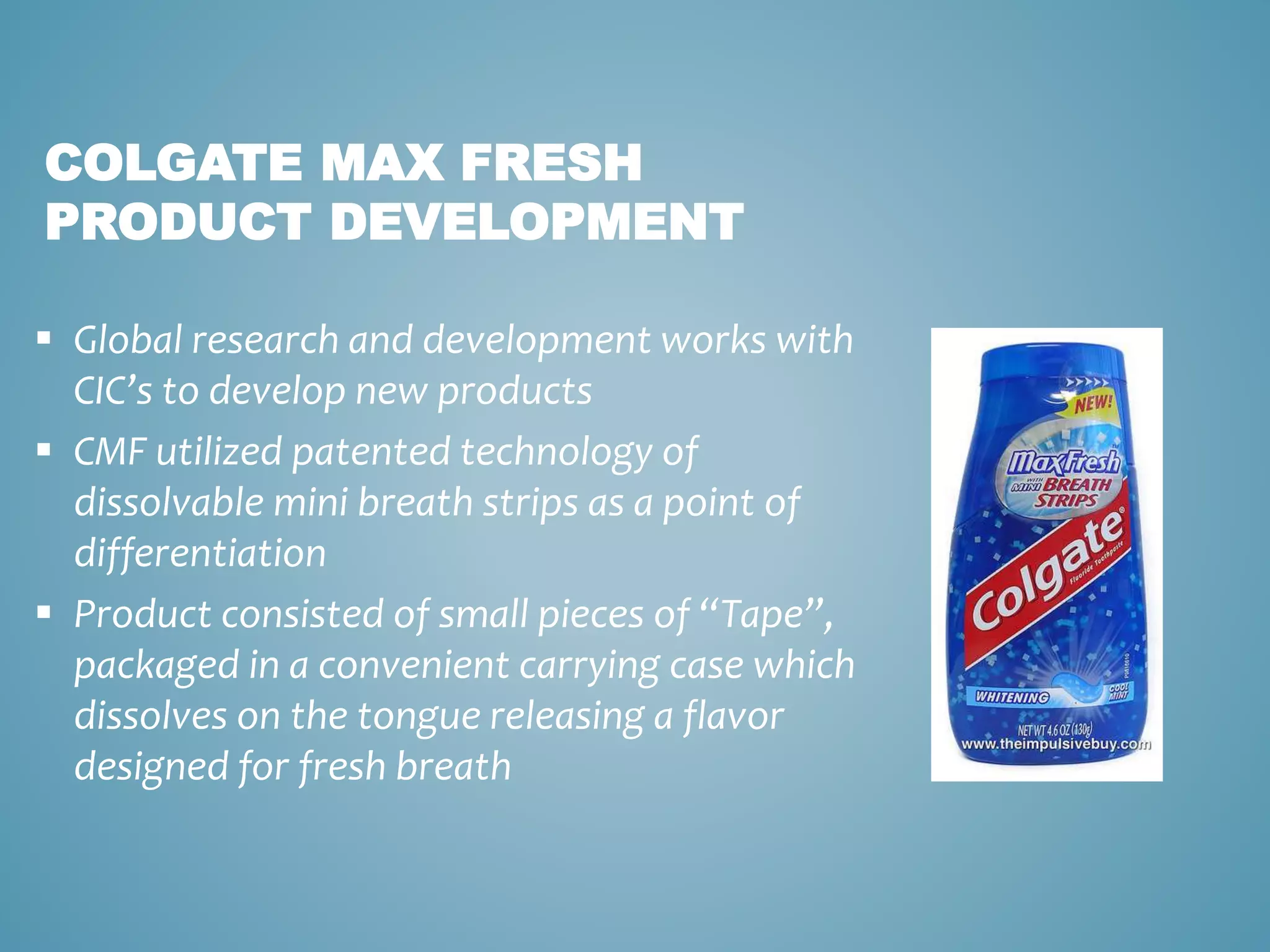
 Global research and development works with 
CIC’s to develop new products 
 CMF utilized patented technology of 
dissolvable mini breath strips as a point of 
differentiation 
 Product consisted of small pieces of “Tape”, 
packaged in a convenient carrying case which 
dissolves on the tongue releasing a flavor 
designed for fresh breath
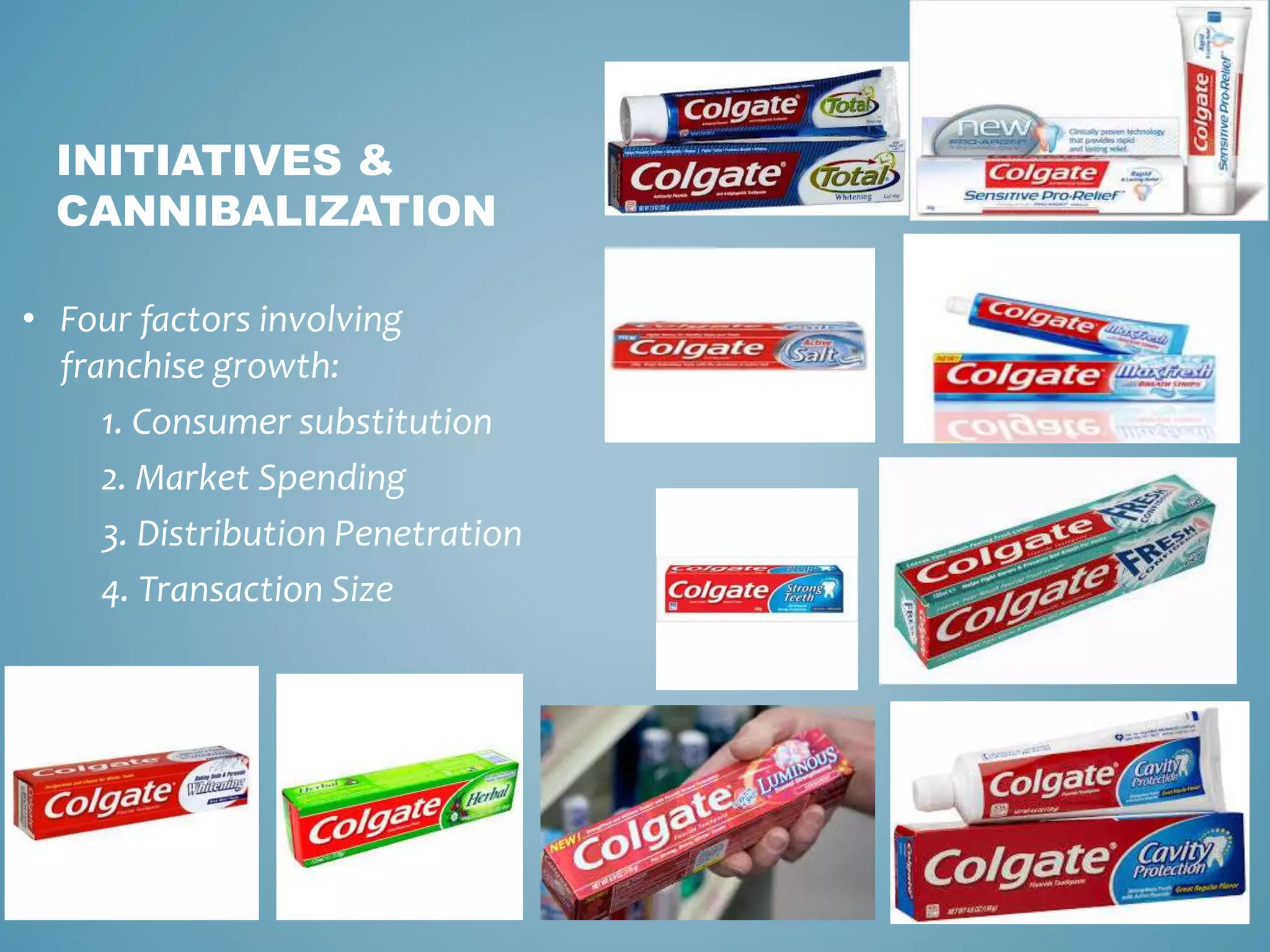
INITIATIVES & 
CANNIBALIZATION 
• Four factors involving 
franchise growth: 
1. Consumer substitution 
2. Market Spending 
3. Distribution Penetration 
4. Transaction Size
UNITED STATES OF 
AMERICA
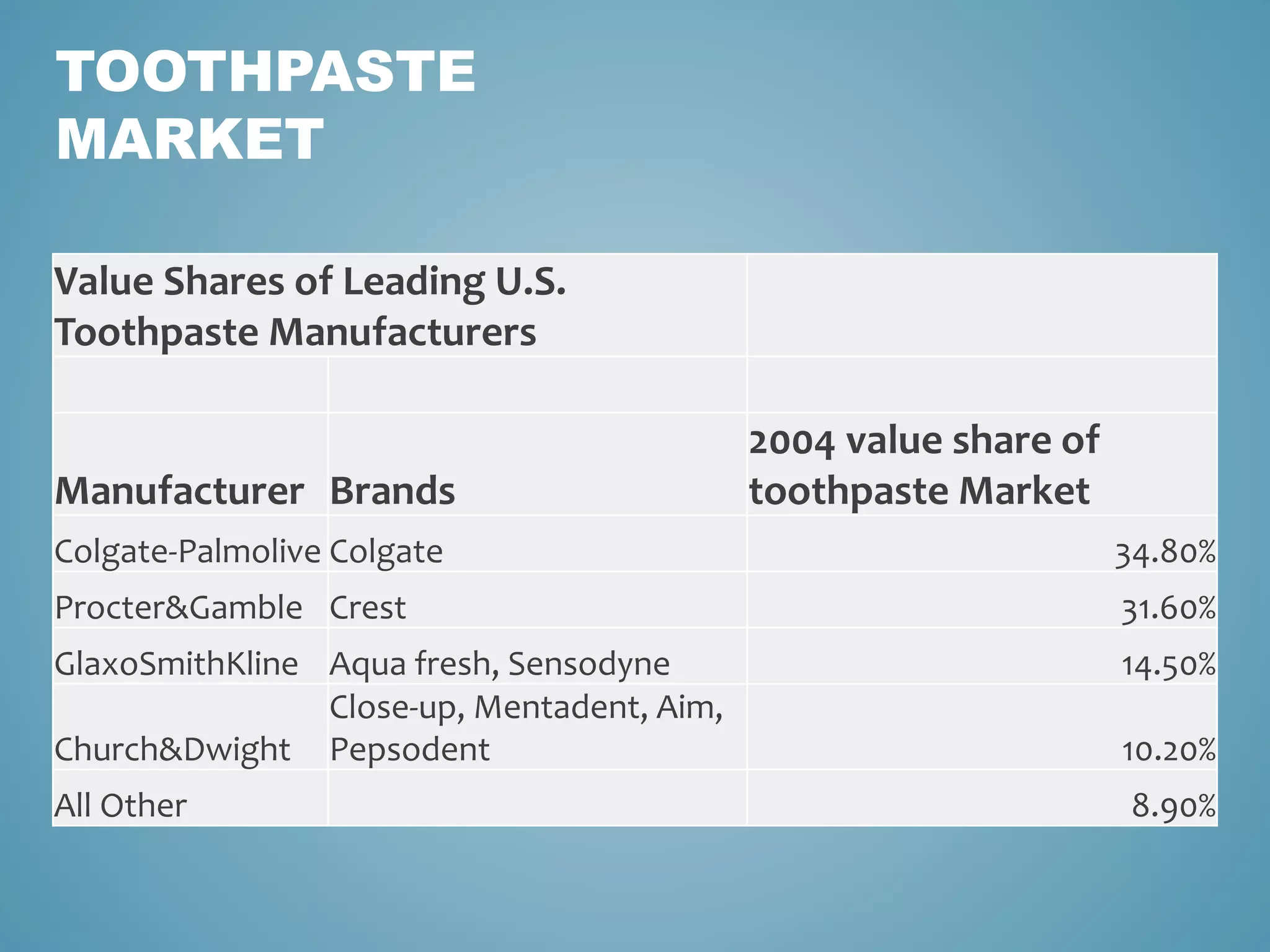
TOOTHPASTE 
MARKET 
Value Shares of Leading U.S. 
Toothpaste Manufacturers 
Manufacturer Brands 
2004 value share of 
toothpaste Market 
Colgate-Palmolive Colgate 34.80% 
Procter&Gamble Crest 31.60% 
GlaxoSmithKline Aqua fresh, Sensodyne 14.50% 
Church&Dwight 
Close-up, Mentadent, Aim, 
Pepsodent 10.20% 
All Other 8.90%
MARKET 
SEGMENTS 
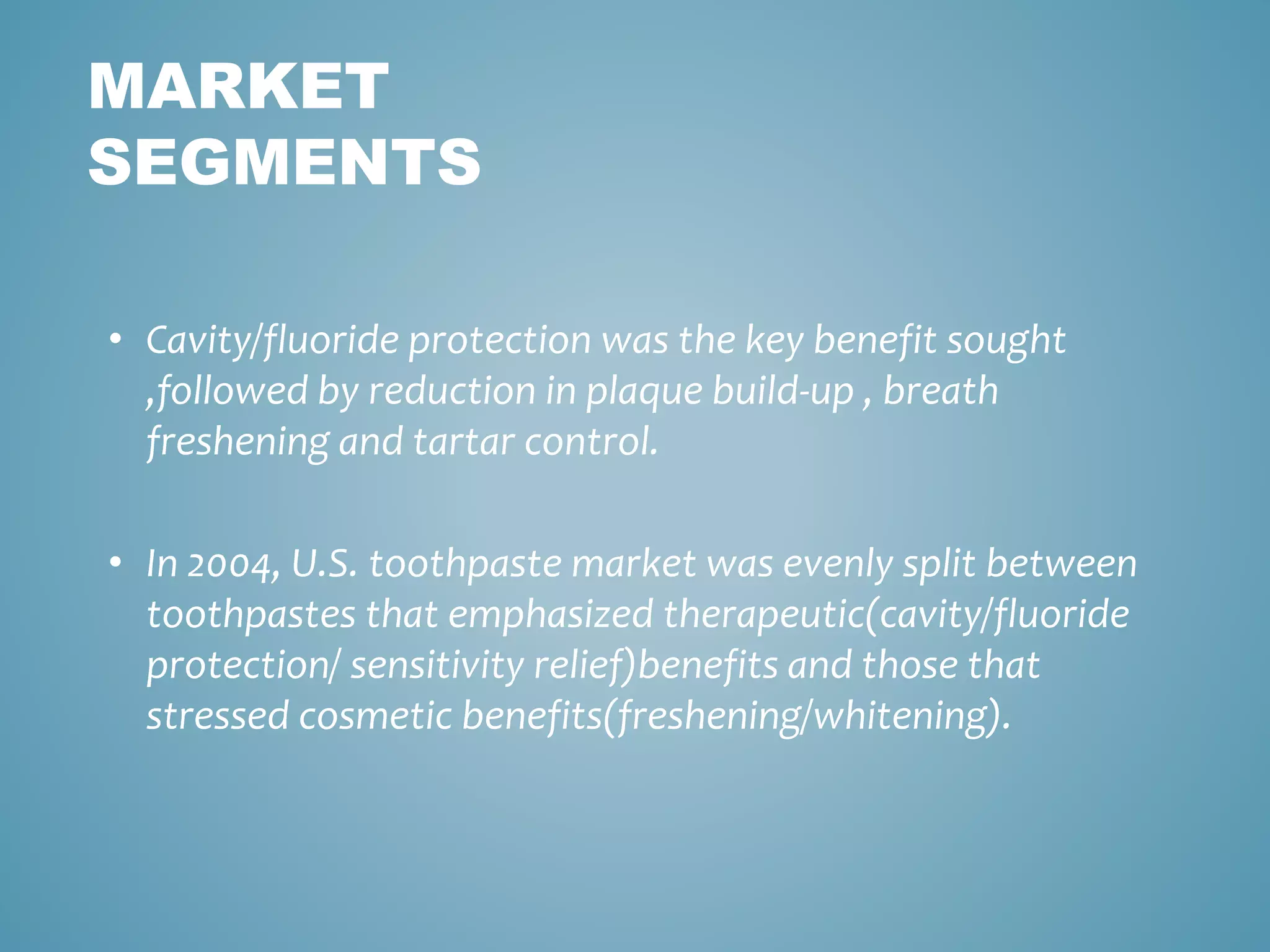
• Cavity/fluoride protection was the key benefit sought 
,followed by reduction in plaque build-up , breath 
freshening and tartar control. 
• In 2004, U.S. toothpaste market was evenly split between 
toothpastes that emphasized therapeutic(cavity/fluoride 
protection/ sensitivity relief)benefits and those that 
stressed cosmetic benefits(freshening/whitening).
COLGATE MAX FRESH 
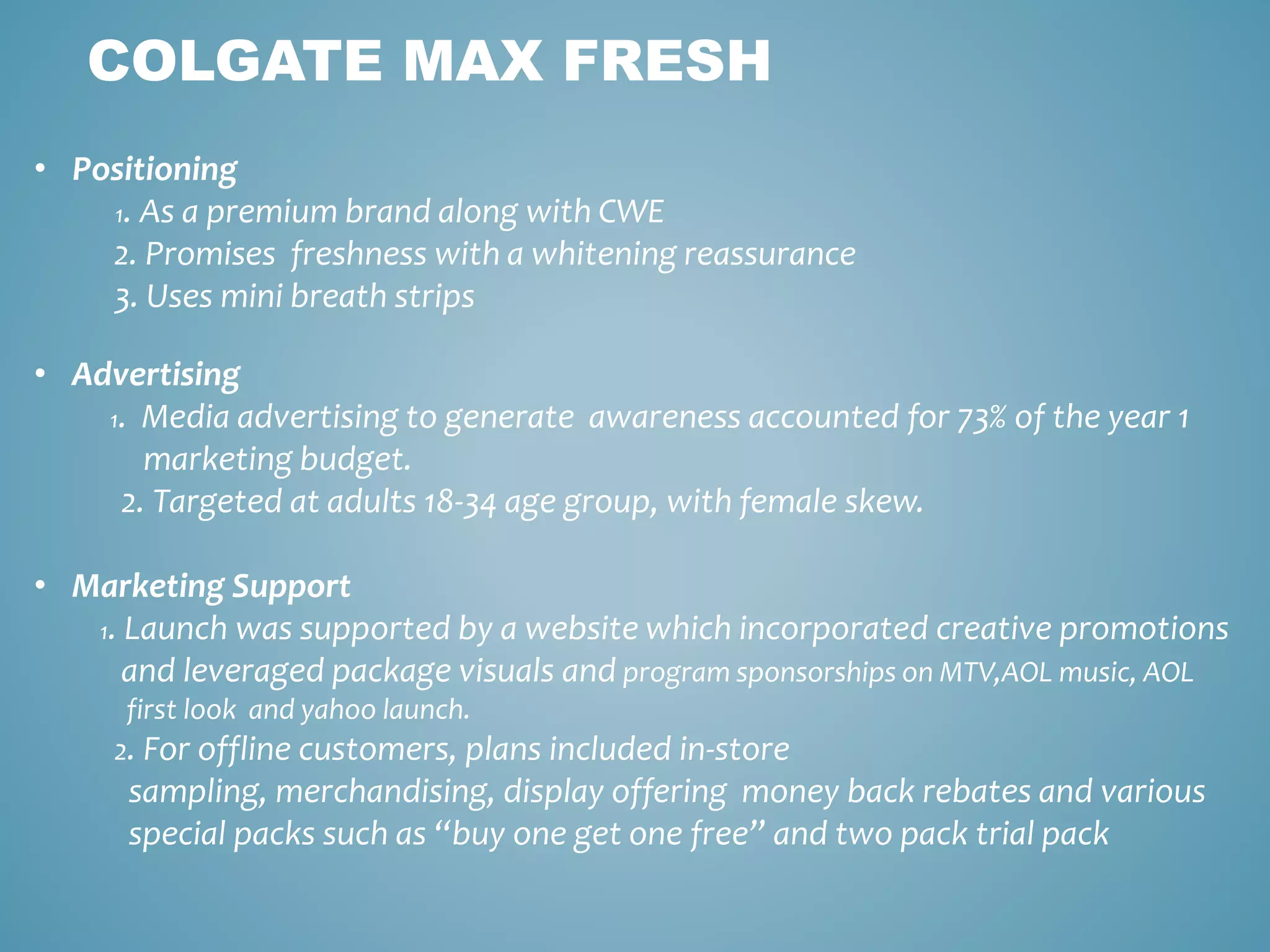
• Positioning 
1. As a premium brand along with CWE 
2. Promises freshness with a whitening reassurance 
3. Uses mini breath strips 
• Advertising 
1. Media advertising to generate awareness accounted for 73% of the year 1 
marketing budget. 
2. Targeted at adults 18-34 age group, with female skew. 
• Marketing Support 
1. Launch was supported by a website which incorporated creative promotions 
and leveraged package visuals and program sponsorships on MTV,AOL music, AOL 
first look and yahoo launch. 
2. For offline customers, plans included in-store 
sampling, merchandising, display offering money back rebates and various 
special packs such as “buy one get one free” and two pack trial pack
CHINA
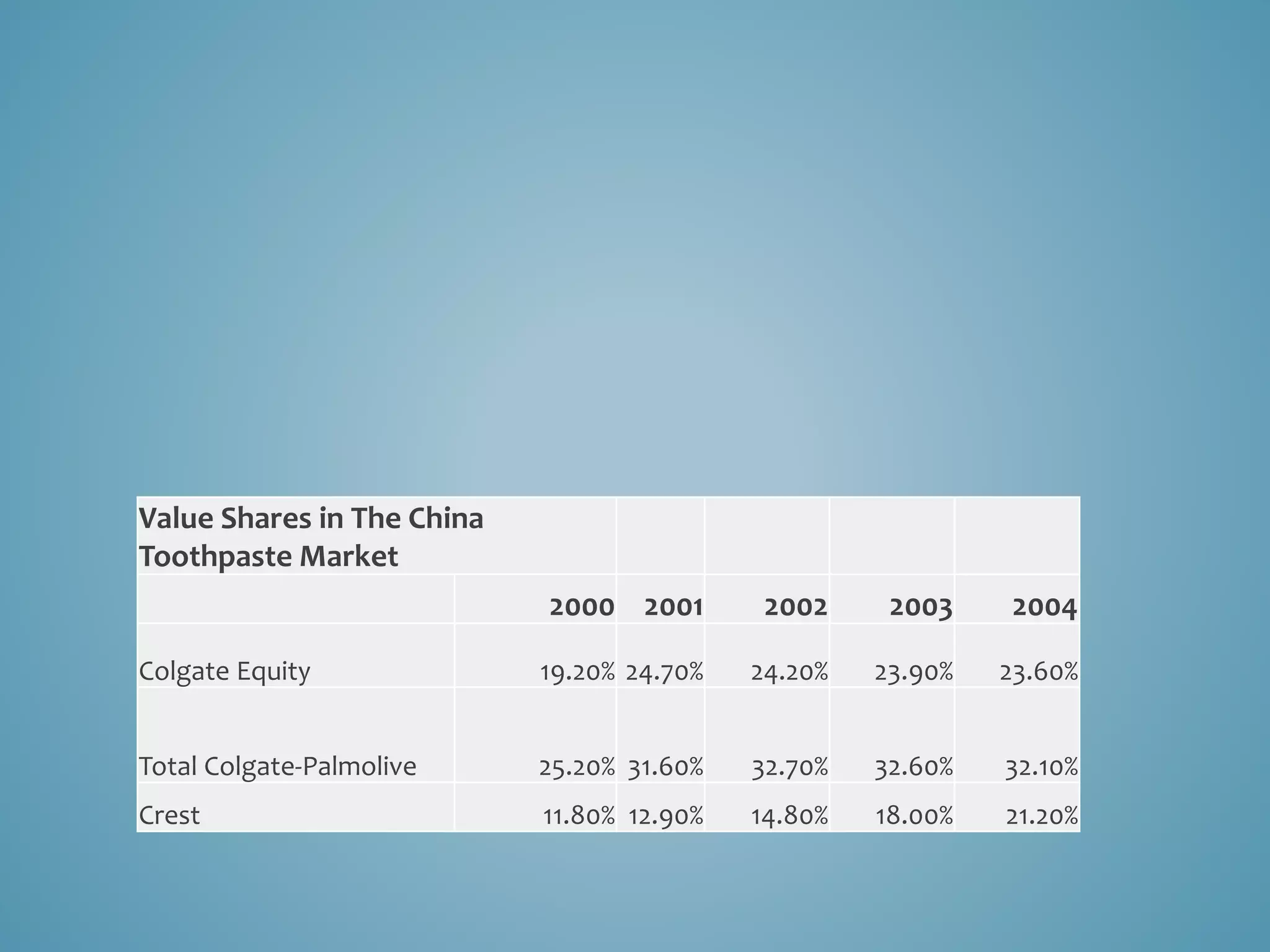
Value Shares in The China 
Toothpaste Market 
2000 2001 2002 2003 2004 
Colgate Equity 19.20% 24.70% 24.20% 23.90% 23.60% 
Total Colgate-Palmolive 25.20% 31.60% 32.70% 32.60% 32.10% 
Crest 11.80% 12.90% 14.80% 18.00% 21.20%
TOOTHPASTE 
MARKET 
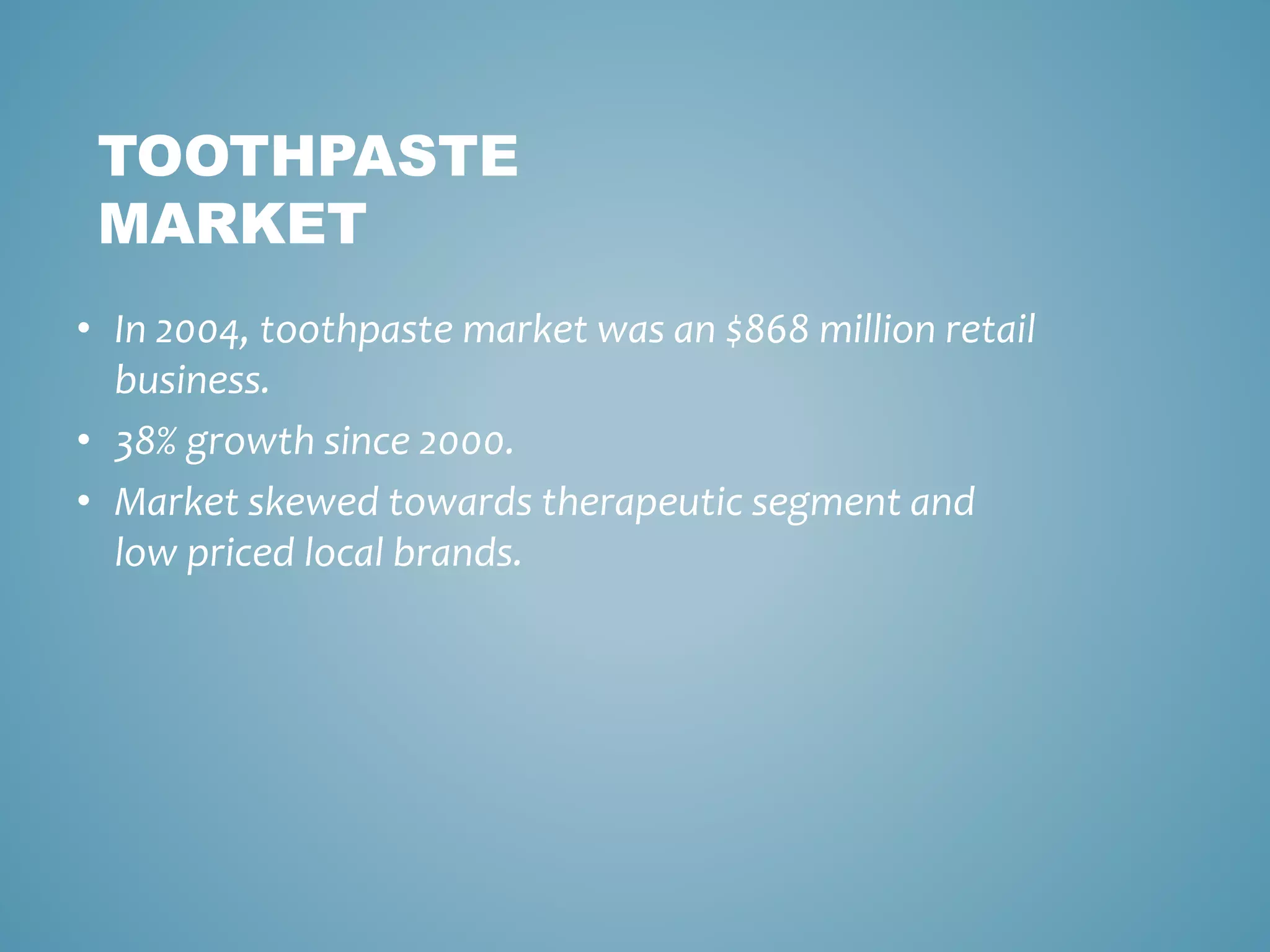
• In 2004, toothpaste market was an $868 million retail 
business. 
• 38% growth since 2000. 
• Market skewed towards therapeutic segment and 
low priced local brands.
COLGATE MAX FRESH: 
QUALIFYING THE PRODUCT FOR MARKET 
• Communication Challenge 
• Colgate Max Fresh did not test as well as others name 
in China which led to the name being changed to “Icy 
Fresh”. 
• “cooling Crystals” was identified as the most relevant 
and meaningful phrase to describe breath strips to 
Chinese consumers. 
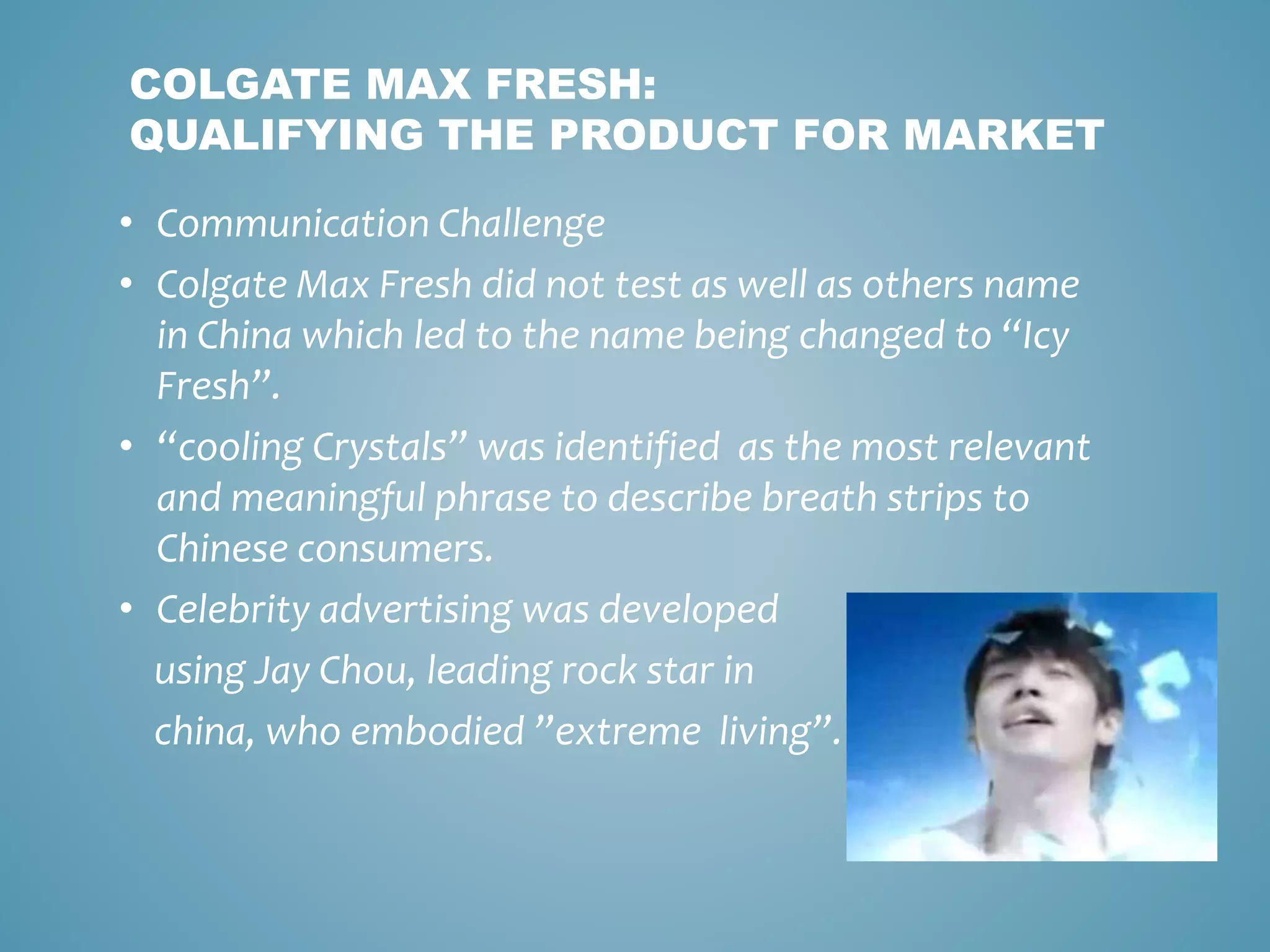
• Celebrity advertising was developed 
using Jay Chou, leading rock star in 
china, who embodied ”extreme living”.
• Colgate dominated in Mexico 
with an 82% value share of the 
$348 million retail toothpaste 
market in 2004. 
• Market heavily skewed 
towards the therapeutic 
segment(87% of value share) 
but growth was slow. 
• Majority of consumers 
focused on basic oral 
care(cavity prevention) 
• Price sensitivity and sales 
promotion activity were both 
high In Mexico. 
MEXICO
COLGATE MAX FRESH 
LAUNCH 
• Concept and product results 
1. Net acceptance was slightly below par in terms of benchmarks for 
comparable new personal care products tested in Mexico. 
2. Consumer Viability Index(CVI) of 62% suggested that the 
initiative had an “average” chance of in-market success, defined 
as maintaining stable distribution for at least two years after 
launch . 
• Sources of Volume 
1. CMF volume sourced from Colgate would be slightly below fair share whereas 
crest would lose more than fair share. 
2. CMF volume was expected to come from CP brands notably Colgate Big Red and 
21% from Crest. 
3. “Shelf Is Not Elastic”. Understanding which Colgate SKU’s might be at risk of 
delisting was important.
• Pricing 
1. Pricing objective was to achieve parity with Crest’s cool explosions. 
2. Price/Value perception was above average for CMF. 
3. Tested at a retail price of 15.99 Pesos 
4. Estimated that CMF could increase volume by +25% if the price was 
decreased from 15.99 to 14.99 Pesos. 
• Advertising 
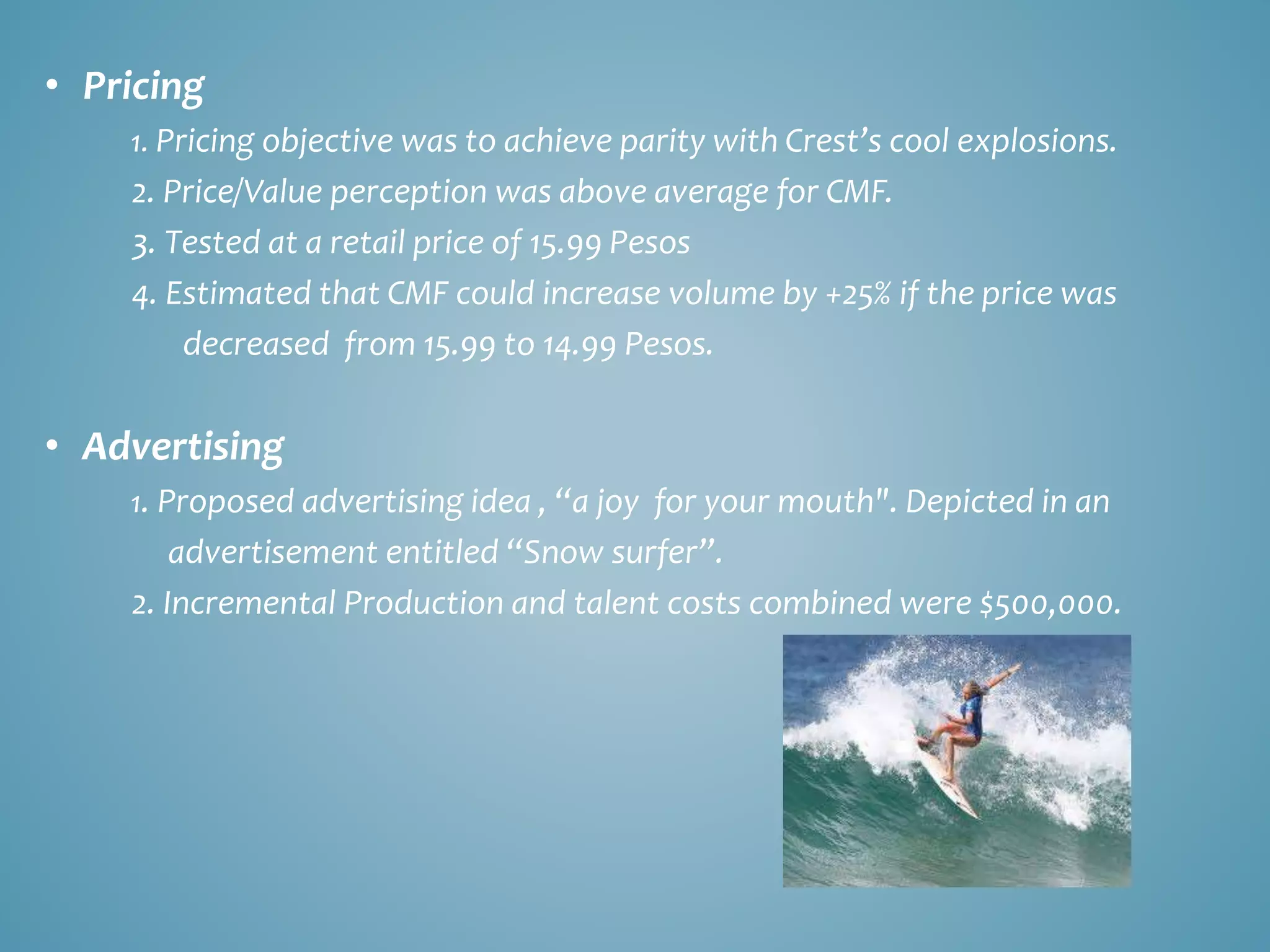
1. Proposed advertising idea , “a joy for your mouth". Depicted in an 
advertisement entitled “Snow surfer”. 
2. Incremental Production and talent costs combined were $500,000.
Colgate max fresh ppt

Colgate max fresh ppt

  • 1.
    COLGATE MAX FRESH: GLOBAL BRAND ROLL-OUT CASE STUDY GROUP 6 MEGHA SINHA PRATEEK JAIN PRIYANKA KANWAR RADHIKA SETHI NISHANT NEGI
  • 2.
    COLGATE PALMOLIVE CompanyBackground • 10.6$ billion revenue (2005) • Operating in 200 countries • 70% of sales outside USA • Two core product segments: Oral personal & home care; pet nutrition segments Organization structure • Regional presidents with P&L responsibility • Global business development groups organized by category Year 2004 • Reported +6.5% unit volume growth • +7% sales dollar growth • +0.1% point growth in gross profit margin to 55.1%
  • 3.
  • 4.
    Colgate launched world’sfirst commercial toothpaste in 1873. In 1955, P&G launched first fluoride toothpaste – Crest By 1990, virtually all toothpaste in U.S. offered fluoride protection and consumers evolved to additional oral care concerns. In 1997, CP launched Colgate Total promising 12 hours protection against full range of oral health problems.
  • 5.
    Global toothpaste marketvalue share 2000 2001 2002 2003 2004 Colgate Palmolive 39.70% 40.60% 39.80% 38.80% 39.70% Procter & Gamble 12.20% 12.50% 13.80% 13.90% 14.70%
  • 6.
    COLGATE MAX FRESH PRODUCT DEVELOPMENT  Global research and development works with CIC’s to develop new products  CMF utilized patented technology of dissolvable mini breath strips as a point of differentiation  Product consisted of small pieces of “Tape”, packaged in a convenient carrying case which dissolves on the tongue releasing a flavor designed for fresh breath
  • 7.
    INITIATIVES & CANNIBALIZATION • Four factors involving franchise growth: 1. Consumer substitution 2. Market Spending 3. Distribution Penetration 4. Transaction Size
  • 8.
  • 9.
    TOOTHPASTE MARKET ValueShares of Leading U.S. Toothpaste Manufacturers Manufacturer Brands 2004 value share of toothpaste Market Colgate-Palmolive Colgate 34.80% Procter&Gamble Crest 31.60% GlaxoSmithKline Aqua fresh, Sensodyne 14.50% Church&Dwight Close-up, Mentadent, Aim, Pepsodent 10.20% All Other 8.90%
  • 10.
    MARKET SEGMENTS •Cavity/fluoride protection was the key benefit sought ,followed by reduction in plaque build-up , breath freshening and tartar control. • In 2004, U.S. toothpaste market was evenly split between toothpastes that emphasized therapeutic(cavity/fluoride protection/ sensitivity relief)benefits and those that stressed cosmetic benefits(freshening/whitening).
  • 11.
    COLGATE MAX FRESH • Positioning 1. As a premium brand along with CWE 2. Promises freshness with a whitening reassurance 3. Uses mini breath strips • Advertising 1. Media advertising to generate awareness accounted for 73% of the year 1 marketing budget. 2. Targeted at adults 18-34 age group, with female skew. • Marketing Support 1. Launch was supported by a website which incorporated creative promotions and leveraged package visuals and program sponsorships on MTV,AOL music, AOL first look and yahoo launch. 2. For offline customers, plans included in-store sampling, merchandising, display offering money back rebates and various special packs such as “buy one get one free” and two pack trial pack
  • 12.
  • 13.
    Value Shares inThe China Toothpaste Market 2000 2001 2002 2003 2004 Colgate Equity 19.20% 24.70% 24.20% 23.90% 23.60% Total Colgate-Palmolive 25.20% 31.60% 32.70% 32.60% 32.10% Crest 11.80% 12.90% 14.80% 18.00% 21.20%
  • 14.
    TOOTHPASTE MARKET •In 2004, toothpaste market was an $868 million retail business. • 38% growth since 2000. • Market skewed towards therapeutic segment and low priced local brands.
  • 15.
    COLGATE MAX FRESH: QUALIFYING THE PRODUCT FOR MARKET • Communication Challenge • Colgate Max Fresh did not test as well as others name in China which led to the name being changed to “Icy Fresh”. • “cooling Crystals” was identified as the most relevant and meaningful phrase to describe breath strips to Chinese consumers. • Celebrity advertising was developed using Jay Chou, leading rock star in china, who embodied ”extreme living”.
  • 16.
    • Colgate dominatedin Mexico with an 82% value share of the $348 million retail toothpaste market in 2004. • Market heavily skewed towards the therapeutic segment(87% of value share) but growth was slow. • Majority of consumers focused on basic oral care(cavity prevention) • Price sensitivity and sales promotion activity were both high In Mexico. MEXICO
  • 17.
    COLGATE MAX FRESH LAUNCH • Concept and product results 1. Net acceptance was slightly below par in terms of benchmarks for comparable new personal care products tested in Mexico. 2. Consumer Viability Index(CVI) of 62% suggested that the initiative had an “average” chance of in-market success, defined as maintaining stable distribution for at least two years after launch . • Sources of Volume 1. CMF volume sourced from Colgate would be slightly below fair share whereas crest would lose more than fair share. 2. CMF volume was expected to come from CP brands notably Colgate Big Red and 21% from Crest. 3. “Shelf Is Not Elastic”. Understanding which Colgate SKU’s might be at risk of delisting was important.
  • 18.
    • Pricing 1.Pricing objective was to achieve parity with Crest’s cool explosions. 2. Price/Value perception was above average for CMF. 3. Tested at a retail price of 15.99 Pesos 4. Estimated that CMF could increase volume by +25% if the price was decreased from 15.99 to 14.99 Pesos. • Advertising 1. Proposed advertising idea , “a joy for your mouth". Depicted in an advertisement entitled “Snow surfer”. 2. Incremental Production and talent costs combined were $500,000.