Major (Dr) Raghavendra RH
Assistant Professor
KSHEMA
Cohort study
Cohort study
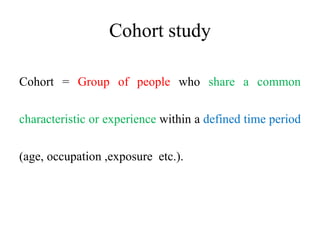
Cohort = Group of people who share a common
characteristic or experience within a defined time period
(age, occupation ,exposure etc.).
Cohort study
• Cohort study: are observational studies in which the
investigator determines the exposure status of
subjects and then follows them for subsequent
outcomes
– Forward looking study
– Incidence study
– Longitudinal study
– Prospective study
– Follow up study
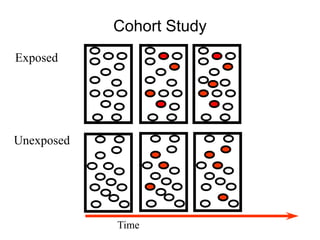
Unexposed
Exposed
Cohort Study
Time
General Considerations
• Cohorts must be free from the disease under study.
• Study and control group must be easily susceptible
to the disease under study
• Both the groups must be comparable in respect to
all the possible variables which may influence the
frequency of the disease.
General Considerations
• The diagnostic and eligibility criteria of the disease
must be defined before hand.
• Groups are then followed, under the same identical
conditions, over a period of time to determine the
outcome of the exposure.
INDICATIONS FOR COHORT
STUDY
• When there is good evidence of an association
between exposure and disease, supported by
descriptive and case control studies.
• When exposure is rare, but the incidence of the
disease if high among the exposed.
• When there is no/minimal attrition problem.
• When ample funds are available.
Elements of Cohort study
• Selection of study subject
• Obtaining the data on the exposure.
• Selection of the comparison group.
• Follow up
• Analysis
Elements of Cohort study
1. SELECTION OF STUDY SUBJECTS:
• The general population – when exposure or cause of
illness is frequent in the population.
• Special groups like select groups or exposure groups
Elements of Cohort study
2. OBTAINING DATA ON EXPOSURE: Information
about exposure may be obtained through
– Survey
– Interviews
– Questionnaires
– Medical records
Elements of Cohort study
3. SELECTION OF COMPARISON GROUP: -
– Internal comparisons
– External comparisons
– Comparison with general population rates
Elements of Cohort study
4. FOLLOW UP: Regular follow up is required which
comprises of
– Periodic medical examination,
– Reviewing hospital records,
– Surveillance of death records,
– Mailed questionnaires,
– Telephone calls,
– Periodic home visits
Elements of Cohort study
5. ANALYSIS:
• The data analyzed in terms of
– Incidence rates of outcome among exposed and
non exposed
– Estimation of risk
• Relative risk
• Attributable risk
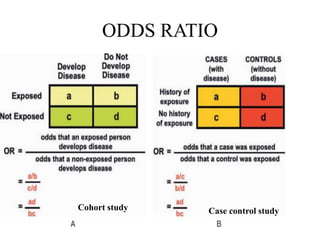
ODDS RATIO
Cohort study Case control study
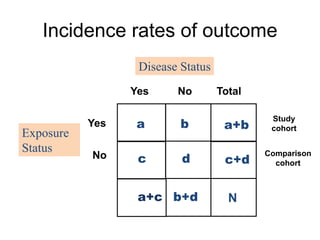
Incidence rates of outcome
N
d
c
b
a
Yes No
Disease Status
Yes
No
Exposure
Status
a+b
c+d
b+d
a+c
Total
Study
cohort
Comparison
cohort
Incidence rate
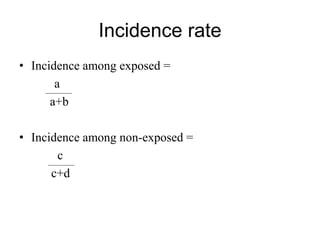
• Incidence among exposed =
a
a+b
• Incidence among non-exposed =
c
c+d
Estimation of risk
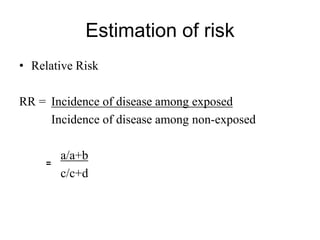
• Relative Risk
RR = Incidence of disease among exposed
Incidence of disease among non-exposed
a/a+b
c/c+d
=
Interpretation of Relative Risk and
Rate Ratio
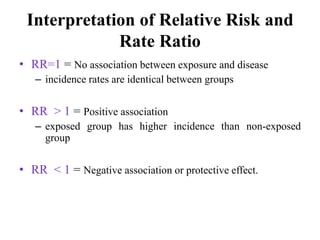
• RR=1 = No association between exposure and disease
– incidence rates are identical between groups
• RR > 1 = Positive association
– exposed group has higher incidence than non-exposed
group
• RR < 1 = Negative association or protective effect.
Estimation of Risk
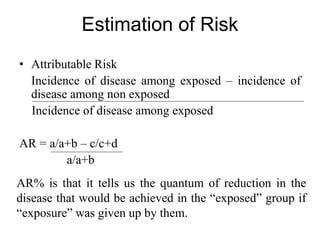
• Attributable Risk
Incidence of disease among exposed – incidence of
disease among non exposed
Incidence of disease among exposed
AR = a/a+b – c/c+d
a/a+b
AR% is that it tells us the quantum of reduction in the
disease that would be achieved in the “exposed” group if
“exposure” was given up by them.
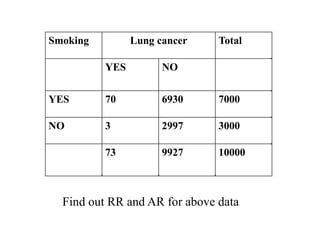
Smoking Lung cancer Total
YES NO
YES 70 6930 7000
NO 3 2997 3000
73 9927 10000
Find out RR and AR for above data
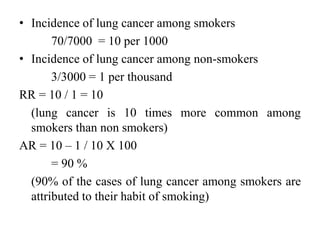
• Incidence of lung cancer among smokers
70/7000 = 10 per 1000
• Incidence of lung cancer among non-smokers
3/3000 = 1 per thousand
RR = 10 / 1 = 10
(lung cancer is 10 times more common among
smokers than non smokers)
AR = 10 – 1 / 10 X 100
= 90 %
(90% of the cases of lung cancer among smokers are
attributed to their habit of smoking)
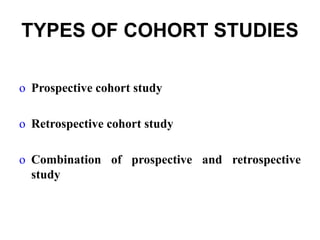
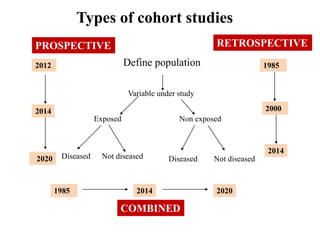
TYPES OF COHORT STUDIES
o Prospective cohort study
o Retrospective cohort study
o Combination of prospective and retrospective
study
Types of cohort studies
Define population
Variable under study
Exposed Non exposed
Diseased Not diseased Diseased Not diseased
2012
2014
2020
1985
2000
2014
RETROSPECTIVE
PROSPECTIVE
COMBINED
1985 2014 2020
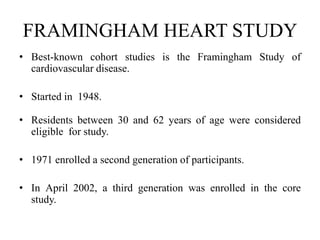
FRAMINGHAM HEART STUDY
• Best-known cohort studies is the Framingham Study of
cardiovascular disease.
• Started in 1948.
• Residents between 30 and 62 years of age were considered
eligible for study.
• 1971 enrolled a second generation of participants.
• In April 2002, a third generation was enrolled in the core
study.
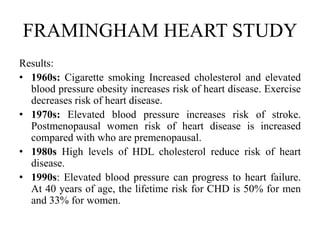
FRAMINGHAM HEART STUDY
Results:
• 1960s: Cigarette smoking Increased cholesterol and elevated
blood pressure obesity increases risk of heart disease. Exercise
decreases risk of heart disease.
• 1970s: Elevated blood pressure increases risk of stroke.
Postmenopausal women risk of heart disease is increased
compared with who are premenopausal.
• 1980s High levels of HDL cholesterol reduce risk of heart
disease.
• 1990s: Elevated blood pressure can progress to heart failure.
At 40 years of age, the lifetime risk for CHD is 50% for men
and 33% for women.
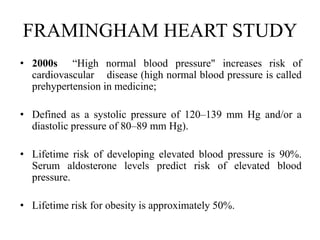
FRAMINGHAM HEART STUDY
• 2000s “High normal blood pressure" increases risk of
cardiovascular disease (high normal blood pressure is called
prehypertension in medicine;
• Defined as a systolic pressure of 120–139 mm Hg and/or a
diastolic pressure of 80–89 mm Hg).
• Lifetime risk of developing elevated blood pressure is 90%.
Serum aldosterone levels predict risk of elevated blood
pressure.
• Lifetime risk for obesity is approximately 50%.
FRAMINGHAM HEART STUDY
• Hypothesis:
Incidence of CHD increases with age
 Hypertension increases CHD
 Elevated cholesterol is associated with increased CHD
Tobacco smoking and habitual use of alcohol increased
CHD
 Increased physical activity a/w with decreased incidence of
CHD
 Increased Body weight inceases incidence of CHD
Diabetes increases incidence of CHD
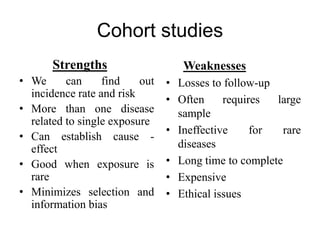
Cohort studies
Strengths
• We can find out
incidence rate and risk
• More than one disease
related to single exposure
• Can establish cause -
effect
• Good when exposure is
rare
• Minimizes selection and
information bias
Weaknesses
• Losses to follow-up
• Often requires large
sample
• Ineffective for rare
diseases
• Long time to complete
• Expensive
• Ethical issues
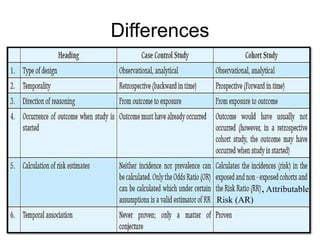
Differences
, Attributable
Risk (AR)
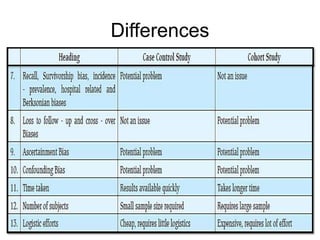
Differences
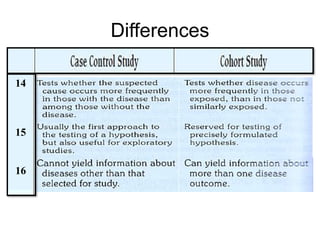
Differences
14
15
16
Cohort study in medical research methodology

Cohort study in medical research methodology

  • 1.
    Major (Dr) RaghavendraRH Assistant Professor KSHEMA
  • 2.
  • 3.
    Cohort study Cohort =Group of people who share a common characteristic or experience within a defined time period (age, occupation ,exposure etc.).
  • 4.
    Cohort study • Cohortstudy: are observational studies in which the investigator determines the exposure status of subjects and then follows them for subsequent outcomes – Forward looking study – Incidence study – Longitudinal study – Prospective study – Follow up study
  • 5.
  • 6.
    General Considerations • Cohortsmust be free from the disease under study. • Study and control group must be easily susceptible to the disease under study • Both the groups must be comparable in respect to all the possible variables which may influence the frequency of the disease.
  • 7.
    General Considerations • Thediagnostic and eligibility criteria of the disease must be defined before hand. • Groups are then followed, under the same identical conditions, over a period of time to determine the outcome of the exposure.
  • 8.
    INDICATIONS FOR COHORT STUDY •When there is good evidence of an association between exposure and disease, supported by descriptive and case control studies. • When exposure is rare, but the incidence of the disease if high among the exposed. • When there is no/minimal attrition problem. • When ample funds are available.
  • 9.
    Elements of Cohortstudy • Selection of study subject • Obtaining the data on the exposure. • Selection of the comparison group. • Follow up • Analysis
  • 10.
    Elements of Cohortstudy 1. SELECTION OF STUDY SUBJECTS: • The general population – when exposure or cause of illness is frequent in the population. • Special groups like select groups or exposure groups
  • 11.
    Elements of Cohortstudy 2. OBTAINING DATA ON EXPOSURE: Information about exposure may be obtained through – Survey – Interviews – Questionnaires – Medical records
  • 12.
    Elements of Cohortstudy 3. SELECTION OF COMPARISON GROUP: - – Internal comparisons – External comparisons – Comparison with general population rates
  • 13.
    Elements of Cohortstudy 4. FOLLOW UP: Regular follow up is required which comprises of – Periodic medical examination, – Reviewing hospital records, – Surveillance of death records, – Mailed questionnaires, – Telephone calls, – Periodic home visits
  • 14.
    Elements of Cohortstudy 5. ANALYSIS: • The data analyzed in terms of – Incidence rates of outcome among exposed and non exposed – Estimation of risk • Relative risk • Attributable risk
  • 15.
    ODDS RATIO Cohort studyCase control study
  • 16.
    Incidence rates ofoutcome N d c b a Yes No Disease Status Yes No Exposure Status a+b c+d b+d a+c Total Study cohort Comparison cohort
  • 17.
    Incidence rate • Incidenceamong exposed = a a+b • Incidence among non-exposed = c c+d
  • 18.
    Estimation of risk •Relative Risk RR = Incidence of disease among exposed Incidence of disease among non-exposed a/a+b c/c+d =
  • 19.
    Interpretation of RelativeRisk and Rate Ratio • RR=1 = No association between exposure and disease – incidence rates are identical between groups • RR > 1 = Positive association – exposed group has higher incidence than non-exposed group • RR < 1 = Negative association or protective effect.
  • 20.
    Estimation of Risk •Attributable Risk Incidence of disease among exposed – incidence of disease among non exposed Incidence of disease among exposed AR = a/a+b – c/c+d a/a+b AR% is that it tells us the quantum of reduction in the disease that would be achieved in the “exposed” group if “exposure” was given up by them.
  • 21.
    Smoking Lung cancerTotal YES NO YES 70 6930 7000 NO 3 2997 3000 73 9927 10000 Find out RR and AR for above data
  • 22.
    • Incidence oflung cancer among smokers 70/7000 = 10 per 1000 • Incidence of lung cancer among non-smokers 3/3000 = 1 per thousand RR = 10 / 1 = 10 (lung cancer is 10 times more common among smokers than non smokers) AR = 10 – 1 / 10 X 100 = 90 % (90% of the cases of lung cancer among smokers are attributed to their habit of smoking)
  • 23.
    TYPES OF COHORTSTUDIES o Prospective cohort study o Retrospective cohort study o Combination of prospective and retrospective study
  • 24.
    Types of cohortstudies Define population Variable under study Exposed Non exposed Diseased Not diseased Diseased Not diseased 2012 2014 2020 1985 2000 2014 RETROSPECTIVE PROSPECTIVE COMBINED 1985 2014 2020
  • 25.
    FRAMINGHAM HEART STUDY •Best-known cohort studies is the Framingham Study of cardiovascular disease. • Started in 1948. • Residents between 30 and 62 years of age were considered eligible for study. • 1971 enrolled a second generation of participants. • In April 2002, a third generation was enrolled in the core study.
  • 26.
    FRAMINGHAM HEART STUDY Results: •1960s: Cigarette smoking Increased cholesterol and elevated blood pressure obesity increases risk of heart disease. Exercise decreases risk of heart disease. • 1970s: Elevated blood pressure increases risk of stroke. Postmenopausal women risk of heart disease is increased compared with who are premenopausal. • 1980s High levels of HDL cholesterol reduce risk of heart disease. • 1990s: Elevated blood pressure can progress to heart failure. At 40 years of age, the lifetime risk for CHD is 50% for men and 33% for women.
  • 27.
    FRAMINGHAM HEART STUDY •2000s “High normal blood pressure" increases risk of cardiovascular disease (high normal blood pressure is called prehypertension in medicine; • Defined as a systolic pressure of 120–139 mm Hg and/or a diastolic pressure of 80–89 mm Hg). • Lifetime risk of developing elevated blood pressure is 90%. Serum aldosterone levels predict risk of elevated blood pressure. • Lifetime risk for obesity is approximately 50%.
  • 28.
    FRAMINGHAM HEART STUDY •Hypothesis: Incidence of CHD increases with age  Hypertension increases CHD  Elevated cholesterol is associated with increased CHD Tobacco smoking and habitual use of alcohol increased CHD  Increased physical activity a/w with decreased incidence of CHD  Increased Body weight inceases incidence of CHD Diabetes increases incidence of CHD
  • 29.
    Cohort studies Strengths • Wecan find out incidence rate and risk • More than one disease related to single exposure • Can establish cause - effect • Good when exposure is rare • Minimizes selection and information bias Weaknesses • Losses to follow-up • Often requires large sample • Ineffective for rare diseases • Long time to complete • Expensive • Ethical issues
  • 30.
  • 31.
  • 32.