Text has cohesion if
The
cohesion
book
Sue Palmer
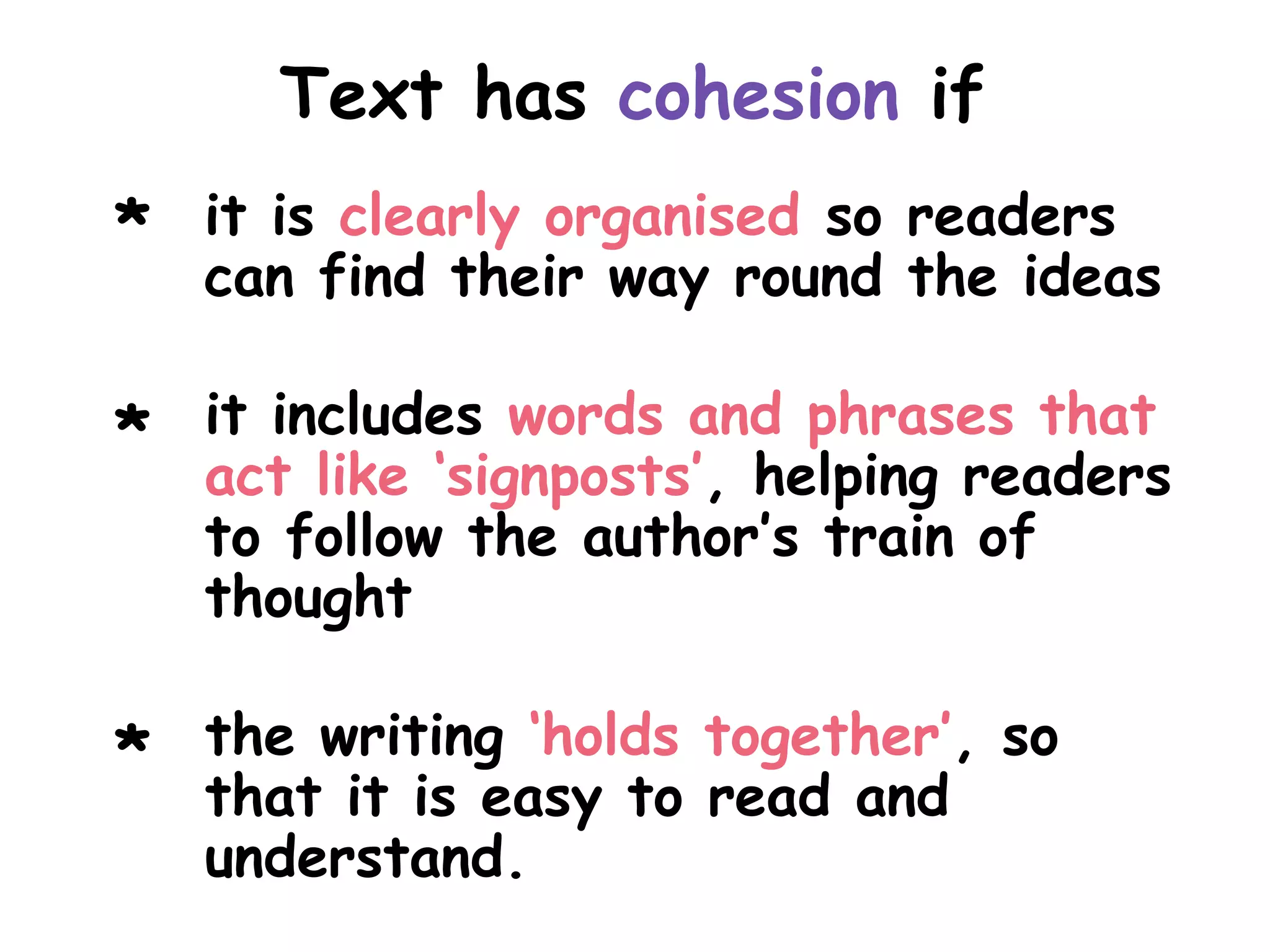
Text has cohesion if
it is clearly organised so readers
can find their way round the ideas
it includes words and phrases that
act like ‘signposts’, helping readers
to follow the author’s train of
thought
the writing ‘holds together’, so
that it is easy to read and
understand.
*
*
*
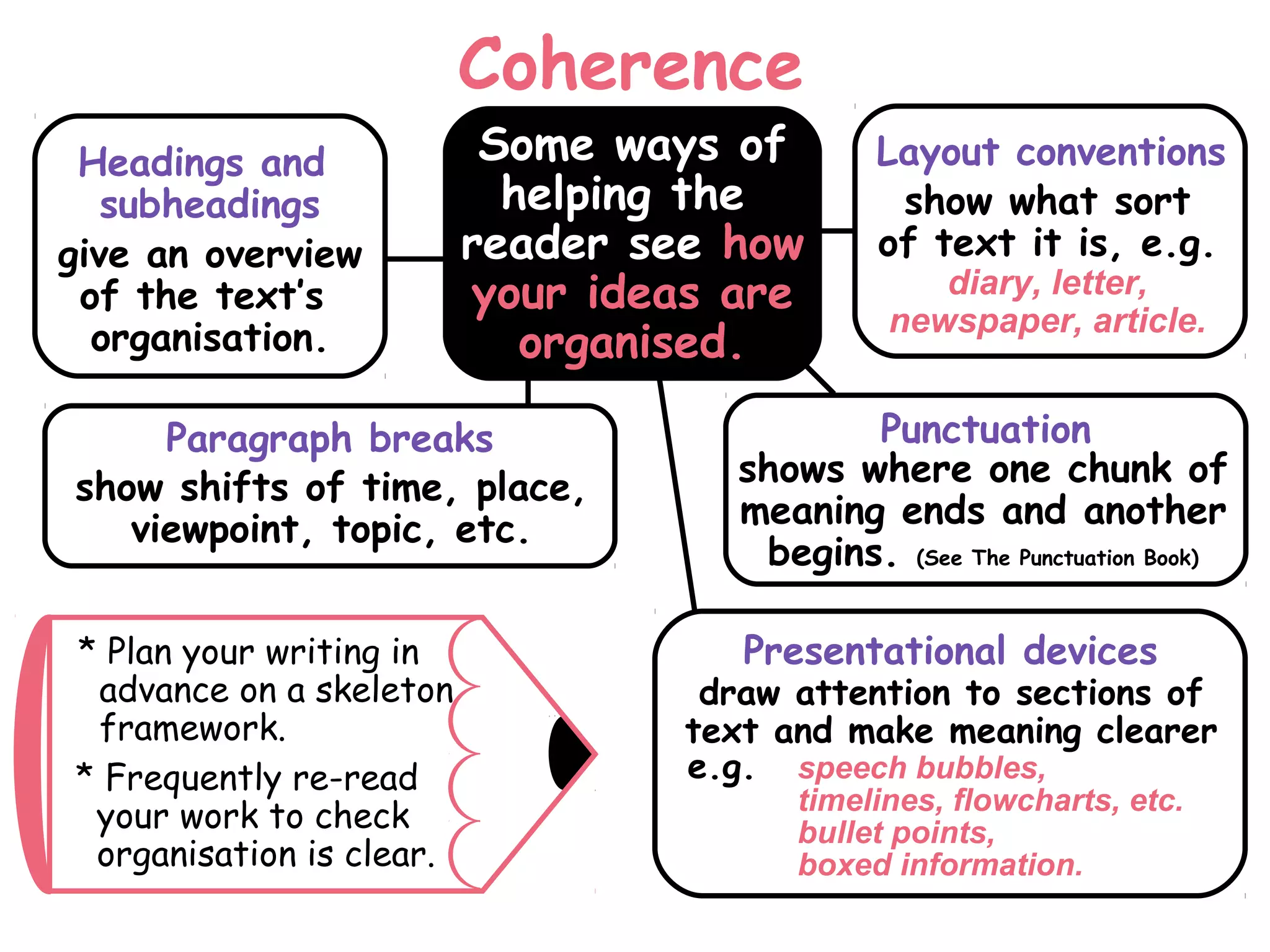
Coherence
Some ways of
helping the
reader see how
your ideas are
organised.
* Plan your writing in
advance on a skeleton
framework.
Headings and
subheadings
Paragraph breaks
Layout conventions
Punctuation
Presentational devices
speech bubbles,
timelines, flowcharts, etc.
bullet points,
boxed information.
e.g.
give an overview
of the text’s
organisation.
show shifts of time, place,
viewpoint, topic, etc.
draw attention to sections of
text and make meaning clearer
shows where one chunk of
meaning ends and another
begins. (See The Punctuation Book)
show what sort
of text it is, e.g.
diary, letter,
newspaper, article.
* Frequently re-read
your work to check
organisation is clear.
Paragraphing
* In non-fiction writing,
plan paragraphs
beforehand.
a new topic or
aspect of a topic
Paragraph breaks
can help readers
to follow your
train of thought
by showing…
Three weeks later…
In 1837,…
a shift of
time
Meanwhile, deep in
the forest,…
Suddenly, they leapt
Into action…
Tom, on the other hand, was furious…
a shift of
place
a shift of
mood or
viewpoint
a new speaker
in direct speech
(See The Sentence Book)
a new step or
stage in a
process
a move from one
main point (or
group of points
to another
one paragraph
per category
*
*
*
*
*
*
*
*
*
* In fiction, beware of
all shifts of emphasis.
Cohesive devices
Collect examples from texts
you read. Read sentences
aloud to get the feel of the
language patterns.
Words and phrases
can act like
signposts to help
readers see
significant links in
the text.
Use these ‘signposts’ to link
your own ideas. Practise
the sentences in speech
before you write.
conjunctions
punctuation
sentence
frames
sentence
connectivesThese show links
between ideas
within a sentence,
e.g. when,
because, until,
although.
Some punctuation marks
(: ; -) can show links
between clauses.
Words and phrases
that show links
between one
sentence and the
next, e.g.
However,
Consequently,
On the other hand…
Where nouns or verbs act as
signposts, you can make a
‘sentence frame’, e.g.
Begin by…
The reason that… is…
Connection words, phrases and sentences are important
throughout written work. However, they are particularly
useful at the start of a new paragraph.
Use time links to show the
passage of time in fiction
and recounts.
sentence
connectives
sentence
frames
Yesterday,…
On 4th June 2000,…
One wintry morning,…
Time Links
Vary the linking devices so
they guide the reader
without being too obvious.
conclusiontime passingsetting the scenee.g.
Finally,…
Eventually,…
At last,…
Next,… Then,…
After that,…
A few weeks later,…
By the end of October,…
conjunctions
linking
clauses
When Jane was
four years old,…
As time went by,…
After she had left,…
When it was
all over,…
It all began with
an invitation.
Several weeks passed.
The clock
struck midnight.
It was the end of
the adventure.
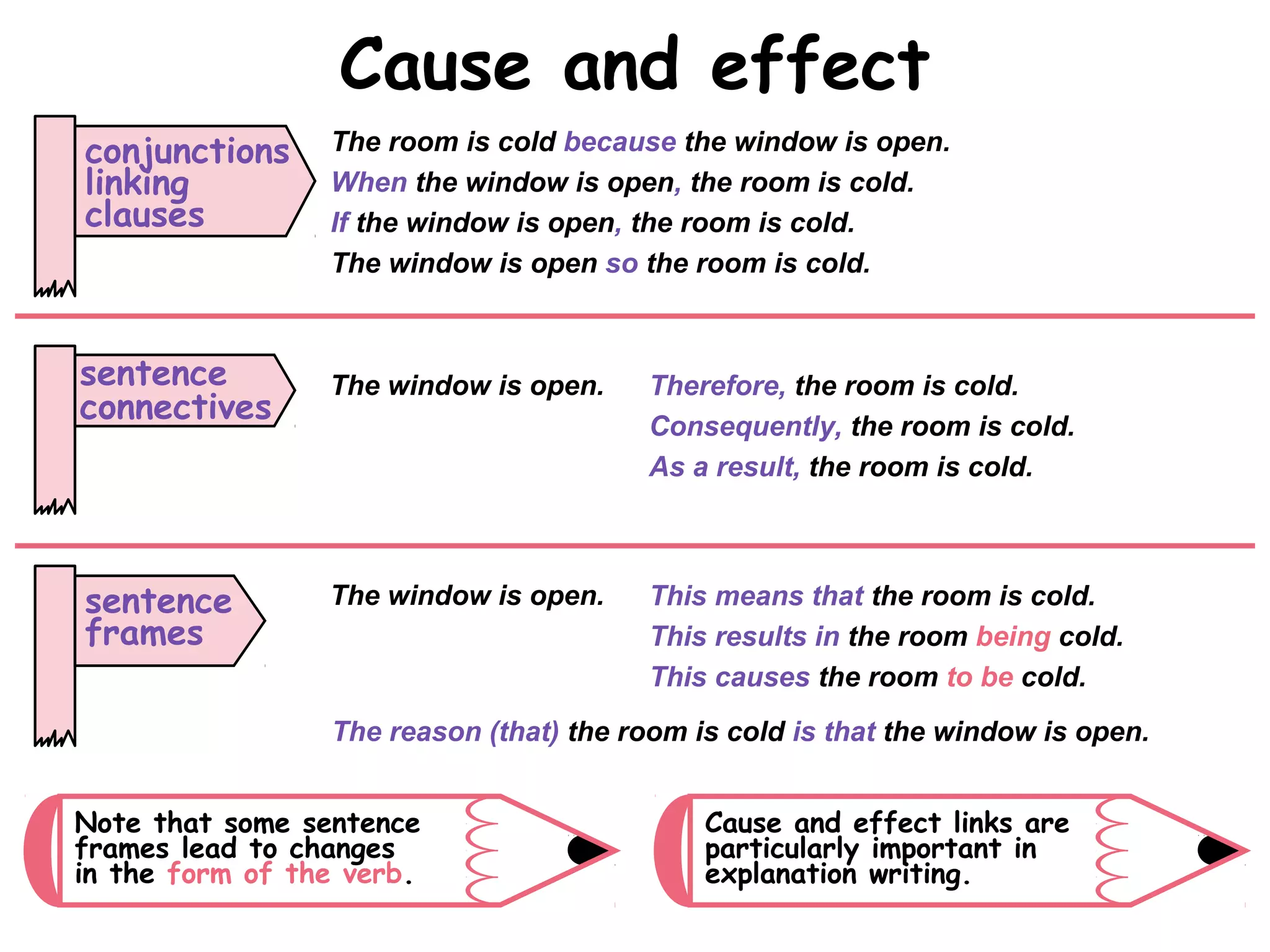
Cause and effect
Note that some sentence
frames lead to changes
in the form of the verb.
sentence
connectives
sentence
frames
The room is cold because the window is open.
When the window is open, the room is cold.
If the window is open, the room is cold.
The window is open so the room is cold.
Cause and effect links are
particularly important in
explanation writing.
conjunctions
linking
clauses
Therefore, the room is cold.
Consequently, the room is cold.
As a result, the room is cold.
The window is open.
This means that the room is cold.
This results in the room being cold.
This causes the room to be cold.
The window is open.
The reason (that) the room is cold is that the window is open.
A further
feature they have in common
is____________.
and as well too
Also, Moreover,
Furthermore,
In addition, What is more,
Another point is …
A further feature is …
These links are useful in
• descriptive writing
• texts which argue for or
against a point of view.
Opposition
but yet
while whereas
However, Alternatively,
On the other hand,
On the contrary,
The opposite point of view is…
Comparison, e.g. Contrast, e.g.
+ Addition +
One
similarity is that __________.
They are
both ____________.
Another way in which they are
alike is ________.
____________ and _______ are
similar in several ways.
____________ and _______ are
different in a number of ways.
For instance, __________ is
_______, while __________ is
____________. Another difference
is that ________. They also differ
in that _________ is ________,
whereas ________is ________.
Sequence
In instructions and explanations, signpost stages in the process,
4
Finally,…
Finish off
by…
1
First,…
Begin by…
2
Secondly,..
The next
stage is…
3
Next,…
When the mixture
is ready…
Introducing examplesIntroducing definitions
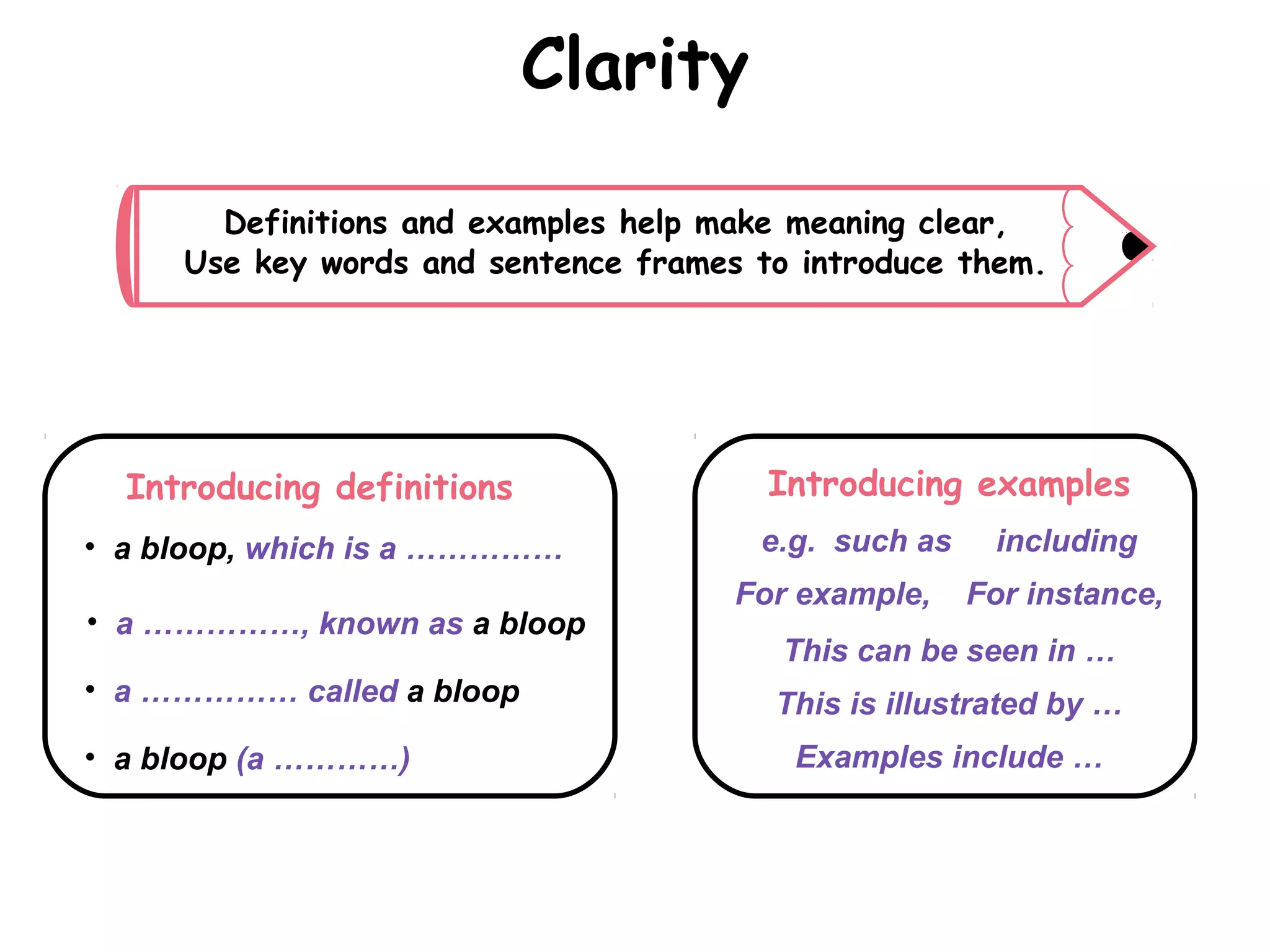
Definitions and examples help make meaning clear,
Use key words and sentence frames to introduce them.
Clarity
• a bloop, which is a ……………
• a ……………, known as a bloop
• a …………… called a bloop
• a bloop (a …………)
e.g. such as including
For example, For instance,
This can be seen in …
This is illustrated by …
Examples include …
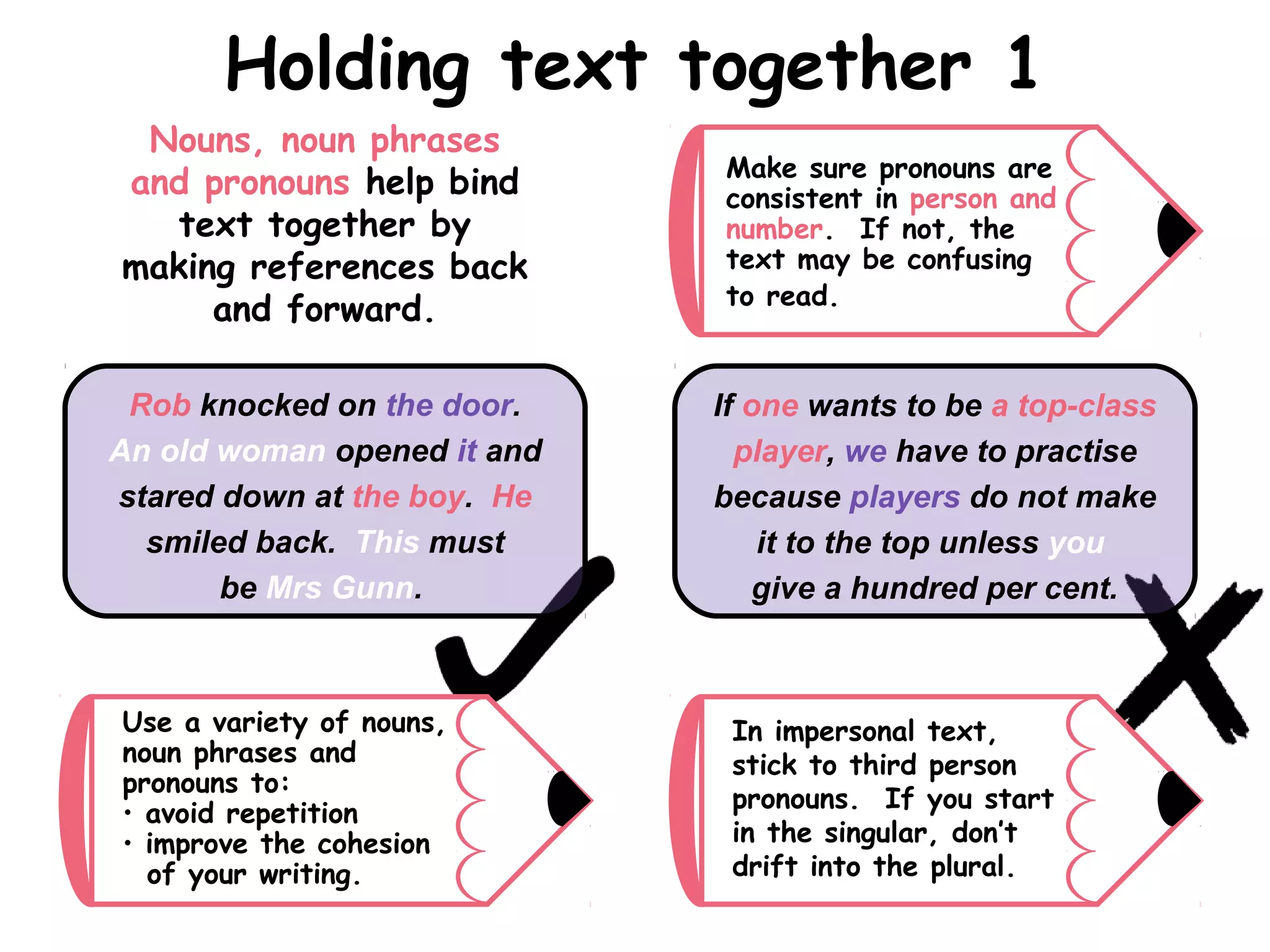
Holding text together 1
Nouns, noun phrases
and pronouns help bind
text together by
making references back
and forward.
Make sure pronouns are
consistent in person and
number. If not, the
text may be confusing
to read.
Use a variety of nouns,
noun phrases and
pronouns to:
• avoid repetition
• improve the cohesion
of your writing.
In impersonal text,
stick to third person
pronouns. If you start
in the singular, don’t
drift into the plural.
Rob knocked on the door.
An old woman opened it and
stared down at the boy. He
smiled back. This must
be Mrs Gunn.
If one wants to be a top-class
player, we have to practise
because players do not make
it to the top unless you
give a hundred per cent.
Holding text together 2
Some texts
are mostly
past tense:
• recount
• narrative
fiction
Make sure verb tenses
are consistent. If not,
the text may be
confusing to read.
Exceptions
* most direct
speech and
quotations
* references to
things which
continue to exist
beyond the
narrative
* sudden changes
into the present
tense for dramatic
effect.
Exceptions
* historical reports
and explanations
* reference to or
examples from
the past.
Some texts
are mostly
present
tense:
• instruction
• report
• explanation
• persuasion
• discussion
Reported speech
is in the
past tense.
Direct speech
is usually
present tense.
The general said that
his men were fit
and highly trained.
They would be
ready when the
invasion began.
“My men are fit
and highly trained.
They will be
ready when the
invasion begins,”
said the general.
Holding text together 3
I, we, you
Make sure your overall
style and viewpoint are
consistent, depending on
purpose and audience.
third person
and/or
passive voice
personal impersonalor
informal formalor
subjective objectiveor
your opinion just the facts
(see The Standard English Book)
(see The Complex Sentence Book)
End Show
The End
Skeleton Poster Books
for GRAMMAR

Cohesion

  • 1.
    Text has cohesionif The cohesion book Sue Palmer
  • 2.
    Text has cohesionif it is clearly organised so readers can find their way round the ideas it includes words and phrases that act like ‘signposts’, helping readers to follow the author’s train of thought the writing ‘holds together’, so that it is easy to read and understand. * * *
  • 3.
    Coherence Some ways of helpingthe reader see how your ideas are organised. * Plan your writing in advance on a skeleton framework. Headings and subheadings Paragraph breaks Layout conventions Punctuation Presentational devices speech bubbles, timelines, flowcharts, etc. bullet points, boxed information. e.g. give an overview of the text’s organisation. show shifts of time, place, viewpoint, topic, etc. draw attention to sections of text and make meaning clearer shows where one chunk of meaning ends and another begins. (See The Punctuation Book) show what sort of text it is, e.g. diary, letter, newspaper, article. * Frequently re-read your work to check organisation is clear.
  • 4.
    Paragraphing * In non-fictionwriting, plan paragraphs beforehand. a new topic or aspect of a topic Paragraph breaks can help readers to follow your train of thought by showing… Three weeks later… In 1837,… a shift of time Meanwhile, deep in the forest,… Suddenly, they leapt Into action… Tom, on the other hand, was furious… a shift of place a shift of mood or viewpoint a new speaker in direct speech (See The Sentence Book) a new step or stage in a process a move from one main point (or group of points to another one paragraph per category * * * * * * * * * * In fiction, beware of all shifts of emphasis.
  • 5.
    Cohesive devices Collect examplesfrom texts you read. Read sentences aloud to get the feel of the language patterns. Words and phrases can act like signposts to help readers see significant links in the text. Use these ‘signposts’ to link your own ideas. Practise the sentences in speech before you write. conjunctions punctuation sentence frames sentence connectivesThese show links between ideas within a sentence, e.g. when, because, until, although. Some punctuation marks (: ; -) can show links between clauses. Words and phrases that show links between one sentence and the next, e.g. However, Consequently, On the other hand… Where nouns or verbs act as signposts, you can make a ‘sentence frame’, e.g. Begin by… The reason that… is… Connection words, phrases and sentences are important throughout written work. However, they are particularly useful at the start of a new paragraph.
  • 6.
    Use time linksto show the passage of time in fiction and recounts. sentence connectives sentence frames Yesterday,… On 4th June 2000,… One wintry morning,… Time Links Vary the linking devices so they guide the reader without being too obvious. conclusiontime passingsetting the scenee.g. Finally,… Eventually,… At last,… Next,… Then,… After that,… A few weeks later,… By the end of October,… conjunctions linking clauses When Jane was four years old,… As time went by,… After she had left,… When it was all over,… It all began with an invitation. Several weeks passed. The clock struck midnight. It was the end of the adventure.
  • 7.
    Cause and effect Notethat some sentence frames lead to changes in the form of the verb. sentence connectives sentence frames The room is cold because the window is open. When the window is open, the room is cold. If the window is open, the room is cold. The window is open so the room is cold. Cause and effect links are particularly important in explanation writing. conjunctions linking clauses Therefore, the room is cold. Consequently, the room is cold. As a result, the room is cold. The window is open. This means that the room is cold. This results in the room being cold. This causes the room to be cold. The window is open. The reason (that) the room is cold is that the window is open.
  • 8.
    A further feature theyhave in common is____________. and as well too Also, Moreover, Furthermore, In addition, What is more, Another point is … A further feature is … These links are useful in • descriptive writing • texts which argue for or against a point of view. Opposition but yet while whereas However, Alternatively, On the other hand, On the contrary, The opposite point of view is… Comparison, e.g. Contrast, e.g. + Addition + One similarity is that __________. They are both ____________. Another way in which they are alike is ________. ____________ and _______ are similar in several ways. ____________ and _______ are different in a number of ways. For instance, __________ is _______, while __________ is ____________. Another difference is that ________. They also differ in that _________ is ________, whereas ________is ________.
  • 9.
    Sequence In instructions andexplanations, signpost stages in the process, 4 Finally,… Finish off by… 1 First,… Begin by… 2 Secondly,.. The next stage is… 3 Next,… When the mixture is ready…
  • 10.
    Introducing examplesIntroducing definitions Definitionsand examples help make meaning clear, Use key words and sentence frames to introduce them. Clarity • a bloop, which is a …………… • a ……………, known as a bloop • a …………… called a bloop • a bloop (a …………) e.g. such as including For example, For instance, This can be seen in … This is illustrated by … Examples include …
  • 11.
    Holding text together1 Nouns, noun phrases and pronouns help bind text together by making references back and forward. Make sure pronouns are consistent in person and number. If not, the text may be confusing to read. Use a variety of nouns, noun phrases and pronouns to: • avoid repetition • improve the cohesion of your writing. In impersonal text, stick to third person pronouns. If you start in the singular, don’t drift into the plural. Rob knocked on the door. An old woman opened it and stared down at the boy. He smiled back. This must be Mrs Gunn. If one wants to be a top-class player, we have to practise because players do not make it to the top unless you give a hundred per cent.
  • 12.
    Holding text together2 Some texts are mostly past tense: • recount • narrative fiction Make sure verb tenses are consistent. If not, the text may be confusing to read. Exceptions * most direct speech and quotations * references to things which continue to exist beyond the narrative * sudden changes into the present tense for dramatic effect. Exceptions * historical reports and explanations * reference to or examples from the past. Some texts are mostly present tense: • instruction • report • explanation • persuasion • discussion Reported speech is in the past tense. Direct speech is usually present tense. The general said that his men were fit and highly trained. They would be ready when the invasion began. “My men are fit and highly trained. They will be ready when the invasion begins,” said the general.
  • 13.
    Holding text together3 I, we, you Make sure your overall style and viewpoint are consistent, depending on purpose and audience. third person and/or passive voice personal impersonalor informal formalor subjective objectiveor your opinion just the facts (see The Standard English Book) (see The Complex Sentence Book)
  • 14.
    End Show The End SkeletonPoster Books for GRAMMAR