Coherence Therapy:
Going Deep When You’ve Been
      Taught to Be Brief

     by Allison Anais Brunner
        Temple University
            April 1, 2009
Brief vs. Deep
Brief vs. Deep
 “For therapy to be brief, depth must be
  sacrificed….”
Brief vs. Deep
 “For therapy to be brief, depth must be
  sacrificed….”
 “Coherence therapy is a complete,
  versatile modality in which theory and
  practice are completely aligned for
  achieving the new level of
  effectiveness that is needed if therapy
  is to be deep and brief.”
Brief vs. Deep
 “For therapy to be brief, depth must be
  sacrificed….”
 “Coherence therapy is a complete,
  versatile modality in which theory and
  practice are completely aligned for
  achieving the new level of
  effectiveness that is needed if therapy
  is to be deep and brief.”
                         (Ecker & Hulley, 2002)
History
History
 1960s: progressive,
  nonpathologizing
  brief therapies
  (emphasis on
  speed)
History
 1960s: progressive,
  nonpathologizing
  brief therapies
  (emphasis on
  speed)
 Backlash against
  longstanding
  Freudian/psycho-
  analytic monopoly
  on in-depth therapy
History
 1960s: progressive,
  nonpathologizing
  brief therapies
  (emphasis on
  speed)
 Backlash against
  longstanding           “The Unconscious”—
  Freudian/psycho-        only recently (1990s)
  analytic monopoly       liberated from the
  on in-depth therapy     psychoanalytic school
                          of thought
History: DOBT
History: DOBT
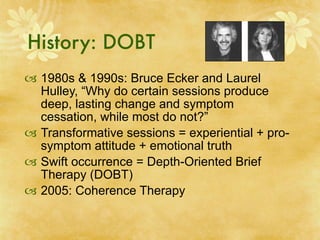
 1980s & 1990s: Bruce Ecker and Laurel
  Hulley, “Why do certain sessions produce
  deep, lasting change and symptom
  cessation, while most do not?”
History: DOBT
 1980s & 1990s: Bruce Ecker and Laurel
  Hulley, “Why do certain sessions produce
  deep, lasting change and symptom
  cessation, while most do not?”
 Transformative sessions = experiential + pro-
  symptom attitude + emotional truth
History: DOBT
 1980s & 1990s: Bruce Ecker and Laurel
  Hulley, “Why do certain sessions produce
  deep, lasting change and symptom
  cessation, while most do not?”
 Transformative sessions = experiential + pro-
  symptom attitude + emotional truth
 Swift occurrence = Depth-Oriented Brief
  Therapy (DOBT)
History: DOBT
 1980s & 1990s: Bruce Ecker and Laurel
  Hulley, “Why do certain sessions produce
  deep, lasting change and symptom
  cessation, while most do not?”
 Transformative sessions = experiential + pro-
  symptom attitude + emotional truth
 Swift occurrence = Depth-Oriented Brief
  Therapy (DOBT)
 2005: Coherence Therapy
Overview
Micro-level intervention
 Individuals and families
Symptoms dispelled:
                              Sexual problems
    Depression
                              Rage
    Anxiety                  Grief
    Panic                    Attention deficit
    Agoraphobia              Codependency
    Low self-worth           Procrastination
    Attachment               Underachievement
     problems
Symptom Coherence
Symptom Coherence

         The symptom is
         necessary.
Symptom Coherence

         The symptom is
         necessary.
         The symptom is
         cogent.
Symptom Coherence

         The symptom is
         necessary.
         The symptom is
         cogent.
         Once
         understood, the
         symptom
         dissipates.
Symptom Coherence

         The symptom is
         necessary.
         The symptom is
         cogent.
         Once
         understood, the
         symptom
         dissipates.
Experiential
 Direct, felt experience
 Subjective
 Gestalt
Experiential
 Direct, felt experience
 Subjective
 Gestalt
Emotional Truth
Emotional Truth
 Definition
Emotional Truth
 Definition
    “the underlying, unconscious emotional schema
     that compellingly requires the client’s symptom
     or problem, despite the suffering entailed in
     having it” (Ecker, 2008)
Emotional Truth
 Definition
    “the underlying, unconscious emotional schema
     that compellingly requires the client’s symptom
     or problem, despite the suffering entailed in
     having it” (Ecker, 2008)
    “specific, unconscious personal themes,
     knowings and purposes that, in one way or
     another, powerfully and passionately require
     having the presenting symptom, even though
     consciously the client wants so much not to have
     it.” (Ecker & Hully, 2002)
Emotional Truths: Example
 “Adam” from video
    Symptom: yearly depression (end of August),
     irritability at work
    ET #1: It was so awful for me [in Sweden] that, to
     this day, I get very unhappy at the end of
     summer.
    ET #2: “I’m really not what you [parents] think I
     am, and I dread that you’ll find out, be
     disappointed in me, give up on me and cut off
     from me. To keep that from happening, I’ll do
     anything, including faking it.
What Coherence Therapy
          Is Not
 Other brief therapies attempt to prevent
  the client’s debilitating symptom with:
   Override
   Counteract
   More rational beliefs
   Insightful interpretations
   Better narratives
   Clever reframes
The Science of Depth Therapy
 Depth therapies
  — engage the
  limbic system.
        vs.
 Surface work—
  engages the
  neocortex.
Current Brain Research
 The old biology: Consolidation (Ecker, 2008)
 1997–2000: Stimulation + implicit memory
  triggered + synapses unlock + can be
  disrupted + erasure of implicit memory = old
  responses/BHs can’t be re-evoked.
                 (Cozolino, 2006; Lipton, 2005;
                                   Siegel, 2007)
Cultural and Ethical Issues
 “Everyone, from every cultural and
  economic group, has the native ability
  to place attention in those emotional
  truths and experience them. This
  makes CT applicable with diverse
  populations.”
            (Coherence Psychology Institute, 2009)
Side Effects
 Clients with trauma/PTSD: therapist must be
  prepared to deal with possible traumatic
  memories.
 Client determination: Never push a client
  who is not ready or willing to go into the
  unconscious. Use of the unconscious can be
  a powerful tool, and therapists must remain
  sensitive to that.
Boundary Spanning
Boundary Spanning
 Littrell, 2008:
Boundary Spanning
 Littrell, 2008:
   Psychotherapy enhances the body’s
    ability to combat disease.
Boundary Spanning
 Littrell, 2008:
   Psychotherapy enhances the body’s
    ability to combat disease.
   Stress suppresses a body’s ability to fight
    illnesses of all sorts (i.e., cancer).
Boundary Spanning
 Littrell, 2008:
   Psychotherapy enhances the body’s
    ability to combat disease.
   Stress suppresses a body’s ability to fight
    illnesses of all sorts (i.e., cancer).
   Psychological distress slows a person’s
    ability to heal physically.
Boundary Spanning
 Littrell, 2008:
   Psychotherapy enhances the body’s
    ability to combat disease.
   Stress suppresses a body’s ability to fight
    illnesses of all sorts (i.e., cancer).
   Psychological distress slows a person’s
    ability to heal physically.
   Vaccinations are less effective in
    individuals dealing with mental distress.
Boundary Spanning (cont’d)
 Health
 Work
 Relationships
 Spirituality
 Case Studies
  Albert’s chronic tension (Ecker, 2003)
  Adrienne’s musculature, weight, optimism
   (Ecker & Hulley, 2002)
How to Become
     a Coherence Therapist
 Online short courses
 Training & certification
  program
 Case consultation
 Graduate degrees highly
  encouraged but not
  required
www.coherencetherapy.org
 Coherence Psychology Institute (2009). What Is Coherence
  Therapy? Retrieved March 14, 2009, from http://
  www.coherencetherapy.org/discover/what.htm
 Cozolino, L. (2008). The Neuroscience of Human
  Relationships: Attachment and the Developing Brain. New
  York, NY: W. W. Norton & Co.
 Ecker. B. (2008, Sep/Oct). Unlocking the Emotional Brain.
  Psychotherapy Networker, 32, 42–47.
 Ecker, B. (2006, October). Teaming up with the brain’s hidden
  rules for change. Psychotherapy Networker Symposium West,
  San Franciso, CA.
 Ecker, B. (2003, Nov/Dec). The hidden logic of anxiety: look for
  the emotional truth behind the symptom. Psychotherapy
  Networker, 27, 38–43.
References
 Coherence Psychology Institute (2009). What Is Coherence
  Therapy? Retrieved March 14, 2009, from http://
  www.coherencetherapy.org/discover/what.htm
 Cozolino, L. (2008). The Neuroscience of Human
  Relationships: Attachment and the Developing Brain. New
  York, NY: W. W. Norton & Co.
 Ecker. B. (2008, Sep/Oct). Unlocking the Emotional Brain.
  Psychotherapy Networker, 32, 42–47.
 Ecker, B. (2006, October). Teaming up with the brain’s hidden
  rules for change. Psychotherapy Networker Symposium West,
  San Franciso, CA.
 Ecker, B. (2003, Nov/Dec). The hidden logic of anxiety: look for
  the emotional truth behind the symptom. Psychotherapy
  Networker, 27, 38–43.
 Ecker, B., & Hulley, L. (2002, July/Aug). DOBT toolkit for in-
  depth effectiveness: methods & concepts of depth-oriented
  brief therapy. New Therapist, 20, 24–29.
 Ecker, B. & Hulley, L. (2002, Jan/Feb). Deep from the start:
  profound change in brief therapy is a real possibility.
  Psychotherapy Networker, 26, 46–51.
 Ecker, B. & Hulley, L. (2000). A new effectiveness for
  psychotherapy. New Therapist, 6, 31–33.
 Ecker, B. & Hulley, L. (1996). Depth Oriented Brief Therapy:
  How to Be Brief When You Were Trained to Be Deep, and Vice
  Versa. San Francisco: Jossey-Bass.
 Ecker, B. & Toomey, B. (2008). Depotentiation of symptom-
  producing implicit memory in coherence therapy. Journal of
  Constructionist Psychology, 21, 87–150.
 Lipton, B. (2005). The Biology of Belief: Unleashing the Power
  of Consciousness, Matter, & Miracles. Santa Rosa, CA:
  Mountain of Love / Elite Books.
 Littrell, J. (2008). The mind-body connection: not just a theory
  anymore. Social Work in Health Care, 46, 17–30.
 Siegel, D. J. (2007). New York, NY: W. W. Norton & Co.
 Toomey, B. & Ecker, B. (2009). Competing visions of the
  implications of neuroscience in psychotherapy. Journal of
  Constructionist Psychology, 22, 95–140.
 Toomey, B. & Ecker, B. (2007). Of neurons and knowings:
  Constructivism, coherence psychology, and their neurodynamic
  substrates. Journal of Constructionist Psychology, 20, 201–
  245.

Coherence Therapy.Ppt

  • 1.
    Coherence Therapy: Going DeepWhen You’ve Been Taught to Be Brief by Allison Anais Brunner Temple University April 1, 2009
  • 2.
  • 3.
    Brief vs. Deep “For therapy to be brief, depth must be sacrificed….”
  • 4.
    Brief vs. Deep “For therapy to be brief, depth must be sacrificed….”  “Coherence therapy is a complete, versatile modality in which theory and practice are completely aligned for achieving the new level of effectiveness that is needed if therapy is to be deep and brief.”
  • 5.
    Brief vs. Deep “For therapy to be brief, depth must be sacrificed….”  “Coherence therapy is a complete, versatile modality in which theory and practice are completely aligned for achieving the new level of effectiveness that is needed if therapy is to be deep and brief.” (Ecker & Hulley, 2002)
  • 6.
  • 7.
    History  1960s: progressive, nonpathologizing brief therapies (emphasis on speed)
  • 8.
    History  1960s: progressive, nonpathologizing brief therapies (emphasis on speed)  Backlash against longstanding Freudian/psycho- analytic monopoly on in-depth therapy
  • 9.
    History  1960s: progressive, nonpathologizing brief therapies (emphasis on speed)  Backlash against longstanding  “The Unconscious”— Freudian/psycho- only recently (1990s) analytic monopoly liberated from the on in-depth therapy psychoanalytic school of thought
  • 10.
  • 11.
    History: DOBT  1980s& 1990s: Bruce Ecker and Laurel Hulley, “Why do certain sessions produce deep, lasting change and symptom cessation, while most do not?”
  • 12.
    History: DOBT  1980s& 1990s: Bruce Ecker and Laurel Hulley, “Why do certain sessions produce deep, lasting change and symptom cessation, while most do not?”  Transformative sessions = experiential + pro- symptom attitude + emotional truth
  • 13.
    History: DOBT  1980s& 1990s: Bruce Ecker and Laurel Hulley, “Why do certain sessions produce deep, lasting change and symptom cessation, while most do not?”  Transformative sessions = experiential + pro- symptom attitude + emotional truth  Swift occurrence = Depth-Oriented Brief Therapy (DOBT)
  • 14.
    History: DOBT  1980s& 1990s: Bruce Ecker and Laurel Hulley, “Why do certain sessions produce deep, lasting change and symptom cessation, while most do not?”  Transformative sessions = experiential + pro- symptom attitude + emotional truth  Swift occurrence = Depth-Oriented Brief Therapy (DOBT)  2005: Coherence Therapy
  • 15.
    Overview Micro-level intervention  Individualsand families Symptoms dispelled:  Sexual problems  Depression  Rage  Anxiety  Grief  Panic  Attention deficit  Agoraphobia  Codependency  Low self-worth  Procrastination  Attachment  Underachievement problems
  • 16.
  • 17.
    Symptom Coherence The symptom is necessary.
  • 18.
    Symptom Coherence The symptom is necessary. The symptom is cogent.
  • 19.
    Symptom Coherence The symptom is necessary. The symptom is cogent. Once understood, the symptom dissipates.
  • 20.
    Symptom Coherence The symptom is necessary. The symptom is cogent. Once understood, the symptom dissipates.
  • 21.
    Experiential  Direct, feltexperience  Subjective  Gestalt
  • 22.
    Experiential  Direct, feltexperience  Subjective  Gestalt
  • 23.
  • 24.
  • 25.
    Emotional Truth  Definition  “the underlying, unconscious emotional schema that compellingly requires the client’s symptom or problem, despite the suffering entailed in having it” (Ecker, 2008)
  • 26.
    Emotional Truth  Definition  “the underlying, unconscious emotional schema that compellingly requires the client’s symptom or problem, despite the suffering entailed in having it” (Ecker, 2008)  “specific, unconscious personal themes, knowings and purposes that, in one way or another, powerfully and passionately require having the presenting symptom, even though consciously the client wants so much not to have it.” (Ecker & Hully, 2002)
  • 27.
    Emotional Truths: Example “Adam” from video  Symptom: yearly depression (end of August), irritability at work  ET #1: It was so awful for me [in Sweden] that, to this day, I get very unhappy at the end of summer.  ET #2: “I’m really not what you [parents] think I am, and I dread that you’ll find out, be disappointed in me, give up on me and cut off from me. To keep that from happening, I’ll do anything, including faking it.
  • 28.
    What Coherence Therapy Is Not  Other brief therapies attempt to prevent the client’s debilitating symptom with: Override Counteract More rational beliefs Insightful interpretations Better narratives Clever reframes
  • 29.
    The Science ofDepth Therapy  Depth therapies — engage the limbic system. vs.  Surface work— engages the neocortex.
  • 30.
    Current Brain Research The old biology: Consolidation (Ecker, 2008)  1997–2000: Stimulation + implicit memory triggered + synapses unlock + can be disrupted + erasure of implicit memory = old responses/BHs can’t be re-evoked. (Cozolino, 2006; Lipton, 2005; Siegel, 2007)
  • 31.
    Cultural and EthicalIssues  “Everyone, from every cultural and economic group, has the native ability to place attention in those emotional truths and experience them. This makes CT applicable with diverse populations.” (Coherence Psychology Institute, 2009)
  • 32.
    Side Effects  Clientswith trauma/PTSD: therapist must be prepared to deal with possible traumatic memories.  Client determination: Never push a client who is not ready or willing to go into the unconscious. Use of the unconscious can be a powerful tool, and therapists must remain sensitive to that.
  • 33.
  • 34.
  • 35.
    Boundary Spanning  Littrell,2008: Psychotherapy enhances the body’s ability to combat disease.
  • 36.
    Boundary Spanning  Littrell,2008: Psychotherapy enhances the body’s ability to combat disease. Stress suppresses a body’s ability to fight illnesses of all sorts (i.e., cancer).
  • 37.
    Boundary Spanning  Littrell,2008: Psychotherapy enhances the body’s ability to combat disease. Stress suppresses a body’s ability to fight illnesses of all sorts (i.e., cancer). Psychological distress slows a person’s ability to heal physically.
  • 38.
    Boundary Spanning  Littrell,2008: Psychotherapy enhances the body’s ability to combat disease. Stress suppresses a body’s ability to fight illnesses of all sorts (i.e., cancer). Psychological distress slows a person’s ability to heal physically. Vaccinations are less effective in individuals dealing with mental distress.
  • 39.
    Boundary Spanning (cont’d) Health  Work  Relationships  Spirituality  Case Studies Albert’s chronic tension (Ecker, 2003) Adrienne’s musculature, weight, optimism (Ecker & Hulley, 2002)
  • 40.
    How to Become a Coherence Therapist  Online short courses  Training & certification program  Case consultation  Graduate degrees highly encouraged but not required www.coherencetherapy.org
  • 41.
     Coherence PsychologyInstitute (2009). What Is Coherence Therapy? Retrieved March 14, 2009, from http:// www.coherencetherapy.org/discover/what.htm  Cozolino, L. (2008). The Neuroscience of Human Relationships: Attachment and the Developing Brain. New York, NY: W. W. Norton & Co.  Ecker. B. (2008, Sep/Oct). Unlocking the Emotional Brain. Psychotherapy Networker, 32, 42–47.  Ecker, B. (2006, October). Teaming up with the brain’s hidden rules for change. Psychotherapy Networker Symposium West, San Franciso, CA.  Ecker, B. (2003, Nov/Dec). The hidden logic of anxiety: look for the emotional truth behind the symptom. Psychotherapy Networker, 27, 38–43.
  • 42.
    References  Coherence PsychologyInstitute (2009). What Is Coherence Therapy? Retrieved March 14, 2009, from http:// www.coherencetherapy.org/discover/what.htm  Cozolino, L. (2008). The Neuroscience of Human Relationships: Attachment and the Developing Brain. New York, NY: W. W. Norton & Co.  Ecker. B. (2008, Sep/Oct). Unlocking the Emotional Brain. Psychotherapy Networker, 32, 42–47.  Ecker, B. (2006, October). Teaming up with the brain’s hidden rules for change. Psychotherapy Networker Symposium West, San Franciso, CA.  Ecker, B. (2003, Nov/Dec). The hidden logic of anxiety: look for the emotional truth behind the symptom. Psychotherapy Networker, 27, 38–43.
  • 43.
     Ecker, B.,& Hulley, L. (2002, July/Aug). DOBT toolkit for in- depth effectiveness: methods & concepts of depth-oriented brief therapy. New Therapist, 20, 24–29.  Ecker, B. & Hulley, L. (2002, Jan/Feb). Deep from the start: profound change in brief therapy is a real possibility. Psychotherapy Networker, 26, 46–51.  Ecker, B. & Hulley, L. (2000). A new effectiveness for psychotherapy. New Therapist, 6, 31–33.  Ecker, B. & Hulley, L. (1996). Depth Oriented Brief Therapy: How to Be Brief When You Were Trained to Be Deep, and Vice Versa. San Francisco: Jossey-Bass.  Ecker, B. & Toomey, B. (2008). Depotentiation of symptom- producing implicit memory in coherence therapy. Journal of Constructionist Psychology, 21, 87–150.  Lipton, B. (2005). The Biology of Belief: Unleashing the Power of Consciousness, Matter, & Miracles. Santa Rosa, CA: Mountain of Love / Elite Books.
  • 44.
     Littrell, J.(2008). The mind-body connection: not just a theory anymore. Social Work in Health Care, 46, 17–30.  Siegel, D. J. (2007). New York, NY: W. W. Norton & Co.  Toomey, B. & Ecker, B. (2009). Competing visions of the implications of neuroscience in psychotherapy. Journal of Constructionist Psychology, 22, 95–140.  Toomey, B. & Ecker, B. (2007). Of neurons and knowings: Constructivism, coherence psychology, and their neurodynamic substrates. Journal of Constructionist Psychology, 20, 201– 245.

Editor's Notes

  • #2 \n
  • #3 “For therapy to be brief, depth must be sacrificed--according to assumptions that have prevailed in the world of psychotherapy for almost a century. Under managed care, on the staff of a counseling center, or in private practice, most brief therapist avoid clients’ deeper, unconscious themes. Consequently many clinicians feel a serious deterioration in both the quality of services rendered and in professional satisfaction. \n\nSwift, focused, in-depth therapy with individuals, couples, and families turns out to be a very real option, however. The approach described here, Coherence Therapy, is a complete, versatile modality in which theory and practice are completely aligned for achieving the new level of effectiveness that is needed if therapy is to be deep and brief.”\n
  • #4 “For therapy to be brief, depth must be sacrificed--according to assumptions that have prevailed in the world of psychotherapy for almost a century. Under managed care, on the staff of a counseling center, or in private practice, most brief therapist avoid clients’ deeper, unconscious themes. Consequently many clinicians feel a serious deterioration in both the quality of services rendered and in professional satisfaction. \n\nSwift, focused, in-depth therapy with individuals, couples, and families turns out to be a very real option, however. The approach described here, Coherence Therapy, is a complete, versatile modality in which theory and practice are completely aligned for achieving the new level of effectiveness that is needed if therapy is to be deep and brief.”\n
  • #5 “For therapy to be brief, depth must be sacrificed--according to assumptions that have prevailed in the world of psychotherapy for almost a century. Under managed care, on the staff of a counseling center, or in private practice, most brief therapist avoid clients’ deeper, unconscious themes. Consequently many clinicians feel a serious deterioration in both the quality of services rendered and in professional satisfaction. \n\nSwift, focused, in-depth therapy with individuals, couples, and families turns out to be a very real option, however. The approach described here, Coherence Therapy, is a complete, versatile modality in which theory and practice are completely aligned for achieving the new level of effectiveness that is needed if therapy is to be deep and brief.”\n
  • #6 1960s: progressive movement; more client-centered, shunned “the unconscious”\n\nThe new breed of therapists during this time railed against working with unconscious, intra-psychic process, unverifiable interpretations, the therapist as authoritarian, pathologizing, preoccupation with the past, monumental goals, the “snail’s pace of change,” and “dubious effectiveness.\n
  • #7 1960s: progressive movement; more client-centered, shunned “the unconscious”\n\nThe new breed of therapists during this time railed against working with unconscious, intra-psychic process, unverifiable interpretations, the therapist as authoritarian, pathologizing, preoccupation with the past, monumental goals, the “snail’s pace of change,” and “dubious effectiveness.\n
  • #8 1960s: progressive movement; more client-centered, shunned “the unconscious”\n\nThe new breed of therapists during this time railed against working with unconscious, intra-psychic process, unverifiable interpretations, the therapist as authoritarian, pathologizing, preoccupation with the past, monumental goals, the “snail’s pace of change,” and “dubious effectiveness.\n
  • #9 In the 1980s and 1990s, Ecker and Hulley began to ask of themselves, why do certain sessions produce deep, lasting personal change and symptom cessation, while others do not? They studied recordings and transcripts from their own sessions for about a decade and began to notice that, in the most transformative sessions, the therapist has NOT done anything to oppose or counteract the symptom, and that the mode of the session was more experiential (felt experience), so that some previously unrecognized “emotional truth” became evident, which was making the symptom necessary to have.\n\nThey found that the majority of their clients were able to get to their “emotional truth” and experience the coherence of their symptoms in just the first session. So they named it DOBT.\n\nIn 2005, Ecker and Hulley renamed it Coherence Therapy, to reflect the central principle of the approach, and because of the association of the phrase 'brief therapy' with depth-avoidant methods\n\n*** PLAY VIDEO!\n\nTherapist training: a man volunteers for demo. His presenting problem is that at the same time every year, end of summer, this man experiences depression. He also notices that he becomes irritable at work and doubts his abilities as an employee. He becomes short, impatient, and gets into power plays with coworkers and his boss. Bruce asks him if anything traumatic ever happened to him at this time of year, and the client remembers that when he was 10 years old, his parents sent him off to Sweden to visit relatives then to attend board school. \n
  • #10 In the 1980s and 1990s, Ecker and Hulley began to ask of themselves, why do certain sessions produce deep, lasting personal change and symptom cessation, while others do not? They studied recordings and transcripts from their own sessions for about a decade and began to notice that, in the most transformative sessions, the therapist has NOT done anything to oppose or counteract the symptom, and that the mode of the session was more experiential (felt experience), so that some previously unrecognized “emotional truth” became evident, which was making the symptom necessary to have.\n\nThey found that the majority of their clients were able to get to their “emotional truth” and experience the coherence of their symptoms in just the first session. So they named it DOBT.\n\nIn 2005, Ecker and Hulley renamed it Coherence Therapy, to reflect the central principle of the approach, and because of the association of the phrase 'brief therapy' with depth-avoidant methods\n\n*** PLAY VIDEO!\n\nTherapist training: a man volunteers for demo. His presenting problem is that at the same time every year, end of summer, this man experiences depression. He also notices that he becomes irritable at work and doubts his abilities as an employee. He becomes short, impatient, and gets into power plays with coworkers and his boss. Bruce asks him if anything traumatic ever happened to him at this time of year, and the client remembers that when he was 10 years old, his parents sent him off to Sweden to visit relatives then to attend board school. \n
  • #11 In the 1980s and 1990s, Ecker and Hulley began to ask of themselves, why do certain sessions produce deep, lasting personal change and symptom cessation, while others do not? They studied recordings and transcripts from their own sessions for about a decade and began to notice that, in the most transformative sessions, the therapist has NOT done anything to oppose or counteract the symptom, and that the mode of the session was more experiential (felt experience), so that some previously unrecognized “emotional truth” became evident, which was making the symptom necessary to have.\n\nThey found that the majority of their clients were able to get to their “emotional truth” and experience the coherence of their symptoms in just the first session. So they named it DOBT.\n\nIn 2005, Ecker and Hulley renamed it Coherence Therapy, to reflect the central principle of the approach, and because of the association of the phrase 'brief therapy' with depth-avoidant methods\n\n*** PLAY VIDEO!\n\nTherapist training: a man volunteers for demo. His presenting problem is that at the same time every year, end of summer, this man experiences depression. He also notices that he becomes irritable at work and doubts his abilities as an employee. He becomes short, impatient, and gets into power plays with coworkers and his boss. Bruce asks him if anything traumatic ever happened to him at this time of year, and the client remembers that when he was 10 years old, his parents sent him off to Sweden to visit relatives then to attend board school. \n
  • #12 In the 1980s and 1990s, Ecker and Hulley began to ask of themselves, why do certain sessions produce deep, lasting personal change and symptom cessation, while others do not? They studied recordings and transcripts from their own sessions for about a decade and began to notice that, in the most transformative sessions, the therapist has NOT done anything to oppose or counteract the symptom, and that the mode of the session was more experiential (felt experience), so that some previously unrecognized “emotional truth” became evident, which was making the symptom necessary to have.\n\nThey found that the majority of their clients were able to get to their “emotional truth” and experience the coherence of their symptoms in just the first session. So they named it DOBT.\n\nIn 2005, Ecker and Hulley renamed it Coherence Therapy, to reflect the central principle of the approach, and because of the association of the phrase 'brief therapy' with depth-avoidant methods\n\n*** PLAY VIDEO!\n\nTherapist training: a man volunteers for demo. His presenting problem is that at the same time every year, end of summer, this man experiences depression. He also notices that he becomes irritable at work and doubts his abilities as an employee. He becomes short, impatient, and gets into power plays with coworkers and his boss. Bruce asks him if anything traumatic ever happened to him at this time of year, and the client remembers that when he was 10 years old, his parents sent him off to Sweden to visit relatives then to attend board school. \n
  • #13 VIDEO!!!!\n
  • #14  Theoretical underpinnings:\n\n1. The symptom is necessary--despite the suffering it enduces, it is necessary in order to disguise or cope with an unconscious reality that may feel, to the unconscious, far more painful.\n2. The symptom is cogent--it makes complete sense when you uncover the reason for the symptom. It was formed as a way to adapt or respond to an earlier, painful experience.\n3. Once the client no longer experiences the “reality” in which the symptom was necessary to have, the symptom dissipates.\n
  • #15  Theoretical underpinnings:\n\n1. The symptom is necessary--despite the suffering it enduces, it is necessary in order to disguise or cope with an unconscious reality that may feel, to the unconscious, far more painful.\n2. The symptom is cogent--it makes complete sense when you uncover the reason for the symptom. It was formed as a way to adapt or respond to an earlier, painful experience.\n3. Once the client no longer experiences the “reality” in which the symptom was necessary to have, the symptom dissipates.\n
  • #16  Theoretical underpinnings:\n\n1. The symptom is necessary--despite the suffering it enduces, it is necessary in order to disguise or cope with an unconscious reality that may feel, to the unconscious, far more painful.\n2. The symptom is cogent--it makes complete sense when you uncover the reason for the symptom. It was formed as a way to adapt or respond to an earlier, painful experience.\n3. Once the client no longer experiences the “reality” in which the symptom was necessary to have, the symptom dissipates.\n
  • #17  Theoretical underpinnings:\n\n1. The symptom is necessary--despite the suffering it enduces, it is necessary in order to disguise or cope with an unconscious reality that may feel, to the unconscious, far more painful.\n2. The symptom is cogent--it makes complete sense when you uncover the reason for the symptom. It was formed as a way to adapt or respond to an earlier, painful experience.\n3. Once the client no longer experiences the “reality” in which the symptom was necessary to have, the symptom dissipates.\n
  • #18 In session, instead of talking ABOUT an experience the client had during the week, she will speak of the experience IN THE MOMENT.She will re-experience it in session, subjectively. The client brings to mind any recent moment in which she experienced the troubling/presenting symptom, and imagine being again in the one of the most recent scenes where it occurred. The client can close her eyes and visualize being in the scene. Typically, the symptom (panic, depression, etc) will then emerge in the session.\n\n“Bruce first asked Tina to reenter a recent situation in which se had felt depressed. Rather than merely getting her to talk “about” her symptoms, Bruce guided her toward directly experiencing them so that the underlying themes and constructs sustaining them could more readily be brought into awareness. He asked questions rich in concrete cues: ‘Where are you sitting? What time of day is it? What are you wearing? How does your body feel on the chair?’” (Ecker & Hulley, 2002)\n
  • #19 Emotional truth: “the underlying, unconscious emotional schema that compellingly requires the client’s symptom or problem, despite the suffering entailed in having it”\n\n“specific, unconscious personal themes, knowings and purposes that, in one way or another, powerfully and passionately require having the presenting symptom, event though consciously the client wants so much not to have it.”\n
  • #20 Emotional truth: “the underlying, unconscious emotional schema that compellingly requires the client’s symptom or problem, despite the suffering entailed in having it”\n\n“specific, unconscious personal themes, knowings and purposes that, in one way or another, powerfully and passionately require having the presenting symptom, event though consciously the client wants so much not to have it.”\n
  • #21 Emotional truth: “the underlying, unconscious emotional schema that compellingly requires the client’s symptom or problem, despite the suffering entailed in having it”\n\n“specific, unconscious personal themes, knowings and purposes that, in one way or another, powerfully and passionately require having the presenting symptom, event though consciously the client wants so much not to have it.”\n
  • #22 \n
  • #23 These methods treat the symptom like a demon we are trying to drive out of the client. CT focuses instead on learning from the client why their depression, panic attacks, story relationships, or obsessions are somehow necessary.\n\nBrief psychotherapists want to reduce unwanted behaviors, moods, or thoughts that arise from emotional learnings by suppressing them or counteracting them--building up new separate learnings and responses. COUNTERACTING, a characteristic common to CBT, includes any direct attempt to make a symptom happen less and some preferred pattern happen more.\n\nBUT, this pits the conscious self and its resources against an underlying self and its implicit symptom-inducing knowledge. This increases internal conflict and the sense of having a divided self, still leaving the person vulnerable to having old responses re-evoked. \n
  • #24 Unconscious, core material is stored in the limbic system. Until the limbic system and this core material is accessed, beliefs and behaviors remain in the unconscious, which puts the client at risk for slipping back into patterned behavior. \n
  • #25 There currently are no peer-reviewed empirical articles in existence regarding Coherence Therapy. However, current brain research seems to support the claims that Eckert and Hulley are making about how Coherence Therapy works.\n\nUntil a few years ago, it was believed that truly dissolving schemas in the unconscious was impossible. It was believed that when a new emotional learning was first installed in stable, long-term (consolidation), its neural circuits in the limbic system are there permanently. Experts believed the synapses forming the circuits were locked in place. \n\nFrom 1997 to 2000, studies demonstrated that when an implicit scheme gets triggered by an event in the present environment, synapses holding the schema in place can unlock for a brief period of time. Then they relock, reconsolidating memory circuits. While these synapses are unclocked, however, they can be disrupted (by experiential therapy, for example) so that relocking is prevented. As a result, the implicit memory and behavioral responses to the memory are erased and can never be re-evoked.\n
  • #26 Read quote.\n\nHowever, I would like to urge you to remain sensitive to ethnic and cultural differences, as we have been taught in this MSW program. Ask your clients what they’re comfortable with. Assess how they feel doing depth work. Hispanic populations, for example, may not appreciate this type of therapy due to stigma in their society regarding mental illness.\n
  • #27 Tell anecdote of my client who got antsy every time I invited him to become experiential.\n
  • #28 \n
  • #29 \n
  • #30 \n
  • #31 \n
  • #32 \n
  • #33 Albert: “Banned from awareness, Albert’s anxieties found expression in his body. He described bands of chronic tension throughout his torso and neck.”\n\nAdrienne: Post-intervention, “she indicated the degree of her change in mood by pointing out that she had to readjust her car’s rear-view mirror because her posture and walk had changed and become more upright. A friend was struck by the new look of vitality she saw in Adrienne’s face. This kind of neuromuscular release in the body is an important indicator of the real depth of the psychological work.\n“I’ve lost 25 pounds, and even my handwriting has changed. And perhaps more important, I find I am now basically an optimist.”\n\n***The research I’ve done has yielded no information regarding side effects except for the positive ones I’ve just described.\n
  • #34 Online short courses--session video segments and interactive training exercises; online pages, videos with transcripts; each course varies in level of difficulty (beginner vs. advanced/more challenging)\nTraining & certification--includes two units of individual practicum (55-minute sessions by phone), two units of group practicum (which can be conference calls), two additional units of either individual or group practicum, and an assessment of an hour’s worth of one or several recorded sessions; go at your own pace; must be trained by at least 3 certified trainers; manual and textbook\n
  • #35 \n
  • #36 \n
  • #37 \n