Physical Scientists
Astronomers. Chemists.
Geologists. Petrologists. Physics.
Mineralogists. Seismologists.
Meteorologists.
Physical Science
• Physical Science is a science that works with
physical properties. It doesn't work with
living things, Apposed to life science, it works
more with the occur of natural things.
Astronomy
The study of the universe
Fun Facts
• Study of the universe, stars and galaxies.
• The meaning of Astronomy is astro- which means star, then
onomy- which means management or measurement.
• Astronomy is one of the oldest sciences. Early civilizations
made observations of the Night sky. Some of them were the
Chinese, Greek, Indians and the Iranians.
• Professional astronomy is split into Observational and
theoretical branches. Observational astronomy gets information
from observations of stuff like stars and all the astronomical
objects. Theoretical astronomy makes computer models to
describe astronomical objects.
• There is an astronomy called Amateur astronomy and it is a
hobby for people that watch the sky and the objects in the sky.
It is usually done with portable telescopes and binoculars.
• In early times, astronomy was only observations and predictions
from the naked eye.
JohnArchibaldWheeler
John A. Wheeler, an
astromomer and
teacher who helped
invent the theory of
nuclear fission and
gave black holes
their name, died
Sunday morning at
his home in
Hightstown, N.J. He
was 96.
chemistry
The study of composition and the
properties of matter .
Fun Facts
• Chemistry works with atoms and mostly with the study of chemical
bonds
• The word chemistry comes from the word alchemy, it was the study
of all the things , metallurgy, philosophy, astrology, astronomy,
mysticism and medicine.
• An alchemist was called a chemist most times. Soon the ending ry
was added to describe chemistry.
• chymistry" is a scientific art where you dissolve bodies, and take
substances when they are decomposing
• By 1000 BC ancient civilizations were using technologies that made
different branches in chemistry like extracting metal from their
ores, making pottery and glazes and fermenting beer and wine.
• Regular Chemistry studies elementary particles, atoms and
molecules.
• Lots of chemistry does not actually use glassware that much. A lot of
their experiments are done without it
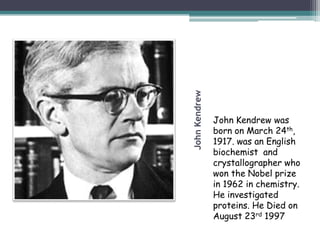
JohnKendrew
John Kendrew was
born on March 24th,
1917. was an English
biochemist and
crystallographer who
won the Nobel prize
in 1962 in chemistry.
He investigated
proteins. He Died on
August 23rd 1997
Geology
The study of rocks and minerals
Fun Facts
• The study of rocks and minerals
• Geology helps uncover the history of the earth
• It shows the climates we had a long time ago
• The word Geology was first used by Ulisse Aldrovandi in
1603.
• In the 19th century a lot of geology was focused on
finding out how old the earth was.
• William Smith made the first geological maps
• One kind of geology is historical geology. Historical
geology focuses on the development of the earth.
• Another kind of geology is physical geology. Physical
geology focuses on How rocks form into other rocks and
the composition of rocks and landforms.
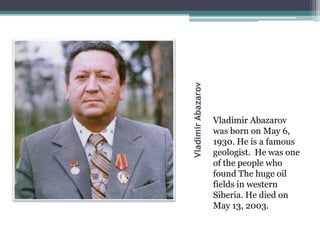
VladimirAbazarov
Vladimir Abazarov
was born on May 6,
1930. He is a famous
geologist. He was one
of the people who
found The huge oil
fields in western
Siberia. He died on
May 13, 2003.
Petrology
The study of the composition and
distribution of rocks
Fun Facts
• One branch of Petrology is Igneous Petrology.
Igneous Petrology focuses on The composition and
texture of Igneous Rocks
• Sedimentary Petrology does the same except with
sedimentary rocks.
• Petrology uses mineralogy, petrography, optical
mineralogy and analysis wit chemicals to describe
rocks
• Today's Petrologists also use geochemistry with
their work
• Petrology does work with oils
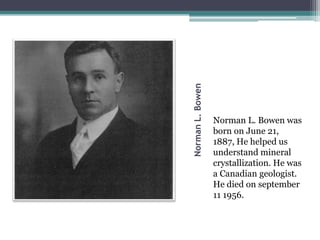
NormanL.Bowen
Norman L. Bowen was
born on June 21,
1887, He helped us
understand mineral
crystallization. He was
a Canadian geologist.
He died on september
11 1956.
Physics
The study of matter and
experimenting with it
Fun Facts
• It works with matter, by experimenting with it, and it also works
with energy and force
• Physics helps with creating new technology
• It helped us understand electromagnetism
• Max Planck started Modern Physics
• Physics uses a lot of different systems to figure out stuff. All of those
theories were tested a lot of times and found an approximation to
nature.
• There are theories like classic mechanics accurately describe the
motion of objects, only if they are much bigger than an atom and
slower than the speed of light.
• There is classic physics and that is more focused on experimenting
with matter and energy on the normal observation
• There is modern physics and that is focused on experimenting with
matter and energy with extreme observation
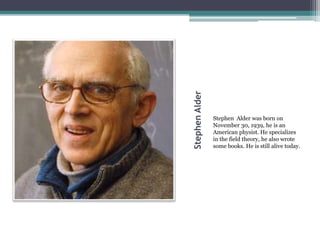
StephenAlder
Stephen Alder was born on
November 30, 1939, he is an
American physist. He specializes
in the field theory, he also wrote
some books. He is still alive today.
Mineralogy
They study of the properties of
minerals
Fun Facts
• Mineralogy studies how Minerals form and what kind of mineral
they are and of course the properties.
• Some of the earliest mineralogy comes from Babylonia.
• There is a thing called the International Mineralogical association.
The international Mineralogical association is a Association where
The members represent Mineralogists from different countries.
• There is Chemical Mineralogy. Chemical Mineralogy focuses on
The chemical Composition of minerals.
• There is optical Mineralogy And that focuses on The ways to identify
minerals with different kinds of light
• There is descriptive mineralogy and that focuses on ways to describe
mineral substances.
• Determinative mineralogy Focuses on using the scientific process to
identify minerals
Angsiah Brown
Angsiah Brown is a famous mineralogist. He
discovered that stalactites and stalagmites never
stop growing, and grow about 1 cm every
thousand years. There are not many famous
mineralogists.
Seismology
The study of earthquakes and
waves through the earth
Fun facts
• Seismology studies earthquakes and the effects
of earthquakes
• A recording of an earth motion is called a
seismogram
• In 132 A.D. Zhang Heng created the first
seismoscope
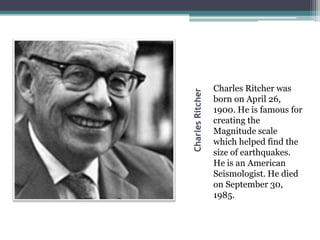
CharlesRitcher
Charles Ritcher was
born on April 26,
1900. He is famous for
creating the
Magnitude scale
which helped find the
size of earthquakes.
He is an American
Seismologist. He died
on September 30,
1985.
Meteorology
The study of the atmosphere
Fun facts
• Meteorology Studies the atmosphere
• Meteorology is one of the sub-fields of the
atmospheric sciences.
• Meteorological phenomena is explained by
meteorology.
• The beginning of meteorology started in ancient
India.
• A person called St. Albert the Great (Possibly
and probably a meteorologist) was the first to
say that a rain drop was a small sphere.
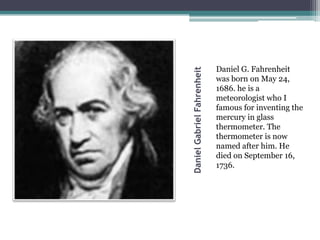
DanielGabrielFahrenheit
Daniel G. Fahrenheit
was born on May 24,
1686. he is a
meteorologist who I
famous for inventing the
mercury in glass
thermometer. The
thermometer is now
named after him. He
died on September 16,
1736.
Thank You for watching
By: Misha K.
Recourses: Wikipedia

Physical scientists misha

  • 1.
    Physical Scientists Astronomers. Chemists. Geologists.Petrologists. Physics. Mineralogists. Seismologists. Meteorologists.
  • 2.
    Physical Science • PhysicalScience is a science that works with physical properties. It doesn't work with living things, Apposed to life science, it works more with the occur of natural things.
  • 3.
  • 4.
    Fun Facts • Studyof the universe, stars and galaxies. • The meaning of Astronomy is astro- which means star, then onomy- which means management or measurement. • Astronomy is one of the oldest sciences. Early civilizations made observations of the Night sky. Some of them were the Chinese, Greek, Indians and the Iranians. • Professional astronomy is split into Observational and theoretical branches. Observational astronomy gets information from observations of stuff like stars and all the astronomical objects. Theoretical astronomy makes computer models to describe astronomical objects. • There is an astronomy called Amateur astronomy and it is a hobby for people that watch the sky and the objects in the sky. It is usually done with portable telescopes and binoculars. • In early times, astronomy was only observations and predictions from the naked eye.
  • 5.
    JohnArchibaldWheeler John A. Wheeler,an astromomer and teacher who helped invent the theory of nuclear fission and gave black holes their name, died Sunday morning at his home in Hightstown, N.J. He was 96.
  • 6.
    chemistry The study ofcomposition and the properties of matter .
  • 7.
    Fun Facts • Chemistryworks with atoms and mostly with the study of chemical bonds • The word chemistry comes from the word alchemy, it was the study of all the things , metallurgy, philosophy, astrology, astronomy, mysticism and medicine. • An alchemist was called a chemist most times. Soon the ending ry was added to describe chemistry. • chymistry" is a scientific art where you dissolve bodies, and take substances when they are decomposing • By 1000 BC ancient civilizations were using technologies that made different branches in chemistry like extracting metal from their ores, making pottery and glazes and fermenting beer and wine. • Regular Chemistry studies elementary particles, atoms and molecules. • Lots of chemistry does not actually use glassware that much. A lot of their experiments are done without it
  • 8.
    JohnKendrew John Kendrew was bornon March 24th, 1917. was an English biochemist and crystallographer who won the Nobel prize in 1962 in chemistry. He investigated proteins. He Died on August 23rd 1997
  • 9.
    Geology The study ofrocks and minerals
  • 10.
    Fun Facts • Thestudy of rocks and minerals • Geology helps uncover the history of the earth • It shows the climates we had a long time ago • The word Geology was first used by Ulisse Aldrovandi in 1603. • In the 19th century a lot of geology was focused on finding out how old the earth was. • William Smith made the first geological maps • One kind of geology is historical geology. Historical geology focuses on the development of the earth. • Another kind of geology is physical geology. Physical geology focuses on How rocks form into other rocks and the composition of rocks and landforms.
  • 11.
    VladimirAbazarov Vladimir Abazarov was bornon May 6, 1930. He is a famous geologist. He was one of the people who found The huge oil fields in western Siberia. He died on May 13, 2003.
  • 12.
    Petrology The study ofthe composition and distribution of rocks
  • 13.
    Fun Facts • Onebranch of Petrology is Igneous Petrology. Igneous Petrology focuses on The composition and texture of Igneous Rocks • Sedimentary Petrology does the same except with sedimentary rocks. • Petrology uses mineralogy, petrography, optical mineralogy and analysis wit chemicals to describe rocks • Today's Petrologists also use geochemistry with their work • Petrology does work with oils
  • 14.
    NormanL.Bowen Norman L. Bowenwas born on June 21, 1887, He helped us understand mineral crystallization. He was a Canadian geologist. He died on september 11 1956.
  • 15.
    Physics The study ofmatter and experimenting with it
  • 16.
    Fun Facts • Itworks with matter, by experimenting with it, and it also works with energy and force • Physics helps with creating new technology • It helped us understand electromagnetism • Max Planck started Modern Physics • Physics uses a lot of different systems to figure out stuff. All of those theories were tested a lot of times and found an approximation to nature. • There are theories like classic mechanics accurately describe the motion of objects, only if they are much bigger than an atom and slower than the speed of light. • There is classic physics and that is more focused on experimenting with matter and energy on the normal observation • There is modern physics and that is focused on experimenting with matter and energy with extreme observation
  • 17.
    StephenAlder Stephen Alder wasborn on November 30, 1939, he is an American physist. He specializes in the field theory, he also wrote some books. He is still alive today.
  • 18.
    Mineralogy They study ofthe properties of minerals
  • 19.
    Fun Facts • Mineralogystudies how Minerals form and what kind of mineral they are and of course the properties. • Some of the earliest mineralogy comes from Babylonia. • There is a thing called the International Mineralogical association. The international Mineralogical association is a Association where The members represent Mineralogists from different countries. • There is Chemical Mineralogy. Chemical Mineralogy focuses on The chemical Composition of minerals. • There is optical Mineralogy And that focuses on The ways to identify minerals with different kinds of light • There is descriptive mineralogy and that focuses on ways to describe mineral substances. • Determinative mineralogy Focuses on using the scientific process to identify minerals
  • 20.
    Angsiah Brown Angsiah Brownis a famous mineralogist. He discovered that stalactites and stalagmites never stop growing, and grow about 1 cm every thousand years. There are not many famous mineralogists.
  • 21.
    Seismology The study ofearthquakes and waves through the earth
  • 22.
    Fun facts • Seismologystudies earthquakes and the effects of earthquakes • A recording of an earth motion is called a seismogram • In 132 A.D. Zhang Heng created the first seismoscope
  • 23.
    CharlesRitcher Charles Ritcher was bornon April 26, 1900. He is famous for creating the Magnitude scale which helped find the size of earthquakes. He is an American Seismologist. He died on September 30, 1985.
  • 24.
  • 25.
    Fun facts • MeteorologyStudies the atmosphere • Meteorology is one of the sub-fields of the atmospheric sciences. • Meteorological phenomena is explained by meteorology. • The beginning of meteorology started in ancient India. • A person called St. Albert the Great (Possibly and probably a meteorologist) was the first to say that a rain drop was a small sphere.
  • 26.
    DanielGabrielFahrenheit Daniel G. Fahrenheit wasborn on May 24, 1686. he is a meteorologist who I famous for inventing the mercury in glass thermometer. The thermometer is now named after him. He died on September 16, 1736.
  • 27.
    Thank You forwatching By: Misha K. Recourses: Wikipedia