Introduction to America’s
Number One
University Admissions Test
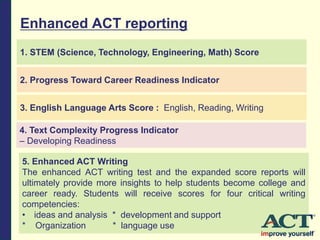
Enhanced ACT reporting
2. Progress Toward Career Readiness Indicator
4. Text Complexity Progress Indicator
– Developing Readiness
1. STEM (Science, Technology, Engineering, Math) Score
3. English Language Arts Score : English, Reading, Writing
5. Enhanced ACT Writing
The enhanced ACT writing test and the expanded score reports will
ultimately provide more insights to help students become college and
career ready. Students will receive scores for four critical writing
competencies:
• ideas and analysis * development and support
* Organization * language use
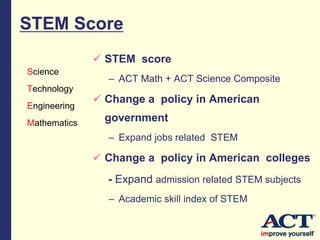
STEM Score
 STEM score
– ACT Math + ACT Science Composite
 Change a policy in American
government
– Expand jobs related STEM
 Change a policy in American colleges
- Expand admission related STEM subjects
– Academic skill index of STEM
Science
Technology
Engineering
Mathematics
The meaning of Career Readiness
Indicator
Career Readiness Indicator
ACT NCRC®
National Career Readiness Certificate
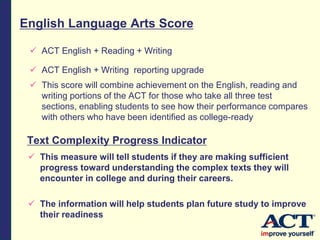
English Language Arts Score
Text Complexity Progress Indicator
 ACT English + Reading + Writing
 ACT English + Writing reporting upgrade
 This score will combine achievement on the English, reading and
writing portions of the ACT for those who take all three test
sections, enabling students to see how their performance compares
with others who have been identified as college-ready
 This measure will tell students if they are making sufficient
progress toward understanding the complex texts they will
encounter in college and during their careers.
 The information will help students plan future study to improve
their readiness
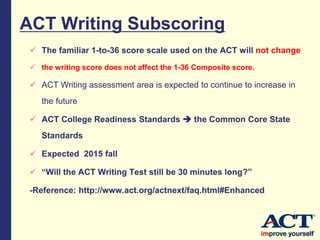
ACT Writing Subscoring
 The familiar 1-to-36 score scale used on the ACT will not change
 the writing score does not affect the 1-36 Composite score.
 ACT Writing assessment area is expected to continue to increase in
the future
 ACT College Readiness Standards  the Common Core State
Standards
 Expected 2015 fall
 “Will the ACT Writing Test still be 30 minutes long?”
-Reference: http://www.act.org/actnext/faq.html#Enhanced
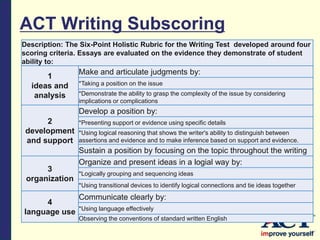
ACT Writing Subscoring
Description: The Six-Point Holistic Rubric for the Writing Test developed around four
scoring criteria. Essays are evaluated on the evidence they demonstrate of student
ability to:
1
ideas and
analysis
Make and articulate judgments by:
*Taking a position on the issue
*Demonstrate the ability to grasp the complexity of the issue by considering
implications or complications
2
development
and support
Develop a position by:
*Presenting support or evidence using specific details
*Using logical reasoning that shows the writer's ability to distinguish between
assertions and evidence and to make inference based on support and evidence.
Sustain a position by focusing on the topic throughout the writing
3
organization
Organize and present ideas in a logial way by:
*Logically grouping and sequencing ideas
*Using transitional devices to identify logical connections and tie ideas together
4
language use
Communicate clearly by:
*Using language effectively
Observing the conventions of standard written English
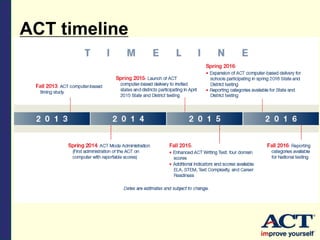
ACT timeline
ACT, Inc.
• Established 1959
• Non-profit
• Mission: helping
people achieve
education and
workplace success
• www.act.org
The ACT Test
The university-entrance exam; administered in more than
130 countries.
ACT Plan® &
ACT Explore®
Our 8th- and 10th-grade
versions of the ACT Test
(i.e., Pre-ACT) designed to
measure if students are on
track for college readiness.
ACT Compass®/ESL
Placement tests used by
two- and four-year
colleges and universities
for their entering
students.
Global Assessment
Certificate™ (GAC)
A university preparation
program designed to prepare
non-native speakers of English
for postsecondary study in an
English-language country.
ACT WorkKeys®/ICRC
Used to assess workplace
skills of individuals, and to
certify individuals as “workp
lace ready.”
The ACT Test
• Standards based
• Achievement test of
knowledge
• Accepted by all 4 year
colleges and universities in
the USA
• 1.84 million U.S. students
tested (57% SoM) in 2013-
14
“There is also a real shift in the
behavior to top high school students,
with many more choosing to work
toward impressive scores on both
tests.”
– News article by Tamar Lewin: New York Times. Aug.
2, 2013
Over 3,400 students submitted only an ACT
test score for admission into Princeton
University this year, and almost 8,000
students this year submitted scores for both
tests.
– News article by Tamar Lewin: New York
Times. Aug. 2, 2013
William R. Fitzsimmons, dean of admissions
and financial aid at Harvard: “The (ACT and
SAT) tests predict college performance
equally well…so it doesn’t concern us at all
whether students send the SAT, the ACT or
both.”
– News article by Tamar Lewin: New York
Times. Aug. 2, 2013
Jonathan Chui, national content director of
high school programs at the Princeton
Review: “ACT is more straightforward in
their question construction….” About 47% of
the students he works with now take both
tests because they “want to sweeten their
college portfolios.”
– News article by Tamar Lewin: New York
Times. Aug. 2, 2013
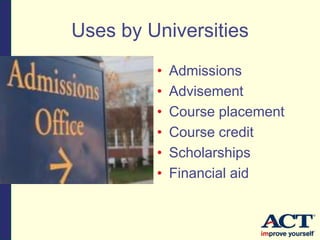
Uses by Universities
• Admissions
• Advisement
• Course placement
• Course credit
• Scholarships
• Financial aid
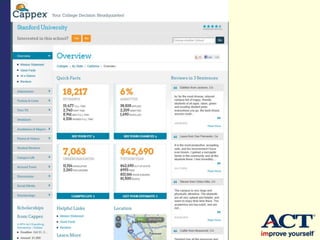
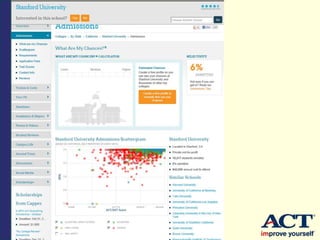
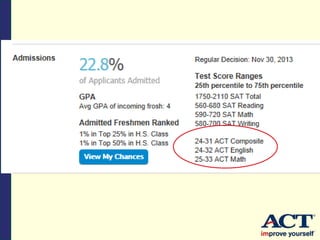
www.cappex.com
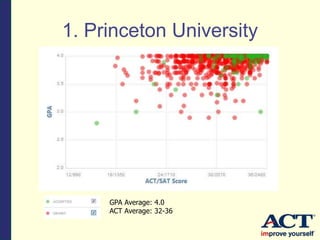
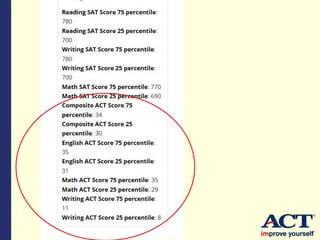
1. Princeton University
GPA Average: 4.0
ACT Average: 32-36
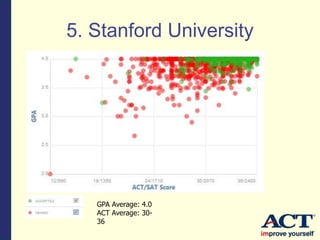
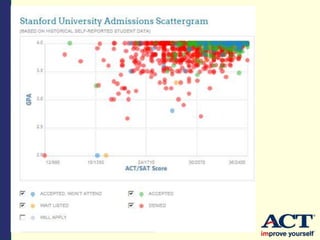
5. Stanford University
GPA Average: 4.0
ACT Average: 30-
36
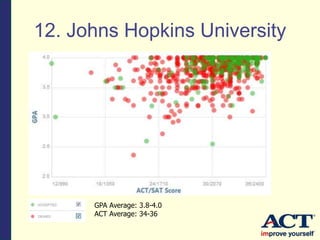
12. Johns Hopkins University
GPA Average: 3.8-4.0
ACT Average: 34-36
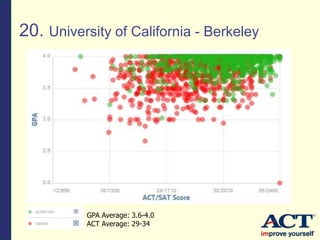
20. University of California - Berkeley
GPA Average: 3.6-4.0
ACT Average: 29-34
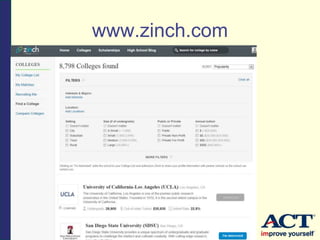
www.zinch.com
www.collegeweeklive.com
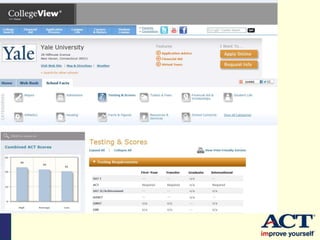
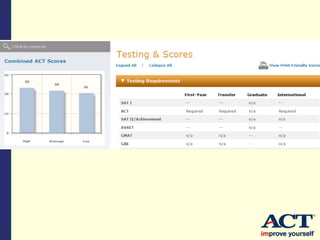
www.collegeview.com
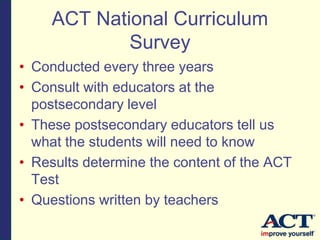
ACT National Curriculum
Survey
• Conducted every three years
• Consult with educators at the
postsecondary level
• These postsecondary educators tell us
what the students will need to know
• Results determine the content of the ACT
Test
• Questions written by teachers
College Readiness Standards
• Direct link between what students have learned
and what they are ready to learn next
• Relate the test scores to the types of skills
needed for success in high school and beyond
• Demonstrate the increasing complexity of skills
across the score ranges in English,
mathematics, reading, and science
• http://www.act.org/standard/
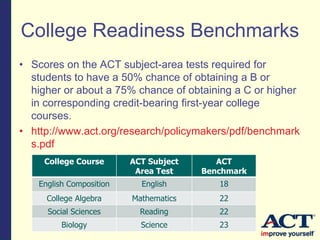
College Readiness Benchmarks
• Scores on the ACT subject-area tests required for
students to have a 50% chance of obtaining a B or
higher or about a 75% chance of obtaining a C or higher
in corresponding credit-bearing first-year college
courses.
• http://www.act.org/research/policymakers/pdf/benchmark
s.pdf
College Course ACT Subject
Area Test
ACT
Benchmark
English Composition English 18
College Algebra Mathematics 22
Social Sciences Reading 22
Biology Science 23
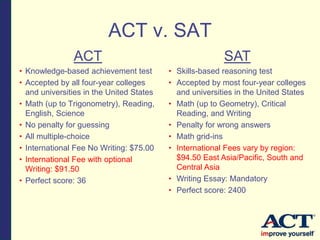
ACT v. SAT
ACT
• Knowledge-based achievement test
• Accepted by all four-year colleges
and universities in the United States
• Math (up to Trigonometry), Reading,
English, Science
• No penalty for guessing
• All multiple-choice
• International Fee No Writing: $75.00
• International Fee with optional
Writing: $91.50
• Perfect score: 36
SAT
• Skills-based reasoning test
• Accepted by most four-year colleges
and universities in the United States
• Math (up to Geometry), Critical
Reading, and Writing
• Penalty for wrong answers
• Math grid-ins
• International Fees vary by region:
$94.50 East Asia/Pacific, South and
Central Asia
• Writing Essay: Mandatory
• Perfect score: 2400
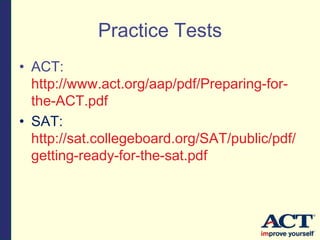
Practice Tests
• ACT:
http://www.act.org/aap/pdf/Preparing-for-
the-ACT.pdf
• SAT:
http://sat.collegeboard.org/SAT/public/pdf/
getting-ready-for-the-sat.pdf
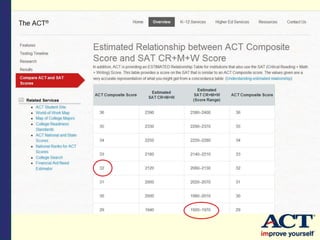
ACT / SAT Concordance
• http://www.act.org/aap/concordance/estimate.html
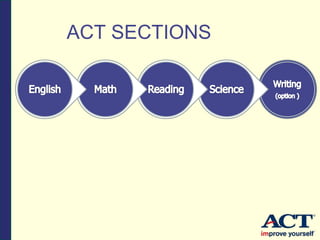
ACT SECTIONS
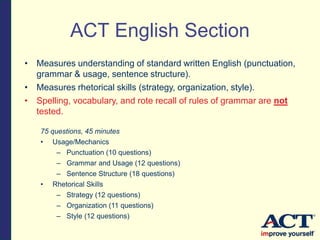
• Measures understanding of standard written English (punctuation,
grammar & usage, sentence structure).
• Measures rhetorical skills (strategy, organization, style).
• Spelling, vocabulary, and rote recall of rules of grammar are not
tested.
75 questions, 45 minutes
• Usage/Mechanics
– Punctuation (10 questions)
– Grammar and Usage (12 questions)
– Sentence Structure (18 questions)
• Rhetorical Skills
– Strategy (12 questions)
– Organization (11 questions)
– Style (12 questions)
ACT English Section
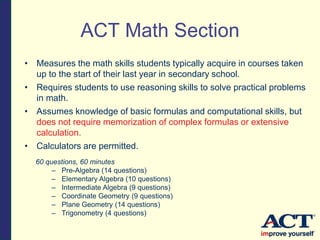
60 questions, 60 minutes
– Pre-Algebra (14 questions)
– Elementary Algebra (10 questions)
– Intermediate Algebra (9 questions)
– Coordinate Geometry (9 questions)
– Plane Geometry (14 questions)
– Trigonometry (4 questions)
ACT Math Section
• Measures the math skills students typically acquire in courses taken
up to the start of their last year in secondary school.
• Requires students to use reasoning skills to solve practical problems
in math.
• Assumes knowledge of basic formulas and computational skills, but
does not require memorization of complex formulas or extensive
calculation.
• Calculators are permitted.
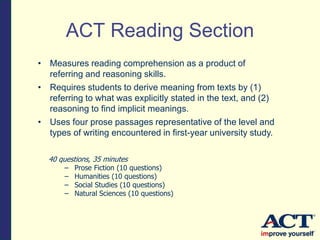
• Measures reading comprehension as a product of
referring and reasoning skills.
• Requires students to derive meaning from texts by (1)
referring to what was explicitly stated in the text, and (2)
reasoning to find implicit meanings.
• Uses four prose passages representative of the level and
types of writing encountered in first-year university study.
40 questions, 35 minutes
– Prose Fiction (10 questions)
– Humanities (10 questions)
– Social Studies (10 questions)
– Natural Sciences (10 questions)
ACT Reading Section
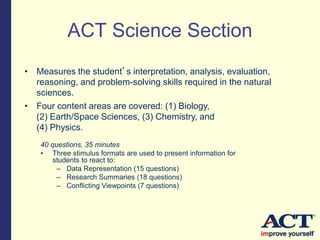
• Measures the student’s interpretation, analysis, evaluation,
reasoning, and problem-solving skills required in the natural
sciences.
• Four content areas are covered: (1) Biology,
(2) Earth/Space Sciences, (3) Chemistry, and
(4) Physics.
40 questions, 35 minutes
• Three stimulus formats are used to present information for
students to react to:
– Data Representation (15 questions)
– Research Summaries (18 questions)
– Conflicting Viewpoints (7 questions)
ACT Science Section
• Measures writing skills emphasized in high school
English classes and in entry-level university composition
courses.
• One prompt, 30 minutes
• The prompt defines an issue and describes two points of view on
that issue.
• Students are asked to write in English about their position on that
issue.
Note: The ACT Writing Test is offered internationally on all
five test dates—September, October, December, April, and June.
ACT Writing Test (Optional)
Why is the Writing Test
Optional?
• It’s optional because not all colleges and universities use it.
(Currently, only about 16% of US colleges and universities ask for
it.)
• Before deciding whether to take the ACT Writing Test, students can
go to www.actstudent.org to find out if the institutions they are
applying to require or recommend it.
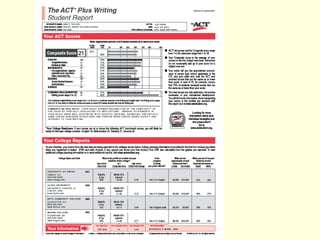
By examining their Student Report and working through the
Career Exploration and Planning Steps, students will be
able to...
•Identify their academic strengths and areas needing
improvement
•Explore possible college majors and careers
•Select a college or university that fits their aspirations
•Decide on their remaining high school courses
•Determine how much education they will need for the jobs
they are thinking about
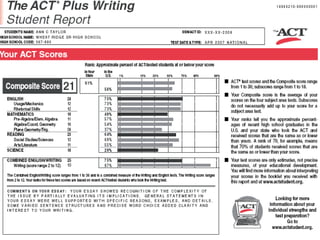
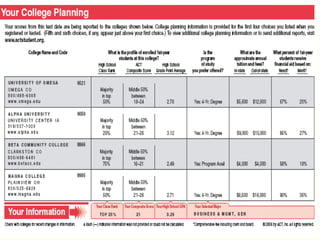
ACT Student Report
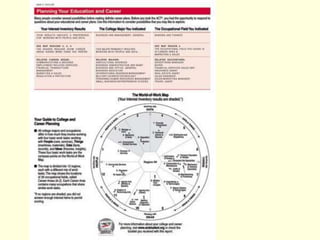
Career Planning
• As part of the registration process for the ACT Test, the students
answer 72 questions about their interests and activities.
• Based on a student’s answers, ACT uses a statistical analysis to
identify careers the student is likely to enjoy and excel at.
• When students receive their ACT Test scores, they also receive
information about careers and occupations that match to their
interests using our
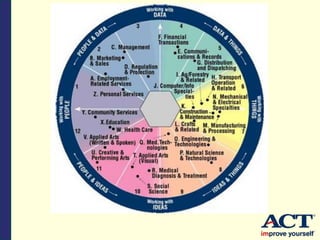
World-of-Work Map.
• Students can use this information to choose a major, select a
college, and identify a career path.
ACT Test Prep Resources
• FREE TEST PREP GUIDE:
• www.actstudent.org/testprep/index.html
• FREE SAMPLE QUESTIONS:
www.actstudent.org/sampletest/index.html
• FREE ACT TEST QUESTION OF THE DAY:
http://www.act.org/qotd/
• Other FREE RESOURCES: http://www.act.org/intl/counselor/
ACT 2014 - 2015
International Test Dates
Test Date Registration Deadline
September 13, 2014 August 8, 2014
October 25, 2014 September 19, 2014
December 13, 2014 November 7, 2014
April 18, 2015 March 13, 2015
June 13, 2015 May 8, 2015
International ACT test fees:
NO Writing, with international surcharge: $75.50
PLUS Writing, with international surcharge: $91.50
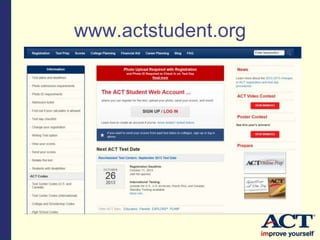
www.actstudent.org
www.actworld-wide.kr
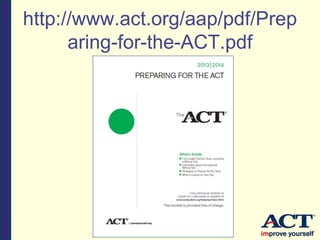
http://www.act.org/aap/pdf/Prep
aring-for-the-ACT.pdf
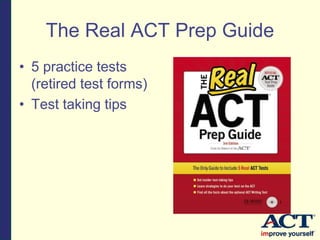
The Real ACT Prep Guide
• 5 practice tests
(retired test forms)
• Test taking tips
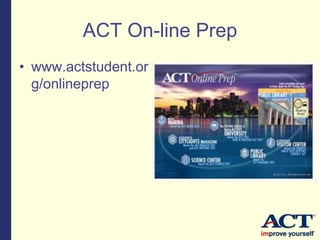
ACT On-line Prep
• www.actstudent.or
g/onlineprep
Registration Tutorial
• http://www.act.org/i
ntl/counselor/files/I
ntl-ACT-
RegTutorial-
Korean.pdf
Reference
• Registration: www.actstudent.org
• Resources: www.act.org/intl/counselor
• Test Prep: www.actstudent.org/testprep
Antarctic Adventures
In February 2001, polar adventurers Liv
Arnesen of Norway, and Ann Bancroft of
Minnesota became the first women to climb
and ski across the continent of Antarctica.
The Two former schoolteachers completed
their 2,400-mile journey in 96 days.
[1] Months before their expedition, Arnesen
and Bancroft began training by learning to ski
behind sails – parachute-like devices that can
pull a skier loaded with supplies about six
miles per hour in steady winds. [2] On
November 13, 2000, the pair boarded a small
plane in South Africa and took a six-hour flight
to Blue One Runway, it is a solid-ice airstrip
on the Atlantic coast of Antarctica. [3] They
set out soon after landing. [4] Hiking
unassisted up the 10,000-foot-high Sygyn
Glacier, and each woman pulled a sled that
weighted more than 260 pounds, [5] The
sleds carried all the women’s supplies,
including a tent, a one-burner camp stove,
diaries, two sets of skis, a laptop computer,
and a snow shovel.
1. A. NO CHANGE
B. Arnesen, of Norway, and Ann Bancroft
C. Arnesen, of Norway and Ann Bancroft,
D. Arnesen of Norway and Ann Bancroft
2. F. NO CHANGE
G. achieved
H. finalized
J. implemented
3. If the writer were to delete Sentence 5, the
essay would primarily lose details that:
A. reveal why Arnesen and Bancroft were each
limited to carrying about 260 pounds of
supplies.
B. Expand upon information provided in
Sentence 4 and also give readers a sense of
what the women needed for their journey.
C. Suggest that the women brought more
supplies than they thought they would need for
their journey.
D. Contradict the information provided in
Sentences 4 about the weight of Arnesen and
Bancroft’s supplies.
English Example
Antarctic Adventures
In February 2001, polar adventurers Liv
Arnesen of Norway, and Ann Bancroft of
Minnesota became the first women to climb
and ski across the continent of Antarctica.
The Two former schoolteachers completed
their 2,400-mile journey in 96 days.
[1] Months before their expedition, Arnesen
and Bancroft began training by learning to ski
behind sails – parachute-like devices that can
pull a skier loaded with supplies about six
miles per hour in steady winds. [2] On
November 13, 2000, the pair boarded a small
plane in South Africa and took a six-hour flight
to Blue One Runway, it is a solid-ice airstrip
on the Atlantic coast of Antarctica. [3] They
set out soon after landing. [4] Hiking
unassisted up the 10,000-foot-high Sygyn
Glacier, and each woman pulled a sled that
weighted more than 260 pounds, [5] The
sleds carried all the women’s supplies,
including a tent, a one-burner camp stove,
diaries, two sets of skis, a laptop computer,
and a snow shovel.
1. A. NO CHANGE
B. Arnesen, of Norway, and Ann Bancroft
C. Arnesen, of Norway and Ann Bancroft,
D. Arnesen of Norway and Ann Bancroft
2. F. NO CHANGE
G. achieved
H. finalized
J. implemented
3. If the writer were to delete Sentence 5, the
essay would primarily lose details that:
A. reveal why Arnesen and Bancroft were each
limited to carrying about 260 pounds of
supplies.
B. Expand upon information provided in
Sentence 4 and also give readers a sense
of what the women needed for their
journey.
C. Suggest that the women brought more
supplies than they thought they would need for
their journey.
D. Contradict the information provided in
Sentences 4 about the weight of Arnesen and
Bancroft’s supplies.
Technical Question:
Grammar
Rhetorical Question:
Reading/Writing
Ability
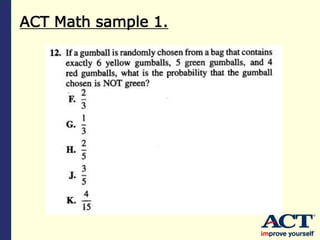
ACT Math sample 1.
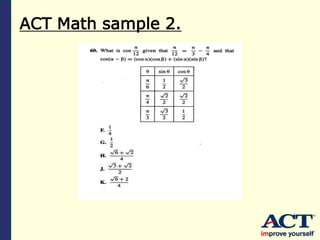
ACT Math sample 2.
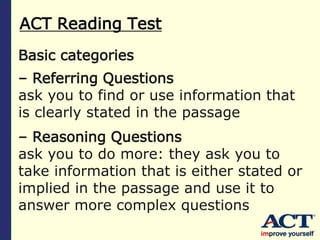
ACT Reading Test
Basic categories
– Referring Questions
ask you to find or use information that
is clearly stated in the passage
– Reasoning Questions
ask you to do more: they ask you to
take information that is either stated or
implied in the passage and use it to
answer more complex questions
Science sample 1-1
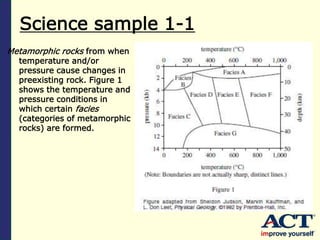
Metamorphic rocks from when
temperature and/or
pressure cause changes in
preexisting rock. Figure 1
shows the temperature and
pressure conditions in
which certain facies
(categories of metamorphic
rocks) are formed.
Science sample 1-2
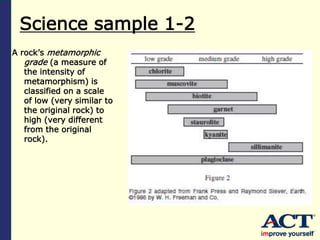
A rock’s metamorphic
grade (a measure of
the intensity of
metamorphism) is
classified on a scale
of low (very similar to
the original rock) to
high (very different
from the original
rock).
Science sample 1-3
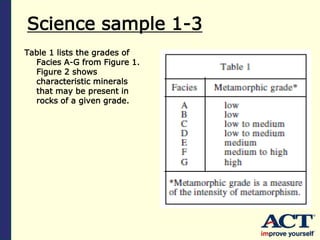
Table 1 lists the grades of
Facies A-G from Figure 1.
Figure 2 shows
characteristic minerals
that may be present in
rocks of a given grade.
Science sample 1-4
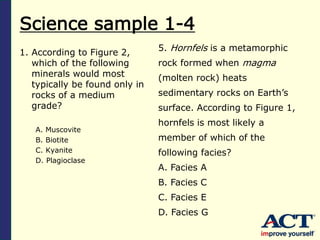
1. According to Figure 2,
which of the following
minerals would most
typically be found only in
rocks of a medium
grade?
A. Muscovite
B. Biotite
C. Kyanite
D. Plagioclase
5. Hornfels is a metamorphic
rock formed when magma
(molten rock) heats
sedimentary rocks on Earth’s
surface. According to Figure 1,
hornfels is most likely a
member of which of the
following facies?
A. Facies A
B. Facies C
C. Facies E
D. Facies G
ACT Writing Test
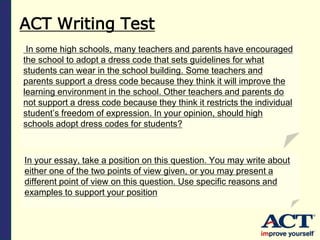
In some high schools, many teachers and parents have encouraged
the school to adopt a dress code that sets guidelines for what
students can wear in the school building. Some teachers and
parents support a dress code because they think it will improve the
learning environment in the school. Other teachers and parents do
not support a dress code because they think it restricts the individual
student’s freedom of expression. In your opinion, should high
schools adopt dress codes for students?
In your essay, take a position on this question. You may write about
either one of the two points of view given, or you may present a
different point of view on this question. Use specific reasons and
examples to support your position
Reading Test Question Types
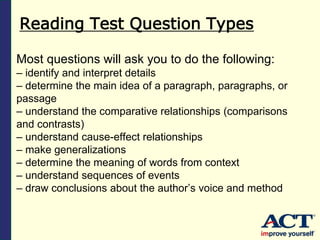
Most questions will ask you to do the following:
– identify and interpret details
– determine the main idea of a paragraph, paragraphs, or
passage
– understand the comparative relationships (comparisons
and contrasts)
– understand cause-effect relationships
– make generalizations
– determine the meaning of words from context
– understand sequences of events
– draw conclusions about the author’s voice and method

Act seminar presentation

  • 1.
    Introduction to America’s NumberOne University Admissions Test
  • 2.
    Enhanced ACT reporting 2.Progress Toward Career Readiness Indicator 4. Text Complexity Progress Indicator – Developing Readiness 1. STEM (Science, Technology, Engineering, Math) Score 3. English Language Arts Score : English, Reading, Writing 5. Enhanced ACT Writing The enhanced ACT writing test and the expanded score reports will ultimately provide more insights to help students become college and career ready. Students will receive scores for four critical writing competencies: • ideas and analysis * development and support * Organization * language use
  • 3.
    STEM Score  STEMscore – ACT Math + ACT Science Composite  Change a policy in American government – Expand jobs related STEM  Change a policy in American colleges - Expand admission related STEM subjects – Academic skill index of STEM Science Technology Engineering Mathematics
  • 4.
    The meaning ofCareer Readiness Indicator Career Readiness Indicator ACT NCRC® National Career Readiness Certificate
  • 5.
    English Language ArtsScore Text Complexity Progress Indicator  ACT English + Reading + Writing  ACT English + Writing reporting upgrade  This score will combine achievement on the English, reading and writing portions of the ACT for those who take all three test sections, enabling students to see how their performance compares with others who have been identified as college-ready  This measure will tell students if they are making sufficient progress toward understanding the complex texts they will encounter in college and during their careers.  The information will help students plan future study to improve their readiness
  • 6.
    ACT Writing Subscoring The familiar 1-to-36 score scale used on the ACT will not change  the writing score does not affect the 1-36 Composite score.  ACT Writing assessment area is expected to continue to increase in the future  ACT College Readiness Standards  the Common Core State Standards  Expected 2015 fall  “Will the ACT Writing Test still be 30 minutes long?” -Reference: http://www.act.org/actnext/faq.html#Enhanced
  • 7.
    ACT Writing Subscoring Description:The Six-Point Holistic Rubric for the Writing Test developed around four scoring criteria. Essays are evaluated on the evidence they demonstrate of student ability to: 1 ideas and analysis Make and articulate judgments by: *Taking a position on the issue *Demonstrate the ability to grasp the complexity of the issue by considering implications or complications 2 development and support Develop a position by: *Presenting support or evidence using specific details *Using logical reasoning that shows the writer's ability to distinguish between assertions and evidence and to make inference based on support and evidence. Sustain a position by focusing on the topic throughout the writing 3 organization Organize and present ideas in a logial way by: *Logically grouping and sequencing ideas *Using transitional devices to identify logical connections and tie ideas together 4 language use Communicate clearly by: *Using language effectively Observing the conventions of standard written English
  • 8.
  • 9.
    ACT, Inc. • Established1959 • Non-profit • Mission: helping people achieve education and workplace success • www.act.org
  • 10.
    The ACT Test Theuniversity-entrance exam; administered in more than 130 countries. ACT Plan® & ACT Explore® Our 8th- and 10th-grade versions of the ACT Test (i.e., Pre-ACT) designed to measure if students are on track for college readiness. ACT Compass®/ESL Placement tests used by two- and four-year colleges and universities for their entering students. Global Assessment Certificate™ (GAC) A university preparation program designed to prepare non-native speakers of English for postsecondary study in an English-language country. ACT WorkKeys®/ICRC Used to assess workplace skills of individuals, and to certify individuals as “workp lace ready.”
  • 11.
    The ACT Test •Standards based • Achievement test of knowledge • Accepted by all 4 year colleges and universities in the USA • 1.84 million U.S. students tested (57% SoM) in 2013- 14
  • 12.
    “There is alsoa real shift in the behavior to top high school students, with many more choosing to work toward impressive scores on both tests.” – News article by Tamar Lewin: New York Times. Aug. 2, 2013
  • 13.
    Over 3,400 studentssubmitted only an ACT test score for admission into Princeton University this year, and almost 8,000 students this year submitted scores for both tests. – News article by Tamar Lewin: New York Times. Aug. 2, 2013
  • 14.
    William R. Fitzsimmons,dean of admissions and financial aid at Harvard: “The (ACT and SAT) tests predict college performance equally well…so it doesn’t concern us at all whether students send the SAT, the ACT or both.” – News article by Tamar Lewin: New York Times. Aug. 2, 2013
  • 15.
    Jonathan Chui, nationalcontent director of high school programs at the Princeton Review: “ACT is more straightforward in their question construction….” About 47% of the students he works with now take both tests because they “want to sweeten their college portfolios.” – News article by Tamar Lewin: New York Times. Aug. 2, 2013
  • 16.
    Uses by Universities •Admissions • Advisement • Course placement • Course credit • Scholarships • Financial aid
  • 17.
  • 20.
    1. Princeton University GPAAverage: 4.0 ACT Average: 32-36
  • 21.
    5. Stanford University GPAAverage: 4.0 ACT Average: 30- 36
  • 22.
    12. Johns HopkinsUniversity GPA Average: 3.8-4.0 ACT Average: 34-36
  • 23.
    20. University ofCalifornia - Berkeley GPA Average: 3.6-4.0 ACT Average: 29-34
  • 25.
  • 28.
  • 31.
  • 34.
    ACT National Curriculum Survey •Conducted every three years • Consult with educators at the postsecondary level • These postsecondary educators tell us what the students will need to know • Results determine the content of the ACT Test • Questions written by teachers
  • 35.
    College Readiness Standards •Direct link between what students have learned and what they are ready to learn next • Relate the test scores to the types of skills needed for success in high school and beyond • Demonstrate the increasing complexity of skills across the score ranges in English, mathematics, reading, and science • http://www.act.org/standard/
  • 36.
    College Readiness Benchmarks •Scores on the ACT subject-area tests required for students to have a 50% chance of obtaining a B or higher or about a 75% chance of obtaining a C or higher in corresponding credit-bearing first-year college courses. • http://www.act.org/research/policymakers/pdf/benchmark s.pdf College Course ACT Subject Area Test ACT Benchmark English Composition English 18 College Algebra Mathematics 22 Social Sciences Reading 22 Biology Science 23
  • 37.
    ACT v. SAT ACT •Knowledge-based achievement test • Accepted by all four-year colleges and universities in the United States • Math (up to Trigonometry), Reading, English, Science • No penalty for guessing • All multiple-choice • International Fee No Writing: $75.00 • International Fee with optional Writing: $91.50 • Perfect score: 36 SAT • Skills-based reasoning test • Accepted by most four-year colleges and universities in the United States • Math (up to Geometry), Critical Reading, and Writing • Penalty for wrong answers • Math grid-ins • International Fees vary by region: $94.50 East Asia/Pacific, South and Central Asia • Writing Essay: Mandatory • Perfect score: 2400
  • 38.
    Practice Tests • ACT: http://www.act.org/aap/pdf/Preparing-for- the-ACT.pdf •SAT: http://sat.collegeboard.org/SAT/public/pdf/ getting-ready-for-the-sat.pdf
  • 39.
    ACT / SATConcordance • http://www.act.org/aap/concordance/estimate.html
  • 41.
  • 42.
    • Measures understandingof standard written English (punctuation, grammar & usage, sentence structure). • Measures rhetorical skills (strategy, organization, style). • Spelling, vocabulary, and rote recall of rules of grammar are not tested. 75 questions, 45 minutes • Usage/Mechanics – Punctuation (10 questions) – Grammar and Usage (12 questions) – Sentence Structure (18 questions) • Rhetorical Skills – Strategy (12 questions) – Organization (11 questions) – Style (12 questions) ACT English Section
  • 43.
    60 questions, 60minutes – Pre-Algebra (14 questions) – Elementary Algebra (10 questions) – Intermediate Algebra (9 questions) – Coordinate Geometry (9 questions) – Plane Geometry (14 questions) – Trigonometry (4 questions) ACT Math Section • Measures the math skills students typically acquire in courses taken up to the start of their last year in secondary school. • Requires students to use reasoning skills to solve practical problems in math. • Assumes knowledge of basic formulas and computational skills, but does not require memorization of complex formulas or extensive calculation. • Calculators are permitted.
  • 44.
    • Measures readingcomprehension as a product of referring and reasoning skills. • Requires students to derive meaning from texts by (1) referring to what was explicitly stated in the text, and (2) reasoning to find implicit meanings. • Uses four prose passages representative of the level and types of writing encountered in first-year university study. 40 questions, 35 minutes – Prose Fiction (10 questions) – Humanities (10 questions) – Social Studies (10 questions) – Natural Sciences (10 questions) ACT Reading Section
  • 45.
    • Measures thestudent’s interpretation, analysis, evaluation, reasoning, and problem-solving skills required in the natural sciences. • Four content areas are covered: (1) Biology, (2) Earth/Space Sciences, (3) Chemistry, and (4) Physics. 40 questions, 35 minutes • Three stimulus formats are used to present information for students to react to: – Data Representation (15 questions) – Research Summaries (18 questions) – Conflicting Viewpoints (7 questions) ACT Science Section
  • 46.
    • Measures writingskills emphasized in high school English classes and in entry-level university composition courses. • One prompt, 30 minutes • The prompt defines an issue and describes two points of view on that issue. • Students are asked to write in English about their position on that issue. Note: The ACT Writing Test is offered internationally on all five test dates—September, October, December, April, and June. ACT Writing Test (Optional)
  • 47.
    Why is theWriting Test Optional? • It’s optional because not all colleges and universities use it. (Currently, only about 16% of US colleges and universities ask for it.) • Before deciding whether to take the ACT Writing Test, students can go to www.actstudent.org to find out if the institutions they are applying to require or recommend it.
  • 48.
    By examining theirStudent Report and working through the Career Exploration and Planning Steps, students will be able to... •Identify their academic strengths and areas needing improvement •Explore possible college majors and careers •Select a college or university that fits their aspirations •Decide on their remaining high school courses •Determine how much education they will need for the jobs they are thinking about ACT Student Report
  • 53.
    Career Planning • Aspart of the registration process for the ACT Test, the students answer 72 questions about their interests and activities. • Based on a student’s answers, ACT uses a statistical analysis to identify careers the student is likely to enjoy and excel at. • When students receive their ACT Test scores, they also receive information about careers and occupations that match to their interests using our World-of-Work Map. • Students can use this information to choose a major, select a college, and identify a career path.
  • 55.
    ACT Test PrepResources • FREE TEST PREP GUIDE: • www.actstudent.org/testprep/index.html • FREE SAMPLE QUESTIONS: www.actstudent.org/sampletest/index.html • FREE ACT TEST QUESTION OF THE DAY: http://www.act.org/qotd/ • Other FREE RESOURCES: http://www.act.org/intl/counselor/
  • 56.
    ACT 2014 -2015 International Test Dates Test Date Registration Deadline September 13, 2014 August 8, 2014 October 25, 2014 September 19, 2014 December 13, 2014 November 7, 2014 April 18, 2015 March 13, 2015 June 13, 2015 May 8, 2015 International ACT test fees: NO Writing, with international surcharge: $75.50 PLUS Writing, with international surcharge: $91.50
  • 57.
  • 58.
  • 59.
  • 60.
    The Real ACTPrep Guide • 5 practice tests (retired test forms) • Test taking tips
  • 61.
    ACT On-line Prep •www.actstudent.or g/onlineprep
  • 62.
  • 63.
    Reference • Registration: www.actstudent.org •Resources: www.act.org/intl/counselor • Test Prep: www.actstudent.org/testprep
  • 65.
    Antarctic Adventures In February2001, polar adventurers Liv Arnesen of Norway, and Ann Bancroft of Minnesota became the first women to climb and ski across the continent of Antarctica. The Two former schoolteachers completed their 2,400-mile journey in 96 days. [1] Months before their expedition, Arnesen and Bancroft began training by learning to ski behind sails – parachute-like devices that can pull a skier loaded with supplies about six miles per hour in steady winds. [2] On November 13, 2000, the pair boarded a small plane in South Africa and took a six-hour flight to Blue One Runway, it is a solid-ice airstrip on the Atlantic coast of Antarctica. [3] They set out soon after landing. [4] Hiking unassisted up the 10,000-foot-high Sygyn Glacier, and each woman pulled a sled that weighted more than 260 pounds, [5] The sleds carried all the women’s supplies, including a tent, a one-burner camp stove, diaries, two sets of skis, a laptop computer, and a snow shovel. 1. A. NO CHANGE B. Arnesen, of Norway, and Ann Bancroft C. Arnesen, of Norway and Ann Bancroft, D. Arnesen of Norway and Ann Bancroft 2. F. NO CHANGE G. achieved H. finalized J. implemented 3. If the writer were to delete Sentence 5, the essay would primarily lose details that: A. reveal why Arnesen and Bancroft were each limited to carrying about 260 pounds of supplies. B. Expand upon information provided in Sentence 4 and also give readers a sense of what the women needed for their journey. C. Suggest that the women brought more supplies than they thought they would need for their journey. D. Contradict the information provided in Sentences 4 about the weight of Arnesen and Bancroft’s supplies.
  • 66.
    English Example Antarctic Adventures InFebruary 2001, polar adventurers Liv Arnesen of Norway, and Ann Bancroft of Minnesota became the first women to climb and ski across the continent of Antarctica. The Two former schoolteachers completed their 2,400-mile journey in 96 days. [1] Months before their expedition, Arnesen and Bancroft began training by learning to ski behind sails – parachute-like devices that can pull a skier loaded with supplies about six miles per hour in steady winds. [2] On November 13, 2000, the pair boarded a small plane in South Africa and took a six-hour flight to Blue One Runway, it is a solid-ice airstrip on the Atlantic coast of Antarctica. [3] They set out soon after landing. [4] Hiking unassisted up the 10,000-foot-high Sygyn Glacier, and each woman pulled a sled that weighted more than 260 pounds, [5] The sleds carried all the women’s supplies, including a tent, a one-burner camp stove, diaries, two sets of skis, a laptop computer, and a snow shovel. 1. A. NO CHANGE B. Arnesen, of Norway, and Ann Bancroft C. Arnesen, of Norway and Ann Bancroft, D. Arnesen of Norway and Ann Bancroft 2. F. NO CHANGE G. achieved H. finalized J. implemented 3. If the writer were to delete Sentence 5, the essay would primarily lose details that: A. reveal why Arnesen and Bancroft were each limited to carrying about 260 pounds of supplies. B. Expand upon information provided in Sentence 4 and also give readers a sense of what the women needed for their journey. C. Suggest that the women brought more supplies than they thought they would need for their journey. D. Contradict the information provided in Sentences 4 about the weight of Arnesen and Bancroft’s supplies. Technical Question: Grammar Rhetorical Question: Reading/Writing Ability
  • 67.
  • 68.
  • 69.
    ACT Reading Test Basiccategories – Referring Questions ask you to find or use information that is clearly stated in the passage – Reasoning Questions ask you to do more: they ask you to take information that is either stated or implied in the passage and use it to answer more complex questions
  • 70.
    Science sample 1-1 Metamorphicrocks from when temperature and/or pressure cause changes in preexisting rock. Figure 1 shows the temperature and pressure conditions in which certain facies (categories of metamorphic rocks) are formed.
  • 71.
    Science sample 1-2 Arock’s metamorphic grade (a measure of the intensity of metamorphism) is classified on a scale of low (very similar to the original rock) to high (very different from the original rock).
  • 72.
    Science sample 1-3 Table1 lists the grades of Facies A-G from Figure 1. Figure 2 shows characteristic minerals that may be present in rocks of a given grade.
  • 73.
    Science sample 1-4 1.According to Figure 2, which of the following minerals would most typically be found only in rocks of a medium grade? A. Muscovite B. Biotite C. Kyanite D. Plagioclase 5. Hornfels is a metamorphic rock formed when magma (molten rock) heats sedimentary rocks on Earth’s surface. According to Figure 1, hornfels is most likely a member of which of the following facies? A. Facies A B. Facies C C. Facies E D. Facies G
  • 74.
    ACT Writing Test Insome high schools, many teachers and parents have encouraged the school to adopt a dress code that sets guidelines for what students can wear in the school building. Some teachers and parents support a dress code because they think it will improve the learning environment in the school. Other teachers and parents do not support a dress code because they think it restricts the individual student’s freedom of expression. In your opinion, should high schools adopt dress codes for students? In your essay, take a position on this question. You may write about either one of the two points of view given, or you may present a different point of view on this question. Use specific reasons and examples to support your position
  • 75.
    Reading Test QuestionTypes Most questions will ask you to do the following: – identify and interpret details – determine the main idea of a paragraph, paragraphs, or passage – understand the comparative relationships (comparisons and contrasts) – understand cause-effect relationships – make generalizations – determine the meaning of words from context – understand sequences of events – draw conclusions about the author’s voice and method