
Equilibration of Coffee 
The Impact of Coffee Rust in Central America
Real World 
Experience in a Free 
Market 
• According to Agrimoney.com, dated May 
21, 2014, coffee growers in Central 
America will continue to pay a heavy toll 
for the Coffee Rust (Fungus) plight until 
2015. 
• Production will fall to a 38-year low. This 
dire forecast makes no allowance for poor 
weather stemming from the El Nino 
weather pattern, which is linked to the 
drought in many places in America. 
• Costa Rica, production is not expected to 
recover toward any relief, but dropping to 
1.38m bags, lowest since 1976-1977. 
• El Salvador’s coffee exports for 2013- 
2014 will fall 74%, a historic low.
The Law of Demand 
and the Determinants 
of Demand 
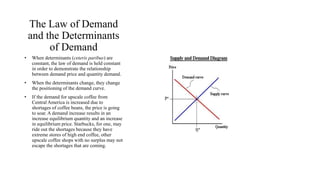
• When determinants (ceteris paribus) are 
constant, the law of demand is held constant 
in order to demonstrate the relationship 
between demand price and quantity demand. 
• When the determinants change, they change 
the positioning of the demand curve. 
• If the demand for upscale coffee from 
Central America is increased due to 
shortages of coffee beans, the price is going 
to soar. A demand increase results in an 
increase equilibrium quantity and an increase 
in equilibrium price. Starbucks, for one, may 
ride out the shortages because they have 
extreme stores of high end coffee, other 
upscale coffee shops with no surplus may not 
escape the shortages that are coming.
The Law of Supply 
and the Determinants 
of Supply 
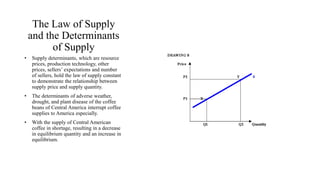
• Supply determinants, which are resource 
prices, production technology, other 
prices, sellers’ expectations and number 
of sellers, hold the law of supply constant 
to demonstrate the relationship between 
supply price and supply quantity. 
• The determinants of adverse weather, 
drought, and plant disease of the coffee 
beans of Central America interrupt coffee 
supplies to America especially. 
• With the supply of Central American 
coffee in shortage, resulting in a decrease 
in equilibrium quantity and an increase in 
equilibrium.
Efficient Markets 
Theory 
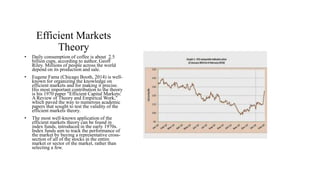
• Daily consumption of coffee is about 2.5 
billion cups, according to author, Geoff 
Riley. Millions of people across the world 
depend on its production and sale. 
• Eugene Fama (Chicago Booth, 2014) is well-known 
for organizing the knowledge on 
efficient markets and for making it precise. 
His most important contribution to the theory 
is his 1970 paper "Efficient Capital Markets: 
A Review of Theory and Empirical Work," 
which paved the way to numerous academic 
papers that sought to test the validity of the 
efficient markets theory. 
• The most well-known application of the 
efficient markets theory can be found in 
index funds, introduced in the early 1970s. 
Index funds aim to track the performance of 
the market by buying a representative cross-section 
of all of the stocks in the entire 
market or sector of the market, rather than 
selecting a few.
Surplus and Shortage 
• Surplus coffee indicates that the quantity 
exceeds the demand for coffee at the price 
in which the producers would desire to 
sell—equilibrium level. 
• If the current market were competitive, 
excess supply is equal to the quantity 
available in the market above the 
equilibrium point of intersection between 
supply and demand. This results in a shift 
in market equilibrium towards lower price 
points. 
• Shortage is a term used to indicate that 
the supply produced is below that of the 
quantity being demanded by consumers.
References 
CBS This Morning News Videos 
http://www.cbsnews.com/videos/search?q=co 
ffee%20rust 
Agrimoney.com, 
http://www.agrimoney.com/news/colombia-coffeee- 
exports-to-hit-21-year-high-- 
7081.html 
AP The Big Story 
http://www.bigstory.ap.org/article/ap-newsbreak- 
brewing-troubles-coffee-fungus 
The University of Chicago Booth School of 
Business 
http://www.chicagobooth.edu/ideas/efficient 
market.aspx

Coffee demand

  • 1.
    Equilibration of Coffee The Impact of Coffee Rust in Central America
  • 2.
    Real World Experiencein a Free Market • According to Agrimoney.com, dated May 21, 2014, coffee growers in Central America will continue to pay a heavy toll for the Coffee Rust (Fungus) plight until 2015. • Production will fall to a 38-year low. This dire forecast makes no allowance for poor weather stemming from the El Nino weather pattern, which is linked to the drought in many places in America. • Costa Rica, production is not expected to recover toward any relief, but dropping to 1.38m bags, lowest since 1976-1977. • El Salvador’s coffee exports for 2013- 2014 will fall 74%, a historic low.
  • 3.
    The Law ofDemand and the Determinants of Demand • When determinants (ceteris paribus) are constant, the law of demand is held constant in order to demonstrate the relationship between demand price and quantity demand. • When the determinants change, they change the positioning of the demand curve. • If the demand for upscale coffee from Central America is increased due to shortages of coffee beans, the price is going to soar. A demand increase results in an increase equilibrium quantity and an increase in equilibrium price. Starbucks, for one, may ride out the shortages because they have extreme stores of high end coffee, other upscale coffee shops with no surplus may not escape the shortages that are coming.
  • 4.
    The Law ofSupply and the Determinants of Supply • Supply determinants, which are resource prices, production technology, other prices, sellers’ expectations and number of sellers, hold the law of supply constant to demonstrate the relationship between supply price and supply quantity. • The determinants of adverse weather, drought, and plant disease of the coffee beans of Central America interrupt coffee supplies to America especially. • With the supply of Central American coffee in shortage, resulting in a decrease in equilibrium quantity and an increase in equilibrium.
  • 5.
    Efficient Markets Theory • Daily consumption of coffee is about 2.5 billion cups, according to author, Geoff Riley. Millions of people across the world depend on its production and sale. • Eugene Fama (Chicago Booth, 2014) is well-known for organizing the knowledge on efficient markets and for making it precise. His most important contribution to the theory is his 1970 paper "Efficient Capital Markets: A Review of Theory and Empirical Work," which paved the way to numerous academic papers that sought to test the validity of the efficient markets theory. • The most well-known application of the efficient markets theory can be found in index funds, introduced in the early 1970s. Index funds aim to track the performance of the market by buying a representative cross-section of all of the stocks in the entire market or sector of the market, rather than selecting a few.
  • 6.
    Surplus and Shortage • Surplus coffee indicates that the quantity exceeds the demand for coffee at the price in which the producers would desire to sell—equilibrium level. • If the current market were competitive, excess supply is equal to the quantity available in the market above the equilibrium point of intersection between supply and demand. This results in a shift in market equilibrium towards lower price points. • Shortage is a term used to indicate that the supply produced is below that of the quantity being demanded by consumers.
  • 7.
    References CBS ThisMorning News Videos http://www.cbsnews.com/videos/search?q=co ffee%20rust Agrimoney.com, http://www.agrimoney.com/news/colombia-coffeee- exports-to-hit-21-year-high-- 7081.html AP The Big Story http://www.bigstory.ap.org/article/ap-newsbreak- brewing-troubles-coffee-fungus The University of Chicago Booth School of Business http://www.chicagobooth.edu/ideas/efficient market.aspx