Shelly P. Harrell, Ph.D.
Jessika Bailey, M.A.
Jacob Stein, M.A.
Tyonna Adams, M.A.
Presented at the Biennial Conference of
The Society for Community Research and Action
June 26, 2015
Lowell, MA
Freire wrote about our ontological “vocation
to be fully human” and how it becomes
distorted by oppression.
Social justice involves processes of
humanization and affirmation of diversity in
the service of individual and collective
wellness.
Injustice is maintained where there is
dehumanization and compromised wellness.
Individually
Relationally
Collectively
Fulfillment of Freire’s human vocation
involves an existential paradox
Central to this vocation to become fully
human includes
Awareness of oppression
Resistance to oppression
Liberation from oppression
Movement toward the transformation of
oppression
While simultaneously trying to “be fully
human”, and live authentically and
meaningfully in the context of oppression.
Interconnectedness and understanding of our
interdependence
across our diversities,
between the local and the global
Compassion for our shared humanity,
Critical Consciousness of our collective condition,
Involvement in the world with a sense of purpose
greater than ourselves
e.g., the dismantling of oppression and promotion of
wellness- individually, relationally, and collectively.
This central aim of this workshop is to introduce
the CO-EXIST approach experientially by
facilitating Communal and Contemplative (CoCo)
practices. CoCo practices, the actual
technologies of CO-EXIST work, emphasize
reflective, creative, and relational processes.
The COmmunity-EXISTential approach was
developed as a way of addressing our shared
calling to become more fully human in our
pursuit of wellness and social justice.
Community – Conscious Awareness of our
Interconnectedness, Relationality, Awareness of
our Interdependence
Existential – Experiential Awareness, Meaning-
Purpose, Authenticity, Challenge of the Human
Condition to Thrive and Maintain Our Humanity in
the Context of Limitations
Please write 4 words on your index card:
One word to describe a strength that you bring to
your personal and professional endeavors.
One word to describe something in the natural world
with which you feel strongly connected or identified
(e.g., color, flower, tree, animal, part of nature, a place etc.)
Choose One of the following words:
Illuminating Affirming Manifesting Mobilizing
Expressing Igniting Revealing Amplifying
Creating Radiating Liberating Engaging
One word to describe a central value in your life that
guides your decisions and ways of living or a word
that represents a vision that you have for our world.
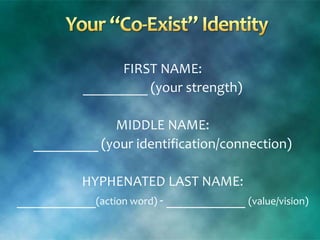
FIRST NAME:
_________ (your strength)
MIDDLE NAME:
_________ (your identification/connection)
HYPHENATED LAST NAME:
___________(action word) - ___________ (value/vision)
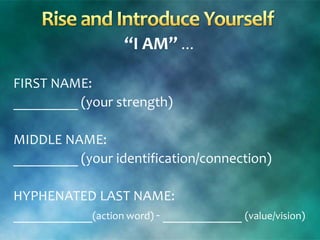
“I AM” …
FIRST NAME:
_________ (your strength)
MIDDLE NAME:
_________ (your identification/connection)
HYPHENATED LAST NAME:
___________(action word) - ___________ (value/vision)
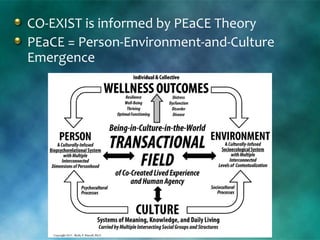
CO-EXIST is informed by PEaCE Theory
PEaCE = Person-Environment-and-Culture
Emergence
1) Interconnectedness and Relationality
2) Complexity and Context
3) Culturally-Syntonic Engagement
4) Affirmative Humanization
5) Existential Meaning-Making
6) Empowerment and Liberation
7) Creative Transformation
How we conceptualize the specific practices that
bring the PEaCE principles to life
Examples we use
-Reflection and Writing
-Diverse Meditative Practices
-Expressive Arts
-Experiential Activities
- “Giving Testimony and Bearing Witness”
Developing the practices involves creativity to
maximize Person-Culture-Environment Fit
Communal and Contemplative
Practices support empowerment and
agency through engagement in
culturally-syntonic and values-
congruent behavior and action
Co-Co practices allow people to
access the energies of
interconnectedness, meaning, and
authenticity that fuel and sustain
action
Wellness-Promoting Transactions that
strengthen interconnectedness through
Identifying and facilitating connection
to integrated/holistic self, culture,
persons, humanity, nature, spirit,
ancestors, etc.
Nurturing interpersonal relationships
Fostering Sense of
Community/Belonging
Dialogue as the practice of love
Wellness-Promoting Transactions that
enhance experiential and critical
awareness of internal and external
conditions through
Attention to Being-in-Culture-in-the-
World transactional processes
Exploring meanings and values
Meditative, Reflective, and Creative
processes
Enhancing Critical Consciousness
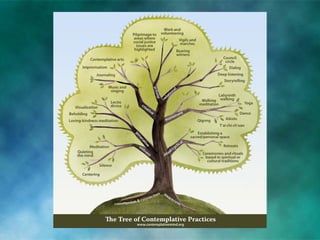
Contemplative Practices can be thought of as
encompassing a variety of strategies for deepening
and expanding experiential and critical awareness
by bearing witness to one’s own experience, both
internally and in the world.
In the CO-EXIST approach, contemplative practices
are a culturally-diverse group of meditative and
consciousness practices that involve experiencing
and directing Mind-Body-Spirit energies.
18
CONTEMPLATIVE PRACTICE refers to a
culturally-diverse family of methods involving
the intentional creation of temporal, mental,
and emotional space to practice the sustained
regulation of attention and facilitate intimate
connection with internal, relational, collective,
and/or spiritual experience, thus creating the
conditions for transformation and optimal
well-being to develop. (Harrell, 2013/14)
19
 “Culture” because there are diverse contemplative
practices in many cultural and religious traditions and the
resonance and effectiveness of any meditative or
contemplative approach is a function of its congruence
with values, beliefs, and cultural worldview
 “Context” because contemplative practices such as
meditation, like all human behavior, occurs in multiple
ecological contexts and these must be understood to
maximize the potential effectiveness of any particular
meditative or contemplative practice
 “Liberation” because the meaningful core of all
contemplative practices is freedom in the context of the
challenges and boundaries of the human condition such
that the effectiveness of the practice is enhanced when it
remains connected to this ultimate purpose of liberation
21
Indigenous and multicultural psychology (e.g.,
Ubuntu Therapy, Testimony Therapy)
Liberation psychology
Transformative education (e.g., Freire, hooks),
Methods of conversation and dialogue
ContempIative practice and pedagogy
Womanist theory and practice,
Narrative counterstorying
…Patriarchy is the root of oppression.
…Change is necessary not optional.
…What does it mean to be fully human?
…Solidarity manifests as peace.
…Cold comforts and conveniences disconnect.
…Beautiful love exists even though we are not free.
…Voiceless oppressed rise toward freedom.
…What can we do to make it better?
…Tragedy and horror can lead to peace and justice.
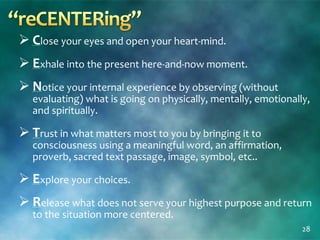
 Close your eyes and open your heart-mind.
 Exhale into the present here-and-now moment.
 Notice your internal experience by observing (without
evaluating) what is going on physically, mentally, emotionally,
and spiritually.
 Trust in what matters most to you by bringing it to
consciousness using a meaningful word, an affirmation,
proverb, sacred text passage, image, symbol, etc..
 Explore your choices.
 Release what does not serve your highest purpose and return
to the situation more centered.
28
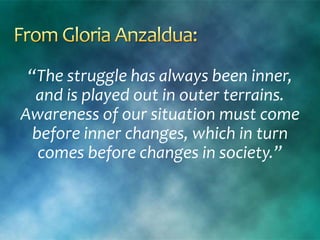
“The struggle has always been inner,
and is played out in outer terrains.
Awareness of our situation must come
before inner changes, which in turn
comes before changes in society.”
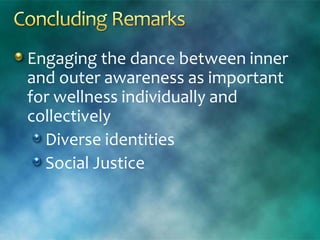
Engaging the dance between inner
and outer awareness as important
for wellness individually and
collectively
Diverse identities
Social Justice
CO-EXIST for Wellness Workshop - SCRA 2015

CO-EXIST for Wellness Workshop - SCRA 2015

  • 1.
    Shelly P. Harrell,Ph.D. Jessika Bailey, M.A. Jacob Stein, M.A. Tyonna Adams, M.A. Presented at the Biennial Conference of The Society for Community Research and Action June 26, 2015 Lowell, MA
  • 3.
    Freire wrote aboutour ontological “vocation to be fully human” and how it becomes distorted by oppression. Social justice involves processes of humanization and affirmation of diversity in the service of individual and collective wellness. Injustice is maintained where there is dehumanization and compromised wellness.
  • 4.
  • 5.
    Fulfillment of Freire’shuman vocation involves an existential paradox Central to this vocation to become fully human includes Awareness of oppression Resistance to oppression Liberation from oppression Movement toward the transformation of oppression While simultaneously trying to “be fully human”, and live authentically and meaningfully in the context of oppression.
  • 6.
    Interconnectedness and understandingof our interdependence across our diversities, between the local and the global Compassion for our shared humanity, Critical Consciousness of our collective condition, Involvement in the world with a sense of purpose greater than ourselves e.g., the dismantling of oppression and promotion of wellness- individually, relationally, and collectively.
  • 7.
    This central aimof this workshop is to introduce the CO-EXIST approach experientially by facilitating Communal and Contemplative (CoCo) practices. CoCo practices, the actual technologies of CO-EXIST work, emphasize reflective, creative, and relational processes.
  • 8.
    The COmmunity-EXISTential approachwas developed as a way of addressing our shared calling to become more fully human in our pursuit of wellness and social justice. Community – Conscious Awareness of our Interconnectedness, Relationality, Awareness of our Interdependence Existential – Experiential Awareness, Meaning- Purpose, Authenticity, Challenge of the Human Condition to Thrive and Maintain Our Humanity in the Context of Limitations
  • 9.
    Please write 4words on your index card: One word to describe a strength that you bring to your personal and professional endeavors. One word to describe something in the natural world with which you feel strongly connected or identified (e.g., color, flower, tree, animal, part of nature, a place etc.) Choose One of the following words: Illuminating Affirming Manifesting Mobilizing Expressing Igniting Revealing Amplifying Creating Radiating Liberating Engaging One word to describe a central value in your life that guides your decisions and ways of living or a word that represents a vision that you have for our world.
  • 10.
    FIRST NAME: _________ (yourstrength) MIDDLE NAME: _________ (your identification/connection) HYPHENATED LAST NAME: ___________(action word) - ___________ (value/vision)
  • 11.
    “I AM” … FIRSTNAME: _________ (your strength) MIDDLE NAME: _________ (your identification/connection) HYPHENATED LAST NAME: ___________(action word) - ___________ (value/vision)
  • 12.
    CO-EXIST is informedby PEaCE Theory PEaCE = Person-Environment-and-Culture Emergence
  • 13.
    1) Interconnectedness andRelationality 2) Complexity and Context 3) Culturally-Syntonic Engagement 4) Affirmative Humanization 5) Existential Meaning-Making 6) Empowerment and Liberation 7) Creative Transformation
  • 14.
    How we conceptualizethe specific practices that bring the PEaCE principles to life Examples we use -Reflection and Writing -Diverse Meditative Practices -Expressive Arts -Experiential Activities - “Giving Testimony and Bearing Witness” Developing the practices involves creativity to maximize Person-Culture-Environment Fit
  • 15.
    Communal and Contemplative Practicessupport empowerment and agency through engagement in culturally-syntonic and values- congruent behavior and action Co-Co practices allow people to access the energies of interconnectedness, meaning, and authenticity that fuel and sustain action
  • 16.
    Wellness-Promoting Transactions that strengtheninterconnectedness through Identifying and facilitating connection to integrated/holistic self, culture, persons, humanity, nature, spirit, ancestors, etc. Nurturing interpersonal relationships Fostering Sense of Community/Belonging Dialogue as the practice of love
  • 17.
    Wellness-Promoting Transactions that enhanceexperiential and critical awareness of internal and external conditions through Attention to Being-in-Culture-in-the- World transactional processes Exploring meanings and values Meditative, Reflective, and Creative processes Enhancing Critical Consciousness
  • 18.
    Contemplative Practices canbe thought of as encompassing a variety of strategies for deepening and expanding experiential and critical awareness by bearing witness to one’s own experience, both internally and in the world. In the CO-EXIST approach, contemplative practices are a culturally-diverse group of meditative and consciousness practices that involve experiencing and directing Mind-Body-Spirit energies. 18
  • 19.
    CONTEMPLATIVE PRACTICE refersto a culturally-diverse family of methods involving the intentional creation of temporal, mental, and emotional space to practice the sustained regulation of attention and facilitate intimate connection with internal, relational, collective, and/or spiritual experience, thus creating the conditions for transformation and optimal well-being to develop. (Harrell, 2013/14) 19
  • 21.
     “Culture” becausethere are diverse contemplative practices in many cultural and religious traditions and the resonance and effectiveness of any meditative or contemplative approach is a function of its congruence with values, beliefs, and cultural worldview  “Context” because contemplative practices such as meditation, like all human behavior, occurs in multiple ecological contexts and these must be understood to maximize the potential effectiveness of any particular meditative or contemplative practice  “Liberation” because the meaningful core of all contemplative practices is freedom in the context of the challenges and boundaries of the human condition such that the effectiveness of the practice is enhanced when it remains connected to this ultimate purpose of liberation 21
  • 22.
    Indigenous and multiculturalpsychology (e.g., Ubuntu Therapy, Testimony Therapy) Liberation psychology Transformative education (e.g., Freire, hooks), Methods of conversation and dialogue ContempIative practice and pedagogy Womanist theory and practice, Narrative counterstorying
  • 25.
    …Patriarchy is theroot of oppression. …Change is necessary not optional. …What does it mean to be fully human? …Solidarity manifests as peace. …Cold comforts and conveniences disconnect. …Beautiful love exists even though we are not free. …Voiceless oppressed rise toward freedom. …What can we do to make it better? …Tragedy and horror can lead to peace and justice.
  • 28.
     Close youreyes and open your heart-mind.  Exhale into the present here-and-now moment.  Notice your internal experience by observing (without evaluating) what is going on physically, mentally, emotionally, and spiritually.  Trust in what matters most to you by bringing it to consciousness using a meaningful word, an affirmation, proverb, sacred text passage, image, symbol, etc..  Explore your choices.  Release what does not serve your highest purpose and return to the situation more centered. 28
  • 29.
    “The struggle hasalways been inner, and is played out in outer terrains. Awareness of our situation must come before inner changes, which in turn comes before changes in society.”
  • 30.
    Engaging the dancebetween inner and outer awareness as important for wellness individually and collectively Diverse identities Social Justice