Ch 2 -  Chapter 2 Communicating over the Network Network Fundamentals
Objectives Describe the  structure  of a network, including the devices and media that are necessary for successful communications Explain the function of  protocols  in network communications Explain the advantages of using a  layered  model to describe network functionality Describe the  role of each layer  in two layered models:  the TCP/IP model and OSI model Describe the importance of  addressing and naming  schemes in network communications Ch 2 -
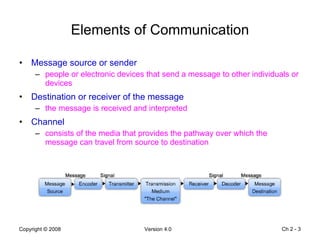
Elements of Communication Message source or sender people or electronic devices that send a message to other individuals or devices Destination or receiver of the message the message is received and interpreted Channel  consists of the media that provides the pathway over which the message can travel from source to destination Ch 2 -
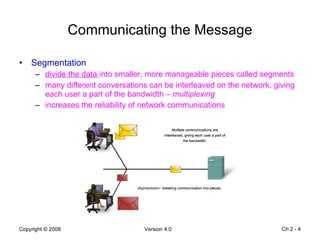
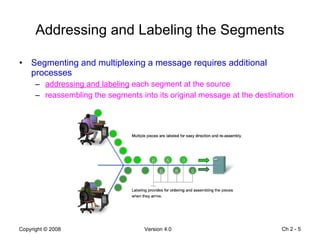
Communicating the Message Segmentation divide the data  into smaller, more manageable pieces called segments many different conversations can be interleaved on the network, giving each user a part of the bandwidth –  multiplexing   increases the reliability of network communications Ch 2 -
Addressing and Labeling the Segments Segmenting and multiplexing a message requires additional processes addressing and labeling  each segment at the source reassembling the segments into its original message at the destination Ch 2 -
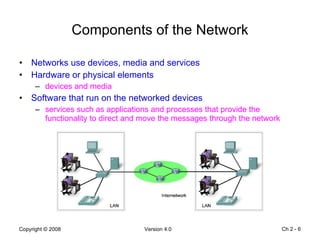
Components of the Network Networks use devices, media and services Hardware or physical elements devices and media Software that run on the networked devices services such as applications and processes that provide the functionality to direct and move the messages through the network Ch 2 -
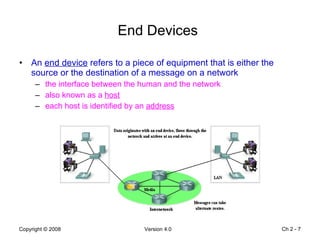
End Devices   An  end device  refers to a piece of equipment that is either the source or the destination of a message on a network the interface between the human and the network also known as a  host each host is identified by an  address Ch 2 -
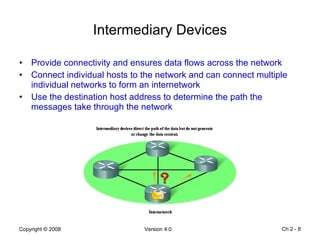
Intermediary Devices Provide connectivity and ensures data flows across the network  Connect individual hosts to the network and can connect multiple individual networks to form an internetwork Use the destination host address to determine the path the messages take through the network Ch 2 -
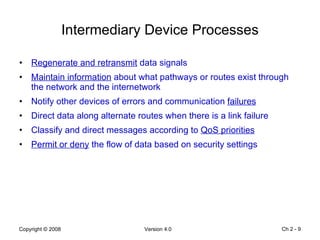
Intermediary Device Processes Regenerate and retransmit  data signals Maintain information  about what pathways or routes exist through the network and the internetwork Notify other devices of errors and communication  failures Direct data along alternate routes when there is a link failure Classify and direct messages according to  QoS priorities Permit or deny  the flow of data based on security settings Ch 2 -
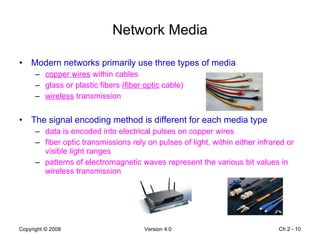
Network Media Modern networks primarily use three types of media copper wires  within cables glass or plastic fibers ( fiber optic  cable) wireless  transmission The signal encoding method is different for each media type data is encoded into electrical pulses on copper wires fiber optic transmissions rely on pulses of light, within either infrared or visible light ranges patterns of electromagnetic waves represent the various bit values in wireless transmission Ch 2 -
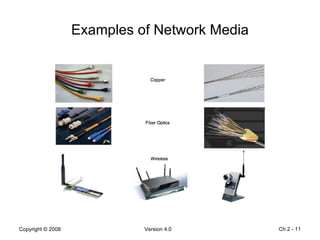
Examples of Network Media Ch 2 -
Selecting a Network Media The distance the media can successfully carry a signal The environment in which the media is installed The amount of data and the speed at which it must be transmitted The cost of the media and installation Ch 2 -
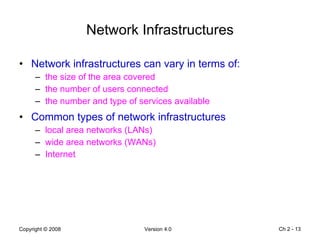
Network Infrastructures Network infrastructures can vary in terms of: the size of the area covered the number of users connected  the number and type of services available Common types of network infrastructures local area networks (LANs) wide area networks (WANs) Internet Ch 2 -
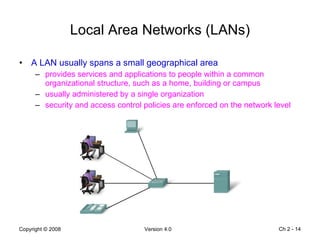
Local Area Networks (LANs) A LAN usually spans a small geographical area provides services and applications to people within a common organizational structure, such as a home, building or campus usually administered by a single organization security and access control policies are enforced on the network level Ch 2 -
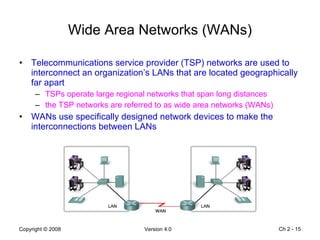
Wide Area Networks (WANs) Telecommunications service provider (TSP) networks are used to interconnect an organization’s LANs that are located geographically far apart TSPs operate large regional networks that span long distances the TSP networks are referred to as wide area networks (WANs) WANs use specifically designed network devices to make the interconnections between LANs Ch 2 -
The Internet – A Network of Networks A need to communicate with a resource on another network sending an e-mail to a friend in another country accessing news or products on a website instant messaging with someone in another city Internetwork a global mesh of interconnected networks owned by large public and private organizations the Internet is an example of a publicly-accessible internetwork Intranet private connection of LANs and WANs that belongs to an organization accessible only by the organization’s members, employees, or others with authorization Ch 2 -
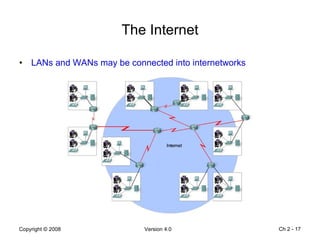
The Internet LANs and WANs may be connected into internetworks Ch 2 -
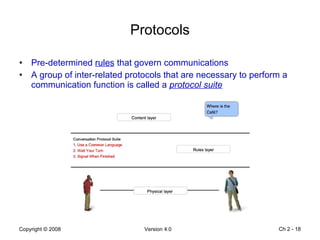
Protocols Pre-determined  rules  that govern communications A group of inter-related protocols that are necessary to perform a communication function is called a  protocol suite   Ch 2 -
What is the Role of Protocols? The format or  structure  of the message, such as how much data to put into each segment  The process by which intermediary devices  share information  about the path to the destination The method to handle  error  and system messages between intermediary devices The process to  setup and terminate  communications or data transfers between hosts Ch 2 -
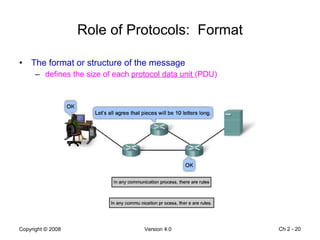
Role of Protocols:  Format The format or structure of the message defines the size of each  protocol data unit  (PDU) Ch 2 -
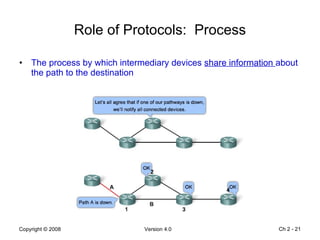
Role of Protocols:  Process The process by which intermediary devices  share information  about the path to the destination Ch 2 -
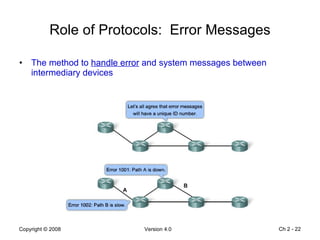
Role of Protocols:  Error Messages The method to  handle error  and system messages between intermediary devices Ch 2 -
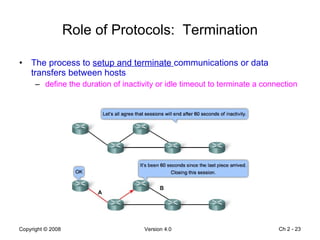
Role of Protocols:  Termination The process to  setup and terminate  communications or data transfers between hosts define the duration of inactivity or idle timeout to terminate a connection Ch 2 -
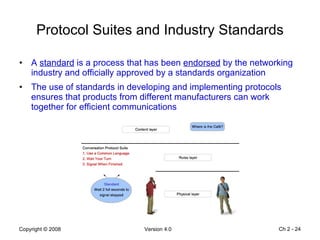
Protocol Suites and Industry Standards A  standard  is a process that has been  endorsed  by the networking industry and officially approved by a standards organization The use of standards in developing and implementing protocols ensures that products from different manufacturers can work together for efficient communications Ch 2 -
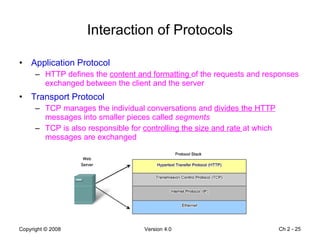
Interaction of Protocols Application Protocol HTTP defines the  content and formatting  of the requests and responses exchanged between the client and the server Transport Protocol TCP manages the individual conversations and  divides the HTTP  messages into smaller pieces called  segments TCP is also responsible for  controlling the size and rate  at which messages are exchanged Ch 2 -
Interaction of Protocols (cont’d) Internetwork Protocol IP is responsible for taking the formatted segments from TCP,  encapsulating them into packets , assigning the  appropriate IP  addresses, and selecting the  best path  to the destination Network Access Protocols describes the  data link  management and the  physical transmission  of the data on the media data-link management protocols  encapsulates the packets into frames  the physical media standards and protocols govern how the signals are sent over the media and how they are interpreted by the receiving end device Ch 2 -
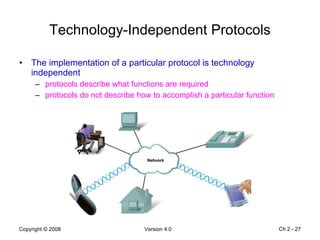
Technology-Independent Protocols The implementation of a particular protocol is technology independent protocols describe what functions are required protocols do not describe how to accomplish a particular function Ch 2 -
What is Benefits of a Layered Model? Assists in  protocol design protocols that operate at a specific layer have defined information that they act upon and a defined interface to the layers above and below Fosters  competition products from different vendors can work together Prevents technology or capabilities  changes in one layer  from affecting other layer above and below Provides a  common language  to describe networking functions and capabilities Ch 2 -
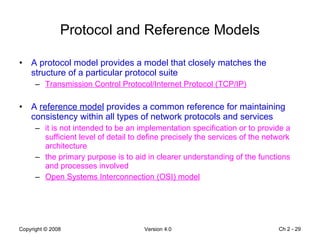
Protocol and Reference Models A protocol model provides a model that closely matches the structure of a particular protocol suite Transmission Control Protocol/Internet Protocol (TCP/IP) A  reference model  provides a common reference for maintaining consistency within all types of network protocols and services  it is not intended to be an implementation specification or to provide a sufficient level of detail to define precisely the services of the network architecture  the primary purpose is to aid in clearer understanding of the functions and processes involved Open Systems Interconnection (OSI) model Ch 2 -
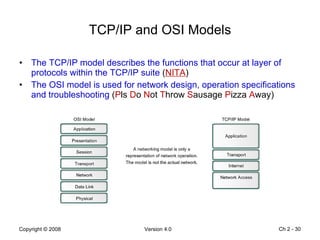
TCP/IP and OSI Models The TCP/IP model describes the functions that occur at layer of protocols within the TCP/IP suite  ( NITA ) The OSI model is used for network design, operation specifications and troubleshooting  ( P ls  D o  N ot  T hrow  S ausage  P izza  A way) Ch 2 -
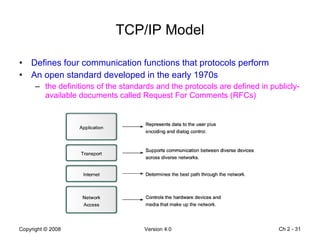
TCP/IP Model Defines four communication functions that protocols perform An open standard developed in the early 1970s the definitions of the standards and the protocols are defined in publicly-available documents called Request For Comments (RFCs) Ch 2 -
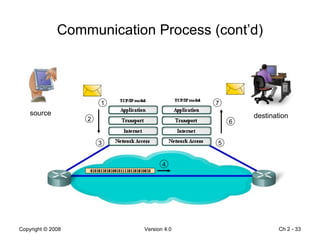
Communication Process Creation of data  at the application layer of the originating source end device Segmentation and encapsulation  of data as it passes down the protocol stack in the source end device Generation of the data  onto the media  at the network access layer of the  stack Transportation of the data  through the internetwork, which consists of media and any intermediary devices Reception  of the data at the network access layer of the destination end device Decapsulation and reassembly  of the data as it passes up the stack in the destination device Passing this data to the  destination application  at the application layer of the destination end device Ch 2 -
Communication Process (cont’d) Ch 2 -  1 2 3 4 5 6 7 source destination
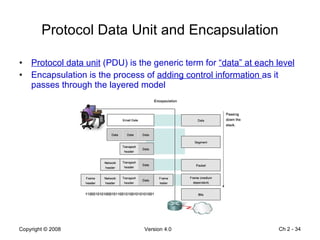
Protocol Data Unit and Encapsulation Protocol data unit  (PDU) is the generic term for  “data” at each level Encapsulation is the process of  adding control information  as it passes through the layered model  Ch 2 -
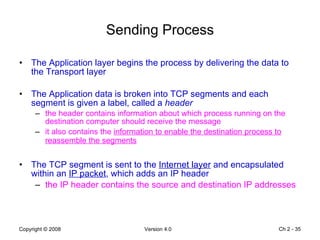
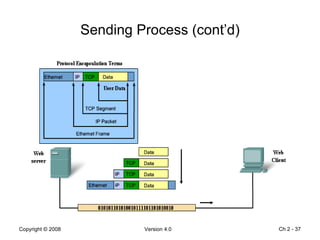
Sending Process The Application layer begins the process by delivering the data to the Transport layer The Application data is broken into TCP segments and each segment is given a label, called a  header the header contains information about which process running on the destination computer should receive the message it also contains the  information to enable the destination process to reassemble the segments   The TCP segment is sent to the  Internet layer  and encapsulated within an  IP packet , which adds an IP header the IP header contains the source and destination IP addresses Ch 2 -
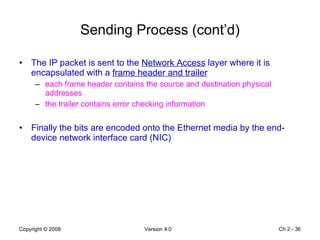
Sending Process (cont’d) The IP packet is sent to the  Network Access  layer where it is encapsulated with a  frame header and trailer each frame header contains the source and destination physical addresses the trailer contains error checking information Finally the bits are encoded onto the Ethernet media by the end-device network interface card (NIC) Ch 2 -
Sending Process (cont’d) Ch 2 -
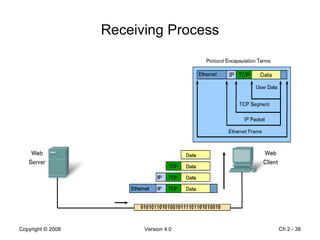
Receiving Process Ch 2 -
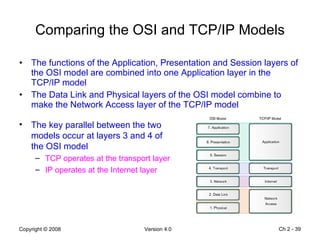
Comparing the OSI and TCP/IP Models The functions of the Application, Presentation and Session layers of the OSI model are combined into one Application layer in the TCP/IP model The Data Link and Physical layers of the OSI model combine to make the Network Access layer of the TCP/IP model Ch 2 -  The key parallel between the two models occur at layers 3 and 4 of the OSI model TCP operates at the transport layer IP operates at the Internet layer
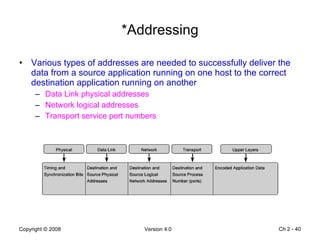
*Addressing Various types of addresses are needed to successfully deliver the data from a source application running on one host to the correct destination application running on another Data Link physical addresses Network logical addresses Transport service port numbers Ch 2 -
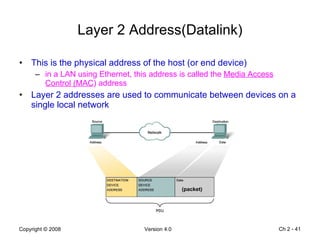
Layer 2 Address(Datalink) This is the physical address of the host (or end device) in a LAN using Ethernet, this address is called the  Media Access Control (MAC ) address Layer 2 addresses are used to communicate between devices on a single local network Ch 2 -  (packet)
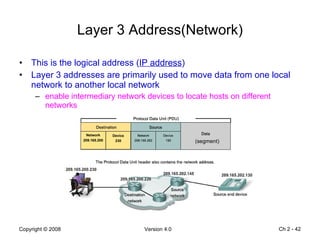
Layer 3 Address(Network) This is the logical address ( IP address ) Layer 3 addresses are primarily used to move data from one local network to another local network enable intermediary network devices to locate hosts on different networks Ch 2 -  (segment) Network 209.165.200 Device 230
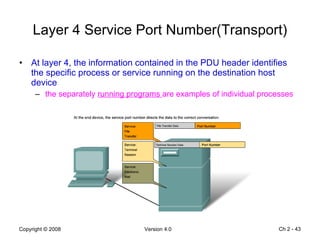
Layer 4 Service Port Number(Transport) At layer 4, the information contained in the PDU header identifies the specific process or service running on the destination host device the separately  running programs  are examples of individual processes Ch 2 -

Chapter2

  • 1.
    Ch 2 - Chapter 2 Communicating over the Network Network Fundamentals
  • 2.
    Objectives Describe the structure of a network, including the devices and media that are necessary for successful communications Explain the function of protocols in network communications Explain the advantages of using a layered model to describe network functionality Describe the role of each layer in two layered models: the TCP/IP model and OSI model Describe the importance of addressing and naming schemes in network communications Ch 2 -
  • 3.
    Elements of CommunicationMessage source or sender people or electronic devices that send a message to other individuals or devices Destination or receiver of the message the message is received and interpreted Channel consists of the media that provides the pathway over which the message can travel from source to destination Ch 2 -
  • 4.
    Communicating the MessageSegmentation divide the data into smaller, more manageable pieces called segments many different conversations can be interleaved on the network, giving each user a part of the bandwidth – multiplexing increases the reliability of network communications Ch 2 -
  • 5.
    Addressing and Labelingthe Segments Segmenting and multiplexing a message requires additional processes addressing and labeling each segment at the source reassembling the segments into its original message at the destination Ch 2 -
  • 6.
    Components of theNetwork Networks use devices, media and services Hardware or physical elements devices and media Software that run on the networked devices services such as applications and processes that provide the functionality to direct and move the messages through the network Ch 2 -
  • 7.
    End Devices An end device refers to a piece of equipment that is either the source or the destination of a message on a network the interface between the human and the network also known as a host each host is identified by an address Ch 2 -
  • 8.
    Intermediary Devices Provideconnectivity and ensures data flows across the network Connect individual hosts to the network and can connect multiple individual networks to form an internetwork Use the destination host address to determine the path the messages take through the network Ch 2 -
  • 9.
    Intermediary Device ProcessesRegenerate and retransmit data signals Maintain information about what pathways or routes exist through the network and the internetwork Notify other devices of errors and communication failures Direct data along alternate routes when there is a link failure Classify and direct messages according to QoS priorities Permit or deny the flow of data based on security settings Ch 2 -
  • 10.
    Network Media Modernnetworks primarily use three types of media copper wires within cables glass or plastic fibers ( fiber optic cable) wireless transmission The signal encoding method is different for each media type data is encoded into electrical pulses on copper wires fiber optic transmissions rely on pulses of light, within either infrared or visible light ranges patterns of electromagnetic waves represent the various bit values in wireless transmission Ch 2 -
  • 11.
    Examples of NetworkMedia Ch 2 -
  • 12.
    Selecting a NetworkMedia The distance the media can successfully carry a signal The environment in which the media is installed The amount of data and the speed at which it must be transmitted The cost of the media and installation Ch 2 -
  • 13.
    Network Infrastructures Networkinfrastructures can vary in terms of: the size of the area covered the number of users connected the number and type of services available Common types of network infrastructures local area networks (LANs) wide area networks (WANs) Internet Ch 2 -
  • 14.
    Local Area Networks(LANs) A LAN usually spans a small geographical area provides services and applications to people within a common organizational structure, such as a home, building or campus usually administered by a single organization security and access control policies are enforced on the network level Ch 2 -
  • 15.
    Wide Area Networks(WANs) Telecommunications service provider (TSP) networks are used to interconnect an organization’s LANs that are located geographically far apart TSPs operate large regional networks that span long distances the TSP networks are referred to as wide area networks (WANs) WANs use specifically designed network devices to make the interconnections between LANs Ch 2 -
  • 16.
    The Internet –A Network of Networks A need to communicate with a resource on another network sending an e-mail to a friend in another country accessing news or products on a website instant messaging with someone in another city Internetwork a global mesh of interconnected networks owned by large public and private organizations the Internet is an example of a publicly-accessible internetwork Intranet private connection of LANs and WANs that belongs to an organization accessible only by the organization’s members, employees, or others with authorization Ch 2 -
  • 17.
    The Internet LANsand WANs may be connected into internetworks Ch 2 -
  • 18.
    Protocols Pre-determined rules that govern communications A group of inter-related protocols that are necessary to perform a communication function is called a protocol suite Ch 2 -
  • 19.
    What is theRole of Protocols? The format or structure of the message, such as how much data to put into each segment The process by which intermediary devices share information about the path to the destination The method to handle error and system messages between intermediary devices The process to setup and terminate communications or data transfers between hosts Ch 2 -
  • 20.
    Role of Protocols: Format The format or structure of the message defines the size of each protocol data unit (PDU) Ch 2 -
  • 21.
    Role of Protocols: Process The process by which intermediary devices share information about the path to the destination Ch 2 -
  • 22.
    Role of Protocols: Error Messages The method to handle error and system messages between intermediary devices Ch 2 -
  • 23.
    Role of Protocols: Termination The process to setup and terminate communications or data transfers between hosts define the duration of inactivity or idle timeout to terminate a connection Ch 2 -
  • 24.
    Protocol Suites andIndustry Standards A standard is a process that has been endorsed by the networking industry and officially approved by a standards organization The use of standards in developing and implementing protocols ensures that products from different manufacturers can work together for efficient communications Ch 2 -
  • 25.
    Interaction of ProtocolsApplication Protocol HTTP defines the content and formatting of the requests and responses exchanged between the client and the server Transport Protocol TCP manages the individual conversations and divides the HTTP messages into smaller pieces called segments TCP is also responsible for controlling the size and rate at which messages are exchanged Ch 2 -
  • 26.
    Interaction of Protocols(cont’d) Internetwork Protocol IP is responsible for taking the formatted segments from TCP, encapsulating them into packets , assigning the appropriate IP addresses, and selecting the best path to the destination Network Access Protocols describes the data link management and the physical transmission of the data on the media data-link management protocols encapsulates the packets into frames the physical media standards and protocols govern how the signals are sent over the media and how they are interpreted by the receiving end device Ch 2 -
  • 27.
    Technology-Independent Protocols Theimplementation of a particular protocol is technology independent protocols describe what functions are required protocols do not describe how to accomplish a particular function Ch 2 -
  • 28.
    What is Benefitsof a Layered Model? Assists in protocol design protocols that operate at a specific layer have defined information that they act upon and a defined interface to the layers above and below Fosters competition products from different vendors can work together Prevents technology or capabilities changes in one layer from affecting other layer above and below Provides a common language to describe networking functions and capabilities Ch 2 -
  • 29.
    Protocol and ReferenceModels A protocol model provides a model that closely matches the structure of a particular protocol suite Transmission Control Protocol/Internet Protocol (TCP/IP) A reference model provides a common reference for maintaining consistency within all types of network protocols and services it is not intended to be an implementation specification or to provide a sufficient level of detail to define precisely the services of the network architecture the primary purpose is to aid in clearer understanding of the functions and processes involved Open Systems Interconnection (OSI) model Ch 2 -
  • 30.
    TCP/IP and OSIModels The TCP/IP model describes the functions that occur at layer of protocols within the TCP/IP suite ( NITA ) The OSI model is used for network design, operation specifications and troubleshooting ( P ls D o N ot T hrow S ausage P izza A way) Ch 2 -
  • 31.
    TCP/IP Model Definesfour communication functions that protocols perform An open standard developed in the early 1970s the definitions of the standards and the protocols are defined in publicly-available documents called Request For Comments (RFCs) Ch 2 -
  • 32.
    Communication Process Creationof data at the application layer of the originating source end device Segmentation and encapsulation of data as it passes down the protocol stack in the source end device Generation of the data onto the media at the network access layer of the stack Transportation of the data through the internetwork, which consists of media and any intermediary devices Reception of the data at the network access layer of the destination end device Decapsulation and reassembly of the data as it passes up the stack in the destination device Passing this data to the destination application at the application layer of the destination end device Ch 2 -
  • 33.
    Communication Process (cont’d)Ch 2 - 1 2 3 4 5 6 7 source destination
  • 34.
    Protocol Data Unitand Encapsulation Protocol data unit (PDU) is the generic term for “data” at each level Encapsulation is the process of adding control information as it passes through the layered model Ch 2 -
  • 35.
    Sending Process TheApplication layer begins the process by delivering the data to the Transport layer The Application data is broken into TCP segments and each segment is given a label, called a header the header contains information about which process running on the destination computer should receive the message it also contains the information to enable the destination process to reassemble the segments The TCP segment is sent to the Internet layer and encapsulated within an IP packet , which adds an IP header the IP header contains the source and destination IP addresses Ch 2 -
  • 36.
    Sending Process (cont’d)The IP packet is sent to the Network Access layer where it is encapsulated with a frame header and trailer each frame header contains the source and destination physical addresses the trailer contains error checking information Finally the bits are encoded onto the Ethernet media by the end-device network interface card (NIC) Ch 2 -
  • 37.
  • 38.
  • 39.
    Comparing the OSIand TCP/IP Models The functions of the Application, Presentation and Session layers of the OSI model are combined into one Application layer in the TCP/IP model The Data Link and Physical layers of the OSI model combine to make the Network Access layer of the TCP/IP model Ch 2 - The key parallel between the two models occur at layers 3 and 4 of the OSI model TCP operates at the transport layer IP operates at the Internet layer
  • 40.
    *Addressing Various typesof addresses are needed to successfully deliver the data from a source application running on one host to the correct destination application running on another Data Link physical addresses Network logical addresses Transport service port numbers Ch 2 -
  • 41.
    Layer 2 Address(Datalink)This is the physical address of the host (or end device) in a LAN using Ethernet, this address is called the Media Access Control (MAC ) address Layer 2 addresses are used to communicate between devices on a single local network Ch 2 - (packet)
  • 42.
    Layer 3 Address(Network)This is the logical address ( IP address ) Layer 3 addresses are primarily used to move data from one local network to another local network enable intermediary network devices to locate hosts on different networks Ch 2 - (segment) Network 209.165.200 Device 230
  • 43.
    Layer 4 ServicePort Number(Transport) At layer 4, the information contained in the PDU header identifies the specific process or service running on the destination host device the separately running programs are examples of individual processes Ch 2 -

Editor's Notes

  • #2 This chapter describes the fundamentals of communication and how they apply to communication in and between data networks. Two important models that describe the process of network communication and the devices will be used to illustrate communication between network hosts.
  • #6 The downside to using segmentation and multiplexing to transmit messages across the network is the level of complexity that is added to the process.
  • #9 Processes running on the intermediary network devices perform these functions: Regenerate and retransmit data signals Maintain information about what pathways exist through the network and internetwork Notify other devices of errors and communication failures Direct data along alternate pathways when there is a link failure Classify and direct messages according to QoS priorities Permit or deny the flow of data, based on security settings
  • #10 The slide shows the processes running on the intermediary network devices.
  • #12 Light is kept in the  core  of the optical fiber by  total internal reflection . 
  • #19 One of the best ways to visualize how all of the protocols interact on a particular host is to view it as a stack. A protocol stack shows how the individual protocols within the suite are implemented on the host. The protocols are viewed as a layered hierarchy, with each higher level service depending on the functionality defined by the protocols shown in the lower levels. The lower layers of the stack are concerned with moving data over the network and providing services to the upper layers, which are focused on the content of the message being sent and the user interface.
  • #25 In data communications, for example, if one end of a conversation is using a protocol to govern one-way communication and the other end is assuming a protocol describing two-way communication, in all probability, no information will be exchanged.
  • #26 An example of the use of a protocol suite in network communications is the interaction between a web server and a web browser. This interaction uses a number of protocols and standards in the process of exchanging information between them. The different protocols work together to ensure that the messages are received and understood by both parties.
  • #29 There are benefits to using a layered model to describe network protocols and operations.
  • #31 Make a Comparison between the 2 models
  • #33 The above seven steps in the communication process are indicated in the next slide.
  • #34 This slide shows the seven steps in the communication process.
  • #36 In the web server example, the TCP/IP model is used to illustrate the process of sending an HTML web page to a client.
  • #39 This process is reversed at the receiving host. The data is decapsulated as it moves up the stack toward the end user application.