AFRICAN-CENTERED
CULTURAL CONSIDERATIONS
FOR CONTEMPLATIVE PRACTICES:
MINDFULNESS, MEDITATION, AND YOGA
Shelly P. Harrell, Ph.D.
Shena Young, Psy.D.
Thema Bryant-Davis, Ph.D.
The 50th Annual Convention of the Association of Black Psychologists
June 30, 2018, Oakland, CA
AIMS OF THE SYMPOSIUM
• Given the severity and complex realities of intersectional
oppression, contemplative practices serve as a potential site of
restoration, empowerment, and community.
• Strategies for separating from the automatic pilot functioning of
persons of African descent who have internalized oppression are
necessary in order to reconnect with optimal and culturally-
grounded ways of being that lead to the “illumination and
liberation of the human spirit”.
• The healing, restorative, and transformational functions of
diverse contemplative practices will be presented in the context
of stress-trauma as risk factors that compromise the optimal
functioning of persons of African descent.
Copyright 2018. Shelly P. Harrell
FREEING OUR MINDS
• The most potent weapon in the hands of the oppressor is the mind
of the oppressed. –Steven Biko
• As long as the mind is enslaved, the body will never be free. –Martin
Luther King, Jr.
• Emancipate ourselves from mental slavery, none but ourselves can
free our minds. –Bob Marley
• You cannot keep the human mind forever locked up in darkness. A
ray of light, a spark from freedom’s altar, the idea of inherent right,
each, all, will become fixed in the soul. -From Slave Narrative of
William Wells Brown
• Contemplative Processes encompass strategies to
facilitate wholeness and emancipate the mind
• Contemplative Processes help you know and EXPERIENCE
• WHO you are
• As a cultural being (African)
• Relationally
• Personally
• WHAT you are (Spirit having human experience)
• WHERE you are (sociopolitical and environmental contexts)
• HOW you are (wellness, illness, emotionally, experientially)
• WHY you are (meaning, purpose, gifts)
CONTEMPLATIVE PROCESSES
Copyright 2018. Shelly P. Harrell
• A primary principle of traditional African healing is to
treat illness by attending to the soul, restoring the person
to balance and wholeness.
• Wholeness refers to the totality of our living
• PERSONALLY – Body-Mind-Heart-Soul
• RELATIONALLY – Connectedness and Belonging
• COLLECTIVELY – Culture and Context
• SPIRITUALLY – Beyond the Visible
• We are not well when we are fragmented
• Lost from ourselves, our culture, our people, our communities,
the earth, our light, from God and our “spiritness”
WELLNESS = WHOLENESS
Copyright 2018. Shelly P. Harrell
6
CONTEMPLATIVE PRACTICES
• Contemplative practices are conceptualized as
encompassing diverse strategies for deepening and
expanding experiential awareness and critical
consciousness by bearing witness to lived experience--
internally, relationally, and collectively.
• Practices involve experiencing, deepening, and enhancing
mental, somatic, emotional, relational, and spiritual energies
• There is a growing body of empirical and applied research
that points to the effectiveness of various strategies such as
mindfulness, transcendental meditation, yoga, and
reflective journaling for improving health and reducing
disease (Plante, 2010).
Copyright 2018. Shelly P. Harrell
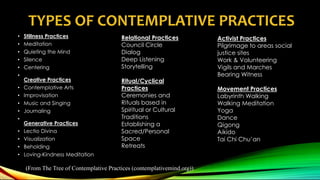
TYPES OF CONTEMPLATIVE PRACTICES
• Stillness Practices
• Meditation
• Quieting the Mind
• Silence
• Centering
•
Creative Practices
• Contemplative Arts
• Improvisation
• Music and Singing
• Journaling
•
Generative Practices
• Lectio Divina
• Visualization
• Beholding
• Loving-Kindness Meditation
Relational Practices
Council Circle
Dialog
Deep Listening
Storytelling
Ritual/Cyclical
Practices
Ceremonies and
Rituals based in
Spiritual or Cultural
Traditions
Establishing a
Sacred/Personal
Space
Retreats
Activist Practices
Pilgrimage to areas social
justice sites
Work & Volunteering
Vigils and Marches
Bearing Witness
Movement Practices
Labyrinth Walking
Walking Meditation
Yoga
Dance
Qigong
Aikido
Tai Chi Chu’an
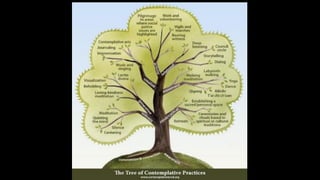
(From The Tree of Contemplative Practices (contemplativemind.org))
CONTEXTUALIZING CONTEMPLATIVE
PRACTICES: CRITICAL CONSIDERATIONS
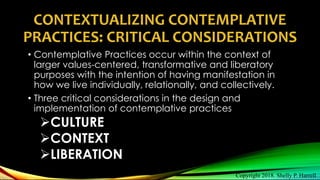
• Contemplative Practices occur within the context of
larger values-centered, transformative and liberatory
purposes with the intention of having manifestation in
how we live individually, relationally, and collectively.
• Three critical considerations in the design and
implementation of contemplative practices
CULTURE
CONTEXT
LIBERATION
Copyright 2018. Shelly P. Harrell
CULTURE, CONTEXT, & LIBERATION
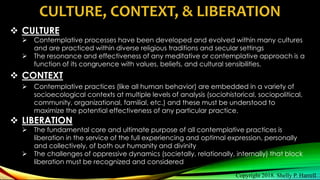
 CULTURE
 Contemplative processes have been developed and evolved within many cultures
and are practiced within diverse religious traditions and secular settings
 The resonance and effectiveness of any meditative or contemplative approach is a
function of its congruence with values, beliefs, and cultural sensibilities.
 CONTEXT
 Contemplative practices (like all human behavior) are embedded in a variety of
socioecological contexts at multiple levels of analysis (sociohistorical, sociopolitical,
community, organizational, familial, etc.) and these must be understood to
maximize the potential effectiveness of any particular practice.
 LIBERATION
 The fundamental core and ultimate purpose of all contemplative practices is
liberation in the service of the full experiencing and optimal expression, personally
and collectively, of both our humanity and divinity
 The challenges of oppressive dynamics (societally, relationally, internally) that block
liberation must be recognized and considered
Copyright 2018. Shelly P. Harrell
AFRICAN-CENTERED CONSIDERATIONS
• For contemplative practices to be relevant to persons of
African descent, it is important to locate their African
cultural roots and diasporic expressions.
• The centrality of spirituality, an ethos of
interconnectedness, cultural and collective
consciousness, and a communal orientation in African-
centered psychology (Myers, 1987; 2013; Nobles, 2006)
provide important areas of emphasis within
contemplative practices.
• This symposium will pay particular attention to themes of
interconnectedness, spirituality, consciousness,
expressiveness, cultural pride, and community.
Copyright 2018. Shelly P. Harrell
CONTEMPLATIVE PRACTICE AND BUILDING
FOR ETERNITY
• Contemplative practices open space for experiencing and expressing
one’s authentic voice, connecting deeply with self and others,
reclaiming one’s humanity, discerning truths and developing wisdom,
and leading a meaningful, purposeful life.
• The convention theme of “building for eternity” suggests that we must
utilize our collective knowledge about ourselves, our strengths and our
gifts to fulfill our highest potential as a people for the betterment of
ourselves and humanity moving forward into the future.
• Contemplative practices can be an important tool in this building
process.
Copyright 2018. Shelly P. Harrell
THE THREE PRESENTATIONS
• Meditation with Soul: Soulfulness as Connectedness,
Consciousness, Calling, Courage, and Creativity (Dr.
Shelly Harrell)
• Yoga as an approach to embodied truth and
healing among Black women (Dr. Shena Young)
• Applying African and Diasporic Psychology,
Proverbs, and Practices to Mindfulness (Dr. Thema
Bryant-Davis)

African-centered cultural considerations for contemplative practices (ce symposium)

  • 1.
    AFRICAN-CENTERED CULTURAL CONSIDERATIONS FOR CONTEMPLATIVEPRACTICES: MINDFULNESS, MEDITATION, AND YOGA Shelly P. Harrell, Ph.D. Shena Young, Psy.D. Thema Bryant-Davis, Ph.D. The 50th Annual Convention of the Association of Black Psychologists June 30, 2018, Oakland, CA
  • 2.
    AIMS OF THESYMPOSIUM • Given the severity and complex realities of intersectional oppression, contemplative practices serve as a potential site of restoration, empowerment, and community. • Strategies for separating from the automatic pilot functioning of persons of African descent who have internalized oppression are necessary in order to reconnect with optimal and culturally- grounded ways of being that lead to the “illumination and liberation of the human spirit”. • The healing, restorative, and transformational functions of diverse contemplative practices will be presented in the context of stress-trauma as risk factors that compromise the optimal functioning of persons of African descent. Copyright 2018. Shelly P. Harrell
  • 3.
    FREEING OUR MINDS •The most potent weapon in the hands of the oppressor is the mind of the oppressed. –Steven Biko • As long as the mind is enslaved, the body will never be free. –Martin Luther King, Jr. • Emancipate ourselves from mental slavery, none but ourselves can free our minds. –Bob Marley • You cannot keep the human mind forever locked up in darkness. A ray of light, a spark from freedom’s altar, the idea of inherent right, each, all, will become fixed in the soul. -From Slave Narrative of William Wells Brown
  • 4.
    • Contemplative Processesencompass strategies to facilitate wholeness and emancipate the mind • Contemplative Processes help you know and EXPERIENCE • WHO you are • As a cultural being (African) • Relationally • Personally • WHAT you are (Spirit having human experience) • WHERE you are (sociopolitical and environmental contexts) • HOW you are (wellness, illness, emotionally, experientially) • WHY you are (meaning, purpose, gifts) CONTEMPLATIVE PROCESSES Copyright 2018. Shelly P. Harrell
  • 5.
    • A primaryprinciple of traditional African healing is to treat illness by attending to the soul, restoring the person to balance and wholeness. • Wholeness refers to the totality of our living • PERSONALLY – Body-Mind-Heart-Soul • RELATIONALLY – Connectedness and Belonging • COLLECTIVELY – Culture and Context • SPIRITUALLY – Beyond the Visible • We are not well when we are fragmented • Lost from ourselves, our culture, our people, our communities, the earth, our light, from God and our “spiritness” WELLNESS = WHOLENESS Copyright 2018. Shelly P. Harrell
  • 6.
  • 7.
    CONTEMPLATIVE PRACTICES • Contemplativepractices are conceptualized as encompassing diverse strategies for deepening and expanding experiential awareness and critical consciousness by bearing witness to lived experience-- internally, relationally, and collectively. • Practices involve experiencing, deepening, and enhancing mental, somatic, emotional, relational, and spiritual energies • There is a growing body of empirical and applied research that points to the effectiveness of various strategies such as mindfulness, transcendental meditation, yoga, and reflective journaling for improving health and reducing disease (Plante, 2010). Copyright 2018. Shelly P. Harrell
  • 9.
    TYPES OF CONTEMPLATIVEPRACTICES • Stillness Practices • Meditation • Quieting the Mind • Silence • Centering • Creative Practices • Contemplative Arts • Improvisation • Music and Singing • Journaling • Generative Practices • Lectio Divina • Visualization • Beholding • Loving-Kindness Meditation Relational Practices Council Circle Dialog Deep Listening Storytelling Ritual/Cyclical Practices Ceremonies and Rituals based in Spiritual or Cultural Traditions Establishing a Sacred/Personal Space Retreats Activist Practices Pilgrimage to areas social justice sites Work & Volunteering Vigils and Marches Bearing Witness Movement Practices Labyrinth Walking Walking Meditation Yoga Dance Qigong Aikido Tai Chi Chu’an (From The Tree of Contemplative Practices (contemplativemind.org))
  • 10.
    CONTEXTUALIZING CONTEMPLATIVE PRACTICES: CRITICALCONSIDERATIONS • Contemplative Practices occur within the context of larger values-centered, transformative and liberatory purposes with the intention of having manifestation in how we live individually, relationally, and collectively. • Three critical considerations in the design and implementation of contemplative practices CULTURE CONTEXT LIBERATION Copyright 2018. Shelly P. Harrell
  • 11.
    CULTURE, CONTEXT, &LIBERATION  CULTURE  Contemplative processes have been developed and evolved within many cultures and are practiced within diverse religious traditions and secular settings  The resonance and effectiveness of any meditative or contemplative approach is a function of its congruence with values, beliefs, and cultural sensibilities.  CONTEXT  Contemplative practices (like all human behavior) are embedded in a variety of socioecological contexts at multiple levels of analysis (sociohistorical, sociopolitical, community, organizational, familial, etc.) and these must be understood to maximize the potential effectiveness of any particular practice.  LIBERATION  The fundamental core and ultimate purpose of all contemplative practices is liberation in the service of the full experiencing and optimal expression, personally and collectively, of both our humanity and divinity  The challenges of oppressive dynamics (societally, relationally, internally) that block liberation must be recognized and considered Copyright 2018. Shelly P. Harrell
  • 12.
    AFRICAN-CENTERED CONSIDERATIONS • Forcontemplative practices to be relevant to persons of African descent, it is important to locate their African cultural roots and diasporic expressions. • The centrality of spirituality, an ethos of interconnectedness, cultural and collective consciousness, and a communal orientation in African- centered psychology (Myers, 1987; 2013; Nobles, 2006) provide important areas of emphasis within contemplative practices. • This symposium will pay particular attention to themes of interconnectedness, spirituality, consciousness, expressiveness, cultural pride, and community. Copyright 2018. Shelly P. Harrell
  • 13.
    CONTEMPLATIVE PRACTICE ANDBUILDING FOR ETERNITY • Contemplative practices open space for experiencing and expressing one’s authentic voice, connecting deeply with self and others, reclaiming one’s humanity, discerning truths and developing wisdom, and leading a meaningful, purposeful life. • The convention theme of “building for eternity” suggests that we must utilize our collective knowledge about ourselves, our strengths and our gifts to fulfill our highest potential as a people for the betterment of ourselves and humanity moving forward into the future. • Contemplative practices can be an important tool in this building process. Copyright 2018. Shelly P. Harrell
  • 14.
    THE THREE PRESENTATIONS •Meditation with Soul: Soulfulness as Connectedness, Consciousness, Calling, Courage, and Creativity (Dr. Shelly Harrell) • Yoga as an approach to embodied truth and healing among Black women (Dr. Shena Young) • Applying African and Diasporic Psychology, Proverbs, and Practices to Mindfulness (Dr. Thema Bryant-Davis)