Álvaro Sánchez-Mariscal
Developing SPI applications using Grails and
AngularJS
@alvaro_sanchez - Odobo
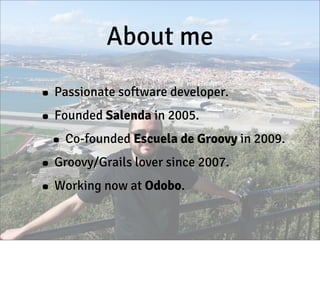
About me
• Passionate software developer.
• Founded Salenda in 2005.
• Co-founded Escuela de Groovy in 2009.
• Groovy/Grails lover since 2007.
• Working now at Odobo.
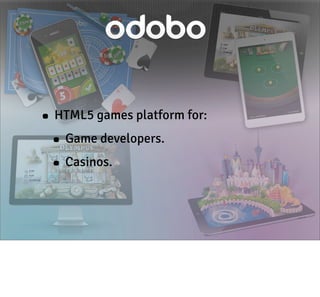
• HTML5 games platform for:
• Game developers.
• Casinos.
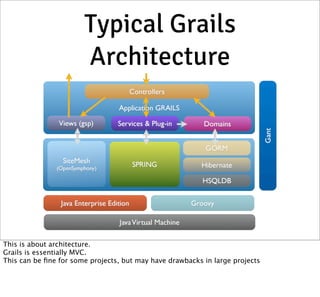
Typical Grails
Architecture

This is about architecture.
Grails is essentially MVC.
This can be fine for some projects, but may have drawbacks in large projects
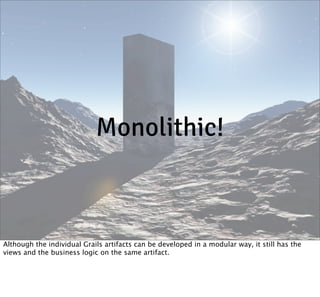
Monolithic!

Although the individual Grails artifacts can be developed in a modular way, it still has the
views and the business logic on the same artifact.
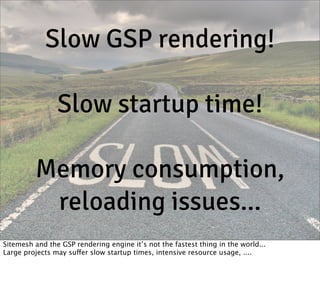
Slow GSP rendering!
Slow startup time!
Memory consumption,
reloading issues...
Sitemesh and the GSP rendering engine it’s not the fastest thing in the world...
Large projects may suffer slow startup times, intensive resource usage, ....
Other problems
• It’s tricky to decouple the view layer to
render views for different devices.

• It’s difficult to do frequent deployments.
• It’s hard to scale development.
Although there are plugins to solve this, it’s not that agile to have different renderings for
different devices.
Changes on the UI will require to redeploy the whole thing.
The development efforts must be synchronized.
Grails 3.0 will have
application profiles

The Grails roadmap is already embracing the change, and 3.0 will offer different profiles:
- Classic MVC.
- Netty.
- Vert.x.
- Etc.
So... WTF is a Single
Page Application?

SPI or SPA.
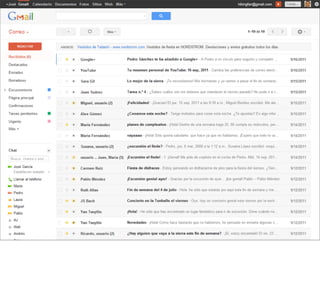
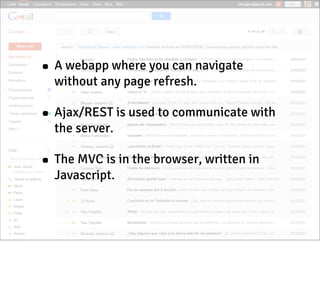
• A webapp where you can navigate
without any page refresh.

• Ajax/REST is used to communicate with
the server.

• The MVC is in the browser, written in
Javascript.
Seriously??

WTF!?!?
Did you say
Javascript??
Oh yeah me
too!
I like
Javascript!
I’m fine with Grails.
Why should I care
about SPI?
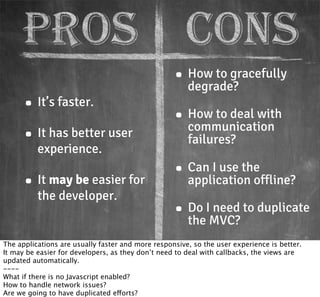
• It’s faster.
• It has better user
experience.

• It may be easier for
the developer.

• How to gracefully
degrade?
• How to deal with
communication
failures?

• Can I use the
application offline?
need
• Do IMVC? to duplicate
the

The applications are usually faster and more responsive, so the user experience is better.
It may be easier for developers, as they don’t need to deal with callbacks, the views are
updated automatically.
---What if there is no Javascript enabled?
How to handle network issues?
Are we going to have duplicated efforts?
Other benefits
• You get ready to expose a public API.
• It allows you to update the UI frequently.
• It’s easier to create mobile apps.
• You can organize/scale your teams
better.

Separating the view you get ready for exposing an API.
The UI can be redeployed frequently, without affecting the platform.
It’s easier to create different views, for different devices.
The dev teams can be reorganized and some development can be done in parallel.
You got me!! How can I
do that with Grails!!
• Use Grails 2.3 REST capabilities.
• Define your backend: GORM? Other web
services?

• Make it a robust, powerful black box for
the front end.

Grails 2.3 comes with significant improvements to build REST API’s.
You can still use all Groovy ecosystem to consume any backend.
Then, you can concentrate on building a robust, tested, black boxed Grails layer.
•

Focus on:

• Transactions.
• Efficient data manipulation.
• Security.
• Scalability.
What are the
alternatives for the
client side?
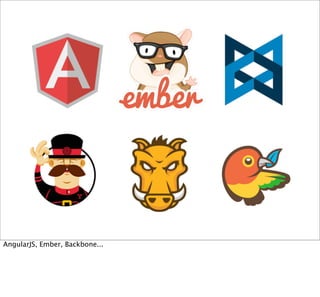
AngularJS, Ember, Backbone...
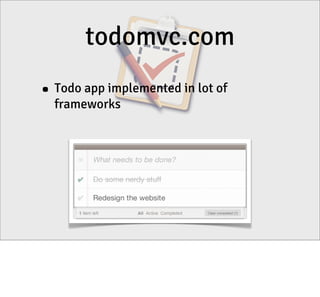
todomvc.com
• Todo app implemented in lot of
frameworks
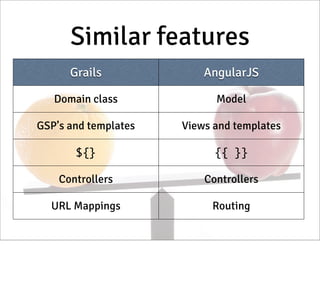
Similar features
Grails

AngularJS

Domain class

Model

GSP’s and templates

Views and templates

${}

{{ }}

Controllers

Controllers

URL Mappings

Routing
Grails & Angular
• Angular will issue an OPTIONS request
as per CORS:

• Use cors plugin.
• Manually configure URL mappings to
avoid 405 responses.
Demo
Álvaro Sánchez-Mariscal
Developing SPI applications using Grails and
AngularJS
@alvaro_sanchez - Odobo

Developing SPI applications using Grails and AngularJS

  • 1.
    Álvaro Sánchez-Mariscal Developing SPIapplications using Grails and AngularJS @alvaro_sanchez - Odobo
  • 2.
    About me • Passionatesoftware developer. • Founded Salenda in 2005. • Co-founded Escuela de Groovy in 2009. • Groovy/Grails lover since 2007. • Working now at Odobo.
  • 3.
    • HTML5 gamesplatform for: • Game developers. • Casinos.
  • 4.
    Typical Grails Architecture This isabout architecture. Grails is essentially MVC. This can be fine for some projects, but may have drawbacks in large projects
  • 5.
    Monolithic! Although the individualGrails artifacts can be developed in a modular way, it still has the views and the business logic on the same artifact.
  • 6.
    Slow GSP rendering! Slowstartup time! Memory consumption, reloading issues... Sitemesh and the GSP rendering engine it’s not the fastest thing in the world... Large projects may suffer slow startup times, intensive resource usage, ....
  • 7.
    Other problems • It’stricky to decouple the view layer to render views for different devices. • It’s difficult to do frequent deployments. • It’s hard to scale development. Although there are plugins to solve this, it’s not that agile to have different renderings for different devices. Changes on the UI will require to redeploy the whole thing. The development efforts must be synchronized.
  • 8.
    Grails 3.0 willhave application profiles The Grails roadmap is already embracing the change, and 3.0 will offer different profiles: - Classic MVC. - Netty. - Vert.x. - Etc.
  • 9.
    So... WTF isa Single Page Application? SPI or SPA.
  • 11.
    • A webappwhere you can navigate without any page refresh. • Ajax/REST is used to communicate with the server. • The MVC is in the browser, written in Javascript.
  • 12.
  • 13.
    Oh yeah me too! Ilike Javascript!
  • 15.
    I’m fine withGrails. Why should I care about SPI?
  • 16.
    • It’s faster. •It has better user experience. • It may be easier for the developer. • How to gracefully degrade? • How to deal with communication failures? • Can I use the application offline? need • Do IMVC? to duplicate the The applications are usually faster and more responsive, so the user experience is better. It may be easier for developers, as they don’t need to deal with callbacks, the views are updated automatically. ---What if there is no Javascript enabled? How to handle network issues? Are we going to have duplicated efforts?
  • 17.
    Other benefits • Youget ready to expose a public API. • It allows you to update the UI frequently. • It’s easier to create mobile apps. • You can organize/scale your teams better. Separating the view you get ready for exposing an API. The UI can be redeployed frequently, without affecting the platform. It’s easier to create different views, for different devices. The dev teams can be reorganized and some development can be done in parallel.
  • 18.
    You got me!!How can I do that with Grails!!
  • 19.
    • Use Grails2.3 REST capabilities. • Define your backend: GORM? Other web services? • Make it a robust, powerful black box for the front end. Grails 2.3 comes with significant improvements to build REST API’s. You can still use all Groovy ecosystem to consume any backend. Then, you can concentrate on building a robust, tested, black boxed Grails layer.
  • 20.
    • Focus on: • Transactions. •Efficient data manipulation. • Security. • Scalability.
  • 21.
    What are the alternativesfor the client side?
  • 22.
  • 23.
    todomvc.com • Todo appimplemented in lot of frameworks
  • 24.
    Similar features Grails AngularJS Domain class Model GSP’sand templates Views and templates ${} {{ }} Controllers Controllers URL Mappings Routing
  • 25.
    Grails & Angular •Angular will issue an OPTIONS request as per CORS: • Use cors plugin. • Manually configure URL mappings to avoid 405 responses.
  • 26.
  • 27.
    Álvaro Sánchez-Mariscal Developing SPIapplications using Grails and AngularJS @alvaro_sanchez - Odobo