Code of conduct of Nepal
pharmacy council
Ashok Kumar Mourya
(ucms)
Presentation
Introduction:-
Pharmacy Council is established in 2058 BS (2001 AD) with the objective of
making the pharmacy profession effective through systematic and scientific
operation and also for the registration of the pharmacists and pharmacy assistants
as per their qualification. Health. Care is a basic need of people. The constitutions
of Nepal states that every citizen shall have equal access to health services as their
fundamental right. The concerned health personnel is now vigorously functioning in
this subject to accomplish directives of the constitution to every corner of the
country for the welfare of the people of Nepal.
It is an opportunity for all, working in health services, including pharmacists to proceed
one step forward to achieve this goal of national interest and provide sincere services to
the needy people.
-Pharmacy profession, industrial and health care are undergoing rapid change. It is
a challenge and needs to strengthen and upgrade our system of education to
produce competent pharmacists. Educate ourselves appropriately and be an
excellent member of our society
Continue……
. In this contest, Nepal Pharmacy Council urges all the pharmacists to take part in
this solemn task of humanitarian service and contribute sincerely for the
betterment of the society. I am confident that pharmacists can serve the interests
of both individual patients and the public at large.
NPC Act:-
Nepal Pharmacy Council Act, 2057 (2000)
Date of Authentication
2057.10.18 (Jan. 31, 2001)
Act number 14 of the year 2057 (2000)
An Act Made to Provide for the Nepal Pharmacy Council
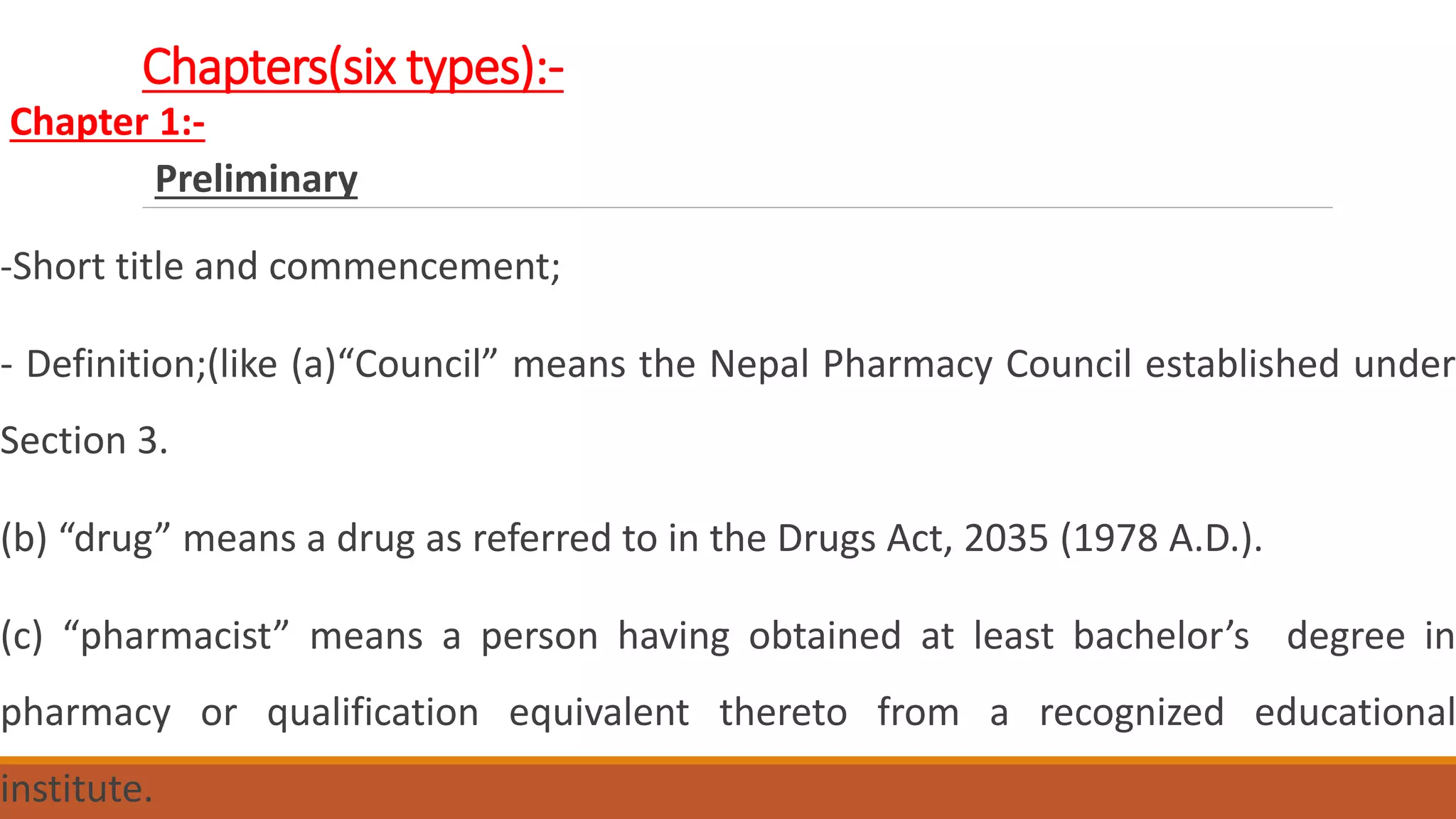
Chapters(six types):-
Chapter 1:-
Preliminary
-Short title and commencement;
- Definition;(like (a)“Council” means the Nepal Pharmacy Council established under
Section 3.
(b) “drug” means a drug as referred to in the Drugs Act, 2035 (1978 A.D.).
(c) “pharmacist” means a person having obtained at least bachelor’s degree in
pharmacy or qualification equivalent thereto from a recognized educational
institute.
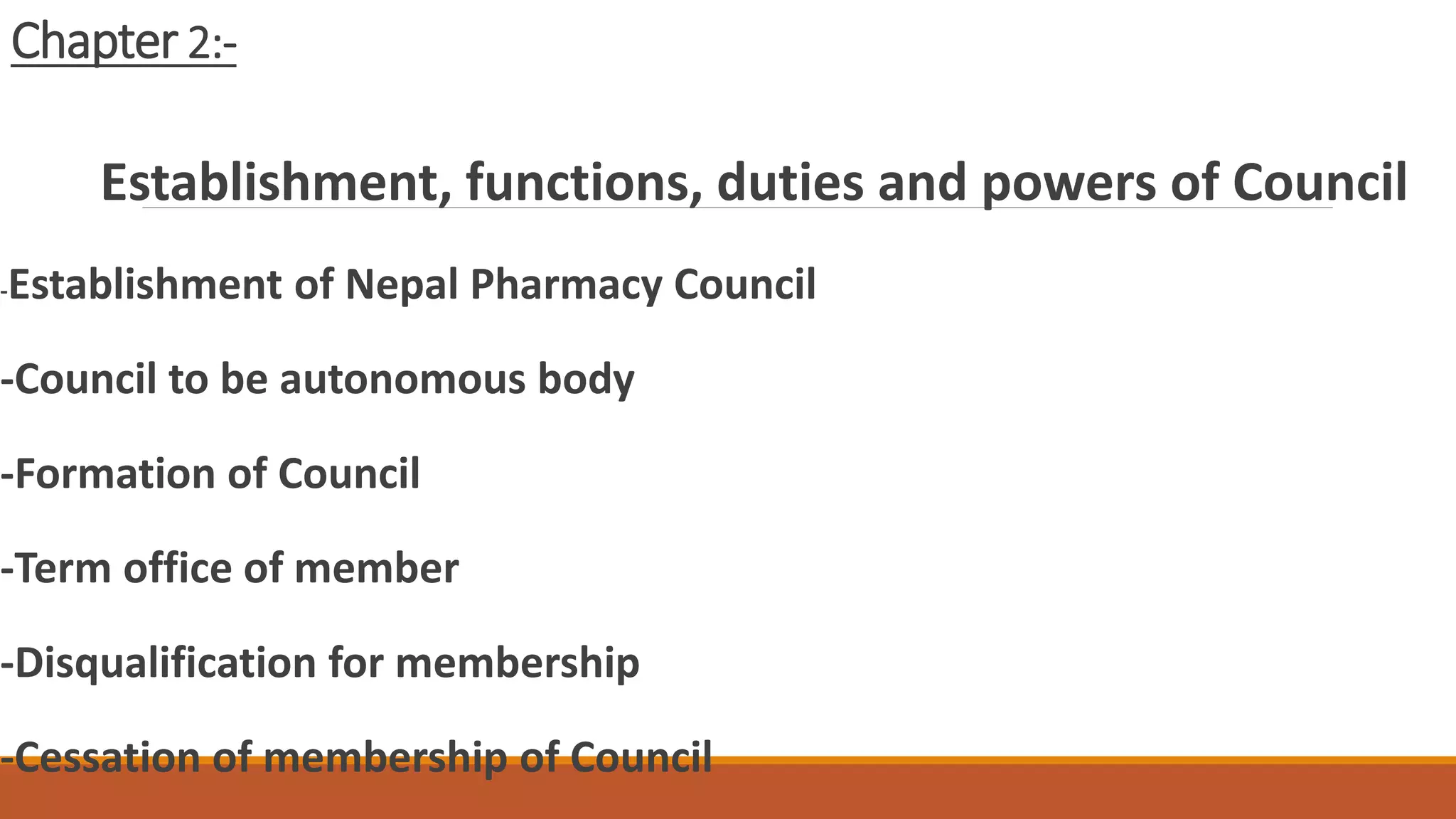
Chapter 2:-
Establishment, functions, duties and powers of Council
-Establishment of Nepal Pharmacy Council
-Council to be autonomous body
-Formation of Council
-Term office of member
-Disqualification for membership
-Cessation of membership of Council
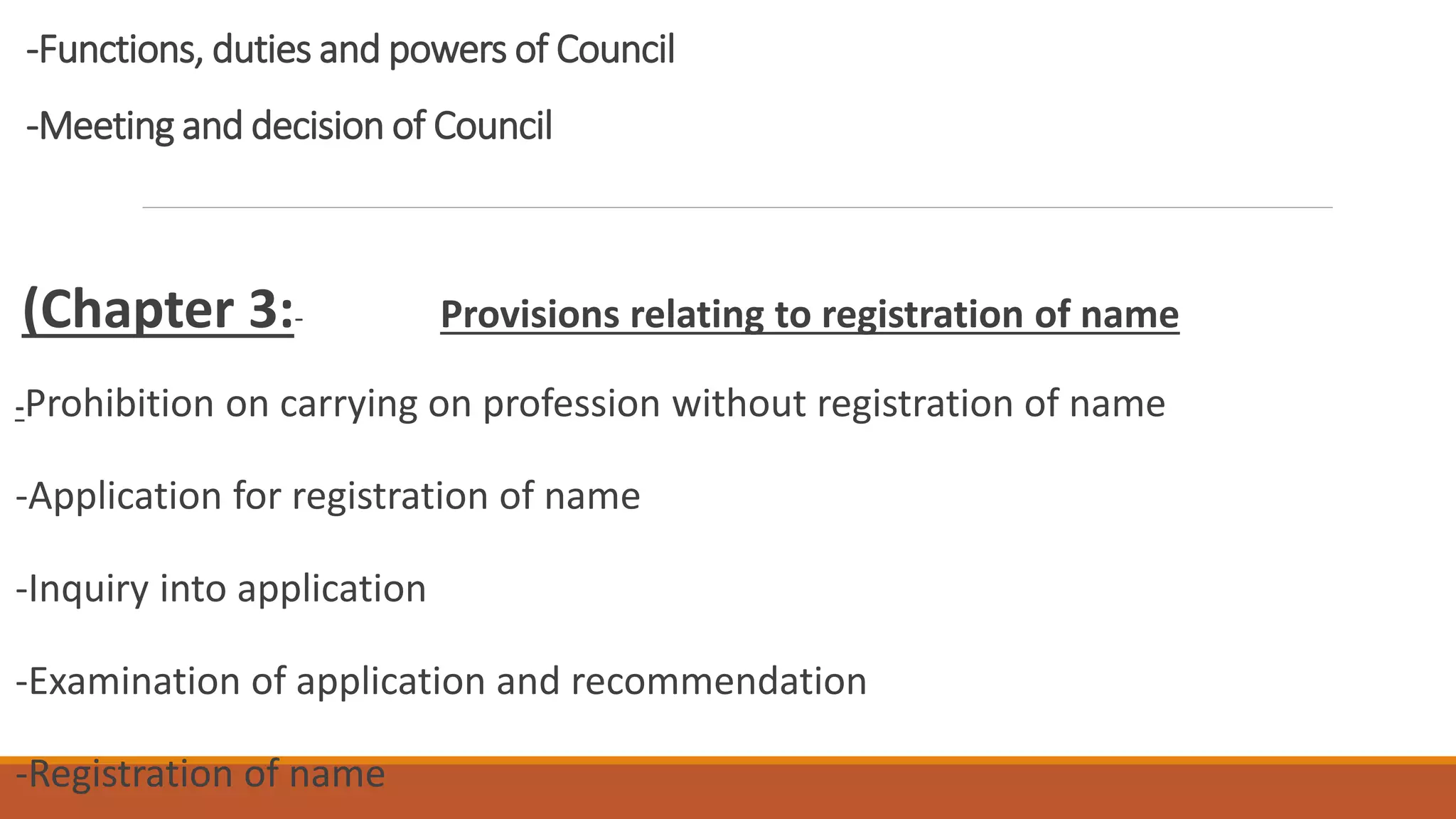
-Functions, duties and powers of Council
-Meeting and decision of Council
(Chapter 3:- Provisions relating to registration of name
-Prohibition on carrying on profession without registration of name
-Application for registration of name
-Inquiry into application
-Examination of application and recommendation
-Registration of name
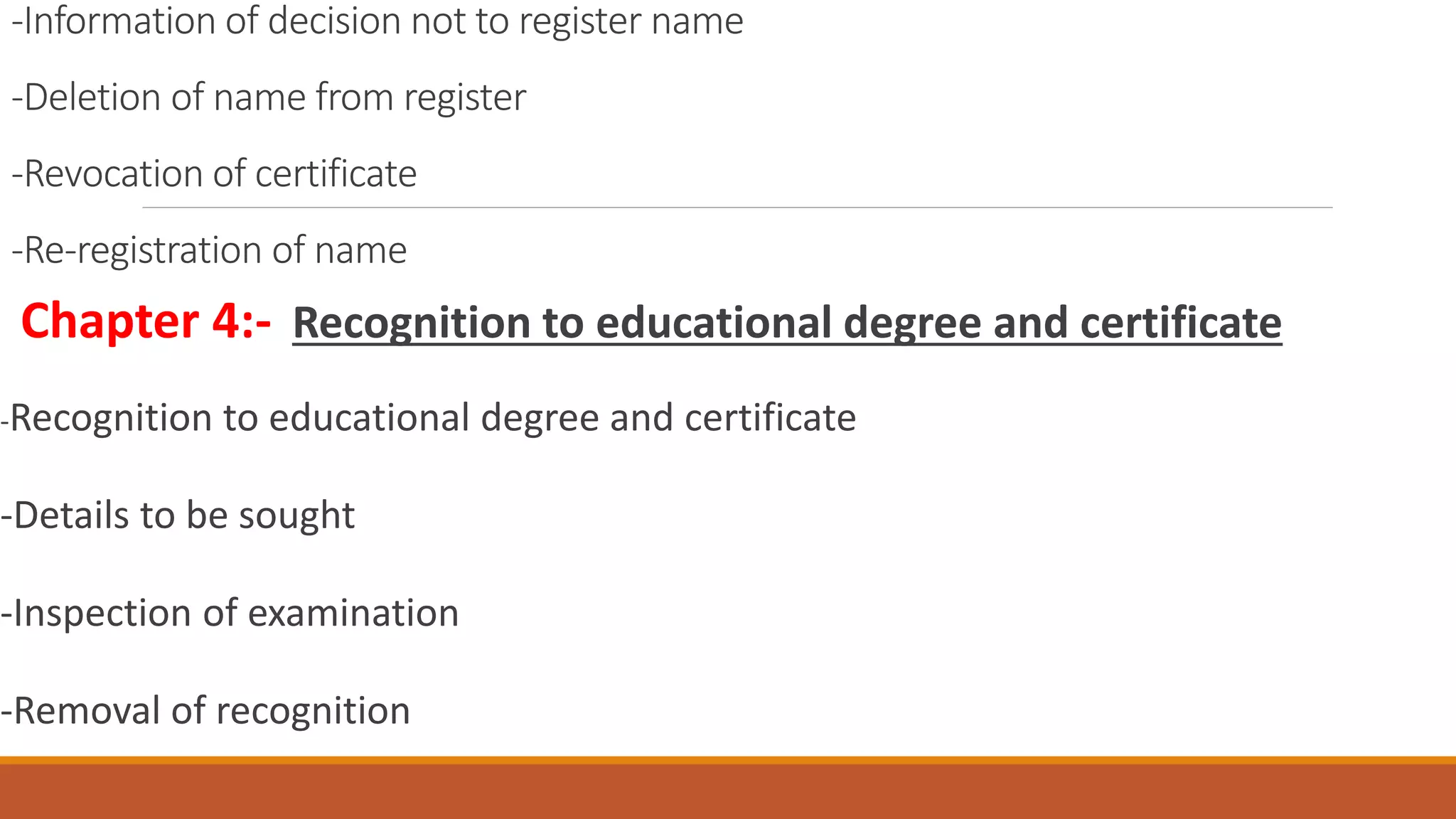
-Information of decision not to register name
-Deletion of name from register
-Revocation of certificate
-Re-registration of name
Chapter 4:- Recognition to educational degree and certificate
-Recognition to educational degree and certificate
-Details to be sought
-Inspection of examination
-Removal of recognition
Chapter 5:-
Provision relating to functions, duties and powers of
chairperson and registrar
-Provisions relating to functions, duties and powers of chairperson
-Registrar
Chapter 6:-(Fund of Council)
-Fund of Council
-Accounts and audit
Chapter 7:-
-Offense and punishment
-Authority to investigate and file case
-Dissolution of Council
-Powers to form thematic committee
-Meeting allowances and other facilities of member
-Employees of Council
-Liaison with the Government of Nepal
Definition and Responsibility:-
A profession is identified by the willingness of Individual practitioners to comply
with ethical and professional standards which exceed minimum legal requirements.
Pharmacists are the professionals with the following responsibilities:
-To help people to maintain good health.
-To avoid ill health with appropriate medication .
-To promote the rational use of medicines
-To assist patients to acquire and gain maximum therapeutic benefit from their
medicines..
Code of ethics:-
-To act with fairness and equity in the allocation of any health resources made
available to them.
-To collaborate with other health professionals to ensure that the best possible
quality of healthcare is provided both to individuals and the community.
-To respect the rights of individual patients to participate in decisions about their
treatment with medicinal products.
-To recognize and respect the cultural differences, beliefs and values of patients.
Continue:-
-To respect and protect the confidentiality of information acquired in the course of
providing professional services and ensure that information about an individual is
not disclosed to others except with the informed consent of that individual or in
specified exceptional circumstances.
-To act in accordance with professional standards and scientific principles.
-To act with honesty and integrity in their relationships with other health
professionals by Including pharmacist colleagues and not engage in any activity
likely to bring the profession into disrepute.
Continue:-
To ensure that they keep their knowledge and professional skills up-to-date through
continuing professional development.
To comply with legislation and accepted codes and standards of practice in the
provision of all professional services and pharmaceutical products and ensure the
integrity of the supply chain for medicines by purchasing only from reputable
sources.
To ensure that all information provided to patients, public members and health
professionals is accurate and objective.
Professional code of conduct(Nepal Pharmacy Council)
◦ Discrimination should not be made on the basis of religion race, sex and social
caste while exercising professional knowledge and skill.
◦ • Pharmaceutical actions should be carried out only on the basis of study or
knowledge or skill obtained by pharmacist.
◦ • Responsibility of each act relating to Pharmacy profession to be performed by
them shall be required to be taken and performed personally.
◦ . Every registered Pharmacy professional shall be required to update their name.
.
Competencies for the pharmacist: Pharmacist practice within legal requirement
demonstrates professional integrity within professional standards of practice and code
of ethics.
The competencies in a pharmacist are:
1. Pharmacist applies legal requirements and ethical principles together with
professional policies and standards concerting with patient care: Pharmacist
accepts responsibility for personal actions and decisions with regard to patient
care. They describe and demonstrate all the parameters of confidentiality. They
comply with legal requirements and ethical principle regarding counselling and in
the provision of pharmacist services and uphold the legal and policy
…..
Ii. Pharmacist can elucidate [i.e. Make clear] the complaints and discipline process
and consequences for pharmacists and non-pharmacist: Pharmacists can describe
components of professional liability such as malpractice and negligence. They can
explain the role and function of complaints committee and the complaints process.
They can also describe the concept of conflict of interest.
Iii. Pharmacist applies legal requirements and ethical principles affecting
acquisition [i.e. Skill], storage, distribution, promotion and disposal of drugs and
devices:
: Pharmaceutical substances should be stored, distributed, promoted
and disposed in proper way by a professionally knowledgeable person
and the person regard to pharmaceutical manage is Pharmacist.
Pharmacists adhere to established drug schedules as well as conditions
of sale and they determine the interchangeability of pharmaceuticals.
Contd….
Iv. Pharmacist can specify the requirements for obtaining, maintaining and
reactivating a license to practice as a pharmacist:
Pharmacist can:-
• Explain the registration process and the requirements for initial licensure
•State the requirements for maintaining and reactivating the license to
practice pharmacy
Differentiate between internship and clerkship
Contd……
V. Pharmacists can explain the requirements for owning and managing the
pharmacy:
The pharmacist can:
• State the accreditation requirements to allow for the operation of a pharmacy
• Explain what is meant by sub-division pharmacy and/or operation
Detail requirements for the supervision of a pharmacy Detail responsibilities of an
owner and/or manager
…..
Vi. Pharmacists can explain the code of ethics: They can outline the code of
ethics and they can also explain the professional ethical principles.
Contd…..
Vil. Pharmacists exercise professional judgment in ethical and legal decision
making: Pharmacist can explain the peer review process as it relates to exercising
professional judgment and can access situations and apply professional judgment
in reasonable manner as judged by peers. They can use the gained knowledge and
experience in legal decision making.
Viii. Pharmacists can demonstrate basic knowledge of legal requirements for
manufacturers of drug and devices: They can explain the basic requirements
regarding manufacturers advertising and describe the basics of licensing and
application of the Good Manufacturing Practice [GMP] requirements.
Continue….
They can explain the basics of manufacturer's responsibility with regard to drug recall.
Descriptions of the manufacturer's get from the pharmacists regarding to the package size
restrictions and labelling requirements can also be useful.
ix. Pharmacists can explain the meaning of fundamental legal terms which are relevant
to pharmacy: Pharmacist can identify and define the fundamental legal terms like drug,
hospital, intern, pharmacist, prescriber, sell, registered pharmacy student and assistant
and explain the relevance of these legal terms to the practice of pharmacy.
……cont.
Pharmacists can describe the role, structure, function and mandate of the
regulatory authorities: Pharmacists can define regulatory authorities and
can describe the role and function of the administration. They help for
management and governance of regulatory authority.
code of conduct of NHPC.pptx

code of conduct of NHPC.pptx

  • 1.
    Code of conductof Nepal pharmacy council Ashok Kumar Mourya (ucms) Presentation
  • 2.
    Introduction:- Pharmacy Council isestablished in 2058 BS (2001 AD) with the objective of making the pharmacy profession effective through systematic and scientific operation and also for the registration of the pharmacists and pharmacy assistants as per their qualification. Health. Care is a basic need of people. The constitutions of Nepal states that every citizen shall have equal access to health services as their fundamental right. The concerned health personnel is now vigorously functioning in this subject to accomplish directives of the constitution to every corner of the country for the welfare of the people of Nepal.
  • 3.
    It is anopportunity for all, working in health services, including pharmacists to proceed one step forward to achieve this goal of national interest and provide sincere services to the needy people. -Pharmacy profession, industrial and health care are undergoing rapid change. It is a challenge and needs to strengthen and upgrade our system of education to produce competent pharmacists. Educate ourselves appropriately and be an excellent member of our society
  • 4.
    Continue…… . In thiscontest, Nepal Pharmacy Council urges all the pharmacists to take part in this solemn task of humanitarian service and contribute sincerely for the betterment of the society. I am confident that pharmacists can serve the interests of both individual patients and the public at large.
  • 5.
    NPC Act:- Nepal PharmacyCouncil Act, 2057 (2000) Date of Authentication 2057.10.18 (Jan. 31, 2001) Act number 14 of the year 2057 (2000) An Act Made to Provide for the Nepal Pharmacy Council
  • 6.
    Chapters(six types):- Chapter 1:- Preliminary -Shorttitle and commencement; - Definition;(like (a)“Council” means the Nepal Pharmacy Council established under Section 3. (b) “drug” means a drug as referred to in the Drugs Act, 2035 (1978 A.D.). (c) “pharmacist” means a person having obtained at least bachelor’s degree in pharmacy or qualification equivalent thereto from a recognized educational institute.
  • 7.
    Chapter 2:- Establishment, functions,duties and powers of Council -Establishment of Nepal Pharmacy Council -Council to be autonomous body -Formation of Council -Term office of member -Disqualification for membership -Cessation of membership of Council
  • 8.
    -Functions, duties andpowers of Council -Meeting and decision of Council (Chapter 3:- Provisions relating to registration of name -Prohibition on carrying on profession without registration of name -Application for registration of name -Inquiry into application -Examination of application and recommendation -Registration of name
  • 9.
    -Information of decisionnot to register name -Deletion of name from register -Revocation of certificate -Re-registration of name Chapter 4:- Recognition to educational degree and certificate -Recognition to educational degree and certificate -Details to be sought -Inspection of examination -Removal of recognition
  • 10.
    Chapter 5:- Provision relatingto functions, duties and powers of chairperson and registrar -Provisions relating to functions, duties and powers of chairperson -Registrar Chapter 6:-(Fund of Council) -Fund of Council -Accounts and audit
  • 11.
    Chapter 7:- -Offense andpunishment -Authority to investigate and file case -Dissolution of Council -Powers to form thematic committee -Meeting allowances and other facilities of member -Employees of Council -Liaison with the Government of Nepal
  • 12.
    Definition and Responsibility:- Aprofession is identified by the willingness of Individual practitioners to comply with ethical and professional standards which exceed minimum legal requirements. Pharmacists are the professionals with the following responsibilities: -To help people to maintain good health. -To avoid ill health with appropriate medication . -To promote the rational use of medicines -To assist patients to acquire and gain maximum therapeutic benefit from their medicines..
  • 13.
    Code of ethics:- -Toact with fairness and equity in the allocation of any health resources made available to them. -To collaborate with other health professionals to ensure that the best possible quality of healthcare is provided both to individuals and the community. -To respect the rights of individual patients to participate in decisions about their treatment with medicinal products. -To recognize and respect the cultural differences, beliefs and values of patients.
  • 14.
    Continue:- -To respect andprotect the confidentiality of information acquired in the course of providing professional services and ensure that information about an individual is not disclosed to others except with the informed consent of that individual or in specified exceptional circumstances. -To act in accordance with professional standards and scientific principles. -To act with honesty and integrity in their relationships with other health professionals by Including pharmacist colleagues and not engage in any activity likely to bring the profession into disrepute.
  • 15.
    Continue:- To ensure thatthey keep their knowledge and professional skills up-to-date through continuing professional development. To comply with legislation and accepted codes and standards of practice in the provision of all professional services and pharmaceutical products and ensure the integrity of the supply chain for medicines by purchasing only from reputable sources. To ensure that all information provided to patients, public members and health professionals is accurate and objective.
  • 16.
    Professional code ofconduct(Nepal Pharmacy Council) ◦ Discrimination should not be made on the basis of religion race, sex and social caste while exercising professional knowledge and skill. ◦ • Pharmaceutical actions should be carried out only on the basis of study or knowledge or skill obtained by pharmacist. ◦ • Responsibility of each act relating to Pharmacy profession to be performed by them shall be required to be taken and performed personally. ◦ . Every registered Pharmacy professional shall be required to update their name. .
  • 17.
    Competencies for thepharmacist: Pharmacist practice within legal requirement demonstrates professional integrity within professional standards of practice and code of ethics. The competencies in a pharmacist are: 1. Pharmacist applies legal requirements and ethical principles together with professional policies and standards concerting with patient care: Pharmacist accepts responsibility for personal actions and decisions with regard to patient care. They describe and demonstrate all the parameters of confidentiality. They comply with legal requirements and ethical principle regarding counselling and in the provision of pharmacist services and uphold the legal and policy
  • 18.
    ….. Ii. Pharmacist canelucidate [i.e. Make clear] the complaints and discipline process and consequences for pharmacists and non-pharmacist: Pharmacists can describe components of professional liability such as malpractice and negligence. They can explain the role and function of complaints committee and the complaints process. They can also describe the concept of conflict of interest. Iii. Pharmacist applies legal requirements and ethical principles affecting acquisition [i.e. Skill], storage, distribution, promotion and disposal of drugs and devices:
  • 19.
    : Pharmaceutical substancesshould be stored, distributed, promoted and disposed in proper way by a professionally knowledgeable person and the person regard to pharmaceutical manage is Pharmacist. Pharmacists adhere to established drug schedules as well as conditions of sale and they determine the interchangeability of pharmaceuticals.
  • 20.
    Contd…. Iv. Pharmacist canspecify the requirements for obtaining, maintaining and reactivating a license to practice as a pharmacist: Pharmacist can:- • Explain the registration process and the requirements for initial licensure •State the requirements for maintaining and reactivating the license to practice pharmacy Differentiate between internship and clerkship
  • 21.
    Contd…… V. Pharmacists canexplain the requirements for owning and managing the pharmacy: The pharmacist can: • State the accreditation requirements to allow for the operation of a pharmacy • Explain what is meant by sub-division pharmacy and/or operation Detail requirements for the supervision of a pharmacy Detail responsibilities of an owner and/or manager
  • 22.
    ….. Vi. Pharmacists canexplain the code of ethics: They can outline the code of ethics and they can also explain the professional ethical principles.
  • 23.
    Contd….. Vil. Pharmacists exerciseprofessional judgment in ethical and legal decision making: Pharmacist can explain the peer review process as it relates to exercising professional judgment and can access situations and apply professional judgment in reasonable manner as judged by peers. They can use the gained knowledge and experience in legal decision making. Viii. Pharmacists can demonstrate basic knowledge of legal requirements for manufacturers of drug and devices: They can explain the basic requirements regarding manufacturers advertising and describe the basics of licensing and application of the Good Manufacturing Practice [GMP] requirements.
  • 24.
    Continue…. They can explainthe basics of manufacturer's responsibility with regard to drug recall. Descriptions of the manufacturer's get from the pharmacists regarding to the package size restrictions and labelling requirements can also be useful. ix. Pharmacists can explain the meaning of fundamental legal terms which are relevant to pharmacy: Pharmacist can identify and define the fundamental legal terms like drug, hospital, intern, pharmacist, prescriber, sell, registered pharmacy student and assistant and explain the relevance of these legal terms to the practice of pharmacy.
  • 25.
    ……cont. Pharmacists can describethe role, structure, function and mandate of the regulatory authorities: Pharmacists can define regulatory authorities and can describe the role and function of the administration. They help for management and governance of regulatory authority.