Confronting obesity: Co-creating
policy with youth (CO-CREATE)
CO-CREATE kick-off meeting
Knut-Inge Klepp, Coordinator
Oslo, June 27, 2018
This project has received funding from the European
Union's Horizon 2020 research and innovation
programme under grant agreement No 774210
Confronting obesity: Co-creating policy with youth
Childhood obesity on the agenda
Confronting obesity: Co-creating policy with youth
Overweight and obesity by
mother’s education
3
11,8
14,3 14,3
2
4,5 5,1
0
5
10
15
20
25
høy utdanning mellomutdanning lav utdanning
Andel(%)
fedme (%)
overvekt (%)
18%
14%
Biehl, A, Hovengen, R, Groholt, EK, Hjelmesaeth, J, Strand, BH et al. Adiposity among children in Norway by urbanity and
maternal education: a nationally representative study. BMC Public Health 2013; 13: 842.
*
19%
Confronting obesity: Co-creating policy with youth
CO-CREATE: impacting the context
The overall aim of CO-CREATE is to
reduce the prevalence of obesity among
adolescents in Europe through policy
actions in promotion of a healthier food
and physical activity environment
Lobstein et.al, Obesity reviews (2004) 5 (Suppl. 1), 4–85
Confronting obesity: Co-creating policy with youth
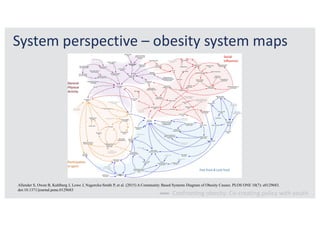
System perspective – obesity system maps
Allender S, Owen B, Kuhlberg J, Lowe J, Nagorcka-Smith P, et al. (2015) A Community Based Systems Diagram of Obesity Causes. PLOS ONE 10(7): e0129683.
doi:10.1371/journal.pone.0129683
Confronting obesity: Co-creating policy with youth
WHO European Childhood Obesity Surveillance
Initiative (COSI)
COSI involves taking standardized weight and
height measurements from over 300 000 6-9-
year-old children across the WHO European
Region, providing nationally representative data
for participating countries, and large region-
wide data set for analysis of the determinants of
childhood overweight and obesity
Over 40 member states in Europe will
participate in the 5th round of COSI during the
2018–2019 school year
Figure: Prevalence of overweight (including obesity) and
obesity (WHO definition) in boys and girls aged 6-9 years,
by age and country
Confronting obesity: Co-creating policy with youth
WHO: Health Behaviour in School Children
Utilizing existing data and investigating variation across
Europe
WHO Regional Office for Europe (2016). Health Behaviour in School-aged Children (HBSC) study: international report from the 2013/2014 survey. WHO, Copenhagen.
Confronting obesity: Co-creating policy with youth
Monitoring policies
World Cancer Research Fund International
NOURISHING:
policy framework to promote healthy
diets & reduce obesity
Confronting obesity: Co-creating policy with youth
Youth involvement
In COCREATE, adolescents are not merely
the object of an intervention designed by
researchers, but are themselves agents for
change, identifying required actions and
collaborating to help achieve them
Confronting obesity: Co-creating policy with youth
State of the art
Systematic review of existing policy and intervention research
Confronting obesity: Co-creating policy with youth
The project objectives are:
To develop methodology for monitoring and benchmarking relevant policies
To establish the state-of-the-art in existing evidence regarding effective policies and policy measures; investigate
changes in overweight, obesity rates and related behaviors across countries over time; study such changes in relation to
relevant European and national policies; to explore associations between policies and prevalence according to socio-
economic background
To develop a set of visual system maps of policy-dependent multi-level drivers of adolescent obesity across the
Netherlands, Norway, Poland, Portugal, South Africa and the United Kingdom
To collaborate with adolescents aged 13-18 and establish sustainable Youth Alliances for Overweight Prevention
Policies; develop novel policy options that will contribute to upstream overweight prevention and reducing inequalities
in overweight/obesity
To establish and evaluate policy dialogue forums between public and private sector stakeholders
To develop prototype outcomes, policies and solutions that policy makers and businesses can respond to, based on
engagement with, and feedback from youth
To use system dynamics modelling to assess and predict the potential impacts of selected evidence-based and co-
created policy options, including the socioeconomic distribution of any impact
To communicate and disseminate purpose, progress, toolkits and other deliverables of CO-CREATE
Confronting obesity: Co-creating policy with youth
Expected impacts
New insight into childhood obesity levels in
relation to implementation of policies
Mapping out the obesity system
Modelling policy responses in the obesity
system
Liaise with youth themselves
Open access, easy to use, policy monitoring
tools
Model for dialogue forums including
stakeholders from various levels of society
Confronting obesity: Co-creating policy with youth
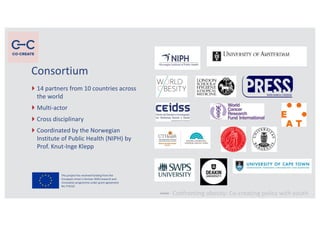
Consortium
14 partners from 10 countries across
the world
Multi-actor
Cross disciplinary
Coordinated by the Norwegian
Institute of Public Health (NIPH) by
Prof. Knut-Inge Klepp
This project has received funding from the
European Union's Horizon 2020 research and
innovation programme under grant agreement
No 774210
Confronting obesity: Co-creating policy with youth
Organization of the work
Confronting obesity: Co-creating policy with youth
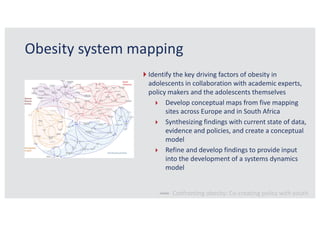
Obesity system mapping
Identify the key driving factors of obesity in
adolescents in collaboration with academic experts,
policy makers and the adolescents themselves
Develop conceptual maps from five mapping
sites across Europe and in South Africa
Synthesizing findings with current state of data,
evidence and policies, and create a conceptual
model
Refine and develop findings to provide input
into the development of a systems dynamics
model
Confronting obesity: Co-creating policy with youth
Youth Alliances for overweight prevention
policies
Establish Youth Alliances for Overweight Prevention
Policies across Europe
Promote and support adolescent participation in
policy formulation processes
Knowledge exchange and learning between the
adolescents and the scientific community
Policy development informed by the adolescents
themselves
Identify, with adolescents, sustainable and
effective overweight prevention policies and
effective ways of including adolescents in the
development of policies targeting their group
Confronting obesity: Co-creating policy with youth
Dialogue forum with representatives from policy
and business
Establish and evaluate policy dialogue forums with
adolescents and important stakeholders that define and
influence policies related to overweight and obesity
prevention
Empowerment of adolescents in dialogue about
their health and welfare
Analysis of the roles and responsibility of each
stakeholder group in tackling overweight and
obesity prevention
Follow up actionable outcomes of the dialogue
forums
Develop recommendations for how to establish
multi-actor dialogue forums
Confronting obesity: Co-creating policy with youth
Evaluation of co-created policy interventions and
methodology
Systems dynamics modelling to assess and
predict impacts of selected evidence based and
co-created policy options for prevention of
overweight and obesity across the social
gradient
Develop infrastructure for the implementation
and evaluation of CO-CREATE outputs
Confronting obesity: Co-creating policy with youth
Communication and dissemination of results
Main web site hosted by Norwegian Institute of Pubic Health:
www.co-create.eu
CO-CREATE project pages on all partners’ sites
WCRFI web site for database on nutrition and physical activity policies
WOF youth-facing web site for information/interaction
Extensive use of social media and presentations at European level
conferences such as EUPHA, ECO, ISBNPA, EAT Forum
Newsletters (i.e. major events, tools and targeted audience)
Established collaboration with the Science & Technology in childhood
Obesity Policy (STOP) project and with the Joint Programming Initiative
on Healthy Diet for a Healthy Life: Policy Evaluation Network (PEN)
The CO-CREATE project has received funding from the European Union’s
Horizon 2020 research and innovation programme under grant agreement No 774210.
The products of the research are the responsibility of the authors: the European
Commission is not responsible for any use that may be made of them.
www.co-create.eu

CO-CREATE official opening presentation professor Knut-Inge Klepp

  • 1.
    Confronting obesity: Co-creating policywith youth (CO-CREATE) CO-CREATE kick-off meeting Knut-Inge Klepp, Coordinator Oslo, June 27, 2018 This project has received funding from the European Union's Horizon 2020 research and innovation programme under grant agreement No 774210
  • 2.
    Confronting obesity: Co-creatingpolicy with youth Childhood obesity on the agenda
  • 3.
    Confronting obesity: Co-creatingpolicy with youth Overweight and obesity by mother’s education 3 11,8 14,3 14,3 2 4,5 5,1 0 5 10 15 20 25 høy utdanning mellomutdanning lav utdanning Andel(%) fedme (%) overvekt (%) 18% 14% Biehl, A, Hovengen, R, Groholt, EK, Hjelmesaeth, J, Strand, BH et al. Adiposity among children in Norway by urbanity and maternal education: a nationally representative study. BMC Public Health 2013; 13: 842. * 19%
  • 4.
    Confronting obesity: Co-creatingpolicy with youth CO-CREATE: impacting the context The overall aim of CO-CREATE is to reduce the prevalence of obesity among adolescents in Europe through policy actions in promotion of a healthier food and physical activity environment Lobstein et.al, Obesity reviews (2004) 5 (Suppl. 1), 4–85
  • 5.
    Confronting obesity: Co-creatingpolicy with youth System perspective – obesity system maps Allender S, Owen B, Kuhlberg J, Lowe J, Nagorcka-Smith P, et al. (2015) A Community Based Systems Diagram of Obesity Causes. PLOS ONE 10(7): e0129683. doi:10.1371/journal.pone.0129683
  • 6.
    Confronting obesity: Co-creatingpolicy with youth WHO European Childhood Obesity Surveillance Initiative (COSI) COSI involves taking standardized weight and height measurements from over 300 000 6-9- year-old children across the WHO European Region, providing nationally representative data for participating countries, and large region- wide data set for analysis of the determinants of childhood overweight and obesity Over 40 member states in Europe will participate in the 5th round of COSI during the 2018–2019 school year Figure: Prevalence of overweight (including obesity) and obesity (WHO definition) in boys and girls aged 6-9 years, by age and country
  • 7.
    Confronting obesity: Co-creatingpolicy with youth WHO: Health Behaviour in School Children Utilizing existing data and investigating variation across Europe WHO Regional Office for Europe (2016). Health Behaviour in School-aged Children (HBSC) study: international report from the 2013/2014 survey. WHO, Copenhagen.
  • 8.
    Confronting obesity: Co-creatingpolicy with youth Monitoring policies World Cancer Research Fund International NOURISHING: policy framework to promote healthy diets & reduce obesity
  • 9.
    Confronting obesity: Co-creatingpolicy with youth Youth involvement In COCREATE, adolescents are not merely the object of an intervention designed by researchers, but are themselves agents for change, identifying required actions and collaborating to help achieve them
  • 10.
    Confronting obesity: Co-creatingpolicy with youth State of the art Systematic review of existing policy and intervention research
  • 11.
    Confronting obesity: Co-creatingpolicy with youth The project objectives are: To develop methodology for monitoring and benchmarking relevant policies To establish the state-of-the-art in existing evidence regarding effective policies and policy measures; investigate changes in overweight, obesity rates and related behaviors across countries over time; study such changes in relation to relevant European and national policies; to explore associations between policies and prevalence according to socio- economic background To develop a set of visual system maps of policy-dependent multi-level drivers of adolescent obesity across the Netherlands, Norway, Poland, Portugal, South Africa and the United Kingdom To collaborate with adolescents aged 13-18 and establish sustainable Youth Alliances for Overweight Prevention Policies; develop novel policy options that will contribute to upstream overweight prevention and reducing inequalities in overweight/obesity To establish and evaluate policy dialogue forums between public and private sector stakeholders To develop prototype outcomes, policies and solutions that policy makers and businesses can respond to, based on engagement with, and feedback from youth To use system dynamics modelling to assess and predict the potential impacts of selected evidence-based and co- created policy options, including the socioeconomic distribution of any impact To communicate and disseminate purpose, progress, toolkits and other deliverables of CO-CREATE
  • 12.
    Confronting obesity: Co-creatingpolicy with youth Expected impacts New insight into childhood obesity levels in relation to implementation of policies Mapping out the obesity system Modelling policy responses in the obesity system Liaise with youth themselves Open access, easy to use, policy monitoring tools Model for dialogue forums including stakeholders from various levels of society
  • 13.
    Confronting obesity: Co-creatingpolicy with youth Consortium 14 partners from 10 countries across the world Multi-actor Cross disciplinary Coordinated by the Norwegian Institute of Public Health (NIPH) by Prof. Knut-Inge Klepp This project has received funding from the European Union's Horizon 2020 research and innovation programme under grant agreement No 774210
  • 14.
    Confronting obesity: Co-creatingpolicy with youth Organization of the work
  • 15.
    Confronting obesity: Co-creatingpolicy with youth Obesity system mapping Identify the key driving factors of obesity in adolescents in collaboration with academic experts, policy makers and the adolescents themselves Develop conceptual maps from five mapping sites across Europe and in South Africa Synthesizing findings with current state of data, evidence and policies, and create a conceptual model Refine and develop findings to provide input into the development of a systems dynamics model
  • 16.
    Confronting obesity: Co-creatingpolicy with youth Youth Alliances for overweight prevention policies Establish Youth Alliances for Overweight Prevention Policies across Europe Promote and support adolescent participation in policy formulation processes Knowledge exchange and learning between the adolescents and the scientific community Policy development informed by the adolescents themselves Identify, with adolescents, sustainable and effective overweight prevention policies and effective ways of including adolescents in the development of policies targeting their group
  • 17.
    Confronting obesity: Co-creatingpolicy with youth Dialogue forum with representatives from policy and business Establish and evaluate policy dialogue forums with adolescents and important stakeholders that define and influence policies related to overweight and obesity prevention Empowerment of adolescents in dialogue about their health and welfare Analysis of the roles and responsibility of each stakeholder group in tackling overweight and obesity prevention Follow up actionable outcomes of the dialogue forums Develop recommendations for how to establish multi-actor dialogue forums
  • 18.
    Confronting obesity: Co-creatingpolicy with youth Evaluation of co-created policy interventions and methodology Systems dynamics modelling to assess and predict impacts of selected evidence based and co-created policy options for prevention of overweight and obesity across the social gradient Develop infrastructure for the implementation and evaluation of CO-CREATE outputs
  • 19.
    Confronting obesity: Co-creatingpolicy with youth Communication and dissemination of results Main web site hosted by Norwegian Institute of Pubic Health: www.co-create.eu CO-CREATE project pages on all partners’ sites WCRFI web site for database on nutrition and physical activity policies WOF youth-facing web site for information/interaction Extensive use of social media and presentations at European level conferences such as EUPHA, ECO, ISBNPA, EAT Forum Newsletters (i.e. major events, tools and targeted audience) Established collaboration with the Science & Technology in childhood Obesity Policy (STOP) project and with the Joint Programming Initiative on Healthy Diet for a Healthy Life: Policy Evaluation Network (PEN)
  • 20.
    The CO-CREATE projecthas received funding from the European Union’s Horizon 2020 research and innovation programme under grant agreement No 774210. The products of the research are the responsibility of the authors: the European Commission is not responsible for any use that may be made of them. www.co-create.eu