Origin and Roots of Coaching
…the secret history

Vikki Brock Ph.D., MCC, EMBA
Master Coach pela International Coach Federation - ICF
Origin and Roots of Coaching
…the secret history
Dr. Vikki G. Brock
Master Certified Coach
2nd Brazilian Coaching Congress
November 14, 2013
Agenda
What do you know about the history
of coaching?
How and when did modern coaching
emerge?
What role did South American
coaches play?

3
What do you know about the history
of coaching?

. . . What do you
want to know?
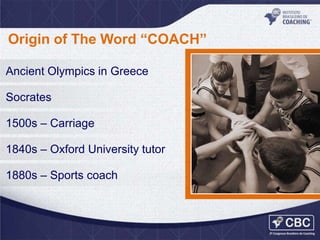
Origin of The Word “COACH”
Ancient Olympics in Greece
Socrates
1500s – Carriage
1840s – Oxford University tutor
1880s – Sports coach
Historical Observation #1

Coaching sprang from
several independent
sources and spread
through relationships
How many influencers in coaching
can you name
Non-Coaches
Coaches
EDUCATION
Malcolm
Knowles
BUSINESS

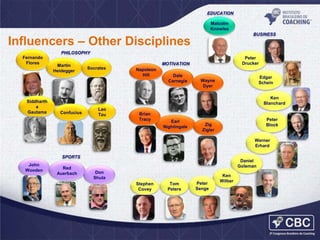
Influencers – Other Disciplines
PHILOSOPHY
Fernando
Flores

Siddharth
a
Gautama

Martin
Heidegger

Peter
Drucker

MOTIVATION
Socrates

Napoleon
Hill

Dale
Carnegie

Edgar
Schein

Wayne
Dyer

Ken
Blanchard
Confucius

Lao
Tzu

Brian
Tracy

Earl
Nightingale

Peter
Block

Zig
Zigler

Werner
Erhard
SPORTS
John
Wooden

Red
Auerbach

Daniel
Goleman
Don
Shula
Stephen
Covey

Tom
Peters

Peter
Senge

Ken
Wilber
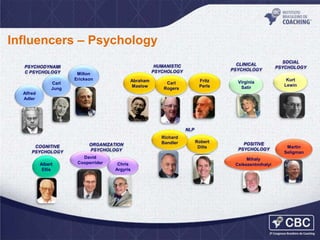
Influencers – Psychology
PSYCHODYNAMI
C PSYCHOLOGY
Carl
Jung

CLINICAL
PSYCHOLOGY

HUMANISTIC
PSYCHOLOGY

Milton
Erickson

Abraham
Maslow

Fritz
Perls

Carl
Rogers

Virginia
Satir

SOCIAL
PSYCHOLOGY
Kurt
Lewin

Alfred
Adler

NLP

COGNITIVE
PSYCHOLOGY

Albert
Ellis

ORGANIZATION
PSYCHOLOGY
David
Cooperrider

Chris
Argyris

Richard
Bandler

Robert
Dilts

POSITIVE
PSYCHOLOGY
Mihaly
Csikezentmihalyi

Martin
Seligman
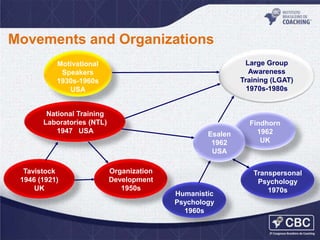
Movements and Organizations
Large Group
Awareness
Training (LGAT)
1970s-1980s

Motivational
Speakers
1930s-1960s
USA

National Training
Laboratories (NTL)
1947 USA

Tavistock
1946 (1921)
UK

Esalen
1962
USA
Organization
Development
1950s

Humanistic
Psychology
1960s

Findhorn
1962
UK

Transpersonal
Psychology
1970s
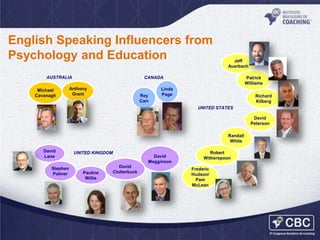
English Speaking Influencers from
Psychology and Education
AUSTRALIA
Michael
Cavanagh

Jeff
Auerbach

CANADA

Anthony
Grant

Rey
Carr

Patrick
Williams

Linda
Page

Richard
Kilberg
UNITED STATES
David
Peterson
Randall
White

David
Lane
Stephen
Palmer

UNITED KINGDOM

Pauline
Willis

David
Clutterbuck

David
Megginson

Robert
Witherspoon
Frederic
Hudson/
Pam
McLean
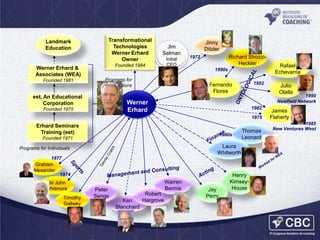
Landmark
Education

Transformational
Technologies
Werner Erhard
Owner
Founded 1984

Werner Erhard &
Associates (WEA)
Founded 1981

Jim
Selman
Initial
CEO

Richard StrozziHeckler

1972
1990s

Programs for
Corporations

est, An Educational
Corporation

Jinny
Ditzler

1982

Fernando
Flores

1982
1975

Erhard Seminars
Training (est)

1980s

Founded 1971

1977
Graham
Alexander
1974

Sir John
Whitmore
Timothy
Gallwey

Thomas
Leonard

Laura
Whitworth

Programs for Individuals

Peter
Senge

Warren
Bennis
Ken
Blanchard

Robert
Hargrove

Jay
Perry

Julio
Olalla

1990
Newfield Network

Werner
Erhard

Founded 1975

Rafael
Echevarria

Henry
KimseyHouse

James
Flaherty
1985
New Ventures West
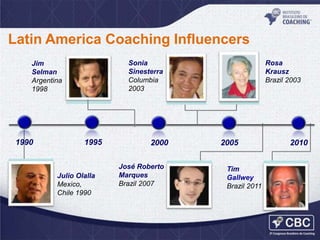
Latin America Coaching Influencers
Sonia
Sinesterra
Columbia
2003

Jim
Selman
Argentina
1998

1990

1995

Julio Olalla
Mexico,
Chile 1990

2000
José Roberto
Marques
Brazil 2007

Rosa
Krausz
Brazil 2003

2005
Tim
Gallwey
Brazil 2011

2010
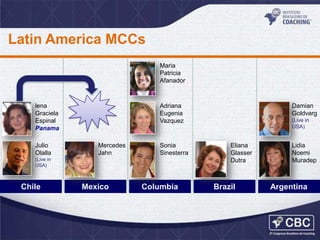
Latin America MCCs
Maria
Patricia
Afanador

lena
Graciela
Espinal
Panama
Julio
Olalla

Adriana
Eugenia
Vazquez

Mercedes
Jahn

Sonia
Sinesterra

(Live in
USA)

Chile

Mexico

Columbia

Damian
Goldvarg
(Live in
USA)

Eliana
Glasser
Dutra

Brazil

Lidia
Noemi
Muradep

Argentina
Historical Observation #2

Coaching has a broad
intellectual framework that
draws on the synergy,

cross-fertilization, and
practices of many disciplines
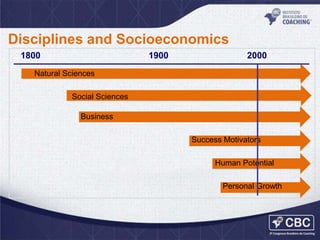
Disciplines and Socioeconomics
1800

1900

2000

Natural Sciences
Social Sciences
Business
Success Motivators

Human Potential
Personal Growth
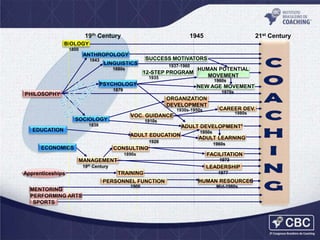
19th Century

21st Century

1945

BIOLOGY
1800

ANTHROPOLOGY
1843

SUCCESS MOTIVATORS

LINGUISTICS
1880s

1937-1960

12-STEP PROGRAM
1935

1960s

PSYCHOLOGY

NEW AGE MOVEMENT

1879

PHILOSOPHY

HUMAN POTENTIAL
MOVEMENT
1970s

ORGANIZATION
DEVELOPMENT
1930s-1950s

SOCIOLOGY

ADULT DEVELOPMENT*

EDUCATION
ADULT EDUCATION
1926

ECONOMICS

CONSULTING
1890s
Century

1960s

FACILITATION
LEADERSHIP

TRAINING
PERSONNEL FUNCTION

MENTORING
PERFORMING ARTS
SPORTS

1950s

ADULT LEARNING

1973

MANAGEMENT
Apprenticeships

1980s

1910s

1838

19th

CAREER DEV.

VOC. GUIDANCE

1900

1977

HUMAN RESOURCES
Mid-1980s
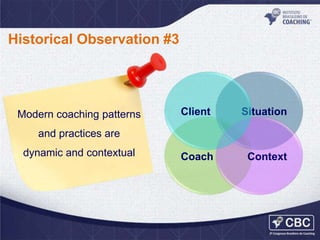
Historical Observation #3

Modern coaching patterns

Client

Situation

Coach

Context

and practices are
dynamic and contextual
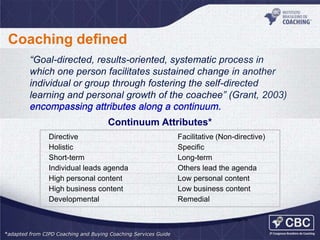
Coaching defined
“Goal-directed, results-oriented, systematic process in
which one person facilitates sustained change in another
individual or group through fostering the self-directed
learning and personal growth of the coachee” (Grant, 2003)
encompassing attributes along a continuum.
Continuum Attributes*
Directive
Holistic
Short-term
Individual leads agenda
High personal content
High business content
Developmental

Facilitative (Non-directive)
Specific
Long-term
Others lead the agenda
Low personal content
Low business content
Remedial
Page 19

*adapted from CIPD Coaching and Buying Coaching Services Guide
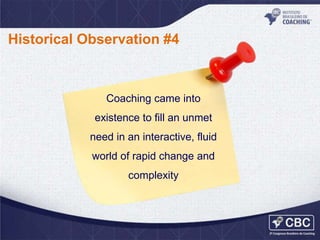
Historical Observation #4

Coaching came into

existence to fill an unmet
need in an interactive, fluid
world of rapid change and

complexity
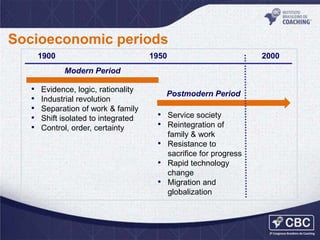
Socioeconomic periods
1900

1950

2000

Modern Period

•
•
•
•
•

Evidence, logic, rationality
Industrial revolution
Separation of work & family
Shift isolated to integrated
Control, order, certainty

Postmodern Period

• Service society
• Reintegration of
•
•
•

family & work
Resistance to
sacrifice for progress
Rapid technology
change
Migration and
globalization
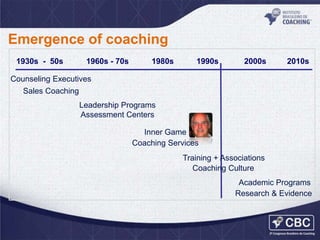
Emergence of coaching
1930s - 50s

1960s - 70s

1980s

1990s

2000s

2010s

Counseling Executives

Sales Coaching
Leadership Programs
Assessment Centers
Inner Game
Coaching Services
Training + Associations
Coaching Culture
Academic Programs
Research & Evidence
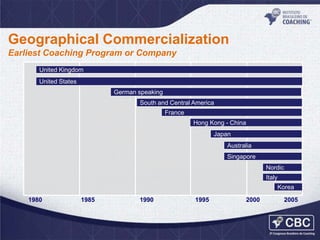
Geographical Commercialization
Earliest Coaching Program or Company
United Kingdom
United States
German speaking
South and Central America
France
Hong Kong - China
Japan
Australia
Singapore
Nordic
Italy
Korea
1980

1985

1990

1995

2000

2005
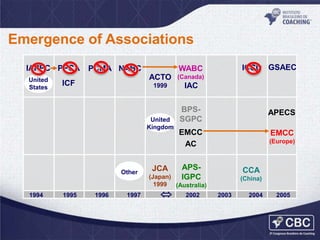
Emergence of Associations
IAPPC PPCA
United
States

PCMA NABC
ACTO

(Canada)

1999

ICF

IAC

United
Kingdom

Other

1994

1995

1996

1997

ICCO GSAEC

WABC

JCA

BPSSGPC

APECS

EMCC
AC

EMCC
(Europe)

APSIGPC

CCA

(Japan)
1999 (Australia)



2002

(China)
2003

2004

2005
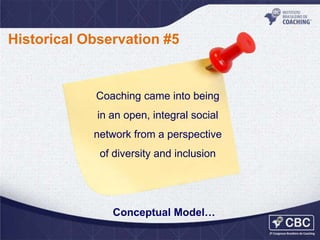
Historical Observation #5

Coaching came into being
in an open, integral social
network from a perspective

of diversity and inclusion

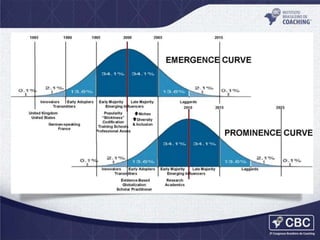
Conceptual Model…
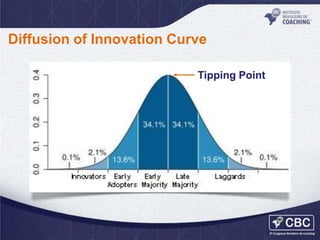
Diffusion of Innovation Curve
Tipping Point
Remember…
Coaching rests on the shoulders of
multiple disciplines...
. . . and came into being to fill an
unmet need in the world.
See you tomorrow for
“Advanced Executive Coaching”

Thank You
You can connect with me at:
coach@vikkibrock.com

As origens e as raízes do Coaching - Vikki Brock

  • 1.
    Origin and Rootsof Coaching …the secret history Vikki Brock Ph.D., MCC, EMBA Master Coach pela International Coach Federation - ICF
  • 2.
    Origin and Rootsof Coaching …the secret history Dr. Vikki G. Brock Master Certified Coach 2nd Brazilian Coaching Congress November 14, 2013
  • 3.
    Agenda What do youknow about the history of coaching? How and when did modern coaching emerge? What role did South American coaches play? 3
  • 4.
    What do youknow about the history of coaching? . . . What do you want to know?
  • 5.
    Origin of TheWord “COACH” Ancient Olympics in Greece Socrates 1500s – Carriage 1840s – Oxford University tutor 1880s – Sports coach
  • 6.
    Historical Observation #1 Coachingsprang from several independent sources and spread through relationships
  • 7.
    How many influencersin coaching can you name Non-Coaches Coaches
  • 8.
    EDUCATION Malcolm Knowles BUSINESS Influencers – OtherDisciplines PHILOSOPHY Fernando Flores Siddharth a Gautama Martin Heidegger Peter Drucker MOTIVATION Socrates Napoleon Hill Dale Carnegie Edgar Schein Wayne Dyer Ken Blanchard Confucius Lao Tzu Brian Tracy Earl Nightingale Peter Block Zig Zigler Werner Erhard SPORTS John Wooden Red Auerbach Daniel Goleman Don Shula Stephen Covey Tom Peters Peter Senge Ken Wilber
  • 9.
    Influencers – Psychology PSYCHODYNAMI CPSYCHOLOGY Carl Jung CLINICAL PSYCHOLOGY HUMANISTIC PSYCHOLOGY Milton Erickson Abraham Maslow Fritz Perls Carl Rogers Virginia Satir SOCIAL PSYCHOLOGY Kurt Lewin Alfred Adler NLP COGNITIVE PSYCHOLOGY Albert Ellis ORGANIZATION PSYCHOLOGY David Cooperrider Chris Argyris Richard Bandler Robert Dilts POSITIVE PSYCHOLOGY Mihaly Csikezentmihalyi Martin Seligman
  • 10.
    Movements and Organizations LargeGroup Awareness Training (LGAT) 1970s-1980s Motivational Speakers 1930s-1960s USA National Training Laboratories (NTL) 1947 USA Tavistock 1946 (1921) UK Esalen 1962 USA Organization Development 1950s Humanistic Psychology 1960s Findhorn 1962 UK Transpersonal Psychology 1970s
  • 11.
    English Speaking Influencersfrom Psychology and Education AUSTRALIA Michael Cavanagh Jeff Auerbach CANADA Anthony Grant Rey Carr Patrick Williams Linda Page Richard Kilberg UNITED STATES David Peterson Randall White David Lane Stephen Palmer UNITED KINGDOM Pauline Willis David Clutterbuck David Megginson Robert Witherspoon Frederic Hudson/ Pam McLean
  • 12.
    Landmark Education Transformational Technologies Werner Erhard Owner Founded 1984 WernerErhard & Associates (WEA) Founded 1981 Jim Selman Initial CEO Richard StrozziHeckler 1972 1990s Programs for Corporations est, An Educational Corporation Jinny Ditzler 1982 Fernando Flores 1982 1975 Erhard Seminars Training (est) 1980s Founded 1971 1977 Graham Alexander 1974 Sir John Whitmore Timothy Gallwey Thomas Leonard Laura Whitworth Programs for Individuals Peter Senge Warren Bennis Ken Blanchard Robert Hargrove Jay Perry Julio Olalla 1990 Newfield Network Werner Erhard Founded 1975 Rafael Echevarria Henry KimseyHouse James Flaherty 1985 New Ventures West
  • 13.
    Latin America CoachingInfluencers Sonia Sinesterra Columbia 2003 Jim Selman Argentina 1998 1990 1995 Julio Olalla Mexico, Chile 1990 2000 José Roberto Marques Brazil 2007 Rosa Krausz Brazil 2003 2005 Tim Gallwey Brazil 2011 2010
  • 14.
    Latin America MCCs Maria Patricia Afanador lena Graciela Espinal Panama Julio Olalla Adriana Eugenia Vazquez Mercedes Jahn Sonia Sinesterra (Livein USA) Chile Mexico Columbia Damian Goldvarg (Live in USA) Eliana Glasser Dutra Brazil Lidia Noemi Muradep Argentina
  • 15.
    Historical Observation #2 Coachinghas a broad intellectual framework that draws on the synergy, cross-fertilization, and practices of many disciplines
  • 16.
    Disciplines and Socioeconomics 1800 1900 2000 NaturalSciences Social Sciences Business Success Motivators Human Potential Personal Growth
  • 17.
    19th Century 21st Century 1945 BIOLOGY 1800 ANTHROPOLOGY 1843 SUCCESSMOTIVATORS LINGUISTICS 1880s 1937-1960 12-STEP PROGRAM 1935 1960s PSYCHOLOGY NEW AGE MOVEMENT 1879 PHILOSOPHY HUMAN POTENTIAL MOVEMENT 1970s ORGANIZATION DEVELOPMENT 1930s-1950s SOCIOLOGY ADULT DEVELOPMENT* EDUCATION ADULT EDUCATION 1926 ECONOMICS CONSULTING 1890s Century 1960s FACILITATION LEADERSHIP TRAINING PERSONNEL FUNCTION MENTORING PERFORMING ARTS SPORTS 1950s ADULT LEARNING 1973 MANAGEMENT Apprenticeships 1980s 1910s 1838 19th CAREER DEV. VOC. GUIDANCE 1900 1977 HUMAN RESOURCES Mid-1980s
  • 18.
    Historical Observation #3 Moderncoaching patterns Client Situation Coach Context and practices are dynamic and contextual
  • 19.
    Coaching defined “Goal-directed, results-oriented,systematic process in which one person facilitates sustained change in another individual or group through fostering the self-directed learning and personal growth of the coachee” (Grant, 2003) encompassing attributes along a continuum. Continuum Attributes* Directive Holistic Short-term Individual leads agenda High personal content High business content Developmental Facilitative (Non-directive) Specific Long-term Others lead the agenda Low personal content Low business content Remedial Page 19 *adapted from CIPD Coaching and Buying Coaching Services Guide
  • 20.
    Historical Observation #4 Coachingcame into existence to fill an unmet need in an interactive, fluid world of rapid change and complexity
  • 21.
    Socioeconomic periods 1900 1950 2000 Modern Period • • • • • Evidence,logic, rationality Industrial revolution Separation of work & family Shift isolated to integrated Control, order, certainty Postmodern Period • Service society • Reintegration of • • • family & work Resistance to sacrifice for progress Rapid technology change Migration and globalization
  • 22.
    Emergence of coaching 1930s- 50s 1960s - 70s 1980s 1990s 2000s 2010s Counseling Executives Sales Coaching Leadership Programs Assessment Centers Inner Game Coaching Services Training + Associations Coaching Culture Academic Programs Research & Evidence
  • 23.
    Geographical Commercialization Earliest CoachingProgram or Company United Kingdom United States German speaking South and Central America France Hong Kong - China Japan Australia Singapore Nordic Italy Korea 1980 1985 1990 1995 2000 2005
  • 24.
    Emergence of Associations IAPPCPPCA United States PCMA NABC ACTO (Canada) 1999 ICF IAC United Kingdom Other 1994 1995 1996 1997 ICCO GSAEC WABC JCA BPSSGPC APECS EMCC AC EMCC (Europe) APSIGPC CCA (Japan) 1999 (Australia)  2002 (China) 2003 2004 2005
  • 25.
    Historical Observation #5 Coachingcame into being in an open, integral social network from a perspective of diversity and inclusion Conceptual Model…
  • 26.
    Diffusion of InnovationCurve Tipping Point
  • 29.
    Remember… Coaching rests onthe shoulders of multiple disciplines... . . . and came into being to fill an unmet need in the world.
  • 30.
    See you tomorrowfor “Advanced Executive Coaching” Thank You You can connect with me at: coach@vikkibrock.com