UNCLASSIFIED Pre-Decisional – Draft Working Papers
CNIC Update
NMFWA Annual Meeting
CNIC N45
March 2020
UNCLASSIFIED Pre-Decisional – Draft Working Papers
Navy Environmental Programs
CNIC/NAVFAC Roles
2
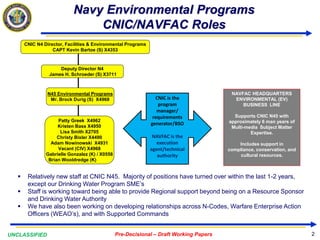
Deputy Director N4
James H. Schroeder (S) X3711
CNIC N4 Director, Facilities & Environmental Programs
CAPT Kevin Bartoe (S) X4353
N45 Environmental Programs
Mr. Brock Durig (S) X4968
Patty Greek X4962
Kristen Bass X4950
Lisa Smith X2705
Christy Bixler X4490
Adam Nowinowski X4931
Vacant (CIV) X4968
Gabrielle Gonzalez (K) / X0558
Brian Wooldredge (K)
NAVFAC HEADQUARTERS
ENVIRONMENTAL (EV)
BUSINESS LINE
Supports CNIC N45 with
approximately 6 man years of
Multi-media Subject Matter
Expertise.
Includes support in
compliance, conservation, and
cultural resources.
CNIC is the
program
manager/
requirements
generator/BSO
NAVFAC is the
execution
agent/technical
authority
 Relatively new staff at CNIC N45. Majority of positions have turned over within the last 1-2 years,
except our Drinking Water Program SME’s
 Staff is working toward being able to provide Regional support beyond being on a Resource Sponsor
and Drinking Water Authority
 We have also been working on developing relationships across N-Codes, Warfare Enterprise Action
Officers (WEAO’s), and with Supported Commands
UNCLASSIFIED Pre-Decisional – Draft Working Papers
Conservation Funding
3
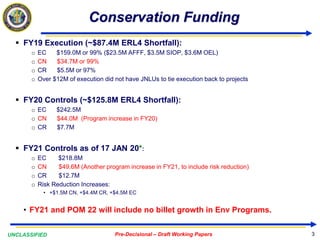
 FY19 Execution (~$87.4M ERL4 Shortfall):
o EC $159.0M or 99% ($23.5M AFFF, $3.5M SIOP, $3.6M OEL)
o CN $34.7M or 99%
o CR $5.5M or 97%
o Over $12M of execution did not have JNLUs to tie execution back to projects
 FY20 Controls (~$125.8M ERL4 Shortfall):
o EC $242.5M
o CN $44.0M (Program increase in FY20)
o CR $7.7M
 FY21 Controls as of 17 JAN 20*:
o EC $218.8M
o CN $49.6M (Another program increase in FY21, to include risk reduction)
o CR $12.7M
o Risk Reduction Increases:
• +$1.5M CN, +$4.4M CR, +$4.5M EC
• FY21 and POM 22 will include no billet growth in Env Programs.
UNCLASSIFIED Pre-Decisional – Draft Working Papers
Region / Installation NR
Recommendations
4
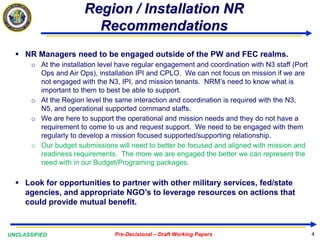
 NR Managers need to be engaged outside of the PW and FEC realms.
o At the installation level have regular engagement and coordination with N3 staff (Port
Ops and Air Ops), installation IPI and CPLO. We can not focus on mission if we are
not engaged with the N3, IPI, and mission tenants. NRM’s need to know what is
important to them to best be able to support.
o At the Region level the same interaction and coordination is required with the N3,
N5, and operational supported command staffs.
o We are here to support the operational and mission needs and they do not have a
requirement to come to us and request support. We need to be engaged with them
regularly to develop a mission focused supported/supporting relationship.
o Our budget submissions will need to better be focused and aligned with mission and
readiness requirements. The more we are engaged the better we can represent the
need with in our Budget/Programing packages.
 Look for opportunities to partner with other military services, fed/state
agencies, and appropriate NGO’s to leverage resources on actions that
could provide mutual benefit.
UNCLASSIFIED Pre-Decisional – Draft Working Papers
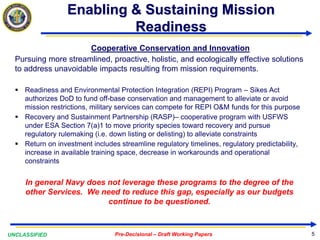
Enabling & Sustaining Mission
Readiness
Cooperative Conservation and Innovation
Pursuing more streamlined, proactive, holistic, and ecologically effective solutions
to address unavoidable impacts resulting from mission requirements.
 Readiness and Environmental Protection Integration (REPI) Program – Sikes Act
authorizes DoD to fund off-base conservation and management to alleviate or avoid
mission restrictions, military services can compete for REPI O&M funds for this purpose
 Recovery and Sustainment Partnership (RASP)– cooperative program with USFWS
under ESA Section 7(a)1 to move priority species toward recovery and pursue
regulatory rulemaking (i.e. down listing or delisting) to alleviate constraints
 Return on investment includes streamline regulatory timelines, regulatory predictability,
increase in available training space, decrease in workarounds and operational
constraints
In general Navy does not leverage these programs to the degree of the
other Services. We need to reduce this gap, especially as our budgets
continue to be questioned.
5
UNCLASSIFIED Pre-Decisional – Draft Working Papers 6
Questions?

CNIC Update

  • 1.
    UNCLASSIFIED Pre-Decisional –Draft Working Papers CNIC Update NMFWA Annual Meeting CNIC N45 March 2020
  • 2.
    UNCLASSIFIED Pre-Decisional –Draft Working Papers Navy Environmental Programs CNIC/NAVFAC Roles 2 Deputy Director N4 James H. Schroeder (S) X3711 CNIC N4 Director, Facilities & Environmental Programs CAPT Kevin Bartoe (S) X4353 N45 Environmental Programs Mr. Brock Durig (S) X4968 Patty Greek X4962 Kristen Bass X4950 Lisa Smith X2705 Christy Bixler X4490 Adam Nowinowski X4931 Vacant (CIV) X4968 Gabrielle Gonzalez (K) / X0558 Brian Wooldredge (K) NAVFAC HEADQUARTERS ENVIRONMENTAL (EV) BUSINESS LINE Supports CNIC N45 with approximately 6 man years of Multi-media Subject Matter Expertise. Includes support in compliance, conservation, and cultural resources. CNIC is the program manager/ requirements generator/BSO NAVFAC is the execution agent/technical authority  Relatively new staff at CNIC N45. Majority of positions have turned over within the last 1-2 years, except our Drinking Water Program SME’s  Staff is working toward being able to provide Regional support beyond being on a Resource Sponsor and Drinking Water Authority  We have also been working on developing relationships across N-Codes, Warfare Enterprise Action Officers (WEAO’s), and with Supported Commands
  • 3.
    UNCLASSIFIED Pre-Decisional –Draft Working Papers Conservation Funding 3  FY19 Execution (~$87.4M ERL4 Shortfall): o EC $159.0M or 99% ($23.5M AFFF, $3.5M SIOP, $3.6M OEL) o CN $34.7M or 99% o CR $5.5M or 97% o Over $12M of execution did not have JNLUs to tie execution back to projects  FY20 Controls (~$125.8M ERL4 Shortfall): o EC $242.5M o CN $44.0M (Program increase in FY20) o CR $7.7M  FY21 Controls as of 17 JAN 20*: o EC $218.8M o CN $49.6M (Another program increase in FY21, to include risk reduction) o CR $12.7M o Risk Reduction Increases: • +$1.5M CN, +$4.4M CR, +$4.5M EC • FY21 and POM 22 will include no billet growth in Env Programs.
  • 4.
    UNCLASSIFIED Pre-Decisional –Draft Working Papers Region / Installation NR Recommendations 4  NR Managers need to be engaged outside of the PW and FEC realms. o At the installation level have regular engagement and coordination with N3 staff (Port Ops and Air Ops), installation IPI and CPLO. We can not focus on mission if we are not engaged with the N3, IPI, and mission tenants. NRM’s need to know what is important to them to best be able to support. o At the Region level the same interaction and coordination is required with the N3, N5, and operational supported command staffs. o We are here to support the operational and mission needs and they do not have a requirement to come to us and request support. We need to be engaged with them regularly to develop a mission focused supported/supporting relationship. o Our budget submissions will need to better be focused and aligned with mission and readiness requirements. The more we are engaged the better we can represent the need with in our Budget/Programing packages.  Look for opportunities to partner with other military services, fed/state agencies, and appropriate NGO’s to leverage resources on actions that could provide mutual benefit.
  • 5.
    UNCLASSIFIED Pre-Decisional –Draft Working Papers Enabling & Sustaining Mission Readiness Cooperative Conservation and Innovation Pursuing more streamlined, proactive, holistic, and ecologically effective solutions to address unavoidable impacts resulting from mission requirements.  Readiness and Environmental Protection Integration (REPI) Program – Sikes Act authorizes DoD to fund off-base conservation and management to alleviate or avoid mission restrictions, military services can compete for REPI O&M funds for this purpose  Recovery and Sustainment Partnership (RASP)– cooperative program with USFWS under ESA Section 7(a)1 to move priority species toward recovery and pursue regulatory rulemaking (i.e. down listing or delisting) to alleviate constraints  Return on investment includes streamline regulatory timelines, regulatory predictability, increase in available training space, decrease in workarounds and operational constraints In general Navy does not leverage these programs to the degree of the other Services. We need to reduce this gap, especially as our budgets continue to be questioned. 5
  • 6.
    UNCLASSIFIED Pre-Decisional –Draft Working Papers 6 Questions?