Strategic Plan
                      FY09 – FY11


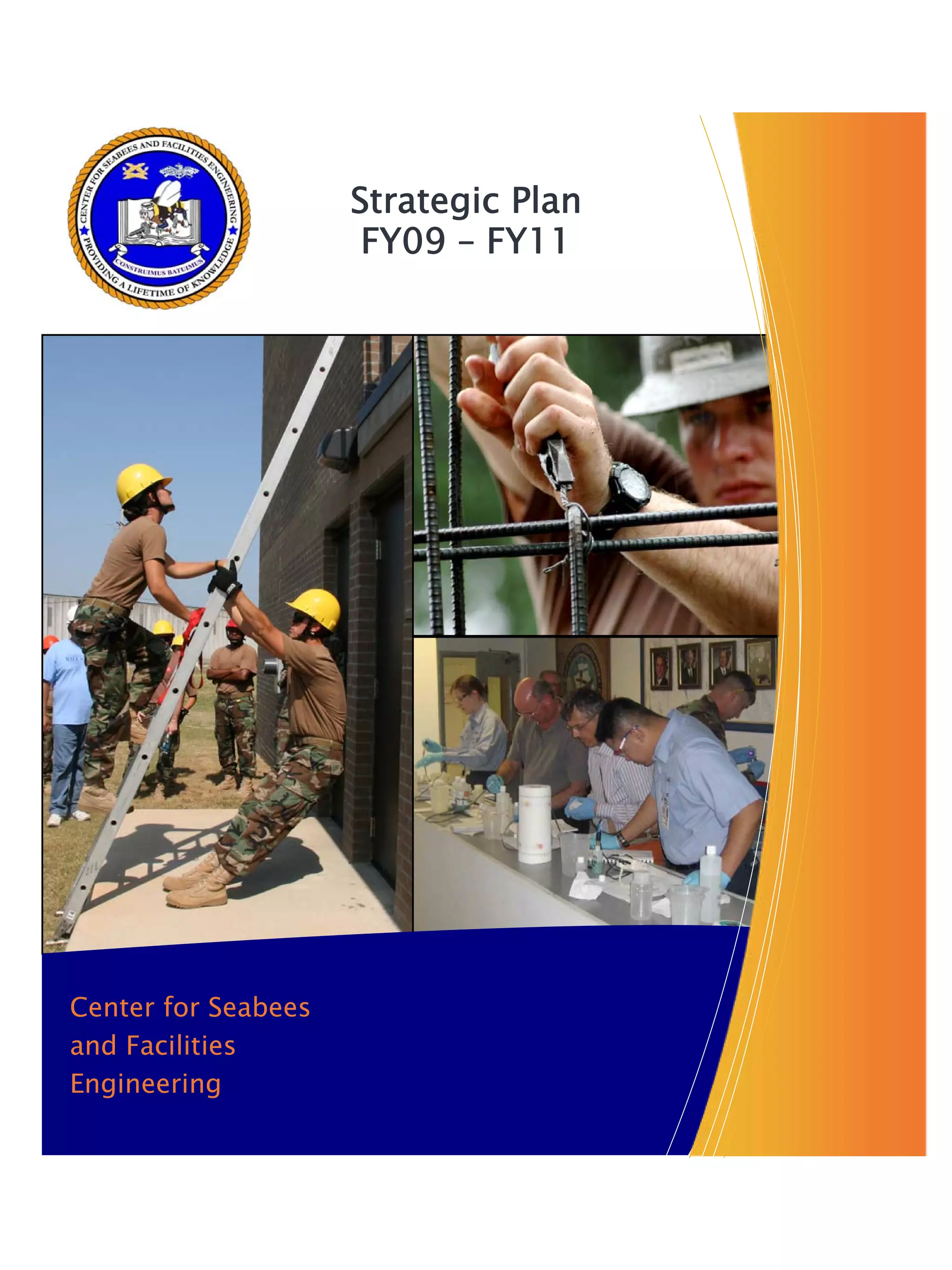
Center for Seabees
and Facilities
Engineering
Commander’s Intent
    We have set forth some important business goals as a
    leadership team. The purpose of the Strategic Plan is
    to ensure all of our activities are undertaken with
    these tenets in foremost in mind.
    Command Philosophy: We will safely execute the
    mission or die trying. Everything we do happens
    through our people, and ultimately, the students we're
    educating and training. Take care of 'em; develop 'em.
    A diverse workforce is a productive creative workforce,
    and everyone will be treated professionally.
    Accountability: Stuff - we've been entrusted with a lot
                                                                   Commanding Officer
    of stuff. Need to take care of it - part of our public
                                                              J.J. Heinzel, CAPT, CEC, USN
    trust.
    Accountability: Time - once spent, we can not recover time; therefore, we must
    continually work to make the most of each and every minute that we've been
    entrusted with for our students, our staffs, our families, and ourselves.
    Alignment: We are in very dynamic times with our supported commands. We will
    regularly work with them for course corrections to maintain instructional alignment.

                             Mission Statement
    To provide Seabees, CEC Officers, Facility Engineers, and
    Environmental Professionals with the necessary skills,
    knowledge, and education to enhance life long learning
    and to provide quality support to the fleet.

                                                            The Navy places a
                                                            lot of value on
                                                            education. We want
                                                            Sailors and Officers
                                                            who can both learn
                                                            and teach — our
                                                            demanding missions
                                                            and high-tech work
                                                            environment
                                                            demand it.
                                                            (http://www.navy.com/benefits/
                                                                              education/ )

2
Vision                 Warfare Enterprise, Operational
                                   Commanders, and System
                                Commander value CSFE as their
                                 Training Center of Excellence.


                           Guiding Principles
CSFE is structured, organized, and staffed,
across the Domain, to deliver trained
Officers/Sailors/Civil Servants to the Fleet.

CSFE is aligned internally and externally the
SYSCOM, TYCOM, and all customers to
support the Navy Total Force (NTF)
Enterprise.

CSFE understands its business and optimizes
its resources.

CSFE leverages innovative solutions, and
harnesses creativity to maximize production
in all business lines.

CSFE values military, Civil Service, and
contractor workforces and develops,
empowers, supports, and rewards its
people.

CSFE products support and enable a surge-
                                                                  3
capable, combat-ready Navy.
Training Professionals
     The Center for Seabees and Facilities Engineering (CSFE) was established in 2003 to
     train and develop Naval facilities engineering and construction professionals by
     providing them with the essential skills and knowledge needed to support career
     growth and Fleet readiness.

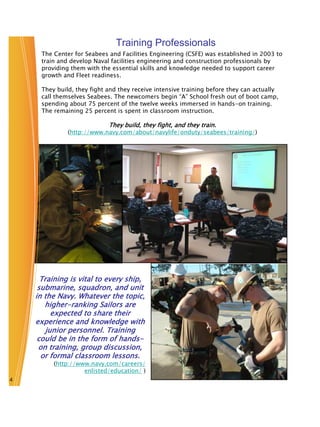
     They build, they fight and they receive intensive training before they can actually
     call themselves Seabees. The newcomers begin “A” School fresh out of boot camp,
     spending about 75 percent of the twelve weeks immersed in hands-on training.
     The remaining 25 percent is spent in classroom instruction.

                            They build, they fight, and they train.
              (http://www.navy.com/about/navylife/onduty/seabees/training/)


      Training is vital to every ship,
     submarine, squadron, and unit
    in the Navy. Whatever the topic,
       higher-ranking Sailors are
          expected to share their
    experience and knowledge with
        junior personnel. Training
     could be in the form of hands-
     on training, group discussion,
      or formal classroom lessons.
         (http://www.navy.com/careers/
                   enlisted/education/ )
4
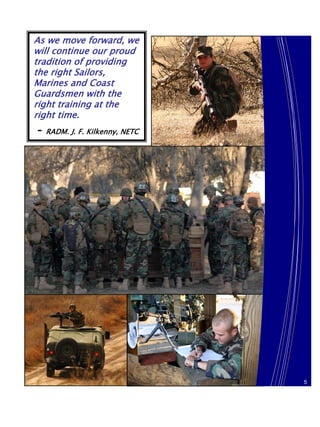
As we move forward, we
will continue our proud
tradition of providing
the right Sailors,
Marines and Coast
Guardsmen with the
right training at the
right time.
- RADM. J. F. Kilkenny, NETC


                               19
                               5
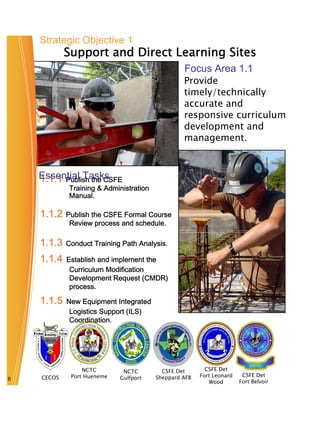
Strategic Objective 1
            Support and Direct Learning Sites
                                                 Focus Area 1.1
                                                 Provide
                                                 timely/technically
                                                 accurate and
                                                 responsive curriculum
                                                 development and
                                                 management.


    1.1.1 Publish the CSFE
    Essential Tasks
            Training & Administration
            Manual.

    1.1.2   Publish the CSFE Formal Course
             Review process and schedule.

    1.1.3   Conduct Training Path Analysis.

    1.1.4   Establish and implement the
             Curriculum Modification
             Development Request (CMDR)
             process.

    1.1.5   New Equipment Integrated
             Logistics Support (ILS)
             Coordination.


                 NCTC        NCTC         CSFE Det       CSFE Det
    CECOS    Port Hueneme               Sheppard AFB   Fort Leonard    CSFE Det
6                           Gulfport
                                                          Wood        Fort Belvoir
Focus Area 1.2
                                                Quarterdecks
    Provide governing policy and guidance         CSFE/CECOS
             across CSFE Domain                  (805) 901-7308

                                                    NCTC PH
                                                 (805) 982-4298

                                                   China Lake
                                                 (760) 939-3203

                                                    NCTC GP
                                                 (228) 871-2132

                                                Fort Leonard Wood
                                                  (573) 596-0488

                                                     Sheppard
        Essential Tasks                           Air Force Base
                                                     (904) 676-

1.2.1 Define and develop                           7940/7537

        standard metrics across                    Workforce
        the Domain.
                                                  Composition
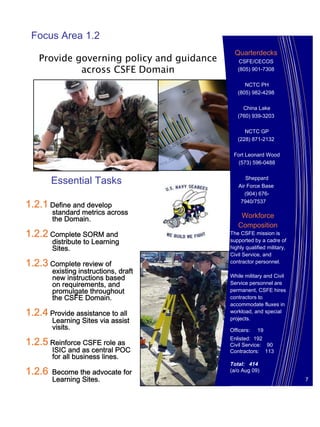
1.2.2 Complete SORM and                     • The CSFE mission is
        distribute to Learning                supported by a cadre of
        Sites.                                highly qualified military,
                                              Civil Service, and
1.2.3 Complete review of                      contractor personnel.
        existing instructions, draft
        new instructions based              • While military and Civil
        on requirements, and                  Service personnel are
        promulgate throughout                 permanent, CSFE hires
        the CSFE Domain.                      contractors to
                                              accommodate fluxes in
1.2.4 Provide assistance to all               workload, and special
        Learning Sites via assist             projects.
        visits.                               Officers:   19

1.2.5 Reinforce CSFE role as                  Enlisted: 192
                                              Civil Service: 90
        ISIC and as central POC               Contractors: 113
        for all business lines.
                                              Total: 414
1.2.6   Become the advocate for               (a/o Aug 09)
        Learning Sites.                                                    7
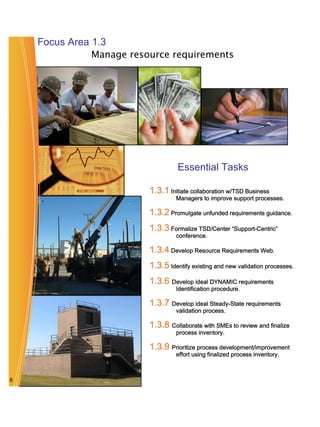
Focus Area 1.3
              Manage resource requirements


                                   Essential Tasks

                         1.3.1 Initiate collaboration w/TSD Business
                                  Managers to improve support processes.

                         1.3.2 Promulgate unfunded requirements guidance.
                         1.3.3 Formalize TSD/Center “Support-Centric”
                                  conference.

                         1.3.4 Develop Resource Requirements Web.
                         1.3.5 Identify existing and new validation processes.
                         1.3.6 Develop ideal DYNAMIC requirements
                                  Identification procedure.

                         1.3.7 Develop ideal Steady-State requirements
                                  validation process.

                         1.3.8 Collaborate with SMEs to review and finalize
                                  process inventory.

                         1.3.9 Prioritize process development/improvement
                                  effort using finalized process inventory.


8
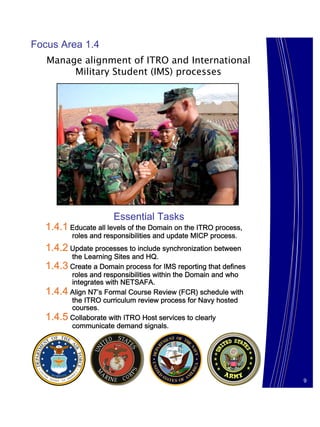
Focus Area 1.4
   Manage alignment of ITRO and International
        Military Student (IMS) processes


                       Essential Tasks
   1.4.1 Educate all levels of the Domain on the ITRO process,
          roles and responsibilities and update MICP process.
   1.4.2 Update processes to include synchronization between
         the Learning Sites and HQ.
   1.4.3 Create a Domain process for IMS reporting that defines
         roles and responsibilities within the Domain and who
         integrates with NETSAFA.
   1.4.4 Align N7’s Formal Course Review (FCR) schedule with
         the ITRO curriculum review process for Navy hosted
         courses.
   1.4.5 Collaborate with ITRO Host services to clearly
         communicate demand signals.


                                                                  9
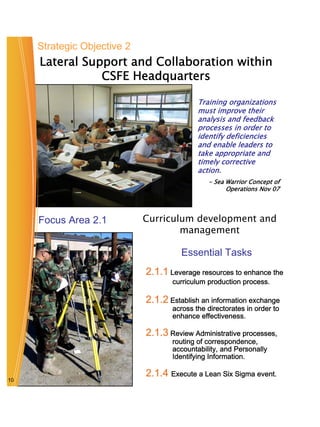
Strategic Objective 2
     Lateral Support and Collaboration within
                CSFE Headquarters

                                            Training organizations
                                            must improve their
                                            analysis and feedback
                                            processes in order to
                                            identify deficiencies
                                            and enable leaders to
                                            take appropriate and
                                            timely corrective
                                            action.
                                               - Sea Warrior Concept of
                                                     Operations Nov 07


     Focus Area 2.1          Curriculum development and
                                     management

                                       Essential Tasks
                             2.1.1 Leverage resources to enhance the
                                    curriculum production process.

                             2.1.2 Establish an information exchange
                                    across the directorates in order to
                                    enhance effectiveness.

                             2.1.3 Review Administrative processes,
                                    routing of correspondence,
                                    accountability, and Personally
                                    Identifying Information.

                             2.1.4 Execute a Lean Six Sigma event.
10
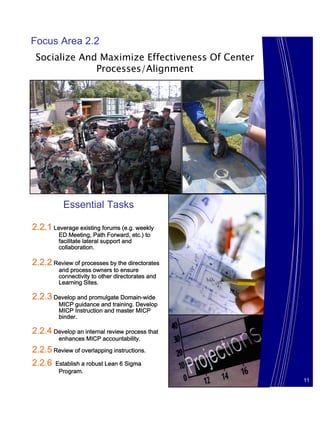
Focus Area 2.2
 Socialize And Maximize Effectiveness Of Center
              Processes/Alignment


           Essential Tasks

2.2.1 Leverage existing forums (e.g. weekly
         ED Meeting, Path Forward, etc.) to
         facilitate lateral support and
         collaboration.

2.2.2 Review of processes by the directorates
         and process owners to ensure
         connectivity to other directorates and
         Learning Sites.

2.2.3 Develop and promulgate Domain-wide
         MICP guidance and training. Develop
         MICP Instruction and master MICP
         binder.

2.2.4 Develop an internal review process that
         enhances MICP accountability.
2.2.5 Review of overlapping instructions.
2.2.6 Establish a robust Lean 6 Sigma
         Program.
                                                  11
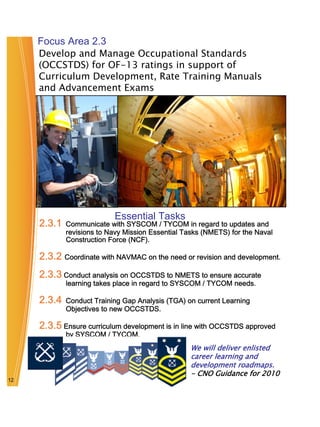
Focus Area 2.3
     Develop and Manage Occupational Standards
     (OCCSTDS) for OF-13 ratings in support of
     Curriculum Development, Rate Training Manuals
     and Advancement Exams


                           Essential Tasks
     2.3.1   Communicate with SYSCOM / TYCOM in regard to updates and
             revisions to Navy Mission Essential Tasks (NMETS) for the Naval
             Construction Force (NCF).

     2.3.2 Coordinate with NAVMAC on the need or revision and development.
     2.3.3 Conduct analysis on OCCSTDS to NMETS to ensure accurate
             learning takes place in regard to SYSCOM / TYCOM needs.

     2.3.4   Conduct Training Gap Analysis (TGA) on current Learning
             Objectives to new OCCSTDS.

     2.3.5 Ensure curriculum development is in line with OCCSTDS approved
             by SYSCOM / TYCOM.
                                                   We will deliver enlisted
                                                   career learning and
                                                   development roadmaps.
                                                   - CNO Guidance for 2010
12
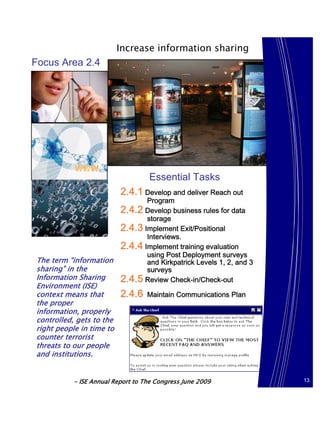
Increase information sharing
Focus Area 2.4


                                   Essential Tasks
                          2.4.1 Develop and deliver Reach out
                                 Program
                          2.4.2 Develop business rules for data
                                 storage
                          2.4.3 Implement Exit/Positional
                                 Interviews.
                          2.4.4 Implement training evaluation
                                 using Post Deployment surveys
The term “information            and Kirkpatrick Levels 1, 2, and 3
sharing” in the                  surveys
Information Sharing       2.4.5 Review Check-in/Check-out
Environment (ISE)
context means that        2.4.6    Maintain Communications Plan
the proper
information, properly
controlled, gets to the
right people in time to
counter terrorist
threats to our people
and institutions.


           - ISE Annual Report to The Congress June 2009              13
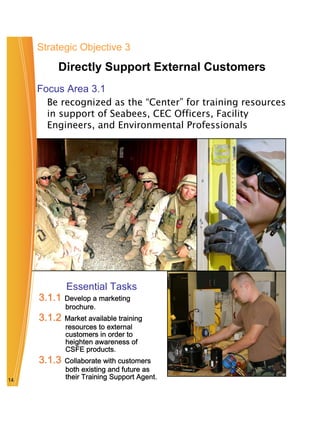
Strategic Objective 3

         Directly Support External Customers
     Focus Area 3.1
       Be recognized as the “Center” for training resources
       in support of Seabees, CEC Officers, Facility
       Engineers, and Environmental Professionals


             Essential Tasks
     3.1.1   Develop a marketing
             brochure.
     3.1.2   Market available training
             resources to external
             customers in order to
             heighten awareness of
             CSFE products.
     3.1.3   Collaborate with customers
             both existing and future as
14           their Training Support Agent.
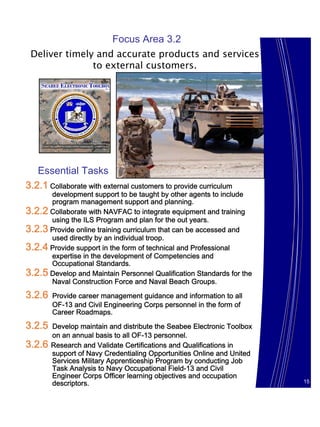
Focus Area 3.2
 Deliver timely and accurate products and services
               to external customers.


   Essential Tasks
3.2.1 Collaborate with external customers to provide curriculum
      development support to be taught by other agents to include
      program management support and planning.
3.2.2 Collaborate with NAVFAC to integrate equipment and training
      using the ILS Program and plan for the out years.
3.2.3 Provide online training curriculum that can be accessed and
      used directly by an individual troop.
3.2.4 Provide support in the form of technical and Professional
      expertise in the development of Competencies and
      Occupational Standards.
3.2.5 Develop and Maintain Personnel Qualification Standards for the
      Naval Construction Force and Naval Beach Groups.

3.2.6   Provide career management guidance and information to all
        OF-13 and Civil Engineering Corps personnel in the form of
        Career Roadmaps.

3.2.5   Develop maintain and distribute the Seabee Electronic Toolbox
        on an annual basis to all OF-13 personnel.
3.2.6   Research and Validate Certifications and Qualifications in
        support of Navy Credentialing Opportunities Online and United
        Services Military Apprenticeship Program by conducting Job
        Task Analysis to Navy Occupational Field-13 and Civil
        Engineer Corps Officer learning objectives and occupation
        descriptors.                                                    15
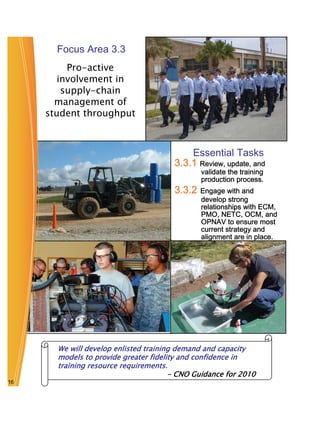
Focus Area 3.3
          Pro-active
        involvement in
         supply-chain
       management of
     student throughput


                                           Essential Tasks
                                       3.3.1 Review, update, and
                                               validate the training
                                               production process.
                                       3.3.2   Engage with and
                                               develop strong
                                               relationships with ECM,
                                               PMO, NETC, OCM, and
                                               OPNAV to ensure most
                                               current strategy and
                                               alignment are in place.


       We will develop enlisted training demand and capacity
       models to provide greater fidelity and confidence in
       training resource requirements.
                                       - CNO Guidance for 2010
16
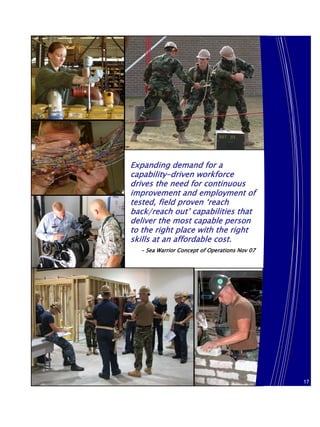
Expanding demand for a
capability-driven workforce
drives the need for continuous
improvement and employment of
tested, field proven ‘reach
back/reach out’ capabilities that
deliver the most capable person
to the right place with the right
skills at an affordable cost.
  - Sea Warrior Concept of Operations Nov 07


                                               17
                                               17
Mission, Functions, & Tasks
     • Carry out all regulations, instructions, and directives from higher
       authority pertaining to the administration of CSFE and its domain and
       issue such detailed internal instructions, regulations, orders, and notices
       as required for the efficient organization and administration.

     • Assign the mission, training requirements, funding and staff personnel
       to support the training requirements of the CSFE domain.

     • Perform all curricula development, monitoring, reviews, and course
       management for CSFE Learning Sites.

     • Manage the Non-Resident Training courses mapped to the CSFE domain.

     • Provide career management development with regard to professional
       development, personal development, leadership, certifications and
       qualifications, and performance.

     • Act as Model Manager for Personnel Qualification Standards (PQS) that
       fall within the CSFE domain.

     • Provide Fleet Integration with Type Commanders, Budget Submitting
       Offices (BSOs) and Fleet units to ensure the skills and education provided
       are relevant, tied to mission requirements, and provided at the right time
       and the right cost.

     • Provide knowledge management through the population of data for
       delivery to the Sailor using the Navy Knowledge Online (NKO) portal and
       other web sites.

     • Provide technical support in the acquisition and contracting of services
       and equipment in support of all training and support systems.

     • Implement staffing plan to ensure all civilian and instructor staffs are
       properly manned.

     • Identify and fill billets with qualified personnel.

18   • Manage resources within CSFE domain.
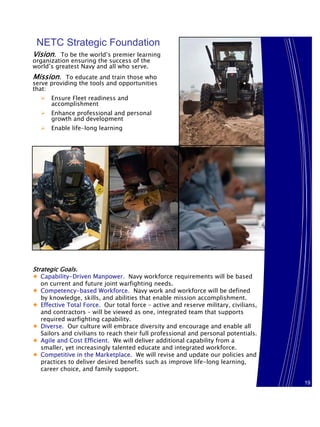
NETC Strategic Foundation
Vision. To be the world’s premier learning
organization ensuring the success of the
world’s greatest Navy and all who serve.
Mission. To educate and train those who
serve providing the tools and opportunities
that:
      Ensure Fleet readiness and
      accomplishment
      Enhance professional and personal
      growth and development
      Enable life-long learning


Strategic Goals.
♦ Capability-Driven Manpower. Navy workforce requirements will be based
  on current and future joint warfighting needs.
♦ Competency-based Workforce. Navy work and workforce will be defined
  by knowledge, skills, and abilities that enable mission accomplishment.
♦ Effective Total Force. Our total force – active and reserve military, civilians,
  and contractors – will be viewed as one, integrated team that supports
  required warfighting capability.
♦ Diverse. Our culture will embrace diversity and encourage and enable all
  Sailors and civilians to reach their full professional and personal potentials.
♦ Agile and Cost Efficient. We will deliver additional capability from a
  smaller, yet increasingly talented educate and integrated workforce.
♦ Competitive in the Marketplace. We will revise and update our policies and
  practices to deliver desired benefits such as improve life-long learning,
  career choice, and family support.

                                                                                     19
                                                                                     19
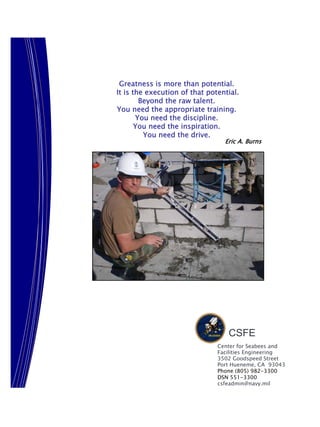
Greatness is more than potential.
It is the execution of that potential.
        Beyond the raw talent.
You need the appropriate training.
       You need the discipline.
       You need the inspiration.
         You need the drive.
                                 Eric A. Burns


                                  CSFE
                               Center for Seabees and
                               Facilities Engineering
                               3502 Goodspeed Street
                               Port Hueneme, CA 93043
                               Phone (805) 982-3300
                               DSN 551-3300
                               csfeadmin@navy.mil

Strategic Plan Booklet Presentation

  • 1.
    Strategic Plan FY09 – FY11 Center for Seabees and Facilities Engineering
  • 2.
    Commander’s Intent We have set forth some important business goals as a leadership team. The purpose of the Strategic Plan is to ensure all of our activities are undertaken with these tenets in foremost in mind. Command Philosophy: We will safely execute the mission or die trying. Everything we do happens through our people, and ultimately, the students we're educating and training. Take care of 'em; develop 'em. A diverse workforce is a productive creative workforce, and everyone will be treated professionally. Accountability: Stuff - we've been entrusted with a lot Commanding Officer of stuff. Need to take care of it - part of our public J.J. Heinzel, CAPT, CEC, USN trust. Accountability: Time - once spent, we can not recover time; therefore, we must continually work to make the most of each and every minute that we've been entrusted with for our students, our staffs, our families, and ourselves. Alignment: We are in very dynamic times with our supported commands. We will regularly work with them for course corrections to maintain instructional alignment. Mission Statement To provide Seabees, CEC Officers, Facility Engineers, and Environmental Professionals with the necessary skills, knowledge, and education to enhance life long learning and to provide quality support to the fleet. The Navy places a lot of value on education. We want Sailors and Officers who can both learn and teach — our demanding missions and high-tech work environment demand it. (http://www.navy.com/benefits/ education/ ) 2
  • 3.
    Vision Warfare Enterprise, Operational Commanders, and System Commander value CSFE as their Training Center of Excellence. Guiding Principles CSFE is structured, organized, and staffed, across the Domain, to deliver trained Officers/Sailors/Civil Servants to the Fleet. CSFE is aligned internally and externally the SYSCOM, TYCOM, and all customers to support the Navy Total Force (NTF) Enterprise. CSFE understands its business and optimizes its resources. CSFE leverages innovative solutions, and harnesses creativity to maximize production in all business lines. CSFE values military, Civil Service, and contractor workforces and develops, empowers, supports, and rewards its people. CSFE products support and enable a surge- 3 capable, combat-ready Navy.
  • 4.
    Training Professionals The Center for Seabees and Facilities Engineering (CSFE) was established in 2003 to train and develop Naval facilities engineering and construction professionals by providing them with the essential skills and knowledge needed to support career growth and Fleet readiness. They build, they fight and they receive intensive training before they can actually call themselves Seabees. The newcomers begin “A” School fresh out of boot camp, spending about 75 percent of the twelve weeks immersed in hands-on training. The remaining 25 percent is spent in classroom instruction. They build, they fight, and they train. (http://www.navy.com/about/navylife/onduty/seabees/training/) Training is vital to every ship, submarine, squadron, and unit in the Navy. Whatever the topic, higher-ranking Sailors are expected to share their experience and knowledge with junior personnel. Training could be in the form of hands- on training, group discussion, or formal classroom lessons. (http://www.navy.com/careers/ enlisted/education/ ) 4
  • 5.
    As we moveforward, we will continue our proud tradition of providing the right Sailors, Marines and Coast Guardsmen with the right training at the right time. - RADM. J. F. Kilkenny, NETC 19 5
  • 6.
    Strategic Objective 1 Support and Direct Learning Sites Focus Area 1.1 Provide timely/technically accurate and responsive curriculum development and management. 1.1.1 Publish the CSFE Essential Tasks Training & Administration Manual. 1.1.2 Publish the CSFE Formal Course Review process and schedule. 1.1.3 Conduct Training Path Analysis. 1.1.4 Establish and implement the Curriculum Modification Development Request (CMDR) process. 1.1.5 New Equipment Integrated Logistics Support (ILS) Coordination. NCTC NCTC CSFE Det CSFE Det CECOS Port Hueneme Sheppard AFB Fort Leonard CSFE Det 6 Gulfport Wood Fort Belvoir
  • 7.
    Focus Area 1.2 Quarterdecks Provide governing policy and guidance CSFE/CECOS across CSFE Domain (805) 901-7308 NCTC PH (805) 982-4298 China Lake (760) 939-3203 NCTC GP (228) 871-2132 Fort Leonard Wood (573) 596-0488 Sheppard Essential Tasks Air Force Base (904) 676- 1.2.1 Define and develop 7940/7537 standard metrics across Workforce the Domain. Composition 1.2.2 Complete SORM and • The CSFE mission is distribute to Learning supported by a cadre of Sites. highly qualified military, Civil Service, and 1.2.3 Complete review of contractor personnel. existing instructions, draft new instructions based • While military and Civil on requirements, and Service personnel are promulgate throughout permanent, CSFE hires the CSFE Domain. contractors to accommodate fluxes in 1.2.4 Provide assistance to all workload, and special Learning Sites via assist projects. visits. Officers: 19 1.2.5 Reinforce CSFE role as Enlisted: 192 Civil Service: 90 ISIC and as central POC Contractors: 113 for all business lines. Total: 414 1.2.6 Become the advocate for (a/o Aug 09) Learning Sites. 7
  • 8.
    Focus Area 1.3 Manage resource requirements Essential Tasks 1.3.1 Initiate collaboration w/TSD Business Managers to improve support processes. 1.3.2 Promulgate unfunded requirements guidance. 1.3.3 Formalize TSD/Center “Support-Centric” conference. 1.3.4 Develop Resource Requirements Web. 1.3.5 Identify existing and new validation processes. 1.3.6 Develop ideal DYNAMIC requirements Identification procedure. 1.3.7 Develop ideal Steady-State requirements validation process. 1.3.8 Collaborate with SMEs to review and finalize process inventory. 1.3.9 Prioritize process development/improvement effort using finalized process inventory. 8
  • 9.
    Focus Area 1.4 Manage alignment of ITRO and International Military Student (IMS) processes Essential Tasks 1.4.1 Educate all levels of the Domain on the ITRO process, roles and responsibilities and update MICP process. 1.4.2 Update processes to include synchronization between the Learning Sites and HQ. 1.4.3 Create a Domain process for IMS reporting that defines roles and responsibilities within the Domain and who integrates with NETSAFA. 1.4.4 Align N7’s Formal Course Review (FCR) schedule with the ITRO curriculum review process for Navy hosted courses. 1.4.5 Collaborate with ITRO Host services to clearly communicate demand signals. 9
  • 10.
    Strategic Objective 2 Lateral Support and Collaboration within CSFE Headquarters Training organizations must improve their analysis and feedback processes in order to identify deficiencies and enable leaders to take appropriate and timely corrective action. - Sea Warrior Concept of Operations Nov 07 Focus Area 2.1 Curriculum development and management Essential Tasks 2.1.1 Leverage resources to enhance the curriculum production process. 2.1.2 Establish an information exchange across the directorates in order to enhance effectiveness. 2.1.3 Review Administrative processes, routing of correspondence, accountability, and Personally Identifying Information. 2.1.4 Execute a Lean Six Sigma event. 10
  • 11.
    Focus Area 2.2 Socialize And Maximize Effectiveness Of Center Processes/Alignment Essential Tasks 2.2.1 Leverage existing forums (e.g. weekly ED Meeting, Path Forward, etc.) to facilitate lateral support and collaboration. 2.2.2 Review of processes by the directorates and process owners to ensure connectivity to other directorates and Learning Sites. 2.2.3 Develop and promulgate Domain-wide MICP guidance and training. Develop MICP Instruction and master MICP binder. 2.2.4 Develop an internal review process that enhances MICP accountability. 2.2.5 Review of overlapping instructions. 2.2.6 Establish a robust Lean 6 Sigma Program. 11
  • 12.
    Focus Area 2.3 Develop and Manage Occupational Standards (OCCSTDS) for OF-13 ratings in support of Curriculum Development, Rate Training Manuals and Advancement Exams Essential Tasks 2.3.1 Communicate with SYSCOM / TYCOM in regard to updates and revisions to Navy Mission Essential Tasks (NMETS) for the Naval Construction Force (NCF). 2.3.2 Coordinate with NAVMAC on the need or revision and development. 2.3.3 Conduct analysis on OCCSTDS to NMETS to ensure accurate learning takes place in regard to SYSCOM / TYCOM needs. 2.3.4 Conduct Training Gap Analysis (TGA) on current Learning Objectives to new OCCSTDS. 2.3.5 Ensure curriculum development is in line with OCCSTDS approved by SYSCOM / TYCOM. We will deliver enlisted career learning and development roadmaps. - CNO Guidance for 2010 12
  • 13.
    Increase information sharing FocusArea 2.4 Essential Tasks 2.4.1 Develop and deliver Reach out Program 2.4.2 Develop business rules for data storage 2.4.3 Implement Exit/Positional Interviews. 2.4.4 Implement training evaluation using Post Deployment surveys The term “information and Kirkpatrick Levels 1, 2, and 3 sharing” in the surveys Information Sharing 2.4.5 Review Check-in/Check-out Environment (ISE) context means that 2.4.6 Maintain Communications Plan the proper information, properly controlled, gets to the right people in time to counter terrorist threats to our people and institutions. - ISE Annual Report to The Congress June 2009 13
  • 14.
    Strategic Objective 3 Directly Support External Customers Focus Area 3.1 Be recognized as the “Center” for training resources in support of Seabees, CEC Officers, Facility Engineers, and Environmental Professionals Essential Tasks 3.1.1 Develop a marketing brochure. 3.1.2 Market available training resources to external customers in order to heighten awareness of CSFE products. 3.1.3 Collaborate with customers both existing and future as 14 their Training Support Agent.
  • 15.
    Focus Area 3.2 Deliver timely and accurate products and services to external customers. Essential Tasks 3.2.1 Collaborate with external customers to provide curriculum development support to be taught by other agents to include program management support and planning. 3.2.2 Collaborate with NAVFAC to integrate equipment and training using the ILS Program and plan for the out years. 3.2.3 Provide online training curriculum that can be accessed and used directly by an individual troop. 3.2.4 Provide support in the form of technical and Professional expertise in the development of Competencies and Occupational Standards. 3.2.5 Develop and Maintain Personnel Qualification Standards for the Naval Construction Force and Naval Beach Groups. 3.2.6 Provide career management guidance and information to all OF-13 and Civil Engineering Corps personnel in the form of Career Roadmaps. 3.2.5 Develop maintain and distribute the Seabee Electronic Toolbox on an annual basis to all OF-13 personnel. 3.2.6 Research and Validate Certifications and Qualifications in support of Navy Credentialing Opportunities Online and United Services Military Apprenticeship Program by conducting Job Task Analysis to Navy Occupational Field-13 and Civil Engineer Corps Officer learning objectives and occupation descriptors. 15
  • 16.
    Focus Area 3.3 Pro-active involvement in supply-chain management of student throughput Essential Tasks 3.3.1 Review, update, and validate the training production process. 3.3.2 Engage with and develop strong relationships with ECM, PMO, NETC, OCM, and OPNAV to ensure most current strategy and alignment are in place. We will develop enlisted training demand and capacity models to provide greater fidelity and confidence in training resource requirements. - CNO Guidance for 2010 16
  • 17.
    Expanding demand fora capability-driven workforce drives the need for continuous improvement and employment of tested, field proven ‘reach back/reach out’ capabilities that deliver the most capable person to the right place with the right skills at an affordable cost. - Sea Warrior Concept of Operations Nov 07 17 17
  • 18.
    Mission, Functions, &Tasks • Carry out all regulations, instructions, and directives from higher authority pertaining to the administration of CSFE and its domain and issue such detailed internal instructions, regulations, orders, and notices as required for the efficient organization and administration. • Assign the mission, training requirements, funding and staff personnel to support the training requirements of the CSFE domain. • Perform all curricula development, monitoring, reviews, and course management for CSFE Learning Sites. • Manage the Non-Resident Training courses mapped to the CSFE domain. • Provide career management development with regard to professional development, personal development, leadership, certifications and qualifications, and performance. • Act as Model Manager for Personnel Qualification Standards (PQS) that fall within the CSFE domain. • Provide Fleet Integration with Type Commanders, Budget Submitting Offices (BSOs) and Fleet units to ensure the skills and education provided are relevant, tied to mission requirements, and provided at the right time and the right cost. • Provide knowledge management through the population of data for delivery to the Sailor using the Navy Knowledge Online (NKO) portal and other web sites. • Provide technical support in the acquisition and contracting of services and equipment in support of all training and support systems. • Implement staffing plan to ensure all civilian and instructor staffs are properly manned. • Identify and fill billets with qualified personnel. 18 • Manage resources within CSFE domain.
  • 19.
    NETC Strategic Foundation Vision.To be the world’s premier learning organization ensuring the success of the world’s greatest Navy and all who serve. Mission. To educate and train those who serve providing the tools and opportunities that: Ensure Fleet readiness and accomplishment Enhance professional and personal growth and development Enable life-long learning Strategic Goals. ♦ Capability-Driven Manpower. Navy workforce requirements will be based on current and future joint warfighting needs. ♦ Competency-based Workforce. Navy work and workforce will be defined by knowledge, skills, and abilities that enable mission accomplishment. ♦ Effective Total Force. Our total force – active and reserve military, civilians, and contractors – will be viewed as one, integrated team that supports required warfighting capability. ♦ Diverse. Our culture will embrace diversity and encourage and enable all Sailors and civilians to reach their full professional and personal potentials. ♦ Agile and Cost Efficient. We will deliver additional capability from a smaller, yet increasingly talented educate and integrated workforce. ♦ Competitive in the Marketplace. We will revise and update our policies and practices to deliver desired benefits such as improve life-long learning, career choice, and family support. 19 19
  • 20.
    Greatness is morethan potential. It is the execution of that potential. Beyond the raw talent. You need the appropriate training. You need the discipline. You need the inspiration. You need the drive. Eric A. Burns CSFE Center for Seabees and Facilities Engineering 3502 Goodspeed Street Port Hueneme, CA 93043 Phone (805) 982-3300 DSN 551-3300 csfeadmin@navy.mil