1
PROJECT PROPOSAL:
INNOVATIVE TECHNOLOGY APPLICATION PROJECT
(ITAP)
THE PURPOSE of the Innovative Technology Application Project is the
introduction of new technology to improve residents’ quality of life.
CMP FUNDING PROPOSAL FOR ITAP
(FOR THE PREDICTION, PREVENTION & TREATMENT
OF PRESSURE ULCERS)
LTC Research Foundation
Contact Information:
Mary Meldrum
(248) 225-2685 Phone
(248) 642-0766 Fax
2
TABLE OF CONTENTS
Purpose 3
Introduction 3
Executive Summary 4
Making Technology Cost-Effective 5
The Great Need for Relief & F-Tag Initiatives 6
Assessment Changes 7
MDS 3.0 Section M Revision 8
Program Proposal/Program Design 9
New Technologies 10
Successful Results of ITAP 11
Conclusion 12
Budget 13
3
THE PURPOSE of the Innovative Technology Application Project is the
introduction of new technology to improve residents’ quality of life.
INTRODUCTION
The LTC Research Foundation is a non-profit organization committed to
multiple aspects of long term care practice, including resident evaluation,
nursing care, facility administration, education, cost savings strategies,
advancement and implementation of new technology, treatments and
medical care.
As professionals in the long term care industry, we have seen how
important it is to recognize and prevent pressure ulcers early in their
development. We have seen the complications, the pain, and the
needless deaths and have experienced the frustration and heartbreak
first-hand.
Additionally, LTC Research Foundation is very familiar with the juggling
of remedies and funds to cover the costs of treatment. Pressure ulcers
are one of the top four deficiencies identified by CMS that haunt the long
term care industry and drain resources. Add in the penalties and legal
costs associated with this problem, and the numbers are staggering.
Long term care facilities tend not to employ new technologies due to the
fear of budgetary constraints and the cost of risk of trying something
new. However, new technology does exist that can detect, prevent and
promote early healing of pressure ulcers and bring early treatment to the
resident prior to eruption of the sore, and substantially abbreviate the
severity and length of time a sore might exist.
The LTC Research Foundation has recently put together an innovative
idea designed to target pressure ulcer prediction, prevention and
treatment with new technology systems. Essentially this is an
investigative program designed to demonstrate the effective use of new
technologies in the early identification and intervention of pressure ulcers
in long term care facilities. We seek to investigate solutions for bringing
these technologies into common use in a cost-effective and perhaps even
cost-saving way, in order to profoundly and positively impact the quality
of life of long term care residents.
In addition, other simple technology exists which provides seamless
continuity of care and the ability to treat wound care patients within a
facility by electronically transmitting the diagnostic information to a
4
wound care clinic in order to get expert medical diagnosis, interpretation
and advice without the patient ever leaving the facility.
A coalition of health care professionals has been assembled and the LTC
Research Foundation has already secured in-kind contributions of certain
equipment for investigative purposes for a one-year pilot project, and the
cooperation of more than 20 nursing home facilities who have agreed to
participate in the pilot project.
In submitting this proposal for CMP funding, it is our hope to gain your
confidence and support for the Innovative Technology Application
Project. This investigation – and other projects like it –have the potential
to directly and positively benefit long term care residents and bring relief
to all those who have to deal with pressure ulcers.
EXECUTIVE SUMMARY
Nursing home quality continues to be a major policy concern for both
State and Federal policymakers. In response to this concern, and
specifically in response to the government’s F-Tag 314/Pressure Ulcer
Initiatives, LTC Research Foundation seeks to provide some resolution of
pressure ulcer deficiencies through investigation of the use of new
technology in long term care facilities. The Innovative Technology
Application Project (ITAP) is designed to positively influence the quality of
care and improve the resident’s outcome related to pressure ulcers.
The purpose of this proposal is to present to the Ohio Department of
Health, the Center for Medicare/Medicaid Services, and the Ohio TAP
Program, a multi-disciplinary project that seeks to deliver genuinely
impactful improvements in wound care in Ohio’s long term care industry.
Often new technologies that are proven and available are under-utilized
in long term care facilities generally due to the perception of high cost
barriers, fear of technological complexity and fear of general change of
established routines of care. This general dismissal and under-use of
potentially life-saving technology could profoundly affect the quality of
care and lives of long term care residents, and may indeed be costing
facilities more in the end.
In requesting CMP funding for ITAP, it is our desire to adhere to the Social
Security Act (Section 1919(h)(2)(A)(ii)), which provides that CMP funds
collected by a state from nursing homes must be applied to the
protection of the health or property of residents of nursing facilities that
the state finds to be deficient. CMS has given states flexibility in
determining the appropriate uses of CMP funds as long as those funds
5
are used "in accordance with the law and in a consistent manner."
(Source: August 8, 2002 Memorandum from Steve Pelovitz, Director of
CMS Survey and Certification Group, to State Survey Agency Directors.)
Making Technology Cost-Effective
Twenty years ago, nursing home patients with bedsores were taped to the
bed rail, painted with Maalox and positioned under a heat lamp.
Today, there is a better medical understanding of bedsores and many
new methods and technologies available for treating them. Because of a
perception of the high cost of implementation and use of some of these
technologies, many facilities choose to stay with traditional methods of
care. In fact, raising the quality of care has proved to be a cost-effective
method in the past for other long term care issues. Adaptation of new
technology could follow this same pathway.
Due to the high introductory cost barrier of initiating and incorporating
some new technologies into tried and true routines, the long term care
industry has not yet fully embraced some of these advancements.
Traditional assessment and treatment methods are generally favored over
new technology in the perception of cost savings. In fact, prolonged use
of traditional dressings and other low-cost methods in wound care often
means extended treatment, complications and pain, and ultimately higher
costs for the complete treatment of a wound.
Where the use of new technology may appear to be a costly and
complicated, it may well be that it will ultimately result in a shorter
treatment time resulting in less pain and suffering, improved quality of
care, lower overall cost and better outcomes. In other words, it may be
costing long term facilities more to not make the leap to the use of new
technologies and methods in order to reap the rewards down the line. It
is not as simple as comparing the line-item costs of dressings versus new
technologies and what is directly reimbursable. There is a powerful need
for a longer term, more comprehensive look at outcomes and overall
costs versus savings.
The Innovative Technology Application Project’s mission is not only to
support medically viable ways to detect and treat bedsores early and
effectively, but to bring these effective technological solutions to the
nursing home industry in an affordable way in order to make it available
to those who need it the most.
6
The Great Need for Relief & F-Tag Initiatives
Pressure Ulcer Statistics:
 More than 1 million patients in the United States still suffer from
bedsores
 More than 65,000 quietly die from related complications each year.
 An estimated 11.6 – 28% of long term care residents are plagued
with pressure ulcers.
 Taking into consideration all direct, indirect and peripheral costs,
over $25 billion total is spent annually on wound care in the United
States.
 Each year the government spends an average of $3 billion on
wound treatment and care for pressure sores and bedsores.
 Insurance companies pay out millions annually for this same
treatment.
 Inflationary effects on these costs alone will push the amounts
spent annually even higher.
 With the advent of the 78 million baby-boomers about to enter the
early stages of the disease process, we are faced with
overwhelming numbers of elderly people due to be warehoused in
long term facilities that need to be tended to by caregivers from a
smaller subsequent generation. This creates a supply/demand that
will significantly increase the cost of per patient care.
 In elderly populations and in those who are institutionalized,
pressure ulcers are one of the most costly diseases to treat.
 Pressure ulcers add an estimated burden of over $1 billion of
expenditures and an additional 2.2 million Medicare hospital days
to the United States health care system.
 The cost of treatment is $2,000 - $40,000 per pressure ulcer.
 Pressure ulcers can increase nursing time up to 50% and are very
costly in time and resources. Total cost of labor, resources and
time invested in treatment continues to rise dramatically.
 The greatest cost of treating pressure ulcers in long term care is
borne by the facility because hospital stays have shortened due to
pressure from insurance companies to cut costs, placing higher
numbers of high-risk patients into nursing homes sooner.
 Since there is no way to predict where the ulcer actually originated,
it is the facility that has possession of the patient at the time of
eruption that bears the burden of the cost of treatment and any
penalties.
 Pressure ulcers represent one of the top four most common
7
deficiencies found in long term care facilities.
 The Center for Medicare, Medicaid Services (CMS) issued non-
compliance citations (with associated sanctions, including fines) to
over 45% of long term care facilities for pressure ulcers in 2002.
 US Health and Human Services Department’s Healthy People 2010
initiative established a goal of reducing the proportion of nursing
home residents with pressure ulcers by 50% by 2010.
 In 2005, US Centers for Medicare/Medicaid Services (CMS) issued
updated guidance for surveyors regarding F-Tag 314/Pressure
Ulcers. This initiative is due to be implemented in 2007:
 F314 – 483.25(c) Pressure Sores: Based on a comprehensive
Assessment of a resident, the facility must ensure that –
(1) A resident who enters the facility without pressure sores does not
develop pressure sores unless the individual’s clinical condition
demonstrates that they were unavoidable; and
(2) A resident having pressure sores receives necessary treatment and
services to promote healing, prevent infection and prevent new
sores from developing.
Intent: (F314) 42 CFR 483.25(c) The intent of this requirement is that
the resident does not develop pressure ulcers unless clinically
unavoidable and that the facility provides care and services to:
 Promote the prevention of pressure ulcer development;
 Promote the healing of pressure ulcers that are present
(including prevention of infection to the extent possible); and
 Prevent development of additional pressure
The timing of cost-effective and medically viable solutions to the
pressure ulcer dilemma is exquisite. LTC Research Foundation is poised
to address these devastating statistics and produce an effective method
of introducing new technologies for pressure ulcer detection, prevention
and treatment that will be sustainable, practical, cost-effective and can be
replicated in most if not all Ohio long term care facilities.
Assessment Changes
Since the recent advent of knowledge that pressure ulcers develop from
deep tissue injury and are present and progressing before they can be
clinically visualized and precede a visible stageable pressure ulcer,
medical professionals, CMS, insurance companies and healthcare
advocates are looking at the development of pressure ulcers in a
different light.
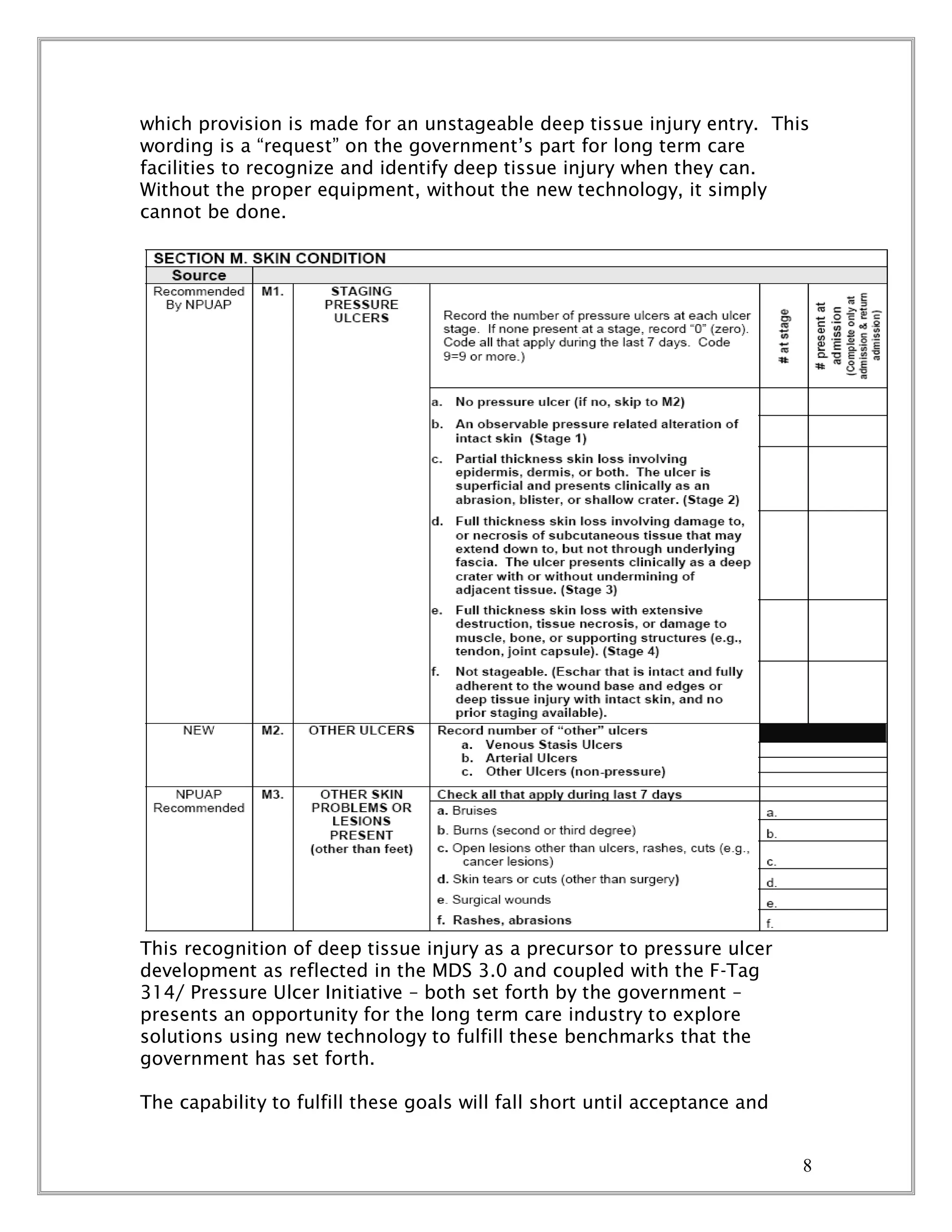
Recognition of deep tissue injury and the significance of its impact on
long term care policy and patient care is evident by the inclusion of a new
category (Section M, category “f”) in the forthcoming MDS version 3.0 in
8
which provision is made for an unstageable deep tissue injury entry. This
wording is a “request” on the government’s part for long term care
facilities to recognize and identify deep tissue injury when they can.
Without the proper equipment, without the new technology, it simply
cannot be done.
This recognition of deep tissue injury as a precursor to pressure ulcer
development as reflected in the MDS 3.0 and coupled with the F-Tag
314/ Pressure Ulcer Initiative – both set forth by the government –
presents an opportunity for the long term care industry to explore
solutions using new technology to fulfill these benchmarks that the
government has set forth.
The capability to fulfill these goals will fall short until acceptance and
9
implementation of new technological solutions replaces traditional
methods and standards of care. Use of new technology in the early
visualization and early medical intervention of pressure ulcers could
conceivably have an enormous impact on the percentages, severity and
actual numbers of pressure ulcers in long term care facilities.
Proposal for CMP Use
Program Design
Participating Facility Demographic Mix:
 More than 15 Certified Medicare beds
 Geographic accessibility
 OSCAR data
 30 Skilled nursing facilities
 23 for-profit / 7 non-profit
 5 Hospital-based
Facility Participation:
 Voluntary participation
 Can withdraw from project with no penalty
 Facility recognition at end of year
 Project will carry no less than 15 and no more than 30 facilities
Resident Participation:
 Resident participation is voluntary
 Resident and/or family members have the right to refuse the use of
new technology at any time without reason
 No coercion will be used to influence resident participation in
project
 No reprisal will be leveled as a result of refusal
Cost/Compensation:
 Residents will not be compensated for participation in project
 There will be no additional costs charged to the patient by the
facility for the use of new technology
 Resident will not be billed by any other company for the use of new
technology
10
 Participating facilities will not be charged for the use of new
technology equipment
Initial 2-Day Training & Education:
 Based on AHCPR guidelines for clinical practice on wound care
 Evaluation of current practices and procedures
 Overview of wound care best practice
 Hands-on training on new technology
 Integration of new technology with current practice
 Open house educational program for family members explaining
ITAP as well as general education on pressure ulcers
 Evaluation of education
 Ongoing support, adjustment, education and feedback throughout
length of project
Weekly Compliance Monitor:
 Monitor will contact each facility weekly
 Record of compliance will be kept
 Report log regarding equipment use will be maintained
 Report log regarding policy & procedure will be maintained
On Call Resource:
 24-hour resource regarding policy & procedure
 24-hour tech support will be provided for equipment
Screening & Assessment Method:
 New technology will be interfaced with admission screening
methods.
 All technology is non-invasive and will not be used as an alternative
or replacement of any plan of care
New Technologies:
Many new technologies and treatments can be integrated into the
assessment and care plans of long term care residents.
The LTC Research Foundation has secured pledges of commitment from
technology companies to provide the equipment and the training
necessary to the selected facility sites for one year for the Innovative
Technology Implementation Project. Their contributions of time and
equipment to this project demonstrate a desire to seek solutions to the
11
pressure ulcer problem as well as the cost barrier difficulties they
experience in the long term care industry.
These are new technologies that have been through clinical trials and are
proven and being used in some long term care facilities, but are still
under-utilized in the long term care community:
1. Ultrasound imaging technology:
 A unique high resolution image
 Has been clinically demonstrated to visualize deep tissue injury
 FDA approved, non-invasive
 Images can be forwarded for interpretation and evaluation
2. Palm Pilot:
 Point of care alternative to paper forms
 Allows clinicians to efficiently enter data. Users enter information at
the bedside
 Return the Palm Pilot to its base station, and synchronize the new
data to a database
 Reduces need for paper and transcription errors.
3. Digital Infrared Thermal Imaging (DITI):
 Produces instant easily visualized thermal images
 No contact with resident/patient
 FDA approved, non-invasive
 Used in detecting and monitoring deep tissue injury.
 Images stored on a computer, which can quickly forward them for
interpretation and evaluation.
These and/or similar technologies will be implemented in the long term
facilities participating in ITAP.
Successful Results:
Our one-year ITAP will provide a 12 month period in which selected
facilities will explore new technologies with solid tech support, without
the fear of penalty or high cost of new equipment.
It is the goal of ITAP in collaboration with in-kind support of technology
companies and assistance from CMP funding to demonstrate some of the
following outcomes:
12
 To provide an understanding how new technology affects the
quality of life of long term care residents.
 Promote the use of new technology in long term care facilities.
 Promote education of patients and families on how new technology
can improve their care and quality of life.
 To provide education of best practice standards of wound care to
staff and residents according to AHCPR guidelines.
 Provide education to direct care workers how the use of new
technology can affect the care and outcome of long term care
residents.
 Identify barriers that inhibit the use of new technology through the
direct care staff.
 To identify obstacles of new technology use and extract solutions
to overcome these obstacles so that new technology can prosper
and improve the quality of care in long term care.
 Demonstrate a better understanding of how facility administration
and technology companies can bridge the cost barriers while
providing the highest level of care.
 To increase the knowledge of technology companies and the long
term care industry on how to work within the budget constraints to
increase use of new technology.
 Provide a better understanding of how the use of new technology
can promote “best practice at best pricing”.
ITAP is designed to act as a portal where the possibilities of a long term
relationship can be explored that can mutually assist both new
technology companies and long term care facilities and promote quality
of life for residents.
Conclusion:
Following the one-year pilot of ITAP for wound care, review and
evaluation of its goals and results by ODH, CMS, TAPS and Ohio’s
Ombudsmen will be initiated by the LTC Research Foundation.
LTC Research Foundation will seek to expand its Innovative Technology
Application Project in the future to include more of Ohio’s long term care
facilities, and to encompass other areas of long term care deficiencies
recommended by ODH.

CMPPROPOSALfinal

  • 1.
    1 PROJECT PROPOSAL: INNOVATIVE TECHNOLOGYAPPLICATION PROJECT (ITAP) THE PURPOSE of the Innovative Technology Application Project is the introduction of new technology to improve residents’ quality of life. CMP FUNDING PROPOSAL FOR ITAP (FOR THE PREDICTION, PREVENTION & TREATMENT OF PRESSURE ULCERS) LTC Research Foundation Contact Information: Mary Meldrum (248) 225-2685 Phone (248) 642-0766 Fax
  • 2.
    2 TABLE OF CONTENTS Purpose3 Introduction 3 Executive Summary 4 Making Technology Cost-Effective 5 The Great Need for Relief & F-Tag Initiatives 6 Assessment Changes 7 MDS 3.0 Section M Revision 8 Program Proposal/Program Design 9 New Technologies 10 Successful Results of ITAP 11 Conclusion 12 Budget 13
  • 3.
    3 THE PURPOSE ofthe Innovative Technology Application Project is the introduction of new technology to improve residents’ quality of life. INTRODUCTION The LTC Research Foundation is a non-profit organization committed to multiple aspects of long term care practice, including resident evaluation, nursing care, facility administration, education, cost savings strategies, advancement and implementation of new technology, treatments and medical care. As professionals in the long term care industry, we have seen how important it is to recognize and prevent pressure ulcers early in their development. We have seen the complications, the pain, and the needless deaths and have experienced the frustration and heartbreak first-hand. Additionally, LTC Research Foundation is very familiar with the juggling of remedies and funds to cover the costs of treatment. Pressure ulcers are one of the top four deficiencies identified by CMS that haunt the long term care industry and drain resources. Add in the penalties and legal costs associated with this problem, and the numbers are staggering. Long term care facilities tend not to employ new technologies due to the fear of budgetary constraints and the cost of risk of trying something new. However, new technology does exist that can detect, prevent and promote early healing of pressure ulcers and bring early treatment to the resident prior to eruption of the sore, and substantially abbreviate the severity and length of time a sore might exist. The LTC Research Foundation has recently put together an innovative idea designed to target pressure ulcer prediction, prevention and treatment with new technology systems. Essentially this is an investigative program designed to demonstrate the effective use of new technologies in the early identification and intervention of pressure ulcers in long term care facilities. We seek to investigate solutions for bringing these technologies into common use in a cost-effective and perhaps even cost-saving way, in order to profoundly and positively impact the quality of life of long term care residents. In addition, other simple technology exists which provides seamless continuity of care and the ability to treat wound care patients within a facility by electronically transmitting the diagnostic information to a
  • 4.
    4 wound care clinicin order to get expert medical diagnosis, interpretation and advice without the patient ever leaving the facility. A coalition of health care professionals has been assembled and the LTC Research Foundation has already secured in-kind contributions of certain equipment for investigative purposes for a one-year pilot project, and the cooperation of more than 20 nursing home facilities who have agreed to participate in the pilot project. In submitting this proposal for CMP funding, it is our hope to gain your confidence and support for the Innovative Technology Application Project. This investigation – and other projects like it –have the potential to directly and positively benefit long term care residents and bring relief to all those who have to deal with pressure ulcers. EXECUTIVE SUMMARY Nursing home quality continues to be a major policy concern for both State and Federal policymakers. In response to this concern, and specifically in response to the government’s F-Tag 314/Pressure Ulcer Initiatives, LTC Research Foundation seeks to provide some resolution of pressure ulcer deficiencies through investigation of the use of new technology in long term care facilities. The Innovative Technology Application Project (ITAP) is designed to positively influence the quality of care and improve the resident’s outcome related to pressure ulcers. The purpose of this proposal is to present to the Ohio Department of Health, the Center for Medicare/Medicaid Services, and the Ohio TAP Program, a multi-disciplinary project that seeks to deliver genuinely impactful improvements in wound care in Ohio’s long term care industry. Often new technologies that are proven and available are under-utilized in long term care facilities generally due to the perception of high cost barriers, fear of technological complexity and fear of general change of established routines of care. This general dismissal and under-use of potentially life-saving technology could profoundly affect the quality of care and lives of long term care residents, and may indeed be costing facilities more in the end. In requesting CMP funding for ITAP, it is our desire to adhere to the Social Security Act (Section 1919(h)(2)(A)(ii)), which provides that CMP funds collected by a state from nursing homes must be applied to the protection of the health or property of residents of nursing facilities that the state finds to be deficient. CMS has given states flexibility in determining the appropriate uses of CMP funds as long as those funds
  • 5.
    5 are used "inaccordance with the law and in a consistent manner." (Source: August 8, 2002 Memorandum from Steve Pelovitz, Director of CMS Survey and Certification Group, to State Survey Agency Directors.) Making Technology Cost-Effective Twenty years ago, nursing home patients with bedsores were taped to the bed rail, painted with Maalox and positioned under a heat lamp. Today, there is a better medical understanding of bedsores and many new methods and technologies available for treating them. Because of a perception of the high cost of implementation and use of some of these technologies, many facilities choose to stay with traditional methods of care. In fact, raising the quality of care has proved to be a cost-effective method in the past for other long term care issues. Adaptation of new technology could follow this same pathway. Due to the high introductory cost barrier of initiating and incorporating some new technologies into tried and true routines, the long term care industry has not yet fully embraced some of these advancements. Traditional assessment and treatment methods are generally favored over new technology in the perception of cost savings. In fact, prolonged use of traditional dressings and other low-cost methods in wound care often means extended treatment, complications and pain, and ultimately higher costs for the complete treatment of a wound. Where the use of new technology may appear to be a costly and complicated, it may well be that it will ultimately result in a shorter treatment time resulting in less pain and suffering, improved quality of care, lower overall cost and better outcomes. In other words, it may be costing long term facilities more to not make the leap to the use of new technologies and methods in order to reap the rewards down the line. It is not as simple as comparing the line-item costs of dressings versus new technologies and what is directly reimbursable. There is a powerful need for a longer term, more comprehensive look at outcomes and overall costs versus savings. The Innovative Technology Application Project’s mission is not only to support medically viable ways to detect and treat bedsores early and effectively, but to bring these effective technological solutions to the nursing home industry in an affordable way in order to make it available to those who need it the most.
  • 6.
    6 The Great Needfor Relief & F-Tag Initiatives Pressure Ulcer Statistics:  More than 1 million patients in the United States still suffer from bedsores  More than 65,000 quietly die from related complications each year.  An estimated 11.6 – 28% of long term care residents are plagued with pressure ulcers.  Taking into consideration all direct, indirect and peripheral costs, over $25 billion total is spent annually on wound care in the United States.  Each year the government spends an average of $3 billion on wound treatment and care for pressure sores and bedsores.  Insurance companies pay out millions annually for this same treatment.  Inflationary effects on these costs alone will push the amounts spent annually even higher.  With the advent of the 78 million baby-boomers about to enter the early stages of the disease process, we are faced with overwhelming numbers of elderly people due to be warehoused in long term facilities that need to be tended to by caregivers from a smaller subsequent generation. This creates a supply/demand that will significantly increase the cost of per patient care.  In elderly populations and in those who are institutionalized, pressure ulcers are one of the most costly diseases to treat.  Pressure ulcers add an estimated burden of over $1 billion of expenditures and an additional 2.2 million Medicare hospital days to the United States health care system.  The cost of treatment is $2,000 - $40,000 per pressure ulcer.  Pressure ulcers can increase nursing time up to 50% and are very costly in time and resources. Total cost of labor, resources and time invested in treatment continues to rise dramatically.  The greatest cost of treating pressure ulcers in long term care is borne by the facility because hospital stays have shortened due to pressure from insurance companies to cut costs, placing higher numbers of high-risk patients into nursing homes sooner.  Since there is no way to predict where the ulcer actually originated, it is the facility that has possession of the patient at the time of eruption that bears the burden of the cost of treatment and any penalties.  Pressure ulcers represent one of the top four most common
  • 7.
    7 deficiencies found inlong term care facilities.  The Center for Medicare, Medicaid Services (CMS) issued non- compliance citations (with associated sanctions, including fines) to over 45% of long term care facilities for pressure ulcers in 2002.  US Health and Human Services Department’s Healthy People 2010 initiative established a goal of reducing the proportion of nursing home residents with pressure ulcers by 50% by 2010.  In 2005, US Centers for Medicare/Medicaid Services (CMS) issued updated guidance for surveyors regarding F-Tag 314/Pressure Ulcers. This initiative is due to be implemented in 2007:  F314 – 483.25(c) Pressure Sores: Based on a comprehensive Assessment of a resident, the facility must ensure that – (1) A resident who enters the facility without pressure sores does not develop pressure sores unless the individual’s clinical condition demonstrates that they were unavoidable; and (2) A resident having pressure sores receives necessary treatment and services to promote healing, prevent infection and prevent new sores from developing. Intent: (F314) 42 CFR 483.25(c) The intent of this requirement is that the resident does not develop pressure ulcers unless clinically unavoidable and that the facility provides care and services to:  Promote the prevention of pressure ulcer development;  Promote the healing of pressure ulcers that are present (including prevention of infection to the extent possible); and  Prevent development of additional pressure The timing of cost-effective and medically viable solutions to the pressure ulcer dilemma is exquisite. LTC Research Foundation is poised to address these devastating statistics and produce an effective method of introducing new technologies for pressure ulcer detection, prevention and treatment that will be sustainable, practical, cost-effective and can be replicated in most if not all Ohio long term care facilities. Assessment Changes Since the recent advent of knowledge that pressure ulcers develop from deep tissue injury and are present and progressing before they can be clinically visualized and precede a visible stageable pressure ulcer, medical professionals, CMS, insurance companies and healthcare advocates are looking at the development of pressure ulcers in a different light. Recognition of deep tissue injury and the significance of its impact on long term care policy and patient care is evident by the inclusion of a new category (Section M, category “f”) in the forthcoming MDS version 3.0 in
  • 8.
    8 which provision ismade for an unstageable deep tissue injury entry. This wording is a “request” on the government’s part for long term care facilities to recognize and identify deep tissue injury when they can. Without the proper equipment, without the new technology, it simply cannot be done. This recognition of deep tissue injury as a precursor to pressure ulcer development as reflected in the MDS 3.0 and coupled with the F-Tag 314/ Pressure Ulcer Initiative – both set forth by the government – presents an opportunity for the long term care industry to explore solutions using new technology to fulfill these benchmarks that the government has set forth. The capability to fulfill these goals will fall short until acceptance and
  • 9.
    9 implementation of newtechnological solutions replaces traditional methods and standards of care. Use of new technology in the early visualization and early medical intervention of pressure ulcers could conceivably have an enormous impact on the percentages, severity and actual numbers of pressure ulcers in long term care facilities. Proposal for CMP Use Program Design Participating Facility Demographic Mix:  More than 15 Certified Medicare beds  Geographic accessibility  OSCAR data  30 Skilled nursing facilities  23 for-profit / 7 non-profit  5 Hospital-based Facility Participation:  Voluntary participation  Can withdraw from project with no penalty  Facility recognition at end of year  Project will carry no less than 15 and no more than 30 facilities Resident Participation:  Resident participation is voluntary  Resident and/or family members have the right to refuse the use of new technology at any time without reason  No coercion will be used to influence resident participation in project  No reprisal will be leveled as a result of refusal Cost/Compensation:  Residents will not be compensated for participation in project  There will be no additional costs charged to the patient by the facility for the use of new technology  Resident will not be billed by any other company for the use of new technology
  • 10.
    10  Participating facilitieswill not be charged for the use of new technology equipment Initial 2-Day Training & Education:  Based on AHCPR guidelines for clinical practice on wound care  Evaluation of current practices and procedures  Overview of wound care best practice  Hands-on training on new technology  Integration of new technology with current practice  Open house educational program for family members explaining ITAP as well as general education on pressure ulcers  Evaluation of education  Ongoing support, adjustment, education and feedback throughout length of project Weekly Compliance Monitor:  Monitor will contact each facility weekly  Record of compliance will be kept  Report log regarding equipment use will be maintained  Report log regarding policy & procedure will be maintained On Call Resource:  24-hour resource regarding policy & procedure  24-hour tech support will be provided for equipment Screening & Assessment Method:  New technology will be interfaced with admission screening methods.  All technology is non-invasive and will not be used as an alternative or replacement of any plan of care New Technologies: Many new technologies and treatments can be integrated into the assessment and care plans of long term care residents. The LTC Research Foundation has secured pledges of commitment from technology companies to provide the equipment and the training necessary to the selected facility sites for one year for the Innovative Technology Implementation Project. Their contributions of time and equipment to this project demonstrate a desire to seek solutions to the
  • 11.
    11 pressure ulcer problemas well as the cost barrier difficulties they experience in the long term care industry. These are new technologies that have been through clinical trials and are proven and being used in some long term care facilities, but are still under-utilized in the long term care community: 1. Ultrasound imaging technology:  A unique high resolution image  Has been clinically demonstrated to visualize deep tissue injury  FDA approved, non-invasive  Images can be forwarded for interpretation and evaluation 2. Palm Pilot:  Point of care alternative to paper forms  Allows clinicians to efficiently enter data. Users enter information at the bedside  Return the Palm Pilot to its base station, and synchronize the new data to a database  Reduces need for paper and transcription errors. 3. Digital Infrared Thermal Imaging (DITI):  Produces instant easily visualized thermal images  No contact with resident/patient  FDA approved, non-invasive  Used in detecting and monitoring deep tissue injury.  Images stored on a computer, which can quickly forward them for interpretation and evaluation. These and/or similar technologies will be implemented in the long term facilities participating in ITAP. Successful Results: Our one-year ITAP will provide a 12 month period in which selected facilities will explore new technologies with solid tech support, without the fear of penalty or high cost of new equipment. It is the goal of ITAP in collaboration with in-kind support of technology companies and assistance from CMP funding to demonstrate some of the following outcomes:
  • 12.
    12  To providean understanding how new technology affects the quality of life of long term care residents.  Promote the use of new technology in long term care facilities.  Promote education of patients and families on how new technology can improve their care and quality of life.  To provide education of best practice standards of wound care to staff and residents according to AHCPR guidelines.  Provide education to direct care workers how the use of new technology can affect the care and outcome of long term care residents.  Identify barriers that inhibit the use of new technology through the direct care staff.  To identify obstacles of new technology use and extract solutions to overcome these obstacles so that new technology can prosper and improve the quality of care in long term care.  Demonstrate a better understanding of how facility administration and technology companies can bridge the cost barriers while providing the highest level of care.  To increase the knowledge of technology companies and the long term care industry on how to work within the budget constraints to increase use of new technology.  Provide a better understanding of how the use of new technology can promote “best practice at best pricing”. ITAP is designed to act as a portal where the possibilities of a long term relationship can be explored that can mutually assist both new technology companies and long term care facilities and promote quality of life for residents. Conclusion: Following the one-year pilot of ITAP for wound care, review and evaluation of its goals and results by ODH, CMS, TAPS and Ohio’s Ombudsmen will be initiated by the LTC Research Foundation. LTC Research Foundation will seek to expand its Innovative Technology Application Project in the future to include more of Ohio’s long term care facilities, and to encompass other areas of long term care deficiencies recommended by ODH.