Running head: PICOT STATEMENT 1
PICOT STATEMENT 2
PICOT Statement
Anna Uka
Grand Canyon
University- NRS490
December 1st , 2019
P: Adults on an Acute Care floor
I: Required education on the Braden Scale
C: Standard Practice
O: Decrease in Hospital-Acquired Pressure Ulcers
PICOT QUESTION: Does the required education on the Braden
scale increase nursing interventions for Adult patients on an
acute care floor at risk of developing pressure ulcers during
hospitalization?
Currently, most hospitals are faced with a clinical problem of
acquired pressure ulcers. According to Pittman et al (2015),
hospital-acquired pressure ulcers remain one of the persistent
and relevant issues that need to be addressed in long-term
hospital stay patients. Health care is attempting to implement
evidence-based protocols, though patients continue to suffer
from this prevalent and preventable injury. Health care
institutions are facing a big challenge for the patients with this
acquired condition because hospital bills continue to balloon
and at the same time insurance companies stopped paying for
this condition. Research shows that pressure ulcer is
preventable; though, in spite of hospitals striving to integrate
evidence-based approaches to curb the issue, it continues to
remain a serious issue for long-term hospital stay patients. This
PICOT statement this research paper is proposing to use is a
Braden Scale which can be used by nurses in their practice to
reduce hospital-acquired pressure injuries which will reduce the
patient stay in the hospital as well as the bills burden in the
hospital.
Evidence-Based
Solution
According to Engels et al (2016), “the importance of using
evidence-based practice in long-term care hospitals to reduce
prevalent pressure ulcers is to promote a safe cost-effective
outcome for our patients, families, and the healthcare group.
Research needs to be conducted and qualitative data collected
when designing an evidence-based solution to hospital-acquired
injuries”. Despite a lot of research being conducted from the
past years concerning acquired pressure ulcers, many patients
continue to get the disease. Evidence-based practice allows the
nurse to get pooled in a team of experts where interdisciplinary
collaboration becomes the ultimate objective for nurses to
practice autonomy that enhances change in the nursing field
based on data. “The nursing research utilizes qualitative and
quantitative logical methods and an EBP approach aimed at
around the study and change of patient consideration,
understanding consideration frameworks, and patient results”
(Mervis & Phillips, 2019). This PICOT question will effectively
apply the Braden Scale to see how it can positively impact long-
term hospital in reducing pressure ulcers injuries.
Nursing Intervention
When starting a nursing research project, one has to consider a
variety of factors. First, a nurse needs to look at the available
intervention that would assist the patient in managing pressure
ulcer injury on an adult acute care floor, particularly when
using Braden Scale (Engels et al., 2016). For example, a nurse
can initiate an intervention of training about the Braden Scale to
make sure every day has the full knowledge of the tool and
making sure that pressure injury prevention techniques are used
when the Braden Scale is at a certain score.
Patient Care
According to Mervis, & Phillips (2019), “Nursing intervention
techniques that are used to prevent pressure injuries in the
hospital include placing silicone dressings on patient’s coccyx
bones, avoiding moisture, RN skin checks to assess the skin
every shift, turning repositioning the patient every two hours.
These are only a few and with the education on the Braden
Scale medical caretakers will have a more note worthy
comprehension of how to better help their patients”.
Health Care Agency
Pittman et al (2015) argue that the health care agency's primary
role is to fund long-term care hospitals is providing safety,
quality and effective communication between patients and
nurses and improving overall healthcare services. An example
of an agency responsible for ensuring patient’s health concerns
are looked into is The National Institute of Nursing Research
and Agency for Healthcare Research and Quality are a few
(Berlowitz, VanDeusen Lukas & Parker, 2015). In the event,
this research project receives great feedback it can perhaps get
the financial support to attain the PICOT statement.
Nursing Practice
Whitehead (2008) stated that nursing practice is an important
phenomenon that should be used by nurses in long-term
hospitals when generating knowledge about their role and the
overall practice of care to patients with acquiring pressure
ulcers, as well as to add to nursing knowledge that every nurse
should be adept with. A nurse should contemplate about the
nursing standards and policies that healthcare utilizes when
providing patient care. These policies were a result of research
findings that affect nursing practice.
References
Berlowitz, D., VanDeusen Lukas, C., & Parker, V. (2015).
Preventing pressure ulcers in hospitals: a toolkit for improving
quality of care. Agency for Healthcare Research and Quality.
Engels, D., Austin, M., McNichol, L., Fencl, J., Gupta, S., &
Kazi, H. (2016). Pressure ulcers: factors contributing to their
development in the OR. AORN Journal, 103(3), 271-281.
Mervis, J. S., & Phillips, T. J. (2019). Pressure ulcers:
prevention and management. Journal of the American Academy
of Dermatology.
Pittman, J., Beeson, T., Kitterman, J., Lancaster, S., & Shelly,
A. (2015). Medical Device–Related Hospital-Acquired Pressure
Ulcers. Journal of Wound, Ostomy and Continence
Nursing, 42(2), 151-154.
Whitehead, D. (2008). Understanding Nursing Research:
Building an Evidence‐Based Practice–4th Edition. Journal of
Clinical Nursing, 17(4), 563-563.
Respond to Erica and Cody. Respond to at least two of your
colleagues on two different days and provide further
suggestions on how their database search might be improved.
Erica F
Top of Form
Main Discussion Post
While there may be no bad questions, there is a way to format
questions that can give you the best answer. Davies (2011)
stated that questions are essential in cultivating a culture of
evidence-based practice (EBP). Formatting a question to reduce
the time and effort it takes to locate useful information is a skill
that takes practice and requires reflection (Davies, 2011). This
discussion will describe the PICO(T) question format and how
to search databases using the terms within the question
effectively.
The spirit of inquiry is what drives EBP. Stillwell, Fineout-
Overholt, Melnyk, and Williamson (2010) reported asking clear,
formatted questions leads to improved patient outcomes. An
example of this is I noticed a lot of clients seen in the clinic
said their mental health declining after a car accident. These
accidents ranged in severity, but none had any long-lasting
physical limitations. From this curious observation, I reflect on
my question and then develop a PICO(T) formatted inquiry. Are
adults who have been in minor car accidents more prone to
developing a mental illness? Is undiagnosed posttraumatic
stress disorder (PTSD) leading to increased diagnoses of
depression and anxiety? Is PTSD overlooked in patients without
significant injuries? Would treating the underlying PTSD make
a difference in patient outcomes? Would a quicker diagnosis of
PTSD improve patient outcomes and lead to less compounded
mental illnesses such as PTSD with depression and anxiety?
Would referring patients to a psychiatric provider following a
possibly traumatic event for early intervention improve
outcomes? Are patients willing to see a psychiatric provider
before their mental health is causing prominent life
disturbances?
P: Do adults with PTSD who
I: have received early intervention
C: compared to those who put off treatment until comorbid
depression and anxiety surface
O: have more positive outcomes?
T: (I didn’t add a time-frame limitation to generate more
results)
The spirit of inquiry is intertwined with the process of using
informatics to gain wisdom. When one question is answered,
many more are ignited because of the new information. It
becomes a circular process and requires evaluation to draw
relevant conclusions and continue the state of curiosity seeking
knowledge. For example, how can I bring awareness of this
issue to providers who would most likely be in contact with a
patient who has just suffered a traumatic event? How can I
bring awareness to the public about the importance of early
intervention and the benefits of following through on
psychiatric referrals? The Institute of Medicine would like 90%
of all healthcare decisions to be made using EBP (Melnyk,
Fineout-Overholt, Stillwell, & Williamson, 2009). Empowering
nurses to seek knowledge and critically analyze research to
inform decisions is vital for this goal to be reached.
I chose to search the Cumulative Index to Nursing & Allied
Health Literature (CINAHL) Plus with Full Text and Joanna
Briggs Institute (JBI) databases to explore my inquiry. I
brainstormed a list of possible search words and came up with
adults, posttraumatic stress disorder, PTSD, early intervention,
early treatment, comorbid depression and anxiety, and
depression and anxiety. I began my search on CINAHL with
PTSD using the Boolean operators AND early intervention AND
depression AND/OR anxiety. This gave me 25 results. Then I
put in the limitations of full text, peer-reviewed articles, and
publications within the last five years. This narrowed the search
to 13 results. Walden University Library (n.d.) recommended
using systematic reviews and evidence summaries to find the
most beneficial research regarding changing practice based on
evidence. CINAHL didn’t have the option of evidence
summaries, so I chose systematic reviews. This narrowed my
search to three. All three were very relevant and applicable to
my inquiry. Then I changed my search terms to PTSD OR
posttraumatic stress disorder OR post-traumatic stress disorder
OR post traumatic stress disorder, AND early intervention OR
early detection OR early diagnosis, AND depression OR
depressive symptoms OR depressive disorder OR major
depressive disorder OR anxiety. This gave me five results,
which surprised me because I thought I would get more with
that many Boolean operators. If I leave those search terms and
take out the parameter of systematic reviews, I can peruse 66
publications.
The second database I wanted to search was JBI. I have never
used this database before, or even heard of it, so I was excited
to check it out. Using the same search that retrieved 66 articles
from CINAHL, I was able to get only six results on JBI. When I
narrowed the parameters to publications within the last five
years and only searched the keyword PTSD, I got 43 results. No
articles on JBI were exactly what I was looking for, but they did
have some useful information regarding EBP and PTSD. I like
that this database specializes in providing EBP research. If I
were to continue my search, I would be sure to utilize a few
other nursing databases, such as MEDLINE, PubMed,
ScienceDirect, and Cochrane, to get more relevant results for
my PICO question.
Formatting nursing questions in a way that will help facilitate
efficient search results is a skill that requires practice. One
strategy that I use often is looking at the subject lines in the
search results I am browsing. I can get ideas of other wording
and related concepts that might be useful to add to my keywords
and broaden or focus my search results. While I like to use the
Boolean operators AND and OR, I don’t usually use the
operator NOT unless I am consistently running into a topic in
my search results that I don’t want to explore. Using an asterisk
at the end of a word, so the search picks up all variations of that
word, is another strategy I use often. The example I used in this
discussion was nurs*, which would search for nurse, nursing,
nurses, etc. Separating the major concepts from the clinical
inquiry, searching several databases, and using multiple search
techniques is crucial to find the best publications to inform
healthcare changes in practice.
Erica
References
Davies, K.S. (2011). Formulating the evidence based practice
question: A review of the
frameworks for LIS professionals. Evidence Based Library and
Information Practice, 6(2), 75-80. doi: 10.18438/B8WS5N
Stillwell, S.B., Fineout-Overholt, E., Melnyk, B.M., &
Williamson, K.M. (2010). Evidence-
based practice, step by step: Asking the clinical question: A key
step in evidence-based practice. American Journal of Nursing,
110(3), 58-61. doi: 10.1097/01.NAJ.0000368959 .11129.79
Walden University Library. (n.d.). Evidence-based practice
research: Joanna Briggs Institute
search help. Retrieved
from https://academicguides.waldenu.edu/library/healthevidence
/ jbisearchhelp
Cody Li
Discussion - Week 4
Top of Form
Clinical inquiry is a demand in all aspects of nursing.
The basis of these inquiries is the driving factor that sets forth
the constant improvement and betterment of our profession. At
the basis utilizing evidence-based practice (EBP) and proper
research helps to perform that. Performing these searches can be
challenging and hard to navigate through the research process.
The push for EBP in the world of healthcare is now more
prevalent then ever. The Institute of Medicine would like 90%
of all healthcare decisions to be made using EBP (Melnyk,
Fineout-Overholt, Stillwell, & Williamson, 2009). With the
introduction of the internet it is readily and easily accessible.
(Laureate Education Producer, 2018). Using One way to
perform these searching is using the PICOT method.
PICOT format (i.e., P: population of interest; I:
intervention or issue of interest; C: comparison of interest; O:
outcome expected; and T: time for the intervention to achieve
the outcome) is the best approach to developing a research
question (Melnyk & Fineout-Overholt, 2018). Using this
technique when combined with proper searching of clinical
information online is key factor to understanding and finding
quality research. One must question research to ensure it
authentication and it purposeful and make it improve our
clinical practice. Questions are essential in cultivating a culture
of evidence-based practice (EBP) (Davies, 2011). Formatting a
question to reduce the time and effort it takes to locate useful
information is a skill that takes practice and requires reflection
(Davies, 2011). As mentioned above we will explore the PICOT
method utilization.
In the world of surgery there are many opportunities to
use this method. At one of the jobs I work at is surgical
services. One of the procedures we perform at least 3 days a
week are total joint replacements (TJR). One inquiry we could
focus on is the development of post-operative infections versus
those that have not from a TJR. So, our question purposed, what
is percentage of those who have developed versus those that did
not develop post-operative infection by the third postoperative
appointment at week 6? Now the third appointment was chosen
as this is the process that our orthopedic surgeons follow.
P- Patients undergoing TJR
I-Post-operative infection acquired
C- Those that did not develop an infection
O- Length of recover
T- By the third appointment
When searching my first database was ProQuest
Nursing & Allied Health Database, initially it yielded 6125
results using post-operative infection rate and TJR. I changed
up my limits to full text and peer-reviewed. This was a decent
search site, but I probably would not use it again. I then used
the CINAHL Plus with Full Text using the same pattern as
above. This generated 7 results using full text reviews. When
changing to peer-reviewed it showed 10 results. I have used this
site many times in the past for research and papers. It is a great
resource.
If the world of searching for research, it can be difficult
to navigate. Learning how to review research effectively and
purposefully can change the results you get and give you
adequate quality resource and research that can be applied to
improve the practice. Once you learn how to separate the
content it can shape the outcome of the results and the EBP we
use to utilize to move and enhance the industry. As mentioned
above EBP is the focus of the world of healthcare and knowing
the best and most effective ways to utilize this will make the
process of finding the information easier.
References
Davies, K. S. (2011). Formulating the evidence-based practice
question: A review of the
frameworks for LIS professionals. Evidence Based Library and
Information Practice,
6(2), 75–80. https://doi.org/10.18438/B8WS5N. Retrieved from
https://ejournals.library.ualberta.ca/index.php/EBLIP/article/vie
wFile/9741/8144
Laureate Education (Producer). (2018). Searching the Evidence
[Video file]. Baltimore, MD:
Author.
Melnyk, B. M., & Fineout-Overholt, E. (2018). Evidence-based
practice in nursing & healthcare:
A guide to best practice (4th ed.). Philadelphia, PA: Wolters
Kluwer.
Melnyk, B. M., Fineout-Overholt, E., Stillwell, S. B., &
Williamson, K. M. (2009). Evidence-
based practice: Step by step: Igniting a spirit of inquiry.
American Journal of Nursing,
109(11), 49–52. doi:10.1097/01.NAJ.0000363354.53883.58.
Retrieved from
https://journals.lww.com/ajnonline/fulltext/2009/11000/Evidenc
e_Based_Practice__Step
_by_Step__Igniting_a.28.aspx
Bottom of Form
Bottom of Form
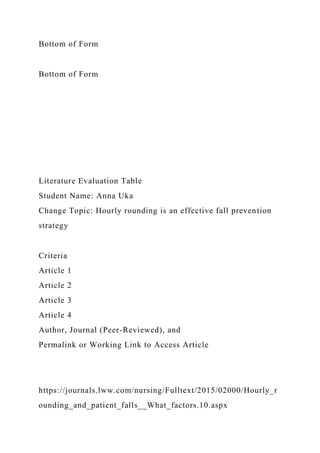
Literature Evaluation Table
Student Name: Anna Uka
Change Topic: Hourly rounding is an effective fall prevention
strategy
Criteria
Article 1
Article 2
Article 3
Article 4
Author, Journal (Peer-Reviewed), and
Permalink or Working Link to Access Article
https://journals.lww.com/nursing/Fulltext/2015/02000/Hourly_r
ounding_and_patient_falls__What_factors.10.aspx
https://academic.oup.com/gerontologist/article/58/2/331/273632
6/
https://pdfs.semanticscholar.org/0bb0/1bd16c44a8a490e0712ca6
6fe1478e65fcfa.pdf
https://epostersonline.com/ons2018/node/1002
Article Title and Year Published
2015
2016
2018
2018
Research Questions (Qualitative)/Hypothesis (Quantitative), and
Purposes/Aim of Study
Does engaging in interdisciplinary team through leadership and
unit champion’s result to reduction in fall rates?
The article seeks to find out those factors that boosts success
and prevents patient falls due to nurse rounding’s.
To explore a nurses experience with fall prevention in hospital
settings.
To determine the effects of those experience on how nurses
provide care for the risk patients.
Does intense messaging from nursing administration to prevent
patient falls, actions taken by nurses to address message and
consequences to nurses and older patients
What are some of the effects of purposeful hourly rounding on
the incidence of patient falls?
The purpose of the article was to determine if implementation
of strategic hourly rounding can reduce falls.
Design (Type of Quantitative, or Type of Qualitative)
Quantitative
Qualitative
Quantitative
Quantitative
Setting/Sample
30-day prospective pilot study was conducted in pre- and post-
implementation units.
27 registered nurses and certified nurses
Two hospitals located in Wisconsin
241- bed acute care facility in south eastern United States
Hourly rounding was conducted during 4-8 am time frame was
implemented on all the patients.
Methods: Intervention/Instruments
Lean Six Sigma process was used to determine improvement in
the project
In-depth interviews were conducted. Open, axial and selective
coding was used in data analysis.
Data was collected through retrospective data review to
determine fall incidence in one year before and after
implementation of hourly rounding program.
An UAMS EBP model was utilized in the project. An hourly
rounding during the 4- 8 am was implemented on all the patients
and it continued throughout the day. The hourly rounding’s
addressed the 4 p’s these are possessions. Position. Hygiene and
personal.
Staffs were educated on rounding through the use of staff
meetings, unit council meetings, daily audits and one- on one
instruction.
Analysis
On the units where staffs were engaged through leadership and
unit champions there was a significant reduction in fall rates in
Unit 1.
In most hospital settings, nursing staff have been placed
directly to prevent falls. As such, nurses feel an increasing
pressure to meet hospital objective of zero falls.
The study illustrates that total falls occurred before and after
implementation of purposeful hourly rounding. In the study
evidence-based standardized prevention resulted to decrease in
falls though it was not statistically significant.
Using analysis of variance in identification of the times when
patients were more vulnerable to falling. Hour rounding for
high risk patients who were vulnerable to falling decreased
Key Findings
The authors found out that active involvement of front-line staff
and leadership in program design and as unit champions during
the period resulted to reduction in inpatient fall rates.
The authors found out that nurses experience negative
consequences as and when they are placed on intense pressure
to prevent falls. As a result nurses adjust the care they deliver
and restrict patient mobility and optimal patient progress.
Purposeful hour settings can effectively prevent falls. The
challenging factor is its implementations in health care settings.
Hourly rounding’s decreases patient falls. Ensuring clinical
support through HDS to drive care and rounding compliance is
an effective reduction strategy.
Recommendations
Current hospital care settings should engage interdisciplinary
team and front line staff to reduce hospital fall rates.
The authors recommend that research is required to gain
knowledge on how nurses should provide care to risk patients.
There is also a need for patient centered and unit based
interventions to prevent patient falls and preserve patient
functions.
The study recommends that further research to be conducted on
one the benefits of purposeful hourly rounding.
Purposeful hourly rounding is a transformation in nursing
culture.
The study also provides opportunities for developing,
implementing and evaluating hourly rounding programs in
hospitals.
Health care settings should clinical decision making support
such as the HDS. This can help them drive care that is paired
with rounding compliance on high fall risking patients as an
effective was to reduce falls.
Explanation of How the Article Supports EBP/Capstone Project
The article supports my capstone project on falls, because it
relates well on how nurse’s hourly rounding’s can be decreased
in hospital settings.
The article provides suggestions on how hospitals should lessen
the pressure put on nurses to prevent patient falls and look for
appropriate strategies to minimize patient falls.
The article supports capstone project in that it explains how
implementation of purposeful hourly rounding can prevent
patient falls.
The article argues that use of hourly rounding does can reduce
the rate of hospital fall in health care settings.
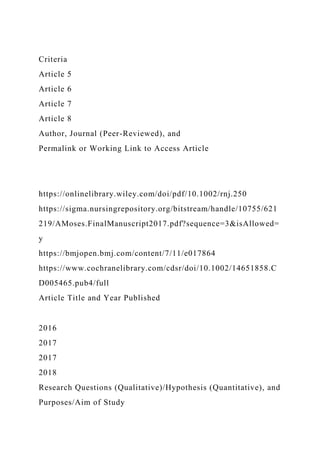
Criteria
Article 5
Article 6
Article 7
Article 8
Author, Journal (Peer-Reviewed), and
Permalink or Working Link to Access Article
https://onlinelibrary.wiley.com/doi/pdf/10.1002/rnj.250
https://sigma.nursingrepository.org/bitstream/handle/10755/621
219/AMoses.FinalManuscript2017.pdf?sequence=3&isAllowed=
y
https://bmjopen.bmj.com/content/7/11/e017864
https://www.cochranelibrary.com/cdsr/doi/10.1002/14651858.C
D005465.pub4/full
Article Title and Year Published
2016
2017
2017
2018
Research Questions (Qualitative)/Hypothesis (Quantitative), and
Purposes/Aim of Study
The article examined how nurse leaders in an inpatient
rehabilitation unit can reduce falls through implementing fall
prevention strategies and sustaining their results by promoting a
strong culture.
What are the effects of an alarm elimination programs compared
to the practice of utilizing alarms on fall rates in a 2 month
period.
To evaluate the effectiveness of fall prevention strategies on
reducing falls in hospitalized adults.
To identify the effects of interventions designed to reduce
incidence falls among older people in acute care facilities
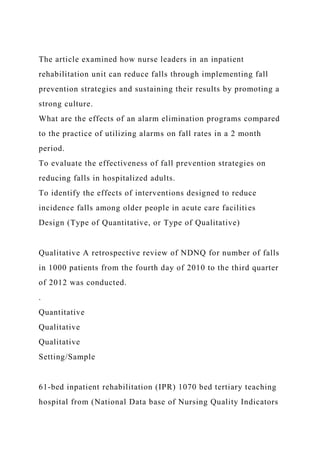
Design (Type of Quantitative, or Type of Qualitative)
Qualitative A retrospective review of NDNQ for number of falls
in 1000 patients from the fourth day of 2010 to the third quarter
of 2012 was conducted.
.
Quantitative
Qualitative
Qualitative
Setting/Sample
61-bed inpatient rehabilitation (IPR) 1070 bed tertiary teaching
hospital from (National Data base of Nursing Quality Indicators
(NDNQI)
Patients in a Rehab long term care facility in Missouri
Meta- analysis Study.
Thirty five trails that is 77,879 participants were included. The
study sed 95 randomized control trial that involved 138,164
participants, Seventy one trials were in care facilities, and 24 in
hospital settings.
Methods: Intervention/Instruments
A retrospective review of IPR fall rates was conducted. The
quarterly fall rates were compared to implementation dates of
fall prevention interventions such as hourly rounding, safety
hurdles and signage,
The quality improvement project followed four steps that is
Plan-Do-Check Act (PDCA).Data was collected from Incident
Reporting Program (IDA).The outcomes were then measured
through pre and prosy intervention deign. Pre intervention was
collected from 2015 and post intervention collected in July to
September 2016/
Criteria were followed in that studies that were eligible for
inclusion for method and quality risk of bias and was based on
the method quality. The author used Pedro scale and the
Cochrane Risk of Bias based on 12 criteria that is binding,
concealed allocation ,baseline comparability outcome
assessment and incomplete data.
The study applied the use of randomized control measures to
prevent falls among older people in residential and nursing care
hospitals. The author screened abstracts where two review
authors were successfully screened for inclusion.
Analysis
Total fall rates per 1000 patients were collected from the fourth
quarter of 2010 to 2013 from NDNQI.
Fall rates decreased after post prevention but there was no
statistical significance in the decrease in fall rates.
The eligibility criteria was based on the type of studies, types of
interventions, compradors, outcome measures, study settings
and t types of participants.
Majority of the results for the study were at risk of bias due to
inadequate binding, Also risk of fracture and other adverse
events were poorly reported the evidence was also of poor
quality.
Key Findings
Decrease in fall rates was noted after revitalization efforts of
IPR unit culture of safety together with hourly rounding.
The need for Alarm Elimination Fall Prevention program was a
requirement in the chosen health care setting. The health care
setting also required a vast amount of support from its
management and administration to enable staff realize its
importance and to view interventions for more work.
The studies suggested various strategies that were used to
prevent patient falls in hospitals.
The authors found out that in hospitals ,there was an effect of
additional physiotherapy on rate of falls as it reduces the risk of
falling.
Recommendations
Physical injuries that occur due to falls reduce mobility and can
increase morbidity. Through evidence based fall reduction
strategies are crucial for nurses and leaders within the health
care.
The authors suggest further studies should consider fall rates in
relation to patient and staff ratios and follow up to be conducted
during a much longer time frame to determine the importance
that is noticed on higher compliance rates. Administrators
through modifications and understanding of ideas and asking the
right questions can create an opportunity and provide safe
environment patients.
A proper understanding of hospital falls and effective strategies
to prevent falls is an essential strategy to prevent individuals
from falling.
The study suggests incorporatuo of apporahces on the
cirumstancs o falls in addition to other factors such as regular
assisted toileting and in facilities and hospitals. Health care
settings should use educational focus and psychological
strategies as patient centered directions.
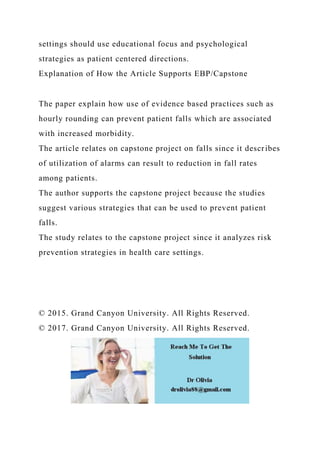
Explanation of How the Article Supports EBP/Capstone
The paper explain how use of evidence based practices such as
hourly rounding can prevent patient falls which are associated
with increased morbidity.
The article relates on capstone project on falls since it describes
of utilization of alarms can result to reduction in fall rates
among patients.
The author supports the capstone project because the studies
suggest various strategies that can be used to prevent patient
falls.
The study relates to the capstone project since it analyzes risk
prevention strategies in health care settings.
© 2015. Grand Canyon University. All Rights Reserved.
© 2017. Grand Canyon University. All Rights Reserved.

Running head PICOT STATEMENT 1PICOT STATEMENT 2.docx

  • 1.
    Running head: PICOTSTATEMENT 1 PICOT STATEMENT 2 PICOT Statement Anna Uka Grand Canyon University- NRS490 December 1st , 2019 P: Adults on an Acute Care floor
  • 2.
    I: Required educationon the Braden Scale C: Standard Practice O: Decrease in Hospital-Acquired Pressure Ulcers PICOT QUESTION: Does the required education on the Braden scale increase nursing interventions for Adult patients on an acute care floor at risk of developing pressure ulcers during hospitalization? Currently, most hospitals are faced with a clinical problem of acquired pressure ulcers. According to Pittman et al (2015), hospital-acquired pressure ulcers remain one of the persistent and relevant issues that need to be addressed in long-term hospital stay patients. Health care is attempting to implement evidence-based protocols, though patients continue to suffer from this prevalent and preventable injury. Health care institutions are facing a big challenge for the patients with this acquired condition because hospital bills continue to balloon and at the same time insurance companies stopped paying for this condition. Research shows that pressure ulcer is preventable; though, in spite of hospitals striving to integrate evidence-based approaches to curb the issue, it continues to remain a serious issue for long-term hospital stay patients. This PICOT statement this research paper is proposing to use is a Braden Scale which can be used by nurses in their practice to reduce hospital-acquired pressure injuries which will reduce the patient stay in the hospital as well as the bills burden in the hospital. Evidence-Based Solution According to Engels et al (2016), “the importance of using
  • 3.
    evidence-based practice inlong-term care hospitals to reduce prevalent pressure ulcers is to promote a safe cost-effective outcome for our patients, families, and the healthcare group. Research needs to be conducted and qualitative data collected when designing an evidence-based solution to hospital-acquired injuries”. Despite a lot of research being conducted from the past years concerning acquired pressure ulcers, many patients continue to get the disease. Evidence-based practice allows the nurse to get pooled in a team of experts where interdisciplinary collaboration becomes the ultimate objective for nurses to practice autonomy that enhances change in the nursing field based on data. “The nursing research utilizes qualitative and quantitative logical methods and an EBP approach aimed at around the study and change of patient consideration, understanding consideration frameworks, and patient results” (Mervis & Phillips, 2019). This PICOT question will effectively apply the Braden Scale to see how it can positively impact long- term hospital in reducing pressure ulcers injuries. Nursing Intervention When starting a nursing research project, one has to consider a variety of factors. First, a nurse needs to look at the available intervention that would assist the patient in managing pressure ulcer injury on an adult acute care floor, particularly when using Braden Scale (Engels et al., 2016). For example, a nurse can initiate an intervention of training about the Braden Scale to
  • 4.
    make sure everyday has the full knowledge of the tool and making sure that pressure injury prevention techniques are used when the Braden Scale is at a certain score. Patient Care According to Mervis, & Phillips (2019), “Nursing intervention techniques that are used to prevent pressure injuries in the hospital include placing silicone dressings on patient’s coccyx bones, avoiding moisture, RN skin checks to assess the skin every shift, turning repositioning the patient every two hours. These are only a few and with the education on the Braden Scale medical caretakers will have a more note worthy comprehension of how to better help their patients”. Health Care Agency Pittman et al (2015) argue that the health care agency's primary role is to fund long-term care hospitals is providing safety, quality and effective communication between patients and nurses and improving overall healthcare services. An example of an agency responsible for ensuring patient’s health concerns are looked into is The National Institute of Nursing Research and Agency for Healthcare Research and Quality are a few (Berlowitz, VanDeusen Lukas & Parker, 2015). In the event, this research project receives great feedback it can perhaps get the financial support to attain the PICOT statement. Nursing Practice
  • 5.
    Whitehead (2008) statedthat nursing practice is an important phenomenon that should be used by nurses in long-term hospitals when generating knowledge about their role and the overall practice of care to patients with acquiring pressure ulcers, as well as to add to nursing knowledge that every nurse should be adept with. A nurse should contemplate about the nursing standards and policies that healthcare utilizes when providing patient care. These policies were a result of research findings that affect nursing practice. References Berlowitz, D., VanDeusen Lukas, C., & Parker, V. (2015). Preventing pressure ulcers in hospitals: a toolkit for improving quality of care. Agency for Healthcare Research and Quality. Engels, D., Austin, M., McNichol, L., Fencl, J., Gupta, S., & Kazi, H. (2016). Pressure ulcers: factors contributing to their development in the OR. AORN Journal, 103(3), 271-281. Mervis, J. S., & Phillips, T. J. (2019). Pressure ulcers: prevention and management. Journal of the American Academy of Dermatology. Pittman, J., Beeson, T., Kitterman, J., Lancaster, S., & Shelly, A. (2015). Medical Device–Related Hospital-Acquired Pressure Ulcers. Journal of Wound, Ostomy and Continence Nursing, 42(2), 151-154. Whitehead, D. (2008). Understanding Nursing Research:
  • 6.
    Building an Evidence‐BasedPractice–4th Edition. Journal of Clinical Nursing, 17(4), 563-563. Respond to Erica and Cody. Respond to at least two of your colleagues on two different days and provide further suggestions on how their database search might be improved. Erica F Top of Form Main Discussion Post While there may be no bad questions, there is a way to format questions that can give you the best answer. Davies (2011) stated that questions are essential in cultivating a culture of evidence-based practice (EBP). Formatting a question to reduce the time and effort it takes to locate useful information is a skill that takes practice and requires reflection (Davies, 2011). This discussion will describe the PICO(T) question format and how to search databases using the terms within the question effectively. The spirit of inquiry is what drives EBP. Stillwell, Fineout- Overholt, Melnyk, and Williamson (2010) reported asking clear, formatted questions leads to improved patient outcomes. An example of this is I noticed a lot of clients seen in the clinic said their mental health declining after a car accident. These
  • 7.
    accidents ranged inseverity, but none had any long-lasting physical limitations. From this curious observation, I reflect on my question and then develop a PICO(T) formatted inquiry. Are adults who have been in minor car accidents more prone to developing a mental illness? Is undiagnosed posttraumatic stress disorder (PTSD) leading to increased diagnoses of depression and anxiety? Is PTSD overlooked in patients without significant injuries? Would treating the underlying PTSD make a difference in patient outcomes? Would a quicker diagnosis of PTSD improve patient outcomes and lead to less compounded mental illnesses such as PTSD with depression and anxiety? Would referring patients to a psychiatric provider following a possibly traumatic event for early intervention improve outcomes? Are patients willing to see a psychiatric provider before their mental health is causing prominent life disturbances? P: Do adults with PTSD who I: have received early intervention C: compared to those who put off treatment until comorbid depression and anxiety surface O: have more positive outcomes? T: (I didn’t add a time-frame limitation to generate more results) The spirit of inquiry is intertwined with the process of using informatics to gain wisdom. When one question is answered,
  • 8.
    many more areignited because of the new information. It becomes a circular process and requires evaluation to draw relevant conclusions and continue the state of curiosity seeking knowledge. For example, how can I bring awareness of this issue to providers who would most likely be in contact with a patient who has just suffered a traumatic event? How can I bring awareness to the public about the importance of early intervention and the benefits of following through on psychiatric referrals? The Institute of Medicine would like 90% of all healthcare decisions to be made using EBP (Melnyk, Fineout-Overholt, Stillwell, & Williamson, 2009). Empowering nurses to seek knowledge and critically analyze research to inform decisions is vital for this goal to be reached. I chose to search the Cumulative Index to Nursing & Allied Health Literature (CINAHL) Plus with Full Text and Joanna Briggs Institute (JBI) databases to explore my inquiry. I brainstormed a list of possible search words and came up with adults, posttraumatic stress disorder, PTSD, early intervention, early treatment, comorbid depression and anxiety, and depression and anxiety. I began my search on CINAHL with PTSD using the Boolean operators AND early intervention AND depression AND/OR anxiety. This gave me 25 results. Then I put in the limitations of full text, peer-reviewed articles, and publications within the last five years. This narrowed the search to 13 results. Walden University Library (n.d.) recommended
  • 9.
    using systematic reviewsand evidence summaries to find the most beneficial research regarding changing practice based on evidence. CINAHL didn’t have the option of evidence summaries, so I chose systematic reviews. This narrowed my search to three. All three were very relevant and applicable to my inquiry. Then I changed my search terms to PTSD OR posttraumatic stress disorder OR post-traumatic stress disorder OR post traumatic stress disorder, AND early intervention OR early detection OR early diagnosis, AND depression OR depressive symptoms OR depressive disorder OR major depressive disorder OR anxiety. This gave me five results, which surprised me because I thought I would get more with that many Boolean operators. If I leave those search terms and take out the parameter of systematic reviews, I can peruse 66 publications. The second database I wanted to search was JBI. I have never used this database before, or even heard of it, so I was excited to check it out. Using the same search that retrieved 66 articles from CINAHL, I was able to get only six results on JBI. When I narrowed the parameters to publications within the last five years and only searched the keyword PTSD, I got 43 results. No articles on JBI were exactly what I was looking for, but they did have some useful information regarding EBP and PTSD. I like that this database specializes in providing EBP research. If I were to continue my search, I would be sure to utilize a few
  • 10.
    other nursing databases,such as MEDLINE, PubMed, ScienceDirect, and Cochrane, to get more relevant results for my PICO question. Formatting nursing questions in a way that will help facilitate efficient search results is a skill that requires practice. One strategy that I use often is looking at the subject lines in the search results I am browsing. I can get ideas of other wording and related concepts that might be useful to add to my keywords and broaden or focus my search results. While I like to use the Boolean operators AND and OR, I don’t usually use the operator NOT unless I am consistently running into a topic in my search results that I don’t want to explore. Using an asterisk at the end of a word, so the search picks up all variations of that word, is another strategy I use often. The example I used in this discussion was nurs*, which would search for nurse, nursing, nurses, etc. Separating the major concepts from the clinical inquiry, searching several databases, and using multiple search techniques is crucial to find the best publications to inform healthcare changes in practice. Erica References Davies, K.S. (2011). Formulating the evidence based practice question: A review of the frameworks for LIS professionals. Evidence Based Library and Information Practice, 6(2), 75-80. doi: 10.18438/B8WS5N
  • 11.
    Stillwell, S.B., Fineout-Overholt,E., Melnyk, B.M., & Williamson, K.M. (2010). Evidence- based practice, step by step: Asking the clinical question: A key step in evidence-based practice. American Journal of Nursing, 110(3), 58-61. doi: 10.1097/01.NAJ.0000368959 .11129.79 Walden University Library. (n.d.). Evidence-based practice research: Joanna Briggs Institute search help. Retrieved from https://academicguides.waldenu.edu/library/healthevidence / jbisearchhelp Cody Li Discussion - Week 4 Top of Form Clinical inquiry is a demand in all aspects of nursing. The basis of these inquiries is the driving factor that sets forth the constant improvement and betterment of our profession. At the basis utilizing evidence-based practice (EBP) and proper research helps to perform that. Performing these searches can be challenging and hard to navigate through the research process.
  • 12.
    The push forEBP in the world of healthcare is now more prevalent then ever. The Institute of Medicine would like 90% of all healthcare decisions to be made using EBP (Melnyk, Fineout-Overholt, Stillwell, & Williamson, 2009). With the introduction of the internet it is readily and easily accessible. (Laureate Education Producer, 2018). Using One way to perform these searching is using the PICOT method. PICOT format (i.e., P: population of interest; I: intervention or issue of interest; C: comparison of interest; O: outcome expected; and T: time for the intervention to achieve the outcome) is the best approach to developing a research question (Melnyk & Fineout-Overholt, 2018). Using this technique when combined with proper searching of clinical information online is key factor to understanding and finding quality research. One must question research to ensure it authentication and it purposeful and make it improve our clinical practice. Questions are essential in cultivating a culture of evidence-based practice (EBP) (Davies, 2011). Formatting a question to reduce the time and effort it takes to locate useful information is a skill that takes practice and requires reflection (Davies, 2011). As mentioned above we will explore the PICOT method utilization. In the world of surgery there are many opportunities to
  • 13.
    use this method.At one of the jobs I work at is surgical services. One of the procedures we perform at least 3 days a week are total joint replacements (TJR). One inquiry we could focus on is the development of post-operative infections versus those that have not from a TJR. So, our question purposed, what is percentage of those who have developed versus those that did not develop post-operative infection by the third postoperative appointment at week 6? Now the third appointment was chosen as this is the process that our orthopedic surgeons follow. P- Patients undergoing TJR I-Post-operative infection acquired C- Those that did not develop an infection O- Length of recover T- By the third appointment When searching my first database was ProQuest Nursing & Allied Health Database, initially it yielded 6125 results using post-operative infection rate and TJR. I changed up my limits to full text and peer-reviewed. This was a decent search site, but I probably would not use it again. I then used the CINAHL Plus with Full Text using the same pattern as above. This generated 7 results using full text reviews. When changing to peer-reviewed it showed 10 results. I have used this site many times in the past for research and papers. It is a great
  • 14.
    resource. If the worldof searching for research, it can be difficult to navigate. Learning how to review research effectively and purposefully can change the results you get and give you adequate quality resource and research that can be applied to improve the practice. Once you learn how to separate the content it can shape the outcome of the results and the EBP we use to utilize to move and enhance the industry. As mentioned above EBP is the focus of the world of healthcare and knowing the best and most effective ways to utilize this will make the process of finding the information easier. References Davies, K. S. (2011). Formulating the evidence-based practice question: A review of the frameworks for LIS professionals. Evidence Based Library and Information Practice, 6(2), 75–80. https://doi.org/10.18438/B8WS5N. Retrieved from https://ejournals.library.ualberta.ca/index.php/EBLIP/article/vie wFile/9741/8144
  • 15.
    Laureate Education (Producer).(2018). Searching the Evidence [Video file]. Baltimore, MD: Author. Melnyk, B. M., & Fineout-Overholt, E. (2018). Evidence-based practice in nursing & healthcare: A guide to best practice (4th ed.). Philadelphia, PA: Wolters Kluwer. Melnyk, B. M., Fineout-Overholt, E., Stillwell, S. B., & Williamson, K. M. (2009). Evidence- based practice: Step by step: Igniting a spirit of inquiry. American Journal of Nursing, 109(11), 49–52. doi:10.1097/01.NAJ.0000363354.53883.58. Retrieved from https://journals.lww.com/ajnonline/fulltext/2009/11000/Evidenc e_Based_Practice__Step _by_Step__Igniting_a.28.aspx
  • 16.
    Bottom of Form Bottomof Form Literature Evaluation Table Student Name: Anna Uka Change Topic: Hourly rounding is an effective fall prevention strategy Criteria Article 1 Article 2 Article 3 Article 4 Author, Journal (Peer-Reviewed), and Permalink or Working Link to Access Article https://journals.lww.com/nursing/Fulltext/2015/02000/Hourly_r ounding_and_patient_falls__What_factors.10.aspx
  • 17.
    https://academic.oup.com/gerontologist/article/58/2/331/273632 6/ https://pdfs.semanticscholar.org/0bb0/1bd16c44a8a490e0712ca6 6fe1478e65fcfa.pdf https://epostersonline.com/ons2018/node/1002 Article Title andYear Published 2015 2016 2018 2018 Research Questions (Qualitative)/Hypothesis (Quantitative), and Purposes/Aim of Study Does engaging in interdisciplinary team through leadership and unit champion’s result to reduction in fall rates? The article seeks to find out those factors that boosts success and prevents patient falls due to nurse rounding’s. To explore a nurses experience with fall prevention in hospital settings. To determine the effects of those experience on how nurses provide care for the risk patients. Does intense messaging from nursing administration to prevent patient falls, actions taken by nurses to address message and
  • 18.
    consequences to nursesand older patients What are some of the effects of purposeful hourly rounding on the incidence of patient falls? The purpose of the article was to determine if implementation of strategic hourly rounding can reduce falls. Design (Type of Quantitative, or Type of Qualitative) Quantitative Qualitative Quantitative Quantitative Setting/Sample 30-day prospective pilot study was conducted in pre- and post- implementation units. 27 registered nurses and certified nurses Two hospitals located in Wisconsin 241- bed acute care facility in south eastern United States Hourly rounding was conducted during 4-8 am time frame was implemented on all the patients. Methods: Intervention/Instruments Lean Six Sigma process was used to determine improvement in the project In-depth interviews were conducted. Open, axial and selective
  • 19.
    coding was usedin data analysis. Data was collected through retrospective data review to determine fall incidence in one year before and after implementation of hourly rounding program. An UAMS EBP model was utilized in the project. An hourly rounding during the 4- 8 am was implemented on all the patients and it continued throughout the day. The hourly rounding’s addressed the 4 p’s these are possessions. Position. Hygiene and personal. Staffs were educated on rounding through the use of staff meetings, unit council meetings, daily audits and one- on one instruction. Analysis On the units where staffs were engaged through leadership and unit champions there was a significant reduction in fall rates in Unit 1. In most hospital settings, nursing staff have been placed directly to prevent falls. As such, nurses feel an increasing pressure to meet hospital objective of zero falls. The study illustrates that total falls occurred before and after implementation of purposeful hourly rounding. In the study evidence-based standardized prevention resulted to decrease in falls though it was not statistically significant. Using analysis of variance in identification of the times when
  • 20.
    patients were morevulnerable to falling. Hour rounding for high risk patients who were vulnerable to falling decreased Key Findings The authors found out that active involvement of front-line staff and leadership in program design and as unit champions during the period resulted to reduction in inpatient fall rates. The authors found out that nurses experience negative consequences as and when they are placed on intense pressure to prevent falls. As a result nurses adjust the care they deliver and restrict patient mobility and optimal patient progress. Purposeful hour settings can effectively prevent falls. The challenging factor is its implementations in health care settings. Hourly rounding’s decreases patient falls. Ensuring clinical support through HDS to drive care and rounding compliance is an effective reduction strategy. Recommendations Current hospital care settings should engage interdisciplinary team and front line staff to reduce hospital fall rates. The authors recommend that research is required to gain knowledge on how nurses should provide care to risk patients. There is also a need for patient centered and unit based interventions to prevent patient falls and preserve patient functions.
  • 21.
    The study recommendsthat further research to be conducted on one the benefits of purposeful hourly rounding. Purposeful hourly rounding is a transformation in nursing culture. The study also provides opportunities for developing, implementing and evaluating hourly rounding programs in hospitals. Health care settings should clinical decision making support such as the HDS. This can help them drive care that is paired with rounding compliance on high fall risking patients as an effective was to reduce falls. Explanation of How the Article Supports EBP/Capstone Project The article supports my capstone project on falls, because it relates well on how nurse’s hourly rounding’s can be decreased in hospital settings. The article provides suggestions on how hospitals should lessen the pressure put on nurses to prevent patient falls and look for appropriate strategies to minimize patient falls. The article supports capstone project in that it explains how implementation of purposeful hourly rounding can prevent patient falls. The article argues that use of hourly rounding does can reduce the rate of hospital fall in health care settings.
  • 22.
    Criteria Article 5 Article 6 Article7 Article 8 Author, Journal (Peer-Reviewed), and Permalink or Working Link to Access Article https://onlinelibrary.wiley.com/doi/pdf/10.1002/rnj.250 https://sigma.nursingrepository.org/bitstream/handle/10755/621 219/AMoses.FinalManuscript2017.pdf?sequence=3&isAllowed= y https://bmjopen.bmj.com/content/7/11/e017864 https://www.cochranelibrary.com/cdsr/doi/10.1002/14651858.C D005465.pub4/full Article Title and Year Published 2016 2017 2017 2018 Research Questions (Qualitative)/Hypothesis (Quantitative), and Purposes/Aim of Study
  • 23.
    The article examinedhow nurse leaders in an inpatient rehabilitation unit can reduce falls through implementing fall prevention strategies and sustaining their results by promoting a strong culture. What are the effects of an alarm elimination programs compared to the practice of utilizing alarms on fall rates in a 2 month period. To evaluate the effectiveness of fall prevention strategies on reducing falls in hospitalized adults. To identify the effects of interventions designed to reduce incidence falls among older people in acute care facilities Design (Type of Quantitative, or Type of Qualitative) Qualitative A retrospective review of NDNQ for number of falls in 1000 patients from the fourth day of 2010 to the third quarter of 2012 was conducted. . Quantitative Qualitative Qualitative Setting/Sample 61-bed inpatient rehabilitation (IPR) 1070 bed tertiary teaching hospital from (National Data base of Nursing Quality Indicators
  • 24.
    (NDNQI) Patients in aRehab long term care facility in Missouri Meta- analysis Study. Thirty five trails that is 77,879 participants were included. The study sed 95 randomized control trial that involved 138,164 participants, Seventy one trials were in care facilities, and 24 in hospital settings. Methods: Intervention/Instruments A retrospective review of IPR fall rates was conducted. The quarterly fall rates were compared to implementation dates of fall prevention interventions such as hourly rounding, safety hurdles and signage, The quality improvement project followed four steps that is Plan-Do-Check Act (PDCA).Data was collected from Incident Reporting Program (IDA).The outcomes were then measured through pre and prosy intervention deign. Pre intervention was collected from 2015 and post intervention collected in July to September 2016/ Criteria were followed in that studies that were eligible for inclusion for method and quality risk of bias and was based on the method quality. The author used Pedro scale and the Cochrane Risk of Bias based on 12 criteria that is binding, concealed allocation ,baseline comparability outcome assessment and incomplete data.
  • 25.
    The study appliedthe use of randomized control measures to prevent falls among older people in residential and nursing care hospitals. The author screened abstracts where two review authors were successfully screened for inclusion. Analysis Total fall rates per 1000 patients were collected from the fourth quarter of 2010 to 2013 from NDNQI. Fall rates decreased after post prevention but there was no statistical significance in the decrease in fall rates. The eligibility criteria was based on the type of studies, types of interventions, compradors, outcome measures, study settings and t types of participants. Majority of the results for the study were at risk of bias due to inadequate binding, Also risk of fracture and other adverse events were poorly reported the evidence was also of poor quality. Key Findings Decrease in fall rates was noted after revitalization efforts of IPR unit culture of safety together with hourly rounding. The need for Alarm Elimination Fall Prevention program was a requirement in the chosen health care setting. The health care setting also required a vast amount of support from its management and administration to enable staff realize its
  • 26.
    importance and toview interventions for more work. The studies suggested various strategies that were used to prevent patient falls in hospitals. The authors found out that in hospitals ,there was an effect of additional physiotherapy on rate of falls as it reduces the risk of falling. Recommendations Physical injuries that occur due to falls reduce mobility and can increase morbidity. Through evidence based fall reduction strategies are crucial for nurses and leaders within the health care. The authors suggest further studies should consider fall rates in relation to patient and staff ratios and follow up to be conducted during a much longer time frame to determine the importance that is noticed on higher compliance rates. Administrators through modifications and understanding of ideas and asking the right questions can create an opportunity and provide safe environment patients. A proper understanding of hospital falls and effective strategies to prevent falls is an essential strategy to prevent individuals from falling. The study suggests incorporatuo of apporahces on the cirumstancs o falls in addition to other factors such as regular assisted toileting and in facilities and hospitals. Health care
  • 27.
    settings should useeducational focus and psychological strategies as patient centered directions. Explanation of How the Article Supports EBP/Capstone The paper explain how use of evidence based practices such as hourly rounding can prevent patient falls which are associated with increased morbidity. The article relates on capstone project on falls since it describes of utilization of alarms can result to reduction in fall rates among patients. The author supports the capstone project because the studies suggest various strategies that can be used to prevent patient falls. The study relates to the capstone project since it analyzes risk prevention strategies in health care settings. © 2015. Grand Canyon University. All Rights Reserved. © 2017. Grand Canyon University. All Rights Reserved.