THE HUMAN EXCRETORY SYSTEM
Names: Lomile Mokhele (2021/2230)
E-mail: lomilemokhele@gmail.com
I am a third year student at Lesotho college of education Thaba-Tseka campus .
My presentation is based on the human excretory system.
THE EXCRETORY SYSTEM
The excretory system maintain homeostatic with respect to water, salt and metabolite
concentration with the blood.
What is excretion?
Excretion is the removal of metabolic waste from the cells.
 Metabolic waste is unwanted material that is formed as a
result of the bodies metabolism. That is the large number
of chemical reactions that occur in the cells, tissue, and
organs.
 The waste products of metabolism are frequently toxic
and so must be removed from the body.
 Kidneys play important role in excretion process in all
vertebrates.
 While skin also helps in excretion of urea, in organic salts
and water through sweaty glands.
1. FUNCITIONS OF THE EXCRETORY SYSTEM
 FILTRATION: The excretory tubule collects filtrate from
the blood. Water and solutes are forced by blood pressure
across the selectively permeable membranes of cluster of
capillaries and into the excretory tubule.
 REABSOPTION: The transport epithelium reclaims valuable
substances from the filtrate and returns them.
 SECRETION: Other substances are extracted from body
fluids and added to the contents of the excretory tube.
 EXCRETION: The filtrate leaves the system and the body.
ORGANS THAT PLAYS A ROLE IN THE
EXCRETORY SYSTEM
 The lung : removes carbon dioxide
 The skin: removes heat
 The liver: removes metabolic waste
 The kidney: removes metabolic waste
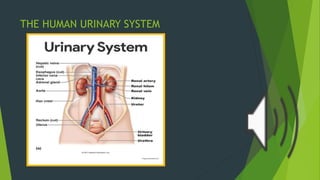
THE HUMAN URINARY SYSTEM
THE KIDNEY
 The kidneys are two bean-shaped organ about five-inches long ,three-inches wide
and one-inches thick located in your back on the side of your spine.
 Each kidney is about the size of a first and weighs from four to six ounces. They
are situated above your waste with the left kidney a little higher and a little
larger.
 The right kidney is a little lower and smaller to make room for the liver. The lower
ribs protect your kidneys.
 Inside the kidneys are nephrons. These are tiny units where the filtering of access
fluids and dissolved particles occurs. There are between 1 and 1.3million nephrons
in each kidneys.
Continuation of the kidney
 Blood enters the kidneys through renal arteries and leaves through renal
nerves.
 Tube called ureters carry waste products from the kidneys to the urinary
bladder for storage or for release.
 During urination, urine is expelled from the urinary bladder through the
urethra.
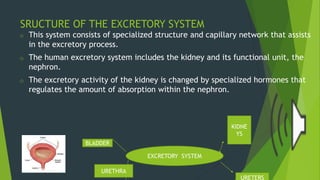
SRUCTURE OF THE EXCRETORY SYSTEM
o This system consists of specialized structure and capillary network that assists
in the excretory process.
o The human excretory system includes the kidney and its functional unit, the
nephron.
o The excretory activity of the kidney is changed by specialized hormones that
regulates the amount of absorption within the nephron.
EXCRETORY SYSTEM
URETERS
KIDNE
YS
URETHRA
BLADDER
THE COMPONENTS OF THE URINARY SYSTEM
 KIDNEYS: Two organs that filter blood to remove
waste (which is excreted in urine) and adjust the
concentration of salt in the blood.
 URETERS: Either of a pair of ducts that’s carry urine
from the kidneys to the bladder.
 URETHRA: The tube through which urine exits the
bladder.
 URINARY BLADDER: Stores urine until it can be
excreted.
Components of the urinary bladder
Continuation
 When proteins are broken down in humans, a compound called ammonia(NH)3
if formed.
 Ammonia is highly toxic ,so it is converted into urea by the liver , this urea is
the primary nitrogenous waste found in urine.
 Other waste products excreted in the urine includes urine acids(from broken
DNA and RNA) and creatinine (from muscle action)
THE KIDNEY HAS THREE SECTION
 CORTEX: The outer part of the kidney, where the
glomerulus, Bowman’s capsule, proximal tubule and distal
tubule of nephrons are located.
 MEDULLA: The inner part of the kidney, where the loop of
henle and the collecting ducts of the nephron are located.
 PELVIS: Part of the kidney where urine accumulates before
it enters the ureters.
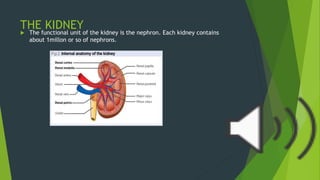
THE KIDNEY
 The functional unit of the kidney is the nephron. Each kidney contains
about 1millon or so of nephrons.
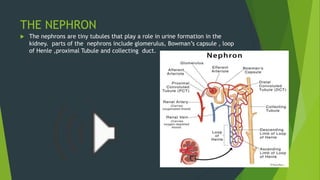
THE NEPHRON
 The nephrons are tiny tubules that play a role in urine formation in the
kidney. parts of the nephrons include glomerulus, Bowman’s capsule , loop
of Henle ,proximal Tubule and collecting duct.
CONCLUSION
 The excretory system plays an important role in
maintaining the overall homeostasis of the human body. It
is responsible for removing waste products ,regulating
fluids balance, and filtering toxins from the bloodstream
.The major organs involved in the excretory system ,such
as the kidneys, bladder , and the skin, work together to
ensure the elimination of harmful substances and
maintain the body’s internal equilibrium.
REFERENCES
 https://img.youtube.com/NhnRhfFLOg/maxtre
 https://www.open.edu>mods>view

CMP3202_P-B_PROJECT_(1)[1].pptx

  • 1.
  • 2.
    Names: Lomile Mokhele(2021/2230) E-mail: lomilemokhele@gmail.com I am a third year student at Lesotho college of education Thaba-Tseka campus . My presentation is based on the human excretory system.
  • 3.
    THE EXCRETORY SYSTEM Theexcretory system maintain homeostatic with respect to water, salt and metabolite concentration with the blood. What is excretion? Excretion is the removal of metabolic waste from the cells.  Metabolic waste is unwanted material that is formed as a result of the bodies metabolism. That is the large number of chemical reactions that occur in the cells, tissue, and organs.  The waste products of metabolism are frequently toxic and so must be removed from the body.  Kidneys play important role in excretion process in all vertebrates.  While skin also helps in excretion of urea, in organic salts and water through sweaty glands.
  • 4.
    1. FUNCITIONS OFTHE EXCRETORY SYSTEM  FILTRATION: The excretory tubule collects filtrate from the blood. Water and solutes are forced by blood pressure across the selectively permeable membranes of cluster of capillaries and into the excretory tubule.  REABSOPTION: The transport epithelium reclaims valuable substances from the filtrate and returns them.  SECRETION: Other substances are extracted from body fluids and added to the contents of the excretory tube.  EXCRETION: The filtrate leaves the system and the body.
  • 5.
    ORGANS THAT PLAYSA ROLE IN THE EXCRETORY SYSTEM  The lung : removes carbon dioxide  The skin: removes heat  The liver: removes metabolic waste  The kidney: removes metabolic waste
  • 6.
  • 7.
    THE KIDNEY  Thekidneys are two bean-shaped organ about five-inches long ,three-inches wide and one-inches thick located in your back on the side of your spine.  Each kidney is about the size of a first and weighs from four to six ounces. They are situated above your waste with the left kidney a little higher and a little larger.  The right kidney is a little lower and smaller to make room for the liver. The lower ribs protect your kidneys.  Inside the kidneys are nephrons. These are tiny units where the filtering of access fluids and dissolved particles occurs. There are between 1 and 1.3million nephrons in each kidneys.
  • 8.
    Continuation of thekidney  Blood enters the kidneys through renal arteries and leaves through renal nerves.  Tube called ureters carry waste products from the kidneys to the urinary bladder for storage or for release.  During urination, urine is expelled from the urinary bladder through the urethra.
  • 9.
    SRUCTURE OF THEEXCRETORY SYSTEM o This system consists of specialized structure and capillary network that assists in the excretory process. o The human excretory system includes the kidney and its functional unit, the nephron. o The excretory activity of the kidney is changed by specialized hormones that regulates the amount of absorption within the nephron. EXCRETORY SYSTEM URETERS KIDNE YS URETHRA BLADDER
  • 10.
    THE COMPONENTS OFTHE URINARY SYSTEM  KIDNEYS: Two organs that filter blood to remove waste (which is excreted in urine) and adjust the concentration of salt in the blood.  URETERS: Either of a pair of ducts that’s carry urine from the kidneys to the bladder.  URETHRA: The tube through which urine exits the bladder.  URINARY BLADDER: Stores urine until it can be excreted.
  • 11.
    Components of theurinary bladder Continuation  When proteins are broken down in humans, a compound called ammonia(NH)3 if formed.  Ammonia is highly toxic ,so it is converted into urea by the liver , this urea is the primary nitrogenous waste found in urine.  Other waste products excreted in the urine includes urine acids(from broken DNA and RNA) and creatinine (from muscle action)
  • 12.
    THE KIDNEY HASTHREE SECTION  CORTEX: The outer part of the kidney, where the glomerulus, Bowman’s capsule, proximal tubule and distal tubule of nephrons are located.  MEDULLA: The inner part of the kidney, where the loop of henle and the collecting ducts of the nephron are located.  PELVIS: Part of the kidney where urine accumulates before it enters the ureters.
  • 13.
    THE KIDNEY  Thefunctional unit of the kidney is the nephron. Each kidney contains about 1millon or so of nephrons.
  • 14.
    THE NEPHRON  Thenephrons are tiny tubules that play a role in urine formation in the kidney. parts of the nephrons include glomerulus, Bowman’s capsule , loop of Henle ,proximal Tubule and collecting duct.
  • 15.
    CONCLUSION  The excretorysystem plays an important role in maintaining the overall homeostasis of the human body. It is responsible for removing waste products ,regulating fluids balance, and filtering toxins from the bloodstream .The major organs involved in the excretory system ,such as the kidneys, bladder , and the skin, work together to ensure the elimination of harmful substances and maintain the body’s internal equilibrium.
  • 16.