IP Communication
Increase Value with IP Communication
David McFeeters-Krone
Intellectual Assets, Corp
IP Strategy - Licensing - Tech Scouting
dmk@intelassets.com
IP Communication
Ground Rules & Caveats
• Patents are just part of the equation.
• Communication is one part of IP
strategy
• Dave is not a lawyer.
IP Communication
“Intellectual Property lies at the
center of the modern company's
economic success or failure”
- Lester Thurow
IP Communication
IP is Intangible Value
• Patents, trademarks, copyrights
• Trade secrets
– Know how
– Secrets
– any work product not publicly known
IP Communication
Why have an IP Strategy?
Source Les Nouvelles 3/2006
QuickTime™ and a
TIFF (LZW) decompressor
are needed to see this picture.
IP Communication
Benefits of the IP Strategy
• Legal
– Freedom to operate
– Cross licensing
• Market
– Competitive advantage
– Premiums
• R&D
– Focus
– Acceleration
• Finance
– Clear explanation
– Value preparation
– Revenue (maybe?)
O - Offensive
X - Defensive
- Market Innovator
Patents, Trade Secrets
$ - Assertion
IP Communication
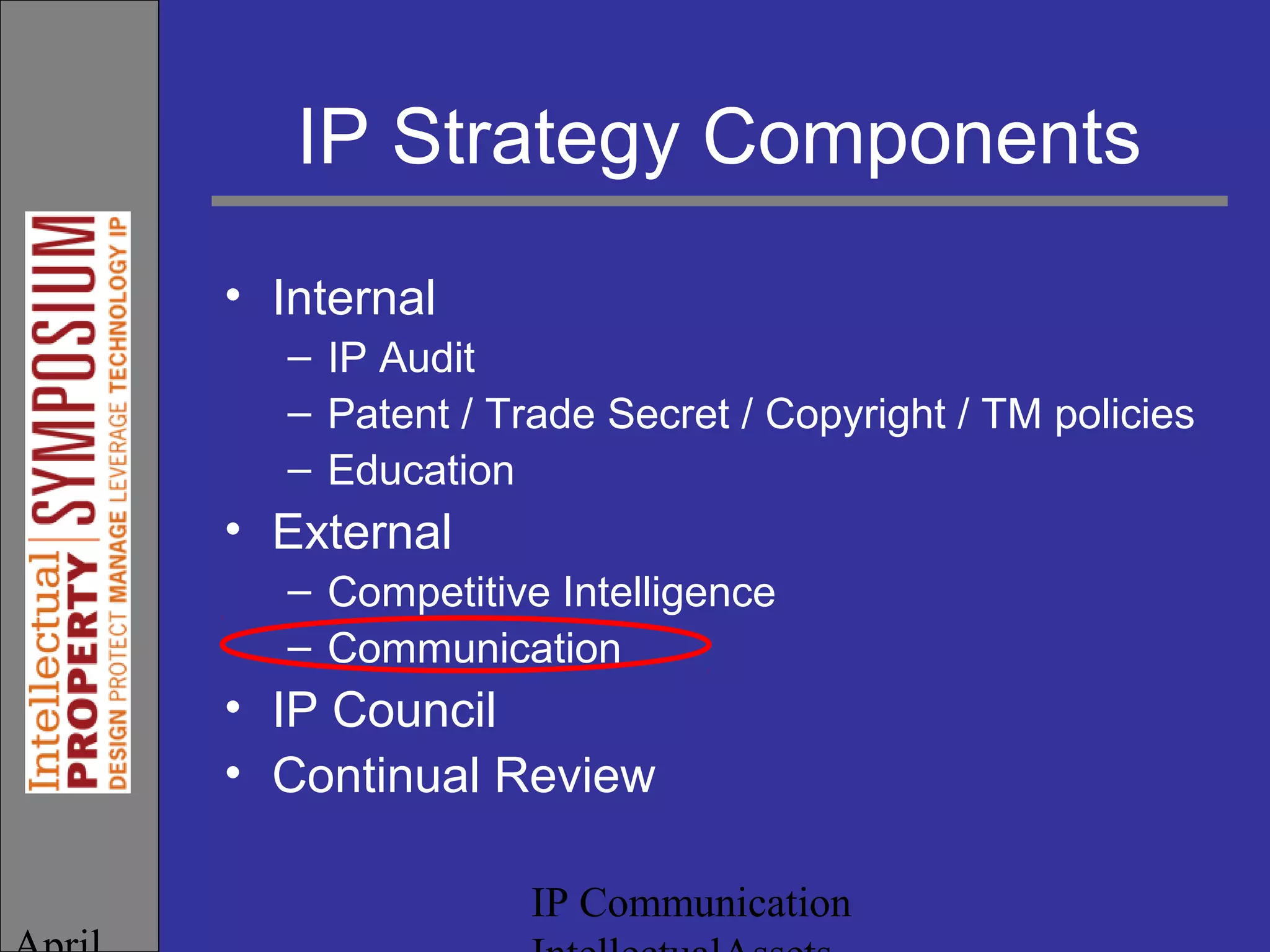
IP Strategy Components
• Internal
– IP Audit
– Patent / Trade Secret / Copyright / TM policies
– Education
• External
– Competitive Intelligence
– Communication
• IP Council
• Continual Review
IP Communication
Communication to Stakeholders
• We understand the value of our IP
• We have an IP generation engine
• We know how to capture and protect IP
• We have a sustainable
competitive advantage
IP Communication
Who Cares?
Your stakeholders
• Investors
• Customers
• Partners
• Employees
IP Communication
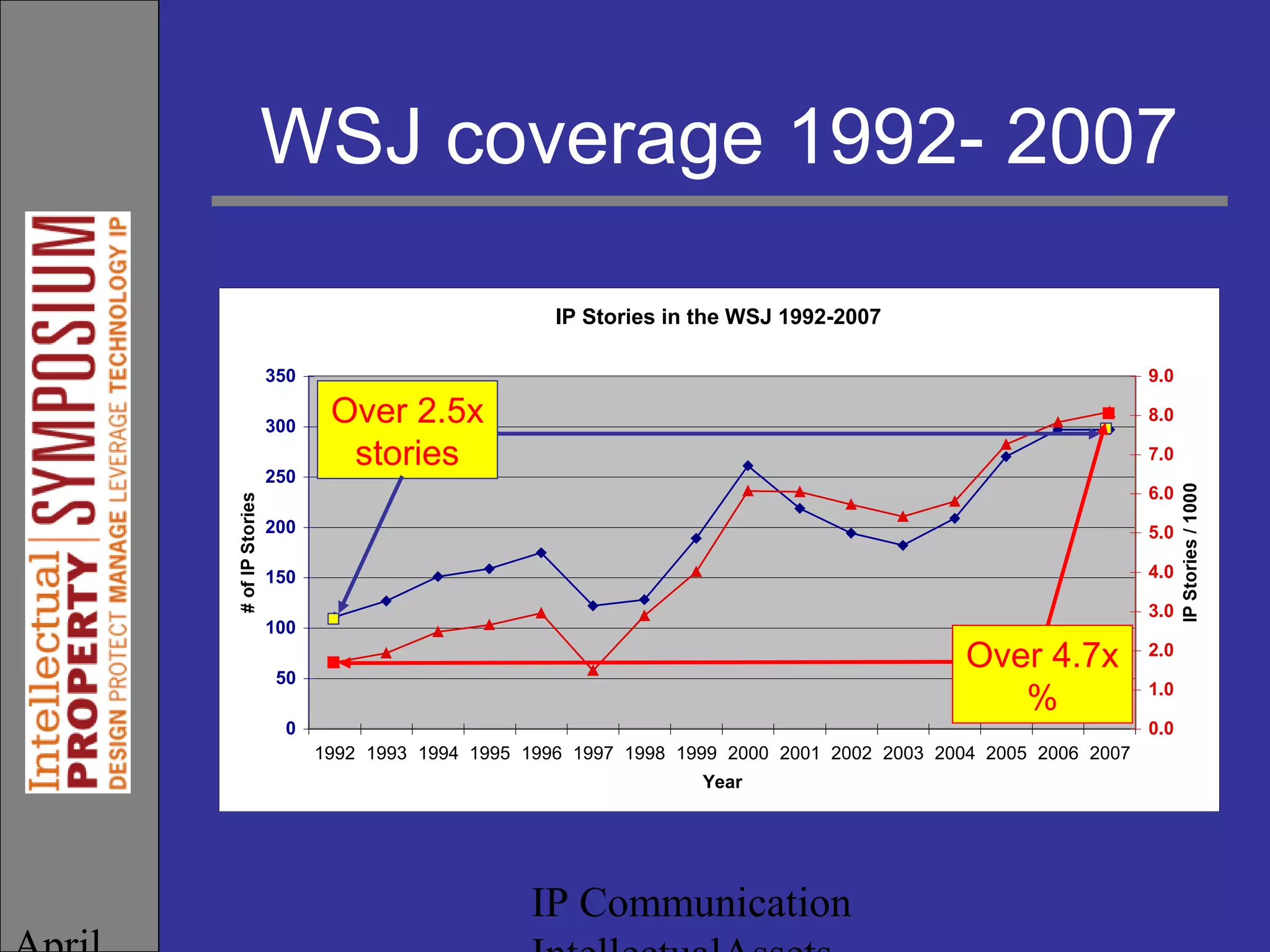
WSJ coverage 1992- 2007
IP Stories in the WSJ 1992-2007
0
50
100
150
200
250
300
350
1992 1993 1994 1995 1996 1997 1998 1999 2000 2001 2002 2003 2004 2005 2006 2007
Year
# of IP Stories
0.0
1.0
2.0
3.0
4.0
5.0
6.0
7.0
8.0
9.0
IP Storie
Over 2.5x
stories
Over 4.7x
%
IP Communication
Investors Care
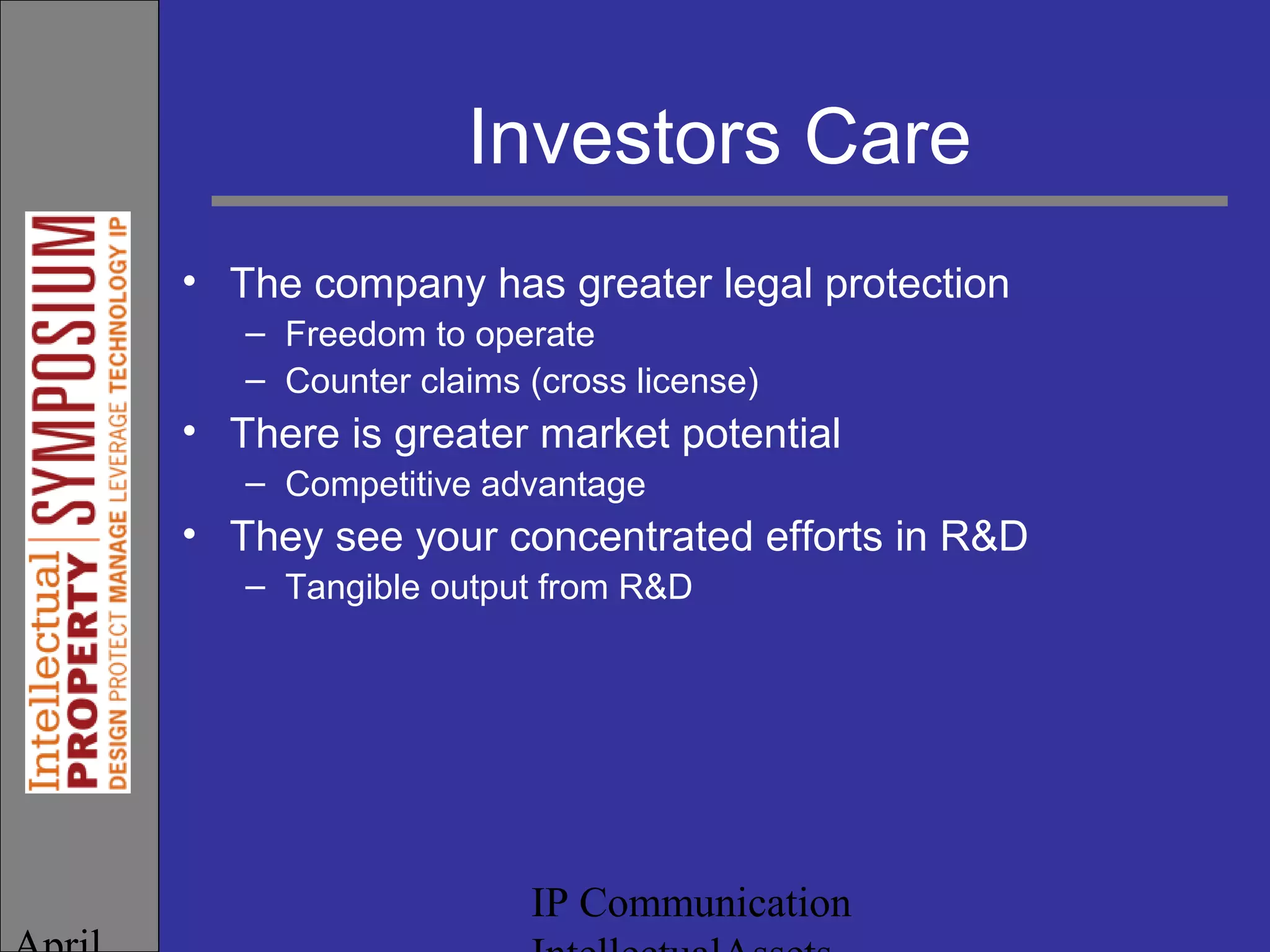
• The company has greater legal protection
– Freedom to operate
– Counter claims (cross license)
• There is greater market potential
– Competitive advantage
• They see your concentrated efforts in R&D
– Tangible output from R&D
IP Communication
‘Take aways’ for Investors
• Link IP to revenues
• Reduce risk with
– More tangible assets, less volatility
– Understanding of the IP strategy
– Confidence in IP management
IP Communication
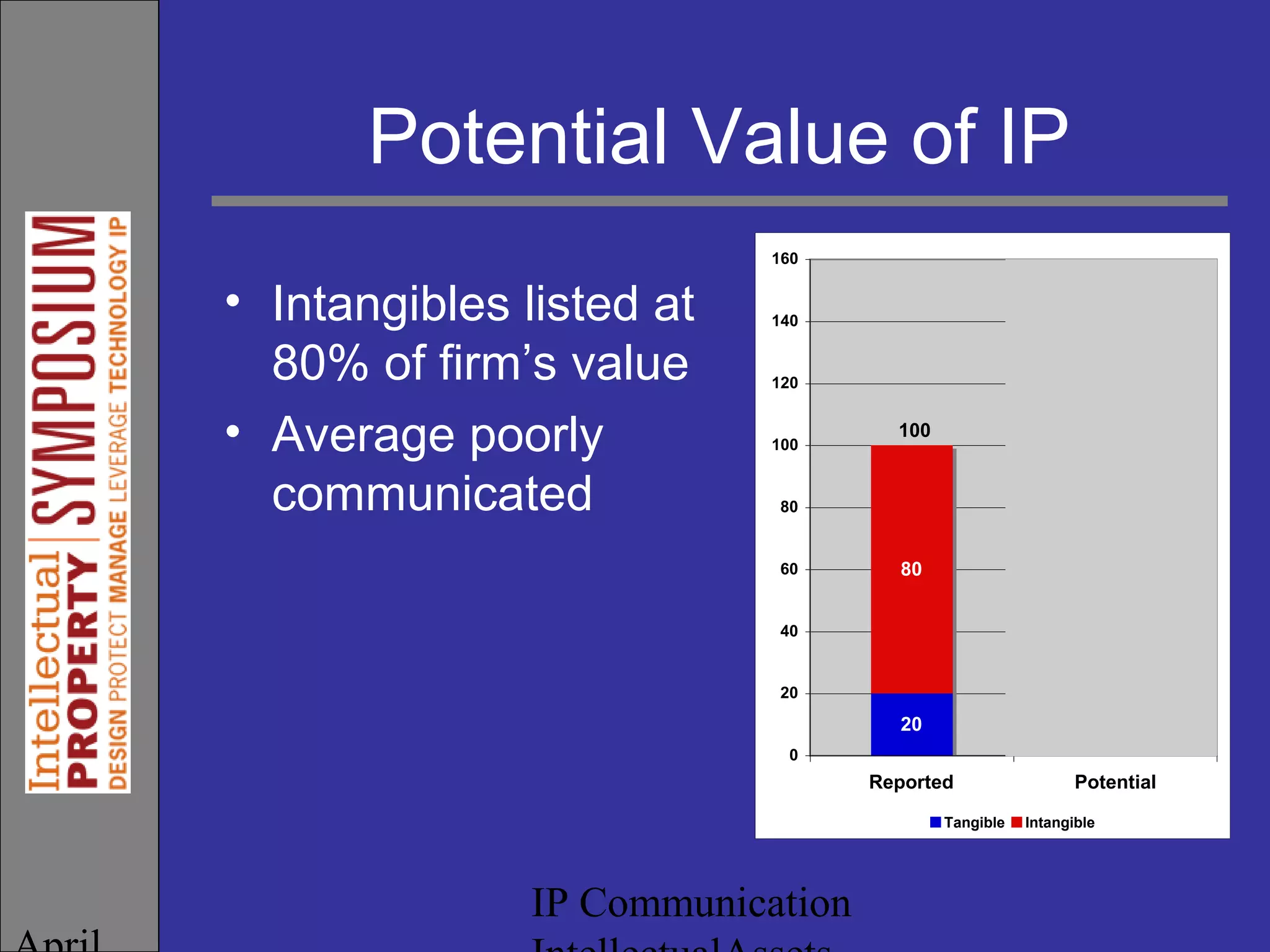
Potential Value of IP
• Intangibles listed at
80% of firm’s value
• Average poorly
communicated
20 20
80
114
0
20
40
60
80
100
120
140
160
Reported Potential
Tangible Intangible
100
134
IP Communication
Esterline
• Specialized manufacturing company serving principally
aerospace and defense markets.
• “Although we hold a number of patents …, we do not
believe that our operations are dependent on our patents
…. In general, we rely on technical superiority, continual
product improvement, exclusive product features, superior
lead-time, on-time delivery performance, quality and
customer relationships to maintain competitive advantage. “
IP Communication
HP (circa 2004)
• Excellent 10-K
– Importance of patents
– Number of patents and trend
– Even a small breakdown by industry
– Comments on licensing
• Don’t Walk the walk
IP Communication
3M
• Poster child for innovation
• R&D called out (including expense)
– Reorg of R&D includes # of personnel
• Patents, ™, licenses including their
value
• Just a taste of patent detail.
IP Communication
Value of Harmony
IP Communication
Business
Communication
• Aligned communications are additive
IP Communication
IP Communication Plan
• Section in Annual Report
• PR Focused on IP
– About the IP of Company
– Distilled into About Company
• White papers
• Raise the level of discourse with
stakeholders (including reporters)
IP Communication
IP is Tangible Value
Processes, Know how
Formulas
Designs, Inventions
Public
Logos, Brands
Written Works, Recordings
Patent
Patent
Patent
™
©
Partnerships, Contracts
Secret
TS
TS
TS
IP Communication
State your IP Value
• Clear space
• Competitive advantage
• Efficiency
IP Communication
CI: Themescape
• ••
•
••
•
•
••
•
•
•
•
•
Clear Space
IP Communication
CI: Citation analysis
Competitive
Advantage
IP Communication
IP Communication
1. Relate its direct impact on your revenue
2. Relate your IP position in the market
3. Outline strategy (capture, alignment, etc)
4. Reveal the IP ↔ business advantage
5. Basic legal issues
IP Communication
Summary
• IP is a significant part of firm value
• If you are not in control of your IP,
then it is out of control.
• A clearly communicated IP strategy
will increase firm value
IP Communication
Thank You
David McFeeters-Krone
Intellectual Assets, Corp
IP Strategy - Licensing - Tech Scouting
dmk@intelassets.com
(503) 493-0477
Increase Value with IP Communication
IP Communication
Customers Care
• It can simplify purchasing decisions
• Offers security and confidence
• Offers competitive differentiation
• Customer can better defend decision
IP Communication
Partners Care
• More reason to do business with you
• Potential barriers to exit
• Channel partners can leverage your
IP
IP Communication
BASF
• R&D: Because of the high degree of complexity and uncertainty
involved in chemical and biological research, there is a risk that
projects might be discontinued or that developed products will not
receive approval for marketing. We lessen this risk through our
global Know-how Verbund, our collaboration with our partners and
customers as well as our innovation process whereby efficiency,
chances of success and general conditions of research projects
are continuously reviewed.
• Patent risks: The Global Intellectual Property department of BASF
SE, together with the appropriate units of the U.S.-based BASF
Corporation and BASF Coatings, Munster, Germany monitors all
the intellectual property rights of BASF. At the same time, we aim
to avoid patent and licensing disputes as far as possible through
our extensive clearance research.
IP Communication

CMP IP communication 4-08

  • 1.
    IP Communication Increase Valuewith IP Communication David McFeeters-Krone Intellectual Assets, Corp IP Strategy - Licensing - Tech Scouting dmk@intelassets.com
  • 2.
    IP Communication Ground Rules& Caveats • Patents are just part of the equation. • Communication is one part of IP strategy • Dave is not a lawyer.
  • 3.
    IP Communication “Intellectual Propertylies at the center of the modern company's economic success or failure” - Lester Thurow
  • 4.
    IP Communication IP isIntangible Value • Patents, trademarks, copyrights • Trade secrets – Know how – Secrets – any work product not publicly known
  • 5.
    IP Communication Why havean IP Strategy? Source Les Nouvelles 3/2006 QuickTime™ and a TIFF (LZW) decompressor are needed to see this picture.
  • 6.
    IP Communication Benefits ofthe IP Strategy • Legal – Freedom to operate – Cross licensing • Market – Competitive advantage – Premiums • R&D – Focus – Acceleration • Finance – Clear explanation – Value preparation – Revenue (maybe?) O - Offensive X - Defensive - Market Innovator Patents, Trade Secrets $ - Assertion
  • 7.
    IP Communication IP StrategyComponents • Internal – IP Audit – Patent / Trade Secret / Copyright / TM policies – Education • External – Competitive Intelligence – Communication • IP Council • Continual Review
  • 8.
    IP Communication Communication toStakeholders • We understand the value of our IP • We have an IP generation engine • We know how to capture and protect IP • We have a sustainable competitive advantage
  • 9.
    IP Communication Who Cares? Yourstakeholders • Investors • Customers • Partners • Employees
  • 10.
    IP Communication WSJ coverage1992- 2007 IP Stories in the WSJ 1992-2007 0 50 100 150 200 250 300 350 1992 1993 1994 1995 1996 1997 1998 1999 2000 2001 2002 2003 2004 2005 2006 2007 Year # of IP Stories 0.0 1.0 2.0 3.0 4.0 5.0 6.0 7.0 8.0 9.0 IP Storie Over 2.5x stories Over 4.7x %
  • 11.
    IP Communication Investors Care •The company has greater legal protection – Freedom to operate – Counter claims (cross license) • There is greater market potential – Competitive advantage • They see your concentrated efforts in R&D – Tangible output from R&D
  • 12.
    IP Communication ‘Take aways’for Investors • Link IP to revenues • Reduce risk with – More tangible assets, less volatility – Understanding of the IP strategy – Confidence in IP management
  • 13.
    IP Communication Potential Valueof IP • Intangibles listed at 80% of firm’s value • Average poorly communicated 20 20 80 114 0 20 40 60 80 100 120 140 160 Reported Potential Tangible Intangible 100 134
  • 14.
    IP Communication Esterline • Specializedmanufacturing company serving principally aerospace and defense markets. • “Although we hold a number of patents …, we do not believe that our operations are dependent on our patents …. In general, we rely on technical superiority, continual product improvement, exclusive product features, superior lead-time, on-time delivery performance, quality and customer relationships to maintain competitive advantage. “
  • 15.
    IP Communication HP (circa2004) • Excellent 10-K – Importance of patents – Number of patents and trend – Even a small breakdown by industry – Comments on licensing • Don’t Walk the walk
  • 16.
    IP Communication 3M • Posterchild for innovation • R&D called out (including expense) – Reorg of R&D includes # of personnel • Patents, ™, licenses including their value • Just a taste of patent detail.
  • 17.
    IP Communication Value ofHarmony IP Communication Business Communication • Aligned communications are additive
  • 18.
    IP Communication IP CommunicationPlan • Section in Annual Report • PR Focused on IP – About the IP of Company – Distilled into About Company • White papers • Raise the level of discourse with stakeholders (including reporters)
  • 19.
    IP Communication IP isTangible Value Processes, Know how Formulas Designs, Inventions Public Logos, Brands Written Works, Recordings Patent Patent Patent ™ © Partnerships, Contracts Secret TS TS TS
  • 20.
    IP Communication State yourIP Value • Clear space • Competitive advantage • Efficiency
  • 21.
    IP Communication CI: Themescape ••• • •• • • •• • • • • • Clear Space
  • 22.
    IP Communication CI: Citationanalysis Competitive Advantage
  • 23.
    IP Communication IP Communication 1.Relate its direct impact on your revenue 2. Relate your IP position in the market 3. Outline strategy (capture, alignment, etc) 4. Reveal the IP ↔ business advantage 5. Basic legal issues
  • 24.
    IP Communication Summary • IPis a significant part of firm value • If you are not in control of your IP, then it is out of control. • A clearly communicated IP strategy will increase firm value
  • 25.
    IP Communication Thank You DavidMcFeeters-Krone Intellectual Assets, Corp IP Strategy - Licensing - Tech Scouting dmk@intelassets.com (503) 493-0477 Increase Value with IP Communication
  • 26.
    IP Communication Customers Care •It can simplify purchasing decisions • Offers security and confidence • Offers competitive differentiation • Customer can better defend decision
  • 27.
    IP Communication Partners Care •More reason to do business with you • Potential barriers to exit • Channel partners can leverage your IP
  • 28.
    IP Communication BASF • R&D:Because of the high degree of complexity and uncertainty involved in chemical and biological research, there is a risk that projects might be discontinued or that developed products will not receive approval for marketing. We lessen this risk through our global Know-how Verbund, our collaboration with our partners and customers as well as our innovation process whereby efficiency, chances of success and general conditions of research projects are continuously reviewed. • Patent risks: The Global Intellectual Property department of BASF SE, together with the appropriate units of the U.S.-based BASF Corporation and BASF Coatings, Munster, Germany monitors all the intellectual property rights of BASF. At the same time, we aim to avoid patent and licensing disputes as far as possible through our extensive clearance research.
  • 29.

Editor's Notes

  • #2 A patent plan is not an IP strategy IP is value Ip is not understood Ip can be communicated. asdf
  • #3 Ask questions So nothing in this presentation should be construed as legal advice. Not only am I not your lawyer, I am not anyone’s lawyer Dave is a physics major, but do not be alarmed. Yes you will hear terms like leverage, congruence, dissonance, vector, and vacuum. But there will not be a test. As a bonus, I try to stay away from business buzzwords, so anyone out there with those buzzword bingo cards will go home unhappy.!
  • #4 Lincoln Quote - Fire of Genious Mark Twain Quote - setting up a patent office Lester Carl Thurow (1938) is a former dean of the MIT Sloan School of Management and author of numerous bestsellers on economic topics. Thurow is on the board of directors of Analog Devices, Grupo Casa Autrey, and E*Trade. Thurow was also one of the original founders of the Economic Policy Institute in 1986. Thurow is currently an economics columnist for, among others, the Boston Globe and USA Today. He was previously an economics columnist for and on the editorial board of the New York Times, and was a contributing editor to Newsweek.
  • #5 Tangilble Intangible Intangible intangibles asdfsdaf
  • #6 Analysts indicate that soon 90% of the value of global 2000 firms will be IP. Gartner/PWC CFO magazine Courts and Torts: Touching on Intangibles http://www.cfo.com/article.cfm/3686823 A whopping 96 percent said that managing IP and intangibles is important to the success of high-performing companies, while 49 percent deemed those assets to be the main source of long-term shareholder wealth creation. (The survey was conducted by the Economist Intelligence Unit, a sister company of CFO.com.) Only 5 percent claimed that their companies have a robust system to catalog and measure the performance of IP and other intangibles. Another 66 percent said their inventory-measurement process is informal or qualitative, while a full one-third admitted they don’t measure performance at all.The cost of such inaction, however, can be high. The Federal Bureau of Investigation estimates that U.S. businesses lose between $200 billion and $250 billion a year because of IP violations, and the U.S. Chamber of Commerce claims that those totals translate into the loss of 750,000 American jobs.
  • #7 PWC quote MIT quote
  • #8 There are lots of components to the Strategy. In truth you can not communicate a plan that does not exist and I would not recommend using the cart to drive the horse. However it does help to have the end in mind. If you want to say “we own this space” then perhaps you should devote some resources (other than PR firms) to making it so. I often think ahead and say, what do I wish I had done 6 months ago that I I could be reaping the benefits of today. IP involvement at project conception Prior art search License early Design around Ownership Tight control through agreement Special control of contractors and separated employees Dates, location, witnesses, all steps of conception, development and reduction to practice. Confidentiality agreements, and training Issues, assignments, trade secrets leak, limit your recourse, unable to warrant in licenses miss dates Patent / Trade Secret / Copyright policies Keep records Document disclosures IP audit
  • #9 OK so what messages do you want to reveal The first two are processes, but can be implemented briskly. What you see is just the tip of the iceberg Show them more of the iceberg! Lock in and customer loyalty
  • #10 Partners - similar to the customer scenario. Everyone must make choices, give them a clear reason to choose you. Employees - everyone wants to be with a winner. It helps them understand how their company is different from the competition It gives them a sense of increased job security
  • #11 Previous study shows 25% increase in stories from 1996-2000 30% increase in importance since 2000
  • #12 Investors - I am not just talking VCs. IP has become highly leveragable. The key is developing a clear, crisp story that even your banker can understand.
  • #13 Revenues= income = stock price
  • #14 CFO magazine
  • #15 States IP is not important Actually gives cases where IP is important Who wrote this (the CPA)
  • #16 Hp Our general policy has been to seek patent protection for those inventions and improvements likely to be incorporated into our products and services or where proprietary rights will improve our competitive position. At October 31, 2004, our worldwide patent portfolio included over 25,000 patents, a significant increase over the 21,000 patents we held at the end of fiscal 2003. Of these 25,000 patents, approximately 9,000 are related to IPG, with approximately 4,000 of the IPG patents related to our supplies business.         … While we believe that our patents and applications are important for maintaining the competitive differentiation of our products and maximizing our return on research and development investments, no single patent is in itself essential to us as a whole or any of our principal business segments.         In addition to developing our patents, we license intellectual property from third parties where we deem appropriate. We have also granted and continue to grant to others licenses under patents owned by us when we consider these arrangements to be in our interests. These license arrangements include a number of cross-licenses with third parties.
  • #17 3M R& D constitute an important part of 3M’s activities. Products resulting from R&D have been a major driver of 3M’s growth. R&D expenses totaled $1.143 billion in 2004 … 3M realigned its research and development efforts in 2003 … bring[ing] together more than 600 researchers … and 400 other 3M technical …. The Company’s products are sold around the world under various trademarks that are important to the Company. The Company also owns, or holds licenses to use, numerous U.S. and foreign patents. The Company’s R&D activities continuously generate new inventions that are covered by patents. Patents applicable to specific products extend for varying periods according to the date of patent application filing or patent grant and the legal term of patents in the various countries where 5 patent protection is obtained. The actual protection afforded by a patent, which can vary from country to country, depends upon the type of patent, the scope of its coverage and the availability of legal remedies in the country. The Company believes that its patents provide an important competitive advantage in many of its businesses. In general, no single patent or group of related patents is in itself essential to the Company as a whole or to any of the Company’s business segments. The importance of patents in the Health Care and Display and Graphics segments is described in “Performance by Business Segment” – “Health Care Business” and “Display and Graphics Business” in Part II, Item 7, of this Form 10-K.
  • #18 IP comm should reinforce and enhance bus comm.
  • #19 What you see is just the tip of the iceberg Show them more of the iceberg! Lock in and customer loyalty
  • #20 IP is normally thought of as an intangible. It is your goal to create tangible value from this asset. Much IP has a public face, however the true value (especially processes and patents) are hidden from view and understanding --therefore undervalued. The market already has accounted for the public information. Your firm can benefit from the absolute increase IN ADDITION TO the risk reduction on the whole.
  • #22 Red dots show competitors patent, note focus.
  • #24 Khj Source: http://www.wipo.int/sme/en/documents/ip_accounting.html Provide a narrative summary: - Analyze and explain the basic business model, plan and strategy and show how the IP contributes to the bottom line of your business.- How do you make money and what role does the IP play in it? Relate your income streams to your IP : - What were the returns from IP-protected business segments?- How do your trade secrets / patents contribute to the new / improved / superior / better- functionality or features of your services/products as compared with those of your competitors?- How do/does your trademark(s) contribute to your company's or your company's products' / services' image, recognition, reputation or branding strategy in the market in developing customer loyalty or attracting new customers?- Do you use industrial designs to protect the unique look or packaging of your products?- How do your trade secrets, such as know-how or business ideas, make your company unique? Relate the IP to your position in the market: - Does the ownership of IP help you to gain/secure/improve your market share or profits?- Are you using IP as an entry barrier to keep competitors out of a particular market?- Does the IP of your competitors pose a threat to your business?- Do you have "freedom to operate" in using your own new ideas, concepts, inventions and innovations, without being required to take prior permission (which may involve making a payment) of someone else (say, a competitor) to develop a new/improved product/service or add new features to an existing product/service?- Does your IP provide you with some form of exclusivity in the market, and, if yes, for how long? Demonstrate your managerial skills: - Are you pursuing a systematic strategy to exploit the commercial benefits of your IP?- Have you understood how the exploitation of your IP relates to other complementary business assets that may be critically needed?- How is your R&D focus aligned to your IP strategy and to your commercial goals?- How do the financial plans for managing your IP relate to your overall financial and business goals?- How determined are you to extract (further) revenue from your IP?- What experience do you have in managing IP?- How are you leveraging your IP to develop new relationships and business partnerships? Understand the legal scope of the IP rights : - What level of practical protection does your IP have in a given business environment?- Can you operate in the market without infringing the IP rights of other market participants?- How likely is it that competitors will legally steal your ideas or creative expression or find legitimate ways to circumvent your IP and thereby effectively free ride on your creativity and innovation?- What is the risk of pirates and/or counterfeiting negatively impacting your market share, and to what extent?
  • #25 Nature abhors a vacuum! it will be filled by your competition or mis information.
  • #27 KHJ It can make customers feel smarter for making this choice! Customers care because they do not want to make a mistake. Think IBM. Perceived IP wealth helps customers rationalize their purchase decision and so make faster decisions. Case - up the street is Nautilus group owners of Bowflex. They have been in an on-going suit with Weidler’s crossbow. Nautilus sales men likely talked to Fred Meyer and told them that they would need to send all their stock back. These guys do not need that kind of hassle. Perhaps this is on the edge of anti-competitive behavior, however IP is a legal monopoly. Perceived wealth in IP can lead to increased brand loyalty Reduce your marketing costs Attract new customers by references Prevent competitive incursions into installed base For you it means get into more RFPs, and shorten the sales cycle More defensible price
  • #28 KHJ They perceive strong reasons to do business with you Barriers to exit It gives you more negotiation power with partners Channel partners can leverage your IP in their sales efforts (standing on the shoulders of giants) Cross box/bow flex